
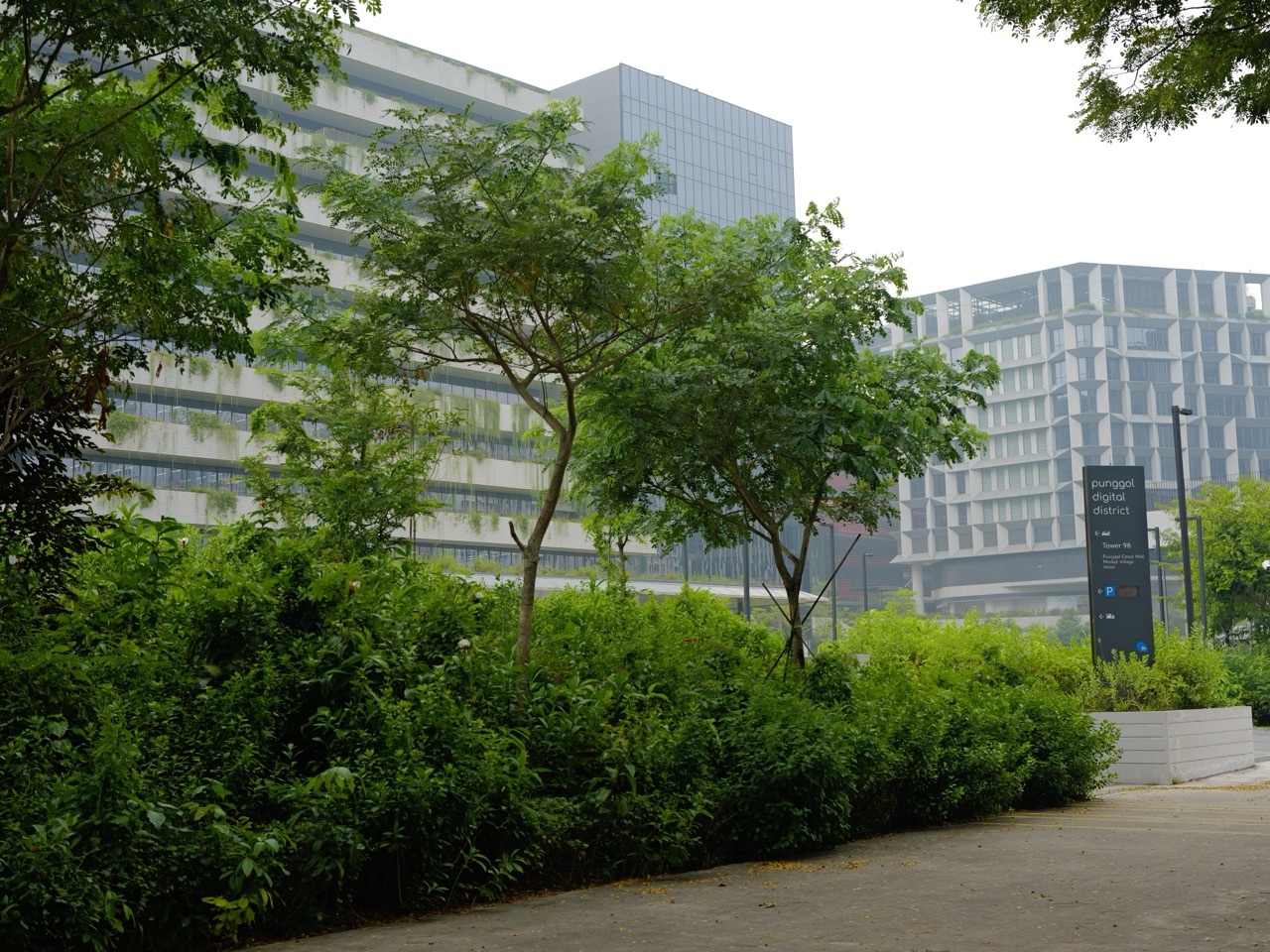
Why does Punggol Coast have a bus interchange built directly into the same district as an MRT station and shopping facilities? A bus interchange could be placed in a large open area, with the rail station somewhere else and shops along another road. That arrangement might still allow people to travel, but it would force more passengers to make separate journeys between services. An Integrated Transport Hub (ITH) is designed to reduce some of that friction by making buses, trains and adjoining destinations work as a connected place.
Punggol Coast Bus Interchange opened on 29 June 2025. LTA identifies it as Singapore’s 15th Integrated Transport Hub at the time of opening, linked with Punggol Coast MRT (NE18) and Punggol Coast Mall in Punggol Digital District. It was intended to improve access for residents, students and workers travelling to the JTC business parks and the Singapore Institute of Technology campus. That puts transport where many everyday journeys meet, rather than treating the bus station as an isolated car park for large vehicles.
The planning choice goes further than convenience. The interchange includes barrier-free entrances, priority queue zones with seating, wheelchair-accessible toilets, a baby care room and a commuter care room. Staff facilities and energy-saving measures are also built into the scheme. Each feature responds to a different kind of user or operational need; none can be understood merely by counting bus services.
This article explains why Punggol Coast connects a bus interchange, MRT station and adjoining development, how transfers work at the level of the whole journey, why a modern interchange requires facilities for people with diverse needs, and why opening a new interchange can change bus routes without replacing every older service. It is not a live departure board or a guarantee that every bus route now starts at Punggol Coast.
The answer in 50 seconds
- Punggol Coast Bus Interchange opened on 29 June 2025, within Punggol Digital District.
- The interchange links with Punggol Coast MRT (NE18) and Punggol Coast Mall, fitting LTA’s definition of an Integrated Transport Hub.
- Services 34 and 117/M were moved from the existing Punggol Bus Interchange as part of the opening arrangements, with route changes to serve the growing area.
- More local connections have continued evolving, including the extension of Service 381 to Punggol Coast from 13 September 2026.
- LTA documented accessibility and family features, priority queue seating, a quiet commuter care room and staff facilities.
- Punggol Bus Interchange and Punggol Coast Bus Interchange are separate places. A similar name does not mean buses board at the same terminal.
The central lesson is that a transport hub makes several systems easier to use together. It does not turn every bus, rail service, shop and destination into one identical facility.
Why transferring is part of a journey
A commuter may start with a short bus ride, change to MRT and then walk to an office or classroom.
The time spent inside vehicles is only one part of that trip. The person must also leave one service, find the next, walk between them, wait and board safely.
An Integrated Transport Hub addresses the relationship between those stages. Its usefulness depends on how well the transitions work, not simply on whether a large number of transport logos are displayed on a map.
What LTA means by Integrated Transport Hub
LTA defines an ITH as a development where a bus interchange is integrated with an MRT station and adjoining uses such as a shopping mall.
The purpose is to allow commuters to change modes and use nearby services in a more connected environment. LTA’s own examples include Punggol Coast alongside other established hubs.
This is a planning category, not merely a marketing description of a bus stop close to a train station.
A successful ITH must consider physical access, passenger circulation, building services and the way adjoining destinations interact with transport operations.
Why a bus interchange is different from a roadside bus stop
A roadside bus stop serves passengers boarding or alighting along a route. An interchange typically includes multiple boarding berths and operational space for services that start, end or otherwise use the facility.
Buses need suitable circulation routes, stopping arrangements and driver or operations support. Passengers need clear information about the appropriate boarding position.
That is why an interchange cannot be understood simply as an oversized bus shelter. It is an operating facility for vehicles and a transfer facility for people.
Why an interchange does not have to be isolated
An old assumption might be that bus infrastructure should occupy a separate parcel of land far from other uses.
LTA’s Integrated Transport Hub model takes a different approach. When site conditions permit, connecting buses with rail and adjoining developments can reduce the need for disconnected transfers and make the surrounding district more convenient.
This does not mean every shopping mall should include a bus terminal. It means a suitable high-demand location can benefit from coordinating land uses rather than designing each in isolation.
Why Punggol Digital District is a suitable setting
Punggol Digital District brings together educational and business destinations, including the SIT campus and JTC facilities.
These places attract travellers arriving from different parts of Singapore. Some may use the North East Line directly; others may need a bus or connecting service.
A transport hub near these destinations can offer several ways of arriving, subject to actual routes and walking conditions.
It would be misleading to claim that every employee or student uses the interchange. The point is that co-location creates a useful option in a district with varied travel needs.
Why the MRT link matters
Punggol Coast MRT is on the North East Line. A nearby bus interchange lets passengers connect local road services with the larger rail network.
That can be useful for journeys beginning at places not immediately within walking distance of the station, or destinations better served by a bus.
The hub’s value lies in the connection rather than an assumption that the bus and MRT are interchangeable. They serve different corridors and stopping patterns.
A resident should still compare the actual routes rather than assume every journey is faster simply because the interchange is integrated.
Why the mall link matters
A shopping facility near a transport interchange allows some errands to be combined with journeys that would occur anyway.
LTA describes this as one of the reasons for integrating transport hubs with adjoining developments.
A commuter might collect a basic item, have a meal or use a suitable service before heading home, subject to the facility’s actual operating hours.
This is a convenience mechanism, not a claim that every tenant in Punggol Coast Mall is open all the time or that every journey should include a shopping stop.
Why co-location saves only some travel effort
If a person already needs to visit the mall or transfer between modes, placing those functions close together can reduce unnecessary travel between them.
But the benefit depends on where the person starts, which service they need and the walking route inside the hub.
A resident travelling directly along the MRT line may not need a bus transfer at all. Another heading to a neighbourhood without a direct rail connection may value the bus interchange.
The appropriate claim is that integration creates more convenient combinations; it does not guarantee the same saving for everyone.
Why the opening date must be stated precisely
LTA announced the new interchange on 20 May 2025 and said passenger operations would begin on 29 June 2025.
Those dates have different meanings. The first records the notice; the second records the actual planned commencement that subsequently took place.
An article published in November 2026 should not continue saying “the interchange will open in June 2025”. Equally, it should not mistake the 2025 opening for the opening date of every shop or nearby building.
Accurate local writing gives absolute dates and separate project milestones.
Why the interchange was Singapore’s fifteenth ITH
At the time of opening, LTA described Punggol Coast as the 15th Integrated Transport Hub in the nationwide network.
That number is part of the historical opening announcement. It should not automatically be used as a live count of all ITHs at every future date without checking subsequent changes.
The meaningful point is that Punggol Coast joined a wider transport-planning approach already used in several other towns.
A resident can understand the model through the local example without memorising the rank in an ever-changing list.
Why the older Punggol interchange remains important
Punggol Bus Interchange by Punggol MRT (NE17) serves the established town centre. Punggol Coast Bus Interchange by NE18 serves the newer northern district.
They are separate facilities with distinct route arrangements. Opening the second did not by itself mean the first ceased operation.
This prevents a practical mistake: asking a relative to meet at “Punggol interchange” without specifying which one.
A good set of directions gives the full name, nearby station and relevant boarding service.
Why names are part of transport safety
Two places with similar names can be confused, especially by visitors or residents unfamiliar with a changed route.
If someone travels to the wrong interchange, they may face a long detour or miss a time-sensitive appointment.
A precise message therefore states Punggol Coast when that is the destination, rather than omit the final word.
This is a basic communication lesson. Good infrastructure still depends on users receiving clear and correct information.
Why services 34 and 117/M moved in 2025
LTA’s opening announcement said that Services 34 and 117/M would shift from the old Punggol interchange to the new Punggol Coast facility, with extensions or amendments to improve access to the growing area.
That shows the opening involved more than an empty building. The bus network had to be adjusted so actual routes could use the new terminal.
A bus service’s terminus influences where passengers start their journey and where drivers and buses turn or wait.
This is why a new interchange can change routes even when a person still recognises the familiar service number.
Why a service number can stay the same while the route changes
A familiar bus number does not guarantee every stop or terminus remains unchanged forever.
LTA’s 2025 changes retained service identities while altering the routes to serve additional parts of Punggol.
For current travel, the correct source is the operator’s current map and official notices, not a screenshot taken before the move.
The broader skill is distinguishing service identity from the exact current route.
Why the 2026 extension of Service 381 matters
LTA’s September 2026 announcement stated that Service 381 had been extended from Punggol East to Punggol Coast from 13 September 2026.
That is a clear example of the bus network continuing to develop after the interchange opened in 2025.
It also demonstrates why a facility’s opening-day list of routes is not necessarily its complete service list one year later.
A useful transport article records later confirmed changes without inventing future additions or claiming that every bus service ends at Punggol Coast.
Why new routes follow the growth of a district
A new educational or commercial development can create travel patterns that did not exist when the surrounding land was less developed.
LTA said further bus changes would be introduced progressively as more facilities opened.
This is a logical approach: the transport network can evolve with the demand for actual destinations.
But a planned development does not prove that a particular bus service will be introduced on an invented date. Future changes must be supported by the relevant official notice.
Why the bus interchange needs a safe circulation layout
Buses require routes into and out of the terminal, space to turn and appropriate positions for boarding and alighting.
Passengers should be separated from inappropriate vehicle movements by designated circulation, barriers, crossings and operational rules.
The facility’s layout must make sense for both buses and pedestrians. A terminal that is convenient for vehicles but confusing for people would not fully meet its purpose.
A visitor should use the official passenger pathways rather than cross vehicle operating areas for a shortcut.
Why boarding and alighting are different movements
When someone boards a bus, they need to identify the correct service and join the proper queue or waiting area.
When someone alights, the immediate task is usually to leave the vehicle and continue to another destination or transfer point.
An interchange design needs to accommodate both movements without assuming they create identical circulation patterns.
This is one reason clear berth numbers and pedestrian directions matter. The physical separation between activities helps people navigate a busy facility.
Why wayfinding matters inside an integrated building
A commuter may need the MRT, a particular bus berth, the mall, a toilet or the exit towards SIT.
Those destinations can be close together but still require clear signs and legible routes. Someone familiar with one portion of the development may not know another.
Effective wayfinding should identify where a person is, where to go and how to return if the chosen route is wrong.
A modern interchange therefore depends on signs and staff information as much as on architectural proximity.
Why a shorter transfer is not the only design goal
Transfer time matters, but so do comfort, safety and accessibility.
A wheelchair user may prefer a step-free route even if it is longer than a staircase. A caregiver with a stroller may need a suitable lift. An older person may value a seat while waiting.
An integrated transport hub should consider these different needs rather than optimise only the walking time of the fastest passenger.
LTA’s documented facilities at Punggol Coast reflect that wider approach.
Why barrier-free entrances matter
LTA said the Punggol Coast interchange includes barrier-free access at all entrances.
This supports people using wheelchairs, strollers or walking aids, as well as others who find steps difficult.
But barrier-free entry is only one part of a complete journey. Commuters still need appropriate routes to the correct berth and onward destination.
The useful concept is end-to-end accessibility, not merely an attractive ramp visible in a promotional photograph.
Why priority queues have seating
LTA’s opening announcement specifies priority queue zones with seating at all boarding berths.
Waiting can be difficult for seniors, people with mobility conditions, pregnant commuters or others who need to rest.
Providing designated space and seats supports a more inclusive experience while people wait for their service.
It does not mean every passenger is guaranteed an empty chair at any moment, nor does it remove the need to respect priority arrangements and the needs of others.
Why a baby care room belongs at a bus interchange
Caregivers may need a suitable space to attend to a young child’s needs during a longer journey.
LTA includes a baby care room among the documented facilities, recognising that public transport users are not all solitary adults travelling without responsibilities.
This is a practical family-support feature, not a decoration or luxury unrelated to transport.
A family still needs to follow the room’s current use rules and operating conditions. Its presence cannot guarantee every individual requirement is met without checking the actual facilities.
Why wheelchair-accessible toilets are essential
A person with mobility needs may be unable to use a toilet that requires stairs or has insufficient space for access.
LTA documented wheelchair-accessible toilets at the new interchange, equipped with touchless sliding doors under the project design.
That responds to a practical need during travel and transfer, especially when the total journey is lengthy.
A fully inclusive route considers facilities between origin and destination, not only whether the bus itself is accessible.
Why the commuter care room is different from an ordinary waiting bench
LTA identifies a commuter care room for travellers who may need a quiet and calming environment.
A busy interchange can include announcements, vehicle movements, conversations and crowds. Some people benefit from a quieter space, particularly when distressed or overwhelmed.
The feature is not a promise of clinical care or a replacement for emergency medical assistance. It provides a calmer environment under the operator’s arrangements.
The design acknowledges that an inclusive transport system needs to consider different sensory and emotional needs alongside physical mobility.
Why quiet rooms do not replace respectful behaviour
An available care room can help certain passengers, but staff and other commuters still need to act considerately throughout the interchange.
Someone who appears overwhelmed may benefit from clear, calm communication and suitable assistance rather than unsolicited physical intervention or public filming.
The relevant operator can provide guidance on access to the designated room.
The principle is that a specialised facility complements ordinary respectful conduct; it does not mean everyone else may ignore accessibility or privacy needs.
Why staff facilities matter to passengers
LTA said Punggol Coast interchange includes a staff canteen, toilets, cleaner’s room and lounge.
Passengers may not use those facilities, but the people operating and maintaining the interchange need appropriate conditions to perform their work.
A bus network cannot be understood only through the passenger waiting area. Drivers, cleaners, supervisors and maintenance teams contribute to dependable service.
Staff support is therefore part of the wider public transport system, even when most visitors never see it.
Why an interchange requires active operations
Buses arrive and depart according to service plans. A vehicle may need an appropriate place to wait, drivers need operating arrangements and the terminal needs cleaning and maintenance.
The interchange must coordinate these activities with passengers moving through the facility.
A building with bus bays but no reliable operations would not provide the intended service.
This is the distinction between infrastructure and a functioning transport operation.
Why the interchange was not designed only for its first day
Punggol Digital District and surrounding developments have been growing in stages.
LTA’s announcement described the possibility of progressive route changes as more destinations opened.
That means the terminal was intended to serve an evolving area rather than remain frozen around the exact routes introduced in June 2025.
However, future flexibility is not proof of unlimited capacity. Decisions about additional services depend on network needs, operating arrangements and actual demand.
Why a central connection can help university students
SIT’s Punggol campus creates journeys for students, educators, staff and visitors from different parts of Singapore.
An integrated bus and rail facility nearby can offer a useful starting or transfer point.
But a university contains several buildings and entrances. The nearest interchange is not necessarily the complete destination, and the final walking route still needs to be checked.
A student should plan from home to the actual classroom or office, including any transfer and pedestrian section.
Why business-park workers also benefit
JTC business-park destinations attract employees, visitors and service providers with varied origins and schedules.
A hub can provide alternatives to driving by connecting regional rail with local bus services.
That is a potential accessibility benefit, not a claim that every worker now travels by public transport or that a particular route suits every shift schedule.
The planning lesson is that employment areas need connections that match real work patterns, not merely one impressive transport building on a map.
Why mixed-use planning changes the experience of travel
A district with homes, workplaces, education and retail creates several trip purposes in a small area.
Some people travel to a class; others visit a shop; others change from bus to train without using the surrounding businesses.
A transport hub supports these overlapping needs because it is part of a wider land-use plan.
The distinction is important: the mall and university are not themselves transport services, but their presence influences the trips that transport infrastructure needs to support.
Why the energy-saving details matter
LTA documented LED lighting, energy-efficient air-conditioning, water-saving taps and motion-sensor lights among the interchange’s sustainability features.
These measures concern the facility’s own operations, distinct from the carbon impact of passengers choosing one travel mode over another.
A light that consumes less power and a bus network that offers alternative journeys address different environmental questions.
A responsible explanation can mention both without claiming an exact annual energy saving that the announcement does not report.
Why sensor lights are not the same as smart parking cameras
A motion sensor light can respond to an appropriate condition to manage illumination. A parking camera may identify vehicles and support transaction records.
Both involve electronic equipment, but their purpose, inputs and consequences differ.
The presence of motion-sensor lighting at the interchange does not imply that every commuter is individually tracked by the same system.
This is an important digital-literacy lesson: smart features should be named by their specific function, not blended into one vague claim about an all-seeing building.
Why the mall link should not create pressure to shop
An integrated hub can make errands convenient, but its public transport role should remain usable for passengers who do not want to spend money.
A student changing from bus to train may simply follow the designated route. A caregiver may need a toilet or quiet place without shopping.
The value of integration is choice and connection, not an expectation that every trip includes a commercial transaction.
Clear public access and route information help preserve that distinction.
Why two Punggol interchanges can coexist
The older Punggol town centre and the newer Punggol Coast district serve different clusters of homes and destinations.
A second interchange creates an additional point at which bus routes can connect with rail and local activities.
That is not necessarily a duplication of every function or service. The routes and geographic demand can differ.
The older interchange therefore should not be described as obsolete solely because a newer integrated facility has opened.
Why station proximity can reduce some transfer uncertainty
A passenger unfamiliar with a district may be unsure which street to cross or which way to walk after leaving a bus.
Integrating services can make the transfer sequence more legible when circulation and signs are designed well.
But a route can still become confusing if the passenger does not know the correct exit or boarding berth.
The best instruction combines the facility name with actual wayfinding information, not just the phrase “everything is connected”.
Why a transfer is a chain of small decisions
The traveller must identify the right bus service, alight at the correct place, follow signs, use appropriate lifts or stairs and locate the next platform.
A wrong decision at any stage can create delay. Integration helps organise those decisions, but it cannot remove the need for passengers to understand the basic sequence.
A child’s first supervised transfer is a useful learning activity: name the origin, the connection and the final destination separately.
This reinforces the distinction between knowing a map and completing a real journey.
A fictional journey-time calculation
Imagine an ordinary bus-to-rail transfer requiring an eight-minute walk. A hypothetical integrated arrangement reduces the walk to three minutes.
Under those assumed conditions, walking time is five minutes shorter. But waiting time and the actual bus or train journey remain separate quantities.
These numbers are teaching examples, not measured Punggol Coast transfer times.
The student should learn to calculate door-to-door time, rather than claim that every part of a trip becomes five minutes faster.
A fictional access comparison
One passenger can use stairs comfortably. Another needs a step-free route.
The shortest route for the first person may not be appropriate for the second, even when both are inside the same integrated development.
Students should draw two valid pathways and ask what information each passenger needs.
The lesson is that a successful hub provides accessible options rather than force everyone through one geometrically shortest route.
A fictional family situation
A caregiver arrives with a baby and an older relative. The family needs a bus berth, a seat while waiting and possibly the baby care room.
An interchange designed only for fast walking would miss several of these needs.
The student plans an appropriate sequence using official facilities and current signs, without assuming that all rooms are unoccupied or that waiting can be eliminated.
The example illustrates why modern transport design considers families as real travellers, not exceptional cases.
A fictional service-change problem
A resident used Service 34 from the original Punggol Bus Interchange before June 2025. Years later, the resident follows an old screenshot and arrives at the wrong terminal.
The problem is not that the service number has disappeared; the original terminus changed under LTA’s announced arrangement.
The resident checks the current bus-operator information and uses the correct boarding location.
The lesson is to date transport instructions and distinguish a historical route from the present service.
A fictional crowded-platform comparison
A traveller finds a queue area busy and is tempted to stand outside the markings.
The appropriate response is to follow staff direction and safe queue arrangements, not improvise a shortcut through vehicle circulation.
This helps students understand that the design of a transfer hub has safety limits as well as convenience goals.
A short walk is not a successful journey if it bypasses essential safety controls.
Why weather protection remains part of the journey
In Singapore’s climate, sun and heavy rain can affect the comfort of a pedestrian transfer.
Integration may reduce some exposed walking or provide sheltered connections, depending on the actual route, but a general article should not promise that every possible path is completely weather-proof.
Passengers should check the entrance and connection appropriate to their destination.
A child can learn that an integrated building and a genuinely sheltered door-to-door route are related but not automatically identical.
Why a hub should be evaluated over time
Passenger patterns change as a district develops and services are added or amended.
A good evaluation might look at transfer ease, queueing, accessibility, route coverage, wayfinding and user feedback over several periods.
A successful opening ceremony is a milestone, not the final measure of everyday service.
This is why the 2026 extension of Service 381 is relevant: the network continued evolving after the interchange’s initial launch.
Why a bus terminal cannot be judged only by its route count
An interchange with many routes may still be inconvenient if the right services do not connect the passenger’s actual destinations.
Conversely, a smaller number of well-planned services can be valuable to the particular area they serve.
The real questions concern accessibility, coverage, transfer convenience and reliability.
Counting numbers on the departure board is useful, but it does not by itself establish the quality of every journey.
Why operations and architecture must be coordinated
A building can offer wide corridors and pleasant waiting areas, but bus services still need appropriate schedules, boarding berths and staff support.
Similarly, a well-planned route may be inconvenient if passengers cannot find the correct berth or reach it safely.
The best arrangement requires coordination between transport planning, architecture and day-to-day operations.
This is the central mechanism behind an Integrated Transport Hub: several systems designed to function together rather than simply occupying nearby land.
Why current advice must be more specific than an opening-day announcement
The 2025 LTA release is authoritative for the original design, opening and service transfers.
Later route changes may supersede its list of services. LTA and operators publish new notices when connections are introduced or amended.
A resident planning travel on 1 November 2026 should use the current route information for boarding, while the 2025 release remains useful for understanding why the hub was built.
Keeping historical explanation separate from live operations prevents accidental misinformation.
Ten frequently asked questions
Where is Punggol Coast Bus Interchange?
It is within Punggol Digital District, linked to Punggol Coast MRT and Punggol Coast Mall.
When did the interchange open?
29 June 2025, as announced by LTA.
Is it the same as Punggol Bus Interchange?
No. They are separate terminals serving different parts of Punggol.
What is an Integrated Transport Hub?
A development integrating a bus interchange with MRT access and adjoining facilities such as a shopping mall.
Which services moved when it opened?
LTA announced the move of Services 34 and 117/M from the older Punggol interchange.
Did any other services change later?
Yes. LTA announced the extension of Service 381 to Punggol Coast from 13 September 2026, among later network changes.
Does the interchange have barrier-free access?
LTA’s opening notice identifies barrier-free access at all entrances and accessible facilities.
What is the commuter care room for?
It provides a quieter, calming space for passengers who may need such an environment, under the operator’s rules.
Does every bus route in Punggol depart from Punggol Coast?
No. Use the current service information to identify the correct terminal or roadside bus stop.
Does integration guarantee a faster journey?
No. It can improve transfer convenience, but the actual route, waiting time and final destination determine the journey.
A practical commuter checklist
- Confirm whether your destination is Punggol or Punggol Coast interchange.
- Identify the service number and current boarding berth.
- Check current operator notices, not an outdated screenshot.
- Use designated passenger routes rather than vehicle circulation areas.
- Identify accessible connections if travelling with a stroller or mobility aid.
- Respect priority queues and seating.
- Ask authorised staff about commuter care or other assistance facilities when needed.
- Allow enough time for an unfamiliar transfer.
- Treat retail and transport opening hours as separate matters.
- Give visitors the exact station, interchange and destination rather than an ambiguous ‘Punggol’ label.
Teaching Guide: build a transport hub for different people
Learning goal. Students explain why an integrated bus interchange, MRT station and adjoining services can be more useful than three disconnected destinations.
Activity one: draw three places. Put a bus interchange, MRT station and mall far apart on a fictional map. Ask how a commuter makes a transfer and completes an errand.
Activity two: bring them together. Reduce the walking separation but preserve safe circulation and clear entrances. Ask what convenience may improve.
Activity three: add passengers. Include a caregiver with a stroller, an older resident, a wheelchair user and a student with a heavy bag. Ask what different needs arise.
Activity four: allocate facilities. Place priority seating, accessible toilets, a baby care room, a quiet care room and staff areas under realistic space constraints.
Activity five: change a bus route. Move an imaginary service’s terminus. Ask why its number may remain familiar even when the old boarding point is incorrect.
Activity six: calculate transfers. Compare hypothetical walking times, then add waiting and journey time. Ask why total travel cannot be judged by the walk alone.
Activity seven: evaluate a claim. A visitor says every Punggol bus now boards at the Coast interchange. Students use the distinction between the two terminals to repair the statement.
Activity eight: transfer. Compare the design with a hospital linked to public transport or a school connected to a community hub. Which coordination principles apply, and which needs differ?
Parent checkpoint. A strong explanation is: “Punggol Coast combines bus, MRT and nearby services so people can change modes and reach daily destinations more easily. The different facilities still have their own rules, routes and responsibilities.”
Where this article fits in eduKatePunggol
The existing Why Punggol | Punggol Coast MRT Is More Than One Extra Station explains the regional rail network. Punggol Bus Interchange 2026: Photos and Boarding Guide is the practical guide to the older terminal. Bus Service 104: Punggol Coast, Buangkok and Woodleigh covers an individual route.
This article answers a separate design question: why place a bus interchange, MRT connection, accessibility facilities and adjoining destinations within an integrated development? Its purpose is to explain how the components work together rather than repeat route listings or station-opening news.
Official references
- LTA: Integrated Transport Hubs
- LTA: Punggol Coast Bus Interchange Opened 29 June 2025
- LTA: Bus Connectivity Enhancements Including Service 381, September 2026
- LTA: Travel Information and Notices
The one idea to remember
Punggol Coast Bus Interchange is more than a place where buses park. By linking buses with MRT, retail, accessibility facilities and a growing education and business district, it turns several separate parts of a journey into one more connected public service. The test of that integration is how safely and conveniently real people can use it.


