
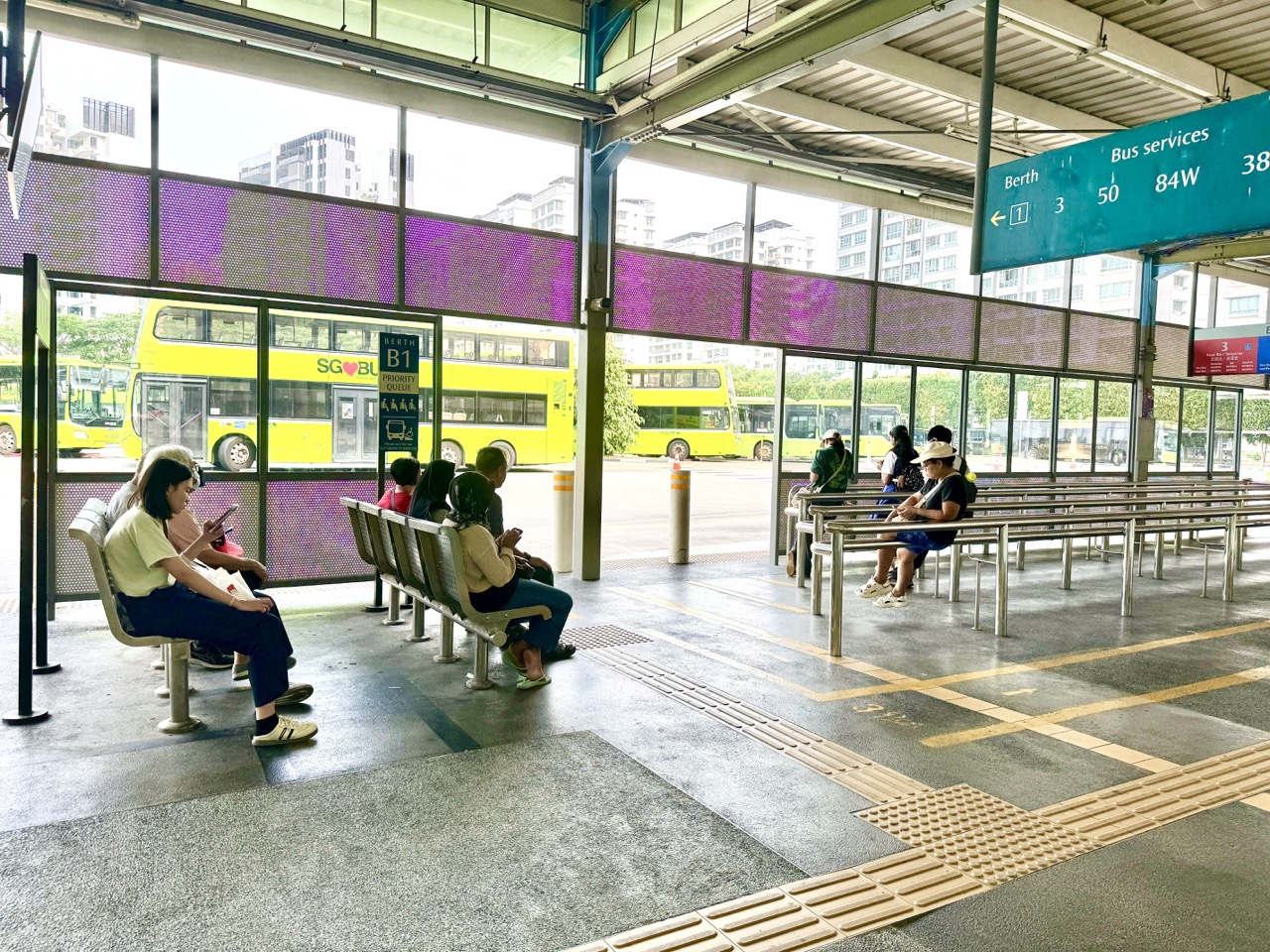
Punggol Bus Interchange remains in service beside Punggol MRT/LRT, at 70A Punggol Place, Singapore 828865. It was originally called Punggol Temporary Bus Interchange, which is the name still used in the descriptions attached to our freshly uploaded October 2026 photographs. But the word ‘Temporary’ was dropped from its public interchange name on 29 June 2025, the same day that the separate Punggol Coast Bus Interchange opened. Both places now matter to Punggol commuters, and they are not interchangeable.
The most important change for somebody planning a journey is this: from 29 June 2025, Services 34 and 117/117M shifted their originating interchange from Punggol to Punggol Coast. Other services continue to use Punggol Bus Interchange. To find a bus today, check the actual service’s current route and boarding berth rather than rely on an old photo caption, an inherited ‘temporary’ label or a memory of where a route began in 2024. Our new photos help illustrate the experience of waiting and alighting; they are not live berth signs.

Punggol Bus Interchange 2026: quick answers
- Current public name: Punggol Bus Interchange; formerly Punggol Temporary Bus Interchange.
- Address: 70A Punggol Place, Singapore 828865, according to current interchange reference data.
- Rail connection: Punggol MRT (NE17) and Punggol LRT (PTC), next to the bus interchange.
- Historical opening: 30 November 2003.
- Important 2025 change: the new Punggol Coast Bus Interchange opened on 29 June 2025.
- Services moved: 34 and 117/117M were extended to operate from Punggol Coast instead of originating at the older Punggol interchange.
- Photographed in October 2026: waiting passengers, seats and railings, and people alighting from buses.
- Best live source: the LTA journey planner, MyTransport.SG or an operator’s current service notice.
- Safety: use only designated pedestrian and boarding routes; never cross the bus operating area as a shortcut.
LTA’s 20 May 2025 press release confirms the 29 June opening and route transfers. Land Transport Guru’s Punggol Bus Interchange guide documents the older interchange’s address, history and 2025 naming update. Where the current service route or passenger timing matters, use LTA’s live information, not either article as an immutable timetable.
Why the word ‘Temporary’ still appears in photographs
The original facility was designed as a comparatively adaptable terminal for the developing new town, so ‘temporary’ became part of its familiar name. Residents used that term for many years. Photographers and media libraries often preserve labels from the time an object became well known, even when an official name changes later. That is why our image descriptions still say ‘Punggol Temporary Bus Interchange’.
A caption is not a legal or administrative naming authority. The correct editorial approach is to explain the old term while giving readers the current name. A family searching for the ‘temporary interchange’ can still find useful information, but should be told plainly that current interchange signs and official materials use Punggol Bus Interchange.
The interchange did not vanish when Punggol Coast opened
One misunderstanding is that the opening of Punggol Coast Bus Interchange replaced the town’s original interchange. That is not what LTA announced. The newer facility serves Punggol Digital District, SIT Punggol and neighbouring development, while the older Punggol interchange continues serving the established town centre.
The pair expands the choices available across a growing town. However, it also creates opportunities for people to travel to the wrong terminus. If a relative says ‘meet at the Punggol interchange’, ask which of the two they mean. A route number, full venue name and nearby MRT station are much better than an ambiguous place name.
Punggol versus Punggol Coast: one extra word matters
Punggol Bus Interchange is next to Punggol MRT (NE17), in the established town centre. Punggol Coast Bus Interchange is associated with Punggol Coast MRT (NE18), Punggol Coast Mall and the digital district. It is an integrated transport hub rather than an additional boarding area within the old interchange.
Travelling to the wrong one can mean an unnecessary transfer and confusion about which service boards where. Give visitors the exact destination from the current itinerary. Our Punggol Bus Interchange versus Punggol Coast guide owns the full venue comparison; this photo-led article concentrates on passenger movements at the existing Punggol interchange.
The history behind the old interchange
Punggol Bus Interchange opened on 30 November 2003 as the town grew. It helped connect new residential estates to the public transport network and provided a place for bus services to begin and end their routes. Over time, route additions and town growth made it a familiar everyday part of Punggol’s transport identity.
History is helpful but should not be confused with current operations. A route running from Punggol in 2010 may have been amended, renamed, withdrawn or shifted in 2025. To understand the opening chronology, our History of Punggol Bus Interchange article is the better destination. This page uses history only to make the current name and service changes understandable.
The 29 June 2025 change in plain English
LTA said Punggol Coast Bus Interchange would commence operations with Service 34 and Services 117/117M transferred from the old Punggol interchange. Those routes were extended to serve additional streets in Punggol as part of the new transport arrangement. The relocation is an official operational change, not a preference made by a third-party map.
That does not mean every bus carrying the number 34 or 117 avoids the wider Punggol town-centre area. A service may still stop at roadside bus stops while no longer using the old interchange as its terminus. Check the actual route and boarding stop code. The distinction between ‘calls at a nearby stop’ and ‘starts at this interchange’ is vital.
Service 34: why the terminus matters
A passenger who once boarded Service 34 at the old Punggol interchange may find an older directions page that still describes that arrangement. Since the 2025 change, LTA’s announcement identifies Punggol Coast as its originating interchange. Someone who needs to catch the service can use current journey information to find the appropriate boarding point along the actual route.
Do not simply assume that a bus service number and an old photograph identify a usable berth. At a bus interchange, the boarding point is part of the current operating information. If a service has changed terminals, waiting beside its former bay may waste time even though the building itself remains busy.
Service 117/117M: a similar but separate route change
SBS Transit confirmed that Services 117 and 117M began operating from Punggol Coast Bus Interchange on 29 June 2025 and were extended along Punggol Place, Sentul Crescent and Sentul Walk. Its official notice names roadside stops along the revised route, including the area near the older Punggol interchange and One Punggol.
This means a commuter may still see those bus numbers in the old town-centre area without them using Punggol Bus Interchange as a terminus. That is an easy source of confusion for visitors reading social posts. The right question is not ‘Does this bus pass Punggol?’ but ‘At which current stop or interchange do I board in my intended direction?’
The new Punggol Coast interchange’s role
LTA describes Punggol Coast Bus Interchange as part of an integrated transport hub connected to Punggol Coast MRT and Punggol Coast Mall, serving the growing digital district and nearby SIT campus. This is a different type of development from the older open-air Punggol interchange.
An integrated hub can make transfers and errands more convenient, but it doesn’t mean all Punggol buses were moved there. Service location should be checked route by route. If a new business or student is travelling to the digital district, the name ‘Punggol Coast’ may be more relevant than ‘Punggol’ alone.
What our waiting-area photograph actually tells us
The first new image captures passengers waiting near seats and railings. This illustrates how people occupy a public transport space between arrivals and departures. It does not verify a particular person’s destination, why they are seated or which bus they intend to board. Nor does it establish how full the interchange is every morning.
Railings help define passenger circulation areas, but an article cannot infer every queue rule from them. Follow the current berth sign and staff instructions. A waiting passenger should not step around a barrier to board a bus sooner, or cross operating space merely because their bus is visible a short distance away.
Boarding is not the same as alighting
Bus interchanges organise passengers getting on and passengers getting off. The photographs of people alighting show a real part of this process, but they are not evidence that the pictured stop is also the boarding point for the same service. Interchanges often have distinct spaces for these activities.
After alighting, move away from the doorway and follow the designated public circulation route. If you need another bus, find the appropriate boarding information before joining a queue. Don’t follow the next person blindly; they may be going to the MRT, a mall or an entirely different service.

Why the photo of a person checking a phone should not become a story
The supplied images include a passenger looking at a mobile phone. We can describe that visible action without inventing a personal reason. Perhaps the person is checking a journey, messaging family or doing something entirely unrelated. The image does not disclose the screen’s contents, their employer, school or destination.
Respect for commuters matters in a local guide. Do not enlarge or share identifiable personal screens or faces unnecessarily. Public transport photography can focus on the interchange’s design, public signs and passenger flow without treating individual travellers as characters in an invented narrative.
Finding the correct boarding berth
At an interchange, the route number on the berth sign and the destination shown on the bus are more useful than a remembered position from last month. Look for current electronic or printed information and check whether the queue serves your intended direction. Some routes may have variants, short trips or other special arrangements.
If you’re confused, step aside from the moving line and ask an appropriate staff member. Don’t board simply because the bus is the colour of a familiar operator or resembles one you took yesterday. A short confirmation can prevent an avoidable trip to the wrong neighbourhood.
When a queue is long
A long bus queue may reflect a peak period, a recently departed bus or a group waiting for a particular service. It is not proof that the service is permanently unreliable. Position yourself in the designated line without obstructing other routes. Give enough space for people with mobility aids and passengers who need to alight.
If you are travelling with children, keep them close and explain that the queue moves when boarding begins. Do not let a child run down the side of a parked bus to find the door. A more comfortable journey begins with an orderly wait, not with a race to the front.
Checking a bus arrival estimate
LTA’s MyTransport.SG provides journey planning and bus-arrival information. These estimates can be useful, but they are not guarantees. In January 2026, LTA publicly reported technical issues that affected displayed estimated arrival times while bus operations continued. That example is a reminder to treat digital predictions as estimates rather than physical promises.
Read the actual service information at the berth and allow reasonable time for an important appointment. If an estimated arrival time appears implausible, check current official advisories instead of assuming the bus has vanished. Public transport journeys are best planned with a margin, especially when connecting to a school event or medical appointment.
Transferring from Punggol MRT to the bus
Punggol MRT is a major station on the North East Line and connects to the Punggol LRT. The adjacent bus interchange provides another stage in a longer journey. A newcomer should follow station and interchange wayfinding rather than guess that every exit reaches every berth equally easily.
If transferring with luggage or a stroller, allow time for lifts and safe movement through the station environment. Avoid blocking fare gates or standing at an escalator landing while searching for directions. A little preparation makes a multi-stage trip less stressful.
Transferring from the Punggol LRT
The LRT serves local neighbourhood stations, and many riders use it to connect with MRT or bus services at Punggol. But the fact that the rail network meets at one station doesn’t mean the passenger’s next bus uses the interchange they remember. Find the correct current service location before committing to the transfer.
A family taking the LRT to the town centre should account for walking through the station and any waiting time at the bus berth. If the child is tired after school, this can matter more than the rail travel time alone. Keep transfers realistic rather than building a plan from ideal minimum timings.
Understanding service direction rather than memorising only a number
A route number can be associated with different directions and different stops. At Punggol Interchange, the appropriate bus may begin a journey toward another town, while a roadside stop elsewhere on the route may carry passengers in the reverse direction. The numbers alone are not enough.
Ask three questions: Where am I boarding? Where do I want to go? Which direction of the current service serves that destination? This is more robust than saying ‘I always take 117 here’ after the terminus has changed. Adults can practise these questions with children who are beginning to plan their own journeys.
What to do when a bus leaves just as you arrive
Missing a bus is frustrating but not a reason to chase it through vehicle lanes or obstruct its departure. Once the doors close and it moves away, return to a safe waiting position. Check the next estimated service or a legitimate alternative route. A bus interchange is not designed for passengers to negotiate directly with drivers in the operating area.
Parents can model a calm response: ‘We missed that one. Let’s see what the next safe option is.’ The child learns that public transport sometimes involves waiting and that a small inconvenience is preferable to dangerous behaviour.
What about bus fares and payment?
LTA accepts several fare-payment methods across public buses, including contactless bank cards, mobile wallets and designated stored-value or concession cards. Which fare applies depends on the passenger and product. A traveller should check the current eligibility and payment rules rather than assume everyone pays the same amount.
Prepare the card or phone before reaching the reader so boarding can proceed smoothly. Avoid displaying personal banking information while helping a child. If a payment issue occurs, follow driver and operator instructions without blocking the entire queue for longer than necessary.
A child and concession-card scenario
Suppose an older primary-school pupil is travelling with an adult. The child’s fare eligibility may depend on age, concession-card status and current LTA rules rather than school uniform alone. Adults should confirm the correct payment method before making the journey. Do not assume that a child’s old fare product remains valid indefinitely.
The useful habit is checking the card before boarding, keeping it secure and knowing whom to contact if it is lost. A child should not have to reveal account details to strangers or share photos of their card online to solve a fare issue.
Boarding with a stroller
Families using a stroller should follow current boarding instructions and operator rules, including the handling of the stroller inside the bus. A photograph of a spacious-looking waiting area does not guarantee a clear path at every berth or a particular vehicle layout. Position the group where they do not obstruct the general queue.
Keep the child safely supervised, prepare payment in advance and ask for assistance when appropriate. If boarding becomes impractical because of a crowd, a calmer next service may be better. Do not force the stroller past other people or into a space that cannot accommodate it safely.
Travelling with someone who uses a wheelchair
Accessibility involves the designated waiting position, bus ramp arrangements, boarding space and the particular vehicle’s operating conditions. It is not established solely by seeing seats or railings in the photo. Follow current interchange signs and consult the bus operator when a specific arrangement is required.
Allow people using mobility aids sufficient room and do not obstruct priority areas. Ask an individual whether assistance would be useful instead of grabbing equipment without permission. A respectful public transport environment gives passengers agency while making practical access possible.
Priority seats and ordinary courtesy
Interchange waiting seats may be useful for older passengers, people who are pregnant or those who cannot stand comfortably. The current posted priority policy should guide use, but ordinary courtesy matters even when a specific label is absent. A visitor can offer a seat without pressuring someone to explain a personal condition.
Don’t assume a person who appears young or healthy has no legitimate reason to sit. Not all disabilities are visible. The principle is consideration, not a public inspection of strangers’ health. During busy times, people can make space for one another without confrontation.
Safe bus-interchange behaviour with small children
Young children may be fascinated by moving buses, doors, lights and the rows of waiting vehicles. Explain the boundaries before entering: stay with the adult, use pedestrian areas, do not go between buses and do not step into a driving lane. A parked bus can move, and its driver’s view may be limited.
Use the designated passenger route and stand back from moving vehicles. If a child drops an object into a restricted area, ask staff for help. No water bottle, toy or schoolbag is worth a dangerous dash across operating space.
Alighting with children and luggage
Before your bus reaches the interchange, gather belongings without creating a rush in the aisle. Wait for safe stopping and follow the driver’s instructions. Step down carefully, especially in wet conditions. Once off the bus, keep moving to a suitable public area so other passengers can alight.
A family with multiple children can agree that the adult goes last or first depending on the safe practical arrangement and the children’s abilities. The exact approach should follow present conditions, not a rigid rule from an online article. The priority is that nobody is left behind or separated in a moving-vehicle zone.

What if you board the wrong bus?
If you realise the mistake before departure, follow staff or driver instructions and alight only when it is safe and permitted. If the vehicle is already moving, do not demand an unsafe emergency stop. Check the next legitimate stop and plan how to return or transfer. A calm correction is much safer than arguing near the driver’s cabin.
Students can rehearse a simple response in advance: tell a trusted adult, identify the bus service and current stop, and follow official instructions. They should not ask strangers to transport them privately as an improvised solution. Families can create an appropriate contact plan for independent journeys.
What to do when your phone battery dies
A journey should not depend entirely on a live smartphone screen. Before setting off, note the important service number, destination and a useful contact number through a safe method. A printed note may help a younger or less confident traveller. Avoid writing sensitive passwords or financial information on the note.
If the phone dies, use current physical signage and seek assistance from appropriate transport staff. Don’t follow an unverified stranger simply because they offer to show you a shortcut. A child should know how to reach a safe, recognised help point.
A first independent journey for a teenager
Independence is built by understanding the route rather than memorising one sequence. A teenager should be able to explain why the intended bus leaves from Punggol rather than Punggol Coast, recognise the berth and service direction, pay correctly and respond safely if the bus is missed or diverted.
Adults can practise the trip together before granting independence, matching the young person’s judgement and circumstances. The transition can be gradual. A reliable plan includes what to do if the interchange is unusually crowded, the expected bus fails to arrive or the teenager alights at the wrong stop.
A weekday morning with a schoolchild
Morning transport can feel rushed, especially when a family connects rail and bus. Work backwards from the school’s required arrival rather than treating the predicted bus time as exact. Include the walk into the interchange, any queue, the bus ride and the final safe route to school.
Do not use a timetable from an old blog post to set a child’s minimum departure time. Service patterns change, and the 2025 relocation shows how significant a route adjustment can be. A family that builds a modest buffer will usually have a more sustainable routine than one that relies on every stage happening perfectly.
A weekend visitor using the interchange
Some visitors arrive at Punggol for the waterway, shopping, a community event or a meal. They may be less familiar with the bus layout than regular commuters. Begin by identifying the return destination and whether the intended bus uses Punggol or Punggol Coast. Then enjoy the outing without assuming the last bus or interchange location from memory.
A practical plan is to check the return service before walking far from the town centre. The Punggol and Punggol Coast bus guide provides wider route context, while the current LTA journey planner should resolve the actual trip.
The difference between a boarding berth and a roadside stop
At a bus interchange, passengers generally board at designated berths. A roadside stop along the same service is a different place, with its own stop code and operating pattern. After the 2025 service changes, this difference matters especially for routes that still pass through parts of Punggol Place while originating at Punggol Coast.
A bus-stop name such as ‘Before Punggol Interchange’ is not the interchange boarding concourse itself. SBS Transit’s official 117/117M notice lists roadside stop codes for the amended service, including 65211 and 65219 near the older interchange. The name helps with orientation, but only the route’s current information confirms the correct place to board.
What a bus stop code can teach a child
A stop code is a precise identifier that can help distinguish two stops on different sides of a road. Unlike a vague landmark, it can be checked against current route information. Show an older child how to compare the code on the sign with the journey planner’s display. They should also verify direction rather than assume a matching street name is enough.
This is a useful real-world example of data precision. A one-digit difference can point to a different stop. But it is never an excuse to run across a road to catch a bus. If the correct stop is opposite, use the legal crossing and accept the next service if necessary.
The route map is a snapshot, not a promise of punctuality
An online route map shows the sequence of stops, but it doesn’t prove that every bus will arrive at a particular minute. Traffic, service adjustments and technical estimate issues can affect the commuter’s experience. LTA provides journey-planning information and advisories, which are better suited to current decisions than an old printed schedule.
For a time-critical trip, check the current service at departure and leave a buffer. If an official route change has occurred, read the notice carefully rather than assume the map will behave as it did last year.
Why bus operators matter
Punggol Bus Interchange is associated with Go-Ahead Singapore as a principal operator, while services can involve more than one bus operator. A passenger should check the actual route number and operator when looking for enquiries or lost property. The entire interchange is not necessarily responsible for an item left on every service in the same way.
If you lose something, record the route, approximate time, direction and relevant details without publicly exposing sensitive information. Contact the correct operator through its official channels. Avoid posting a fellow passenger’s name, photograph or personal belongings online in an attempt to find them.
Buses, the MRT and the LRT as one network
Punggol’s public transport choices combine different scales. The North East Line connects the town to destinations farther away, the LRT loops reach local neighbourhoods and buses serve routes and connections with their own road network. The interchange is valuable because it gives people a place to transfer among these layers.
But a transport network is only useful to an individual when they can navigate its connections. A new visitor needs clear labels; a person with a stroller needs a suitable path; a student needs a safe routine; an older person may appreciate seating and a calmer pace. Those everyday needs are just as important as the map of lines.
The photograph as an English-writing exercise
Ask a child to describe the waiting-area photograph accurately. ‘Passengers wait near seats and railings at Punggol Bus Interchange’ is grounded. ‘Commuters are late for work and angry about the service’ is invented. A facial expression or mobile phone in a photo does not reveal someone’s schedule or emotions reliably.
An older student can expand the description into a paragraph about how an interchange organises movement. They should use observation for concrete details and cite official sources for service changes. That is better information literacy than writing a dramatic story about people they don’t know.
The photograph as a Mathematics exercise
Suppose a hypothetical bus queue has 18 passengers and the next bus can take 12 more people. Six would remain if everyone ahead boards and nobody joins or leaves. That is a simple subtraction exercise with stated assumptions, not evidence about the actual queue in our photo.
An older student can explore a transfer-time model: three minutes to leave the rail platform, five minutes waiting and twelve minutes riding totals twenty minutes in the hypothetical case. Real times vary; using real observations and checking service estimates is necessary before making a journey promise.
The interchange as a Social Studies lesson
Public transport infrastructure is a shared service shaped by planning decisions, passenger behaviour, labour and changing town needs. The opening of Punggol Coast in 2025 shows the network adapting to new development while retaining the older interchange. A student could ask why two interchanges are useful and which groups benefit from connections to different areas.
A good answer would use official LTA announcements rather than assuming the new hub made the old interchange unnecessary. It would also distinguish transport intentions from individual experiences. A public system can offer more routes while some travellers still need time to learn the changes.
Rainy-day bus travel without panic
Heavy rain can make walking to the interchange uncomfortable and increase the need for careful footing. A sheltered waiting space can help, but the existence of a roof does not mean every connecting path is fully sheltered or that there are no wet surfaces. Use the safe designated route and keep umbrellas controlled in a crowd.
If visibility is poor, allow more time and avoid rushing across roads or bus lanes. Do not stand where a driver’s view may be obstructed. The child’s safety matters more than catching the very next departure.
Hot afternoons and the value of waiting comfortably
Heat and humidity may make standing difficult for some commuters, especially older visitors, young children and people who have been outdoors for a long time. Use available seating appropriately and share space with those who may need it. Bring water when suitable, and adjust the journey when somebody feels unwell.
A commuter who chooses to wait for a less crowded bus may be making a perfectly sensible decision. There is no moral value in squeezing into a boarding queue as quickly as possible. Public transport works best when passengers can make practical choices within the operating rules.
Why photographing strangers at a bus interchange needs care
Transport images can be useful without closely identifying the people in them. Avoid publishing readable phone screens, cards, home addresses or identifiable images of children unless there is a legitimate reason and appropriate permission. Respect any photography restrictions and staff instructions at the interchange.
Our newly uploaded images are valuable for showing seating, railings, boarding and alighting patterns, not for interpreting strangers’ lives. A person looking at a phone may be doing a hundred things. An accurate caption needs only to describe the visible scene.
A ten-minute familiarisation visit
For a family with a child learning how to use buses, a supervised short visit can focus on finding the main signs and understanding the difference between boarding and alighting. Point out where people should queue and why passengers stay out of vehicle lanes. Look up the current route number before moving to a berth.
This is not a licence to treat the operating space as a playground or a place to run a scavenger hunt. Keep the exercise short and stay where passengers are permitted. The aim is recognition and safety, not collecting every possible bus number in one visit.
A first trip to Punggol Coast from the old town centre
If your destination is Punggol Digital District, use an official journey planner to decide whether rail, a direct roadside bus or another service makes sense. You may not need to enter the older bus interchange at all. The route depends on where you start and what you’re carrying.
The important habit is naming the correct destination precisely. ‘Punggol Coast Bus Interchange’ and ‘Punggol Bus Interchange’ are separate. Once the family understands the difference, the live planner can provide the relevant present-day connection without relying on outdated route assumptions.
How to share a route with grandparents or visitors
Send the full interchange name, the nearest MRT station and the current service or stop code. For someone unfamiliar with smartphone apps, a short written note is often more useful than a complicated screenshot full of arrows. Avoid giving a route based only on a landmark that the visitor has never seen.
Ask whether the visitor needs lift access, a shorter walking route or time to rest. Don’t assume everybody finds the same transfer easy. A safe plan respects the traveler’s preferences and provides an alternative if a bus is delayed or a route changes.
When an announced service change takes effect
Operators may introduce a new service, withdraw a route or adjust a boarding location. An announcement usually gives an implementation date and explains the affected stops. Read the date carefully. A change described as starting next Sunday should not be treated as already in force on Friday.
After implementation, verify the actual berth and updated journey information. This is especially important for people who travel only occasionally. Punggol’s 2025 transition is a clear reminder that a service’s previous terminal can remain a real operating building while the route itself moves elsewhere.
A responsible photo caption about an old name
If a filename says ‘Punggol Temporary Bus Interchange’, preserve that original metadata as part of the photographic record if needed, but publish a corrected contextual caption: ‘Punggol Bus Interchange, formerly known as Punggol Temporary Bus Interchange.’ Explain the date of the naming change rather than silently rewriting history.
That small editorial choice helps people who remember the older name and people learning the present one. Good local information doesn’t pretend names never change; it tells readers when and why the terminology shifted.
What this guide deliberately does not promise
It does not claim that every route listed on an old directory still serves the same berth. It does not invent current first- and last-bus times, live arrival predictions, seat availability or individual passengers’ reasons for travel. It does not tell children to cross restricted bus lanes or recommend unverified pickup points.
Instead, it gives stable facts about the interchange, a clear explanation of the 2025 changes and a framework for checking real trips. That is more useful than a long list of services that may be wrong the next time an operator changes its route.
Frequently asked questions
Is Punggol Temporary Bus Interchange still there?
The interchange itself remains in service, but its public name is now Punggol Bus Interchange. The former ‘Temporary’ wording was dropped in June 2025.
Where is Punggol Bus Interchange?
It is beside Punggol MRT/LRT at 70A Punggol Place, Singapore 828865, according to interchange reference information.
Is Punggol Coast Bus Interchange the same place?
No. It is a separate integrated transport hub beside Punggol Coast MRT within Punggol Digital District.
When did the Punggol Coast interchange open?
It opened on 29 June 2025, according to LTA’s official announcement.
Which routes moved to Punggol Coast in 2025?
LTA confirmed that Services 34 and 117/117M shifted their originating interchange there as part of route extensions.
Does Service 117 still travel along Punggol Place?
SBS Transit’s 2025 amended-route notice lists stops along Punggol Place, Sentul Crescent and Sentul Walk, even though the service now starts at Punggol Coast.
Does a nearby roadside bus stop mean my bus boards inside the interchange?
No. A roadside stop and an interchange berth are different locations. Check the current route and boarding information.
What is the nearest MRT to Punggol Bus Interchange?
Punggol MRT, NE17 on the North East Line, which also connects with Punggol LRT.
Do all Punggol buses depart from the same terminal?
No. Punggol Bus Interchange and Punggol Coast Bus Interchange serve different sets of routes. Verify the particular service.
Can I use a 2024 boarding guide today?
Only as historical context. Check current services and berths after the 2025 changes and any later amendments.
Can I trust the bus arrival time shown in an app?
It is an estimate, not a guarantee. LTA has documented situations when displayed arrival estimates were inaccurate despite continuing services.
Where should I wait for my bus?
At the currently designated boarding berth or stop for the service, following signs and operator instructions.
Can children walk between parked buses to reach a queue?
No. Use designated passenger circulation areas and never cross bus operating lanes as a shortcut.
Can a stroller be used at the interchange?
Families use public transport with strollers, but exact boarding and safe positioning depend on current facility and operator rules.
Is wheelchair access available?
Transport facilities provide accessibility features, but the precise boarding arrangement should be verified with the current operator and staff for the service.
How should I pay for a bus journey?
Use an eligible payment method accepted by LTA, such as a contactless bank card, mobile wallet or appropriate stored-value/concession card.
What if I board the wrong bus?
Stay calm, alight at a permitted safe stop and use official information to correct the route. Don’t seek an unsafe emergency stop.
What if the last bus has already gone?
Check verified current public transport alternatives and seek appropriate help. Do not guess first or last bus times from this dated article.
Can I photograph buses and passengers?
Follow staff and site instructions, stay out of operating lanes and respect people’s privacy, especially identifiable children and phone screens.
What do the October 2026 photos show?
They show people waiting and alighting in the older Punggol town-centre interchange. They do not confirm live service locations or schedules.
Who operates the bus interchange?
Go-Ahead Singapore is the principal operator identified for the interchange, with service operations involving relevant public bus operators. Check the operator for your specific service.
What is the history of the original interchange?
It opened in 2003 during Punggol’s development. Read the separate eduKatePunggol historical article for its full chronology.
Where can I find official updates?
Use LTA’s journey planner, MyTransport.SG, route-change notices and the relevant bus operator’s announcements.
Why does this page keep mentioning the word ‘Temporary’?
The supplied photograph metadata uses the historical name. Explaining the June 2025 naming change prevents a current guide from repeating an outdated label without context.
Official sources and useful onward guides
- LTA — Punggol Coast Bus Interchange opening and route transfers, 20 May 2025.
- SBS Transit — Service 117/117M route extension and roadside stop codes.
- LTA — Integrated Transport Hubs and Punggol Coast.
- LTA — Plan Your Journey and MyTransport.SG.
- LTA — January 2026 bus estimated-arrival-time technical issue.
- Land Transport Guru — Punggol Bus Interchange, current and historical name.
- Punggol Bus Interchange vs Punggol Coast Bus Interchange.
- History of Punggol Bus Interchange in 2003.
- Punggol and Punggol Coast Bus Guide.
- Complete Punggol Guide.
Editorial review: 23 October 2026. Images are original October 2026 photos from the eduKatePunggol media library. Their labels retain the historical ‘Temporary’ name, which this article corrects to Punggol Bus Interchange. Boarding berths, route timetables, fares, assistance arrangements and current arrivals must be checked against live official sources; no individual in the photographs is identified or assigned a personal story.


