
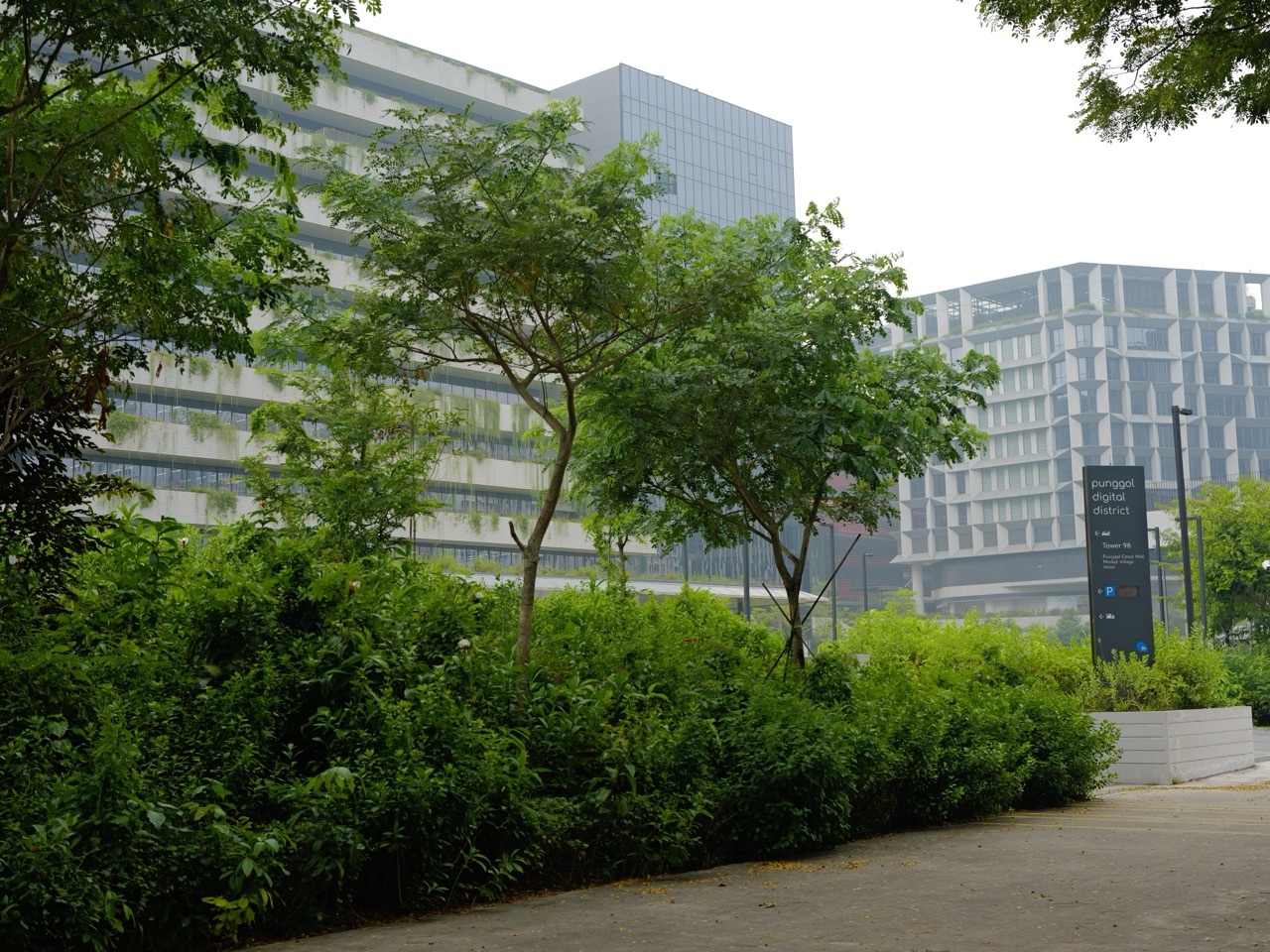
Did you know that a new MRT station can change the usefulness of an entire neighbourhood even when it adds only one stop to a train line? Punggol Coast provides a good example. On 10 December 2024, the North East Line was extended beyond Punggol MRT to a new terminal in the northern part of town. To somebody looking only at the railway diagram, that is a short addition. To somebody travelling to a university, workplace, public space or home in north Punggol, it can change where a journey begins and ends.
The interesting question is not simply “Where is Punggol Coast MRT?” The more revealing question is “Why was it worth extending an established rail line to this place?” The answer involves the position of Punggol Digital District, the Singapore Institute of Technology, northern housing areas and a wider network of walking, cycling, buses and public transport connections.
This guide explains why the station matters as infrastructure, what it changes for different people, why the final walking link is as important as the train, and how a child can learn about urban planning from one new dot on a transit map. It does not duplicate detailed station-exit guides or claim that every commute is now faster. It is about the planning logic behind a transport extension.
The answer in 50 seconds
The Land Transport Authority says Punggol Coast station, NE18, opened for passenger service at 3pm on 10 December 2024. It became the new northern terminal of the North East Line, extending the route from the existing Punggol station. Its location in Punggol Digital District gives rail access to the JTC business park and SIT’s Punggol campus, as well as other emerging destinations in the area.
The station has two entrances—one along New Punggol Road and the other within the Digital District—more than 300 bicycle parking lots, and covered links to nearby transport access points. LTA also describes a public space at the entrance, green building features and integrated district cooling.
The key idea is that a railway station is more than its platform. It is a connection between many other journeys. A good extension brings people closer to where they need to be and reduces the awkwardness of the trip before and after the train ride.
Why a railway’s last station can be important
Imagine a train that stops just short of a major destination. Passengers still need to leave the train, find another mode of transport and complete the remaining distance. For some people, that extra leg is trivial. For others, it may be the difference between a journey that feels predictable and one that requires another transfer or a substantial walk.
Extending the line can shift the effective reach of the whole railway. The train has not become a new transport system, but it now has another point where people can enter and leave. That point can serve homes, workplaces and public facilities that were previously farther from the nearest station.
A terminal also creates particular operational responsibilities. The station must be integrated into the line’s existing services, signalling, systems, train movements and passenger information. LTA describes how work to integrate Punggol Coast required preparation and testing before opening. That is one reason a station cannot be viewed simply as a building with escalators.
For residents, the important result is a new option in the network. Whether it is the best option depends on where a person actually starts, the destination and the remaining walking or transport connections.
Why northern Punggol needed a different access point
Punggol developed around its existing town-centre MRT and LRT interchange, but the northern coastal district has a different geography. Homes, workplaces, the university campus and new destinations do not all sit directly beside the older station.
A rail line that previously ended at Punggol could serve northern destinations through onward walking or other transport, but the journey still had an extra segment. A new station in the northern development area can reduce the need for that segment for many travellers.
This is not a claim that everybody in Punggol benefits equally. Someone living closer to Punggol MRT may still prefer that station. A person on a particular LRT or bus route may find another transfer pattern more convenient. The improvement is specific to the network and the journeys it makes practical.
The way to evaluate it is door-to-door: which combination of walking, rail, bus or cycling now gets a person to the actual destination with less burden?
Why SIT and the business park affect the station’s usefulness
A university and a business park create travel demand from people who do not necessarily live in the immediate area. Students may arrive from elsewhere in Singapore. Staff and visitors may have different working hours. Businesses may host meetings, events and work that bring people from other parts of the city.
Punggol Digital District was planned as an integrated industry-and-university ecosystem. JTC’s public material explains its emphasis on digital-economy industries and applied collaboration. The new MRT station helps make that setting accessible without requiring every user to approach from the existing town centre.
The transport network and the district therefore support each other. Buildings create reasons to travel; rail creates a practical way to reach them. But the mere existence of the station does not guarantee that every company offers jobs or that every campus facility is open to the public.
Parents and students should distinguish transport access from admissions or employment eligibility. A train can take you to a university. It does not admit you to a course.
Why Punggol Coast is a new terminal, not a replacement for Punggol MRT
Punggol Coast became the terminal of the North East Line after the extension. That does not make the existing Punggol MRT station obsolete. Both stations now serve different areas and journeys along the same line.
Punggol MRT remains an important connection with the Punggol LRT network and the surrounding town-centre area. The newer terminal is closely integrated with the northern district. Someone travelling to Waterway Point may still be better served by Punggol MRT, while a person heading to a destination in Punggol Digital District may find Punggol Coast more suitable.
The distinction is easy for children to understand with a simple map. A train line can have multiple useful stops in the same town because the town contains multiple destinations. The closest railway station by name is not always the closest usable station to a particular building.
Avoid using a fixed rule such as “always take Punggol Coast if going north.” The exact destination, exit and connecting route determine the correct choice.
Why two entrances matter
LTA reports that the station has two entrances, one along New Punggol Road and one within Punggol Digital District. At first glance, an extra entrance might sound like a small feature. In urban design, it can meaningfully change how easily a station connects with the paths around it.
Suppose a traveller arrives at one end of a station but needs to reach a destination beyond the opposite side. If the station permits appropriate entry and exit patterns, those entrances can make access more convenient. They can also distribute movements between the surrounding spaces.
An entrance, however, is not useful merely because it exists. The walking path beyond it must lead somewhere. The route must be legible, accessible and appropriate for the traveller. A destination may still require several minutes of walking.
For a real trip, check current station diagrams and directional signs. Names such as “New Punggol Road” and “Digital District” are orientation cues, not a complete step-by-step route to every campus block or office.
The first-and-last-mile problem
Transport planners use the phrase first and last mile to describe how a traveller reaches public transport and completes the trip from public transport to the final destination. The “mile” is not a promise that each segment is literally one mile. It refers to the connecting portions that can determine whether the main transport service is convenient.
Imagine someone taking a comfortable train ride but then facing a lengthy exposed walk, difficult crossing or inaccessible route. The train portion may work well while the complete journey remains challenging. The reverse is also true: a station placed close to an important destination can make rail a far more practical option.
At Punggol Coast, LTA describes covered linkways to nearby bus stops, taxi stands, pick-up and drop-off points, plus extensive bicycle parking. These features matter because passengers arrive by different modes and have different needs.
A family evaluating a trip to SIT should ask where they need to go within the campus, which entrance best serves that block and how the walking link works on the day. The station is an access point, not the final address of every destination.
Why bicycle parking is part of a railway station
LTA reports more than 300 bicycle parking lots at Punggol Coast. A bicycle rack might look like a minor facility compared with trains and tracks. In reality, it supports a different access pattern: a person can cycle from a nearby origin to the station, park appropriately and continue by rail.
This can make the station accessible to people for whom walking the entire first segment is less convenient. It can also broaden the practical catchment of the station, depending on safe cycling paths and the person’s ability.
But the presence of parking does not guarantee that a space is available at a particular minute. Cyclists must use designated parking facilities and follow current active-mobility rules. A secure lock remains important, and riding on shared paths requires consideration for pedestrians.
The planning lesson is that public transport is often a network of modes. A train line becomes more useful when people can reach it by different safe and suitable methods.
Why sheltered links matter in a tropical town
Singapore’s weather can make a short outdoor journey feel very different depending on the time of day and conditions. Direct sun, heavy rain and humidity influence comfort. A covered link can reduce some exposure, although it does not make an entire trip weatherproof or safe during lightning.
LTA specifically highlighted covered access around Punggol Coast in its station-opening material. That is significant because commuting is repeated many times, not experienced once as a sightseeing trip. A practical station works on ordinary school days, workdays and during changes in weather.
It would be wrong to infer that a shelter continues all the way from every nearby home or building to the platform. Some routes may still have exposed segments. An actual journey should be checked in full.
The general principle also applies beyond Punggol: the comfort of walking to a station can affect whether people choose public transport routinely.
Why a station needs public space as well as platforms
LTA describes Punggol Coast as the first station designed with a public space at its entrance for events and community programmes. This is an interesting design decision because it treats the station threshold as part of the district, not merely a place for people to hurry through.
Public spaces can provide a setting for meeting, orientation or approved activities. They can help a station become a recognisable part of the neighbourhood. They may also support interaction between people going to different destinations, when properly managed.
That does not mean every open area can be booked without permission or that events are held every day. Access and use depend on current operating rules and the organisers responsible.
For children, the idea is useful: infrastructure can do more than move people from A to B. Its surrounding design can influence how the town feels and how residents use shared space.
Why the station has energy-saving features
LTA says Punggol Coast station has achieved the Green Mark Platinum Certification under BCA’s Green Mark for Transit Station scheme. Its design uses a hybrid cooling approach: district cooling for air-conditioning within the station and fans at platform level, together with other efficiency features such as LED lighting and sleep-mode enabled lifts.
Why would a railway station need to care about energy? Stations operate for many hours, with lighting, ventilation, vertical transport and other systems supporting passengers. Improving the efficiency of these systems can reduce operating demands while maintaining the necessary conditions for safe and comfortable use.
It is important not to turn these features into an unsupported claim of exact energy savings. The certification and design approach are documented, but any particular percentage of savings requires specific verified performance data.
The educational lesson is that a transport facility is also a building and a collection of operating systems. Its usefulness includes reliability, accessibility and responsible resource management.
Why district cooling is different from ordinary room air-conditioning
Most people understand air-conditioning by imagining a separate unit cooling one room or building. A district cooling system can produce and distribute chilled water or cooling from a central arrangement serving multiple connected spaces. The technical and commercial advantages depend on its design and operations.
Punggol Digital District has a district cooling system, and LTA reports that Punggol Coast station uses that connection for its air-conditioning. The station is therefore not an isolated piece of transport infrastructure; it can share an engineered utility arrangement with its broader district.
This is another example of systems integration. A decision about land use can affect how a railway station is designed. A transport extension can be connected with energy infrastructure rather than planned completely separately.
For a fuller technical explanation, readers can consult eduKatePunggol’s existing guide to Punggol Digital District cooling. The important point here is the relationship between a station and its surrounding urban systems.
Why the public artwork matters
LTA identifies the station artwork “Trajectories” by local artist Zul Othman, also known as ZERO. Its inspiration includes the changing history and future of Punggol. Artwork is not necessary to move a train, so why include it?
Public art can give a place a recognisable character and invite people to think about the neighbourhood beyond its practical infrastructure. A new station is part of a wider story of homes, work, landscapes and movement. Art can make that story visible.
Different viewers may interpret a work differently. A child could describe its shapes or movement and connect them with what they know about Punggol. That is a valid exercise in observation, provided they distinguish their interpretation from the artist’s documented intention.
The deeper lesson is that a station can be both a technical asset and a civic place. Good infrastructure need not erase culture or history.
Why the station opening date matters
Punggol Coast began passenger service on 10 December 2024. That date is important when reading old articles. A guide written before the station opened may describe it as a future project, even though it is now operating.
The same issue applies to photographs and archived transport maps. A historic map may still show Punggol as the end of the North East Line. That does not mean the current network ends there. A reader must check the date and distinguish the state of the system at publication from the present.
This is an excellent media-literacy lesson for students. A source can be accurate for its time and still be outdated for a current travel decision. The correct response is not to reject the old source completely; it is to place the information in chronological context.
For the station’s original design rationale, LTA’s 2024 announcements are useful primary records. For today’s operating conditions, current LTA and SBS Transit resources matter more.
A station does not guarantee a particular journey time
LTA’s 2024 opening materials used a Punggol North-to-Outram Park example to illustrate reduced travel time compared with the earlier journey pattern. That is evidence of the transport benefit the agency intended to communicate at opening.
It is not a universal travel-time guarantee. Actual journeys depend on the traveller’s exact origin and destination, service intervals, transfers, walking speed and current conditions. Someone going from a different Punggol precinct to a different city location may obtain a different result.
This distinction protects residents from misleading comparisons. It is easy to say that every north-Punggol commuter “saves 15 minutes,” but a specific illustrative journey cannot establish that for everyone.
The correct family decision is to plan the route that matters, using current information, and make allowances when an appointment or school arrival time is important.
How Punggol MRT and Punggol Coast can serve different people
Imagine two people boarding the same North East Line. One needs to reach a shop near Waterway Point. The other is going to a university building in the Digital District. Their destinations are in the same town, but the appropriate stations may differ.
Now imagine a third person who needs to transfer to the Punggol LRT. Punggol MRT’s role as an interchange could be central to that journey. A fourth person may live on a convenient bus route to a northern destination and find that bus more suitable than adding a train transfer.
These examples are not a live journey recommendation for unnamed addresses. They show why a transport network benefits from multiple nodes. Each node connects a different set of surrounding places.
Instead of asking which Punggol station is “best,” ask which station provides the best complete connection for the actual task.
The difference between connectivity and accessibility
Connectivity concerns which places or networks are linked. Accessibility concerns whether a person can use those links in practice. A station can improve connectivity by extending the line, but accessibility depends on the full journey and the traveller.
Consider a person with a stroller or wheelchair. Lift availability, step-free routes, signs and the distance to the destination are important. A station opening alone does not prove that every related building can be reached without a barrier.
Similarly, a student may be physically able to reach a workplace but not eligible to enter it. Access to transport is not access to a private office or laboratory. These are separate meanings of the word accessibility.
Urban planning is more successful when it acknowledges both the transport link and the real people who must use it.
Why the timing of housing and transport development matters
A town changes over years rather than appearing fully complete overnight. New housing and commercial spaces may be opened at different stages. A transport project needs planning, funding, construction, testing and operating arrangements, all of which take time.
LTA says construction of Punggol Coast station began in 2018, with operational preparations continuing before the December 2024 opening. This reminds us that a visible new platform represents years of work rather than a quick addition to a map.
People may naturally ask whether a station should open before or after surrounding buildings. There is no simple universal rule; the decision depends on expected users, construction readiness and how the growing district will function. Opening at a useful stage can support further development, but it also has to meet safety and operating requirements.
The child-friendly lesson is that cities are assembled in interdependent parts. Housing, jobs and transport need to be coordinated over time.
Why the station does not make every surrounding space public
Punggol Coast serves the Digital District and SIT, but offices, laboratories, classrooms and certain campus spaces may have restricted access. Being a station commuter does not override those rules.
A visitor should identify whether they are travelling to an open public area, an event, a shop, a workplace with an appointment or an institutional facility requiring permission. The correct final route depends on this distinction.
That matters especially for families wanting to explore the new district. It is reasonable to enjoy public spaces and observe the urban design, while respecting signs and private boundaries. Avoid entering a restricted building because it appears connected to a station.
Good wayfinding includes understanding where a public journey ends and permission-controlled space begins.
Three everyday scenarios
Scenario one: the student travelling to SIT
A student has an authorised class or activity at SIT. They identify the correct campus building from the university’s current directions and then compare the station exits. The train may take them to Punggol Coast, but they still need to reach the specific block.
They check the walking route, accessible links where needed and arrival time. They do not assume every entrance leads directly to every facility. If arriving for the first time, they leave some margin for orientation.
The lesson is that a station address and a class location are not interchangeable. A complete trip ends at the room or building that the traveller actually needs.
Scenario two: a parent choosing between rail and bus
A parent needs to bring a child to an activity in northern Punggol. They compare a rail route that arrives at Punggol Coast with an available bus route and the amount of walking after each option.
The best choice may change with weather, traffic, the child’s age or the family’s location. The parent checks current transport information rather than assuming that rail is always faster.
The lesson is that adding a station gives people an extra option. It does not make every other transport mode redundant.
Scenario three: a worker cycling to the station
A worker lives within a suitable cycling distance, has a safe route and wishes to use public transport for the longer journey. They locate designated bicycle parking near Punggol Coast and follow applicable active-mobility rules.
They should still allow time for parking and securing the bicycle. A bicycle rack is a connection facility, not a guarantee of an empty space or a substitute for safe riding.
The lesson is that rail access can be extended by walking and cycling connections beyond the immediate station entrance.
What children can learn about maps and networks
Draw the North East Line ending at Punggol. Then add one more node labelled Punggol Coast. Ask the child what changes. The obvious answer is that the line reaches another station. The stronger answer is that more destinations become accessible through the rail network.
Next, draw homes, a university and an office district around the new station. Include walking links from the platform to these places. The student should notice that adding the node changes the whole network only if useful paths connect to it.
Then draw a bicycle path and bus stop. Discuss how additional modes expand access. Finally, add a constraint: one traveller cannot use stairs. Ask what must be checked before claiming the journey is suitable.
This exercise introduces network thinking without requiring formal graph theory.
A numerical example with explicit assumptions
Consider a fictional journey in which a commuter previously travelled 12 minutes from the old station to a destination using a separate connection. With a new station, imagine the traveller needs only 5 minutes of walking beyond the rail exit, but the rail trip itself is 3 minutes longer.
In this made-up example, the old final segment contributes 12 minutes, while the new extension plus walk contributes 8 minutes, making a 4-minute improvement. The result is not a statement about any real Punggol commute.
Now introduce a 6-minute wait for a connecting service in the old option or a temporary obstruction in the new walking route. The comparison changes. Students learn that travel time is composed of several parts, and a useful analysis must include them all.
A child who can state the assumptions and revise the answer when conditions change has learned the actual reasoning skill.
The importance of station maintenance and changing conditions
An MRT station is an operating system. Lifts, escalators, signage, electrical equipment, ventilation and passenger areas require maintenance. Temporary works or service adjustments can affect the journey even after the main station has opened.
This is why a blog article about the station’s design cannot be used as the final source for live lift status, train service or entrance accessibility. Commuters should use official operator information and on-site directions.
A reliable transport network includes public communication when conditions change. Travellers need to know what has changed and how to make an alternative journey. Planning a backup route is particularly useful when an appointment is time-sensitive.
The broader lesson is that infrastructure is not finished as a public service when construction ends. Its reliability depends on continuing operation, inspection and maintenance.
Why the station matters to residents who never use it
A resident might prefer the existing MRT station or travel mostly by bus. Why would an additional station still matter? It can change the distribution of activity in the town. People working or studying in northern Punggol have another rail access point; some public spaces and nearby destinations become easier to reach.
Those are potential network-level changes. They do not establish that property values rise by a fixed amount, that every road becomes less congested or that a resident personally saves money. Those claims require separate evidence.
But the principle is understandable: infrastructure can create options for people beyond its most frequent users. A town with more practical access points may support a wider range of journeys.
The sensible measure is not excitement alone. It is whether the station helps residents and visitors complete real trips safely and efficiently.
Common misunderstandings
One mistake is calling Punggol Coast a replacement for Punggol MRT. Both stations are part of the current North East Line and serve different travel needs. Another is interpreting a new terminal as the new best stop for every Punggol destination.
A third mistake is treating a station’s advertised rail travel-time example as a guarantee for the whole household journey. A fourth is assuming the district’s planned employment numbers equal current vacancies. A fifth is overlooking the walking route and the need to check exact entrances.
Other mistakes include believing that bicycle parking makes every cycling route safe, that a covered link protects against every storm, and that a public station creates unrestricted access to nearby workplaces.
These misunderstandings have one thing in common: they describe a component without considering the wider system. The right explanation always follows the complete journey.
Frequently asked questions
When did Punggol Coast MRT open?
LTA confirms passenger service began at 3pm on 10 December 2024. Historical references to it as “upcoming” should be read in that context.
Is Punggol Coast now the North East Line terminal?
Yes. LTA identifies it as the northern terminal after the extension beyond Punggol station.
Does Punggol MRT still operate?
Yes. It remains an existing station and important interchange, especially for journeys involving the Punggol LRT or town-centre destinations.
Why build the station in Punggol Digital District?
It improves rail access to the district’s university and business destinations and other northern-Punggol journeys, as LTA’s opening materials explain.
How many entrances does the station have?
LTA identifies two: one along New Punggol Road and one within the Digital District. Use current signs for the precise route.
Is there bicycle parking?
LTA documents more than 300 bicycle parking lots. Actual availability and suitable routes need to be assessed when travelling.
Does the station have environmentally efficient features?
Yes. LTA reports Green Mark Platinum certification, integrated district cooling, platform fans, LED lighting and other design features.
Is the station completely sheltered from every nearby destination?
No such universal claim follows from the official description. LTA identifies covered links to nearby transport points, but the full route depends on the final destination.
Can families visit every SIT building from the station?
No. The rail station provides physical access to the area, not permission to enter restricted university or business facilities.
Does the station guarantee shorter travel for every household?
No. The benefit depends on origin, destination, transfers, walking and current operations.
A simple Punggol journey checklist
- Identify the exact destination, not only “Punggol Digital District”.
- Compare Punggol MRT and Punggol Coast by the full door-to-door journey.
- Use the current North East Line map and official service updates.
- Check the relevant entrance and final walking connection.
- Include transfers, weather, accessibility and comfortable time margins.
- Confirm permission or appointment arrangements at nearby institutions.
- For cycling, use permitted routes and designated bicycle parking.
- Do not mistake a historical journey-time illustration for a live guarantee.
- Respect signs, restricted areas and station staff directions.
- Recheck your plan when there are temporary works or operational changes.
Teaching Guide: why one extra station changes a network
Learning goal. The student should explain why a station extension can improve accessibility, even if the rail-line diagram changes by only one stop. They should distinguish a train ride from the complete journey and a station from the destination.
First activity. Draw a line with three fictional stations and a cluster of important buildings beyond its terminal. Ask the learner to plan a journey before the line is extended. Include a hypothetical walk or bus ride from the old terminal.
Second activity. Add a new terminal closer to the buildings. Ask which journeys can now change. The learner should identify who benefits and who might not.
Third activity. Add two station entrances, a bicycle path and a covered link. Ask why these features matter even though they are outside the train. Explain the first-and-last-mile principle.
Fourth activity. Give invented journey times and ask the student to compare totals. Insist on listing assumptions. A calculation should not be reported as a real Punggol timetable.
Fifth activity. Introduce a traveller needing step-free access and ask what must be verified before a route can be recommended. This shows that accessibility is more than distance.
Transfer test. Present an unfamiliar new town where a train extension reaches a university. Ask the child to explain the infrastructure’s effect without using any of Punggol’s proper names.
Parent checkpoint. A strong answer is: “The extra station brings the train closer to more destinations, but I still have to check the route from the station to where I actually need to go.” That is network understanding, not just map memorisation.
Where this article belongs in the Punggol guide library
The existing Punggol MRT versus Punggol Coast MRT guide focuses on station choice for particular destinations. The Punggol Coast station guide is a location-oriented resource. The Why Punggol explanation of SIT and the Digital District explains the education–industry relationship.
Here we answer a distinct question: why one additional MRT stop can change the usefulness of the northern town. That makes it a companion to practical station guides rather than a competing duplicate.
Official sources and further reading
- LTA: Punggol Coast station opening factsheet, 10 December 2024
- LTA: Punggol Coast opening announcement, 10 October 2024
- LTA: Rail network information
- SBS Transit: Service information
- eduKatePunggol: Why the LRT has two loops
The one idea to remember
Punggol Coast is not important because it adds one more station name to a map. It matters because it links northern homes, the university, jobs and public spaces more directly to the wider city. Its real success is measured in the complete journeys people can make—not merely in the length of railway added.


