
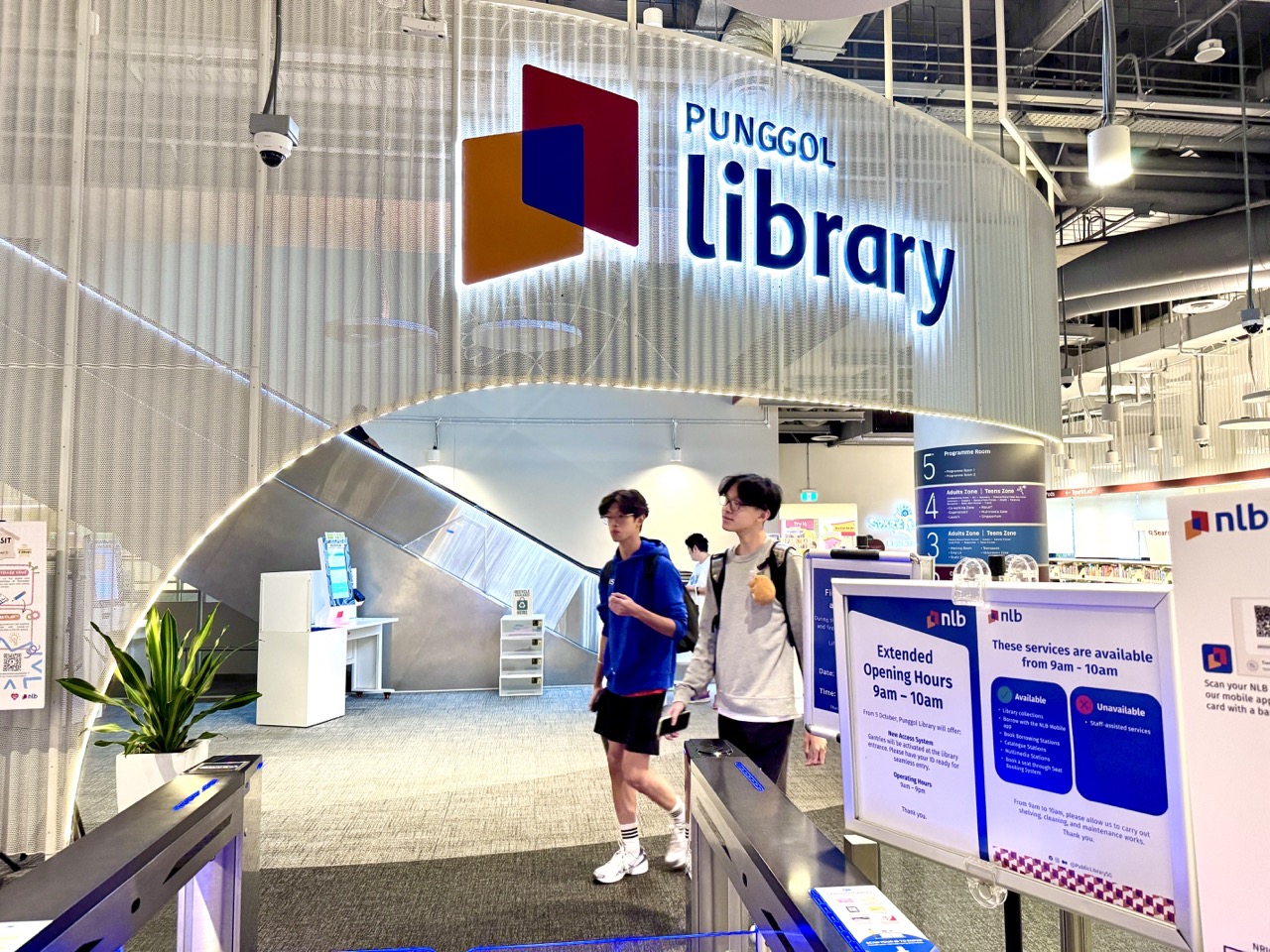
What to do in Punggol when a child struggles with ordinary small print, an older relative prefers listening to text, or a family wants to discover books in a more comfortable format? Plan a short, consent-based reading-format trial at Punggol Regional Library. Choose one real reading goal, compare the available options and ask the intended reader what helps. An accessible book or assistive device should be selected for its usefulness to a person, not because it looks technologically impressive.
Punggol Regional Library at One Punggol offers an Accessible Collection, accessible borrowing facilities, assistive technology and Calm Pods. The Ministry of Social and Family Development describes these features as part of an inclusive design shaped by engagement with the disability community; the National Library Board also describes magnifiers, text-to-speech functions and accessible keyboards. However, the availability of a named feature does not guarantee that every title, device or session is immediately accessible during a particular visit.
This is a practical first-visit comparison, not a disability assessment, formal assistive-technology prescription or promise that an individual will qualify for Accessible Membership. The library’s current borrowing rules, staff instructions, equipment access, and the reader’s own preferences govern what can be used. Start with one manageable task such as understanding a short passage, and do not press someone to disclose personal medical information to take part.
The six-step accessible reading-format visit
- Ask the reader whether they prefer print, larger print, Braille, audio, tactile material, or another format.
- Look up the current Punggol Regional Library information and the specific item or device.
- Agree on a short, voluntary reading goal rather than a test of impairment.
- Visit through the reader’s preferred suitable route, confirming any essential access needs.
- Explore the authorised accessible collection or device with the library’s current instructions.
- Ask what worked and what did not, record one next step, and let the reader choose whether to continue.
The question is what reading should feel like for this person
Some readers want to enlarge a few words on a page. Others benefit from listening to text while following the page visually, using Braille, exploring a tactile book, or hearing a story read aloud. A single technology cannot be assumed best for all of them. The first useful action is asking about the person’s actual reading goal and comfort.
A person may dislike a proposed format even if someone else finds it helpful. That is legitimate feedback. The goal is not to persuade an older resident to use a screen or prove that a child can complete a particular passage. The reader should control the activity, with suitable assistance from family or library staff when invited.
Accessible is a relationship between person, task and material
A large-print book can help a reader who prefers bigger text but will not necessarily answer the needs of a Braille reader. A text-to-speech feature can make certain digital text easier to access, yet its language, voice, pace or interface may be unsuitable to someone else. The same material can be helpful in one context and frustrating in another.
Record the intended task: reading a short story, finding a transport notice, comparing two information pages or borrowing a novel. This makes the choice concrete. Do not classify somebody’s abilities or diagnosis from which material they choose. The family is testing the usability of one reading approach, not assessing the person.
Where the library is located
The NLB Punggol Regional Library page identifies the library at One Punggol, 1 Punggol Drive. This is distinct from the Comics & Games Library at Punggol Coast Mall. Saving the correct destination matters when a visitor’s travel is tiring or requires step-free access.
Check the main library’s current operating details before a special journey. The fact that a building is accessible does not guarantee that a specific machine, quiet space or title is available at the same time. A short, comfortable visit may be more effective than planning to explore every floor.
The Accessible Collection is a real designated area
The NLB library social-story information and a 2023 MSF overview describe an Accessible Collection curated for readers with disabilities, families and caregivers. It includes different types of reading materials rather than one uniform book format.
The collection’s existence does not mean every title is permanently in stock or that every copy is free to reserve under ordinary membership. Check the real catalogue and account terms when a particular book matters. A visitor can also begin by browsing available formats without making a purchase or formal reservation.
The first floor helps make a short visit manageable
Published descriptions of Punggol Regional Library place the Accessible Collection and Borrow-n-Go facilities on Level 1. This can reduce the burden of navigating multiple floors for somebody who prefers a brief, predictable visit. The arrangement was designed with user accessibility in mind, not simply as a special display.
A family should still confirm the actual entrance, lift route and necessary support through current NLB information. A first-floor location does not mean that every person can enter or borrow without any barriers. Ask the visitor what route they prefer rather than imposing the route that looks shortest on a map.
Braille plus print can support different readers together
Sources describing the Accessible Collection list books combining Braille with printed text. Such a format may enable a Braille reader and a sighted family member to engage with the same material in different ways. It can also encourage conversation without requiring the Braille reader to abandon their preferred method.
Do not treat Braille as a novelty for a person to touch without regard for the reader who needs the item. The family should handle shared materials carefully and follow the library’s lending rules. Braille literacy is a learned reading skill, not something anyone can be expected to master in a single afternoon.
Social stories explain situations, not every person’s life
The library’s accessible materials include social stories, which can present everyday experiences in a structured way. A reader may find a story about visiting a new place or navigating a routine reassuring. The usefulness depends on the reader, topic, presentation and their own preferences.
A social story is not automatically a therapeutic intervention or a perfect description of how every child should behave. Ask whether the particular story matches the situation the family wants to explain. A visitor who dislikes the content can choose another format or activity without being told they are using it incorrectly.
Phonics readers and language learning
Phonics-oriented books can help some learners connect sounds, letters and words. In the Accessible Collection they appear among several approaches rather than as the sole appropriate resource for someone who finds reading difficult. A beginner may need shorter text, repeated vocabulary or more comfortable pacing.
Do not assume a school-age reader’s needs can be identified from one mistake or one short book. A library visit can help explore materials, but a persistent learning concern deserves appropriate educational or professional assessment when relevant. The family should not announce a diagnosis because a child preferred one reading level.
Touch-and-feel books support tactile exploration
Tactile books can communicate information through surface and shape, giving some readers another route into a story. They may be particularly engaging during shared reading, depending on age, interests and access needs. They should be handled under the same respect and care owed to all library materials.
Do not treat tactile resources as toys to damage, take apart or photograph for a public demonstration. If a book is designed for supervised use, follow the relevant instructions. A child can enjoy the tactile features while an adult models careful handling and considerate sharing.
Text-to-speech is one option, not an automatic cure
NLB and public library reports describe assistive devices with magnification and text-to-speech functions, including access to suitable digital materials. A reader may find listening to text helpful, especially when coupled with highlighting or enlarged display. But pronunciation, language support and reading pace can vary across tools.
The family can ask staff what functions are currently provided and how they may be accessed legitimately. Do not assume that any book can be digitised or read aloud by every machine. Copyright, technical limitations and the content’s format may affect what is possible.
Magnification and print adjustment are different
A physical or digital magnifier enlarges displayed text or objects, while an eBook interface may allow font size, spacing or contrast changes. These can help different reading tasks in different ways. A low-vision reader’s preferred arrangement may not be the same as another person’s.
Ask the reader whether text is clearer and whether it remains comfortable over a short passage. Do not prescribe a setting based on a relative’s preference. A trial should test usability, not establish a permanent device recommendation or claim clinical improvement.
Accessible keyboards and alternative controls
Public descriptions of Punggol Regional Library identify accessible keyboards, joysticks or trackballs among catalogue-station features. Such controls can offer different ways of navigating a digital interface when an ordinary mouse or keyboard is difficult to use. The right tool depends on the user’s physical comfort and task.
Never adjust equipment or install software without permission. Ask staff about current access arrangements and proper use. A visitor may simply observe an authorised demonstration or choose not to use the device. It is not necessary to try every control to complete a useful reading-format visit.
Borrow-n-Go has a specific function
NLB reports describe Borrow-n-Go as an accessible borrowing station that helps wheelchair users borrow books more easily, with a suitably positioned screen. It is a library-loan feature, not an electronic shop, tutoring programme or unregulated equipment trial.
Borrowing a book and selecting its format are related but separate decisions. Check whether the chosen item is eligible for lending and follow the correct borrowing sequence. A family cannot assume that an accessible borrowing station automatically places a reserved title in the user’s account.
Calm Pods are for a particular access need
The library has Calm Pods described by MSF and NLB as spaces that support people with disabilities who need a quieter environment. A visitor may consider them when sensory comfort matters, subject to the library’s current access instructions and priority arrangements.
Do not occupy a Calm Pod as a private meeting room, gaming station or general-purpose study cubicle. Respect the intended users and ask staff rather than treating an unoccupied pod as a free booking. A family can plan a shorter visit or ordinary quiet break if the pod is unavailable.
Accessible Membership is not automatic
The MDDI explanation of Accessible Membership describes enhanced borrowing and reservation privileges for qualifying library members, including people connected with eligible disability schemes or government-funded SPED schools. The details and eligibility can evolve over time.
Do not tell every person who finds standard print difficult that they already qualify for Accessible Membership. Check NLB’s current rules privately with the relevant member. A visitor can still use many general library services under normal membership arrangements without making eligibility claims.
Borrowing terms may differ by membership
Accessible Membership can provide longer borrowing and renewal periods and free reservations of eligible items. Those benefits should not be confused with the ordinary physical reservation charge applying to other membership types. A family comparing two accounts must recognise that the rules can legitimately differ.
Always check the current actual account privileges before placing a reservation. An online screenshot showing somebody else’s fee or due date is not proof of your own entitlement. The aim of an accessible library experience is useful, authorised participation, not bypassing account controls.
No one has to disclose private health details to a classmate
A visitor may have an access need but prefer not to describe its medical cause to accompanying relatives or other users. Ask about the practical requirement and respect how much information they choose to share. An adult helping a child should preserve privacy and follow any legitimate programme conditions.
A family writing a report afterwards should focus on what resources were explored and what was helpful, without publishing diagnoses, disability status or the person’s borrowing history. Accessibility discussions can be educational without making someone’s private experience public.
The reader chooses the goal before the format
Begin with a sentence such as ‘I would like to understand a short story more comfortably’ or ‘I want to locate information in a nonfiction book.’ The choice of format then serves that goal. A device demonstration that does not help the chosen task may still be interesting but should not determine the whole visit.
Ask what success would mean to the reader. They may value clarity, autonomy, pace, reduced fatigue, shared reading or privacy. Those are different outcomes. Let the person choose which matters, and avoid forcing a numerical score on a subjective reading experience.
A short passage is enough for a first comparison
Choose one suitable passage or concept and examine it through one or two legitimately available formats. The reader may prefer a brief paragraph rather than a complete chapter. A manageable length allows attention to clarity and comfort without fatigue.
Do not choose technical or emotionally difficult material merely to create a demanding test. A simple familiar story can demonstrate whether the tool changes the reading experience. The purpose is not to rank people’s abilities but to understand what helps an individual engage with content.
Compare format A and format B fairly
Where possible, use similar difficulty and content for each trial. A large-print beginner story cannot be fairly compared with a complex unabridged reference book solely to decide which format is ‘better’. Content complexity, language and familiarity all affect the experience.
Record what differed: printed text size, audio pace, navigation, physical handling or concentration. Do not attribute every change in comfort to one technology when multiple conditions changed. The family can still reach a practical preference without claiming a controlled experiment.
Allow breaks without treating them as failure
Some readers tire quickly or find a busy library environment overwhelming. A voluntary reading-format trial should have a convenient stopping point. The person may want to leave after looking at one book or speaking with staff. That is a valid use of the visit.
Do not extend the session just because travel took effort or an adult prepared a long checklist. A short successful experience can build confidence and make another visit possible, while forcing continued participation may undermine the goal.
Choose current availability, not catalogue optimism
The NLB OneSearch catalogue can show titles and formats, but a result may be on loan, at another branch, digital-only or subject to a different access arrangement. A family seeking one exact title should check the record and choose an appropriate legitimate borrowing or reservation route.
Do not promise an item will be waiting because it appeared in a static webpage or historical list. Physical reservations, digital holds and onsite devices are different operations. When uncertainty matters, ask staff or check the current account before travelling.
The official library social story supports preparation
NLB has published a Punggol Regional Library social story and visual schedule showing spaces and possible activities. A visitor who benefits from predictable steps can review it with a caregiver beforehand. It is a planning aid, not a command to visit every listed room.
Let the person select the sequence that suits them: arrive, find the Accessible Collection, try one item and leave. An unused picture card does not mean the visit has failed. Flexibility supports autonomy, especially when the environment is busy or the person becomes tired.
Use current access routes, not an old image
The social story and NLB venue information can help families understand the building layout, and wheelchair-friendly route materials may offer preparation. However, present lift availability, maintenance and venue access can change. A route in an older document is not a real-time guarantee.
Where step-free access is essential, check the operator’s current instructions and avoid assuming that any public shortcut is suitable. Travel planning should include an appropriate return route and an easy way to seek assistance if access changes.
A relative can support without taking over
An adult child, parent or caregiver may help locate a book or operate an interface when invited. The reader should still have a meaningful say in what is selected, whether a device is comfortable and whether to continue. Supporting reading is not permission to decide for someone else.
Do not replace a person’s answer with your own because their preferred format seems unusual. A familiar ordinary printed book may remain their choice even when a sophisticated assistive technology is available. Successful accessibility means usable options and agency.
A child with a reading difficulty deserves careful language
A child who prefers an easier text or listening to a story should not be labelled lazy, unintelligent or automatically diagnosed with a condition. Reading experiences vary with language, familiarity, interest, attention and many other factors. A library exploration can help identify comfortable formats without claiming to explain the underlying cause.
Where persistent educational concerns exist, use appropriate professional or school support rather than expecting one public library visit to resolve them. The activity should remain encouraging and concrete: which format made this passage easier to engage with today?
A senior may choose audio without needing a diagnosis
An older person might enjoy audiobooks while resting or prefer text-to-speech because certain print sizes are uncomfortable. They do not need to frame that preference as a medical problem in a family discussion. Many people use multiple formats depending on context.
Ask whether the person enjoys the narrator, pace or control features. A short trial can reveal a preference without promising that every audiobook is available or that all devices provide the same voices. Personal enjoyment is a legitimate outcome.
Braille books are not universally interchangeable with audio
A Braille reader may value direct reading and control of text, while another person prefers listening. Treating audio as an automatic replacement can ignore the reader’s literacy and autonomy. The same applies in reverse: introducing Braille to someone who has never learned it does not immediately provide access.
Ask the reader what formats they know and want to use. Library resources are options, not compulsory substitutions. An inclusive comparison respects established skills as well as curiosity about new methods.
Digital access has login and licensing boundaries
Some NLB eBooks, audiobooks and databases require a library account or have specific lending licences. A magnifier or text-to-speech device does not remove those terms. The household should use its authorised credentials and follow the actual library and provider rules.
Do not share passwords publicly or copy protected content into unknown services to obtain an alternative format without permission. If access is difficult, ask NLB about supported legitimate methods. A good solution should be both usable and authorised.
A sensory space is not a universal reading recommendation
Someone may enjoy a Calm Pod for a short reset while preferring to read elsewhere. Another visitor may need quiet and decide not to use the pod at all. The pod is an accommodation-oriented feature rather than a test of who can tolerate a public building.
Do not make the person enter a pod to prove that it works or turn the space into a photo opportunity. Follow staff access procedures and leave the feature available to people whose needs require it. The family’s first visit can remain focused on reading formats.
A practical library question can be short
Instead of asking staff to ‘show us everything accessible’, explain one request: ‘We want to find a book with both Braille and print,’ or ‘Is there a current magnification option for this kind of text?’ This gives staff a useful starting point without requiring the reader to disclose private medical details.
Staff may explain current stock, device rules or alternative collections. The family should record the actual answer and any availability condition rather than assume all resources are immediately usable. A referral to the right service can be a successful result.
Do not ask staff for a medical recommendation
Library personnel can help people navigate resources and equipment under their remit. They are not necessarily responsible for diagnosing visual, developmental or hearing conditions or prescribing assistive technology for medical needs. A family should keep the request within the legitimate library service.
If a tool appears to help, that can be recorded as a personal observation. It does not establish clinical effectiveness for every user. Appropriate professionals may be needed for an individual support plan, especially when health or formal educational accommodations are involved.
Worked example: a family reading a social story
Imagine a consenting parent and child choose a public social story about a new activity. They read the short sequence together, ask what the child expects to happen and decide which pictures would make an upcoming outing easier to understand. The child prefers a simple two-step version and asks to stop.
That is a complete hypothetical trial. The parent does not insist on finishing the entire book or claim the child has received therapy. The result is the child’s reported preference and an opportunity to prepare, not a diagnosis or verified outcome for every family.
Worked example: a reader comparing magnified text
Suppose a reader asks to enlarge a small printed passage using a currently available authorised magnification tool. They compare clarity with ordinary print for a short paragraph, note which presentation feels comfortable and decide whether they want to try another text later.
The family records only what the reader says. It does not claim the magnifier restores vision or that a particular degree of enlargement is medically correct. The example teaches a practical comparison within a library setting.
Worked example: Braille plus shared printed text
Two relatives want to enjoy the same story, but one reads Braille and the other reads print. They look for an eligible dual-format book and decide whether the topic and reading level fit both. They follow current NLB item availability and borrowing rules.
The imagined result is shared participation without treating either format as lesser. If the desired book is unavailable, the family can browse other suitable titles or return another day. A public collection can support options without guaranteeing every requested copy.
Worked example: a visitor who prefers a brief stop
A visitor wants to see the Accessible Collection but expects to become tired during a long outing. They plan a short first-floor visit, confirm suitable access, select one shelf to explore and agree that they can leave early without explanation.
The family does not attempt to complete all floors or demand a Calm Pod simply because it exists. The outcome is information about what the visitor enjoys and whether a return would be welcome. Shortening the activity is not failure.
A Primary English reading extension
A child can compare how a story is understood through a printed page and an available narrated version, where both are legitimately accessible. Ask the child to explain one character action and how they found the information. The aim is meaning, not proving one medium is intrinsically superior.
Do not record the child reading or upload the story to public services without permission. A short private comprehension question and the learner’s own response can provide enough information for a useful family reflection.
A Secondary information-literacy extension
A teenager can investigate why a book may be available in print, audio or another format, and how interface design affects navigation. They can compare the library’s published access features with what they actually tested during a permitted visit, clearly separating documented provision from personal experience.
The student should avoid describing a device as fully compliant with a standard they have not assessed. A responsible report says what function was used, what the user found helpful and which questions remain unanswered. This is evidence-based design thinking.
Accessibility testing should involve the person, not a simulation
A common mistake is asking classmates to cover their eyes or tie one arm to imitate a disability and then declaring that they understand the user’s needs. Such a simulation cannot capture the full range of skills, adaptations and lived experience. This activity instead invites the actual reader to describe their preferred access where they want to participate.
Do not make a person into a demonstration or require disclosure of private conditions. If a larger design project needs genuine user testing, follow appropriate consent, ethical practice and qualified access research methods. One family reading trial is intentionally modest.
One option may work today and not tomorrow
Comfort, fatigue, text difficulty and context can change. A reader who enjoys audio for a long novel may prefer print for a diagram or Braille for another task. A single successful trial does not establish a permanent universal format preference.
Keep the notes specific: date, material, format tried and the reader’s chosen feedback. Do not create a ranking of the person or declare that they can never use a different resource. The ability to switch options is itself a useful kind of access.
Borrowing responsibly is part of accessibility
An accessible item remains part of a public collection. Follow current loan periods, reservation privileges, renewal rules and return procedures, which can differ by membership category or item type. A family should not assume that the device or book can be taken home simply because it was used during a demonstration.
Check the actual account and borrowing confirmation. If the person prefers home use, ask whether a legitimate copy or eResource is available. Responsible sharing keeps resources available to others who need them.
What if an item is unavailable?
A requested Braille book, tactile story or digital format may be borrowed, licensed to a limited number of users or offered at another branch. The family can ask about the proper catalogue, reservation or digital access process, then decide whether to wait or choose another suitable item.
Do not promise a date or a free reservation without checking actual member privileges. The companion book-reservation guide covers that separate workflow. The first format trial can still succeed using another appropriate resource.
What if the reader dislikes all the options?
The person may simply not enjoy the material or be tired that day. Do not interpret a disappointing visit as evidence that accessible reading cannot work for them. Ask which part was difficult: the story, physical environment, tool, controls, transport or something else.
Record an unresolved question and stop. A future visit, another library collection or appropriate expert guidance may offer different possibilities. A person who declines another trial has made a choice that deserves respect.
The one-page family reading-format card
Write the reading goal, material, format tried, any equipment access rule, the reader’s own feedback and one next step. Leave health and diagnosis fields out of the card unless a legitimate service specifically needs that information through an authorised private channel.
Keep the record easy to find and share only with people the reader agrees should see it. A simple note can save the effort of repeating the same unsuccessful trial, without turning personal reading preferences into a permanent public profile.
How the visit supports a larger inclusive community
MSF reports that Punggol Regional Library was shaped by engagement with members of the disability community and caregivers. NLB has continued improving accessible resources and programmes. A resident can appreciate this public effort by using spaces considerately and offering factual feedback where relevant.
Do not infer that one inclusive building makes every service in Punggol universally accessible. Different facilities have different operators and limitations. A thoughtful local guide should celebrate documented features while remaining honest about availability, individual fit and current conditions.
The best ending is the reader’s own next choice
At the end of a manageable visit, the reader should know at least one resource worth considering again, or have a clear reason to explore another option. The family can record which material, feature or setting was comfortable and ask whether a return would be useful.
Success is not the number of devices tried, a photograph of an assistive station or a claim of measurable improvement after one afternoon. It is a respectful, informed step towards reading access for a particular person, chosen with their participation.
Related Punggol learning activities
Explore these three other original Punggol family activities. Each has a separate learning goal and explains why its own observations must not be mistaken for official reports or live access guarantees.
- Make a Ten-Minute Soundscape Map Without Recording Strangers
- Test a Public Direction Sign’s Clarity on Paper
- Draw One Living Leaf Without Picking It or Guessing Its Species
Frequently asked questions
Where is Punggol Regional Library?
At One Punggol, 1 Punggol Drive. It is separate from the Comics & Games Library at Punggol Coast Mall.
What is the Accessible Collection?
NLB’s dedicated collection of formats and topics supporting readers with different access needs, including Braille-with-print, social stories, tactile books and related material.
Is it on Level 1?
Published NLB and related official descriptions place the Accessible Collection on Level 1. Check current layout and access before travelling.
What is Borrow-n-Go?
An accessible NLB borrowing feature, including suitable interfaces for wheelchair users; it is not a separate unrestricted membership or machine-rental system.
Does the library have text-to-speech?
NLB’s descriptions list magnification and text-to-speech among assistive technology functions. Confirm which specific tools are available and usable during the visit.
Can every visitor claim Accessible Membership?
No. Eligibility follows the current NLB rules for the relevant approved groups and membership arrangements. Ask through official channels.
Can someone with no diagnosis use ordinary library services?
Yes, subject to general NLB rules. A voluntary reading-format exploration should not require inventing a diagnosis.
Are accessible-item reservations always free?
The benefit depends on the user’s current Accessible Membership and eligible item, not simply the presence of an Accessible Collection.
Can the family book a Calm Pod for private study?
Do not assume so. Calm Pods are designed for disability-related calming needs under the library’s own access arrangements, not ordinary study-room reservations.
Does one format suit every reader with low vision?
No. People have different skills, preferences, tasks and comfort needs. Ask the actual reader and use qualified guidance where appropriate.
Can a child try Braille for one day and become fluent?
No. Braille is a learned literacy system. A brief encounter can build awareness but does not establish reading competence.
Do tactile books replace conventional books?
They provide another way to engage with information and may complement other formats; suitability depends on the reader.
Can I take an assistive device home after trying it?
Only if the actual NLB service specifically permits lending. Do not assume onsite tools are take-home items.
Do we need an appointment for every format?
Different resources and devices may have separate access arrangements. Check current NLB instructions for the exact one needed.
Should a child disclose private health information in an assignment?
No. Use ordinary learning observations and safeguard the learner’s privacy.
Does a successful trial diagnose a condition?
No. It shows what the reader found useful in one specific context and does not replace professional assessment.
How should we handle an unavailable title?
Check official availability and the appropriate item-specific borrowing, reservation or digital option without inventing a collection date.
What should our one-page note record?
Reading goal, chosen format, actual experience, reader’s own feedback and next steps, without unnecessary sensitive information.
Can a person change their preferred format?
Yes. Preferences and needs can differ by content, fatigue, task and day. A one-time trial is not a permanent verdict.
What matters most?
The reader’s agency, a legitimate accessible option, a manageable task and an honest account of what worked and remains unknown.
Official sources and connected Punggol guides
- NLB: Punggol Regional Library official venue information
- MSF: opening and inclusive design of Punggol Regional Library
- MSF: subsequent accessible-library programme development
- MDDI: Accessible Membership benefits and eligibility
- NLB BiblioAsia: assistive technology and Borrow-n-Go descriptions
- IFLA: Punggol accessible borrowing and magnifier stations
- NLB: OneSearch for current item and format availability
- NLB: official membership and library account
- eduKate Punggol: accessible collection details
- eduKate Punggol: library accessibility and Calm Pods
- eduKate Punggol: choosing a book reservation
Editorial check: 1 November 2026. The described accessible collections and features are sourced to NLB, MSF, MDDI and related institutional records, but current devices, access procedures, stock, membership eligibility and patron preferences must be confirmed. This activity is not a clinical or educational assessment, an NLB reservation or a promise of immediate availability. The reader’s consent and choices come first.


