
Secondary 4 G2 Malay Language K221 in 2027 requires two very different kinds of writing within a two-hour Paper 1: a functional response of at least 100 Malay words, and a composition of at least 200 words. The functional question can be an informal forum/blog response or a formal email; the composition can be narrative or expository. A pupil who writes one impressive memorised story but cannot adjust to an audience and purpose is not ready for the whole paper.
The second detail for Punggol families is the balanced 30/30/30/10 assessment. Paper 1 writing contributes 30%, Paper 2 computer-based language and comprehension another 30%, oral 30%, and listening 10%. A good tuition programme must therefore develop effective writing, contextual grammar, textual evidence, spoken reasoning and attentive listening, rather than concentrating all effort on a single essay type.
- Exam: SEC 2027 G2 Malay Language K221 (previous code 1197); not G1 K121 or G3 K321.
- Paper 1: 2 hours, 60 marks, 30%; functional 20 marks, composition 40 marks.
- Paper 1 minimums: 100 words for one functional response; 200 words for one chosen composition.
- Paper 2: 1 hour 30 minutes, 60 marks, 30%, e-examination for language use and comprehension.
- Paper 3 oral: approximately 15 minutes, 60 marks, 30%, with 20 marks for reading aloud and 40 for video conversation.
- Listening: approximately 30 minutes, 20 marks, 10%; ten MCQs on various spoken texts.
- Most useful approach: identify task and audience, organise evidence, answer the real question, then verify independent progress.
Where the official K221 syllabus comes from
The SEAB 2027 G2 school-candidate syllabus directory identifies Malay Language K221. Its detailed K221 syllabus PDF for SEC 2027 specifies the writing, computer-based Paper 2, oral and listening tasks.
This is the syllabus to use for a pupil whose school registers G2 Malay. G1 K121 has a much shorter 60-word online functional-writing task and gives 65% to oral plus listening. G3 Malay K321 follows another specification. A tutor must not present a complete paper from one of those levels as the official K221 mock.
The K221 learning objectives come from the MOE Secondary Malay Language 2021 curriculum, addressing listening, speaking, reading, writing and interaction. Its useful recurring principle is language appropriate to context, purpose and intended audience.
G2 Malay is neither an artificial downgrade nor a guarantee of difficulty for every child. Actual needs can range from comprehension evidence to unfamiliar formal-email conventions and spontaneous spoken interaction.
Why the two-hour Paper 1 is more demanding than a single essay
Paper 1 Section A is functional writing worth 20 marks. Candidates choose one of two tasks, often distinguishing an informal blog or forum setting from a formal email. The response must address information in the stimulus and meet the official 100-word minimum.
Paper 1 Section B is composition worth 40 marks. Candidates choose one from three tasks, with narrative and expository possibilities, and write at least 200 words.
An approved dictionary is permitted in Paper 1 under the stated rules. But a dictionary cannot decide which details are relevant, what audience is addressed or whether the ending follows logically from the story.
A pupil should practise deciding which question they can answer responsibly and allocating enough time for both sections. Spending nearly the entire paper on a narrative can leave the functional task unfinished, even if the story is good.
Functional writing: audience changes language
Imagine a fictional school reading activity that needs volunteers. One task asks the student to comment on a peer-to-peer online forum. Another asks the student to email a school teacher formally requesting clarification.
The underlying subject is similar, but the relationship between writer and reader changes. A forum comment may use a natural personal tone and share a relevant suggestion. A formal email needs an appropriate greeting, clear purpose, relevant details and a courteous conclusion.
A weak pupil repeats the same memorised opening for both. A stronger pupil asks: Who receives this message? Why am I writing? What action or information do they need?
That reasoning is more dependable than counting how many times a particular polite phrase appears.
Worked example 1: an original informal forum response
Fictional prompt: The school forum asks whether a weekly reading-corner activity would help students use recess productively.
An example of a suitable opening in Malay:
“Saya menyokong cadangan untuk mengadakan aktiviti membaca secara santai pada waktu rehat. Murid yang ingin membaca boleh berkongsi cadangan buku, dan rakan yang belum biasa membaca boleh mendapatkan bantuan memilih cerita yang sesuai.”
The writer takes a position and explains how the activity might help.
But to earn marks on the complete task, the response must answer any additional question the prompt includes and meet the 100-word minimum. The paragraph above is a teaching excerpt, not a fully compliant answer to every possible forum stimulus.
The tutor can ask for another distinct point, such as a practical way to ensure that the activity remains inclusive, followed by a new original closing sentence.
Worked example 2: a formal email needs a clear request
Fictional school context: A pupil wants to ask the teacher whether a proposed after-school reading event has a registration requirement.
A suitable formal-email body might explain the writer’s purpose, mention the event, and ask a precise question.
“Cikgu, saya ingin mendapatkan maklumat lanjut tentang program membaca yang diumumkan. Bolehkah Cikgu menjelaskan tarikh akhir pendaftaran dan sama ada peserta perlu membawa bahan bacaan sendiri?”
The text asks for two relevant pieces of information, using an appropriate respectful tone.
The complete answer must follow the actual prompt, email conventions and required length. A tutor should not add irrelevant praise just to fill words.
A good correction asks whether the reader could act on the message without having to guess what the writer intended.
The difference between information and invented assumptions
Consider a fictional poster that states a registration deadline but does not give any fee.
A pupil may try to add: “Penyertaan adalah percuma,” meaning participation is free. That might be plausible, but it was not supplied.
In a functional response, the student should not invent a price, venue or requirement as an established fact. They may appropriately request the missing information.
This small discipline matters in actual communication: clear writing distinguishes known details, reasonable suggestions and questions requiring confirmation.
A useful tutor trains pupils to highlight stimulus facts before composing, and to review every numerical detail after writing.
Narrative composition: the missing middle is often the real problem
An original picture-sequence scenario may show a pupil carrying school exhibition drawings, a gust of wind scattering papers, friends helping, and a successful final display.
A weak story states that the protagonist panicked, then everything was fixed. The middle has no meaningful action.
A coherent composition explains who made a decision, which actions were taken, why those actions worked, and what happened afterwards.
A pupil need not use a complicated crisis or exaggerated ending to write an effective narrative. The reader should understand the events and the character’s response.
The 200-word minimum in K221 Paper 1 is not permission to repeat generic thoughts until a number is reached.
Worked example 3: an original Malay composition plan
Fictional narrative problem: Several art posters become disorganised before a school exhibition.
An effective plan:
- Latar: Who is preparing the exhibition? What are they trying to do?
- Masalah: Which materials are misplaced, and why does it matter?
- Pilihan: What are the practical options?
- Tindakan: Who organises the search, sorting or reconstruction?
- Kesan: How does the action allow the event to proceed?
- Pengajaran: What meaningful observation arises from the event?
A possible original sentence: “Saya meminta rakan-rakan memeriksa nombor halaman sementara saya menyusun semula poster yang masih berada di atas meja.”
This describes a real action that can lead towards resolving the problem. It is a practice illustration, not a passage candidates should copy into an assessed composition.
A skilled tutor then changes the scene so the student must independently apply the same underlying structure.
Expository composition: each paragraph needs a new idea
An expository prompt might ask how pupils can encourage responsible use of shared school facilities.
A weak response repeats “students should be responsible” in many forms without developing anything.
A stronger response identifies distinct approaches: clear information about rules, shared responsibility during use and suitable reporting when a problem occurs.
Each point should explain how the action works and why it supports the purpose. A specific original example can make the explanation clearer.
The pupil should avoid treating a single personal experience as proof that every school faces exactly the same situation.
A tutor should correct repeated ideas and unsupported generalisations, not merely the grammar of individual sentences.
Paper 2 is an e-examination, not a copy of Paper 1
The official K221 Paper 2 is computer-based, lasts one hour 30 minutes and contributes 60 marks, 30%.
It has three sections:
- Section A: ten marks of language-use MCQs in short expository texts.
- Section B: twenty marks of comprehension, including phrase completion in dialogue and practical authentic-text questions.
- Section C: thirty marks of free responses to a narrative passage, including contextual vocabulary and evidence-based questions.
Because answers are entered digitally under the prescribed system, students should become familiar with the school’s actual e-exam practice arrangements.
But typing speed is only part of the issue. A typed unsupported answer is still incorrect. The pupil needs to identify the question and evidence before writing.
Do not assume unapproved spell-checking tools, browser search or AI assistance will be accessible during the examination.
Worked example 4: contextual grammar, not keyword guessing
Consider these original Malay sentences:
“Adik sedang menulis ceritanya.”
“Tulisan adik mudah dibaca.”
The first uses a verb describing writing; the second uses a noun referring to the written work.
A pupil may know both forms but choose the wrong one if they do not identify the sentence’s grammatical role.
The useful method is read the whole sentence → identify whether an action or thing is needed → select the correct form → check meaning.
The teacher can change the root word and surrounding text so the learner must apply the relationship rather than memorise the example.
Worked example 5: a dialogue answer must be relevant
Original fictional dialogue:
Teacher: “Adakah kamu sudah memulangkan buku yang dipinjam?”
Student: “Belum, saya akan memulangkannya selepas tamat kelas.”
The teacher asks whether the borrowed book has been returned. The student answers no, then gives the future action.
A distractor such as “Buku itu berwarna biru” refers to the book but does not answer the question.
This demonstrates a common challenge in phrase completion: several options may be grammatical, but only one makes sense in the dialogue.
The pupil should identify the type of information requested—status, reason, place, time or action—before choosing a response.
Worked example 6: distinguish main idea from supporting detail
Original fictional short passage:
“Sekolah memperkenalkan sudut bacaan untuk menggalakkan murid membaca pada waktu rehat. Aktiviti yang dijalankan termasuk perkongsian buku dan cadangan cerita daripada rakan sebaya.”
The main idea concerns encouraging reading during recess through a reading corner.
Sharing recommendations is a supporting detail describing how the initiative operates.
A weak answer might say the entire point is “to discuss one particular book”, when the passage describes a broader purpose.
In e-exam comprehension, students should distinguish the central claim from an example, reason or method given to support it.
This also helps with expository writing: each paragraph should have a controlling idea and relevant details, not merely disconnected facts.
Worked example 7: a narrative inference requires evidence
Original fictional passage:
“Amir ternampak seorang murid yang lebih muda mencari buku yang hilang. Walaupun dia sendiri sedang tergesa-gesa, Amir berhenti dan membantu murid itu bertanya kepada pustakawan.”
A defensible inference is that Amir was willing to help despite being in a hurry. The evidence is the decision to stop and offer assistance.
An unsupported response says Amir found the missing book, bought a replacement or received a reward. None of those events is included.
A tutor should ask the pupil to state the action, what it suggests, and why the conclusion follows.
If the learner consistently adds invented details, shorter evidence-based tasks may be more useful than longer model answers.
Context changes what a familiar word means
The word jalan can mean a road, but in expressions such as mencari jalan, it may refer to finding a solution or way forward.
A pupil who supplies only the dictionary’s first sense may misunderstand the sentence.
Likewise, an idiom should be read as a phrase rather than as unrelated literal words.
K221’s contextual vocabulary work asks students to use the relevant passage and question wording, not merely translate a word in isolation.
The tutor can ask the child to paraphrase the whole phrase, identify the supporting surrounding text and test whether the chosen meaning fits the writer’s intention.
The oral paper is a distinct thirty percent
The official K221 oral component carries 60 marks and 30%, comprising 20 marks for reading aloud and 40 marks for video-stimulus conversation.
The pupil receives approximately ten minutes of preparation and participates in an oral examination lasting about fifteen minutes. The video is approximately 55–60 seconds long.
Reading aloud assesses how meaning is conveyed through pronunciation, clear phrasing, rhythm and pace.
Conversation assesses whether the pupil can provide relevant ideas, explain opinions, respond naturally and develop answers when the examiner asks a new question.
A memorised one-minute speech is not enough if the examiner’s follow-up changes the situation.
Worked example 8: video conversation with changing conditions
Original fictional video stimulus: Students are helping to organise a school reading corner. One student notices that the path to a shelf is obstructed by stacked bags.
A question could ask how the pupils should respond. A relevant answer suggests moving the bags to an appropriate location to keep the route accessible and safe.
A follow-up might ask what to do if the area is too small to store the bags elsewhere.
The pupil might suggest consulting a teacher about another storage arrangement, rather than placing items in a walkway again.
The answer should explain why the suggested action suits the new problem. The point is not to recite the generic importance of teamwork, but to evaluate the actual situation.
Listening has a smaller weighting but deserves independent practice
K221 listening contributes 20 marks and 10%, using ten MCQs based on several spoken texts, including some short messages.
The lower weighting does not make the skill dispensable. Listening also supports the oral examination, classroom understanding and real communication.
A child can know every word in an announcement but overlook that the speaker corrected an earlier location or time.
That is a relationship error. A tutor should practise identifying the final instruction, condition and exception.
Use unfamiliar short announcements in Malay rather than repeating the same recording until the student has memorised the correct option.
Worked example 9: the revised instruction
Original fictional announcement:
“Pertandingan membaca pada mulanya dijadualkan di dewan pada pukul tiga. Oleh sebab dewan sedang digunakan, pertandingan akan diadakan di perpustakaan pada pukul tiga setengah.”
The final location is the library, and the final time is 3.30 p.m.
A pupil who chooses the hall at three o’clock has retained the first announcement but missed its revision.
The tutor should ask what was changed and which phrase signals the change. Then use a new situation with different times and locations.
Correct listening is not simply hearing individual words; it means reconstructing the speaker’s intended message.
How to allocate practice without inventing tuition guarantees
A pupil weak in writing might need short practice in audience and paragraph organisation. Another with strong writing but weak oral responses should spend more time on spontaneous spoken explanation.
A sensible programme can be adjusted to the student’s actual school work rather than applying equal homework volume to all components automatically.
Check the syllabus weightings and the student’s marked errors. If the learner struggles with contextual reading across both Paper 2 and oral work, prioritising interpretation may improve multiple tasks at once.
The goal is transfer: the child can answer an unfamiliar prompt independently, not just recognise the tutor’s favourite example.
No responsible programme can guarantee an SEC grade from attendance alone.
A four-phase SEC K221 plan for Punggol families
Term 1: establish the registered code and a baseline
Confirm K221 G2 Malay. Collect samples of a formal email, informal forum response, narrative or expository composition, comprehension and spoken answer.
Term 2: practise distinct writing forms
Develop the 100-word functional response and 200-word composition separately. Teach audience, purpose, relevance, reasoning and coherent development. Use authentic school tasks or clearly fictional practice prompts.
Term 3: strengthen e-exam comprehension and oral
Work on short language-use items, main idea, dialogue phrase completion, supported inference and contextual vocabulary. Practise typing where permitted and answering changed video questions orally.
Final SEC period: use the official durations
Rehearse two-hour Paper 1, 90-minute Paper 2 and the prescribed oral and listening components. Follow the SEAB SEC portal and school for exact 2027 paper dates and e-examination arrangements.
What a genuine three-pupil Malay tutorial can add
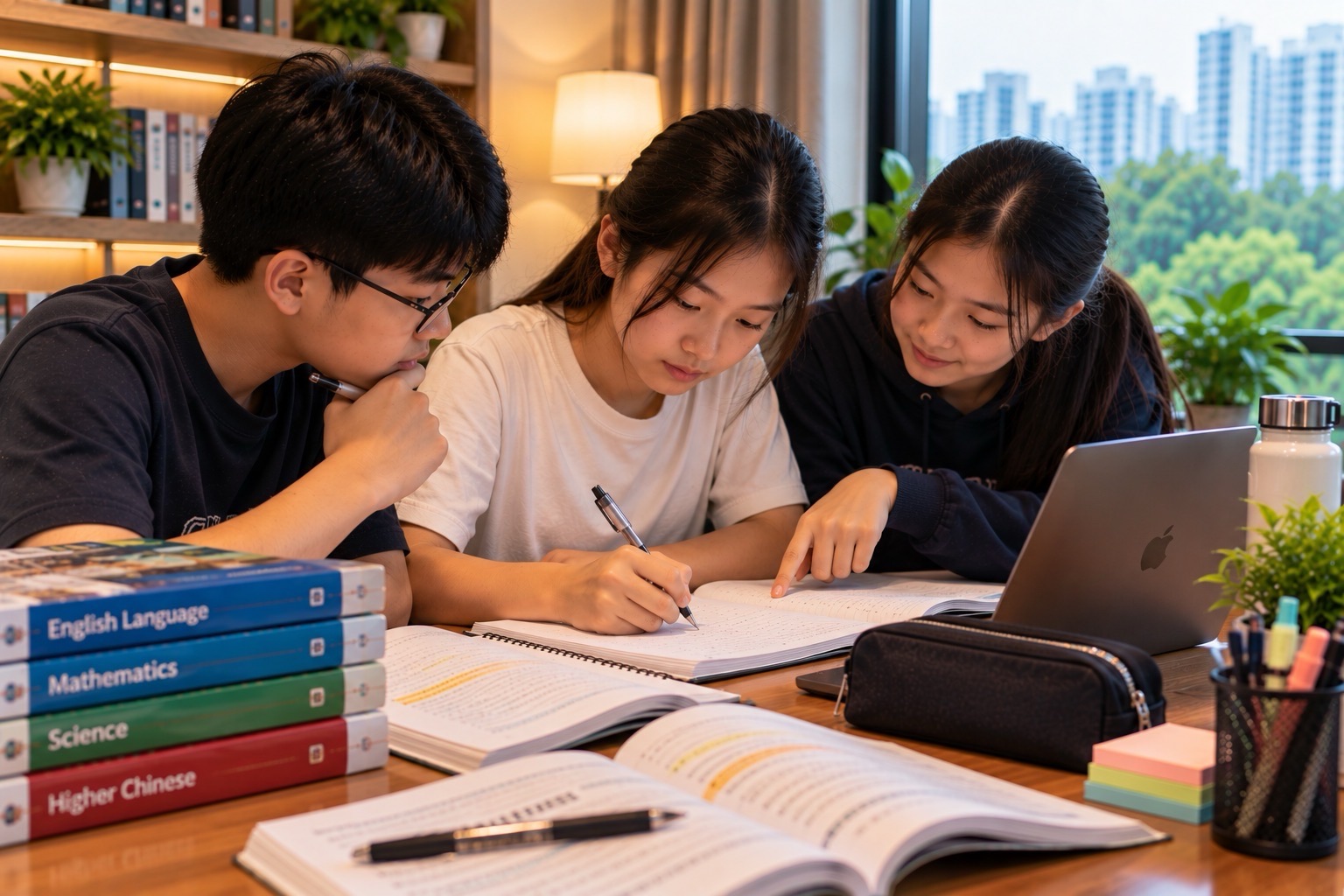
Three learners may examine one fictional forum prompt. One identifies the target audience, another proposes a relevant reason and a third checks which information the response must include.
However, every learner must then write an independent answer and receive feedback on the precise first point of difficulty.
In comprehension, the same group can locate a direct fact, infer a character’s attitude and challenge an unsupported claim before each pupil answers a changed passage alone.
The eduKate maximum-three-student, 1.5-hour teaching philosophy can support this close feedback when a suitably qualified Malay tutor and appropriate class are available. Families should confirm actual K221 specialist provision and timetable before booking.
Related Punggol resources include G2 Malay writing for audience and context, the context of unfamiliar vocabulary, developing distinct composition points, the G1 Malay K121 comparison and why eduKate uses three-student lessons.
Questions parents should ask before choosing tuition
- Has the school confirmed G2 Malay K221 rather than G1 K121 or G3 K321?
- Does the tutor know the 30% writing, 30% e-exam, 30% oral and 10% listening balance?
- Can the pupil distinguish informal forum writing from a formal email?
- Are the 100-word functional response and 200-word composition taught as different tasks?
- Does Paper 2 practice include both contextual language and free-response comprehension?
- Can the student explain textual evidence rather than invent a plausible answer?
- Does oral work include new video questions and follow-ups?
- Is every corrected skill assessed again in an unfamiliar independent task?
Frequently asked questions
How long is G2 Malay K221 Paper 1?
Two hours, with a 20-mark functional-writing section and 40-mark composition, totalling 60 marks and 30%.
Must the pupil write two texts in Paper 1?
Yes. The student answers one functional-writing question and one composition question.
Is Paper 2 handwritten?
The official 2027 syllabus identifies Paper 2 as an e-examination, requiring the school-authorised digital answer arrangements.
How is oral weighted?
Oral contributes 30%, with twenty marks for reading aloud and forty for conversation. Listening contributes another ten percent.
Does a G2 pupil have to write a 60-word online response like G1?
No. The G2 K221 functional task specifies at least 100 words, and its composition requires at least 200 words. G1 K121 uses a different shorter writing format.
The Punggol 2027 takeaway
G2 Malay K221 develops flexible written and spoken communication. Its real assessment asks a pupil to adapt between an audience-specific email or forum response, a coherent composition, computer-based comprehension and an unscripted video conversation. Good tuition teaches the learner to identify the question, express a reason and use evidence independently.
Official references: SEAB G2 Malay K221 2027 syllabus · SEAB SEC G2 2027 subject directory. Reviewed November 2026; later official and school instructions take precedence.


