
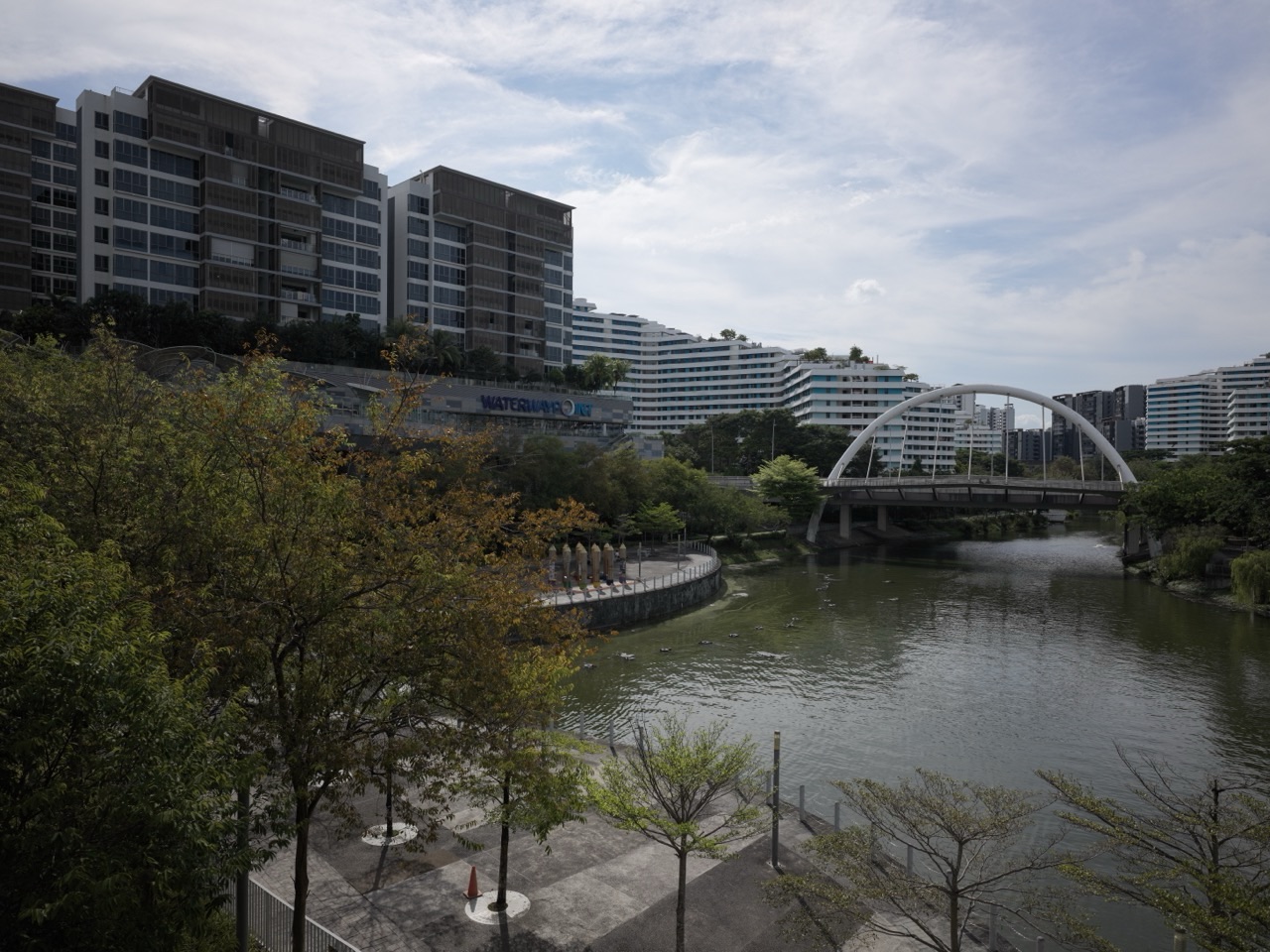
What to do in Punggol when a child notices that a path looks shady in the morning but sunny during another visit? Make a simple two-observation shade study from the same safe public viewpoint. Sketch the patch of shade you can see at one time, return at another suitable time if conditions allow, and compare how the shadow’s position and length appear to change. This is a practical way to learn that sunlight, trees, buildings and time all influence what a family experiences during an ordinary neighbourhood walk.
Punggol Waterway Park is a useful local context because NParks describes it as a large public park along Sentul Crescent Road, with paths, trees and themed spaces. But shade is not a fixed characteristic of a bench or pathway: the Sun’s apparent position changes, clouds move, and foliage can change. Singapore’s Meteorological Service also reports UV Index measurements from Changi, not a personalised UV reading for every shaded point in Punggol. The study should describe visible shadows without claiming to measure temperature or ultraviolet exposure.
This is a short supervised field-sketch exercise, not a recommendation to expose children to midday sun, a clinical heat assessment, a live shade map or a route-accessibility certification. Never stare directly at the Sun, damage a tree, mark a public surface or stand in a cycle lane to measure a shadow. Select a safe, comfortable place, use ordinary sun protection, consult current forecasts, and stop or complete the exercise indoors whenever needed.
Six steps for a safe two-observation shade study
- Choose a safe, legal viewpoint with ordinary shade, seating or a comfortable resting option.
- Check weather and heat conditions and keep all participants protected from excessive exposure.
- Draw the path and a stable, visible reference such as a bench, tree or railing.
- Sketch only the shadow that can be observed without looking towards the Sun.
- Repeat from a comparable point at another safe suitable time, recording conditions.
- Compare the diagrams with clear labels, and state what cannot be concluded.
The question is about changing shade, not finding the hottest place
A child may want to know why a bench felt sheltered during a morning walk but appeared exposed later. The activity starts with that manageable question. It does not require the family to experience the hottest hours or identify the single brightest place in the park.
Choose a sheltered viewpoint and limit the observation to a few minutes. The learner can describe shade that is visible from the chosen spot without walking into intense sun. A useful question can be answered with safe observation and still leave room for scientific discussion.
Pick an appropriate public location
NParks identifies Punggol Waterway Park as a public park extending along Sentul Crescent Road. A family can use an appropriate permitted path or resting point where trees and nearby built features create visible patterns of shade. The park’s exact conditions and access rules should be checked before a visit.
Do not create a special outing to a remote or obstructed location simply because the shadows there look dramatic. A familiar tree near a safe public path may provide sufficient material. The activity can also be completed in a home garden or another authorised private area.
The park connector is shared space
The Punggol Waterway Park Connector is described by NParks as an 8.4-kilometre route used by joggers, cyclists and visitors. A family making a drawing occupies space even when standing still. Choose a position outside the movement lane and leave the path clear.
Do not place a tripod, schoolbag or ruler across a cycling route or use the centre of a bridge as a classroom. If the preferred spot is crowded, switch to an appropriate resting place or complete the sketch from an existing photograph with known limitations.
A shadow study does not require the whole park
The 8.4-kilometre connector offers many views, but a comparison study works best with one recognisable place revisited. Walking the entire length would add travel and exposure without making the selected shadow observation more reliable.
Choose one small scene with a stable object, such as a railing or tree trunk, and a visible surface. The task is to compare the same scene at two moments, not count every shaded section of the corridor. A short scope makes the method teachable.
Use a stable reference point
A bench, fixed lamppost, tree trunk or existing public feature can help the learner relate the first sketch to the second. The reference must remain in the same place between observations. Do not move public furniture or attach markers to trees.
Write where the object sits in the drawing and which side of it the shadow appears on. If the family cannot use the same safe viewing position later, note that the comparison has an additional uncertainty. Drawing consistency matters more than perfect artistic accuracy.
Never look directly at the Sun
NASA’s Sun safety description warns against looking directly at the Sun without proper protection. This activity requires no direct viewing of the solar disc. Observe shadow patterns on safe surfaces, keeping the gaze away from the bright source.
Do not ask children to look up at the Sun to confirm its direction, even briefly. Do not use a phone camera, binoculars or improvised filters as an observing device. The entire learning objective can be achieved by studying shadows on the ground.
The Sun’s apparent motion explains a useful pattern
As Earth rotates, the Sun’s apparent position in the sky changes during the day, so shadows from stationary objects can shift in position and direction. A learner can observe this effect indirectly without measuring solar angles.
That does not mean every shadow change in a public park comes only from Earth’s rotation. Clouds, moving tree branches and the observer’s position can also change what is visible. A careful explanation considers these additional factors instead of using one idea to explain everything automatically.
The length of a shadow can change
When sunlight meets an object at a different angle, the object’s visible ground shadow may lengthen or shorten, subject to the surface geometry and other conditions. A child might notice a tree’s shadow reaches farther across a path during one observation.
Do not assign exact solar elevation or distance to a vague sketch. A shadow falling on uneven ground can appear distorted, and other objects may overlap it. Use qualitative language first, such as longer or shorter where the evidence is sufficiently clear.
Clouds affect the visibility of shadows
A sharply defined shadow may become faint when clouds scatter the sunlight, even if the object itself has not moved. That means a later sketch might show less contrast rather than a straightforward shift in position.
Record broad weather conditions with the observation. Do not interpret a weak shadow as proof that the Sun is directly overhead or that the ground is receiving no ultraviolet radiation. Cloud cover complicates both the visual result and outdoor exposure.
Moving leaves can produce changing patterns
Tree shadows can contain a shifting pattern of light and dark as branches and leaves move in the wind. A child may be tempted to trace every tiny leaf-shaped mark, but these may change before the drawing is completed.
Instead, sketch the broad shaded area and note that the edge moved or flickered. This is a good example of choosing a measurement scale appropriate to the question. The family wants the general pattern, not an impossible permanent outline of each leaf.
Buildings create a different kind of shade
A building or fixed wall can cast a broad shadow with a relatively clear boundary in some lighting conditions. Trees produce more irregular and often dappled shade. The family can compare the visual patterns without claiming one is universally safer or cooler.
Different materials, reflected light and airflow affect comfort. A shaded concrete wall may still radiate warmth, while an open tree canopy may admit sunlight. The sketch records what is visible, not a direct measurement of all environmental conditions.
A shade diagram is not a UV meter
Singapore’s NEA UV Index guidance explains that UV radiation can harm skin and eyes and provides protective advice. A visible shadow does not tell a person exactly how much UV reaches their skin from the sky and surrounding reflections.
Do not convert a dark patch into a zero-UV reading or claim that all shaded locations are completely protected. Wear appropriate sun protection and follow current health advice. The sketch is about geometry and observation rather than certifying exposure.
The official UV Index is regional context
NEA says Singapore’s UV Index is measured at the Changi Meteorological Station every 15 minutes between 7am and 7pm, with values that may vary across the island. Its categories describe exposure potential, not the exact UV intensity under a particular Punggol tree.
The official UV webpage has at times indicated temporary sensor unavailability. Never invent a current number when the service is offline. The family can plan with general sun-safety guidance and current notices rather than claiming that a field sketch supplied missing measurements.
Avoid unnecessary midday exposure
NEA’s public advice highlights the period between about 11am and 3pm when UV levels tend to be high. A shadow comparison does not require conducting the second observation during that interval. The family can choose other suitable times or work from permitted dated photographs.
Do not make an educational target more important than heat safety. If weather, exposure or a participant’s needs make outdoor work unsuitable, change the schedule or use a safe indoor demonstration. The science question remains valid even when a session is postponed.
Shade can improve comfort without proving a temperature
A person may feel more comfortable out of direct sunlight, but perceived comfort depends on humidity, airflow, activity, clothing and individual factors. A shadow sketch cannot determine the exact air temperature, radiant heat or heat-stress level.
Do not label a shaded bench ’25°C’ without a reliable appropriate measurement. A family may say it felt more comfortable, identifying that as a subjective response. Official heat-stress assessments require different information and methods.
Understand WBGT as a separate heat measure
NEA’s heat-stress advisory guidance explains wet-bulb globe temperature, which incorporates factors such as temperature, humidity and radiant heat. It is not the same as air temperature or visible shadow coverage.
This distinction matters when a child asks why a shady place can still feel oppressive in humid weather. The study does not measure WBGT, and the family should use current public advisories rather than pretend a shadow-length calculation predicts personal heat risk.
Plan water, rest and a short activity
A supervised short observation should include appropriate hydration and rest, particularly when participants have different ages or comfort needs. The family can complete the study in a few minutes and continue only if conditions remain suitable.
Do not impose an arbitrary requirement to stand still through discomfort. A younger child may need to leave or sit down, and another participant may prefer to avoid outdoor heat entirely. Scientific curiosity should remain compatible with ordinary wellbeing.
Do not trace shadows on public surfaces
Chalk, paint, permanent markers or adhesive tape on a public pathway can affect cleanliness, create obstruction or damage property. This activity can record shadow outlines entirely on paper or a tablet without modifying the ground.
Use a sketch with the reference object in the same place each time. If precise drawing is difficult, a few words such as ‘shadow reached halfway to railing’ can serve as observations. Public infrastructure is not a classroom whiteboard.
Do not attach anything to a tree
Trees and their roots are living parts of the park environment. A family should not nail, tie or stick measuring markers to trunks or branches for a temporary lesson. Nor should children climb a tree to obtain a new viewing angle.
Use existing visible features or a paper reference instead. The goal is to notice how the shadow behaves without changing the object or place. A responsible outdoor activity leaves no new damage or materials behind.
Choose a safe viewing direction
A shadow may stretch towards the edge of a path or open water. The family does not need to follow it to its far end to make a note. Choose an angle where the ground pattern is visible from an authorised stable surface.
Never step into a roadway, over a rail or down an embankment to capture the full outline. If the shadow extends beyond the safe observation area, mark that its end is out of view. An incomplete sketch can still represent the evidence accurately.
Watch for cyclists and moving vehicles
A child focused on a shadow may forget about people moving behind them. Use a location clear of the main circulation path, with adult supervision. Crossing a shared route should be treated as a separate safety action, not something done while staring at a notebook.
Do not position bags or equipment in a cycling lane or near a construction vehicle gate. If the area becomes crowded, relocate or stop. This is a study of visible light and shade, not a test of how long a family can occupy a busy path.
The first observation needs a clear record
Write the date, approximate time, general public location, weather conditions and reference object. Draw the visible object and shade boundary as best you can. Add a note about anything uncertain, including whether the shadow is partly hidden by another object.
Do not invent exact coordinates or a minute-by-minute weather log after the visit. A simple honest record is sufficient. Its main purpose is letting the second observation be interpreted against the first.
The second observation needs comparable conditions
When returning, use the same safe public viewpoint and reference object where practicable. Note the new date and time separately. If cloud cover is very different, the comparison may still be useful, but the family should explain why the shadow’s visibility may have changed.
Do not claim that a changed sketch proves a particular solar angle unless the method supports it. The family can report that the shaded area seemed to shift relative to the bench or path. That is an appropriate qualitative result.
Two different days add uncertainty
A family may be unable to revisit the spot on the same day. Comparing observations across different dates can reveal changes, but the Earth’s seasonal position, weather, foliage and other conditions may differ. The family should record these factors instead of assuming only time of day changed.
For a beginning student, this is an excellent lesson in fair comparisons. If several conditions vary, the result should be described cautiously. A school exercise need not isolate every variable perfectly to teach why limitations matter.
Use a short diagram legend
A solid shape can represent the tree or bench, a pale region the observed shade, and a dashed outline an uncertain boundary. Label the two observations with their times and explain what each symbol means. A reader should not need the author present to decode the picture.
Do not use a colour to imply measured UV or temperature unless there is a proper underlying measurement. The drawing is a visual representation of where shade was observed, not a heat map or scientific hazard rating.
The difference between measured and described distances
A child might say that a shadow looks about twice as long in one sketch. If the drawing is not to scale, that comparison may only be an impression. The author should say longer in the second observation unless a valid measurement was actually made.
A ruler on paper can measure the sketch itself, but not the real-world shadow automatically. To claim actual metres, the family would need a safe, appropriate field method and a reliable scale. For this activity, qualitative comparison is enough.
Do not measure a shadow by walking into an unsafe area
The safest way to describe a large shadow may be to relate it to a fixed visible landmark, such as a bench leg or the edge of a permitted paved area. If it extends across a roadway or near water, stop the physical check at the safe boundary.
An adult should not encourage children to take risks for a tidy number in a table. A good scientific record includes the limit of the observation. The words ‘end not visible from safe position’ can be more accurate than a guessed full length.
A fictional two-time example
Imagine a practice sketch of a tree beside a public path. At an earlier observation, the shadow extends across part of the path. At another observation, it lies more along the path’s edge. The two drawings use the same tree trunk as a reference.
This is a hypothetical learning example, not a report from a particular Punggol tree. A careful conclusion says that the apparent shadow direction changed between the observations. It does not claim a specific UV reduction, shade duration or permanent safe seating location.
A fictional cloudy-day example
A child observes a clear bench shadow on one visit and no distinct bench outline on a second, overcast visit. The first draft says the Sun must have disappeared and there was no UV. The evidence does not support either conclusion.
A better note says that the shadow became less distinct under cloudier conditions, making direct comparison difficult. The family can learn how diffuse light affects visual patterns without making an incorrect claim about the Sun’s presence or health risk.
A fictional building-and-tree comparison
A student notices that a tree produces dappled shade while a wall creates a broad, darker area in the scene. They draw both and explain the differences in the visible patterns. The sketch does not establish which location is cooler in every condition.
Ask what additional evidence would be required to compare comfort or temperature reliably. The learning outcome is recognising that shadow geometry and thermal conditions are related but not identical. The family does not need to purchase sensors to understand that distinction.
A parent may already have useful dated photographs
If returning to the same spot is inconvenient, a family may own two images taken from a comparable position on different occasions. They can investigate the visible shade as a document-based activity, provided the image dates and views are sufficiently clear.
Do not pretend the photographs are controlled measurements or fill in missing capture times from memory. An image can still teach why shadows change while leaving the comparison’s exact timing uncertain. Protect private people and copyright when using photographs.
The role of surrounding buildings
Urban landscapes create changing shade through building height, orientation, canopies and setbacks. In Punggol, residential towers and public structures can affect how a pathway looks at different hours. A child’s drawing can show the relative position of a tree and nearby building without claiming a full solar simulation.
Do not infer property boundaries, legal access or engineering performance from the sketch. A building shadow may extend into a public space, but the observer still follows current site and path rules. The study describes light, not land ownership.
Shade can change as trees grow
A tree that provides limited canopy shade today may grow and change its form, while pruning or weather can alter the visible foliage. That means a photograph taken several years ago cannot always serve as a reliable present shade guide.
Do not assume tree growth rate, species or pruning schedule from one snapshot. If the family is curious about the actual tree, appropriate NParks sources may help, but the shadow study can remain useful without identifying every plant.
A map of shade is not an accessibility assessment
A shaded path may still have slopes, uneven paving, steps or temporary barriers. The family should not label it universally wheelchair-friendly or suitable for every senior simply because the sketch shows a large canopy.
NParks publishes broad accessibility information for its parks, but an individual’s actual needs and current conditions require separate checks. A safe route for a pram or mobility aid should not be inferred from a sunshine drawing alone.
A broad map is not a live travel forecast
An observation made at one time does not guarantee the same shade will be present on the next visit. Time of year, weather, foliage and surrounding work can change. Avoid sharing a permanent recommendation that a particular bench is always shaded at noon.
A practical outdoor plan uses the latest forecast, available shelter and an alternative if conditions differ. The family may find a sketch informative without making it a promise of comfort or safety.
Primary Science: describe the change
A Primary pupil can label a light source, an object and the shadow visible on the ground in a conceptual drawing. Then they can compare the observed positions at two times and explain that shadows can change as the apparent direction of sunlight changes.
Do not require direct solar observation or advanced calculations. Ask the child what the picture actually shows and which additional factors may have changed. A simple accurate explanation is better than memorising a complicated formula.
Primary Mathematics: order time and direction
A child can place the two observations in chronological order and describe longer, shorter, nearer or farther relationships. If the family records times on the same day, it can calculate the interval between them without needing to measure solar angles.
The learner should not use clock arithmetic to invent a rate of shadow movement when the sketch lacks a consistent scale. State which quantity is known and which is not. This is a useful lesson in choosing valid operations.
Secondary Science: identify variables
An older student can discuss independent and dependent variables for a better-controlled shadow study. Time of observation may be deliberately varied, while the reference object and viewing position are kept as consistent as practical. Cloud cover and movement of branches can interfere.
Students should record those limitations rather than claim an ideal laboratory experiment in a busy park. They can propose how a future authorised investigation would improve reliability without installing equipment or occupying public paths.
Secondary Geography: built form and microclimate
Shade is one aspect of urban outdoor experience alongside wind, materials, vegetation, humidity and heat. A Punggol path with nearby buildings may have different visual shade at different times from an open waterfront promenade. Geography learning begins by recognising these multiple influences.
Do not conclude that a shaded corridor is automatically lower in heat stress or more sustainable without appropriate evidence. The sketch can identify a question about urban design, then consult authoritative planning and environmental information to investigate it.
English learning: precise location sentences
The learner can write: ‘At the first observation, a broad tree shadow extended towards the path. At the second, its visible edge lay closer to the seating area.’ Such sentences require clear subjects and time references.
Do not replace precise everyday language with exaggerated claims such as ‘the entire park became a furnace’. A descriptive passage can still be engaging while remaining accurate. Good writing lets another reader understand what changed and what the author saw.
A family comparison should welcome different experiences
One person may feel comfortable in a shaded location while another prefers an indoor break. Different ages and health circumstances can influence outdoor needs. The family should not treat the sketch as proof that everyone ought to tolerate the same exposure.
Ask each participant what is comfortable and provide legitimate alternatives. A person who declines the outdoor study can help review the sketches later. Inclusion does not require making everyone stand at the same spot or reveal private health information.
Heat-related symptoms end the activity
If anyone develops concerning heat symptoms or feels unwell, stop the fieldwork, move to a suitable cooler place and follow appropriate health guidance. The need to protect people overrides completing the second observation.
Do not continue a science exercise as a way to test how much heat somebody can withstand. The activity is about observing shadows safely, not deliberately producing heat stress. Serious symptoms warrant prompt medical attention.
Use current weather sources before both observations
MSS publishes current conditions and short-range forecasts through its weather portal. The information can help families decide whether an outdoor visit is sensible. A forecast is not a guarantee that the precise Punggol spot will remain dry or comfortable.
If rain or lightning becomes a concern, abandon the fieldwork and use a safe alternative. Do not rush to finish a drawing after a warning because the earlier observation is already recorded. A good experiment can be postponed or cancelled.
A public park being open 24 hours is not a safety instruction
NParks lists Punggol Waterway Park as open 24 hours. That describes its normal operating schedule, not a recommendation for children to conduct an observation alone at night or a guarantee every route remains open during maintenance.
Choose appropriate daylight, supervision and weather conditions. A shadow experiment specifically needs suitable light and visible ground features. Do not infer that published park hours make every secluded place safe at every hour.
Why no chalk or measuring poles are needed
Permanent marks, physical installations and improvised equipment can obstruct or damage shared areas. A paper sketch, short note and existing visual reference are sufficient for the learning objective. The family does not need to create a miniature survey site.
This approach also helps students understand that the best measurement method is not always the most elaborate one. Choose the simplest safe method that supports the question. Where the question requires more precision, state that a separate approved investigation would be necessary.
The four-line record
Use one line for when and where the study happened, one for the reference object, one for the visible shadow position, and one for the conditions or uncertainty. Repeat the same four lines for a second observation. Keep any photographs optional and privacy-safe.
The format is short enough for a family outing but structured enough to check. If a line is unknown, write unknown. A blank or qualified field is better than inventing exact temperatures, UV numbers or distances merely to make the worksheet look complete.
Compare without forcing a verdict
Place the two drawings side by side and ask what actually changed. A longer shadow, different direction or blurrier boundary can be recorded. Then identify which other conditions might explain or complicate the result.
Do not demand that the second drawing be dramatically different. If the sketches look similar, the learner may have sampled times close together, experienced cloud cover or made an imprecise observation. The result can lead to a better question without requiring a fabricated discovery.
The final result is a safe explanation
A successful Punggol shade study has two labelled sketches or notes, a stable visible reference, a comparison of what changed and an honest limit about what was not measured. It helps a child understand the apparent movement of sunlight without ever staring at the Sun.
The family can reuse the method at another authorised place when conditions suit it, but should not publish a permanent heat-safety map based on two observations. The lasting habit is to learn from visible evidence while protecting people, nature and shared public spaces.
Continue exploring Punggol
These companion guides cover three different practical Punggol activities. Check the relevant official sources and current conditions before using their information for a real decision.
- Make a Ten-Minute Soundscape Map Without Recording Strangers
- Read a Construction Notice Without Mistaking Work Dates for Opening Dates
- Compare a Refrigerator Energy Label Without Mistaking Ticks for Dollars
Frequently asked questions
Do children have to look at the Sun?
No. Never look directly at the Sun. Observe shadows on safe ground surfaces, away from the bright source.
Where is a suitable Punggol location?
An authorised, comfortable part of Punggol Waterway Park or another safe familiar location where visible shade can be sketched.
Must we visit at midday?
No. Choose suitable safe times or use appropriately dated images. Do not increase UV or heat exposure simply for an experiment.
Can clouds change the shadow?
Yes. Diffuse light can make shadow edges less distinct, complicating a comparison.
Does a dark shadow mean zero UV?
No. Visible shade does not measure ultraviolet exposure or eliminate the need for appropriate sun protection.
Where is Singapore’s UV Index measured?
MSS and NEA say the UVI is measured at Changi, with observations that can differ elsewhere.
Does the UV page always show live values?
Not necessarily. The official site may report sensor maintenance. Never invent a current reading.
Is shade the same as cool air?
No. Heat comfort depends on humidity, airflow, radiation and other factors as well as visible shade.
What is WBGT?
Wet-bulb globe temperature is a heat-stress measure using multiple environmental factors, not a value derived from a shadow drawing.
Can we chalk an outline on a public pathway?
Do not mark or alter public surfaces. Sketch on paper or a permitted personal device.
Can I attach a ruler or marker to a tree?
No. Use existing features and do not damage vegetation or place equipment in shared routes.
Does an 8.4-km park connector require an 8.4-km study?
No. NParks describes the full Punggol Waterway connector length, but one safe small location is enough.
Can the second observation be on another day?
Yes, with more uncertainty due to weather, season and changed conditions. Label the difference.
Can two hand sketches establish an exact solar angle?
No. They support qualitative observation unless a properly designed measurement method is used.
What if a child feels hot or unwell?
Stop, seek suitable shade or cooler conditions and follow appropriate medical guidance when needed.
Is a shaded route guaranteed wheelchair-accessible?
No. Shade does not establish gradients, steps, closures or specific accessibility conditions.
Can we use old family photographs?
Yes, if legitimately used with relevant date and viewpoint information, while acknowledging their limitations.
What should the final record show?
Two labelled observations, a stable reference, a clear comparison and uncertainty about unmeasured factors.
Can we predict tomorrow’s perfect shady bench?
Not reliably from two sketches. Weather, time, foliage and other conditions may change.
What is the key lesson?
Shadows change as the geometry of sunlight and surroundings changes, but observations must remain safe and appropriately qualified.
Official sources and related Punggol activities
- NParks: Punggol Waterway Park official visitor guidance
- NParks: Punggol Waterway Park Connector, 8.4 km context
- NParks: sharing park connectors and no-riding sections
- NEA: ultraviolet index, locations and sun-protection measures
- MSS: UV Index portal and possible sensor maintenance
- MSS: local forecasts and observations
- MSS: weather forecast and observation FAQ
- NEA: heat stress and WBGT explanation
- NASA: Sun safety and direct viewing warning
- eduKate Punggol: considerate public-space habits
- eduKate Punggol: evidence-based public art observation
- eduKate Punggol: supervised nature soundscape activity
Editorial check: 1 November 2026. This is a qualitative supervised shadow observation, not a UV measurement, WBGT heat-stress assessment, calibrated temperature survey or live accessibility and shade map. The fictional examples are not claims about actual observations at a named Punggol bench. Never look directly at the Sun or mark public surfaces, and always prioritise current weather, sun protection, children’s comfort and public-path rules.


