
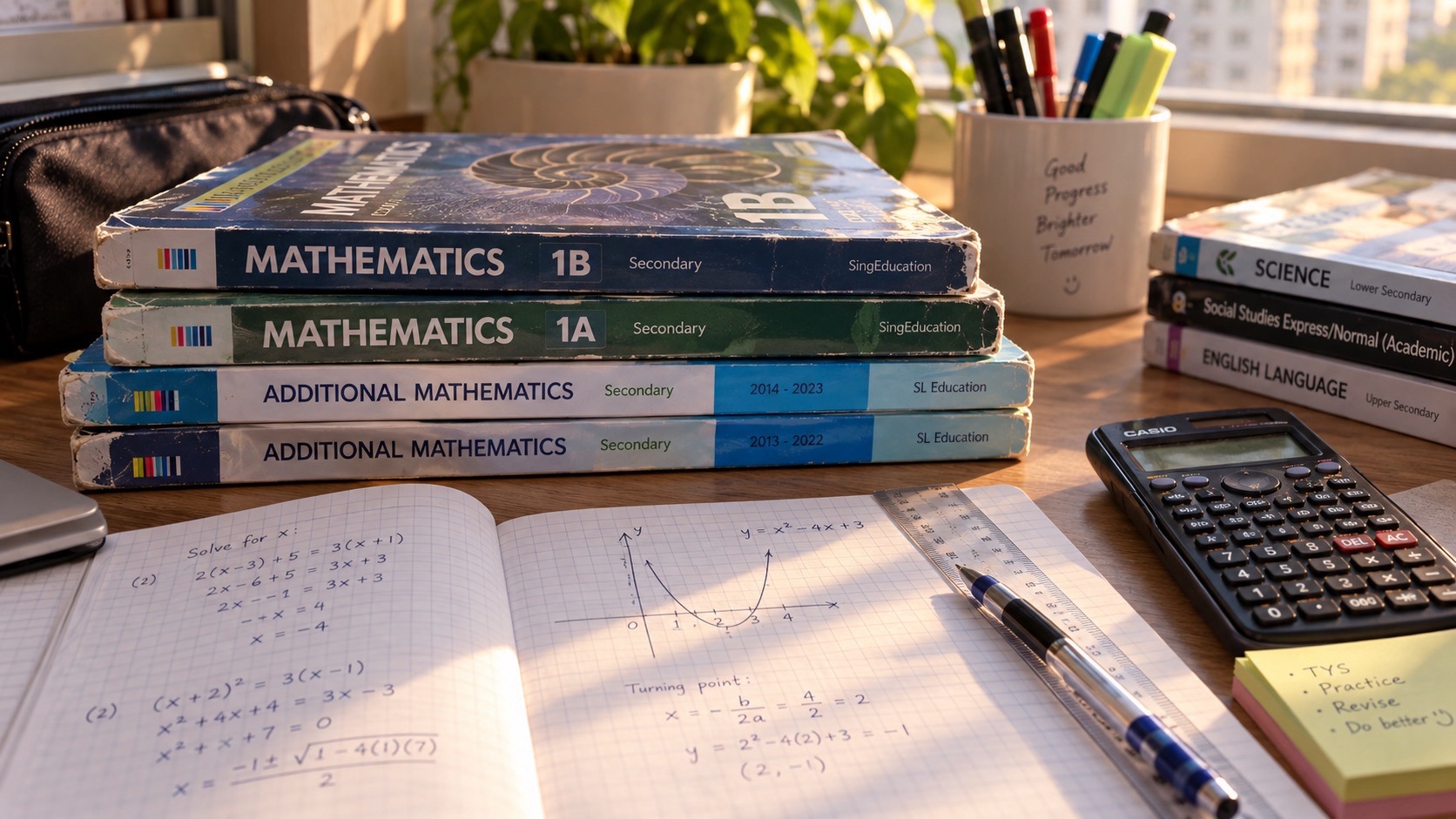
PG3 means Posting Group 3, the Secondary 1 school-admission route that generally starts most subjects at G3 under Singapore’s Full Subject-Based Banding (Full SBB). It does not mean a pupil is automatically confident with every Geometry question. For Punggol families, the important transition is learning to read diagrams correctly, explain angle relationships, distinguish perimeter from area, interpret units and scale, and reason about shapes rather than guessing a formula from their appearance.
MOE’s G2/G3 Mathematics syllabus for Secondary One to Four includes Geometry and Measurement alongside Number and Algebra and Statistics and Probability. Topics include angles, triangles, polygons, congruence, similarity, mensuration and coordinate geometry, with the sequencing and assessment expectations guided by the receiving school. This article teaches the underlying thinking through worked examples and local everyday contexts without claiming that every named topic is taught in Secondary 1 or that PG3 automatically qualifies a pupil for Additional Mathematics.
- PG3 is the posting group; G3 is the level of a subject under Full SBB.
- Identify the shape, quantities, units, conditions and angle markings before calculating.
- Basic angle relationships include a straight line of 180°, a full turn of 360° and a triangle sum of 180°.
- Perimeter measures boundary length; area measures surface; volume measures three-dimensional space.
- Use diagrams as mathematical evidence, not decoration or proof that a figure is drawn to scale.
- Scale drawings, coordinates, congruence and similarity need careful distinction and may be taught at different points.
- Check every result using units, estimates, an alternate method or a valid geometric property.
- Use official MOE G3 Mathematics guidance and the actual school’s teaching sequence for the relevant cohort.
Definition lock: the measurements students must distinguish
| Quantity | What it describes | Unit example | Common mistake |
|---|---|---|---|
| Angle | Amount of turn between rays | Degrees | Guessing from a sketch |
| Perimeter | Length around boundary | m | Using area units |
| Area | Enclosed surface | m² | Counting interior lines as boundary |
| Volume | Space occupied by a solid | cm³ | Forgetting the third dimension |
| Scale | Ratio of represented to real length | 1:200 | Mixing units or route distance |

Guide chapters
- Why a strong PSLE score does not settle Geometry readiness
- Definition lock: geometry, measurement and spatial reasoning
- A geometry diagram is not necessarily drawn to scale
- Angle types must be recognised without confusion
- Straight lines and full turns are foundational
- Vertically opposite angles are equal for a reason
- Parallel lines create several distinct angle rules
- Triangle angle sum and special cases
- Exterior angles of triangles need proper interpretation
- Polygons connect patterns to general rules
- Perimeter is a boundary measurement
- Area measures a region rather than its edge
- Triangle area requires a perpendicular height
- Composite figures require decomposition
- Area-unit conversion is not length conversion
- Volume brings the third dimension into view
- Nets help students mentally fold a solid
- Congruence and similarity are different relationships
- Coordinates describe location with an agreed order
- Scale drawings link Mathematics to real spaces
- Symmetry reveals properties without measurement
- A geometry proof explains the link between statements
- How to check an answer without redoing the same error
- A four-week Geometry foundation plan for Punggol
- What to ask about the actual school’s Mathematics teaching
Why a strong PSLE score does not settle Geometry readiness
Many pupils leave Primary 6 able to recognise familiar figures and substitute values into formulas. Secondary Geometry places greater emphasis on explaining why a relationship holds. A student may correctly remember that triangle angles total 180 degrees yet struggle when the triangle is drawn inside another shape and the unknown angle is not labelled clearly. That is a reasoning gap rather than simply a memory gap.
Two students with the same PSLE total may have very different mathematical profiles. One reads diagrams carefully but works slowly. Another calculates rapidly and overlooks a perpendicular sign or an extension of a straight line. The correct preparation addresses the particular difficulty. Spending hours on random geometry worksheets may simply rehearse the same misconception.
Start with a question the child has not seen before. Ask what information is given, what can be inferred without measurement, and which relationship supports the next step. The ability to explain that chain matters more than completing a page quickly.
Definition lock: geometry, measurement and spatial reasoning
Geometry studies shapes, positions, relationships and properties. Measurement assigns numerical quantities to features such as length, angle, area or volume. Spatial reasoning involves visualising and transforming relationships between objects. These areas overlap but are not identical. A pupil can draw a cube well yet misunderstand its volume, or calculate a rectangle’s area without appreciating how its shape changes.
A good question therefore begins by identifying the type of reasoning required. Is the unknown an angle justified by a property, a length derived from dimensions, or a measure of space? A student who identifies this correctly is much less likely to choose an irrelevant formula. Words and units tell part of the story.
Parents can help by asking the pupil to explain what is being measured in ordinary language. The answer should distinguish a side from the enclosed region and a flat surface from a solid object.
A geometry diagram is not necessarily drawn to scale
Students often assume that a line that looks longer must have a larger value. In examination diagrams, this may be false unless the question states that the figure is drawn to scale or provides a reliable measurement method. A sketch conveys relationships, not necessarily exact lengths or angles. Mathematical evidence comes from labels, markings and stated properties.
Suppose a triangle looks almost isosceles but has no equal-side markings and no relevant measurements. The student cannot conclude that two sides are equal merely because they appear similar. Similarly, a drawn right angle should not be assumed without an appropriate right-angle symbol, a given relationship or valid deduction.
Teach the child to circle guaranteed information and write ‘not given’ beside a visual impression that cannot be justified. This small distinction prevents many avoidable errors.
Angle types must be recognised without confusion
Acute angles are smaller than a right angle, obtuse angles are larger than a right angle but smaller than a straight angle, and reflex angles exceed a straight angle while remaining below a full turn. A pupil should recognise these concepts in different orientations. A shape turned sideways does not change its angles.
Ask the student to classify an angle of 35 degrees, 90 degrees, 145 degrees and 270 degrees. The answers are acute, right, obtuse and reflex respectively. Then ask them to sketch examples with each angle opening in an unfamiliar direction. Orientation changes should not change the classification.
A useful check is to visualise the entire 360-degree turn. The learner can estimate whether an answer is plausible before reaching for a calculator.
Straight lines and full turns are foundational
Adjacent angles forming a straight line sum to 180 degrees. Angles around a point sum to 360 degrees. These facts are simple, but their application can become complicated when several rays meet or labels appear in a crowded diagram. The learner must identify precisely which angles form the required line or full turn.
For an original example, imagine two adjacent angles on a straight line measuring 68 degrees and x degrees. Then x = 180 − 68 = 112 degrees. If three angles around a point are 90, 125 and x degrees, x = 360 − 90 − 125 = 145 degrees. The working should name the property, not merely display subtraction.
After solving, ask the pupil whether the answer fits the drawing qualitatively. An answer of 300 degrees for a small adjacent angle on a straight line is immediately inconsistent with the stated property.
Vertically opposite angles are equal for a reason
When two straight lines intersect, the opposite angles are equal. This follows from the relationships between adjacent supplementary angles. Students sometimes memorise the rule but apply it to any angles that happen to sit opposite one another in a complicated drawing. The equality applies to the specific intersection configuration.
Imagine two intersecting straight lines where one angle is 47 degrees. The vertically opposite angle is also 47 degrees, and each adjacent angle is 133 degrees. The second result follows from 180 − 47, not from a false assumption that all four angles at an intersection are equal.
Encourage the learner to mark the actual lines being extended. The explanation is stronger when they can identify the geometrical structure instead of pointing at a pair of angles and saying they look opposite.
Parallel lines create several distinct angle rules
With two parallel lines crossed by a transversal, students encounter corresponding, alternate and interior angle relationships. These are not all the same statement. Some angle pairs are equal, while a relevant pair of co-interior angles sums to 180 degrees. The configuration and parallel condition matter. A transversal crossing nonparallel lines does not automatically produce the same properties.
Ask the student to identify the pair type before calculating. If alternate interior angles measure 62 degrees and x degrees in an appropriate parallel-line configuration, then x = 62 degrees. If co-interior angles are 62 degrees and y degrees, then y = 118 degrees. A clearly labelled sketch is essential to distinguish these examples.
A useful teaching strategy rotates the entire diagram or changes the position of the unknown angle. The pupil should still identify the same property. This tests understanding instead of a memorised picture.
Triangle angle sum and special cases
Every Euclidean triangle has interior angles totalling 180 degrees. An equilateral triangle has three equal angles of 60 degrees, while an isosceles triangle has equal base angles opposite equal sides. A right triangle contains a 90-degree angle, so its other two angles total 90 degrees. These are different properties and should not be applied interchangeably.
If a triangle contains angles of 37 and 82 degrees, its third angle is 61 degrees. If an isosceles triangle has a vertex angle of 40 degrees, each base angle is 70 degrees. These simple calculations become meaningful when the learner explains why the equal-angle condition follows from the equal-side condition.
Encourage the child to write the property beside the calculation. A bare number can conceal whether the pupil made a valid deduction or guessed the shape.
Exterior angles of triangles need proper interpretation
An exterior angle is formed when a side of a triangle is extended. It equals the sum of the two opposite interior angles in Euclidean geometry. The rule is useful, but students should understand how it relates to the adjacent straight-line angle and the triangle’s 180-degree interior sum.
Suppose two remote interior angles are 52 degrees and 67 degrees. The corresponding exterior angle is 119 degrees. The adjacent interior angle is then 61 degrees because it forms a straight line with the 119-degree exterior angle. This offers two independent checks using consistent properties.
Ask the pupil to explain which angle is exterior and which two interior angles are remote. Confusion over labels is usually more important to repair than arithmetic speed.
Polygons connect patterns to general rules
A quadrilateral has an interior angle sum of 360 degrees. More generally, a convex polygon with n sides has an interior angle sum of (n − 2) × 180 degrees. The formula can be understood by dividing the polygon into n − 2 triangles from one vertex, rather than merely memorising it as another expression.
A convex pentagon therefore has an interior angle sum of 540 degrees. A regular pentagon has equal interior angles of 108 degrees, because 540 divided by five is 108. The regularity condition matters: an irregular pentagon still has the same total, but its individual angles need not be equal.
Ask the child to draw a convex polygon and show the triangles that justify the total. This turns a symbol into a structural explanation and prepares the learner for unfamiliar configurations.
Perimeter is a boundary measurement
Perimeter counts length along the boundary of a two-dimensional shape. Its units are linear: centimetres, metres and so on. A rectangular region measuring eight metres by five metres has perimeter 2 × (8 + 5) = 26 metres. The formula is useful because it reflects two lengths and two widths, not because it is a phrase to memorise mechanically.
On a compound shape, a student may accidentally include an internal dividing line that is not part of the outside boundary. Ask the pupil to trace the boundary once without lifting a finger, identifying the segments being counted. This often reveals the error before calculation.
An estimate helps. If a figure is roughly the size of a small classroom plan, a result measured in square metres for perimeter signals a unit error immediately.
Area measures a region rather than its edge
Area measures the amount of surface enclosed by a boundary and uses squared units. The same eight-by-five-metre rectangle has area 40 square metres. It is possible for two shapes to share the same perimeter while having different areas, or share the same area while having different perimeters. The quantities answer different questions.
One way to test understanding is to compare rectangles measuring six by four and eight by three units. Their areas are both 24 square units, but their perimeters are 20 and 22 units respectively. If the child can explain why, the two ideas are becoming distinct.
Parents should avoid teaching that ‘area is always multiply’ as a universal shortcut. Complex shapes, triangles and other figures require geometrically justified calculations.
Triangle area requires a perpendicular height
The area of a triangle is one-half times a base times its corresponding perpendicular height. The height is not automatically any visible sloping side. It must be perpendicular to the selected base or the line containing that base. A student who chooses the wrong segment may compute a plausible-looking but invalid area.
Consider a triangle with a horizontal base of 10 centimetres and a perpendicular height of six centimetres. Its area is 30 square centimetres. If the only other labelled side is eight centimetres but it is not perpendicular, substituting eight for the height would be an error.
Ask the pupil to mark a small right angle where the height meets the base. The symbolic calculation becomes much more reliable after this geometric check.
Composite figures require decomposition
An L-shaped region can be divided into rectangles whose areas are calculated separately, or handled by subtracting a missing rectangle from a larger one. Both methods can be correct. The student should identify which lengths are known and ensure that no region is counted twice or omitted.
Imagine a large rectangle measuring 10 by 8 metres with a 4-by-3-metre rectangular corner removed. The remaining area is 80 − 12 = 68 square metres. The alternative decomposition should yield the same result if the figures are partitioned correctly. This cross-check is more useful than simply remembering a new L-shape formula.
Parent questions should focus on the pieces. Which area is being included? Which is excluded? How do we know the pieces cover the original figure exactly?
Area-unit conversion is not length conversion
When lengths are converted, the conversion factor applies once; when areas are converted, the linear factor is squared. As one metre equals 100 centimetres, one square metre equals 10,000 square centimetres. Confusing these produces a common but conceptually serious error. A student who writes 1 m² = 100 cm² has applied the length conversion to an area.
Draw a one-metre square with each side labelled 100 centimetres. Its area is 100 × 100 = 10,000 square centimetres. The diagram explains why the factor is squared. The same reasoning extends to volume, where a cubic conversion involves three dimensions.
A child who can reconstruct the factor from a picture no longer needs to rely on a fragile memorised number.
Volume brings the third dimension into view
Volume describes the space occupied by a three-dimensional solid. A cuboid with dimensions four, three and two centimetres has volume 4 × 3 × 2 = 24 cubic centimetres. Its surface area is a different measurement referring to the areas of the faces. The two must not be confused simply because both involve multiplication.
Ask the learner to distinguish packing a box from covering its outside. The amount the box can contain is related to volume, while covering the sides concerns surface area. These everyday contexts are useful but need careful wording when actual containers have wall thickness or irregular shapes.
Draw a simple net for a cuboid and ask which quantities correspond to faces and which to the enclosed solid. Visualisation strengthens the meaning of the formulas.
Nets help students mentally fold a solid
A net is a two-dimensional arrangement of faces that can fold into a three-dimensional solid when compatible. Students need to imagine where faces meet, which edges coincide and whether the proposed layout can close without overlap. A drawing can look plausible yet fail to form the intended object.
Use six appropriately arranged squares to discuss a cube net, then ask which faces would become opposite after folding. Students may find it useful to visualise the folds or use a safe paper model. The activity is reasoning practice rather than an instruction to construct unfamiliar equipment or buy special materials.
The learner should explain why a face arrangement works. This ability transfers to packaging design, construction drawings and later spatial questions.
Congruence and similarity are different relationships
Two plane figures are congruent when they have the same shape and size under appropriate rigid transformations. Similar figures have the same shape but may differ in size by a consistent scale factor. Every pair of congruent figures is also similar, but a pair of similar figures need not be congruent. The distinction matters in scale drawings and shape problems.
Suppose one triangle has corresponding side lengths three, four and five, while another has six, eight and ten. The corresponding sides share a scale factor of two, so the triangles are similar; they are not the same size. Their perimeters scale by two, while their areas scale by four. Those differences are structural rather than arbitrary rules.
Schools may introduce these concepts at different points in a multi-year syllabus. Parents should use them as understanding targets, not claim that every PG3 pupil studies the full topic immediately in Secondary 1.
Coordinates describe location with an agreed order
Coordinates use numerical positions relative to axes. In a standard Cartesian plane, the pair (x, y) specifies horizontal position first and vertical position second. Reversing the order can move a point to a completely different location. Students should read the axis labels and scale rather than assume every diagram uses identical intervals.
For a point at (3, 2), the pupil moves three units along the x-axis and two along the y-axis, in the usual orientation. The point (2, 3) is different. A child can draw both and explain the role of the ordered pair before connecting this to more advanced graph ideas.
Coordinate geometry and gradient relationships appear in broader G3 Mathematics study. The exact timing depends on the school’s programme and should not be assumed from a general guide.
Scale drawings link Mathematics to real spaces
Scale diagrams can represent layouts, models or maps where one length corresponds to a different actual length. A scale of 1:200 means one unit in the drawing represents 200 of the same units in the corresponding real dimension. If a drawing shows a four-centimetre segment, its real length is eight metres, provided the representation is a true scale drawing.
The student should convert units only after understanding the relationship. Four centimetres multiplied by 200 gives 800 centimetres, which is eight metres. A wrong result may come from a conversion error rather than misunderstanding the scale itself.
Local Punggol walks provide familiar discussion contexts, but a real route length is not automatically the straight-line distance shown on a diagram. Teach the distinction between mathematical representation and the actual journey.
Symmetry reveals properties without measurement
A shape has line symmetry when reflection across an appropriate line matches it to itself. Rotational symmetry concerns whether the shape matches itself after a turn of less than 360 degrees. These can be explored with paper sketches or a mirror under suitable supervision. A shape may have one type without having the other.
An ordinary rectangle has two lines of symmetry and rotational symmetry of order two, while a non-square parallelogram has rotational symmetry of order two but no lines of reflection symmetry. The school can introduce further examples and conditions as appropriate. The pupil needs to understand the transformation rather than count visual decorations.
Ask whether flipping or rotating changes the shape’s properties. The reasoning helps students recognise invariant relationships and prepares them for later geometric ideas.
A geometry proof explains the link between statements
At school level, geometric explanation often means giving the reason for each deduction. A pupil who writes x = 68 and x = 112 without naming the relevant properties may have guessed the relationship. Clear working can state that vertically opposite angles are equal or that angles on a straight line sum to 180 degrees. The explanation should match the diagram.
Teach a two-column habit when a task is difficult: statement on one side, reason on the other. For instance, ‘Angle A = Angle C’ might be paired with ‘vertically opposite angles’. This helps students see whether the reasoning contains a gap rather than treating the answer as a series of numbers.
Formal proof develops over time. The first goal is accurate justification and a willingness to revise a deduction when the condition is missing.
How to check an answer without redoing the same error
Checking is most valuable when it uses independent constraints. An angle result should fit the stated sum and angle type. An area result should have squared units and a plausible size. A volume conversion should account for three dimensions. A coordinate should be located according to the correct ordered pair. These checks can reveal different kinds of mistake.
Have the student keep a short correction record with the wrong assumption, the valid relationship and a checking action. ‘I assumed the picture was to scale’ suggests an evidence check. ‘I converted square metres by 100’ suggests a dimensional check. Different mistakes need different repairs.
Revisit the concept with a new figure several days later. A correct answer on a changed drawing demonstrates transfer more convincingly than memorising the original solution.
A four-week Geometry foundation plan for Punggol
Week one can revisit angle types, straight lines, triangles and parallel-line properties. Week two can contrast perimeter, area and volume with labelled shapes and units. Week three can introduce scale and coordinate reasoning through fictional layouts. Week four can combine diagrams with explanations, using previously unseen shapes and an error log to identify repeated misunderstandings.
Keep sessions focused, and do not rush to the hardest upper-secondary formula because the pupil entered PG3. If basic unit conversion is unstable, repair it first. If the child already understands the foundations, explore non-routine questions that require choosing among several valid properties.
Parents can ask the pupil to explain one solved problem aloud without looking at the notes. The ability to reconstruct the reason is an important sign of readiness.
What to ask about the actual school’s Mathematics teaching
Ask which geometry and measurement concepts appear in the coming school term, how teachers expect reasoning to be presented and how conceptual errors are corrected. The MOE syllabus provides the wider content and learning framework, but schools determine their scheme of work and classroom examples. Do not assume every Punggol school teaches each topic in the same order.
Find out whether the pupil struggles to read diagrams, identify mathematical properties, convert units or carry out arithmetic accurately. A general instruction to ‘do more geometry’ is far less useful than a diagnosis of what failed. School consultation and focused practice may be sufficient without extra paid lessons.
PG3 is the starting route. Genuine mathematical confidence comes when a learner can explain shapes, dimensions and relationships clearly, transfer ideas to unfamiliar figures and detect their own mistakes.

Frequently asked questions
Does PG3 mean every student is already good at Geometry?
No. PG3 is an admission group; individual students can have different geometry strengths and gaps.
Is every topic in this article taught in Secondary 1?
Not necessarily. The MOE G3 syllabus spans Secondary One to Four, while schools determine actual sequencing.
Can a student assume a drawn angle is exactly 90 degrees?
Only when it is given, marked or validly deduced. Diagrams may not be drawn to scale.
What do angles on a straight line sum to?
180 degrees; angles around a point sum to 360 degrees.
What do triangle interior angles sum to?
180 degrees in the Euclidean geometry taught at school level.
What is the difference between area and perimeter?
Perimeter measures the boundary length; area measures the enclosed surface, using squared units.
Why is one square metre 10,000 square centimetres?
Both side lengths are multiplied by 100, so area scales by 100 × 100.
Is a scale drawing the same as a real walking route?
No. A scale drawing can show geometric distance; the actual route may curve or involve other constraints.
What is the difference between similar and congruent figures?
Congruent figures have the same shape and size; similar figures share shape but can differ by scale.
Can a child use a calculator to replace geometry reasoning?
No. Calculation does not establish which relationship or measurement is valid.
Does PG3 guarantee Additional Mathematics later?
No. Upper-secondary subject offerings and eligibility are school-based decisions.
What is the best first step for a pupil who keeps making geometry mistakes?
Identify the repeated cause—diagram reading, property selection, arithmetic or units—and repair it with new examples.
Continue the PG3 Punggol learning series: PG3 Science Diversity and Punggol Biodiversity | PG3 English Presentations and Listening | PG3 Computational Thinking and Coding
Official syllabus and related Punggol learning guides
- MOE 2024 publication: G3 and G2 Mathematics syllabuses, Secondary One to Four
- What is PG3: G3 English and Mathematics readiness
- What is PG3: Geography fieldwork and map scale
- What is PG3: choosing Punggol secondary schools by learning fit
- eduKateSG: Secondary 1 Mathematics tutor Clementi, teaching and correction reference
Your next step
Give your child two unfamiliar angle diagrams and one measurement question. Ask which facts are actually given, why each calculation is valid and whether the units and answer size make sense. If a misconception recurs, teach that specific relationship before adding more questions. Follow the receiving school’s current G3 Mathematics sequence and feedback.


