
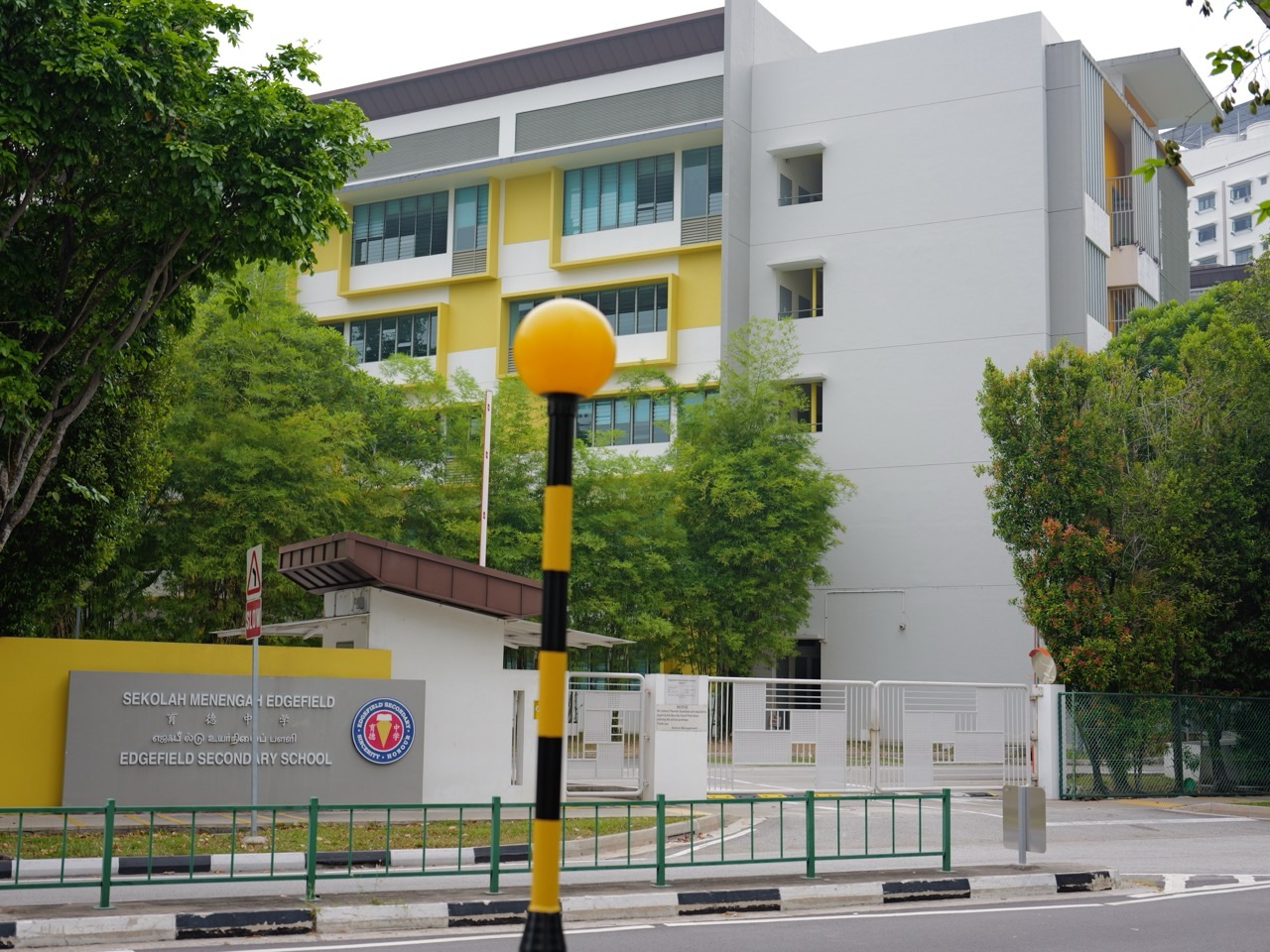
Edgefield Secondary School is a co-educational government school at 36 Punggol Field. If your child is considering it through PSLE Posting Group 2 (PG2) for Secondary 1 in 2027, the previous intake provides a reference. Edgefield’s reported PG2 range was 21–23 for the 2025 Secondary 1 Posting Exercise, which placed students into Secondary 1 in 2026. The 2027 intake’s cut-off will be determined by the new exercise.
To decide where Edgefield belongs on your list, look at the daily journey, your child’s starting subject levels and two school programmes that shape the experience. The G.E.M. Applied Learning Programme develops problem-solving and entrepreneurial thinking through projects. The Learning for Life Programme uses Taekwondo during curriculum time to teach habits such as respect and perseverance.
- Location: 36 Punggol Field, Singapore 828814. The school identifies Punggol MRT as the nearest MRT station.
- PG2 reference: 21–23 for the 2026 Secondary 1 intake. Check the current Edgefield profile on MOE SchoolFinder.
- Open house: The school’s homepage advertises Saturday, 21 November 2026, from 9 am to 1 pm. Check the school site for any updates before travelling.
- Full Subject-Based Banding: PG2 guides school entry and the usual starting subject level. The timetable shows the actual subjects and levels.
- Applied learning: Edgefield’s G.E.M. and Future Ready Programme pages describe projects involving collaboration, scenario planning and problem-solving.
- Character education: The school’s September 2026 programme description lists two curriculum periods of Taekwondo weekly for Year 1 and Year 2, totalling one hour.
- After posting: Follow the school’s 2027 registration, orientation, booklist and subject-offer instructions when issued for that intake.
Contents
- Get the most from a visit to Edgefield
- Read the 2026 PG2 reference correctly
- Understand the form class and the subject timetable
- See what students do in G.E.M. and the Future Ready Programme
- Ask how the school builds relationships and learning habits
- Know how Taekwondo and other CCAs fit into a week
- Walk the journey to 36 Punggol Field
- If your child is posted to Edgefield
- Questions families ask about Edgefield and PG2
- Related Punggol reading
Get the most from a visit to Edgefield
Edgefield’s public homepage advertises its 2026 open house for Saturday, 21 November, from 9 am to 1 pm. Use the homepage for the current announcement. The page linked from its banner displayed material for the 2025 open house when checked, so confirm current activities with the school if a particular showcase, talk or session matters to your visit. If the family is reading later, use the school’s current event information or contact page. Edgefield Secondary School homepage.
Choose two things to see and one question for the child to ask before arriving. A child who enjoys a hands-on activity could ask how Year 1 teams are put together for a Future Ready Programme project. Someone considering the school through PG2 could ask a teacher to explain when the form class meets together and when it separates for subject lessons. A child curious about Taekwondo could ask how the school introduces the activity to students who have never tried it. Short questions leave room for a useful answer.
When you see a project sample, ask a student what changed between the first and last version. If they can describe an idea they tried and what they learned when it failed, you have seen something about the way the programme works. When looking at a CCA display, ask what beginners do during an ordinary first term and what a usual training time is. Keep a note of things you can verify later. A photograph of a programme may show an exciting part of school life, while a short conversation can help your child see where they would take part.
The school was established in 2011 and describes its distinctive programmes in terms of future readiness, entrepreneurship and character education. Read the school’s current descriptions before the visit. Have your child name one theme they would like to encounter in a real assignment. This gives you a way to turn the information into a conversation about school fit. About Edgefield Secondary School.
Read the 2026 PG2 reference correctly
The range of 21–23 refers to the 2025 posting exercise and the students who joined Secondary 1 the following year. The smaller value is the stronger-score end of the range. The larger value, 23, was the score of the last student posted to the school through PG2 in that exercise. The school explains in its public FAQ that each year’s result is known when posting results are released. That FAQ gives older examples, so attach the PSLE or intake year to any figure you write down. Historical 2025 posting range and Edgefield’s explanation of how the cut-off changes.
Imagine two children applying through PG2. A child with a score of 23 was at the previous intake’s last-admitted score. A child with an overall score of 24 is eligible for PG2 under the national mapping and had a score one point higher than Edgefield’s previous PG2 cut-off. Both families can use the historical comparison alongside the school’s current information and other genuine choices. The 2027 posting result will reflect that year’s applicants, their results and choices, and the places available. Read the Edgefield row for the group you actually selected. Edgefield Secondary School in MOE SchoolFinder.
A learner with an overall PSLE score of 21 or 22 can choose PG2 or PG3. Scores of 23 and 24 qualify for PG2, while a score of 25 gives a PG1 or PG2 choice. If your child can use two Posting Groups, the chosen group applies across the single six-school submission. Prepare a list for each eligible group if it helps you compare, then choose one route and rank your school choices within it. The group also indicates the starting level for most levelled subjects. That makes the child’s learning profile part of the decision. Posting Group eligibility under Full Subject-Based Banding and MOE’s Secondary 1 posting instructions.
Rank Edgefield with alternatives you would accept
If Edgefield is your child’s genuine first preference, the family can place it first and give the other choices serious attention. The order of school choices matters as a tie-breaker after citizenship when students with the same PSLE score compete for a remaining place. Computerised balloting follows when a tie persists. Other schools you are comparing may also have specific conditions to check. Use the profiles and official instructions before submitting. Secondary 1 posting tie-break guidance.
For each alternative, record the school name, the relevant Posting Group and previous range, one programme the child finds appealing and a route home after CCA. If you are comparing Greendale, Punggol Secondary or Yusof Ishak Secondary, use their own official profiles as well as trying the journeys. A student might put Edgefield first because they enjoy group design challenges and can travel there independently. Another child might favour a different school that has their preferred activity and an easier return after training. A ranking becomes easier to discuss when each school has a concrete reason beside it.
Families with a Direct School Admission outcome should read the conditions and follow the instructions issued for that route. The primary school can explain whether the result places your child in the Secondary 1 posting exercise and what to do on results day. If your child is considering DSA in a future year, check Edgefield’s published talent areas, application timetable and commitments for that year. These involve decisions about sustained participation as well as school entry. Edgefield’s information for parents and DSA applicants.
Understand the form class and the subject timetable
Edgefield was among the schools that piloted aspects of Full Subject-Based Banding from 2020. Its page describes mixed form classes and a pilot for eligible students to take Humanities at a more demanding level from Secondary 2. The historical section uses the course terms that existed during the pilot. For a 2027 entrant, ask the school how mixed form classes and more demanding subject offers work for the intake your child is joining. Edgefield’s Full Subject-Based Banding page and pilot history.
The distinction emerges during an ordinary day. Your child may join classmates in a form-class activity, then move into a class for their level of English, Mathematics or Science. They may return to the same form class for common experiences. At the usual G2 starting profile, a Standard PSLE result of AL5 or better in the corresponding English, Mother Tongue, Mathematics or Science subject can make a student eligible for a G3 offer in that subject. Ask the school how it confirms the offer, the response deadline and the books that match the level the child accepts. Full Subject-Based Banding and more demanding subject criteria.
If the child receives an offer, compare a recent assignment with the work described by the teacher. A student with a strong Mathematics result may welcome more demanding problems and still need time to adjust to secondary algebra or longer classes. A child with a strong English result may be ready for more complex reading and writing, especially if they independently reflect on feedback. If more than one subject is offered, ask what taking them together would mean across an ordinary week. Base the choice on the actual offer, the child’s readiness and the family’s understanding of the timetable.
When your child reaches Secondary 2, the school will provide the information that applies to their Secondary 3 choices. Edgefield’s Year 3 page, updated in August 2026, provides a useful example of how the school describes packages for different mixtures of G levels. Read the chart that fits the child’s profile when the choice arrives, and ask about eligibility and how an individual subject can continue or change level. Edgefield’s Year 3 subject-combination page.
Look at the work behind the subject levels
At the start of G2 English, ask your child to show how they answered one reading question. A student may have made a reasonable inference and still need to connect it to a phrase in the text. They can practise saying the answer, identifying the words that support it and explaining the connection. If the task is written for an audience, encourage them to say who will read it and what that person needs to know. This gives the child a way to revise after the teacher points to something specific.
In Mathematics, a student expanding 3(x + 2) may write 3x + 2 because they have only applied the multiplier once. Ask what is inside each of the three identical groups. Then draw the groups or write the repeated addition and compare that with 3x + 6. Later, have the child explain a fresh example with different numbers. A drawing can make the relationship clear, and the student can then record the formal algebraic steps used in their lesson.
Science gives another useful question to bring to the school visit. When a student makes a claim, how do they decide what evidence would support it? A water-harvesting scenario, for example, could lead the child to ask what can be measured, how conditions affect the amount collected and whether the design would work throughout the year. In class, a child can practise using observations to support a precise explanation. A comparable example from a teacher can show how the curriculum and a scenario project are connected.
Plan around the examination year when it comes
The Singapore-Cambridge Secondary Education Certificate (SEC) begins in 2027 and reflects the subjects and levels a student sits. A child entering Edgefield in Secondary 1 in 2027 will use the examination guidance for their own later cohort. A school programme such as G.E.M. can provide a context for building skills, while the subject syllabuses specify what students are taught and assessed on. When reviewing a school at the PSLE stage, ask how teachers help pupils use those skills in lessons and understand when different subject combinations become available. SEAB’s overview of the SEC.
See what students do in G.E.M. and the Future Ready Programme
Edgefield’s Applied Learning Programme page describes G.E.M., Growing the Edgefield Mindset, as a programme that develops inventive thinking, collaboration and the ability to notice and act on opportunities. Its August 2026 description links that work to the Future Ready Programme, which presents pupils with scenarios and asks them to develop solutions. The scenarios can give the school subjects a practical purpose. Making sense of a diagram or writing a clear explanation becomes part of how the group decides what to try next. Edgefield’s Applied Learning Programme and Future Ready examples.
One example on the official page is a simulated disaster-response task where students use programmed drones to search a wide area. A team has to decide what information would help, where to look and how to communicate what it finds. One student may organise the area into smaller parts, another can test whether the information matches the map and a third can explain how the team reached its decision. As a parent, ask how teachers structure group roles so each student has something to contribute. Ask whether members revise the plan after a test or explain which information made a difference.
Other published examples explore resource shortages, water harvesting, social diversity and how people might respond to rising sea levels. Treat them as examples of how the school uses scenarios. Ask which experiences are planned for Year 1 and whether the programme introduces the necessary skills in stages. If your child is concerned about group work, ask what pupils do when teammates disagree, or when someone needs more time to explain an idea. A real example of how feedback works can tell you more about fit than a list of project names.
Look at ARTasFEST as an example of student work
The school describes ARTasFEST 2025 as a student-led carnival within the Applied Learning Programme. Its account gives year-level examples. Secondary 1 students helped with merchandise booths, Secondary 2 students coordinated food and beverage offerings, and Secondary 3 students designed and ran games. These were roles at the May 2025 event. Ask the school which comparable activities the 2027 intake may encounter and what support students receive as they take on unfamiliar jobs.
A booth gives a child several things to think through. They may need to explain a choice to a vendor, estimate how long a task will take or adjust an idea when it is too complicated to run. Notice whether that kind of work interests your child. If they prefer to observe first, ask whether roles differ and how younger students build confidence to speak or make decisions. Taking responsibility for one small task can help a pupil see what goes into organising something as a group.
Ask how the school builds relationships and learning habits
Edgefield’s research page describes work with National Institute of Education researchers on peer networks. The school explains that it has used findings to inform peer support and class bonding, including work in mixed form classes. At a visit, ask what this looks like when Year 1 students are settling in. You might ask how form teachers help pupils get to know classmates, where a student can turn if they feel left out, or how groups work together when students bring different levels of confidence. Edgefield’s description of its research-informed teaching.
The same page describes sketchnoting workshops introduced during Secondary 1 activities. Sketchnoting uses visual organisation alongside short text. To understand what the school means, ask your child to sketch a simple connection from a lesson they already know. Three boxes can show what happened, the reason and the result. An arrow can show a relationship between two steps of a process. A child can then explain the idea from the page and see which piece they have left out. If the format appeals to them, ask teachers which subjects or activities use it and how they help students turn it into an independent habit.
The school also describes strategies that encourage pupils to notice how they learn. A practical family question after entry is “Which method helped you figure out what you had missed?” A student might realise that trying a problem from memory uncovered a missing step, or that discussing the explanation with a classmate made the point clearer. This can help you recognise progress beyond a single mark and give the child a more precise question to ask in class.
Know how Taekwondo and other CCAs fit into a week
Edgefield’s Learning for Life Programme is based on character education through sport, with Taekwondo as its main example. The description updated on 30 September 2026 says all Year 1 and Year 2 students take part in curriculum time, with two periods each week totalling around an hour. It describes later options for older students to continue. Ask the school about the 2027 cohort’s arrangements, what clothing or equipment is required, and how a student who needs an adjustment should discuss it. Edgefield’s Learning for Life Programme.
A child who is unfamiliar with the sport can ask what happens in a beginner lesson. Teachers can explain how they introduce movement, practise skills and give feedback. Ask how pupils are encouraged to work with partners and respond to correction. A child who already trains outside school can ask how the curriculum programme fits alongside their experience and how the school distinguishes it from the separate Taekwondo CCA.
The school also lists clubs such as Robotics, Art and New Media, plus performing arts, uniformed groups and sports. Look at two activities that might suit your child and ask about entry, first-term commitments, training times and equipment. The school’s Robotics Club page, for example, describes design, testing and competition activities. A student who enjoys investigating why a device failed may find that interesting. Another child may prefer rehearsal, performance or a team sport. Confirm current details with the school before planning the family schedule. Edgefield’s current CCA pages and Robotics Club.
Ask how students find suitable enrichment
Edgefield’s Potential Development page describes activities across thinking, leadership, community participation, the arts and sport. It explains that activities are organised with different levels of interest, readiness and commitment in mind. Some opportunities can serve as an introduction to an activity and others expect more sustained practice or involve selection. Ask which activities a new Year 1 student can explore and whether families should expect additional time outside the timetable. Edgefield’s Potential Development framework.
An example from outside the classroom can matter to the child. A student who is interested in designing a solution but dislikes public speaking may prefer an activity where they can begin by building or testing, then explain one part of the work when ready. Another may enjoy representing a group or helping plan a community project. Ask whether there are beginner opportunities and who helps students identify them. Schools can change provision, so record the question and the date when you receive an answer.
If the family wants to understand co-curricular attainment, use the school’s current explanation of LEAPS 2.0 and ask where participation, service, leadership and achievement are recorded. A student can want to understand the framework and also choose a CCA they are willing to spend time on each week. It helps to picture what their usual contribution will be. That can mean preparing equipment, rehearsing a passage, testing a robot or organising a small task for a team.
Walk the journey to 36 Punggol Field
Edgefield Secondary is on Punggol Field. Punggol Secondary School is a different school on Edgefield Plains, so check the destination before you leave. The school’s contact page lists the full address and identifies Punggol MRT as the nearest MRT station. Time the full journey from your front door, including lifts, transfers and crossings. A journey from Northshore can involve different walking and connection decisions from a journey beginning around Punggol Central or Sumang. If walking is feasible, try it with your child at their pace. Edgefield Secondary School location and contact details.
Practise the return separately. On a CCA afternoon, the child may leave later and be carrying additional equipment. See where there is shelter, which crossings they are comfortable using and where they can wait for a delayed connection. A route that makes sense for an adult with a map may take longer for a new student during the first week. Give them a chance to lead the trip back. When two schools are close on your shortlist, put their door-to-gate morning times and late-afternoon return times beside each other.
If your child is posted to Edgefield
Save the official posting result and follow the school’s instructions for the 2027 intake. The public registration page checked in November 2026 still referred to Year 1 registration for 2026. Check the intake year on the replacement notice or official school message when it arrives. Record the registration steps, orientation reporting time, uniform arrangements and any level-specific booklist. If your child receives a separate subject offer, keep its response deadline beside the other dates. Edgefield’s Secondary 1 registration page.
In the first month, help your child learn the timetable and identify a teacher or staff member to ask for help. After a few ordinary journeys, allow them to take the lead where they are comfortable. If they start homework and repeatedly get stuck on a particular question type, ask them to show an example and see what explanation would help. School support or independent practice may be enough. If extra lessons would address a recurring gap, choose a concrete goal, such as giving evidence for an inference or separating the steps of an algebra problem. Progress is visible when the child can work through a similar task with greater independence.
Put the visit notes to work when the result arrives
Bring back the short list you made before the visit and let your child update it. Ask which part of the school day they saw clearly, which programme they can explain in their own words and which point still needs confirmation. Then put the results slip next to the school list. Check eligibility, use the applicable row for the selected Posting Group and read back the full order of your school choices before submission. If your child’s posting is at a different school, the questions you prepared about class arrangements, programmes, books and travel will still be useful for their transition.
Questions families ask about Edgefield and PG2
Can a PG2 student attend Edgefield and take a G3 subject?
Edgefield has admitted students through PG2. A student who meets the applicable threshold in a particular subject may be offered a more demanding level. Check the individual offer and timetable issued by the school.
Does the 2026 PG2 score range give us a 2027 admission decision?
The 21–23 range describes the previous posting exercise. Use it to compare choices while checking the current SchoolFinder profile. The 2027 cut-off is known after that cohort is posted.
Is curriculum Taekwondo the same as joining the Taekwondo CCA?
The school describes a Year 1 and Year 2 curriculum programme and publishes a separate Taekwondo CCA page with its own activity and training information. Confirm how each applies to your child’s year and timetable. Edgefield Taekwondo CCA.
What should we ask if we can only speak to one teacher?
Ask how the timetable works for a newly posted PG2 student who is eligible for a higher level in one subject. Then ask what a Year 1 pupil does in a typical G.E.M. activity. Those answers give your child a picture of the academic timetable and one distinctive part of school life.
Are the programmes on the school website the same as the 2027 timetable?
The public pages describe programmes and show examples from identified years. Ask the school which parts are in the current Year 1 timetable, whether an activity is open to the whole cohort and how the school will communicate any later arrangements. If you are making purchases or committing to an activity, keep the date on the notice and consult the school’s actual instructions for the intake. For an unresolved question, the school also publishes its Edgefield FAQ on AskGov.
Related Punggol reading
- What PG2 means and which PSLE scores qualify
- How to choose six secondary schools for PG2
- The first 100 days of Secondary 1 in Punggol


