
Posting Group 2 (PG2) is a secondary-school admission route under Singapore’s Full Subject-Based Banding system. For Punggol families planning Secondary 1 after the PSLE, PG2 helps determine which school places a child may compete for and usually guides the initial level of most subjects. It does not mean that every subject must remain at G2, and it is not the old Normal (Academic) stream wearing a new name. A student can enter through PG2 and be offered selected G3 subjects when the applicable requirements are met.
The practical Punggol decision is to choose schools that fit the child rather than chase one historical cut-off point. Edgefield Secondary, Greendale Secondary, Punggol Secondary and Yusof Ishak Secondary are four local options, but families can consider schools elsewhere too. Look at the child’s PSLE eligibility, the previous year’s PG2 range, school programmes, the journey from home and how the school supports mixed subject levels. The six choices should form a genuine preference order with sensible risk spread, not six guesses built around reputation.
- PG2 means Posting Group 2: an admission group, not a permanent class or fixed academic identity.
- PSLE 23–24: generally within PG2; at 21–22, eligible pupils may choose PG2 or PG3; at 25, eligible pupils may choose PG2 or PG1.
- Group choice: check the current S1 Posting rules because the chosen group is used across the school-choice submission.
- Local schools: Edgefield, Greendale, Punggol Secondary and Yusof Ishak Secondary; also consider suitable schools outside Punggol.
- Historical reference: 2026 intake PG2 last-posted scores were 23, 23, 24 and 22 respectively in that school order; never treat them as guaranteed 2027 cut-offs.
- Six school choices: use all available choices, in honest preference order, including practical options.
- Full SBB: mixed form classes, common curriculum, and subject levels that can vary by child and subject.
- Best next action: check official MOE SchoolFinder and the current-year S1 instructions before submission.

PG2 and G2 answer two different questions
Parents often see PG2 and G2 in the same leaflet and assume the letters are interchangeable. They are not. PG2 answers an admission question: which posting-group places can this child apply for at the start of secondary school? G2 answers a curriculum question: at which level is this particular subject taught? The distinction sounds technical until a family sees its consequences. A child might be posted through PG2, attend a mixed form class with peers from other groups, and take English at G3 while taking Mathematics at G2. A school can offer such a combination when eligibility and readiness support it.
The old practice of speaking about a child as permanently belonging to one stream can lead to unnecessarily narrow decisions. Under Full SBB, the more useful vocabulary is specific. Ask which posting group was used for admission, which subject level is currently offered, what evidence would justify a change, and what kind of support the child needs. This precision helps Punggol parents compare secondary schools fairly, avoid mistaken tuition purchases, and discuss school choices with a child without turning a single PSLE result into an identity.
Start with the PSLE result, not a list copied from social media
At the end of Primary 6, a family receives a PSLE Score and eligibility information. A total score of 23 or 24 normally sits within PG2; scores of 21 or 22 bring a choice between PG2 and PG3; a score of 25 brings a choice between PG2 and PG1. These boundary choices matter. A family should read the current official instructions rather than decide from a graphic forwarded by another parent. General online tables explain the system, but the child’s actual eligibility notice is the individual starting point.
The decision is not a verdict on intelligence. One student with a 22 may prefer the PG2 school options because of a better fit, while another may choose PG3 options after weighing the available schools and readiness. Neither decision can be judged without the actual school list and family priorities. Write the score and eligible group or groups on one page. Then list the schools the child would genuinely enjoy attending. Only after this should you inspect historical ranges. The sequence protects the family from treating admission arithmetic as a substitute for thought.
The meaning of a previous year’s PG2 cut-off
A cut-off point is the PSLE Score of the last student posted to a school in a particular posting group in a previous exercise. It is not a school entrance examination, a target score fixed in advance, or a promise that the same score will secure the same school next year. Schools receive different applications from different cohorts. Demand, places and the distribution of results can change. Last year’s cut-off is evidence about the past, not knowledge of the future.
For the 2026 Secondary 1 intake, the PG2 historical last-posted scores recorded in eduKatePunggol’s existing local comparison were Edgefield 23, Greendale 23, Punggol Secondary 24 and Yusof Ishak 22. Those figures describe the previous posting exercise relevant to that intake; they must not be advertised as the 2027 admission outcome. A child with a better numerical score than a historical cut-off can still face uncertainty. A child whose score equals a historical cut-off should not mistake a past boundary for a reserved place. Use MOE SchoolFinder during the actual exercise and keep several viable options.
How to read a PSLE range without pretending to predict
Imagine a school showing a historical PG2 range from 21 to 23. The first figure describes the strongest numerical PSLE Score among that cohort’s posted PG2 students, while the last figure is the historical last-admitted score. Because lower PSLE Scores represent stronger overall PSLE performance, 21 is better than 23. This is where parents accustomed to percentage marks can reverse the logic by accident. Write a note beside the table: lower total PSLE Score means better total PSLE performance.
Now imagine your child has 23. The range is relevant, but it does not tell you how many applicants with 23 will select the school this year, or whether places will be available after higher-priority applicants are processed. It certainly does not show how well teachers explain concepts or whether your child will enjoy the CCA programme. Treat ranges as one risk indicator among several. Use them to build a spread of choices, then return to the human question: could this school work as a place to learn, belong, and grow for four important years?
Build the six choices around real preference and realistic access
MOE’s parent guidance encourages families to use all six school options and include schools for which the child’s PSLE Score compares favourably with the previous cut-off. A practical list begins by identifying genuine favourites rather than ranking schools mechanically by numerical selectivity. If a child strongly prefers Greendale’s outdoor-learning opportunities, do not automatically place another school first because a spreadsheet describes it as more competitive. Preference order is meaningful in the posting process when relevant tie-breakers apply.
A sound shortlist usually has some ambitious options, some that appear reasonably aligned to the previous cohort, and some that are less exposed to a narrow historical cut-off. It is tempting to call the last group ‘safety schools’, but the better phrase is ‘schools the child would still be pleased to attend’. A sixth choice entered reluctantly, without knowing its commute or available subjects, is not good planning. Every listed school should survive a simple question: if this is the offer, can our family say yes and support the child enthusiastically?
Why choice order is not decorative
Suppose two applicants have the same PSLE Score and are competing for the remaining place in a school. The posting system uses stated tie-breakers, including citizenship status and school choice order, before computerised balloting where needed. That gives preference order a real function. Parents should not copy a friend’s list or arrange choices solely by past cut-offs. They should rank schools in the order they honestly want them, subject to the child’s eligibility and practical limits.
This does not mean putting an extremely unlikely school at choice one magically improves the odds. Academic merit remains central, and a preferred school may have insufficient places. Nor does placing a historically less competitive school first guarantee entry. The reasonable method is to distinguish desire from possibility: make the first choices genuinely attractive, spread risk across all six, and use the most current MOE information. A careful list respects both the child’s voice and the competition that the family cannot control.
One local example: Edgefield Secondary School
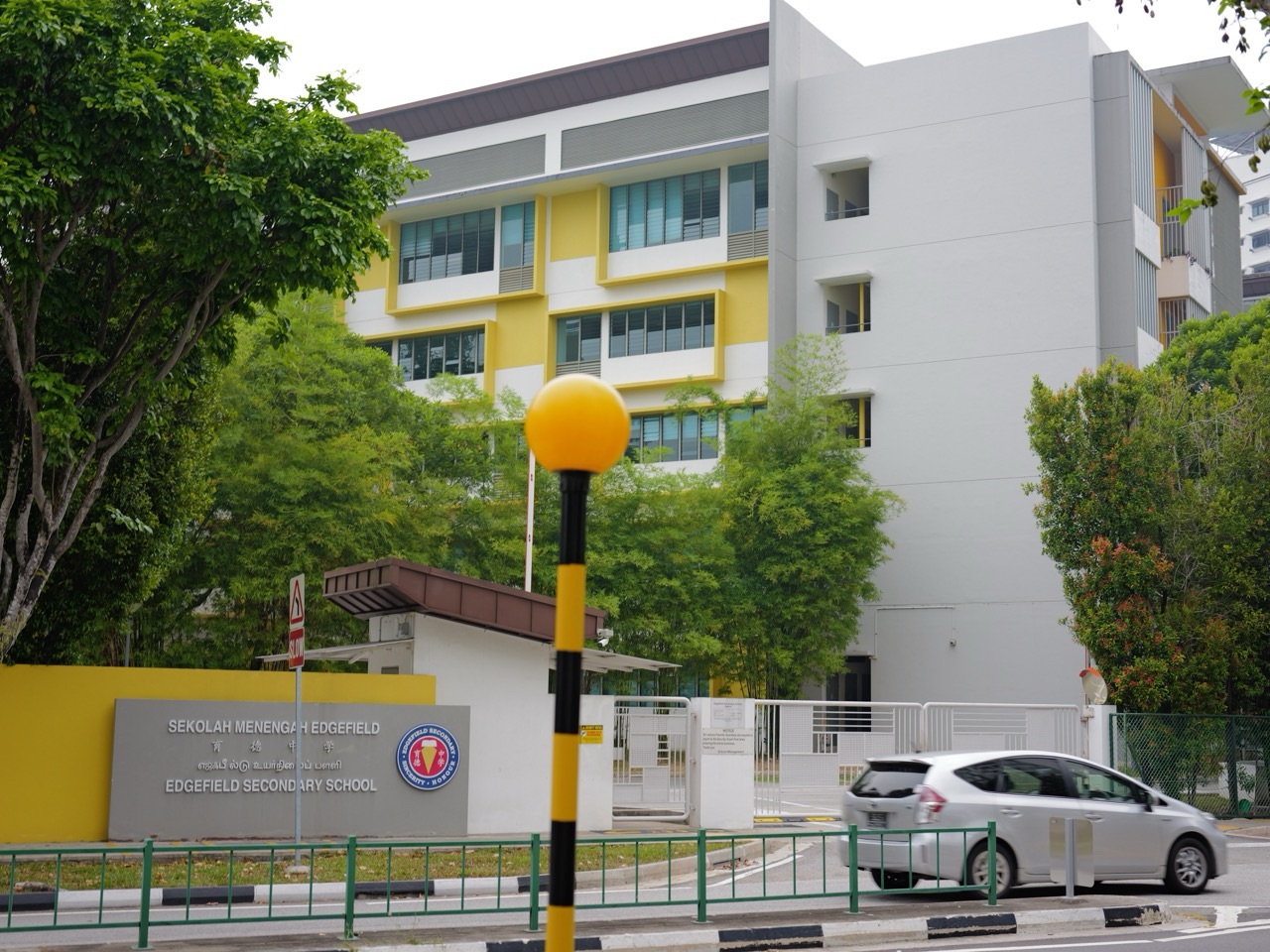
Edgefield Secondary School is at 36 Punggol Field. Its published Applied Learning Programme emphasises entrepreneurial thinking, collaboration and inventiveness through Growing the Edgefield Mindset. That is a meaningful feature for a teenager who likes making, organising, debating ideas or testing solutions. It is not an entry advantage in itself, and it should not be reduced to a glossy promotional phrase. Ask what pupils actually make or present, how challenges are scaffolded and how quieter students participate.
A PG2 family evaluating Edgefield might ask how mixed subject-level lessons are timetabled, how teachers monitor a child’s readiness for a more demanding subject and what the school expects from parents in Secondary 1. Test the actual journey from home in the morning and after CCA. A campus visit can help you observe the environment, but avoid treating a short visit as proof of every teacher’s approach. The objective is not to choose a winner in a school beauty contest. It is to learn whether the daily pattern fits the child.
Another local example: Greendale Secondary School
Greendale Secondary School is located at 51 Edgedale Plains. Its stated emphasis on design, technology and engineering gives families a concrete starting point for questions about applied learning. A child who loves working out how an object works may appreciate hands-on design activities even if that child is not currently strongest in every examination subject. This illustrates why PG2 school selection should not be a single-number exercise. Learning environments can cultivate interests that a PSLE result only partially reveals.
Ask about the school’s current subject offerings, routines for mixed form classes, CCAs, student support, after-school commitments and methods for explaining assessment feedback. Do not assume that every learner automatically joins every specialist activity. Programmes have schedules, eligibility and capacity. Invite the child to describe which opportunities feel exciting and which feel intimidating. You can then distinguish unfamiliarity from genuine disinterest. If the family’s home is closer to another LRT branch, calculate the full walk, transfer and wait rather than looking only at the straight-line distance.
A third local example: Punggol Secondary School
Punggol Secondary School is at 51 Edgefield Plains, despite a history that predates the modern housing estate. Its current published themes include environment education and community or youth leadership. These programmes can give schoolwork a practical context: observing an ecosystem, considering waste, gathering evidence and participating in activities that require reliability. For a PG2 learner, that can be an advantage when school feels more meaningful beyond marks. It does not make the academic curriculum optional; the best applied work connects experience with disciplined thinking.
A parent could ask how environmental learning is integrated with Science, Humanities or project work, whether students receive feedback on writing and presentation, and how leadership opportunities are distributed. Check whether the child can imagine travelling to the school regularly, not simply visiting it once. The family’s transport plan should include a wet-weather alternative and what happens after later CCA dismissal. A sensible school choice lasts beyond the first impressive open-house presentation.
A fourth local example: Yusof Ishak Secondary School
Yusof Ishak Secondary School is at 8 Sumang Walk. Its modern Punggol campus and published interests in sustainable, smart-city STEM and leadership make it worth investigating for families who value projects, technology and civic participation. Because the school has a longer history than its Punggol building, it is helpful to look at both its heritage and its present-day student experience. Compare the school’s actual programmes with the teenager’s strengths rather than assuming the newest building creates the best fit.
For PG2 school choice, families should check current posting-group availability and the year’s indicative ranges, especially where historical PG2 admission has been relatively competitive. Ask teachers how they encourage a student who is strong in one subject but needs support in another. A child who enjoys a specialist programme may still need quiet structure for English writing or Mathematics. Looking at those two truths together leads to better decisions than either an enthusiastic brochure or a cut-off table alone.
Should a Punggol family look beyond Punggol?
Yes. School choice is not restricted to the four secondary schools inside the town. Depending on eligibility and circumstances, families may compare other suitable schools in nearby estates such as Sengkang, Hougang or Pasir Ris, or farther away if a programme is unusually well matched to the child. The constraint is not a district boundary. It is the combination of real admissions opportunities, daily logistics, child wellbeing and educational fit. A school outside Punggol may be excellent; it also imposes a journey that needs to work on an ordinary Tuesday.
Avoid treating a farther school as automatically better because it is harder to enter. Ask what the extra commute buys: an unusual CCA, a distinctive educational programme, closer friendships with a sibling, or an environment where the child genuinely thrives. Then consider what it costs in rest, travel reliability and after-school time. A PG2 student needs room to learn and adapt. The household’s transport and care arrangements are part of that plan, not a minor footnote.
A travel test beats a route estimated on a phone
Punggol has an MRT interchange, LRT loops, buses, crossings and many residential precincts with different walking approaches. A route that appears short in an app may require a transfer with a wait or a long walk in rain. School-day travel is also affected by reporting time, CCA dismissal, construction and the child’s confidence navigating independently. The most useful test is to perform the route at the time it would actually be used, with the child involved in decisions.
Make the test practical. Locate the correct school gate, note the expected reporting time, check the best sheltered path, and identify a backup if a train or bus is delayed. Repeat the journey for a later dismissal when feasible. Include the time needed to eat, bathe, rest and complete homework. Thirty extra minutes each way can become five hours in a school week. The number is only an illustration, but it shows why distance has a cumulative educational effect. School fit includes the hours outside school.
Talk to your child before finalising the list
A twelve-year-old may struggle to explain what makes a school attractive. Ask smaller questions. Would you rather join an outdoor CCA or a performing-arts activity? Do you enjoy building things with a team or working quietly on independent projects? Are you comfortable making a bus transfer each morning? What do you want to try in Secondary 1 that Primary school did not offer? The child’s answers can reveal priorities that adults do not see in admission tables.
Keep the conversation free from labels such as ‘only PG2’ or ‘not clever enough’. A PSLE result is a useful measure of attained performance at a particular age; it does not describe the full person. A teenager choosing a school needs both realistic information and permission to be interested in learning. The aim is not to give the child unlimited control of the six choices. It is to make the decision together, with parents providing the structure and the child providing the lived preferences that no website can supply.
Compare programmes with evidence rather than slogans
Applied Learning Programmes, Learning for Life Programmes, CCAs and school cultures appear frequently in prospectuses. They are useful only when families translate them into observable questions. If a school promises leadership, ask how students practise leading. If it advertises sustainability, ask what projects students complete and how they evaluate outcomes. If it describes an inclusive culture, ask what happens when a student feels isolated or needs help. Good schools should be able to explain ordinary routines, not merely exceptional achievements.
One way to collect evidence is a two-column notebook. In the first column write the claim or attractive feature. In the second, write what you saw or what an official source states. For example, ‘design thinking’ can be paired with a description of actual lessons or projects. ‘Convenient commute’ can be paired with a timed journey. ‘Good support’ can be paired with the process for contacting a form teacher. This turns school selection from impression management into a family investigation.
The special problem at PSLE boundary scores
Scores of 21, 22 and 25 can bring eligible students a choice of posting groups. It is easy to misunderstand this as choosing the ‘easy’ or ‘hard’ version of a child’s whole future. The actual decision concerns the school admission group and initial curriculum guidance, in a system with more subsequent flexibility than the old streams. A child with 22 may be able to consider PG2 or PG3 options; the family’s choice should depend on the real schools and the student’s readiness, not prestige anxiety alone.
Compare available schools under each eligible group, then check the consequences of the group’s selection under the current admission procedure. Discuss possible initial subject levels and ask the prospective school how individual strengths can be recognised. Keep school-choice strategy separate from wishful assumptions about future level changes. Eligibility to offer a more demanding subject must be established; a family should not select a posting group on a guarantee the school has not made.
What a school-choice spreadsheet should contain
Your spreadsheet does not need twenty complicated formulas. Put one school per row and create columns for posting-group eligibility, previous PG2 range, child’s interest, relevant programmes, actual travel time, possible CCA commitments, subject-level questions and your family’s overall preference. Mark unknowns explicitly. For example, ‘ask school about current G3 Science option’ is better than writing ‘yes’ based on a forum comment. Add the school website and MOE SchoolFinder page so you can revisit the evidence during the live posting exercise.
A useful final column is ‘would we accept this offer?’ If the answer is no, do not keep the school simply to fill a position. Find another eligible option instead. Parent and child can score factors informally, but resist creating an artificial mathematical total that conceals deal-breakers. A bus route the child cannot manage matters more than a one-point preference score. A school’s ethos may matter more than an attractive photograph. The sheet should expose decisions, not make them for you.
A worked example: choosing among four Punggol schools
Consider a fictional student, Mei, with a PSLE Score of 23. She enjoys Science and drawing but does not want a daily journey involving many transfers. Her parents initially sort the four Punggol schools by last year’s PG2 cut-offs. That produces a neat list but answers the wrong question. Mei is not a ranking number. The family instead checks eligibility, reads each school’s published programme, times journeys and looks for CCAs she would try. They preserve the historical cut-offs as one risk indicator rather than throwing them away.
Suppose Mei likes Edgefield’s innovation theme but finds the Greendale trip easier. She is also curious about Punggol Secondary’s environmental work. The family can compare those interests and discuss what she would actually do during lessons and after school. They then expand the list beyond the four local schools to make six genuine preferences. The scenario is illustrative, not a forecast of Mei’s admission or a statement about present vacancies. Its lesson is that a sound choice records both school evidence and the child’s day-to-day life.
What if a favourite school’s historical PG2 cut-off looks too competitive?
Do not hide the information from the child, and do not turn it into a personal judgement. Explain that a historical cut-off describes who obtained the last place in one earlier exercise. It can shift. If a school is highly desired, it may still appear in an appropriate position in an honest preference list, but the remaining choices should not all depend on the same optimistic assumption. You are managing uncertainty, not bargaining with a fixed score.
Avoid claiming an admission probability based solely on one year’s number. Without the current applicant pool and available places, a confident percentage is not credible. Parents can instead ask: if the first two schools are unavailable, are choices three through six sensible, reachable and acceptable? If the answer is yes, the family has reduced the chance that posting outcomes become a crisis. Planning for an alternative is not a lack of ambition. It is what makes ambition manageable.
What to ask at an open house or school enquiry
Bring a short list of specific questions rather than asking whether the school is ‘good’. Ask how Secondary 1 form classes are organised under Full SBB; what subject-level offer letters look like; how students receive feedback after their first assessments; how CCA selection works; whether counselling and learning-support channels are available; how to contact the form teacher; and how the school supports students who find the first term overwhelming. These questions work across all four Punggol schools.
Ask about dates and procedures rather than demanding guarantees. School representatives cannot know the coming year’s final cut-off before the posting process. Nor can they responsibly promise that every PG2 student will qualify for a G3 subject by a particular date. You want the current documented procedure and the kind of evidence considered. Take notes, thank the staff and verify essential details on the official website. This keeps the enquiry both respectful and genuinely useful.
After the posting result arrives
Once the school has been assigned, move from admissions strategy into transition planning. Read the school’s official registration instructions carefully, including uniform and book purchasing, reporting arrangements, subject-level offers, transport, device requirements and school communications. Do not rely on a checklist from another year. Every intake can have administrative differences. Invite your child to take responsibility for one or two safe tasks, such as identifying the bus stop or organising stationery, while adults handle payment, consent and formal submission where needed.
Make the first weeks less crowded. A child starting Secondary 1 is adjusting to new teachers, classmates, subject formats and a larger campus. Keep some time available for sleep, exercise, free conversation and settling into CCA. A tutoring decision is better made from actual learning evidence than from fear immediately after posting. When a gap appears, ask what the child cannot yet do; that diagnosis is more useful than assuming the entire PG2 curriculum requires extra tuition.
PG2 families and the first year of Full SBB
Under Full SBB, students can share a form class while attending different subject classes. This is normal. A PG2 student may have classmates whose initial subject combinations are different, and friendship groups need not follow the level of a Mathematics lesson. Parents can help by teaching children to speak respectfully about subject levels. ‘I take this subject at G2’ is a description. ‘I am a G2 person’ is a misleading identity statement that can limit effort and belonging.
The school will communicate its timetable and actual subject offers. Keep those documents together. If a child is offered a more demanding subject, discuss the workload and interest before assuming that accepting more challenge is always best. If the child begins at G2 across most subjects, that can be an appropriate starting point. The purpose of the system is to fit learning to readiness and permit development, not to require every child to chase every available higher level immediately.
A practical first-term parent routine
During the first two weeks, ask about adjustment rather than grades: does the child know where classrooms are, who to approach when lost, how to read the timetable and what time to leave home? In weeks three and four, examine how homework is recorded and submitted. Later, review the first actual marked work for patterns. A child who understands lessons but repeatedly forgets materials needs a different intervention from one who cannot explain a concept. Do not turn every dinner conversation into a grade interview.
Keep one small weekly check-in. Ask three questions: what did you understand well, what confused you, and what is one action that would help next week? Record the action and revisit it rather than inventing a new plan every day. This gives the child practice in self-monitoring. If a concern persists, communicate with the relevant teacher calmly and specifically. A sentence about an observed error is far more actionable than saying the child is weak in everything.
Supporting PG2 learning without automatic tuition
A new school level does not automatically require a new paid programme. Before arranging tuition, consider whether the child needs a clearer homework routine, more regular reading, a careful review of marked work or help with a particular prerequisite. In Mathematics, missing fraction or percentage understanding can make algebra feel impossible. In English, weak comprehension may be a question-reading problem, not simply a vocabulary problem. Small, correct repairs often outperform an indiscriminate increase in worksheets.
If external tutoring is appropriate, choose someone who can teach the actual subject level and explain how the student will become more independent. Bring current school materials, ask about diagnostic methods and agree on a narrow first goal. The immutable eduKateSG small-group teaching standard is useful here as an editorial principle: clarity, visible reasoning, feedback and a practical next step matter more than promotional adjectives. Parents should measure whether the child can solve similar problems without constant prompting.
What parents should not infer from PG2
Do not infer that PG2 automatically means entry to a particular Punggol school. Do not infer that every PG2 child studies every subject at G2. Do not infer that a child will certainly move to G3 with tuition, or that a historical cut-off is the same as the upcoming year’s cut-off. Do not infer that a more competitive school must be the better educational setting for your child. These are tempting shortcuts because they create easy sentences, but they remove the details families need to make good decisions.
The reliable alternative is to name the variable you are discussing. When the question is admission, check the posting group and school choice. When the question is teaching, check the current subject level. When the question is progress, inspect actual work and school guidance. When the question is future options, check the qualification and admission rules relevant to the child’s graduating cohort. Separating these variables is one of the strongest habits a parent can develop.
2027 planning: what is established and what can still change
As at 1 November 2026, Singapore’s Full SBB framework is established, and the first Singapore-Cambridge Secondary Education Certificate examination is scheduled for 2027. That does not mean the cut-offs for the next Secondary 1 intake can already be announced. Those outcomes depend on the actual posting exercise. School-specific programme details, administrative dates and support arrangements can also be updated. A guide written in 2026 should therefore distinguish stable system explanations from admission-year information that must be checked again.
For families whose children enter Secondary 1 in 2027, the SEC examination is not an examination they sit immediately; it is part of the evolving secondary education framework they will learn within. Keep the child’s actual cohort in view. Follow MOE and the school’s official notices when deadlines, subject offerings or pathways become relevant. Good planning leaves space for new verified facts instead of filling the future with false certainty.
A conversation script for a calmer family decision
One parent might begin, ‘Your PSLE result tells us which admission options we can consider. It does not tell us everything you can become.’ Then ask, ‘Of these schools, what looks interesting to you, and why?’ When the child answers, reflect it back. ‘You like projects and would prefer a shorter trip.’ Parents can then add their constraints: ‘We need a route you can manage on CCA days, and we want six options we can genuinely accept.’ This is not a trick to make a child agree. It is an honest way to show how families balance competing needs.
The final conversation can be practical: ‘Here is our present order. Which choice worries you? What information would help?’ If the family disagrees, name the trade-off rather than arguing about prestige. For example, one school may have a more exciting CCA while another offers a much easier commute. The child learns that responsible decisions involve reasons, evidence and compromise. That lesson is useful long after the school posting form has been submitted.
Useful sources and the next step
Use MOE for national policy and the current Secondary 1 posting exercise, and use MOE SchoolFinder for current school information and indicative ranges. For local context, read eduKatePunggol’s four-secondary-school comparison, the Secondary 1 posting guide, and the Full SBB parent guide. Each page answers a different question, so this guide concentrates on the PG2 family decision rather than duplicating every school profile.
Your next step is simple: record your child’s eligible posting group, build a six-school list of authentic preferences, compare current MOE data with real family logistics, and revise the list before the official deadline. Talk to the child about what will help them thrive. Take the PSLE result seriously, but do not let one number do all the thinking. The best school decision is the one a family can explain clearly and support wholeheartedly.
Frequently asked questions about PG2 school choice in Punggol
Is Posting Group 2 the same as G2?
No. PG2 is used to admit a student to secondary school and to guide initial subject-level offerings. G2 is a subject curriculum level. A student posted through PG2 can have a mixed profile when the relevant requirements are met.
Can a PG2 student take G3 English?
Potentially, yes, if the student’s subject-specific results meet the applicable eligibility conditions and the school makes the offer. Confirm with the school; do not assume a guaranteed offer from the overall PSLE score alone.
What are the four secondary schools in Punggol?
Edgefield Secondary at 36 Punggol Field, Greendale Secondary at 51 Edgedale Plains, Punggol Secondary at 51 Edgefield Plains, and Yusof Ishak Secondary at 8 Sumang Walk. All four should be evaluated for fit, not ranked by labels.
Are the 2026 cut-offs guaranteed for 2027?
No. A previous year’s last-posted PSLE Score is historical. The actual final cut-off for a new cohort is known only after that exercise’s admission and choices are processed.
Should I put the least competitive school last?
Not automatically. Use honest preference order while covering realistic admission possibilities. All six choices should be schools the student could genuinely attend. Review MOE’s current tie-breaker rules.
What if my child is eligible for PG2 and another group?
Read the actual eligibility notice and current S1 instructions. Compare the schools and initial curriculum implications available under each option. Do not base the decision on perceived status alone.
Does a Punggol address give priority in Secondary 1 posting?
Do not assume a neighbourhood priority simply from home location. Apply the published Secondary 1 posting criteria rather than importing Primary 1 distance-based registration concepts into secondary admissions.
Does PG2 decide later polytechnic or ITE admission?
No single posting group should be treated as a permanent post-secondary allocation. Later routes depend on the relevant qualifications, subject levels, results and admission criteria applicable in the child’s graduating year.
Do all PG2 students need tuition?
No. Many students adjust successfully with school teaching, appropriate routines and support at home. Tuition is most helpful when it diagnoses a specific gap and strengthens independent learning.
Where should a family verify this information?
Begin with MOE’s current Secondary 1 posting notices and SchoolFinder, then consult the individual school websites. Treat external comparison tables as aids, not official admission decisions.
Editorial note: Information checked against MOE guidance and existing eduKatePunggol school guides on 1 November 2026. School offerings, posting arrangements and indicative score ranges should be rechecked for the child’s own admission year. Fictional scenarios are illustrative, not student testimonials.


