
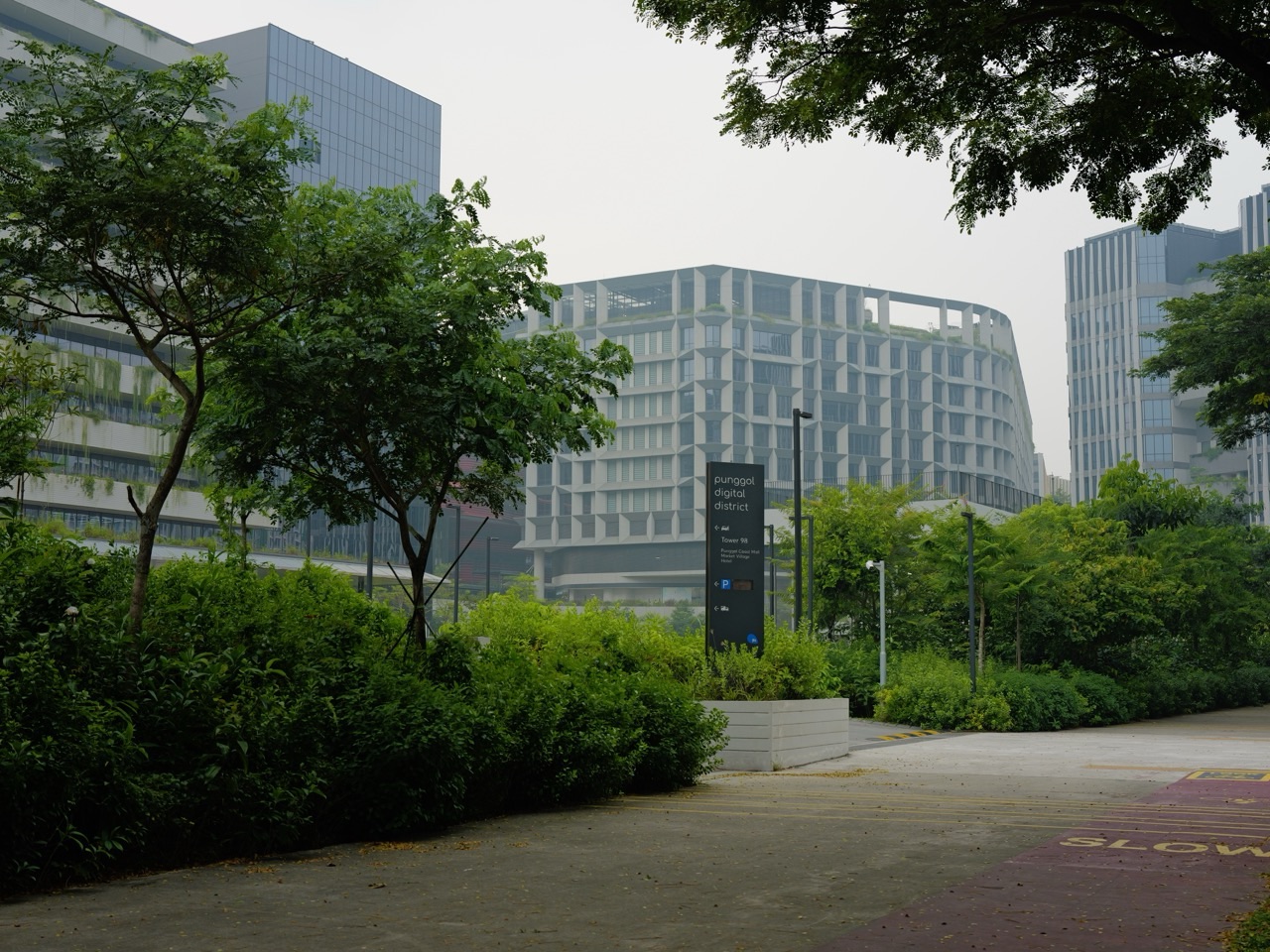
Quick answer, 27 October 2026: Punggol residents considering cloud infrastructure, data-centre operations and energy-efficient computing careers in 2027–2028 should know that Singapore’s IMDA has an official Green Data Centre Roadmap, targeting at least 300 megawatts of additional data-centre capacity in the near term alongside efficiency and green-energy measures. JTC has separately built Punggol Digital District as a smart, connected innovation precinct. Neither announcement confirms that a new 300 MW data centre is being constructed in Punggol or that the projected capacity equals a set number of Punggol jobs.
Did you know that the online services a bank employee uses in Punggol can run on computing hardware located somewhere else in Singapore or abroad? A neighbourhood can contain a large technology workforce without hosting the underlying data centres. Cloud systems, computer networks, electrical infrastructure and buildings form a connected industry, but the people and equipment are spread across different places.
For a Secondary-school learner, ITE or polytechnic student, university graduate or adult seeking a practical next step, the useful 2027–2028 question is which part of infrastructure you enjoy working on: electrical systems, cooling, networks, cybersecurity, software reliability, cloud architecture, maintenance or energy management. This article turns a national strategy into an honest skills forecast without inventing local construction or vacancies.
The facts you can safely use
| Verified fact | Source | What it does not mean |
| IMDA’s Green DC Roadmap aims for at least 300 MW of additional capacity near term | IMDA’s national roadmap | A single Punggol data centre of 300 MW, or 300 MW already operating in 2026 |
| BCA–IMDA Green Mark for Data Centres evaluates energy efficiency, design, digital tools and maintainability | BCA–IMDA certification information, updated April 2026 | Every data centre has achieved the top award or the same PUE |
| JTC says PDD’s Open Digital Platform integrates information from more than 20,000 sensors | JTC’s July 2026 Panasonic partnership announcement | That a public visitor can access the data or the sensors are all in a data centre |
| IMDA reported about 214,000 national tech workers in 2024 | Singapore Digital Economy Report 2025 | That 214,000 workers are employed by data centres or are located in Punggol |
| Cloud and energy infrastructure skills may be useful across sectors | Reasoned occupational analysis | That an employer has made a specific 2028 hiring commitment |
The best primary sources are IMDA’s Green DC Roadmap, the BCA–IMDA Green Mark scheme, and JTC’s 9 July 2026 smart-building collaboration. These initiatives have different scales and functions.

What happens inside a data centre?
A data centre is a facility designed to house computing, storage and networking equipment under conditions that support security, reliability, connectivity and controlled maintenance. Its electricity use can include both the equipment performing computation and the supporting systems such as cooling, power conversion and other building infrastructure.
Not every cloud service belongs to one physical site. Some organisations rent capacity from a cloud provider, others use colocation services, and some own infrastructure. A public-facing application may depend on multiple locations. The worker troubleshooting a cloud outage could be in a Punggol office while the affected equipment is far away.
A cloud professional is not always a data-centre technician
| Job family | Typical problem | Where the work may happen |
| Data-centre facilities technician | An electrical, cooling or environmental-control system needs safe inspection or maintenance | Authorised physical facility |
| Network engineer | Traffic cannot reach a service reliably | Office, network operations centre or approved site |
| Cloud platform engineer | Compute, identity, storage and services need reliable configuration | Cloud-facing team, office or distributed location |
| Site reliability engineer | A critical online service degrades or becomes unavailable | Service operations team, often on-call under clear rules |
| Cybersecurity specialist | A system has vulnerabilities or suspicious activity | Security operations, engineering or governance team |
| Energy management engineer | Consumption needs careful measurement and improvement | Facilities, technical planning or energy-operations team |
| Procurement and service manager | The organisation needs controlled vendor, asset and contract processes | Business and infrastructure operations |
These are occupational categories to investigate, not a list of named current vacancies. The location and legal employer of each advertised position must be verified.
1. Electricity is fundamental, not an optional green add-on
Large computing systems need dependable power. Power systems require capacity planning, safe electrical design, protective equipment, maintenance and approved procedures. Electrical qualifications and safety authorisations depend on the actual task and law. A programmer cannot safely replace an electrical professional simply by learning the building’s control software.
A 2027–2028 scenario is increasing attention to the energy cost of computing, especially where organisations deploy more artificial-intelligence workloads. The plausible need is for people who can measure accurately, improve efficiency without undermining availability, and coordinate technical changes safely.
2. Cooling and the Singapore climate
Servers convert much of their electrical input into heat. Equipment must operate within appropriate environmental limits. In tropical Singapore, heat removal and humidity management are therefore important infrastructure problems. A cooling solution must be judged by its overall energy use, reliability and operational constraints, not only the temperature displayed on a screen.
JTC’s Punggol Digital District has its own smart facilities and energy infrastructure, which can be a local learning example. But the district’s cooling project is not automatically a data-centre cooling installation; the load and equipment served are different facts to establish.
3. Networks, storage and fault recovery
A secure digital service depends on routing, access controls, identity systems, backups, monitoring and recovery procedures. These are design and operations responsibilities, even when much of the hardware is managed by a cloud provider. An online system can appear to fail because of an application defect, DNS configuration, network problem, permission error or a provider incident.
The job skill is systematic troubleshooting: define the symptom, identify affected users, examine authorised logs, test hypotheses, preserve incident records and restore service without careless workarounds. It also includes knowing when to escalate a problem.
4. Energy-efficient code and capacity planning
The infrastructure workforce includes programmers whose decisions affect computation. Unnecessary data transfers, inefficient queries, repeated jobs, unused resources and oversized systems can waste electricity and money. The aim is not to slow down essential work blindly: it is to establish a service-quality baseline and reduce resource use while preserving required performance.
IMDA’s Green DC materials frame efficiency as an ongoing engineering and operations effort. In a school project, a student can compare two harmless computing methods with the same output, measure time or resource use honestly, and state the conditions. That is a safer learning activity than touching a real company’s production infrastructure.
What is power usage effectiveness (PUE)?
PUE is a common measure comparing total data-centre facility energy to energy used by IT equipment. The basic formula is PUE = total facility energy ÷ IT equipment energy, using comparable measurement periods and units. A lower ratio generally indicates less supporting energy per unit of IT energy, but the figure does not capture all environmental effects, service performance or carbon intensity.
Hypothetical example: if a facility uses 130 units of electricity during a measured period and its IT equipment uses 100 of those units, its PUE is 1.30. The remaining 30 units are supporting consumption. Those numbers are invented solely to teach the ratio, not actual values for PDD or any Singapore data centre.
If an engineering team lowers the facility total to 120 with the same measured 100 units of IT energy and unchanged service requirements, the simple ratio becomes 1.20. But before declaring a successful improvement, check weather, load changes, measurement accuracy, availability and any shifted energy consumption.
An educational PUE comparison table
| Illustrative situation | Total facility energy | IT equipment energy | PUE |
| Starting period (fictional) | 130 units | 100 units | 1.30 |
| Measured efficiency improvement (fictional) | 120 units | 100 units | 1.20 |
| Increased facility load (fictional) | 160 units | 130 units | About 1.23 |
The final row illustrates why raw total energy and ratio must not be confused. A lower PUE does not necessarily mean less absolute energy if the amount of computing increases. A good practitioner explains both.
Forecast for 2027 compared with 2028
| Period | What could happen | Evidence to watch | Uncertainty |
| 2027 | National capacity approvals and efficiency programmes advance; employers seek selected technical skills | IMDA/EDB official updates, recognised certification and real vacancy descriptions | Sites and investments may not become operational in the same year |
| 2028 | Some systems move from implementation into routine maintenance, optimisation and security work | Recurring operational posts, stable service contracts and published site milestones | Automation and supplier models can alter net staffing |
No site-specific Punggol data-centre project is confirmed by the sources used here. A resident can work in cloud services with a Punggol technology employer while the physical servers remain elsewhere. Avoid adding national capacity figures to JTC’s district jobs estimate; the measures represent different things.
Which subjects and training pathways help?
| Education route | Useful foundations | A practical evidence project |
| Secondary school | Mathematics, Science, English, computing literacy and safe digital behaviour | Explain the journey of a web request and record points where it can fail |
| ITE or technical apprenticeship | Electrical/electronics foundations, equipment records, safety and maintenance | Supervised test procedure with fault-log documentation |
| Polytechnic | Networks, IT systems, electronics, control, engineering mathematics and laboratory work | Build a small monitored application in an authorised environment |
| University | Software engineering, computing, cybersecurity, electrical and energy systems | Design and evaluate a resilient architecture with failure testing |
| Mid-career | Existing operations, project, facilities or support competence plus targeted new skills | Demonstrate a documented improvement while employed |
Not every data-centre role requires a university computing degree. Equally, some work involving high-voltage equipment or specialised design needs proper qualifications. Read the actual requirements rather than substituting a generic ‘cloud certificate’.
A four-week portfolio experiment for a teenager or adult
- Week 1: Choose a simple personal or educational website and diagram the path from user request to application and stored data; avoid accessing other people’s systems.
- Week 2: Record safe, authorised performance measurements from a test application with no personal data.
- Week 3: Make one small change, such as caching appropriately, reducing unnecessary requests or improving error handling.
- Week 4: Compare results fairly, document trade-offs and write what your experiment cannot prove about energy or production-scale performance.
Questions to ask when an employer advertises a cloud job
- Is this role in a physical data centre, a public-cloud engineering team, a vendor operations group or an internal business team?
- Which technologies and service-level responsibilities are actually used?
- Will the job involve rotating shifts, standby, incident response or weekend maintenance?
- Where is the reporting site, and is travel between facilities required?
- Are licences or safety certifications essential for any electrical or mechanical duties?
- How are mistakes, customer data, system access and security incidents supervised?
- Does the employer provide practical training and time to learn, or expect independent production support on day one?
What residents should not do
- Do not tell others that 300 MW of national planned capacity will be built in Punggol.
- Do not assume all computing employers operate physical data centres at their office addresses.
- Do not treat IMDA’s 214,000 national tech workforce as data-centre employment.
- Do not accept unsafe requests to inspect, connect to or change equipment without authorisation.
- Do not claim a classroom efficiency test demonstrates a real facility’s carbon emissions.
- Do not pay for an expensive credential until you have checked job requirements and employer acceptance.
- Do not assume that a green rating, a PUE number and a good environmental outcome are interchangeable.
Frequently asked questions
Is a new data centre confirmed for Punggol Digital District in 2027?
The sources here do not confirm such a facility. They establish national capacity policy and PDD’s separate smart-district infrastructure. Do not infer a local data centre from those facts.
Does every cloud engineer work near servers?
No. Many cloud roles operate platforms remotely, manage configurations, investigate incidents or design applications. The work site and physical equipment can be different places.
Will AI create new data-centre jobs by 2028?
AI adoption can change infrastructure demand, but actual hiring depends on construction, operations, technology, vendors, automation and business conditions. A numerical Punggol jobs forecast is not established.
Is PUE the same as a company’s carbon footprint?
No. PUE measures an energy-efficiency ratio within a defined boundary. Emissions depend on energy amounts and sources, among other factors.
Official sources and connected eduKatePunggol reading
- IMDA: Singapore Green Data Centre Roadmap
- BCA–IMDA: Green Mark for Data Centres, April 2026
- IMDA: Digital Economy Report 2025 summary
- JTC: PDD smart facilities and 20,000+ sensors, July 2026
- eduKatePunggol: practical cloud engineering career portfolio
- Series: smart buildings and engineering pathways
- Series: AI, cybersecurity and fintech job tasks
The distinction to remember
National computing infrastructure plans create reasons to learn engineering, cloud systems, energy management and reliable software. Punggol Digital District provides nearby examples of technology being applied. The best career strategy for 2027–2028 is to join these ideas without confusing them: investigate authentic employers, learn the underlying physical or digital skills, and never turn a national capacity target into a fabricated neighbourhood job promise.


