
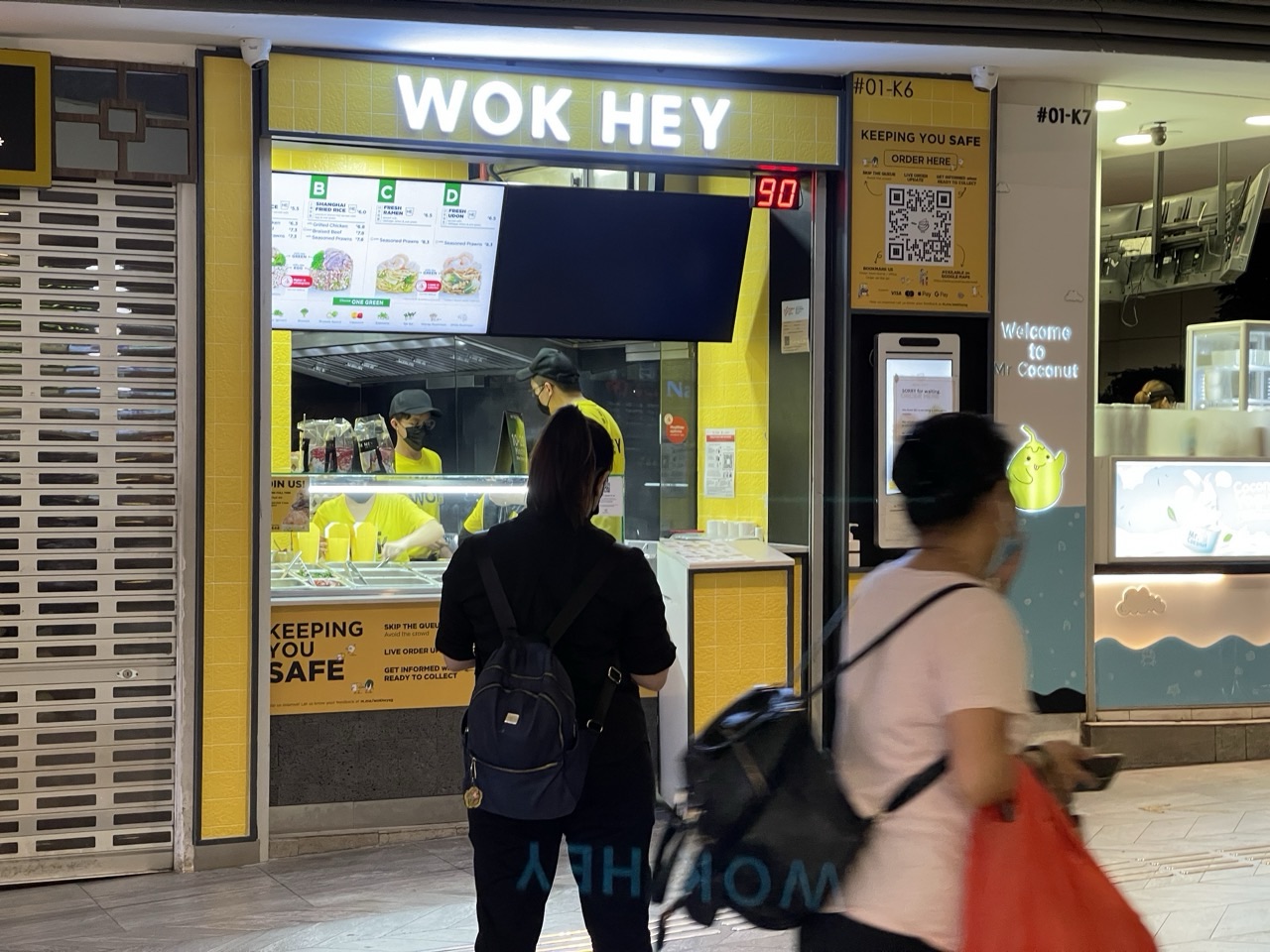
WOK HEY is one of the takeaway food names photographed at Waterway Point in Punggol. Three original October 2026 images in eduKatePunggol’s media library show the branded kiosk and takeaway setting. Waterway Point is at 83 Punggol Central, Singapore 828761, next to Punggol MRT/LRT. An older mall-published participating-food directory lists Wok Hey at #01-K6, but because that PDF is dated, visitors should use the current mall or WOK HEY outlet information rather than treat the old unit number as permanent.
What makes WOK HEY a useful example for families is its ordering structure. The brand’s official menu invites customers to choose a stir-fry base—such as egg fried rice, Shanghai fried rice, fresh ramen or fresh udon—and then choose add-ons. It also shows brown-rice and other variants. That menu creates decisions about taste, vegetables, protein, budget and takeaway timing. A photograph of the counter cannot tell us what anyone ordered, how long the queue took or what each item costs now. This guide helps readers make those decisions accurately and carry the food home safely.

WOK HEY at Waterway Point: quick facts
- Mall: Waterway Point, 83 Punggol Central, Singapore 828761.
- Photographed business: WOK HEY takeaway kiosk, from three October 2026 WordPress media records.
- Historic mall directory: Wok Hey at #01-K6 in an older official F&B retailer PDF; confirm live unit information rather than using a dated PDF as a current locator.
- Official menu families: egg fried rice, Shanghai fried rice, fresh ramen and fresh udon, with variants and optional additions.
- Wholegrain possibilities: WOK HEY’s current web menu shows egg fried brown rice and Shanghai fried brown rice, but individual outlet stock and availability may differ.
- Menu additions: the brand lists protein and vegetable choices, including chicken, beef, prawns and several greens; availability and suitability require checking the actual order.
- Health guidance: HealthHub recommends considering wholegrains, vegetables, sodium, oil and portion size when choosing a stir-fry meal.
- Takeaway safety: SFA advises buying takeaway close to when it will be consumed, eating cooked food soon, or refrigerating promptly if not eating immediately.
- Food allergies and certification: no outlet-specific allergen-free, halal or dietary certification claim is made from photographs; check current responsible information.
The authoritative menu is WOK HEY’s official menu and nutrition calculator. Waterway Point has a WOK HEY store directory entry, while the older F&B unit list is historical rather than a live locator. The food-safety guidance comes from SFA’s consumer food-safety tips and SFA’s explanation of safe cooked rice handling.
What the three October photographs actually show

The media library titles identify WOK HEY at Waterway Point and a takeaway counter. Repeated views help a reader recognise the branding and kind of ordering environment. They don’t establish which menu items were available during the visit, what every customer bought or how the food tasted.
A useful image caption says ‘WOK HEY takeaway counter at Waterway Point, photographed in October 2026’. Calling it the best fried rice in Punggol would require real comparative research and a disclosed method. The photographs should introduce a practical meal choice, not pretend to be an independent taste test.
Why the brand’s menu structure matters
WOK HEY’s published ordering flow separates the initial rice or noodle choice from customised additions. That is more useful to understand than a list of temporary promotional names. A parent can decide what their child wants before reaching the counter, reducing confusion while people wait behind.
The structure doesn’t guarantee that any particular combination is available in the Waterway Point kiosk at this precise moment. Menus, seasonal specials and stock change. Read the present listing and confirm the actual order when paying.
Step one: choose rice or noodles
The official menu shows egg fried rice, Shanghai fried rice, fresh ramen and fresh udon families. A person who enjoys rice can begin there, while somebody wanting noodles can look at ramen or udon. Texture, seasoning and toppings may differ even when the categories sound similar.
A common mistake is to decide on a protein first and then discover the chosen base doesn’t match the eater’s preference. Start with the base, then consider additions. This keeps the order manageable for a family with different tastes.
Egg fried rice is not the same as every other rice bowl
Egg fried rice generally involves cooked rice stir-fried with egg and other seasonings. The brand publishes variants with different proteins and additions. Without an exact confirmed recipe, we should not assign one sodium or calorie figure to every bowl bearing the name.
An allergy to egg is particularly relevant. A bowl described as egg fried rice cannot be treated as suitable for somebody avoiding egg without specific vendor information. Removing a visible egg addition is not a reliable way to establish the contents of the cooked rice.
Shanghai fried rice as a distinct menu family
WOK HEY lists Shanghai fried rice separately from egg fried rice, reflecting a different flavour profile and menu preparation. If a customer hasn’t tried it, asking the counter how the two differ can be more useful than choosing based on a photograph of a takeaway container.
Don’t assume that a family member who dislikes a sauce on one dish will be happy with another. Read the current menu, check ingredients as needed and allow each person to make a sensible choice. A brand category is a starting point, not a nutritional or flavour guarantee.
Fresh ramen and fresh udon: different textures
The official menu lists both ramen and udon under its stir-fry choices. Their appearance and texture may differ, even though both are noodles. Someone who enjoys a springier or thicker noodle may have a clear preference. A younger child may simply want the texture they recognise.
Ask about the specific sauce and add-ons rather than assume either option is a soup dish. WOK HEY’s menu describes wok-fried offerings. Choosing a noodle type doesn’t tell you how oily, salty or spicy the final preparation will be.
What brown-rice options do and don’t promise
WOK HEY’s online menu includes egg fried brown rice and Shanghai fried brown rice. Wholegrain options can help increase fibre intake, which aligns with HealthHub’s guidance. However, the website listing doesn’t guarantee unlimited brown-rice availability at every outlet and time.
Ask the counter whether the selected dish is offered with brown rice today and whether the choice changes the price. Do not invent the nutritional impact of a whole bowl from the name alone; protein, oil, toppings and portions remain relevant.
What the Healthier Edition label tells us
The brand’s menu contains items labelled as a Healthier Edition. That is an operator-defined menu grouping. It does not mean a photograph of a container proves the exact nutritional composition, nor does it replace a full ingredient or allergen check.
Use the brand’s own nutrition information as a starting point and check the actual chosen ingredients. HealthHub’s general advice is helpful for comparing food groups, but individuals with prescribed diets should follow their own professional guidance.
Protein additions: make the portion suit the eater
The official menu lists additions such as grilled chicken, braised beef, prawns and crab meat. These offer different tastes and amounts of protein. A student may want a more substantial meal after sport; a small child may prefer fewer additions. There is no one perfect combination for all families.
Prices and portion sizes should be confirmed on the current order screen. An ingredient’s presence doesn’t automatically mean the whole meal is balanced. Vegetables, wholegrains and sauces are still part of the decision.
Vegetables need to be chosen deliberately
WOK HEY’s current online add-on list includes broccoli, asparagus, capsicum, kale, nai bai and mushrooms, among other choices. The actual stock at Waterway Point should be checked. A parent wanting more vegetables can see whether a suitable addition is available rather than assume the default bowl contains enough.
HealthHub’s practical eating-out guidance encourages asking for more vegetables. This does not require everybody to order the same greens. Children may accept a familiar vegetable more readily than an unfamiliar one, and a parent can build variety across meals.
The hidden question behind extra sauces
Different condiments and sauces can change the flavour and sodium of a stir-fry. The menu photo or product name may not reveal the final quantity added. If a family member needs less seasoning, ask the vendor whether adjustments are possible.
Avoid claiming an outlet can make every combination low-sodium or sauce-free. Some ingredients may be pre-seasoned. The correct answer is the staff’s actual explanation, not a blanket recommendation invented to sound healthy.
What wok hei means without turning it into a guarantee
‘Wok hei’ is commonly used to describe the characteristic aroma and flavour that can arise in high-heat wok cooking. It is a culinary expression, not a scientifically standardised grade stamped on every serving. A dish’s taste depends on many factors in addition to the name of the technique.
Don’t confuse the brand WOK HEY with a promise that every person will perceive exactly the same smoky note. Sensory experience is subjective. A photo of a takeaway counter cannot measure flavour, temperature or cooking energy.
Fast stir-frying still requires proper food safety
A high-heat cooking style can sound reassuring, but food safety also depends on ingredients, handling, storage and avoiding cross-contamination. SFA advises ensuring cooked food is thoroughly prepared and kept at safe temperatures. An external photograph cannot verify individual kitchen records.
Readers should evaluate the responsible business using current official information and sensible consumer judgement, not make accusations or guarantees based on the counter’s appearance. Food-safety questions require evidence beyond a colourful logo.
Buying takeaway is a different plan from eating in
WOK HEY is presented as a takeaway-oriented concept. A family should decide where the food will be eaten before ordering. Carrying several hot containers on public transport or trying to balance them on a stroller may be less convenient than eating at a suitable local table.
Check whether there is an appropriate public place to eat and what packaging the outlet supplies. Don’t assume all nearby mall dining tables may be used for food from any counter. Follow the venue’s actual rules and leave shared spaces clean.
Why the takeaway should be one of the last errands
SFA explicitly advises buying takeaway just before heading to the place where it will be eaten, to minimise time between purchase and consumption. This matters at Waterway Point, where a visitor may be tempted to buy rice first and then spend an hour shopping.
If you have many errands, finish most of them before collecting the meal. A fresh hot bowl is easier to enjoy promptly and safely. The convenience of a takeaway counter should not encourage prolonged unrefrigerated storage.
Cooked rice deserves particular care
SFA explains that Bacillus cereus can cause food poisoning in improperly stored cooked rice and other starchy foods. Spores can survive cooking, and toxins may not be destroyed by reheating. This is general food-science guidance, not a claim about any particular Waterway Point business.
The practical message for consumers is simple: eat freshly cooked food soon, keep any food held for later at safe temperatures and avoid leaving rice at room temperature for long periods. Do not use a reheating plan to justify unsafe storage.
The temperature danger zone in plain language
SFA describes the range from 5°C to 60°C as a temperature danger zone where foodborne microbes can grow. It recommends refrigerating food below about 4°C or holding it hot above 60°C if immediate consumption isn’t possible. These are broad safety controls, not conditions that a shopping bag guarantees.
A parent should not assume that a warm-feeling container has been safely hot-held for hours. If the meal will be delayed, make a proper refrigeration plan rather than relying on an ordinary tote. Follow the food’s instructions and SFA guidance.
Reheating is not permission for indefinite storage
SFA recommends thorough reheating of properly stored cooked food, but notes that reheating cannot necessarily remove all toxins caused by earlier mishandling. This is why prompt eating or safe storage is important. A parent’s common assumption that ‘the microwave will fix it’ is not reliable.
Do not store takeaway for extended periods in a warm vehicle or under the sun and then treat a quick reheat as a solution. When in doubt about unsafe storage, discard the food. The article isn’t diagnosing a particular container; it is explaining a general precaution.
Children and hot stir-fry containers
A fresh rice or noodle box can be hotter than its outer packaging suggests, particularly near the top. Give younger children suitable portions and allow food to cool appropriately before eating. An adult should handle any container that is difficult to open or carry.
Children may be excited to help collect the food, but carrying heavy hot portions through a busy mall isn’t a task every child should undertake. Match responsibility to ability. A calm return to the table or home matters more than speed.
A family meal with different appetites
Imagine two adults and two children. One adult prefers brown rice and vegetables, the other wants ramen, and the children want familiar flavours. Customisable bases can make individual preferences easier to meet, provided the current counter actually offers the requested combinations.
Agree on a family spending limit and which options are important. A customised meal can become expensive when every addition is selected. Read the live total instead of assuming that all vegetables or proteins are included in a base price.
A simple hypothetical budget
Suppose a family of three has S$30 for takeaway. Three made-up meals cost S$7.50, S$8.80 and S$9.20. The total is S$25.50, leaving S$4.50. These numbers are mathematical examples, not the verified Waterway Point menu or a claim about the actual cost of any protein.
Ask a child what would happen if a vegetable extra added a hypothetical S$1.20. They can update the total and decide whether to buy it within the budget. The skill is tracking actual choices, not treating leftover money as something that must be spent.
The difference between menu prices and delivery prices
Online ordering platforms can display different prices, delivery fees, small-order charges and promotions from a physical counter. A price seen for a different WOK HEY branch may not match Waterway Point. Do not copy one delivery-platform price into a local article and present it as a permanent in-store price.
Use the current relevant order channel for the exact price. If comparing pickup with delivery, include all applicable charges and the practical benefit of the service. A fair comparison uses the total paid, not only the headline price.
A single bowl’s nutrition isn’t a universal number
WOK HEY publishes an interactive nutrition calculator on its menu page. It can help compare selected bases and additions, but the result is specific to the options entered and the information the operator provides. One number for ‘WOK HEY’ would hide differences among rice, noodles, proteins and vegetables.
Readers should not invent the calories or sodium of the photographed bowl because no bowl contents were independently confirmed. When nutrition matters, select the real meal in the official tool and consider any individual dietary guidance.
Healthier choices without pretending fried food is a moral failure
HealthHub suggests more vegetables, wholegrains where available, portion awareness and moderation of oily or salty preparations. Those principles can guide a WOK HEY order without banning familiar foods or declaring every stir-fry meal unhealthy.
Ask whether brown rice or additional vegetables are available, consider the total add-ons and choose a drink that suits the person. A child who doesn’t finish a large portion doesn’t need a lecture. The aim is a sustainable pattern across meals.
Allergens and cross-contact
Egg, wheat, soy, seafood and other ingredients may matter to someone with allergies, but the exact ingredient list and preparation flow require operator confirmation. WOK HEY’s published menu shows items containing egg and various proteins. A photo of a box cannot certify its absence of a particular allergen.
Communicate a serious need clearly, including shared cooking surfaces and sauces. If staff cannot provide enough assurance for the individual, choose another suitable meal. Do not assume that choosing a vegetable topping makes a dish allergen-free.
Halal certification should be verified at the outlet
Third-party delivery listings for some WOK HEY branches describe halal-certified operations, but this article does not use those unrelated branch listings to declare the precise current Waterway Point outlet’s certification. Verify current displayed MUIS information or the responsible operator’s official certification if it matters to the family.
A reader should never be asked to make a significant dietary decision from the appearance of a shop sign or an old photograph. Accurate local content treats certification as a specific verifiable fact, not a marketing impression.
Queue timing and the made-to-order process
A freshly prepared stir-fry can involve several cooking steps, but a photograph of the kiosk doesn’t establish the normal waiting time. An order with different ingredients may take longer or shorter depending on preparation and demand. A parent with a timed class should look at the current queue before paying.
If a late meal would disrupt an appointment, choose a simpler plan or collect food later. Asking the counter about estimated waiting time is appropriate when done politely. One customer’s order should not be treated as proof of every customer’s experience.
A takeaway before a library visit?
Punggol Regional Library is at One Punggol, a separate building from Waterway Point. A family might want to purchase food before visiting, but carrying a hot takeaway through a library is rarely a good fit with the purpose of the space. Follow the library’s own food rules rather than assuming any purchase may be eaten anywhere.
Plan the order of activities: complete the library visit, then buy the meal closer to the time it will be eaten, or choose a suitable dining place first. This fits SFA’s guidance on limiting delays between purchase and consumption.
A takeaway before catching the MRT
Waterway Point’s rail connection is convenient, but a crowded carriage is not a stable place for handling hot rice or noodles. Secure the container and avoid opening it during travel. Don’t let a child carry a loose hot box near other passengers.
If the onward trip is long, food-safety timing becomes relevant. Decide whether the meal should be eaten before travel or purchased nearer the destination. The shortest purchase route is not always the most practical eating plan.
Photography ethics at a takeaway counter
The original media images identify the WOK HEY counter but do not justify identifying customers or workers personally. Avoid claiming someone is a delivery rider, parent or office worker unless that is independently verified and relevant. The counter can be documented without a fictional story about people nearby.
When photographing your own food, stay out of the service queue and avoid capturing private payment data. A clear image of the food and branded setting is enough for a local guide. Ethical coverage makes the page useful without intruding on other people’s ordinary day.
A useful Science question: why food is cooked quickly in a wok
Stir-frying involves heat transfer from the cooking surface and contact with hot oil or ingredients. Frequent stirring can expose different surfaces to heat. The aroma and final texture depend on ingredients, cooking conditions and timing. This is a general food-science description, not an inspection of WOK HEY equipment.
A student can discuss conduction, convection and the effect of surface area without trying to measure temperatures at a busy restaurant. For practical experiments, use safe supervised classroom or home activities. Commercial cooking operations should not become an informal public science lab.
An English exercise: write a clear order
Give a pupil the menu categories and ask them to write a complete hypothetical order: base, protein, one vegetable and any relevant preference. Then ask what information is still needed before submitting it, such as actual price or whether an ingredient is in stock.
The exercise teaches accurate reading and polite communication. It is better than telling a student to memorise a long commercial menu. They learn that small modifiers change a real outcome—just as they do in a mathematics problem or a written instruction.
A Social Studies question about takeaway work
A takeaway kiosk depends on food preparation, suppliers, cashiers, cleaners and customers moving through the mall. A photograph shows the visible edge of that work, not the hours, wages or personal circumstances of any employee. Respect workers and make clear requests without obstructing the queue.
Students can explore how convenience affects everyday community life while recognising trade-offs in packaging, waste, transport and labour. Those questions need more evidence than a picture; the important first step is understanding the system without making ungrounded accusations.
A quick meal that remains enjoyable
The simplest practical plan is to check the current Waterway Point outlet, choose a base from the actual menu, select only additions you want, confirm the full price and carry the food directly to a suitable place to eat. If a dietary question cannot be answered safely, choose something else.
A takeaway lunch should make the day easier. It need not be optimised into the lowest imaginable calorie count or shortest queue. Thoughtful choices and a comfortable eating plan are enough.
How this photo guide avoids repeating other Punggol food pages
The broader Punggol food guide helps people discover eating options across the town. Our Waterway Point fish soup guide focuses on a particular soup-and-rice question. This page owns a separate WOK HEY kiosk, its published build-a-bowl menu and practical takeaway safety.
Readers can follow those canonical pages for different needs. The purpose here is not to rank all lunch outlets or copy an entire brand menu, but to turn three new local photographs into a useful, responsible customer guide.
Frequently asked questions

Is WOK HEY at Waterway Point?
Original October 2026 photographs and a mall store page document the branded outlet at Waterway Point. Verify the current unit and operating status before travelling solely for it.
Where is Waterway Point?
83 Punggol Central, Singapore 828761, beside Punggol MRT/LRT.
What unit was WOK HEY in?
An older official mall F&B PDF listed #01-K6, but a historic PDF is not a guarantee of its current unit number.
What food categories does WOK HEY publish?
Egg fried rice, Shanghai fried rice, fresh ramen and fresh udon, including variants and add-ons.
Does WOK HEY offer brown rice?
Its current official web menu shows brown-rice variants. Confirm the relevant outlet and meal’s actual availability.
Can I add vegetables?
The brand’s official menu lists several vegetable choices; check present stock and charges.
Can I add chicken or prawns?
The official menu includes protein options such as grilled chicken, beef and prawns. Confirm current choices and suitability.
Is every meal a fixed-price set?
No such claim is made. Base, protein and extra choices may affect the current order total.
What does wok hei mean?
A culinary expression for the distinctive aroma associated with certain wok-cooking conditions, not a universal measured flavour guarantee.
Is WOK HEY certified halal at Waterway Point?
No outlet-specific current certification is independently asserted. Verify relevant current MUIS or operator documentation.
Is the food egg-free?
Some bases and additions include egg; ask about ingredients and cross-contact where necessary.
Are nutrition figures available?
WOK HEY publishes a nutrition calculator on its official menu website, based on the chosen items.
Is the photograph a restaurant review?
No. It documents the kiosk, not a controlled taste, hygiene or service assessment.
Does the counter offer dine-in seating?
The photographic record describes a takeaway outlet; do not assume a dedicated dine-in area is available.
What if there is a long queue?
Check the live situation and your next appointment rather than infer timing from a photograph.
Can I carry hot takeaway on the MRT?
Secure the food and follow transit rules; avoid spilling or eating hot meals on a crowded train.
Should I buy cooked food before other shopping?
SFA advises buying takeaway close to when you intend to eat it, to reduce time at unsafe temperatures.
Why is cooked rice storage important?
SFA explains that Bacillus cereus can multiply in improperly stored rice and produce toxins not necessarily destroyed by reheating.
Can I leave fried rice at room temperature until dinner?
That is not a safe plan by default. Consume soon or follow SFA’s prompt refrigeration and temperature guidance.
Can I reheat improperly stored fried rice to fix it?
Not reliably. Certain toxins can resist heat; do not rely on reheating to reverse unsafe storage.
Are prices current in this guide?
No. A previous PDF and generic delivery menu may have different prices; check the actual relevant order channel.
Is WOK HEY automatically a healthy meal?
No. Individual ingredients, portions, sauces, oil and dietary context matter. HealthHub offers general guidance.
Where can I find the full menu?
Visit WOK HEY’s official menu and nutrition calculator, linked above.
What other meal options are on eduKatePunggol?
Use the site’s broader Punggol Food Guide and the dedicated Waterway Point photo-led guides.
Official sources and related local reading
- WOK HEY — Official Menu and Nutrition Calculator.
- WOK HEY — Official Brand Site.
- Waterway Point — WOK HEY Mall Directory Entry.
- Waterway Point — Older Participating F&B Directory (dated unit evidence, not a live locator).
- HealthHub — Healthy Hawker Eats.
- HealthHub — Eating-Out Tips.
- SFA — Consumer Food Safety Tips.
- SFA — Fried Rice Syndrome, Prevention and Rice Storage.
- SFA — Temperature Control in Cooked Food.
- Waterway Point Fish Soup and Rice Guide.
- Punggol Food Guide.
- Complete Punggol Guide
Editorial update, 23 October 2026: original photographs from 16 October 2026 identify WOK HEY at Waterway Point. Menu descriptions are supported by the brand’s current web menu; old mall unit information is clearly dated. No photo-derived claim of prices, exact waiting time, nutritional values, staff practices, food certification or individual customers’ circumstances is made. SFA food-safety advice is general public guidance, not an allegation against this outlet.


