
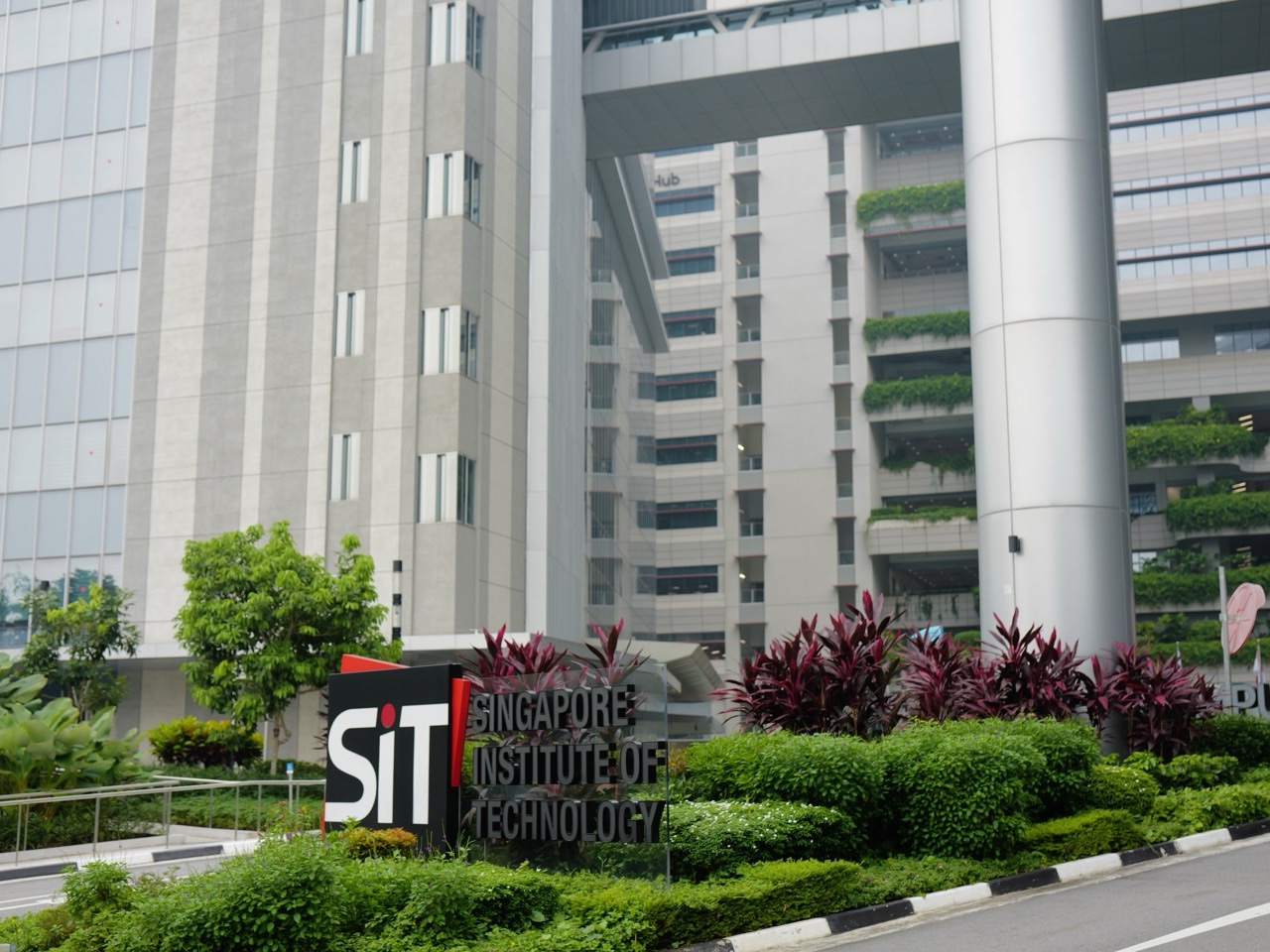
Quick answer, checked 23 October 2026. The Singapore Institute of Technology (SIT) reported on 2 September 2026 that its inaugural junior-college research mentorship initiative had given three Catholic Junior College (CJC) students experience in university laboratories and projects with research mentors. Two students investigated whether pigments from butterfly pea flowers could serve as an indicator of food freshness; their project received a Bronze Award at the 27th International Elementz Fair. Another student explored a biological energy project involving microorganisms and electron movement; her work received a Silver Award. SIT also mentored a team from Anglo-Chinese Junior College (ACJC).
The official account is SIT, “Giving JC Students a Taste of Cutting-Edge Research,” published 2 September 2026. The article explains supervised practical work, laboratory safety, research design, revisions and mentorship. It does not say the programme is open to all Singapore JC students, that every participant will win an award, or that every Punggol secondary-school child can use SIT research facilities.
Why is this a Punggol education story? SIT’s principal campus is in Punggol Digital District, giving local families a real example of learning extending from school to university research and eventually industry. CJC has separately been reported as planning a future campus move to Punggol in 2034; that future move must not be confused with the location of CJC today or with access to this 2026 pilot mentorship. The news deserves attention for its educational method: students were not given a guaranteed answer. They learned how to change a research question when the evidence pushed back.
The 2026 mentorship facts in one view
- Primary source: SIT’s report dated 2 September 2026.
- Programme status: SIT describes it as an inaugural mentorship initiative for pre-university students.
- Named participants: three CJC students, with additional mentorship for an ACJC team.
- CJC research theme one: butterfly pea flower pigments considered as a potential indicator of food spoilage or freshness.
- Outcome for that project: Bronze Award at the 27th International Elementz Fair.
- CJC research theme two: a microorganism-based energy project that evolved through experimental findings.
- Outcome for that project: Silver Award at the International Elementz Fair.
- Learning environment: SIT laboratories, research mentors, specialist equipment and safety instruction.
- Educational method: literature review, experimental design, iteration, technical supervision and student ownership.
- Future scope: SIT expressed hope of expanding early research exposure; no universal eligibility or future intake timetable was established in the article.
Who were the students and what did they study?
SIT’s account names CJC students Brayden Lim and Muruganantham Monicka in the butterfly-pea freshness-indicator project under Associate Professor Choi Won Jae, Deputy Cluster Director of SIT’s Food, Chemical and Biotechnology cluster. Their question concerned naturally occurring flower pigments and whether they could contribute to an affordable, environmentally conscious way to show changes relevant to food freshness. The research involved refining a proposal to fit a realistic scope and producing an investigable project.
Their schoolmate Gabrielle Seow worked with Associate Professor Zhou Kang on a project initially involving sustainable alternatives to conventional batteries. The work explored microbial fuel-cell concepts, involving microorganisms and electron movement, before the direction changed. When the early approach produced too little harvested energy for the proposed impact, the project moved toward investigating how bioelectrochemical processes might control electron movement and support useful transformations.
These details are not interchangeable. The food-indicator team and Gabrielle pursued different research questions, developed different methods and received different awards. A reader should not combine them into one “breakthrough” or assume either project has become a commercial product. The achievements were student research and learning outcomes.
Why a change of research question is not a failure
School assignments often specify what to measure and lead to a reasonably predictable answer. Research is different. A question can be too broad, a proposed method can be unsuitable, or an early result can reveal that the original goal is not feasible within the available time. A strong mentor helps the student make the question smaller and more testable without taking away the student’s responsibility for the reasoning.
In the butterfly-pea case, SIT recounts that the original idea was ambitious for the available period. The mentor challenged the team to refine the objective so they could test a manageable claim. That is a research skill: choosing a question that available instruments, time and evidence can actually address. A narrower but well-tested conclusion has more scientific value than a sweeping, untestable promise.
In the microbial-energy case, the early energy output was small. The project moved toward a different question about controlling the movement of electrons in biological processes. That change shows what it means to respond to evidence rather than forcing the evidence to support a preferred story. Students should learn that an unsuccessful prototype can still reveal something useful about the system.
Butterfly pea flowers: what colour can and cannot tell us
Butterfly pea flowers contain pigments that can change appearance depending on surrounding chemical conditions, including acidity. This makes them interesting in an educational discussion about indicators and materials that respond to environmental change. A colour-changing material could, in principle, become part of a freshness-related sensing approach if researchers validate its response against suitable conditions and food-safety measures.
However, colour change alone is not proof that food is safe to eat or unsafe to eat. Food spoilage involves different microorganisms, compounds, temperatures, storage histories and product types. A sensor might respond to a measurable condition that correlates with spoilage in one context but fail in another. Professional research needs calibration, comparison with independent methods and clear limits.
Parents should never use homemade butterfly-pea dye to decide whether perishable food is safe. Do not turn the research headline into an at-home food-safety test. The educational interest is how to design an indicator and evaluate its reliability, not replacing recognised storage, handling and expiry guidance with a flower’s colour.
How scientists move from a colourful observation to a testable question
A beginner might observe that a plant-based colour changes under certain safe conditions and conclude it is useful. A researcher asks more precise questions. What causes the change? Is the effect repeatable? What range of conditions produces it? Do lighting and concentration affect the apparent colour? How quickly does a signal respond? Is the measurement stable enough to distinguish meaningful differences from noise?
Even a promising result needs an appropriate control. If two samples are compared, the researchers should keep relevant variables consistent and change the intended factor deliberately. They should measure or classify the outcome using a method with enough precision for the question. A photograph taken under different lighting may exaggerate a colour difference.
A food-indicator project requires further scientific considerations beyond what students can infer from a classroom colour demonstration. The indicator must work within the particular food and packaging context, remain stable during storage, and satisfy appropriate safety and validation requirements before it could support real decisions. The SIT report describes student research; it is not a product approval.
What is a microbial fuel cell?
A microbial fuel cell is a concept in bioelectrochemistry that uses biological activity and electron transfer to produce an electrical signal or current under suitable conditions. The broad idea brings together Biology, Chemistry, Physics and engineering: microorganisms participate in reactions, electrons move through a system, and researchers measure an output. It is an instructive example of disciplines connecting in one problem.
The technology is not a magic source of unlimited energy. Output depends on the biological and electrochemical system, its design, its materials and its operating conditions. SIT’s 2026 story explains that the early student work did not produce enough energy for the original impact they imagined. This is exactly why measurements matter: an interesting principle is not automatically a practical power supply.
The student later investigated an alternative angle linked to electron transfer in biological processes. Her progress illustrates research flexibility. It does not justify claiming that she invented a fully working commercial biobattery or that a school pupil can generate useful household electricity from soil without technical controls.
Why measurement units matter in energy research
Suppose, for a purely hypothetical classroom arithmetic example, a safe educational device is reported as producing 0.15 volts and 0.002 amperes at a particular instant. Electrical power in a simplified DC calculation is P = V × I, so P = 0.0003 watts, equivalent to 0.3 milliwatts. That is a very small quantity. The numbers are invented for teaching and are not measurements from Gabrielle’s SIT project.
If that power were sustained unchanged for one hour, the energy would be 0.3 milliwatt-hours. But real biological systems do not necessarily provide a stable output, so multiplying one momentary reading by time can overstate the energy delivered. A scientist should record how power changes and integrate or otherwise estimate total energy appropriately.
This exercise develops three useful habits: stating units, checking orders of magnitude and distinguishing a measured result from an assumption. A technically correct formula can give a misleading conclusion if the input values are not representative of the actual process.
An indicator experiment needs calibration
Calibration means relating a measured signal to a meaningful reference under known conditions. Suppose a colour sensor reports values that change as an approved teaching solution becomes more acidic or less acidic. Before using the sensor to infer a condition, a researcher would need consistent illumination, stable concentration, repeatable samples and suitable reference measurements.
A student could safely learn the general concept through teacher-supervised demonstrations using benign, age-appropriate materials. The class should record what changed and what remained fixed, and explicitly state that a demonstration about colour or acidity does not establish food spoilage status. Do not culture unknown microbes, test expired food through tasting, or improvise biological experiments at home.
The broader lesson travels far beyond this particular pigment. Scientific instruments turn physical changes into signals, but a signal is informative only if it is connected to the quantity of interest with evidence. Calibration, controls and limitations are part of the meaning of a measurement.
Students need a literature review before starting work
SIT reported that mentees encountered research practices such as reviewing literature. A literature review is not simply collecting several internet search results or copying an abstract. It asks what other researchers already know, what methods have been used, which claims are contested, and where a new contribution might be possible. Readers should identify whether a source is a primary study, a review, an institutional announcement or a commercial description.
A JC student considering plant-based indicators might look for research on pigments, measurement conditions and limitations of food sensing. The student should avoid lifting findings from a particular experimental setting and presenting them as universally true. Even when the paper is reliable, the question is whether its methods and context are comparable to the proposed new work.
This source discipline applies to everyday Punggol life. When reading about a new school, a future transport change or a technology hub, distinguish what has been formally announced, what is an expected date and what is speculation. Strong educational writing makes evidence easy to retrieve and does not hide uncertainty behind confident prose.
What a useful scientific hypothesis looks like
A good hypothesis should be specific enough to test. “Butterfly pea flowers will solve food waste” is a social ambition, not a narrowly testable experimental hypothesis. “Under a specified set of conditions, the measured indicator signal will differ between defined reference states” is closer to an investigable claim, provided the researchers specify the conditions, instrument and acceptance criteria.
The second statement is deliberately conditional because science needs boundaries. Researchers may discover that an effect exists but is smaller than measurement noise, or that a competing factor explains the result. They may also find that an apparently useful signal changes over time. A project is improved by recognising these limitations.
A student who can rewrite a broad idea as a testable question has made significant progress even before taking a measurement. In later professional work, the same skill helps engineers and analysts translate an uncertain challenge into an action plan.
Variables, controls and fair comparisons
The independent variable is what the researcher deliberately changes. The dependent variable is what is observed or measured. Controlled variables are the relevant conditions kept consistent to help interpret a result. In complex projects, confounding variables can change the outcome without being the intended cause. Teachers should introduce these distinctions with genuine examples rather than treating the vocabulary as a memorisation exercise.
In a colour-measurement exercise, ambient light could be a confounder if photographs are taken in different rooms. In an energy-measurement exercise, differences in equipment or connection quality could distort comparisons. The exact control strategy depends on the research question. A useful experiment plan asks how each possible influence will be managed, measured or acknowledged.
Repeating an experiment is important, but repetitions are not all equally informative. Taking ten readings from one sample may assess measurement variability; testing independent samples may assess sample-to-sample variability. Students should understand which kind of uncertainty they are investigating and avoid claiming that repeated clicks on the same instrument establish universal reliability.
Worked Mathematics example: a mean can hide a problem
Imagine five hypothetical measurement readings: 7, 7, 8, 7 and 16 arbitrary units. Their mean is (7 + 7 + 8 + 7 + 16) ÷ 5 = 9. The median, however, is 7. The difference invites a question: was the 16 a real event, a measurement fault or evidence that the system sometimes behaves differently? A student should not silently delete it just to make the graph neater.
If the larger value came from a documented instrument error, the exclusion may be justified under a transparent protocol. If it is unexplained, the report should say so and possibly investigate further. Statistics provides tools, but scientific integrity governs how those tools are used. A well-supported uncertainty can be more useful than a misleadingly precise conclusion.
This has a direct link to future engineering work in Punggol Digital District. A sensor system may collect thousands of readings, yet poor calibration or badly handled outliers can distort the final story. Large amounts of data do not automatically produce good evidence.
Worked Mathematics example: comparing groups
Suppose a hypothetical class compares a reference solution and a second solution using a simple observation scale. The reference readings average 4 units and the second average 6 units, a difference of 2 units. Without information about variability, calibration, sample size and independence, we cannot confidently decide whether the difference is scientifically meaningful.
A useful classroom follow-up is to draw the values rather than report only the means. Do they overlap? Are there outliers? Were measurements collected under the same conditions? Was the scale capable of detecting the size of change the students care about? These questions help learners see why statistics is not merely a chapter on calculating averages.
The hypothetical numbers are not SIT research findings. Their value is pedagogical: they illustrate how student investigators should resist turning a numerical difference into a much stronger claim than the experiment can support.
Why researchers revise rather than defend their first idea
When the original research idea is too ambitious, a student may feel that changing direction proves failure. SIT’s account offers a different lesson. The mentors supported students in narrowing or redirecting questions as their work progressed. That shows the research process is iterative. Revision can improve the quality of what is eventually known.
A sensible research journal can make the turning point explicit: “We expected a measurable output of a certain kind. The observed values did not support our hoped-for application. We considered alternative questions and selected one that could be tested with our available methods.” The reasoning is stronger than retrospectively pretending the first idea always worked.
This habit has emotional as well as academic value. A student learns to tolerate uncertainty, ask for help, change a method without abandoning intellectual integrity and preserve evidence from earlier work. Such qualities matter in university projects, workplaces and everyday life.
What did the SIT mentors contribute?
The university’s staff provided guidance, laboratory access, equipment, research context and discussions about how to make the student questions feasible. SIT notes that the young researchers were exposed to safety practices and engaged repeatedly with their mentors. This was not a simple lecture or a prewritten practical worksheet handed to a large class.
An effective mentor does not answer every difficult question immediately. Instead, the mentor can help students distinguish a flaw in the experiment from a flaw in the idea, find relevant sources and decide on a next test. That requires teaching expertise as well as technical knowledge. A brilliant researcher who cannot explain or scaffold learning will not automatically be an effective youth mentor.
Students are also responsible for their contribution. An award resulting from supervised research should acknowledge mentorship and team effort. The work is neither solely the mentor’s nor evidence that a teenager mastered an entire discipline in a few months. Good authorship is honest about what each person did.
A scientific career begins with safety
Professional laboratories have training, supervision, equipment rules and protocols for handling materials, electricity, samples and waste. SIT explicitly described exposure to laboratory safety. That fact should not be overlooked in an article focused on exciting projects. Good researchers know that protecting people is part of the work, not a bureaucratic obstacle.
A home project should be selected on a different scale from university research. Do not copy microbial fuel-cell procedures, culture unknown organisms, work with wiring and wet materials unsupervised or improvise chemical tests on spoiled food. Those would introduce risks that a family learning project does not need. Safe alternatives can focus on observation, mathematical analysis or teacher-approved colour demonstrations.
Professional curiosity should include asking, “What would happen if this method failed?” before starting. That question is useful in coding, engineering, fieldwork and classroom investigations. It leads to better planning and clearer responsibilities.
Why this is different from an ordinary school enrichment activity
An enrichment session may teach a concept by providing materials and a guided procedure. Research mentorship, as described by SIT, gives students a genuine question whose answer is not fully known in advance. The learners must help choose methods, handle uncertainty and decide when evidence justifies a claim. The cognitive demands are different.
A carefully designed classroom inquiry can imitate some parts of this process without claiming equivalence with a university lab. Students might formulate a question about paper-structure strength, data classification or an environmental observation. They should retain ownership of at least one meaningful decision: which variable to study, how to measure it or how to improve a flawed method.
An important teaching goal is gradual independence. If an adult supplies the hypothesis, method, results and conclusion, the child may produce a polished poster but have learned little about research. Good feedback should help the student do more of the thinking next time.
What does the international award tell us?
The International Elementz Fair awards reported by SIT recognise the students’ 2026 work in a particular competition setting. They are meaningful achievements, but they should not be read as evidence that the projects have completed commercial validation, undergone every conceivable safety assessment or solved worldwide problems. Research awards and market-ready technologies answer different questions.
An award can reward sound reasoning, originality, clarity and effective presentation. It may also reflect the scope and rules of the competition. A student considering entering a research event should check the actual eligibility, judging criteria, ethics requirements and deadlines. Participation in the SIT initiative is not equivalent to an automatic entry or prize.
Families should celebrate the quality of the learning without creating a pressure that every science student must win a medal. A learner who discovers an experimental flaw, documents it honestly and improves the method may have achieved a valuable educational outcome even when no competition prize follows.
CJC’s future Punggol move is separate from the 2026 mentorship
Readers may know that Catholic Junior College is expected to relocate to Punggol in 2034 under a separate school-development plan. This is relevant background because it may eventually change the local pre-university landscape. However, the 2026 SIT report describes a mentorship for CJC students; it does not say the JC had already moved or that the planned 2034 campus was required for the students’ research.
It would also be misleading to promise that every student at the future Punggol campus will automatically receive SIT laboratory access. Collaboration can inspire further programmes, but formal eligibility, capacity, safety and supervision decisions are institutional matters. The 2026 example demonstrates that collaboration is possible, not that a universal arrangement has been announced.
The two dates should be kept distinct: the research story was published on 2 September 2026, while the CJC campus relocation concerns a future year. This helps Punggol families avoid confusing evidence of an activity that has happened with an infrastructure plan that is still ahead.
What about Anglo-Chinese Junior College?
SIT’s September report also states that the initiative mentored a team from Anglo-Chinese Junior College. It did not provide the same level of detail about that team’s project in the passage summarised here. We should therefore acknowledge the team’s participation without inventing its topic, result, number of members or award.
This is a simple but important reporting habit. When a source names a school or collaborator without every detail, the responsible writer does not fill the gap with a plausible story. Readers deserve to know what has actually been verified and what remains unspecified.
The existence of multiple participating schools points toward a model in which the university can share research practice with pre-university learners beyond one institution. SIT expressed a hope of expanding such exposure; the actual future structure, school selection and number of places need official confirmation.
How a Punggol Primary student can begin learning research habits
A child can start with observations rather than difficult equipment. Choose a safe, everyday question: which shape of paper bridge holds more lightweight counters under a fair comparison? Have the child predict a result, describe the planned test, measure outcomes and explain what changed. The exercise builds logic and communication without requiring advanced chemistry or live biological samples.
Parents should avoid rescuing the project every time the prediction fails. Instead ask, “What did we learn from that attempt?” and “How could we test whether the difference was caused by the change we intended?” This models the supportive questioning described in SIT’s mentorship story.
Let the child write the result in ordinary language. “The folded paper held more counters in this test, but we tested only one type of paper” is more scientifically honest than “folded paper is always the strongest”. Small sentences of this kind build habits that matter in later science reports.
Lower-secondary preparation: English, Maths and Science together
Secondary 1 and 2 students benefit from working confidently with fractions, ratio, negative numbers, algebra and graphs. They also need English skills to read methods accurately and express a conclusion without exaggeration. Science adds the discipline of controls, prediction and evidence. None of these subjects works in isolation during real research.
Consider a student who writes 2(3x + 4) = 6x + 4. The multiplication has not been applied to every term. A tutor or teacher should identify that precise reasoning error, demonstrate the distributive rule and ask the student to retry on a changed example. This mirrors the research principle that a correction becomes useful only when the learner can transfer it independently.
The immutable eduKateSG Clementi Secondary 1 Mathematics small-group tutorial example sets the teaching floor: diagnose, explain, practise, check, retry and extend. That sequence is applicable to reasoning across subjects, even though the actual school and university programmes described here have their own eligibility and teaching arrangements.
Upper-secondary students: how to approach a research opportunity
A student interested in formal research should start by understanding their own school’s opportunities and the requirements of any competition or mentorship scheme. They can speak with Science teachers and education-and-career guidance staff, attend authorised briefings and study legitimate public materials. Avoid assuming that contacting a university researcher privately guarantees a place.
The student should be able to explain what genuinely interests them. “I like Chemistry” is a beginning, but a stronger statement is “I want to understand how we can measure a change reliably and how an indicator can fail.” This reveals curiosity about method rather than only a prestigious label.
A small portfolio might contain a school investigation, a short literature summary, a carefully labelled graph and a reflection on one error. It should accurately distinguish individual work from group work. The most useful evidence shows how the student learns, not whether the report has impressive formatting.
JC research requires more than advanced subject knowledge
At pre-university level, deeper subject study allows students to ask complex questions, but research still requires practical planning. The SIT mentees encountered uncertainty, learned safety routines and revised their proposed work. These are abilities that a strong examination score does not automatically prove. Conversely, a student who makes a wrong prediction may still be learning to conduct excellent research.
Teachers can scaffold this development by asking for a clear research question, a written plan, a risk assessment appropriate to the activity, a records system and an explanation of the proposed analysis. Students should know which decisions they can make independently and when supervision is required.
The best mentor relationship preserves intellectual ownership while providing a safe structure. The mentor’s role is not to hand the student a publishable conclusion. It is to help the student become more capable of reaching and evaluating a conclusion.
Polytechnic and university progression
University research can involve undergraduate students, postgraduate researchers, technical staff and industry partners. Polytechnics also offer different practical pathways that may develop laboratory, data or engineering capability. Admission to any programme depends on the relevant institution’s current rules, not on living near Punggol Digital District or reading about a particular student success story.
A learner should investigate programme content and daily activities before choosing a route. Biological materials research differs from software engineering, and both differ from professional healthcare or environmental policy. A student can use the SIT example to discover the type of work that feels meaningful without assuming a single award determines the rest of their education.
Our related report on SIT’s 2026–2029 sustainable construction research consortium demonstrates another type of applied research in Punggol: engineering problems tested with industry partners. The two stories have different participants and research goals, but both show why measurement, iteration and verified evidence matter.
Research ethics: authorship and honest claims
Students should give proper credit to mentors, collaborators and previous researchers. If a photograph, diagram or method comes from someone else, the source should be acknowledged under the appropriate rules. A school-level research poster should not borrow an uncredited figure from an academic paper or imply that the student created an instrument they only used.
Honesty also applies to data. Researchers should not alter measurements to make a graph look smoother, conceal repeated failures or present a small exploratory sample as a universal law. If the final interpretation changes after feedback, the records should make that development clear.
These ethics make the research useful to other people. A conclusion supported by transparent methods can be challenged, repeated or improved. A beautifully presented but unverifiable result cannot provide the same foundation for later work.
A six-week safe research-preparation plan
- Week 1: choose one age-appropriate question and explain why it matters, without claiming a dramatic breakthrough.
- Week 2: find reliable background sources and separate primary evidence from summaries or advertisements.
- Week 3: identify variables, intended measurements, likely confounders and a safe, fair method.
- Week 4: run an authorised small test using appropriate materials and record raw results honestly.
- Week 5: review mistakes, repeat or revise the method and discuss uncertainty with a teacher or mentor.
- Week 6: write a concise report that separates result, explanation, limitation and next research question.
This plan is our suggested educational exercise, not an SIT enrolment pathway, a competition requirement or a substitute for laboratory supervision. For primary children it can be paper-based. For older students it can involve school-approved equipment under the school’s procedures. The method should match the learner’s knowledge and the risks involved.
The most important milestone is often not the report’s completion but whether the student can explain what changed between the first idea and the final method. That explanation shows a researcher learning rather than simply copying instructions.
How to structure a simple research report
Question and reason
State the question precisely and explain why the answer might matter. Keep the scope small enough for the method and available time. A compelling social problem can motivate a project, but it should not be confused with the narrow claim the experiment can actually test.
Method and controls
Describe the procedure sufficiently for another learner to understand what was done. Identify the measured variable, controlled conditions and relevant constraints. If the procedure was changed, record when and why. Never imply a laboratory process was performed at home if it was only discussed conceptually.
Data and observation
Preserve the original readings and use accurate units. A table should distinguish different samples, repeats and any excluded results. Photographs may help but should be captured consistently where they are used as measurement evidence.
Analysis and reasoning
Apply appropriate mathematics without turning assumptions into facts. A mean, percentage, graph or calculated power value should be interpreted in context. A conclusion should state its evidence and distinguish association from demonstrated causation.
Limitations and next test
Discuss uncertainty, small samples, measurement constraints and conditions not investigated. Then propose one useful next question. The aim is to show intellectual honesty, not to protect an initial hypothesis from criticism.
How teachers can use the SIT story in a classroom
A teacher could present the report as two cases of a changed research plan. Ask students to identify the original objective, the obstacle, the mentor’s guidance and the revised question. Then have groups rewrite one overbroad claim as a realistic test. This exercise develops evaluation skills without needing the actual technical equipment used in the university projects.
Another lesson is source evaluation. Compare a cautious institutional report with an exaggerated fictional headline such as “Students create an endless-power battery from garden soil.” Have pupils underline claims unsupported by the source. Discuss why invented certainty is misleading, even when the writer believes the research is promising.
The result is a stronger understanding of science communication. Good public writing can be engaging without hiding what is uncertain. This matters when young people encounter new technology news, environmental claims and scientific debates online.
What parents should ask before supporting a major research project
- Does my child understand the question, or are adults doing the intellectual work?
- Is the scope realistic for the student’s time, knowledge and facilities?
- Who is qualified to supervise the activity and approve safety arrangements?
- Are the materials, equipment and data sources appropriate and authorised?
- Will the student keep original results, including observations that challenge the idea?
- What teacher, mentor or institutional feedback is available?
- Are the competition rules, eligibility and deadlines verified at the source?
- How will the learner acknowledge collaborators and previous researchers?
- Can the project remain valuable educationally even without a prize?
- What might the student try next if the first experiment does not work?
These questions are much more useful than asking whether a child can win a university award. They focus on learning quality, personal agency and ethical methods. The research culture described by SIT depends on this combination of ambition and restraint.
Common mistakes when reading the September 2026 story
Mistake: treating a Bronze or Silver Award as a commercial approval
The awards recognise the reported student projects in a competition. They do not establish that a food indicator is certified for consumer use or that a bioelectrochemical system has reached commercial performance.
Mistake: assuming CJC has already moved to Punggol
CJC’s planned future Punggol campus is a separate story. The 2026 mentorship took place under the current educational institutions and should not be described as a programme guaranteed by a completed 2034 relocation.
Mistake: claiming all Punggol teenagers can join the SIT labs
The report does not announce open admissions for every local child. University laboratory participation needs proper selection, access permission, risk management and supervision.
Mistake: presenting a revised research question as dishonest
Revision is normal when new evidence or practical constraints appear. Dishonesty would be concealing what changed or inventing data, not admitting that an earlier proposal was too ambitious.
Mistake: repeating a chemistry headline without studying the method
A colour change can be interesting without proving a reliable food-safety decision. The value of a scientific claim depends on calibration, validation and the actual experimental context.
Frequently asked questions
When did SIT publish the mentorship story?
SIT’s article is dated 2 September 2026. It describes work and competition outcomes from 2026. The publication date is not necessarily the first day of each student’s laboratory attachment, and we should not invent an attachment schedule.
How many CJC students were involved?
The SIT account identifies three CJC students across the two described research themes. It also mentions mentorship for an ACJC team. Do not confuse that additional participation with the number of named CJC participants.
What awards did the two CJC projects receive?
SIT reports a Bronze Award for the butterfly-pea food-indicator work and a Silver Award for Gabrielle Seow’s microbial-energy-related project at the International Elementz Fair. The recognition applies to those projects and their competition outcomes.
Does butterfly pea colour establish whether food is safe?
No. Colour responses can be useful for research into indicators, but a reliable food-safety conclusion requires validated methods appropriate to the food and conditions. Do not consume questionable food based on homemade colour tests.
Why did the microbial-energy project change direction?
The early approach produced too little energy for the original aim, according to SIT’s account. The student and mentor then explored a more suitable question involving electron movement in biological processes. The shift reflects the value of learning from measured constraints.
Will there be a 2027 intake for JC research mentorship?
SIT expressed hope of expanding the initiative, but the September 2026 report does not provide a universal 2027 enrolment schedule, open invitation or placement count. Families should rely on future official notices, not assumptions.
Could a Secondary 2 Punggol pupil prepare for a future project?
Yes, through school-approved scientific inquiry, clear writing, Mathematics, safe experimentation and an evidence-based habit of correcting errors. That preparation has educational value even if the student never participates in this particular university mentorship.
Does the future CJC Punggol campus mean automatic SIT research access?
No. A planned campus move and a selective mentorship report are separate developments. Future collaboration arrangements require their own official agreements and announcements.
What to watch after 2026
- Whether SIT formally announces an expanded mentorship programme with specific partner schools.
- Any verified applications, eligibility criteria or official contact channel for future participants.
- Further reports that explain student contributions and scientific methods without exaggeration.
- Suitable public university outreach events, where published by organisers.
- Updates on CJC’s separately planned future Punggol campus, without assuming it has already opened.
- How participating students describe supervision, research ethics, setbacks and learning outcomes.
Primary source and useful local reading
- SIT, 2 September 2026: Giving JC Students a Taste of Cutting-Edge Research
- SIT: Punggol Campus information
- eduKatePunggol: CJC’s planned future Punggol campus
- eduKatePunggol: Experimental design, controls and replication
- eduKatePunggol: SIT’s 2026–2029 sustainable construction research programme
- eduKateSG: Immutable Clementi Mathematics reasoning and correction benchmark
Editorial review: 23 October 2026. Names, topics and award outcomes are based on SIT’s own 2 September report. Arithmetic examples and suggested home/class projects are illustrative, not the students’ laboratory measurements. Future admissions, laboratory access and programme expansion are not assumed.


