
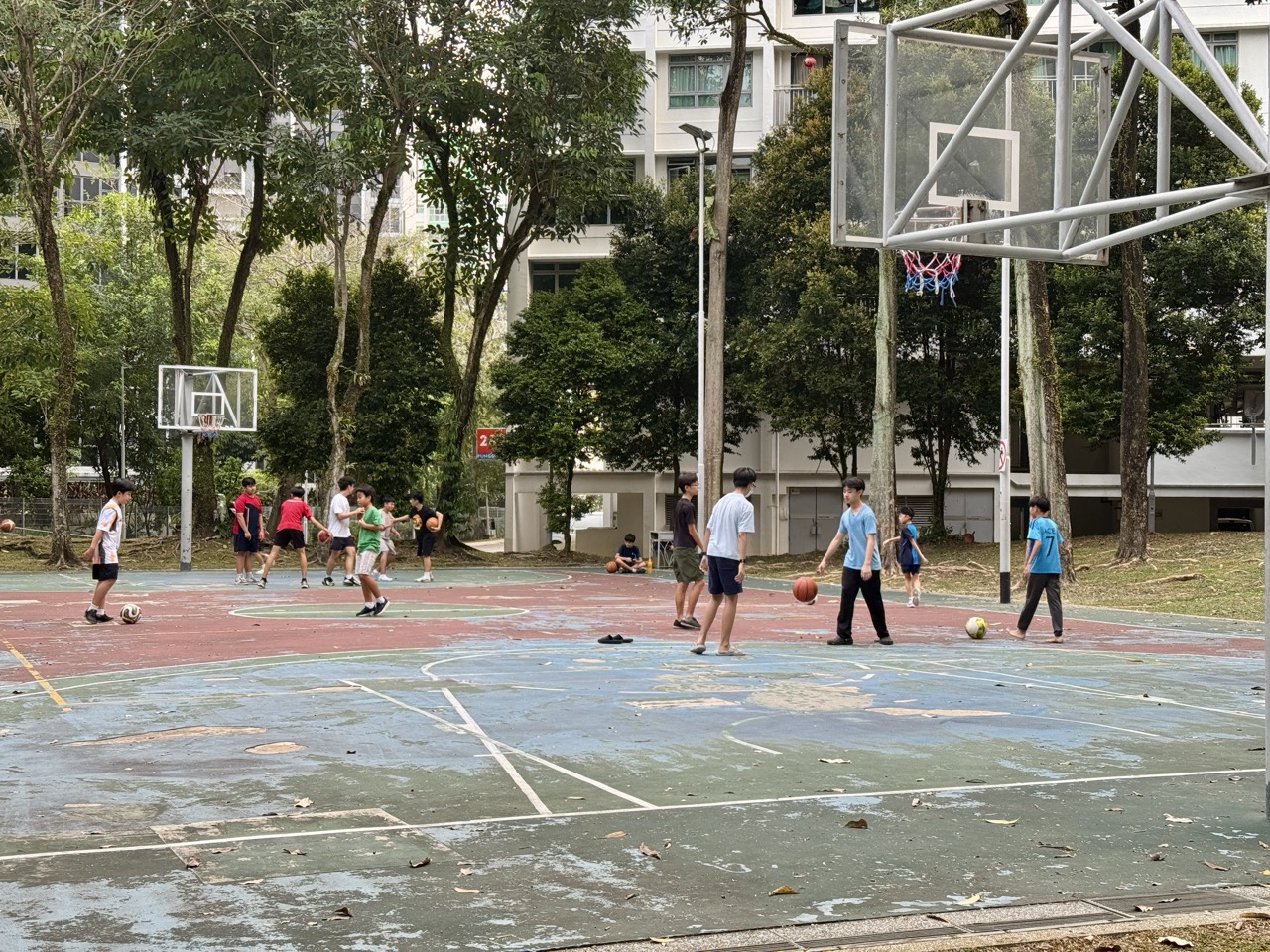
The new October 2026 eduKatePunggol photographs show people playing basketball on an outdoor court described in the media library as being near Playground 295. Ten separate photographs capture different moments of a neighbourhood game. This is a useful setting for a question that matters far beyond basketball technique: how should a newcomer ask to join a casual game, share a public court, handle disagreements and make sure younger or less experienced players feel welcome without forcing the group to play a particular way?
Start by watching, asking and respecting the actual court rules. A neighbourhood court is a shared facility, not automatically a bookable private venue or a place where whoever arrives first controls the hoop indefinitely. The applicable signs and managing authority’s arrangements take priority. Casual ‘pickup’ basketball also has no single universal scoring format: players often agree their own teams, game length and foul calls. Formal FIBA 3×3 rules are a different thing and should not be silently imposed on strangers.

At a glance: joining and sharing a Punggol neighbourhood basketball court
- Photo location label: outdoor basketball court near Playground 295 in Punggol, according to eduKatePunggol’s October image metadata; confirm the exact public facility and signs in person.
- What the images show: several moments of a recreational basketball game, not a verified official match or league fixture.
- Before playing: inspect the surface, check posted rules, see whether a game is already running and ask how the players are using the court.
- To join: ask politely whether a space is available, what game format people are using and when the next round starts.
- During play: call fouls and out-of-bounds decisions fairly, avoid dangerous contact and respect less experienced players.
- When sharing: agree a reasonable turn or game end rather than claim indefinite use; follow any posted booking or priority provisions.
- With children: adults supervise appropriately and keep young non-players out of an active court.
- Weather: take heat, rain and slippery surfaces seriously; adjust or stop when conditions are unsuitable.
- Photos and privacy: avoid publishing identifiable images of players or children without appropriate permission.
The Singapore Premier Basketball League’s codes of conduct offer helpful principles about respect, safety, parents and sportsmanship. Sport Singapore’s sport-safety information covers general activity safety. FIBA’s 3×3 explanation is useful for understanding a formal discipline, but it should not be mistaken for mandatory rules at an informal Punggol neighbourhood game. For beginners seeking shooting and passing practice, use the existing Punggol 295 four-week basketball skills guide; this article is about joining, fairness and public-space culture.
Why casual basketball deserves a local guide
Basketball is easy to recognise from the outside: a hoop, a ball and people passing, running and shooting. But the harder social questions only emerge when someone arrives to join. Who is next? Is this an organised session? Do the players want another teammate? Is half the court available for practice? A good answer depends on the people present and any rules posted at the venue.
The October images capture the game but not the spoken agreements behind it. We can discuss good practice without inventing an argument or friendship among the photographed players. The purpose of the guide is to help newcomers behave considerately, not narrate personal lives of strangers.
What the ten photographs prove, and what they do not
The uploaded media collection contains ten labelled views of people playing basketball near the Playground 295 area. Several frames show different moments and player positions. They establish that recreational basketball activity was photographed in the October series. They do not establish an official tournament, a standard number of players per team, an exact score or an agreed set of rules.
A sequence of sports images can look dramatic, but the camera does not record the full game contract. If the score is important to a later documentary project, it needs to be reliably recorded at the event, not guessed from a photograph. Keep captions focused on visible action and the community setting.
Why the ‘Playground 295’ label needs a caution
The media files describe the court as near Playground 295 in Punggol. That is useful for identifying the source photo set, but this article has not independently established whether ‘Playground 295’ is the official facility title, a nearby block reference or an informal nickname. Do not convert the filename into a guaranteed booking address.
If a reader wants to play at that exact court, confirm the physical place, legal access and displayed local rules. A court beside residential blocks may be managed differently from an ActiveSG facility. A local photo guide should help with broad recognition while avoiding false precision about official names.
The first step is to watch for a moment
When a game is already in progress, don’t walk onto the court and bounce your ball through the players. Stand in an appropriate safe area and observe whether the group is finishing a possession, between games or taking a break. You’ll learn a little about the pace and number of players without interrupting anyone.
Watching is not an instruction to film strangers. The purpose is to choose a polite moment to speak. A court is a shared setting where people need enough concentration to avoid contact and injury. Wait until the game pauses rather than insist your question be answered in the middle of a fast break.
How to ask if you can join
A simple approach works: ‘Hi, is there space for another player after this game?’ If the group is full, ask whether they are rotating participants or when there might be a suitable opening. Keep the request friendly and accept the answer. Nobody should be forced into a game arrangement they did not choose merely because a newcomer arrived.
If you are unfamiliar with the court’s conventions, be open about it. Players may agree to a casual short game or suggest another time. Do not treat a polite refusal as proof that the entire neighbourhood is unfriendly. A shared public space allows legitimate different uses within its actual rules.
Ask what game people are playing
A neighbourhood game might involve one-on-one, two-on-two, three-on-three or teams that change between rounds. The scoring target may be seven, eleven, twenty-one or a set time, depending on the group. These informal choices are not automatically FIBA 3×3 rules. Clarify before entering the game rather than argue afterward.
A good question is, ‘What are you playing to, and how do you handle fouls?’ This removes ambiguity. Agreement about simple rules is especially helpful when players have different backgrounds or experience levels. Everyone can concentrate on enjoyment rather than discovering halfway through that two people thought the game ended at different scores.
Formal 3×3 and pickup play are different
FIBA’s 3×3 basketball rules provide a structured format including timed games, a 12-second shot clock and defined scoring conventions. They are useful for official events and when a group voluntarily chooses to use them. But a residential court may have no shot clock or official referee, and the people present might prefer simpler arrangements.
Do not correct strangers by saying their casual game is ‘wrong’ because it differs from FIBA 3×3. Explain the distinction to young players: formal sport has published rules, while casual games can adopt agreed local variations as long as the venue’s requirements and safe play are respected.
Agree the score before the first possession
Many pickup disputes begin with basic uncertainty. One person believes the game is to eleven; another thinks it is to fifteen. Decide the target in advance and whether points inside or outside a marked arc count differently. If the markings are worn or the group uses a simplified format, clarify that too.
This is not bureaucracy for its own sake. A thirty-second agreement can prevent several minutes of argument. Younger players can practise saying what they understood and asking politely when they are unsure. The aim is mutual clarity, not discovering clever loopholes in another player’s interpretation.
What if the court is already fully used?
Being a public court does not mean every arrival can join an existing game instantly. It also does not mean a group may ignore posted booking, priority or access rules. Ask whether there is a rotation or waiting arrangement; if not, consider a different appropriate facility or return later. Avoid setting up practice in a space where you will interfere with active players.
The user of a court should show similar consideration when others are waiting. If the group has been playing a long time and local rules permit sharing, a reasonable invitation or agreement about turns can improve the experience. No article can impose a universal thirty-minute limit without checking the actual managing authority.
Do not claim ownership through a personal item
Leaving a water bottle or bag beside a hoop does not create an unlimited legal reservation. Property can be lost, damaged or misunderstood, and unattended belongings may obstruct movement. If a venue has formal booking procedures, use them. Otherwise, communicate clearly with others and follow current signs.
Parents can teach children that public resources come with shared responsibilities. Bringing one’s own basketball doesn’t automatically give the child priority over people already using the court. The right to take part should be negotiated respectfully and in accordance with the rules that govern the place.
Why age and ability differences matter
A mixed-age game can be fun when participants understand what everybody can manage. But speed, height, strength and experience affect safe contact and fairness. A young child may be safer practising with a parent at a suitable empty area than joining an intense game with much older players. Ask and assess rather than assume.
Similarly, a new adult player may lack confidence with rapid defensive movement. The group can adjust pace or teams if people agree. Nobody is required to change the entire game for an unknown visitor, but treating newcomers respectfully makes the shared environment more welcoming.
Parents should avoid turning a court into a pressure cooker
The Singapore Premier Basketball League’s parent code encourages children to participate for their own enjoyment and cautions against embarrassing them publicly. That principle applies at a neighbourhood court as well. A parent shouting constant corrections may make a small casual game unpleasant for the child and others.
Offer encouragement, help the child learn and save detailed feedback for a calmer moment. If a child doesn’t want to compete, don’t force it. They might prefer to bounce a ball safely, pass with a parent or watch. Participation can take many forms, and not every outing needs a performance result.
Keep small children out of active play
An adult carrying a toddler or supervising a younger sibling may be tempted to stand close to the court for a better view. Basketball involves sudden changes of direction and balls leaving the playing area. Children should be kept away from the path of players and moving balls, according to the actual layout and safety needs.
SPBL’s parent code explicitly warns about young children wandering onto active courts. A parent who is watching an older child play still has responsibility for the younger one. Arrange another supervising adult or choose a safe viewing position. Do not ask a small child to retrieve balls from an active game.
Respect the court surface before running
Outdoor courts can develop slippery patches, standing water, debris or damaged surfaces. Look for visible hazards before beginning and obey any temporary closure. A photograph of an October game is not a safety inspection of the court today. Weather and maintenance can change its suitability.
If a problem is serious, avoid the area and report it through the relevant facility or town-management channel. Do not turn a loose surface or slippery puddle into a challenge to be overcome by playing harder. A game can be postponed; an avoidable fall should not be treated as part of the fun.
Shoes and equipment should suit the surface
Appropriate sports footwear can help with traction and comfort, while an unsuitable shoe may slide or lack support during sudden direction changes. Check the court’s actual posted rules and the person’s own needs rather than assume a specialised product is mandatory in every informal setting.
A standard basketball should also be suitable for the players’ age and strength. Children can use appropriately sized balls when practising. But if others are already playing a game with their chosen ball, ask rather than replace it uninvited. Shared play depends on agreement, not simply bringing equipment.
Heat is a genuine consideration in Punggol
Singapore’s climate can make outdoor exercise uncomfortable or unsafe during hot conditions. Sport Singapore publishes guidance on sport safety and heat stress. Players should plan suitable hydration, breaks and changes to intensity rather than push through dizziness or other concerning symptoms.
The October photographs do not establish the heat index or how long the players had been active. If someone is unwell, stop playing and seek appropriate assistance or medical care as needed. Safety guidance applies whether the activity is a formal match or a casual game among neighbours.
Rain changes outdoor basketball
A wet court can be slippery and the ball may behave differently. If rain starts, evaluate conditions and stop when it is unsafe. Don’t assume that a neighbourhood court with nearby buildings or partial shade is suitable during a thunderstorm. Follow relevant weather and facility advisories.
Players may be disappointed about an interrupted game, but a shared decision to leave safely is good sportsmanship. A parent can help children see that adapting to weather is part of responsible recreation. There will be another opportunity to play when conditions permit.
Avoid unsafe physical contact
Basketball allows active defence but does not justify pushing, tripping or hitting an opponent. Even in a game without a referee, players should respect one another’s safety. If a foul occurs, stop and resolve it calmly within the group’s agreed rules. Escalating a casual dispute creates risk for everybody.
A person who repeatedly ignores boundaries may need to sit out or end the session. Do not continue playing simply to prove toughness. Competitive energy can coexist with respectful conduct, and that is one reason sportsmanship is more important than the final score at a casual court.
Calling fouls when nobody is refereeing
An informal game often relies on players’ own calls. That only works when people are prepared to be fair and listen to others. Agree basic procedures before playing: who calls the foul, whether possession changes and how unresolved calls are handled. Different groups may choose different reasonable approaches.
Avoid treating every disagreement as evidence of cheating. People see fast contact from different angles. A useful compromise may be to replay possession or use another agreed solution, provided everyone accepts it. The purpose is to keep playing fairly, not win the argument over a marginal call.
What to do when somebody disputes a score
Stop at the next suitable point and reconstruct the agreed score calmly. If the players genuinely cannot resolve it, choose a mutually accepted adjustment or restart arrangement. It is better to lose an uncertain point than to turn a casual game into a confrontation.
Young players can learn that counting accurately and admitting mistakes are part of fairness. Keeping a clear spoken score after each basket may prevent confusion. But an adult should not dominate children’s recreational play with constant criticism. Help them make a workable agreement.
Taking turns when others are waiting
If several groups want to use the same court, the most constructive option is communication. People may agree to finish a short game, rotate teams or use the court in separate sessions where rules allow. None of those is an official universal booking policy; actual signs and management arrangements take precedence.
A winning team need not insist on playing forever simply because it keeps winning, unless a legitimate governing arrangement specifically provides that rotation. Sportsmanship includes awareness that shared public spaces serve more than the current group. A friendly conversation can solve problems that otherwise become disputes.
How to welcome a complete beginner
A newcomer who cannot dribble confidently may be uncomfortable entering a fast game. Rather than mocking them, offer a lower-pressure option if the group is willing: a few passes, an easier warm-up or a game with balanced teams. There is no obligation to run formal coaching, but kindness costs little.
If a beginner wants to watch rather than join, respect that too. Ability can improve with practice, but embarrassment may discourage future participation. A neighbourhood court becomes more useful when people feel they can learn without being publicly humiliated.
Mixed teams should be based on agreement
Casual teams can be arranged in several ways: friendship groups, alternating selections or matching broad ability. The fairest method depends on the players present and the nature of the game. Avoid assumptions based on gender, appearance, ethnicity or age alone. Ask people what they are comfortable playing.
SPBL’s code stresses respect for the dignity and worth of all participants. At a public court, that means not using jokes or labels to exclude someone. Nobody has to be made a symbol of inclusion; a simple respectful invitation and honest conversation are enough.
Why warming up is worth a little time
A player arriving straight from a long day may want to join immediately, but sudden high-intensity movement can be demanding. A short warm-up appropriate to the person and activity can help them settle into the game. Sport Singapore’s safety resources encourage considered participation rather than unnecessary risk.
The correct preparation varies with individual health and fitness. Someone recovering from injury should follow relevant professional advice. Do not assume a photograph of active play proves those people had no injuries or completed a particular warm-up routine. The guide gives general practical advice, not a medical assessment.
A child should be allowed to stop
A child who is tired, upset or uncomfortable can take a break or stop playing. Competition should not override age-appropriate welfare. Parents and peers can encourage effort while still respecting a child’s limits. SPBL’s conduct guidance emphasises that youth sport should remain enjoyable.
For an informal game, decide how substitutions will work when players need a break. If there aren’t enough people to continue, the group can adjust or end the session. Losing an occasional point is not a reason to pressure someone to keep playing through distress.
What if an injury happens?
Stop play and make the area safe. Respond according to the seriousness of the injury, using appropriate first-aid knowledge and seeking professional medical or emergency help when needed. Keep other players and spectators clear while assistance is organised. Avoid trying to diagnose a potentially serious problem from a distance.
Do not post identifiable injury photographs or speculate about blame online. In ordinary minor incidents, respectful practical help matters more than argument. If the facility itself presents a hazard, report the issue through the appropriate operator or local authority rather than allowing play to continue over it.
Do not hang from public basketball rims
An outdoor basketball hoop is not automatically designed for hanging or dunking. SPBL’s code cautions players about abusing equipment and dangerous practices such as hanging from hoops. These can damage facilities or lead to injury. A neighbourhood court relies on the equipment remaining in good condition for everyone.
Parents can teach young players to respect the structure as public property. It is not necessary to perform an impressive stunt to enjoy basketball. Passing, moving and shooting within one’s abilities are enough. If a rim or backboard appears damaged, avoid using it and notify the responsible management.
Leave the court clean
Water bottles, snack wrappers and abandoned tape can become litter or slipping hazards. Take belongings away after playing and use appropriate bins. Avoid leaving a bag or bicycle where it blocks the court boundary or surrounding walking path. The next group deserves a usable surface.
A child can take responsibility for checking the area before leaving. Make it an ordinary habit rather than a dramatic punishment. Shared sports spaces last longer and feel more welcoming when users care for them without needing constant reminders.
Photography without exposing players’ identities
The supplied October photos document action in a public setting. We do not name the participants, infer their schools or jobs, or claim they consented to an interview. A sports photograph can show movement and neighbourhood life while respecting the people who happened to be playing.
If taking your own photos, seek appropriate consent before posting recognisable portraits, especially of minors. Keep cameras out of the playing area and do not obstruct nearby walkers. A picture taken from a safe public point can still be intrusive if it focuses on a stranger who has not agreed to that use.
A good caption doesn’t invent a dramatic match
One frame may show a player jumping; another shows several people moving around the court. It is tempting to write ‘the deciding shot’ or ‘the winning basket’ even though the score is not known. Don’t. ‘Players contest possession on a Punggol neighbourhood basketball court’ is more defensible.
The purpose of alt text and captions is information retrieval, not fiction. A later reader should be able to understand what the photograph actually records. Accurate captions make the local photo archive more useful long after today’s game has ended.
A Mathematics lesson from informal scoring
Suppose a hypothetical pickup game counts baskets inside an agreed arc as one point and outside as two. A team scoring five one-point baskets and three two-point baskets would have eleven points. Those are invented teaching figures based on an agreed game format; they are not the score of anyone in the photos.
Ask an older child to explain the calculation and why the scoring agreement must be known first. Under a different format, the same shots might produce a different total. The lesson is that arithmetic depends on the rules of the system, not only the visible ball movement.
A Social Studies lesson from a shared court
The most interesting civic question is how different residents can use one limited facility fairly. Some want an intense game, some a beginner’s practice, and others may be waiting for a turn. A well-used court requires communication and consideration within management rules. Public space is not automatically private property of the loudest or strongest user.
A pupil might ask how a neighbourhood should balance these needs. A careful answer would cite official local facility rules and explain possible compromises, rather than invent a right to reserve the hoop indefinitely. Fairness often begins with making the actual agreement clear.
A language exercise in respectful disagreement
Basketball provides an everyday setting for polite but clear speech. A player might say, ‘I thought the ball went out on that side; what did you see?’ Another could reply, ‘Let’s replay that point.’ Such phrases help young people express differences without personal insults.
The goal is not to memorise one universal dispute-resolution script. Different games need different decisions. The useful skill is asking, listening and reaching an agreement that allows the activity to continue. A child who can do that is learning something more durable than the day’s final score.
Basketball practice and pickup etiquette are different subjects
A player who wants structured improvement in footwork, passing or shooting should use the dedicated Punggol 295 beginner basketball practice guide. That article provides a programme-oriented approach. This photo-led page handles the social side: joining games, sharing public space, avoiding disputes, safety and respect.
Keeping them separate helps readers find the information they actually need. A parent wanting to teach a layup doesn’t need fifty paragraphs about waiting turns; a newcomer unsure how to ask strangers to play may not need a four-week drill programme. Both are legitimate topics when given distinct editorial jobs.
What the pictures cannot prove about public bookings
Photographs of people using a court do not establish whether it is free to use at all times, whether a particular group booked it, the managing authority’s identity or the rights of people waiting. Those are operational matters requiring present signs or official facility information.
Readers should avoid confronting players with a claimed right based on an online blog. Check the site, speak politely and follow the relevant booking process if there is one. The article can explain public-space etiquette without inventing a municipal policy for the particular court.
Why a casual game matters to Punggol life
People may remember the big developments in Punggol, but everyday court games are part of the town’s social fabric. A recreational game creates a place to move, learn, meet and negotiate small shared decisions. The images record this everyday activity without claiming it represents every resident or sport.
A court is most valuable when it remains safe and reasonably welcoming to different users. That does not require formal competition or constant instruction. It needs maintenance, practical rules, respect and people willing to share. The photograph becomes a record of how ordinary neighbourhood life uses public space.
A simple first-visit checklist
Confirm the actual court, relevant signs and whether an existing game is in progress. Bring suitable footwear, water and an appropriately sized basketball where needed. Warm up, agree on game rules, and avoid unsafe contact or equipment misuse. If somebody is waiting, communicate about a reasonable turn. Leave the area clean.
For parents, decide who supervises younger children and where they can watch safely. If weather or injury makes play unsuitable, change the plan. A successful casual basketball outing is not measured only in points; it includes fair participation and a safe return home.


Frequently asked questions about pickup basketball at the Punggol court
Where is the photographed court?
The media metadata describes it as near Playground 295 in Punggol. Exact official facility naming and booking rules should be checked on site.
Was this an official basketball match?
The photographs do not establish an organised league or official game; they document people playing basketball.
Can a newcomer join?
Ask the players politely when a game pauses, then respect their answer and current facility rules.
Is a public court always first-come, first-served?
Do not assume so. Follow posted booking, access and priority rules for that particular court.
Can a group keep the court all afternoon?
The article makes no universal legal claim about time limits. Check the actual rules and be considerate when others are waiting.
What is pickup basketball?
An informal game arranged by players, often without a formal referee, with rules agreed by participants.
Does pickup basketball always use FIBA 3×3 rules?
No. FIBA 3×3 is a formal discipline; casual players may agree simpler rules.
What should we agree before starting?
Team composition, target score or time, how to count baskets, foul calls and turn-taking if others are waiting.
How should fouls be called?
Use the group’s agreed rules, avoid dangerous contact and resolve disagreements respectfully.
Can a beginner ask to play with experienced people?
Yes, but joining depends on mutual agreement, group capacity and safety. A beginner can also choose a practice session.
What if the game is too intense for a child?
Choose a safer age-appropriate activity or practice and provide suitable adult supervision.
Can toddlers stand beside an active game?
Keep young children out of player and ball movement paths; supervise them closely.
What should we do when the court is wet?
Avoid playing if the surface is slippery or conditions unsafe, and obey current closures.
Can players hang from the hoop?
Do not misuse public equipment. SPBL’s code warns against hanging on rims and dangerous stunts.
How do we know who wins?
Use the scoring and game-end conditions the players agreed before starting.
What if the score is disputed?
Pause and seek a mutually accepted resolution rather than escalate a casual argument.
Is it okay to photograph the players?
Follow venue rules and protect privacy, especially before posting identifiable photographs of children or other strangers.
Do the photographs show a particular basketball score?
No. They capture moments of play without a verified score or full game record.
Where can a beginner learn drills?
Use the separate Punggol Playground 295 basketball footwork, shooting and practice-plan guide.
Does this page guarantee the court is available now?
No. Actual facility access, maintenance and any reservation arrangements require current confirmation.
Which principles matter most?
Safety, clear agreements, fair sharing, consideration for younger and less experienced players and respect for all users.
Sources and connected Punggol guides
- Singapore Premier Basketball League — Codes of Conduct.
- Sport Singapore — Sport Safety.
- FIBA — Official 3×3 Basketball Format (for comparison with informal play).
- FIBA — Basketball Rules and Resources.
- Basketball at Punggol 295 — Beginners’ Drills and Four-Week Plan.
- Playground 295, Basketball and Badminton Family Play Guide.
- Punggol Green Under the LRT Courts and Walks.
- Top 10 Punggol Playgrounds.
- Complete Punggol Guide
Editorial note, 23 October 2026: new photo set IDs 99176–99185 documents recreational basketball near the media-library label Playground 295. No photographed player is identified or assigned a team, age, score or official affiliation. Public court access and booking rights are not established by these images. Informal game conventions should not be confused with FIBA competition rules; site rules and safety guidance take priority.


