
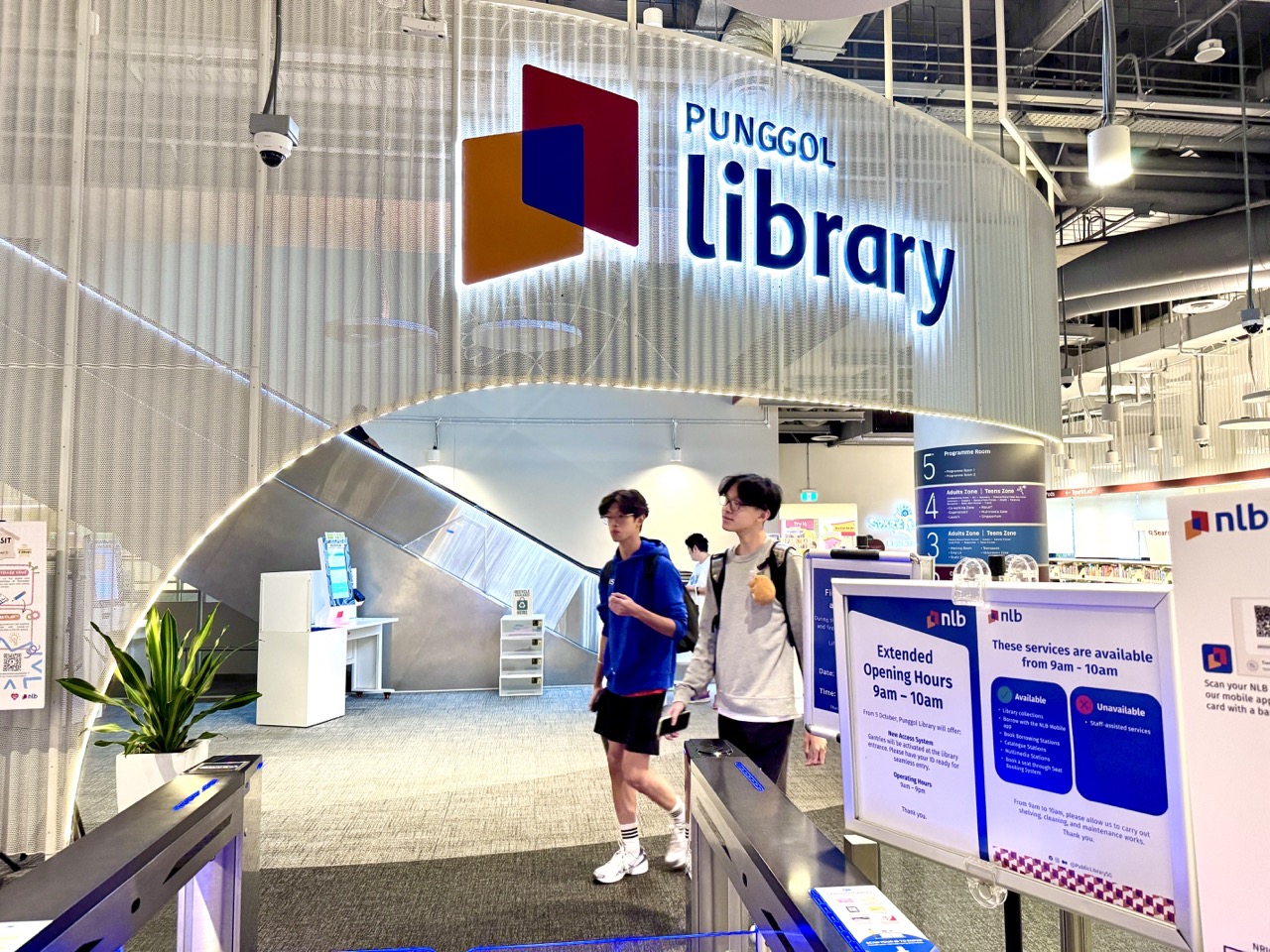
Quick answer: Families in Punggol can combine National Library Board’s S.U.R.E. information-literacy courseware with genuine research at Punggol Regional Library. S.U.R.E. stands for Source, Understand, Research and Evaluate. NLB publishes age-levelled school resources; the public library provides a local space to read and investigate. A particular S.U.R.E. workshop is not automatically scheduled at Punggol Library—check NLB’s live events separately.
Start with the right answer: what is available in Punggol?
Punggol Regional Library at One Punggol is a real local venue where families can use books, reference material and reading spaces as part of school research. The National Library Board (NLB) also publishes its nationwide S.U.R.E. information-literacy resources online, including school courseware for Primary, Secondary and pre-university learners. S.U.R.E. stands for Source, Understand, Research, Evaluate.
The useful educational opportunity is to combine these resources into a structured habit: decide what question needs answering, identify an authoritative source, understand what it actually says, investigate other relevant information and evaluate the claim fairly. This is not an assertion that Punggol Library runs a specific S.U.R.E. class on every visit. Courses, teacher workshops and other NLB events require separate confirmation through the official NLB listings.
The main resources are NLB’s S.U.R.E. for Schools and the official Punggol Stories exhibition page. The latter describes a permanent heritage exhibition across levels 1, 3 and 4 of Punggol Library. This guide shows how to use legitimate local topics for reading, source analysis and a clear student report without pretending that a specific research activity is an official library lesson.
Why source literacy is part of education, not just avoiding scams
Students encounter claims in textbooks, websites, social media clips, school chats, project work and discussions about future jobs. Some statements are accurate, others are incomplete, and some mix a confirmed event with an uncertain prediction. A learner who can read critically is better equipped to write English essays, analyse Science data, evaluate History sources and make practical family decisions.
The skill is not simply distrusting everything. Cynicism can become another shortcut. Responsible research asks what has been established, which evidence is relevant and where uncertainty remains. A government notice can reliably announce an intention while not proving that a planned facility is already open. A parent recounting a childhood memory can be a valuable primary account of experience without establishing every date of town planning.
Punggol is a useful place to practise because it has changed rapidly, and many official announcements discuss education, transport, housing and a growing digital district. These provide a manageable set of case studies that parents and students can investigate with publicly available primary sources.
The S.U.R.E. framework in everyday language
Source: Who produced this information, when, for what purpose and with what access to the facts? An institutional website may be authoritative for its own admissions dates but not necessarily the best evidence for a claim about another institution. An eyewitness can establish what they personally saw, not every broader explanation for what happened.
Understand: Read the claim exactly. What is the subject, date, unit and level of certainty? Distinguish “has opened” from “is scheduled to open”, an estimate from a measured result, and an opinion from a factual assertion. Misunderstanding is a frequent cause of accidental misinformation even when the original source was accurate.
Research: Look beyond the first result. Search for the primary announcement, a relevant handbook, archival record or credible independent evidence. Keep track of which sites repeat the same original story so that duplication does not masquerade as several independent confirmations.
Evaluate: Decide what the evidence supports, what remains ambiguous and whether an alternative explanation better fits the facts. A well-supported conclusion can still include qualifications. The ability to say “not yet established” is a strength in schoolwork and public discussion.
Punggol Library and the difference between a space and a programme
The National Library Board’s Punggol Library serves readers across ages and interests. NLB’s official library materials describe accessible collections, spaces for children and teenagers, research and reading resources, and a local history exhibition. These can support a family learning routine, but a public space does not guarantee a librarian will run a personal research lesson for every visitor.
A practical plan is to arrive with a small question, identify suitable printed or digital resources, take accurate notes and finish with one verifiable answer. For a younger child, a parent may read a short passage aloud and ask what the author actually said. For an older student, the work may involve identifying a primary document and comparing it with a secondary discussion.
Borrowing policies, opening arrangements and event registration should be checked on NLB’s current pages. A student’s learning project should also respect other library patrons’ privacy, the need for quiet in appropriate zones, accessibility features and any photography rules.
Four different kinds of statements about Punggol
Consider four deliberately different statement types. “Punggol Library fully opened on 5 April 2023” is a historical factual claim that can be checked against official NLB records. “Punggol’s library is the best place to study” is a personal evaluation whose meaning depends on the learner. “A future project is planned to be completed by a given date” is a forecast or schedule, not proof of present completion. “If the town had twice as many study spaces, every student would score better” is a speculative causal claim that requires evidence and may not be defensible.
Students should label the type before deciding what kind of verification is possible. A fact can be checked against reliable records, an opinion can be discussed with its criteria, a plan can be tracked against subsequent announcements, and a causal claim requires a suitable method that considers alternative explanations.
This improves writing because a paragraph no longer treats every statement as equally certain. A student can move from vague claims like “Punggol has the most opportunities” toward a precise and useful statement about an identifiable facility and the learning opportunities it actually offers.
A first research project: when did the library open?
A Primary school student can investigate a manageable question: “When did Punggol Regional Library open?” The answer needs attention because the library’s initial opening was staged. NLB describes a soft launch of its first two floors in January 2023 and full opening on 5 April 2023. If two sources give January and April, they may refer to different stages rather than being contradictory.
The child writes a research question, searches an official NLB page or report and copies the relevant date into notes with the source. They should then explain the difference between “first floors opened” and “fully opened”. That explanation is more informative than simply choosing whichever date appeared first in a search result.
The exercise teaches that apparent factual conflicts can be resolved by defining the event precisely. It also reinforces careful reading and a habit of using date-specific verbs. Students should not claim the site or programme began on a guessed day when NLB’s own records are available.
A second project: read Punggol history without turning memory into certainty
NLB’s Punggol Stories exhibition covers the area from early communities and plantations through leisure, agriculture and later urban transformation. This supplies rich context for school History, English and Social Studies. Yet the goal of a source project is not to retell every part of Punggol’s history from one wall panel.
Invite a child to select one photograph, display caption or documented event. Ask who made the record, which date is given, what the image can directly show and which historical explanation must come from other material. A photograph of a place may establish how a feature appeared at a moment in time; it may not establish why planning authorities made a decision.
For family oral histories, seek the person’s consent and separate “My grandmother remembers…” from “The government decided…”. Memory is valuable as personal evidence, while planning decisions need documentary corroboration. The student can respect both instead of using one to invalidate the other.
A third project: is an ambitious Punggol digital-district claim true?
A student might encounter the statement that Punggol Digital District will support 28,000 jobs. JTC’s official district overview uses this figure as part of the district’s intended scale. It should not be rewritten as “28,000 jobs are already filled today” without separate operational evidence. A projected capacity, a future employment opportunity and a verified count of existing jobs are different quantities.
Ask the learner to find JTC’s official source, note its date and wording and produce a two-column comparison: “What the source says” and “What a sensational headline might incorrectly imply”. The answer should recognise that a long-term ambition may be real and important even if the final outcome remains in the future.
This exercise is particularly useful for older pupils studying percentages, economics or public policy. They can discuss how figures can be accurate within one definition and misleading when placed under a different headline. The problem is not necessarily arithmetic; it may be the meaning of the denominator and the time frame.
How to research a claim about a school or course
Educational decisions have direct consequences for families. A parent reading that a particular diploma automatically qualifies a student for a degree should identify the awarding institution, exact programme, entry rules and intake year. A news article about a university building is not proof that every degree accepts every applicant.
A research checklist begins with the official admissions page and programme handbook. Record the qualification name, applicant category, deadlines, stated prerequisites, supporting documents and whether the source is current. If a key requirement remains unclear, the responsible conclusion is to contact the institution, not to fill the gap with a confident assumption.
This method is especially useful around Punggol Digital District where SIT, DigiPen and other partners may share a geographical area while retaining separate programmes and admissions. A nearby campus is an opportunity to investigate, not an automatic pathway into every institution.
What do Basic, Intermediate and Advanced levels mean in NLB S.U.R.E.?
NLB’s current S.U.R.E. for Schools site categorises courseware as Basic for Primary students, Intermediate for Secondary students and Advanced for pre-university or junior college students. The framework is the same, but the learning tasks become more sophisticated with age. NLB also provides resources across information literacy, digital safety and digital wellness.
A Primary learner may evaluate a short headline and learn to ask who wrote it. A Secondary student may compare two reports, identify an incomplete claim and investigate where a photograph first appeared. A pre-university learner may analyse how search systems, algorithms, social context and framing influence information.
These levels are resource categories, not proof that every activity occurs at Punggol Library, and not formal school examination levels. Teachers and families should select tasks appropriate to reading ability and maturity rather than using the most advanced resource merely because it sounds impressive.
Why images, captions and dates must be checked together
A photograph can be genuine but misleadingly captioned. An older image might be used to illustrate a future project, a picture from a different place may be presented as Punggol, or a cropped frame may conceal the context. A student should ask whether the date, location, photographer and original description are known before treating the image as proof of a current event.
For a safe class exercise, use an officially captioned photograph from a public archive or an educational image for which reuse is permitted. Compare its actual caption with a deliberately misleading fictional headline, and identify which claims remain unsupported. The student is learning source analysis, not being asked to track people or obtain private location information.
Do not repost images of strangers simply to create a fact-checking challenge. Respect intellectual property, privacy and source credit. Written descriptions or neutral diagrams can serve the same educational purpose when imagery adds no independent evidence.
Artificial intelligence and the new problem of fluent answers
Generative AI can produce polished text that appears organised and authoritative, but fluency does not establish factual correctness. It may combine real facts with wrong dates, invented citations or unsupported comparisons. Students should therefore ask AI to help structure a research plan rather than treating its first response as the final authority.
A useful sequence is: formulate the question, gather actual sources, verify dates and quotations, then draft an explanation that cites the material. If AI is used to summarise a source, the learner should compare the summary with the original and identify at least one omitted qualification. They must follow school rules on AI use and attribution.
For high-stakes areas such as health, money, law, university admissions or safety, the cost of an invented detail may be substantial. A student should be ready to say, “I cannot confirm this from the sources I have,” and seek an appropriate authoritative channel. That is more responsible than pretending that every question has a simple final answer.
How a family can use the physical library without overcomplicating it
The easiest routine is a single focused question rather than an exhausting research marathon. A Primary child might ask how a familiar animal moves, while a Secondary pupil might investigate one year in Punggol’s history. Choose appropriate resources, let the child identify the relevant passage and ask them to explain its meaning in their own words.
If the family is visiting Punggol Stories, choose one exhibit item and discuss what it teaches. Follow the venue’s instructions and avoid obstructing other readers or visitors. If a child needs accessible formats or a lower-sensory environment, consult NLB’s current accessibility guidance and plan around the child’s own needs rather than assuming every feature is available at every moment.
The measure of success is an answer the learner can support, not the number of books photographed or online tabs opened. A short visit followed by a thoughtful discussion can build a habit more effectively than a heavily scheduled outing.
Source notes that an examiner or teacher can actually use
Every note should capture a working title of the document, the organisation or author, publication date when available, the exact point being used and where the evidence can be found. If a pupil writes only “Google says”, the teacher cannot tell what the source actually was. A search engine helped find the information; it is not automatically the author of the claim.
A compact note may read: “NLB, Punggol Stories exhibition description, official exhibitions site, checked October 2026: exhibition spans levels 1, 3 and 4.” This is not a complete bibliography for every academic style, but it establishes provenance. Older students should use the citation style specified by their school or institution.
A citation is not a decoration added after writing. It lets another reader trace a claim, check context and discover whether the source supports the wording. It also protects the student from accidentally treating a copied assertion as their own independently verified finding.
A family-friendly evidence table
Make a four-column worksheet: claim, source, exact evidence and status. For a claim about an official 2026 course, the source might be the institution’s live programme page, the evidence its named entry requirements, and the status “confirmed for the listed intake” or “not verified”.
A second source is useful when it adds genuinely different evidence. Two news sites repeating the same press release do not necessarily create two independent confirmations. An official institution announcement paired with the actual current admissions handbook can be stronger because they answer different parts of the question.
Avoid rating evidence solely by whether it appears high in search results. Relevance, independence, currency and proximity to the underlying facts matter more. A beautiful site with no named author or documentary support may be less useful than an unexciting official document.
Frequently asked questions
Does NLB offer S.U.R.E. resources for Primary and Secondary students? Yes. NLB describes Basic, Intermediate and Advanced school courseware on its official site.
Is S.U.R.E. a weekly class at Punggol Library? The framework and online courseware are established; a specific in-person local session requires a current NLB event notice.
Where can we research Punggol’s history in person? NLB’s Punggol Stories exhibition is an official local resource at Punggol Library. Check its current visitor information.
Are search-engine summaries enough for a school citation? No. Students should identify the underlying author or organisation and the source that contains the evidence.
Can AI write my child’s research report? Students must follow school academic-integrity rules and personally verify every factual claim and attribution. AI fluency does not substitute for evidence.
Can a personal memory be a primary source? It may be primary evidence of the person’s recollection or experience, with consent and appropriate context. It does not necessarily establish broader historical causation.
Why is the exact date important? A plan, announcement, opening and present-day operating status may describe different stages. Dates prevent accidental mixing of them.
Is this method only useful for Humanities? No. It improves Science claims, Maths word-problem interpretation, English writing, financial decisions and work research.
A fifteen-minute fact-check routine for Primary students
Begin with a sentence the child can understand, such as “Every sea creature lives in salt water” or “Punggol Library opened all its levels on the same day.” The statement should be age-appropriate and should not involve frightening or private material. Ask the child to identify the exact word that makes the statement testable. Words like “every”, “always”, “only” and “never” often demand stronger evidence than the speaker realises.
Next, look for one suitable reference from NLB or another credible educational source. Invite the child to retell the relevant passage without copying it word for word. Ask what the source confirms and whether the sentence needs to be rewritten. If a child finds an exception, encourage a more accurate claim instead of celebrating that someone else was “wrong”.
The final step is a dated note in one or two lines: the original statement, the relevant source and a corrected version. The aim is a repeatable habit that leaves the child curious. A fifteen-minute exercise carried out consistently is more useful than an occasional long lecture about misinformation.
Secondary school: practise lateral reading
An older pupil can open a claim in one tab and investigate the source in separate tabs before accepting what it says. Who operates the website? Does the named author have relevant expertise? Can a primary document confirm the claim? Is the report current, or does it describe an earlier stage of a project?
This approach is sometimes called lateral reading: instead of only reading within a page, the investigator checks information about the page and its claims from other relevant sources. Students should also distinguish independent evidence from duplication. Ten websites syndicating the same announcement do not automatically count as ten original witnesses.
A practical Punggol exercise is to take an announcement about a proposed district facility and find the original agency release. Then look for a later official opening notice. If none is available, the student records that the launch status cannot be confirmed from the sources checked. That is a complete and defensible research outcome.
Pre-university research: how to judge a source without relying on its appearance
NLB’s advanced S.U.R.E. courseware introduces the source, understand, research and evaluate stages while extending into synthesis, news literacy, digital safety and wellness. A pre-university learner should go beyond checking whether a website looks professional. They should investigate underlying methodology, source incentives, publication date, data quality and whether an author’s conclusion is proportionate to the evidence.
For instance, a study reporting improved results after a digital-learning intervention may lack a relevant comparison group. If another factor changed at the same time, the improvement cannot simply be attributed to the intervention. This is not a reason to dismiss the study without reading it; it is a reason to ask about method, alternative explanations and the stated limitations.
A strong school report draws a distinction between what a source observes, how it interprets the evidence and what the student concludes after comparing sources. The student’s original contribution is the reasoning that connects these pieces honestly.
A source-dependence problem: five links may tell one story
Imagine a student finds five articles that make the same claim about a future Punggol campus facility. On inspection, three articles quote the same institutional press release, a fourth summarises one of those articles and the fifth contains a separate official schedule. There are five links, but the first four may offer little independent corroboration of a specific operational date.
Students can draw a simple source map with arrows. Put the original press release in one box and draw arrows from the three reports that rely on it. Put the summarising article beneath its immediate source. The separate schedule goes in another box because it provides information from a different document. This visualises why citation quantity and evidence independence are not the same.
The work is conceptual, not a formula assigning a numerical trust score to all websites. Different claims need different types of evidence: an event date, a scientific measurement, a personal memory and a legal requirement are not verified through exactly the same process.
A worked example: percentages need the correct denominator
Suppose a fictional school newsletter claims that a new reading programme has “doubled participation”. The underlying table shows ten children participated in one term and twenty in another. Participation did double in absolute number, but a thoughtful reader asks how many pupils were eligible in each term. If eligibility rose from 20 to 100, the participation rate changed from 50% to 20%, despite more children joining.
The arithmetic demonstrates how two mathematically correct statements can tell different stories. Ten to twenty is a 100% increase in the count. Yet ten out of twenty and twenty out of one hundred compare different rates. Neither measure alone proves that the programme became more or less effective for individual readers.
All figures are invented for teaching. The example is not an NLB programme evaluation. A student should learn to label the population, period and meaning of each metric before repeating an apparently striking percentage.
The difference between a source quote and the student’s interpretation
A student preparing a school project may find a sentence on an official website and paraphrase it too strongly. For example, if a source states that a university “intends to develop workshops”, it is inaccurate to write that workshops are already open for everyone. Even without changing the proper nouns, the paraphrase has converted a possibility into a present fact.
Teach the child to underline modal and time-related words: may, will, expects, plans, proposed, opened, begins and subject to approval. These words often control the answer. A short quotation can preserve an important technical distinction, but students should avoid copying long passages and should follow citation and copyright rules.
A responsible paraphrase retains the source’s scope and uncertainty in the student’s own words. When the source does not resolve the question, the student may explain what additional document would be needed, such as a formal admissions handbook or a dated opening notice.
Science enquiries need reproducible evidence, not popularity
Imagine a child sees a widely shared claim about the quality of water in a Punggol waterway. The number of likes and shares does not validate an environmental measurement. A credible scientific assessment would need a defined parameter, sample location, sampling method, units, collection time and suitable interpretation.
A classroom can investigate the principle with wholly fictional values for temperature or turbidity. The students graph the values, compare two points and ask what could cause differences. They must not claim to have measured actual water safety, touch unknown water or infer that a local environment is unsafe from an invented exercise.
The key research question is what information would allow a reliable conclusion. This connects S.U.R.E. information literacy with scientific method: source provenance, measurement reliability, controlled comparison and clear limitations.
Media literacy does not require finding a villain
Not every wrong claim comes from deliberate deception. A person may misunderstand a schedule, mix two similarly named programmes, use a dated image or repeat a friend’s estimate as if it were a verified figure. Students should investigate claims without automatically accusing the speaker of bad intent.
A respectful correction states the strongest relevant evidence and explains the difference in plain language. For example: “The notice announces a planned opening next year; it does not say the facility is currently operating.” This is far more useful than mocking someone for sharing the original message.
Parents can model the habit when family group chats circulate uncertain claims. The aim is to protect people and improve the shared information environment while maintaining healthy relationships. Good judgement includes deciding whether a correction is useful, urgent or better addressed privately.
How to use AI as a research assistant without surrendering judgement
A student can ask a generative system to propose search keywords, explain an unfamiliar concept, suggest alternative interpretations or organise questions. Those are potentially useful supporting activities. The student must then verify every cited document, date, quotation and finding against an actual source. AI-generated citations can be malformed or fabricated, and models can confidently present an incorrect claim.
A safe assignment uses an intentionally invented claim and asks the student to identify which parts of an AI answer require external verification. Then the learner looks for primary sources and revises the answer. No personal data or private documents should be entered into tools that the school or family has not approved.
The educational outcome is not the number of prompts produced. It is the student’s ability to state what they independently checked, where the answer remains uncertain and whether the assistance complied with academic-integrity requirements.
A Punggol 2026–2027 research notebook
Encourage older students to keep a notebook with a page for each dated source. A useful page records the question, search terms, source URL, author or organisation, publication date, relevant claim, what it does not establish and the next item to investigate. This allows the learner to revisit a developing town plan without silently rewriting history.
For example, an October 2026 article may report that a service is proposed for 2027. In the notebook, mark the October record as a plan at that time. When a later announcement becomes available, add a new dated entry rather than editing the earlier source to make it sound prophetic. This preserves the distinction between what people knew at the time and what happened afterward.
The same method is useful for school assignments and future university research. Knowledge improves as evidence arrives; reliable researchers make those changes visible rather than pretending they were always certain.
An eight-week family research progression
Week 1 introduces the four S.U.R.E. questions using a short school-appropriate claim. Week 2 focuses on who produced the information and how to locate an original source. Week 3 teaches children to identify fact, opinion, forecast and speculation. Week 4 makes a simple research table with two relevant sources and a note about how they are connected.
Week 5 examines a photograph or chart and checks whether its caption, date and denominator support the proposed conclusion. Week 6 introduces an AI-generated summary that contains a deliberately inserted error; students must check it against a real document. Week 7 asks the learner to write a 250-word answer with honest sourcing and limitations. Week 8 is a presentation to a family member followed by one round of revision.
Adapt the complexity to the child’s school level. A younger child may present one sentence and a picture; an older learner may build a short referenced report. Consistency, accuracy and independent thinking are the important measures of progress.
A practical family visit plan at Punggol Library
Before leaving home, choose one research question and check the current NLB library details. Bring a notebook or an appropriate device and agree on how long the family will spend. The opening minutes are for locating relevant material, not racing through every feature of the building.
During the visit, let the learner read the actual passage. For a Punggol history topic, use the official exhibition and any suitable library sources without disturbing other patrons. For a science or information-literacy topic, ask staff where appropriate collections may be found, while recognising that librarians cannot be expected to conduct a private tutorial on demand.
After the visit, write a short answer at home and identify one remaining question. Do not photograph unsuspecting patrons or publish copyrighted pages wholesale. Learning should respect the community space as much as it develops the student’s research skills.
Questions teachers can use to assess the final answer
Can the student name the exact claim being investigated? Have they selected sources that are relevant to that claim rather than merely popular? Does the answer distinguish a plan from a completed event? Have they made independent observations about what the evidence supports and where uncertainty remains?
If two references disagree, has the student checked whether they refer to different dates or definitions? If the report contains a number, is the unit and denominator stated? If an image appears, is its provenance and role clear? If AI assistance was used, has the student followed school rules and personally checked the result?
The standard does not require a child to solve every contested issue. It requires them to reason transparently. A supported “I cannot determine this from the available evidence” may be a better answer than a confident assertion that ignores uncertainty.
How schools can use NLB’s official courseware appropriately
NLB describes S.U.R.E. materials across Basic, Intermediate and Advanced levels, including videos, case studies, infographics and slides. Educators can select relevant material aligned with the students’ age and objectives. The official advanced-level page also addresses news literacy, personal data, digital footprints, AI and digital wellness, reinforcing that information quality is connected to responsible technology use.
An educator should not treat all modules as compulsory for every class or assume that the programme has replaced the school’s approved curriculum. Instead, the materials can support lessons on reading a source, evaluating a claim or completing a research project. Current programme enquiries should be directed through NLB’s designated channels and event information.
The best adaptation is small and specific: a five-minute source question in English, an evidence table in Science or a Punggol archive comparison in History. Repeated across subjects, the same discipline builds independence without creating a separate layer of busywork.
The lasting value of learning to say what we know
Punggol’s libraries, schools, university and digital district bring many kinds of information into everyday family life. The challenge is not a shortage of claims. It is knowing how to tell a confirmed fact from an estimate, a proposal from an opening, a genuine photograph from a misleading caption, and an attractive AI answer from a supported explanation.
S.U.R.E. gives families a short and teachable structure for that work. At Punggol Regional Library, a child can practise it with real books, a local history exhibit or a carefully chosen official online source. The educational gain is a habit of mind: read attentively, trace evidence, compare responsibly, and update a belief when better information appears. That capability will serve the learner long after a single school project is finished.


