
Quick answer: At a signalised Punggol pedestrian crossing, begin crossing during the steady green-man phase, not when the figure starts flashing. LTA explains that flashing green gives people already in the crossing time to finish. At some junctions, pressing the pedestrian button registers a request within Singapore’s GLIDE signal-control system. Eligible seniors and persons with disabilities can receive three to thirteen additional seconds at crossings equipped with Green Man+. These technologies help, but pedestrians must still watch for turning vehicles and use the correct crossing.

Why does pressing the button not instantly turn the red man green? Why do traffic signals sometimes remain red when no cars seem to be coming? And why do some crossings beep or give an older person extra seconds? These questions have practical answers. They concern the allocation of road time among pedestrians, cars, buses, cyclists and turning vehicles, rather than an arbitrary timer that someone can speed up by pressing harder.
This guide explains the operating principles and safe pedestrian decisions using LTA’s current public explanations. It does not duplicate eduKatePunggol’s photographs of individual crossings or promise exact waiting times at named Punggol junctions. Equipment, timing and traffic conditions may differ by street and can change after works or a traffic review. The aim is a durable way for families to read and use signalised crossings responsibly.
Understand the crossing before stepping off
| Feature | Meaning | Safe response |
|---|---|---|
| Red pedestrian man | No crossing start | Remain on the kerb |
| Steady green man | Phase to begin crossing | Check traffic and walk steadily |
| Flashing green man | Clearance for people already crossing | Finish; do not start |
| Pedestrian push button | Registers a request where required | Press once, then wait |
| Green Man+ reader | Eligible card holders can request extra time | Tap only where installed |
| Sound and countdown features | Additional accessibility or timing cues | Use with pedestrian signal and road checks |
1. Pedestrian signals distribute shared road time
A junction may serve vehicles going straight, vehicles turning, buses from side roads and people crossing several different approaches. These movements cannot all occupy the same space simultaneously. Signals divide the movements into phases, including pedestrian crossing intervals and necessary clearance between incompatible vehicle movements. Safety is therefore the first reason a signal cannot simply change whenever one person wishes.
Pedestrian crossing widths and local traffic patterns vary. A short residential road and a multi-lane junction near the Punggol transport hub need not receive identical signal timing. LTA’s public explanations describe a balance of movement, accessibility and network efficiency. Residents should resist guessing the programmed duration of a named junction from a short visit.
A family can improve its crossing experience without changing the signal. Arrive with enough time, wait at the marked kerb and know the actual route to the next crossing. A less stressful journey is more dependable than assuming every green phase will arrive the moment it is requested.
Punggol example
A parent on the way to school budgets a little waiting time at a Punggol junction, reducing the temptation to start on a flashing pedestrian signal.
2. Push buttons register pedestrian demand
At many crossings, pressing the button tells the controller that a pedestrian is waiting. LTA explains that this avoids allocating pedestrian green time when there is no request and the road can continue to serve other traffic. Not all junctions operate this way: some busy intersections automatically include a pedestrian phase because pedestrian demand is continuously high.
A single legitimate request is enough. LTA’s GLIDE article makes clear that repeated, harder button pressing will not make a signal appear faster after the request has been registered. The controller still needs to complete relevant vehicle phases and safety clearances. A person should check the push-button indicator where provided and then remain safely at the kerb.
It is useful to explain the difference between a request and a command. The button does not directly cut power to every traffic signal or immediately stop moving cars. It is one input to a managed traffic sequence. This makes the waiting period easier to understand without encouraging risky crossing behaviour.
Punggol example
A child presses the button near an HDB precinct and presses again because the man remains red. The adult explains that pressing twice does not accelerate a request.
3. GLIDE coordinates more than one junction
Singapore’s Green Link Determining system, known as GLIDE, uses information about vehicle and pedestrian demand to coordinate traffic signals. LTA describes road sensors and regional signal control that help distribute green time and connect junctions along a corridor. The objective is to reduce avoidable stopping while preserving safe road movements.
A traveller sees only one intersection, but its controller may be part of a sequence involving nearby junctions. The visible absence of a vehicle at the nearest stop line does not prove the phase can safely change at once. Other vehicles may be approaching or another pedestrian movement may need completion. LTA’s March 2026 reply confirms the importance of safety-clearance intervals and network coordination.
Do not interpret a green wave as advice to drive faster or to ignore speed limits. GLIDE allocates phases based on traffic demand and safety constraints, not a personalised speed target for individual drivers. Its existence is most useful for understanding why signals do not work as isolated stopwatches.
Punggol example
Two neighbouring Punggol crossings show different red periods. That is not evidence by itself that one has failed; their phase requirements may differ.
4. Waiting after pressing the button is normal
Once a pedestrian request enters the system, an active vehicle phase may continue to its appropriate termination. Additional clearance time may be needed before pedestrians can proceed. LTA has explained that such time can be present even when observers do not see conflicting vehicles, because safety must not depend on a single person’s incomplete view of the road.
Pedestrians should not decide to ignore the red man simply because they believe the intersection is empty. Vehicles can approach faster than anticipated, and a turning movement may not be visible from one standing position. Wait for the proper phase rather than attempting to negotiate informally with a driver.
On the way to a school, bus interchange or appointment, build timing variability into the walk. A route that requires stepping off during red signals to stay on schedule is a badly planned route. That problem is solved by allowing travel time, not by pressing the button more aggressively.
Punggol example
A person reaches a Punggol junction with no obvious cars and wonders why the signal stays red. The right response is still to wait at the kerb.
5. Steady green is the time to begin
LTA distinguishes the steady green-man phase from the later flashing phase. The steady phase provides the opportunity for pedestrians waiting at the kerb to enter the crossing. It is particularly important for people who need time to start moving, such as older adults or families guiding children.
Even with a steady green, check for turning vehicles and other hazards. Motorists have duties to give way where the traffic rules require, but a pedestrian should not treat a signal as a force field that prevents every mistake. Walk along the marked crossing rather than weaving between stopped vehicles.
Begin deliberately rather than rushing. A child may be distracted by friends on the other side, and a parent may be handling a stroller or carrying bags. Maintain a controlled pace and pay attention to what is happening at the road, not a device held in the hand.
Punggol example
A family begins walking during steady green on Punggol Drive only after checking the relevant turning traffic. They cross directly instead of running diagonally.
6. Flashing green is primarily clearance time
The flashing green man is intended to let pedestrians already on the crossing finish. LTA specifically cautions that someone only arriving at the kerb when flashing begins may not have enough remaining time to cross. This is why a visible green figure does not always mean a new pedestrian should start.
Flashing duration is linked to factors such as crossing width and typical walking pace. It cannot guarantee that every person starting at the last second will make it to the other side safely. Children should not use a countdown display as a personal challenge to beat a timer.
Teach a two-part rule: begin on steady green; if the figure flashes after you are already crossing, continue steadily to the safe side. Running wildly or stopping midway to photograph the lights creates unnecessary hazards.
Punggol example
A student reaches the kerb after the green figure begins flashing. The safe choice is to wait for another cycle, even if several seconds remain on the counter.
7. Green Man+ is a special extension feature
LTA’s current Intelligent Transport Systems page says equipped Green Man+ crossings can grant between three and thirteen extra seconds, depending on the crossing width. The feature is designed to make crossing easier for eligible elderly pedestrians and persons with disabilities. It does not exist at every signalised crossing.
At a crossing with the feature, the card reader sits above the standard push button. Eligible users can tap the relevant CEPAS-compliant senior citizen or disability concession card to register the need for more time. The person still follows the pedestrian signals and normal road checks. The extra time is not an instruction to start late.
The amount of additional time is not universal. A family cannot promise that every Punggol crossing adds the maximum number of seconds. Confirm the actual installed reader and current eligibility guidance before relying on it for a specific route.
Punggol example
A grandparent visiting a Punggol community facility checks whether the chosen pedestrian crossing has a Green Man+ reader rather than assuming the feature is townwide.
8. Eligibility does not mean every crossing has a reader
A senior citizen concession card and an equipped Green Man+ crossing are two separate requirements. LTA describes the eligible senior citizen card route for Singapore citizens and permanent residents aged at least sixty, and points persons with disabilities toward SG Enable arrangements. The details of card issuance should be checked with the relevant provider.
Even an eligible resident cannot receive a Green Man+ extension from a pole that has no reader. The absence of that equipment does not invalidate the concession card. It simply means that the crossing has the ordinary set of facilities unless other accessibility arrangements exist.
An accessible route also depends on more than timing: kerb ramps, level footpaths, sufficient waiting space and suitable crossings along the whole journey matter. Choosing the right route may therefore be more effective than focusing on the additional seconds alone.
Punggol example
A family identifies a useful equipped crossing near a Punggol amenity, but also checks the path leading to it for ramps and surface defects.
9. Audible signals make crossings more usable
Selected pedestrian signals include sound cues intended to help people with visual impairments. LTA’s GLIDE explanations describe locating tones and crossing tones that provide information beyond the visual red and green figures. Sound levels can be adjusted according to surrounding noise conditions.
Not every pole has identical sound equipment, and a sound cue should be interpreted with its relevant purpose. Other features such as tactile ground indicators and consistent kerb design can contribute to a usable crossing. Accessibility is a system of complementary aids rather than one special button.
Residents should not tamper with audible equipment or assume that silence always means a signal is faulty. If a particular device expected to operate appears damaged or absent, describe the exact location to LTA through an official channel.
Punggol example
A child asks why one Punggol pedestrian crossing beeps and another does not. The adult explains that some crossings have additional accessibility facilities.
10. Countdowns are not an invitation to sprint
At selected busy junctions and school areas, countdown timers provide information about time remaining in the pedestrian phase. The numbers help a person already crossing understand the approaching end of that phase. They do not override the distinction between steady and flashing green.
A child may treat a visible number as a game and try to race it. A parent should establish that road crossing is about moving predictably and checking traffic, not achieving a personal record. Sprinting may create a fall risk or cause a child to move beyond the marked crossing.
Someone arriving at the kerb while the green man is flashing should wait regardless of the remaining number. Someone already on the crossing should continue calmly and directly toward safety. The countdown supports judgement only when interpreted alongside the relevant signal.
Punggol example
A student with a backpack sees five seconds remaining and wants to start. The family uses the next steady green instead.
11. Turning vehicles still need attention
Turning movements can bring vehicles across a pedestrian route under certain signal arrangements. Drivers have applicable giving-way obligations, but they can make mistakes or fail to notice pedestrians. A green pedestrian figure therefore does not eliminate the need to look in the relevant directions.
Large junctions are harder to interpret because a vehicle may approach from a lane hidden behind another vehicle or may be waiting to turn. Avoid relying on a single driver waving, and do not cross on red because one vehicle stops. The safe sequence follows the crossing’s own signal.
Children benefit from practice recognizing vehicles that may turn across their path. They should be taught not to look down at phones and to travel with a supervising adult until they have demonstrated reliable crossing decisions.
Punggol example
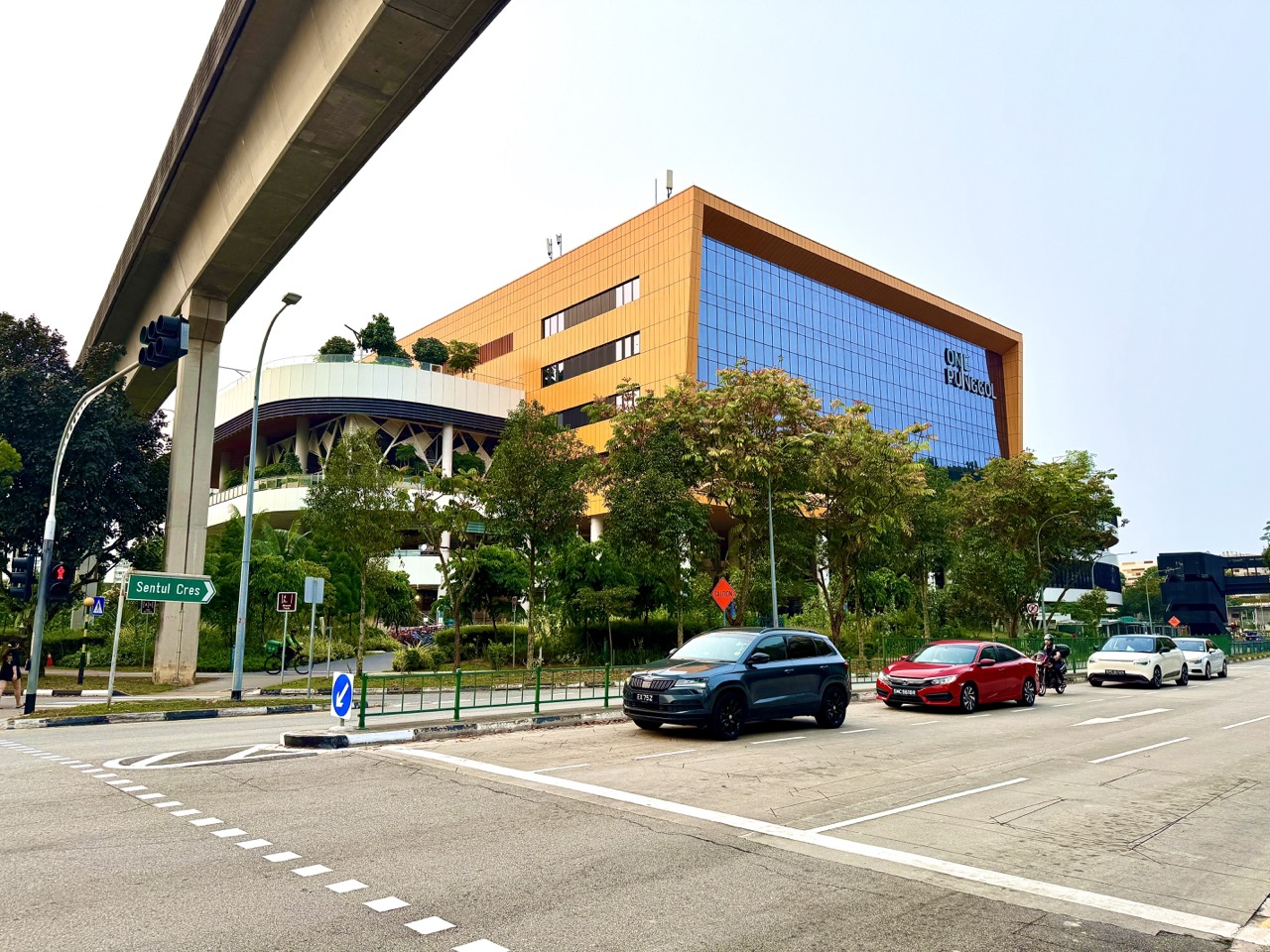
At a junction beneath Punggol’s elevated LRT, a parent waits for the green man and checks for turning vehicles rather than looking only at the signal.
12. Zebra crossings are not signalised crossings
A zebra crossing and a green-man crossing manage pedestrian movement differently. Zebra crossings use specific road markings and giving-way rules, while a signalised crossing allocates movement in time through a pedestrian indication. A zebra crossing does not need a green-man button to be complete.
LTA’s walking information also describes raised zebra crossings and other traffic-calming designs that increase visibility and encourage lower speeds. Those engineering features should not be confused with Green Man+. The presence of bright markings or a raised surface does not prove that a card-based timing extension exists.
Families should teach the appropriate behaviour for each facility. At a signalised crossing, wait for the steady green man before starting. At a zebra crossing, use the marked area with careful checks under the applicable priority rules.
Punggol example
A Punggol family meets a zebra crossing and later a traffic-signal crossing. The child learns why the two approaches differ.
13. A wide road may be crossed in two stages
Some road designs include central pedestrian refuges that allow people to cross in stages. LTA notes that such resting points are used in suitable situations. A refuge can reduce the distance that a pedestrian must cover in one continuous movement across a wide road.
Where the crossing is divided, each segment may be controlled separately. A green man for the first segment should not be treated as automatic permission to cross the remaining lanes if the far-side signal is red. Waiting within a marked refuge may be the intended procedure.
People using wheelchairs or prams may need more waiting space and should not be crowded by others stepping into traffic. A family can maintain an orderly crossing in stages without regarding the additional wait as a signal malfunction.
Punggol example
A parent reaches the central island with a stroller and sees the opposite signal still red. They wait on the refuge rather than entering the next segment.
14. Signals along a road may be coordinated
GLIDE can link traffic signals along corridors, sometimes helping vehicles travel through adjacent junctions with fewer stops. Coordination is based on network conditions and does not guarantee every vehicle or pedestrian receives its preferred phase instantly. The sequence must still accommodate protected pedestrian movements.
LTA’s March 2026 response highlights the importance of preserving safety-clearance time within corridor coordination. Residents may observe a red light even without obvious cross traffic, but that alone is not proof of a fault. Some work is happening in the controller’s plan that is not visible from the kerb.
When reporting a possible malfunction, focus on a measurable or visible problem such as a broken button, missing display or an unresponsive request over repeated appropriate cycles. Do not claim to know the controller’s internal timings without official technical evidence.
Punggol example
Two adjoining Punggol traffic lights do not turn green together. A student should not conclude they are incorrectly programmed based on that short observation.
15. Construction can change the usable crossing
Roadworks may close an established walkway or move a crossing approach. A familiar green-man pole can become inaccessible behind a barrier during temporary works. Pedestrians must use the current signed route rather than ducking through hoardings or relying on last year’s photograph.
Families with schoolchildren should check any current school and worksite communication, especially where an entrance or drop-off has moved. The shortest distance on a map may no longer describe a legal or safe walking line. A parent should not send a child through a work zone to save waiting time.
If the diversion lacks a suitable accessible route, report the exact concern to the responsible site or road authority. The objective is correcting an unsafe design, not shifting a barrier independently and introducing further risk.
Punggol example
A previously used Punggol junction approach is blocked for works. The family follows the signed crossing and raises a clear accessibility concern if needed.
16. A child’s crossing routine should be easy to repeat
A simple routine can support independence: stop at the marked kerb, check the correct pedestrian signal, press the button once where appropriate, wait for steady green, look for turning traffic and walk directly along the crossing. This is easier for a child to remember than an elaborate explanation of adaptive signal algorithms.
The parent should practise the routine on ordinary trips when nobody is running late. Ask the child what a flashing signal means and what to do if the signal appears faulty. The correct reaction to confusing traffic is to wait at a safe place and ask for help rather than improvise across the road.
The technology explanation can follow later. Children who understand the basic physical decisions will be better prepared to learn about road sensors, traffic demand, signal coordination and accessibility as science and civic topics.
Punggol example
Before a Primary school journey, an adult walks the route with the child and asks them to explain each crossing decision aloud.
17. A crossing for an older adult is part of a complete route
Green Man+ can provide additional time, but an older resident also needs usable kerbs, footpaths, resting places and safe sightlines. A crossing with excellent signal timing is less useful if reaching it requires negotiating a damaged ramp or an unsuitable detour.
Families planning a trip for someone using a walking frame should test the whole route under safe conditions. Determine which side of the street has the accessible approach and whether a central refuge is needed. Do not assume the card-based extension resolves every mobility challenge.
When an existing crossing remains difficult, consider a more appropriate nearby crossing or raise a site-specific issue with the responsible agency. Protecting the person’s independence means considering movement before and after the green-man phase.
Punggol example
A grandparent travelling to Oasis Terraces selects a route with appropriate kerbs and an accessible crossing, not merely the shortest line between two addresses.
18. Report a fault without inventing a theory
LTA manages Singapore’s traffic-signal network, and OneService can help residents route suitable municipal concerns. A useful report names the road intersection, the exact side or approach, the visible problem and the time. This allows a technician to locate a particular pole and check the relevant equipment.
Observations such as a damaged button, an unlit display or an expected audible signal not functioning are more useful than claims that a junction’s AI is broken. A longer-than-expected wait is not sufficient by itself to prove a defect, since signal timings can vary with traffic.
Never step into live traffic to film a faulty signal closely. If the crossing appears unsafe, use another legal route and contact the appropriate urgent authority where immediate danger exists. Avoid sharing unrelated people’s faces or private information in a public complaint.
Punggol example
A button appears damaged near a Punggol school. A parent notes the crossing side and photograph from a safe point, then reports the physical condition.
19. The crossing makes a good systems-thinking example
A push button is one input in a wider system. Vehicle sensors, pedestrian demand, phase safety and coordination across junctions inform the traffic signal’s behaviour. The example introduces a familiar mathematical and computing idea: optimising one small outcome may create trade-offs elsewhere in a network.
A student can sketch a simple input–decision–output flowchart, then discuss why an immediate green for every request would disrupt traffic and potentially create conflicts. The class should mark the diagram as a conceptual explanation rather than the actual controller software at a named junction.
Experiments should remain observational or simulated. Do not press a real traffic button repeatedly for data collection or ask someone to stand in a road. LTA’s official guides and classroom modelling are sufficient to explain how coordinated public infrastructure works.
Punggol example
A Secondary student draws the relationship among road sensors, button requests and signal phases for a project on everyday computing in Punggol.
20. What to remember at the kerb
The safe crossing question is not whether you can outrun the countdown or persuade the red light to change. It is whether you have a designated route, the appropriate signal to begin and enough attention for the real traffic environment. These checks work at quiet residential roads and busy Punggol intersections alike.
Use Green Man+ only where installed and appropriate, and remember that the extra time depends on the crossing. Keep a good distance from turning vehicles, obey temporary diversions and never begin on a flashing green man. Equipment helps road users share time; it cannot remove all personal responsibility.
Punggol’s traffic conditions and development layouts can change. A family that learns these principles will remain safer than one that memorises the guessed number of seconds at a single crossing. The durable skill is reading the actual signal and choosing calmly.
Punggol example
At the next Punggol crossing, let the child identify the right time to begin and explain what flashing green means before moving on to the next junction.
Four practical family decisions
The school-morning countdown
A parent and child arrive just as the green man flashes and the display shows a few seconds. The child wants to race across because they are late. The parent explains that flashing time is intended for pedestrians who have already started, so they wait. A safer school routine is to leave earlier or accept a short delay, not to make late starts into a daily crossing habit.
The grandparent using Green Man+
A relative with an eligible concession card finds a crossing equipped with a reader and taps according to the posted instructions. The family knows that extra seconds vary by crossing width and do not guarantee an extended phase at another unequipped junction. They select the route based on the crossing equipment and the kerb ramps leading to it.
The button-pressing disagreement
A waiting pedestrian repeatedly presses the button and insists it speeds the sequence. LTA’s explanation says additional presses after registration do not make the green man arrive sooner. Rather than arguing, the group waits for the correct phase. If the button is physically broken, they report that observable problem through the proper channel.
The moved crossing during roadworks
A temporary worksite closes the familiar route and marks an alternative. A family follows the new signs rather than using an old crossing behind a barrier. When the diversion is inaccessible for a stroller, they document the precise issue safely and ask the responsible party to review it. The appropriate response is an accessible authorised path, not trespassing into the works.
Frequently asked questions
1. Why press the pedestrian button?
It registers a request at crossings where pedestrian activation is not automatic.
2. Will pressing the button repeatedly help?
No. LTA says further presses do not accelerate an already registered request.
3. Why do some signals turn green without pressing?
At junctions with high pedestrian volumes, activation may be automatic.
4. Can I start crossing when green flashes?
No. Flashing green is clearance time for people already crossing.
5. What does Green Man+ do?
It adds crossing time for eligible users at equipped crossings.
6. How much time can Green Man+ add?
LTA currently states between three and thirteen seconds depending on crossing width.
7. Does every Punggol crossing have Green Man+?
Do not assume so. Confirm the actual reader at the site.
8. What is GLIDE?
Singapore’s traffic-signal coordination system that uses demand and safety constraints.
9. Why is the signal red if there are no cars?
Other movement phases, clearance time and junction coordination can still be active.
10. Do all crossings have audible signals?
No. Equipment differs by location and accessibility arrangements.
11. Can a child start while a countdown still shows several seconds?
Not if the green-man phase is flashing. Wait for steady green to begin.
12. Where do I report a damaged crossing button?
Report the exact junction and problem through the appropriate LTA or municipal channel.
Official sources
LTA: Intelligent Transport Systems, GLIDE and Green Man+
LTA: Why Some Pedestrian Crossings Need Push-Button Activation
LTA: March 2026 Explanation of Signal Coordination and Safety Buffers
LTA: Green Wave and Why Repeated Pressing Does Not Help
LTA: Walking Infrastructure and Green Man+
Related Punggol guides
Punggol Drive beneath the LRT | Understanding the Junction
Things to Know About Punggol | Sheltered Walkways and Step-Free Routes
Things to Know About Punggol | Service Roads, Loading Bays and Drop-Offs
A pedestrian signal gives a safe opportunity to cross when used correctly; it is not a stopwatch to race. Remember the steady green-man start, the flashing clearance phase, and the need to watch actual turning traffic. Those three habits remain valuable as Punggol’s road network evolves.


