
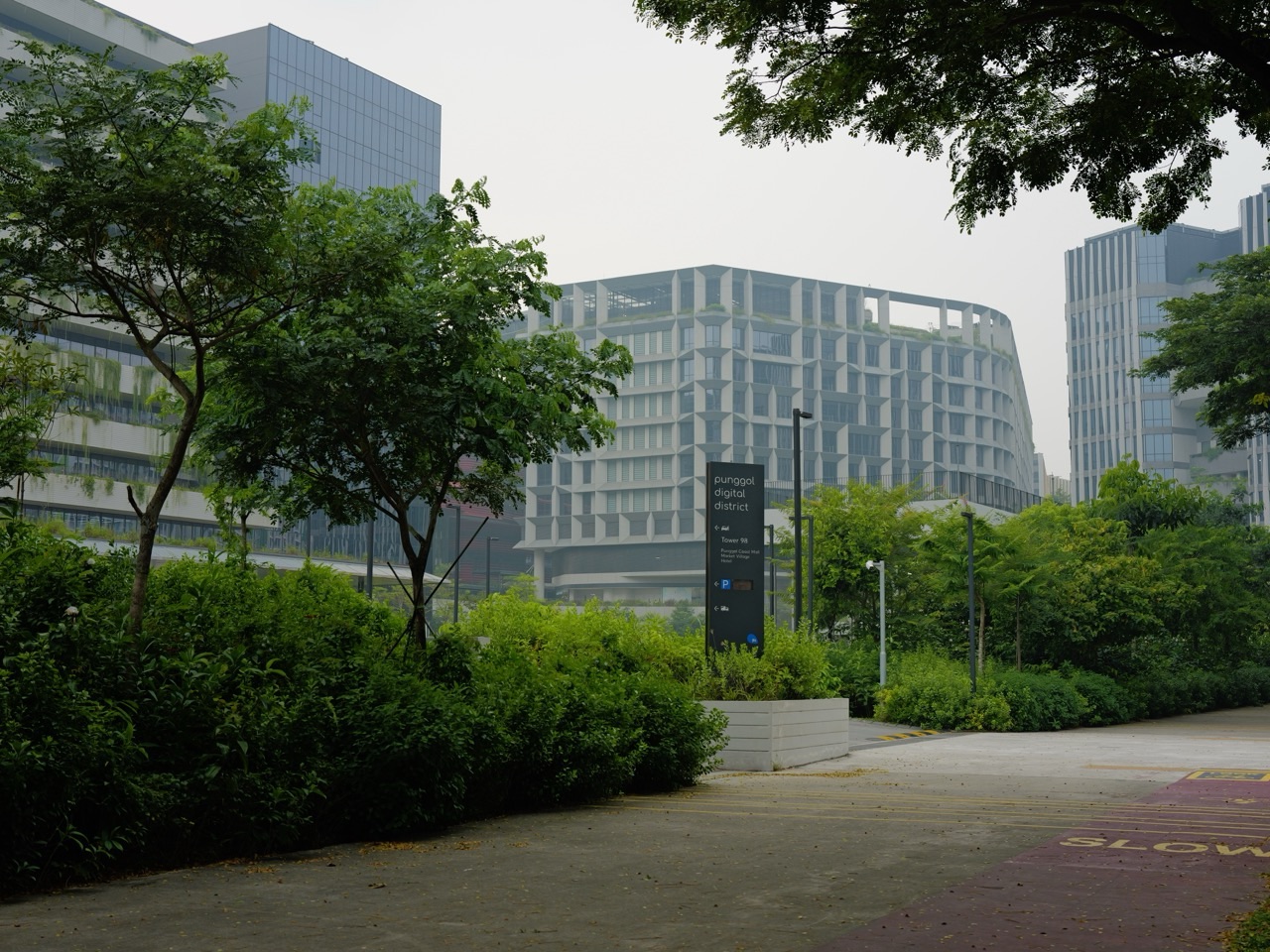
A real Punggol event on 27 October 2026
Quick answer, checked 23 October 2026. The Singapore Green Building Council (SGBC) lists a professional Learning Journey to HY M&E at Punggol Digital District (PDD) for Tuesday, 27 October 2026. The programme focuses on sustainable office fit-out, green and healthy building frameworks, a live digital-twin demonstration, and a district walkthrough examining cooling, greenery and sustainable mobility. SGBC’s public events index marks continuing professional development (CPD) credits as pending approval. It does not establish a free public walk-in tour, a final CPD-credit number or a confirmed seat for any individual reader.
Families who see the words ‘learning journey’ may assume this is a school excursion or a public workshop for children. It is instead presented as an industry CPD event, powered by SGBC member HY M&E Consultancy Services. The original SGBC events listing and its event-specific registration link should be checked for participation rules, start time, exact reporting location and places remaining. Do not interpret the wider district’s public walkways as permission to enter a member’s office.
The local educational value is that professionals are visiting Punggol to study the relationship between a building’s environmental performance and its occupants’ experience. A Primary child can learn why shade feels different from direct sunshine; a Secondary student can interpret an energy graph; an architecture or engineering professional can examine more demanding certification, measurement and operational questions. These are linked ways of learning, but they are not the same programme or qualification.
The event details SGBC has actually published
Event: SGBC Learning Journey to HY M&E at PDD: Exploring Sustainability and Innovation in a Smart District. Date: 27 October 2026. Location: Punggol Digital District, with the hosted experience at HY M&E and a campus walkthrough. Format: in-person professional CPD learning journey. CPD status: credits pending approval on the event listing. Neither a session-by-session clock timetable nor a guaranteed entry route can be derived from the index alone.
SGBC describes exploration of Green Mark Interiors (GMI), LEED and WELL considerations; a live demonstration of a digital twin; the district’s sustainability masterplan; and a guided look at district cooling, energy efficiency, biophilic design and sustainable mobility. The programme is not a promise to inspect every plant room or system that appears in a promotional description. Visitors should follow their host’s actual site-access and photography instructions.
The practical step is to open SGBC’s current events page, identify the 27 October HY M&E listing and follow the organiser’s authorised registration route. Check whether sign-up has closed and whether the session is appropriate to your professional background. Registration and CPD eligibility are organiser decisions; an article published by eduKatePunggol does not constitute a ticket.
Why a professional learning journey is different from a public attraction
The same town contains publicly accessible parks and buildings, workplaces with controlled access and university premises with academic restrictions. They may all appear in photographs, yet the rules governing entry are different. A professional CPD visit can include demonstrations or discussion that a casual visitor would not be permitted to attend. The organiser must decide who is admitted and which activities are safe for registered participants.
A parent searching for a school-holiday activity should not assume the event offers supervised children’s programming. A student hoping to learn about architecture may be better served by observing public design features from permitted spaces and using published information for study. Those alternatives can be valuable without implying access to a private office or technical installation.
An adult learner can use a formal visit to ask informed questions and compare professional approaches. Where a CPD scheme recognises attendance, the credit details should be verified from the actual approving body rather than presumed from the event’s broad label. The public listing expressly says approval is pending, so a claim that participants automatically receive a specified number of points would be unjustified.
What does sustainable office fit-out mean?
An office fit-out is more than furniture and decoration. It can involve lighting, ventilation, acoustic comfort, material selection, spatial planning, accessibility, thermal conditions and maintenance. A workplace can look stylish without delivering good environmental performance or usability. The practical question is whether design choices improve outcomes for occupants while using resources responsibly under the building’s actual constraints.
The event description specifically relates HY M&E’s location at PDD to Green Mark Interiors, LEED and WELL considerations. These frameworks have different emphases and methods. A discussion about designing with their principles is not proof that the host office has received all three certifications. For any claim of certification, readers should seek a published record showing the exact scheme, version, rating and certified project.
A good school-level analogy is comparing two study spaces. One may look attractive but have uncomfortable glare and poor sound control. Another may support reading and conversation while using suitable daylight and ventilation. Children can articulate what helps them work; professionals must go further by measuring conditions and checking recognised requirements.
Green Mark Interiors, LEED and WELL are not interchangeable
Green Mark is Singapore’s green-building assessment ecosystem administered by the Building and Construction Authority, with relevant schemes and criteria for different project types. Green Mark for Interiors deals with interior fit-out performance within its applicable version and rules. LEED is a separate international green-building framework, while WELL concentrates particularly on how buildings and organisational practices affect human health and wellbeing under its own standards.
A building or interior can consider elements common to these frameworks without being formally certified. Some areas may overlap—such as energy use, materials or indoor environmental quality—but the actual scoring and evidence differ. Parents should not teach children that a ‘green label’ is a universal certificate that automatically proves every claim about an office.
A professional visitor should ask which framework version is being discussed, whether the project is certified or merely designed with a target, and what evidence has been measured. A student can learn the general critical-reading principle: identify who issues a rating, what it assesses and whether a result refers to the current building or an aspirational goal.
What is a digital twin, really?
A digital twin is a digital representation connected, to varying degrees, with information about a physical asset or system. A building twin may represent equipment, spatial relationships and operational measurements. Its value is not that it displays a beautiful 3D model; it is that users can combine valid information and relevant models to investigate a question about the real building.
SGBC’s description promises a live digital-twin demonstration. That supports describing it as a demonstration, not announcing that attendees will receive open access to the entire district’s operational database. Data privileges, systems represented and the degree of live connection must be established from the actual demonstration. A model can be helpful even when incomplete; it becomes dangerous when viewers treat an incomplete picture as the whole physical reality.
A useful question for professionals is: which decisions become better because of this twin, and how do we know? Does it reduce investigation time, help identify energy inefficiencies or allow safer planning? The answer should depend on demonstrated use and valid measurements. The digital twin is a means to understand a system, not an end in itself.
A simple digital-twin thought experiment for students
Imagine a school classroom represented by a drawing that includes desks, windows and a temperature sensor. The drawing can show where sunlight enters. If someone then adds actual time-stamped temperature readings, the model can help compare observations. But one sensor at the back of the room may not describe conditions near every desk. A diagram that looks complete may contain substantial uncertainty.
Give students a fictional sequence of readings: 28°C, 29°C, 30°C and 28°C. Ask whether the room became uniformly hotter or whether the sensor’s location and other conditions matter. The four numbers describe one recorded series, not every student’s experience. A learner who asks about sampling and measurement has understood a key limitation of digital representations.
The thought experiment needs no personal data or network access. Teachers can use invented values, public diagrams and paper maps. It should not prompt students to attach devices to school infrastructure or seek access to operational control systems without authorisation.
How Punggol Digital District connects offices and learning
JTC describes Punggol Digital District as an integrated business and academic ecosystem. The Singapore Institute of Technology operates its Punggol campus there, while agencies and businesses support various technology and sustainability initiatives. Proximity can support collaboration, but a published district masterplan is not evidence that a particular student has permission to enter private offices or join company projects.
SGBC’s journey uses the district as a learning environment for professionals. The event description mentions campus walks, greenery and mobility infrastructure, demonstrating the possibility of studying interconnected urban systems in a real place. Residents can also examine public features independently as long as they respect access rules and avoid obstructing working premises.
A useful local lesson is that development has layers: what a public planning body intends, what has been constructed, which services are operating, and what has been independently measured. A claim that a future district will save resources must be distinguished from an audited outcome for a completed asset.
District cooling: why the whole system matters
In a district cooling arrangement, cooling can be produced and distributed through coordinated infrastructure instead of each building necessarily relying entirely on separately managed plant. The precise configuration, ownership, metering and benefits depend on the actual scheme. The engineering rationale often involves scale, operational control and opportunities to improve efficiency across connected demand.
The SGBC listing says district cooling is part of the masterplan discussion. It does not disclose enough information to calculate the cooling efficiency of HY M&E’s office or a particular Punggol building. Do not treat an overview of the technology as a measured claim about every tenant.
For a learner, the important question is what boundary a comparison uses. One central system may look efficient under a partial metric yet have pumping or distribution costs that must be included. Good Science and Mathematics ask what was counted, what was omitted and which data are needed before a firm conclusion.
Worked example: why energy per floor area needs units
Consider two fictional office spaces. Office A uses 2,400 kWh during a specified month over 400 square metres of floor area. Its simplified monthly intensity is 2,400 ÷ 400 = 6 kWh/m². Office B uses 3,000 kWh over 600 m², or 5 kWh/m². B has higher total use but a lower area-normalised value. Both observations can be true.
Does this prove B is the more sustainable office? Not by itself. The spaces may have different opening hours, occupants, equipment loads, activities and measurement boundaries. Neither the energy’s source nor relevant comfort outcomes are captured by that one ratio. A fair comparison needs a consistent scope and appropriate contextual information.
A Secondary pupil can solve the arithmetic and write two sentences: what the number demonstrates, and why it cannot settle the whole question. This is an excellent bridge between ratios in Mathematics and evidence-based evaluation in Geography or Science.
Thermal comfort is not the same for everyone
Temperature influences comfort, but so do humidity, airflow, clothing, activity and personal characteristics. An office’s design should consider legitimate occupant needs and applicable standards rather than assuming one reading guarantees universal comfort. The concept matters in Singapore’s hot and humid climate, where cooling and energy use are closely connected.
An occupant may complain that a workstation is uncomfortable even when a central thermostat shows a reasonable number. That does not automatically prove a system has failed or that the occupant is mistaken. Local conditions and measurement location deserve investigation. Better workplace design begins by taking both data and users seriously.
Children can learn the principle through ordinary observation: a shaded bench may feel different from one in full sun. No intrusive experiment is needed. Encourage them to describe differences carefully and avoid assuming that the same physical conditions feel identical to every person.
Biophilic design: nature as part of built space
Biophilic design seeks to integrate experiences of nature or nature-inspired features into built environments. It can include views of greenery, natural light, materials, planting or spatial design. The term should not become a blanket promise that adding plants produces a quantified health or performance benefit in every office. Outcomes depend on actual conditions and evidence.
The SGBC event description includes biophilic design among the features observed during a campus walkthrough. For students, this is a way to think about urban planning and the relationship between public space and wellbeing. Are trees providing shade? Is greenery accessible? How are maintenance and biodiversity needs handled? Which parts of the scene are genuinely living ecosystems?
A simple research task can ask learners to compare two public paths at different times and describe shade, accessibility and walking comfort. They should record the time and weather rather than treating one photograph as proof of performance across an entire year.
Green infrastructure and sustainable mobility
An integrated district also depends on how people reach it. Public transport, walking paths, cycling routes and safe access can influence the practical environmental footprint of daily activity. An apparently energy-efficient building does not exist independently from commuting and delivery logistics. The event’s description makes mobility infrastructure part of the professional learning discussion.
A family can compare the door-to-door journey to SIT Punggol Campus by public transport and walking without inventing exact travel times. The useful habit is to include the whole journey, changes between services and the safety of the route. Children should not enter construction or restricted work zones to measure a shortcut.
A built-environment professional should examine which mobility outcomes are measured, not just whether a promotional map shows a green bicycle icon. Actual route accessibility, continuity and use matter more than a decorative symbol.
Carbon claims: plans, estimates and measured outcomes
Sustainability communication often uses large figures: percentage reductions, annual savings and emissions equivalents. Such statements can be informative only when their boundary, baseline, period and calculation method are clear. JTC publishes wider district sustainability ambitions, but that does not mean every tenant automatically achieves the same reduction.
Suppose a fictional building reports estimated yearly emissions of 200 tonnes before a change and 150 tonnes afterward under otherwise comparable assumptions. The arithmetic reduction is (200 − 150) ÷ 200 × 100 = 25%. To establish a real benefit, an analyst still needs to examine how emissions were calculated and whether activities or energy sources changed.
A young learner can practise this distinction by labelling a number as forecast, target or measured result. A confident marketing phrase cannot substitute for a methodology. Learning to separate ambition from evidence is part of future-ready education.
The role of continuing professional development
CPD events help professionals keep up with methods, technologies and industry expectations after formal qualification. They may include demonstrations, peer discussions and applied examples that are harder to learn from a static textbook. That does not mean attendance automatically establishes technical competence or that a CPD programme replaces formal professional licensing.
SGBC’s event index expressly marks CPD credits as pending approval. A reader who needs credits for a specific professional registration should therefore confirm the approving body, eligibility and final award before relying on this event. Do not construct a professional renewal plan around an unverified number.
The educational principle reaches beyond architecture. Teachers, healthcare workers and engineers all revisit knowledge as standards and practice change. Punggol’s university-business district can make that habit visible to children: education is not a task that ends with one examination.
How to prepare for the HY M&E learning journey
A registered professional should read the final programme and choose one learning objective. Perhaps the question concerns healthy interiors, understanding a digital twin, measuring energy performance or managing cooling operations. A specific objective makes the visit more useful than collecting photographs or technical buzzwords.
Prepare three questions: What problem was the solution meant to address? What evidence supports its effectiveness? What trade-offs or limits should an adopter know? These questions can guide discussion about design frameworks as well as digital technology. They invite explanation without presuming that the host will disclose sensitive commercial details.
Bring only items permitted by the organiser and follow all safety and photography rules. The public page does not establish walk-in entry, a particular start hour or a fee. Check directly rather than circulating invented logistical information.
A field-note template for students and professionals
A useful record has five sections: feature observed; intended function; evidence offered; information still missing; and one question to investigate. A student looking at a public green space might write that a tree provides shade, while admitting that they have not measured its effects on nearby building energy use. A professional at an authorised demonstration might note that a digital model displays current readings, while asking about calibration and update delays.
The purpose is to separate observation from interpretation. A building with greenery might improve the visible environment but require irrigation and maintenance. A smart dashboard may be helpful but depend on reliable sensors. A professional claim is stronger when it anticipates these limitations rather than hiding them.
Field notes should not contain other participants’ private information or restricted technical details. Respecting confidentiality is itself part of high-quality technical and educational practice.
A Primary-school lesson: heat, shade and fair comparison
Ask a child to identify two publicly accessible spots: one in sunlight and one under shade. Discuss why they may feel different, and which measurements would be necessary for a fair comparison. The child can draw the locations and record time and weather. Do not claim that a single felt sensation provides a laboratory temperature measurement.
If school-approved thermometers are available, a teacher can plan a safe fair test using consistent instrument placement and conditions. Without instruments, the activity can remain a discussion of variables. This supports observation, careful speech and early Science habits.
The lesson is not to prove that all green buildings save a specified percentage of energy. It is to develop honest observation and an understanding that changing one factor may also change others.
A Secondary-school lesson: graph and source checking
Give students an invented dataset of monthly electricity use and floor area. Ask them to calculate a ratio, label graph axes and interpret a change. Then reveal that one month included a major event and longer operating hours. The class can discuss how context alters what is a fair comparison.
A stronger assignment compares a public masterplan statement with a real building performance report, if both are reliably available. The student should identify who published each, whether the number is forecast or measured, and what time period it covers. A documented uncertainty is preferable to a false conclusion.
The eduKate Secondary 1 Mathematics small-group exemplar offers a transferable teaching approach: locate the precise reasoning mistake before repeating more questions. If a pupil confuses kWh with kW or an estimate with a measured total, repair the concept first.
University and career pathways that connect to the event
Architecture, building-services engineering, facilities management, data analytics, sustainability consultancy and public-policy work can all intersect with the issues discussed at a smart district. They do not have identical academic or professional entry criteria. A family should not infer that interest in a green-building tour guarantees a place in a related university course.
A student considering a built-environment path can investigate which subjects and qualifications support the role, ask practitioners what they do in an ordinary workweek and create a small evidence-based study project. That is more useful than assuming every smart-city job involves programming. Many roles need technical measurement, design, communication and responsible collaboration.
For an adult considering a course, the same framework applies: identify an actual skill gap, select a programme that assesses it and verify fees and entry conditions. The SIT systems-thinking guide explores one relevant professional learning route without being a substitute for this SGBC event.
How this differs from other Punggol Digital District articles
A broad guide to the district’s technology explains what its infrastructure is meant to do. An article on Panasonic’s sensor testbed examines one partnership and its technical learning implications. This page is narrower and time-specific: it answers who is hosting a 27 October 2026 professional learning journey, what topics it announces and what interested readers must verify.
Related reading includes the Panasonic PDD smart-building testbed, the SIT microgrid energy-literacy explainer and our smart playground and STEM learning guide. These link to different questions and should not be copied as interchangeable claims.
A town with a growing education ecosystem benefits from precise article boundaries. A dated event guide should age gracefully by keeping its status and official source clear, while evergreen resources continue to explain the underlying ideas.
Questions Punggol readers are likely to ask
When is the SGBC PDD learning journey? The SGBC event listing shows 27 October 2026. Is it a school trip? No; it is presented as an industry CPD event. Can anyone walk in? The index does not establish public walk-in access; follow authorised registration instructions. Are CPD points guaranteed? No, approval was pending on the checked listing.
Will participants see a digital twin? The organiser advertises a live demonstration, but the precise systems and access rights are organiser-controlled. Can children enter a control room? The announcement does not establish such access. Is the host office certified under all named frameworks? The event describes design aligned with GMI, LEED and WELL concepts; certification cannot be inferred.
What can a parent teach from the news? Safe public observation, graph interpretation, identifying differences between forecasts and measurements, and respecting site restrictions. These are useful future skills even without attendance at the professional event.
An event photograph is a small piece of evidence
A photograph can establish that a feature was visible at a particular time, but it cannot by itself reveal building energy performance, certification or maintenance procedures. The same photo might show a shaded walkway, an attractive lobby and a screen displaying a simulated building. Each has a different evidential meaning. A careful caption identifies what is in the frame without claiming what cannot be seen. This habit is particularly important in Punggol, where development photographs circulate quickly and estimated future functions can be mistaken for completed operations.
The distinction between inputs, outputs and outcomes
A building project may install new equipment, produce data dashboards and hold learning sessions. Those are activities or outputs. The intended outcome may be lower energy use, a healthier indoor environment or more effective maintenance. The existence of an output does not prove the outcome occurred. A good review defines the outcome, selects a fair measurement and examines whether its assumptions hold. Children can understand this through a study plan: buying more notebooks is not the same as demonstrating better understanding of an unfamiliar question.
Ethics of digital building data
A modern office can collect data from multiple sensors and services. Some information may be innocuous when aggregated but sensitive in combination, especially if it reveals patterns involving individuals or restricted operations. The right to attend a demonstration does not establish a right to export databases or publish private details. Professionals need clear permissions and governance, while students should use invented or properly authorised data. Protecting information is part of thoughtful smart-city design, not a barrier to curiosity.
A simple home budgeting analogy
Suppose a fictional family compares two air-conditioning routines. One appears to reduce the electricity bill, but the comparison spans different weather conditions and family occupancy. The observed bill change could reflect several factors. Instead of declaring a strategy universally successful, the family can ask what else changed and whether more comparable records are available. This is not a recommendation to adjust equipment unsafely. It is an example of how evidence from everyday life can train students to test claims about building performance.
Making the CPD experience transferable
A professional can leave a learning journey with a list of interesting technologies and still struggle to improve work back at the office. A stronger follow-up identifies one question, the evidence needed, the person responsible and an appropriate time to review it. For example, the attendee might investigate whether a proposed comfort measure can be assessed against occupant feedback and monitored conditions. Actual implementation requires relevant organisational approval. The transfer of learning is visible when a better decision is made, not when more jargon appears in a report.
How to read an unfamiliar building standard
Begin with the organisation that publishes the standard, its purpose, the specific version and the category of building it applies to. Then examine the evidence needed for a claim. A certification may cover particular aspects while leaving other issues outside scope. This method helps parents evaluate environmental claims without needing to become architects. It also improves students’ source-checking ability in Humanities and Science, where evidence must support exactly the conclusion presented.
What changes after the event date passes
A dated professional learning journey remains useful as a case study even after registration closes, but the logistics become historical. Readers should not be encouraged to attend on a past date or assume a new edition exists without a new organiser notice. After 27 October, the educational part of this article can still explain digital twins and green interiors, while the dated event information should be read as a record. An update ought to identify any confirmed outcomes rather than silently converting predictions into facts.
Original sources and next reading
- Singapore Green Building Council — 27 October 2026 HY M&E at PDD event listing
- JTC — Punggol Digital District overview and sustainability context
- BCA — Green Mark certification information
- eduKatePunggol — PDD smart-building and sensor partnership
- eduKatePunggol — solar PV training and energy calculations
Editorial check: 23 October 2026. SGBC provides event identity, date, host, themes and the pending CPD status; examples involving readings, energy and school routines are invented for learning, not measured values from an office or Punggol infrastructure. Confirm admission and arrival details with SGBC.


