
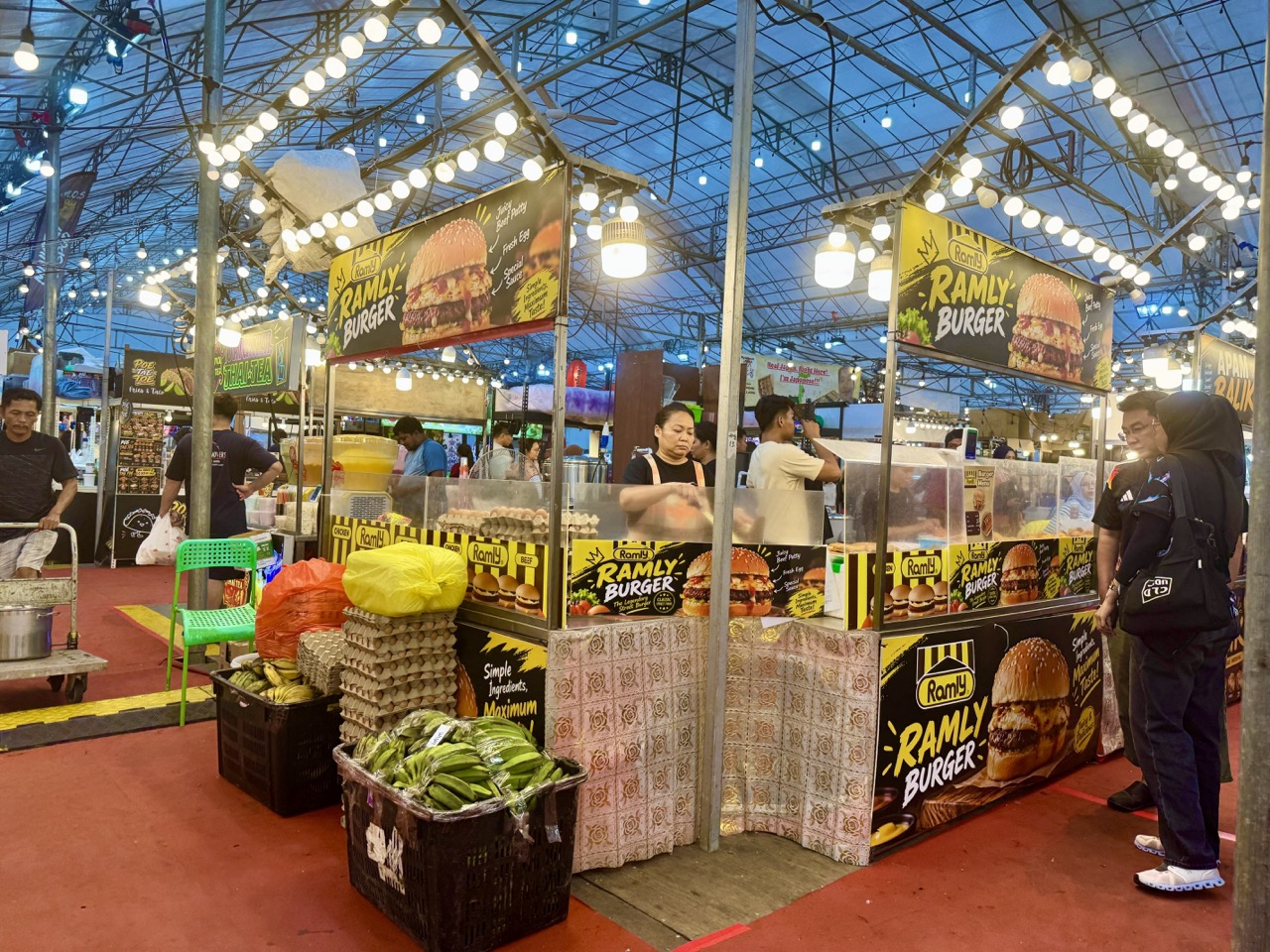
A pasar malam stall is a small business with a short selling window. At Punggol’s October 2026 night market near Punggol MRT, the new eduKatePunggol photographs show Ramly burgers being prepared, queues for biryani, macaroni-and-cheese counters and drinks. They capture the part customers see. Behind each order, however, are prices, ingredients, staff, equipment, food-safety requirements, preparation time and the risk of food going unsold.
So what do the photographs teach us? A queue shows people waiting; it does not prove a stall is the most profitable. Revenue must cover expenses. Demand changes with price, weather and time of day. A vendor must serve orders safely rather than simply make a line disappear. This conversational guide explains those relationships through the photographed scene and carefully labelled worked examples. All financial figures below are fictional classroom models, not sales data or menu prices from the businesses pictured.

Punggol pasar malam economics: the answer in a minute
- When: the photographed October 2026 edition was advertised from 30 September to 31 October near Punggol MRT and Waterway Point.
- What the images show: cooking, ordering, queues, different dishes and drink counters at that particular market.
- Business equation: a simplified profit is sales revenue minus the relevant costs for the same period.
- Why queues happen: new orders can arrive faster than a stall completes them, even while workers are busy.
- Why prices differ: products, portions, costs, service and customers’ valuations differ; a photograph does not reveal the exact reasons at a named stall.
- Who regulates qualifying temporary fairs: Singapore Food Agency (SFA), with a fair permit for the organiser and licences for relevant food-preparation stalls.
- How families can use the market: talk about value, budgeting and waiting without interrogating workers or inventing profit margins.
For the market’s dates and location, see the site’s existing Punggol Pasar Malam 2026 photo visitor guide. For official regulation, use SFA’s temporary-fair requirements and application and fees. This article owns the economics, not directions, food rankings or a live stall directory.
Why temporary trading changes the business calculation
Imagine selling food from the same shop every day of the year. You may spread some preparation expenses across many months and build a reputation at a fixed address. At a pasar malam, the event has a known end. A vendor may have to transport equipment, organise power and cleaning arrangements, acquire suitable ingredients and recover event-specific expenses while the fair is running. There is less room to pretend that a slow first week can be made up indefinitely in later months.
This doesn’t mean every temporary stall is riskier than every permanent shop. The costs and arrangements differ from business to business. What matters is the planning horizon. A child can understand this with a simple question: if you can sell burgers at an event for a limited number of days, how do you decide how much to prepare? The answer involves uncertainty, not merely optimism.
The organiser and food stallholder are different participants
Under SFA’s temporary-fair framework, the organiser applies for the qualifying fair permit and coordinates applications for individual stalls that prepare or handle food and drinks. The organiser also has responsibilities for site permission, layout and certain supporting facilities. A vendor manages its own offering and must comply with the applicable operating and licensing conditions. These roles work together but should not be collapsed into one imaginary person.
The distinction is important for prospective entrepreneurs. Being invited to occupy a pitch is not itself a promise that every menu or cooking process can operate there. The vendor should check the organiser’s current terms, allowed activities and SFA requirements. From the visitor’s side, a tent and counter look simple; for the people responsible, the surrounding rules are part of how the temporary site functions.
What an attractive queue can and cannot tell us
One of our photographs shows a long line for biryani. It certainly shows customers waiting at a particular moment, but why were they there? Perhaps they preferred that food; perhaps one large group arrived; perhaps the final preparation step was slower; perhaps the queue belonged partly to collections. A still image cannot separate these explanations. Even a clearly identified stall may have quiet periods outside the photograph.
A useful economic question is therefore not ‘Which stall wins?’ but ‘What extra information would settle the cause?’ A measured queue arrival rate, completed orders, service timing and prices would help. Those are not numbers a passer-by automatically has a right to obtain. A family can discuss plausible mechanisms respectfully without treating working vendors and customers as subjects of an unsolicited study.
Demand is not the same as completed sales
Demand concerns the quantity buyers want under particular prices and circumstances. Completed sales are actual transactions. People may be interested in a dish but leave when the queue is long; a family may browse a stall without buying; someone may order several portions at once. A photograph full of visitors cannot tell us precisely how many paid orders have been completed.
This is one reason market research needs carefully defined variables. If a student counts heads, the result is a headcount, not revenue. If they count receipts from their own family’s orders, that is evidence about those purchases only. Accurate analysis starts by naming what the data represent and avoiding the temptation to relabel every observed number as profit or popularity.
Revenue is the beginning, not the end, of the calculation
Suppose an entirely fictional stall sells 40 meals at S$8 each during a defined period. The revenue is S$320. That calculation is correct, but it says nothing about what remains after raw materials, packaging, labour, pitch costs or utilities. If variable expense is assumed to be S$3 per meal, the forty portions use S$120 of that category, leaving S$200 to meet other costs.
Children often hear a big sales amount and think it is what the seller ‘made’. The distinction between money collected and money retained is the central enterprise lesson. A real food business may have several products, unsold stock, staff arrangements and taxes; we are using the smaller example to make the logic visible. Never attach these figures to a pictured Punggol vendor as reported accounts.
Contribution per unit explains why cost changes matter
In the fictional example, a meal priced at S$8 with S$3 of variable cost contributes S$5 toward fixed expenses and possible profit. If the ingredient and packaging expense rises to S$4 while the selling price stays S$8, unit contribution falls to S$4. That one-dollar change matters on every sale. It illustrates why a menu can look unchanged while the economics behind it shift.
Would a real stall raise prices in that situation? Not necessarily. The seller might absorb part of the increase, change purchasing arrangements or reconsider the product mix, subject to food requirements and customer expectations. Each option has trade-offs. From a photograph, we cannot know which input costs apply, much less whether a vendor has altered its margin.
A clear break-even example
Suppose the fictional stall has S$500 in fixed costs for the same model period, receives S$8 per meal and spends S$3 in variable costs per meal. Each sale contributes S$5, so break-even occurs after 100 sales if all simplifying assumptions hold. The calculation is S$500 divided by S$5. At that volume the model has covered its assumed fixed costs, not necessarily every real expense a business might encounter.
Change variable cost to S$4 and the required volume becomes 125 meals. Students can see how sensitive a small business may be to input prices. Break-even is useful because it connects arithmetic to planning, but it depends on the choice of period, actual fixed costs and realistic variable costs. A responsible worked example states them before displaying the result.
Why a queue may grow while food is being cooked continuously
Imagine an illustrative burger counter completing ten orders every ten minutes while fifteen new orders arrive in the same interval. If those rates persist, five additional orders join the backlog each ten minutes. The staff may be constantly active and still face a longer line. The line is not evidence of idleness; it can be a predictable consequence of a mismatch between demand and capacity.
Real stalls may handle multiple meals per order, prepare in batches or lose some customers who decide not to wait. Those details affect the actual model. We use the simple rates to understand a general relationship, not to estimate the photographed queue’s waiting time. A good student identifies the assumptions and explains how the result would change if arrivals slowed.
The bottleneck may be packing rather than cooking
Suppose a fictional griddle can prepare twelve portions in ten minutes, but the packaging counter completes eight portions during that interval. Unless other stages change, the completed-order rate cannot exceed eight in that period for long. Adding a second griddle would not solve the constraint if packing remains the limiting step. That slower stage is a bottleneck.
The pictured burger counter shows activity, but its staffing and workflow are not fully visible. It would be unfair to label a particular worker the bottleneck. Students can use a blank flowchart—receive order, cook, assemble, pack, collect—to examine hypothetical rates. Systems analysis should improve understanding, not assign blame from a single image.
Batch cooking changes the shape of the line
Not every dish is completed one portion at a time. Some preparation can occur in batches, producing several finished items together. A queue may hardly move for a short period, then several customers collect orders in quick succession. The average output rate may look reasonable over a longer interval even though individual waiting experiences differ.
A student could compare a model of one meal every minute with a model of six meals completed every six minutes. Both average one per minute, but a newly arrived customer may experience the timing differently. That distinction helps explain why the words ‘average wait’ need care. The photograph itself does not establish whether the pictured biryani vendor used any particular batching system.
Inventory is a decision under uncertainty
Food must be available when customers arrive, yet ingredients are not free and some items are perishable. Too little prepared stock can lose orders, while too much can create waste or unsafe leftovers. An event operator cannot predict tomorrow’s foot traffic perfectly from one busy night. Weather, school schedules, promotions and other attractions affect how people use the site.
Imagine a fictional stall that sold thirty portions on one day and sixty on another. It would be rash to assume demand is always sixty. A more thoughtful plan might use a range and consider why the two days differed. Students who learn to forecast with explicit uncertainty are better prepared to reason about everyday decisions than those who memorise one impressive average.
The role of weather in an outdoor food business
Singapore weather can change both the comfort and timing of a night-market visit. Heavy rain may discourage browsing, while a cooler evening could alter how long people want to stay. Lightning safety can require people to leave exposed outdoor areas. Stalls also have to protect food and work safely whatever the customer demand. The advertised event hours should never be treated as a promise that every vendor serves through every severe-weather condition.
Weather makes a good scenario-planning variable. A fictional business can compare low, middle and high sales outcomes instead of claiming one number is certain. That is not a forecast for Punggol’s next market. For a real visit, current weather information and the organiser’s instructions are more important than a photograph captured on a pleasant evening.
What a food price is trying to do
A seller chooses a price while considering its costs, desired return, competitors, product and customers. The customer evaluates the same displayed number differently, asking whether the meal suits their appetite, budget and preferences. These are distinct decisions. A family may reject a price because it doesn’t fit the day’s allowance without claiming the vendor is dishonest or making an excessive profit.
Explain this gently to a child. Instead of saying, ‘This stall is expensive, so it must be greedy’, try, ‘This is more than we planned to spend on dinner; which option fits better?’ That sentence is both financially practical and fair to workers whose actual costs the family does not know. Economic reasoning should make consumer choices clearer, not encourage unfounded accusations.
Why variety can attract customers to the whole fair
Our images show burgers, rice dishes, macaroni and cheese and drinks within the same temporary market. Different foods may appeal to different people, and a group with several preferences may find a fair convenient for that reason. A collection of food options can therefore draw visitors even as individual stalls compete for each person’s money.
However, the presence of variety does not prove that every vendor benefits equally. A busy location can also raise costs or draw customers toward particular menus. The economic effect depends on many factors. Students can discuss both possibilities: competition within a market and the shared attraction that a market creates. Neither should be presented as a measured verdict without suitable evidence.
A family budget includes the drink and the extra snack
Suppose a family sets an illustrative S$30 food allowance. They buy two fictional mains at S$9.50 and S$8.80, then two fictional drinks at S$2.60 each. Their total is S$23.50, leaving S$6.50. The arithmetical steps are straightforward: add the mains, add the drinks and subtract from the allowance. The prices are invented classroom data, not posted Punggol menu prices.
The more useful discussion comes next. Does the unspent S$6.50 have to be spent? What if another family member needs a meal? What if the queue means the group must leave soon? Budgeting is a way of making choices with awareness, not a competition to spend the full amount. Children can calculate real receipts later if the family wishes.
Opportunity cost makes waiting a conscious choice
A person deciding between a fifteen-minute line and a five-minute line is also deciding what to do with ten minutes. They could browse more stalls, eat earlier or begin the trip home. That forgone alternative is the opportunity cost of waiting. It does not mean the longer wait is a mistake; the preferred meal may be worth it to that person.
Parents can explore this without turning dinner into a test. Ask, ‘Is that burger worth waiting for today, or would you rather choose something else?’ Two members of the same family can answer differently. They have different tastes, energy levels and commitments. Economics is most useful when it explains those choices rather than forcing everybody into one supposedly optimal meal.
Why the sugarcane stall has different operational requirements
An image in the batch shows sugarcane drinks near other food counters. Fresh drink preparation uses equipment and ingredients differently from cooking a burger. SFA’s temporary-fair rules discuss requirements specific to sugarcane and fruit juices, including the handling of produce and the type of equipment permitted for pressing sugarcane. These controls are designed for food safety, not just commercial appearance.
The photo cannot establish the pictured stall’s food-safety compliance, nor should anyone infer a violation from an image of a machine or cup. Readers who want the detailed safe-drinks explanation can consult the current SFA conditions. The general lesson for this article is that the cost and workflow differ across products even at one fair.
A temporary food licence is not the same as stall rental
SFA states that relevant individual temporary-fair food stall licences are coordinated through the fair organiser and have no separate licence fee. The fair permit itself has its own fee and process. Those facts are about regulatory applications. They do not establish what a vendor pays for pitch rental, electricity, transport, staff or equipment. A business may face costs that never appear in the regulator’s fee table.
This is another valuable source-reading exercise. If a student finds a SFA licensing fee, ask whose application it covers and for what period. A number has meaning only when matched to its actual definition. Confusing public fees with the full cost of a food stall is the kind of error that produces an impressive-looking but useless business plan.
Waste and hygiene belong in the financial plan
A temporary fair needs adequate rubbish management and safe food operations. Packaging, food scraps, cleaning and refuse collection are part of the process, even though a customer may mainly notice the food counter. SFA’s rules set responsibilities for fair organisers and food stalls. Businesses must plan to comply rather than hope the temporary nature of the fair removes those duties.
For families, the contribution is simple: put rubbish into suitable receptacles and do not leave food packaging in shared walking areas. Students can explore why some apparently small operational tasks still cost money. They should not label a named stall unhygienic from a wide photograph or make regulatory claims without a proper verified record.
How to compare two fictional business scenarios
Consider two imaginary stalls, A and B. A sells 100 servings at S$8 with S$3 variable cost per serving and S$500 fixed costs: simplified profit is zero. B sells 80 servings at S$10 with S$4 variable cost and S$400 fixed costs: simplified profit is S$80. B makes fewer sales but has a different cost structure. The result illustrates why sales volume alone is not sufficient to determine profit.
Neither model establishes that one menu is better or a business will succeed in reality. The example ignores several complications and depends on invented inputs. Ask an older student to change one variable and explain what happens. The objective is to reason about relationships, not to attach invented numbers to real Punggol vendors.
A Secondary Mathematics graph for the stall model
Let q be sales in the first fictional burger example. Under the constant price and cost assumptions, simplified profit is P(q) = 5q − 500. It is a straight-line function with slope five and vertical intercept negative five hundred. At q = 60, the model gives a loss of S$200; at q = 100 it breaks even; at q = 140 it gives a S$200 profit.
The mathematical graph is a model of assumptions, not a forecast of the October market. Real costs may be nonlinear, multiple products may be offered and prices may differ. Students should label axes and units, explain the break-even point in words and evaluate whether their assumptions make sense. A correct equation without an interpretation is only a partial answer.
A simple Primary ratio exercise
Suppose two fictional stalls completed 36 and 24 orders during a class exercise. The ratio is 36:24, which simplifies to 3:2. The combined completed orders are 60. Ask what the numbers count before simplifying. Do they represent orders or customers? One customer may place multiple orders, so the distinction matters even in a simple model.
Then ask whether the 3:2 ratio proves that one stall earned more profit. It does not. Prices, portions and costs could differ. The pupil learns an accurate ratio and a valuable limit on what that ratio can justify. This connects number skills with real-world interpretation without putting schoolwork in the middle of a vendor’s busy queue.
A Secondary Economics prompt about product differentiation
Why might a person choose macaroni and cheese over biryani when both are available in one market? The decision may reflect taste, price, serving size, hunger or past experience. Businesses can differentiate products to meet these varied preferences. They do not necessarily compete only by offering the lowest price.
A strong student answer should avoid treating preferences as stereotypes. The photographs show products and customers, but cannot reveal anyone’s reasons for choosing. Instead, write a conditional explanation: if a group has different food preferences, variety may increase the appeal of the fair. That is a plausible mechanism that would need customer evidence to evaluate fully.
A student research project should not interrupt workers
The photographed workers are trying to prepare and sell food. They are not automatically available for questions about private business figures, licensing or work schedules. Children and teenagers should not treat a customer queue as a free interview panel. Observing general operations from a suitable public place is different from recording personal conversations or photographing identifiable people close-up.
If an interview is genuinely necessary for a legitimate project, request permission, explain the purpose and accept refusal. Official SFA sources and hypothetical datasets can often answer classroom questions without involving busy people at all. Good research means asking a clear question and using an ethical method.
A caption can be factual without inventing a business result
Caption the burger image as a food vendor working with customers at the October Punggol market. Caption the biryani image as people waiting at a rice stall. Avoid descriptions such as ‘Punggol’s highest-grossing stall’ or ‘the best burger in town’ unless those claims are independently and appropriately substantiated. A single photo does not supply the necessary evidence.
Editorial restraint improves the article. A reader who values useful local information can decide whether to try a product from accurate photos and current menus. They do not need a fabricated ranking. The images are especially valuable as dated records because temporary food markets change, whereas an exaggerated caption may mislead people long after the stalls have moved on.
What happens after the 31 October fair end date
After a temporary market’s advertised closing date, the site may return to another use, and the vendors may move on to other events or arrangements. Do not assume any particular business’s next location. The October photos remain useful as a record of a specific period, but they cannot be treated as a permanent food directory.
The economic ideas remain relevant: limited trading windows, capacity, prices, costs and customer decisions apply to other fairs. Keeping the event’s date clearly attached to its photos makes this a lasting educational resource rather than an outdated recommendation pretending to be current.
The takeaway for a family, a student and a prospective vendor
For a parent, the market can provide a quick conversation about choosing food, spending and waiting. For a Primary pupil, actual receipts or invented prices support arithmetic and ratios. For a Secondary student, break-even, functions and queue rates make useful models. For a prospective vendor, the practical starting point is current organiser terms and SFA conditions rather than guessing sales from a photograph.
Those different uses are why a pasar malam deserves more than a list of snacks. It is a place where ordinary decisions connect to work, public regulation and economic trade-offs. The strongest lesson is to respect what the image shows, name what is unknown and use the appropriate evidence before drawing a conclusion.


Frequently asked questions
Was this market permanent?
No. The photographed Punggol edition was advertised for 30 September to 31 October 2026. A future market requires a new organiser notice.
Does a long queue mean a stall is profitable?
No. A queue does not reveal completed sales, unit costs, fixed costs, wastage or profit.
What is the difference between revenue and profit?
Revenue is money received from sales. Simplified profit is what remains after the relevant expenses are deducted.
What is a variable cost?
An expense that varies with production under the model, such as ingredients used per serving.
What is a fixed cost?
An expense treated as unchanged across the range of sales being analysed for a defined period.
How do I find break-even volume?
Under constant unit assumptions, divide fixed costs by price minus variable cost per unit.
Why can a queue grow while staff are busy?
Customers may arrive faster than the stall completes orders.
Do your example prices describe real stalls?
No. They are explicitly invented classroom figures for arithmetic and modelling.
What does product differentiation mean?
Businesses offer distinct products, presentations or experiences that appeal to different preferences.
Why do temporary markets need permits?
Relevant food fairs operate under SFA rules designed to cover site organisation, food safety and supporting facilities.
Does every vendor apply individually to SFA?
SFA says applications for relevant temporary-fair food stall licences are coordinated by the fair organiser.
Is a licensing fee the same as rental?
No. A regulator’s fee and a stall’s commercial operating costs are different categories.
Can a photo certify a food stall’s safety?
No. Food training, equipment conditions, temperatures and licences require reliable, current evidence.
Can a child ask a vendor for earnings data?
They may ask politely where appropriate, but no vendor is obliged to supply private data. Fictional scenarios usually suffice.
How can a Primary pupil practise Maths here?
Use actual paid prices or clearly invented figures for change, budgeting, totals and ratios.
What can a Secondary pupil learn?
Contribution margin, break-even, functions, queue capacity, assumptions and sensitivity analysis.
Does a line indicate better food quality?
Not necessarily. A line can arise from demand, timing, preparation processes and other factors.
Is this a review of Ramly burgers or biryani?
No. This is an economics explainer grounded in photographed market scenes.
Where is the visitor guide?
The linked Punggol Pasar Malam 2026 visitor guide covers location, family planning and the event’s advertised run.
What should I check before opening an actual stall?
Current organiser contracts, SFA conditions, permitted food, site infrastructure and a realistic budget.
Sources and relevant Punggol reading
- Singapore Food Agency — Temporary Fair Permit and Food Stall Requirements.
- Singapore Food Agency — Applications and Fees.
- October 2026 Punggol Pasar Malam Event Listing.
- Punggol Pasar Malam 2026 — Family Visitor and Photo Guide.
- One Punggol Hawker Centre — Permanent Food Venue and Operator.
- Money-Smart Family Activities in Punggol.
- Punggol in Pictures — Original October 2026 Photo Archive
Photographs: eduKatePunggol’s October 2026 local collection. Article reviewed 23 October 2026. Every financial figure and illustrative arrival or service rate is a hypothetical classroom example, not information about an individual vendor’s accounts. Operational, menu and licensing details require current official or stall-specific verification.


