
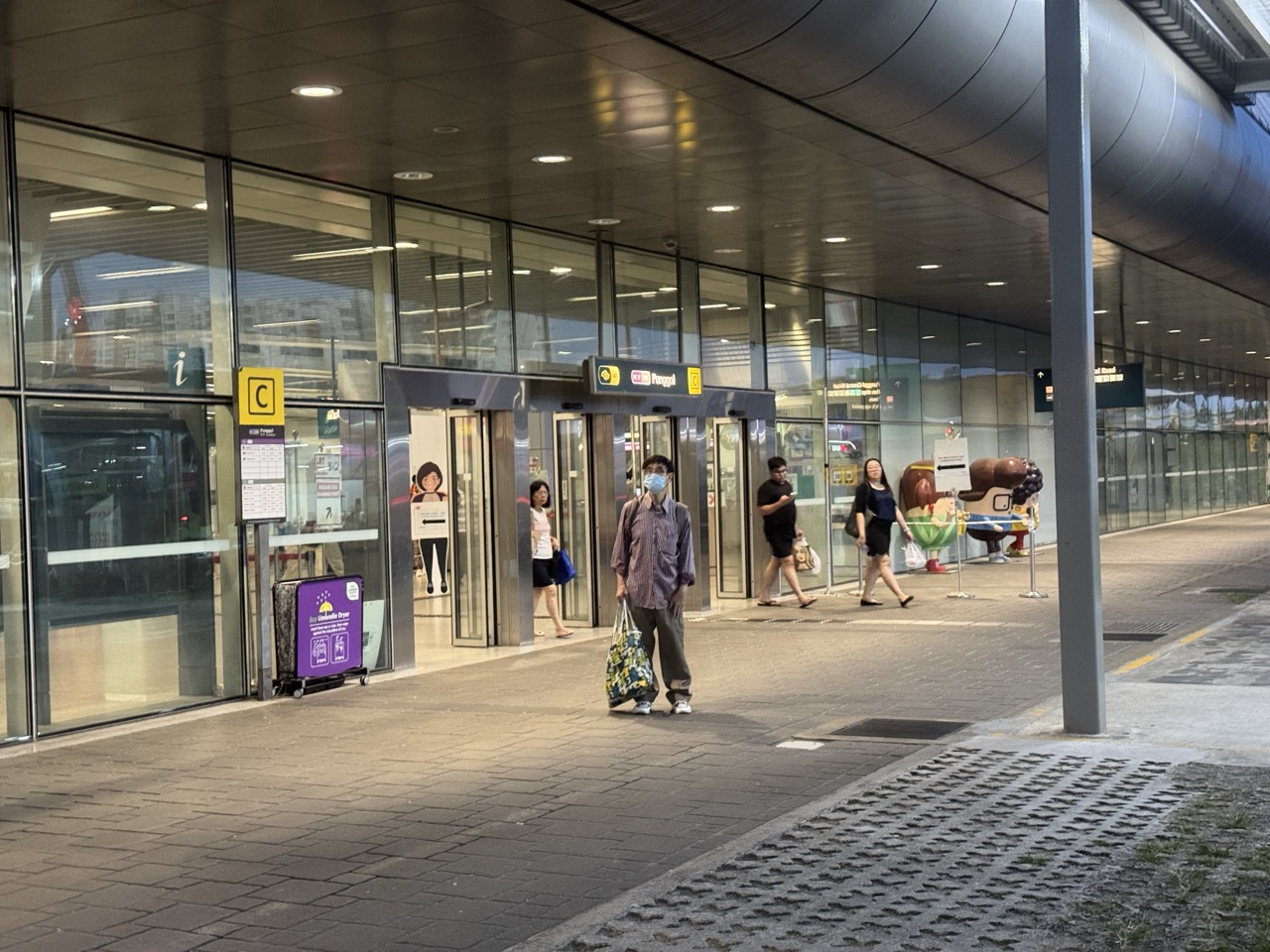
To reach the main Punggol Bus Interchange from Punggol MRT, SBS Transit identifies Exit C as the exit for the bus interchange. Punggol station is NE17 on the North East Line and PTC for the Punggol LRT connection. The official station information also identifies exits A and B for the waterway/Waterway Point area and Exit D for Punggol Central, as well as lift access within the station’s exit groups. This is different from travelling to Punggol Coast Bus Interchange beside Punggol Coast MRT.
Our original October 2026 photographs show a Punggol MRT exit leading toward the bus interchange, nearby steps, buses and public waiting areas. They are useful for seeing what a transfer looks like, but their filenames do not independently establish the exact exit letter, current accessible route, berth number or live bus arrival. We use the rail operator for those official wayfinding facts and the photos only for visual context.

Punggol MRT to bus interchange: quick answers
- Main Punggol station: North East Line NE17, connected to Punggol LRT (PTC).
- For the main Punggol Bus Interchange: SBS Transit currently lists Exit C.
- Waterway Point: station information lists Exit A, with waterway references at exits A and B.
- Punggol Central: Exit D in the operator’s station listing.
- Step-free planning: the station lists lifts at exit groups A/B and C/D and wide faregates; check current ground signs for the exact suitable path.
- Different terminus: Punggol Coast Bus Interchange is a separate site served by Punggol Coast MRT, not a second exit of NE17.
- For a bus: identify service, direction and present boarding berth; never assume an alighting bay is a boarding bay.
- For families: agree a safe meeting point away from doors, escalators, bus lanes and crowds.
- Photographs: October exit, stairs and interchange scenes; not a live route map.
- If mobility matters: do not infer lift access from a staircase photograph; follow operator signs and seek staff assistance.
Primary source: SBS Transit Punggol Station Information, which names exits, bus interchange, lifts, tactile flooring, wide faregates and other services. LTA’s May 2025 Punggol Coast announcement explains how the separate hub opened and changed some routes. Our existing Punggol Bus Interchange guide covers boarding etiquette and the historical Temporary name; this page owns the rail-to-bus station exit and stairs.
Why Exit C is a more reliable instruction than ‘follow the stairs’
An unfamiliar traveller might see the staircase pictured in the October photo and assume it is the only route to the interchange. A photo can suggest a direction but cannot identify the best route for everybody, especially someone travelling with a pram or wheelchair.
SBS Transit’s live station description names Exit C for Punggol Bus Interchange. Start with that official designation, then follow the current signs and accessible routes. Don’t navigate solely by matching a photo angle.
Punggol Bus Interchange is a specific destination
Punggol’s main bus interchange is beside NE17 at the town centre. Punggol Coast Bus Interchange, opened in 2025, is a separate hub in Punggol Digital District. Both may appear in search results for Punggol buses.
The distinction changes where a commuter should get off the train and which bus route they need. A family message should include the full interchange name, not simply ‘meet by the Punggol buses’.
Why the North East Line code matters
NE17 identifies Punggol on the North East Line, while Punggol Coast is NE18. A visitor who knows only the names may assume they are different entrances to one large station. They are separate stops.
Check the route before exiting the fare gates. The Punggol LRT network also connects at the town centre, but LRT station codes and directions are different from the MRT line. A clear station name helps avoid a needless transfer.
Reading all four exit labels
SBS Transit’s current list identifies A for Waterway Point and waterway destinations; B for the waterway; C for Punggol Bus Interchange; and D for Punggol Central. These exit labels orient passengers toward different parts of the town centre.
A trip to a shop, park or bus connection may start in the same underground station but use a different exit. Read the operator signs rather than assume every stairway leads to the bus interchange.
What the exit photograph proves
The source image is labelled ‘Punggol MRT Station Exit toward Bus Interchange’. That supports the broad visual topic: a station exit near the interchange. Its metadata does not independently confirm the exact exit letter or prove that the same steps are open during maintenance.
A careful caption preserves that boundary. The Exit C identification comes from the official station map, not from an invented close-reading of an unreadable sign in the photograph.
The stairs in the second photograph
Another October image shows stairs from the station toward the bus interchange. This can help a first-time visitor understand that changing levels may be part of the journey. But stairs are only one form of circulation within a station.
For a wheelchair user, traveller with luggage or caregiver pushing a stroller, the lift route may be more appropriate. Find the currently signed accessible route instead of following somebody else up steps that aren’t suitable.
Lifts are part of the official station facilities
SBS Transit states that lifts serve exit groups A/B and C/D as well as travel between the concourse, MRT and LRT platform levels. The station also offers wide faregates and tactile flooring.
This information is stronger than assuming an accessible connection merely because a station is modern. Real routes may be affected by a temporary lift outage, so check actual signs and contact staff for the current alternative if needed.
A wheelchair user’s route is not the same as a staircase route
A photo of stairs cannot establish step-free access. A usable journey may require locating a lift, navigating an appropriate exit and reaching the correct bus berth without steps or blocked paths.
Ask the traveller what works for them, and follow SBS Transit or interchange staff guidance. Accessibility is about the whole continuous journey, not one symbol on a map.
Strollers and families with young children
At busy station exits, adults may be carrying bags, holding children or managing a stroller. Choose a suitable lift when needed; don’t take an occupied stroller on an unsuitable escalator or attempt to carry it through a crush.
Before exiting the station, agree which adult is supervising each child. Once outdoors, stop in a permitted place to confirm the bus rather than clustering at the top of stairs or in the interchange pedestrian flow.
Why wide faregates can help
The operator identifies wide faregates among the standard accessibility features at North East Line stations. These help travellers with bulkier items, wheelchairs or prams navigate the barrier with suitable space.
Use the appropriate gate and follow station staff when assistance is needed. Do not force large equipment through a narrow gate because it is slightly closer to the exit you wanted.
Tactile flooring matters
Tactile guidance is one feature the operator identifies for travellers with visual impairment. Other passengers should keep these routes clear rather than stop over them to discuss directions or arrange bags.
A photo-led local guide may show corridors without revealing the entire tactile route. Treat the operator’s accessible facilities as an essential part of the journey, not a detail inferred from a general station picture.
From concourse to the outdoor interchange
A passenger may arrive at the MRT platform, take a lift or escalator to the concourse, leave through the designated exit and then continue to the interchange’s correct boarding point. The journey involves several distinct spaces with separate signs.
Don’t confuse a station exit with a bus berth. Exit C indicates the general connection, while the actual service and boarding position should be checked on the interchange’s current display.
How to choose the right bus after reaching the interchange
Read the bus number, destination and direction before joining a queue. Some routes can be relocated or amended. A person heading to Punggol Coast may need a different terminus from somebody going to an older town-centre destination.
The current operator board, not an October photo, decides which berth to use. If a sign changes, seek staff guidance. An alighting point isn’t automatically an authorised boarding point.
Punggol Coast changed some routes in 2025
LTA announced that the new Punggol Coast hub would open on 29 June 2025 and that Services 34 and 117/117M would relocate their terminus there. An old bus list directing every service to the main Punggol interchange could therefore mislead.
Check the current route before travelling. A valid historical photograph and a valid current timetable answer different questions. Both should be labelled with dates.
What the interchange photographs add
The related October pictures show waiting areas, buses and passengers. They make the transfer environment more concrete for a newcomer, but no image establishes the entire berth plan or average transfer duration.
A child can use them to learn the difference between arriving by bus, alighting, walking and boarding another service. The exact process still needs real signs and appropriate adult supervision.
Don’t stop on the stairs to check a phone
A station staircase carries people in both directions. Stopping at the middle or landing to read messages can obstruct others, especially during a crowd. Move to a safe public side area first.
This is useful etiquette beyond the bus transfer. When people are carrying luggage or using mobility aids, predictable movement matters. A photo of an empty stairway cannot guarantee it will be quiet on the next visit.
Why meeting at an exit needs precision
Two relatives may be using the same station but approaching from different exits. ‘Meet at Punggol MRT’ leaves too much ambiguity. ‘Meet near Exit C in a permitted public waiting area’ is a clearer instruction for the interchange side.
Do not choose a spot that blocks the lift, fare gates, doors or escalators. For a young child, the agreed meeting plan should include a known responsible adult and a safe way to seek authorised staff help.
If a family becomes separated
A young child who loses sight of an adult should not be expected to explore bus lanes or station corridors searching alone. Families can prepare an age-appropriate contingency involving authorised station staff and the agreed caregiver.
Adults should remain calm and use official assistance channels. A publicly posted personal itinerary or identifiable child photo is not needed to manage a routine trip.
Luggage on the way to a bus
Large bags slow movement and make some stairs or narrow paths inconvenient. Check whether an accessible lift route suits the traveller, allow extra time and keep bags out of people’s way while waiting.
Don’t occupy multiple priority seats with luggage or block a walkway to repack. A sensible transfer may take a little longer than a quick map estimate and still be the better route.
Rain and the final outdoor connection
Even a transfer between nearby facilities can include partially exposed walking areas. A photograph taken on a dry October afternoon cannot guarantee a continuously sheltered route between every station exit and bus berth.
Carry suitable rain protection and follow current signage if the path has temporary works. During severe weather, slow down rather than rush on wet stairs or road crossings.
Heat and the trip with older relatives
A station’s indoor air and the outdoor interchange can feel different, particularly on a hot day. A person needing a seat or more time to walk should be accommodated rather than urged through a crowd to catch one specific bus.
Use designated waiting and priority facilities as appropriate. Avoid claiming every berth has identical seating based on a photo of one waiting area.
A hypothetical transfer-time calculation
Imagine a journey requiring two minutes to leave the platform, three minutes to navigate the concourse and four minutes to reach the intended berth. That’s nine minutes before waiting for the bus, in a simplified example.
These are invented numbers for a primary Mathematics exercise, not measured Punggol station travel times. Real conditions, lift access and bus assignments can change the outcome. Include buffer time for fixed appointments.
Why the route needs to be checked in both directions
Getting from the MRT to the interchange may seem straightforward, but the return journey could use a different entrance, lift or crowd flow. A traveller should note the actual signs and how they plan to reach the station again.
Do not assume the visible stairs are the only route back. An older person or caregiver who needs a lift should plan the appropriate direction separately, especially after a late event.
A simple English directions exercise
Ask a pupil to improve ‘Exit Punggol station and find the bus’. A clearer instruction names Exit C, the main Punggol Bus Interchange and the need to find the current service berth. It gives both the place and the next decision.
Then ask what information is still missing for a real trip: service number, destination and departure condition. The lesson is that complete directions depend on the traveller’s actual goal.
A transport-systems thinking lesson
An integrated transport node connects underground rail, elevated LRT and surface bus routes. Passengers move between these levels through stairs, lifts and corridors, while information signs coordinate their decisions.
The photographs reveal some of the architecture but not the full timetable or operations. An older student can distinguish fixed infrastructure from variable services and ask which evidence each claim requires.
Safe photography around transport
A good photograph of a station exit can help future readers recognise a place. But do not block stairs, escalators, fare gates or bus movement while taking it. Avoid close-ups of identifiable strangers or their payment screens.
Write descriptive captions with the month and general location. Don’t label an unreadable sign as Exit C unless verified from an official source, and don’t infer individuals’ destinations from where they happen to stand.
What if the lift is unavailable
Accessibility features may occasionally be affected by maintenance. A photo cannot verify their live operating status. Look for current advisories and ask SBS Transit staff for a suitable alternative rather than improvise a hazardous stair manoeuvre.
Allow a little travel margin when the trip has strict timing or a person depends on step-free access. Transport operators, not a static article, own operational disruption information.
A clear four-step transfer checklist
Before leaving the train, confirm that the destination is the main Punggol Bus Interchange, not Punggol Coast. Follow Exit C and any accessible directions you need. Read the current bus berth and service information. Move and wait without blocking others.
If signs change, consult the operator. The photograph’s role is recognition, not a replacement for the real transfer. That is the habit that will remain useful even when routes or station facilities evolve.


Frequently asked questions about the Punggol MRT bus transfer
Which exit is for Punggol Bus Interchange?
SBS Transit lists Exit C for the main Punggol Bus Interchange.
Is Punggol MRT NE17?
Yes; it is North East Line station NE17, connected to Punggol LRT.
Does the main station have lifts?
SBS Transit identifies lifts serving exits A/B and C/D and between rail levels.
Can someone using a wheelchair make the transfer?
Plan through the operator’s current lift and accessible path information, with staff assistance where needed.
Do I have to use the stairs pictured here?
No. The photograph documents stairs, not the only permitted way out.
Which exit serves Waterway Point?
SBS Transit lists Exit A.
Which exit is for Punggol Central?
The current station information lists Exit D.
Is Punggol Coast Bus Interchange at this exit?
No. Punggol Coast is a different transport hub near NE18.
Where do I find my bus berth?
Use the current interchange signs and operator information after reaching the interchange.
Can I board where the picture shows buses alighting?
Not necessarily. Boarding and alighting locations can differ.
Have services changed since 2024?
Yes. LTA’s 2025 Punggol Coast opening moved routes including 34 and 117/117M.
Are the stairs fully sheltered?
No complete route-shelter guarantee is made from the photographs.
Can I push a stroller on an escalator?
Follow operator safety guidance and use an appropriate lift route when needed.
What if a lift is out of service?
Follow current advisories and seek staff directions to an accessible alternative.
Can I meet someone at Exit C?
Agree on a permitted public landmark without blocking the passenger flow.
How long does the transfer take?
The article does not claim a universally measured time; it depends on the berth, mobility needs and conditions.
Are these recent station photos?
The assets were uploaded in October 2026 and are labelled as Punggol exit and interchange scenes.
Can a child make this transfer alone?
Readiness depends on the child’s actual route, judgement and family plan.
Where are public toilets?
SBS Transit identifies toilets at the concourse near Exit A.
What about broad Punggol bus information?
Follow the site’s existing Punggol Bus Interchange and Punggol Coast comparison guides.
Sources and related Punggol guides
- SBS Transit — Punggol MRT Station Exits, Lifts, Bus Interchange and Facilities.
- LTA — Punggol Coast Bus Interchange and Service Changes.
- Punggol Bus Interchange Photo and Boarding Guide.
- Punggol Bus Interchange versus Punggol Coast.
- Understanding Punggol Transport.
- Complete Punggol Guide
Editorial date 23 October 2026. Original October photographs document a Punggol MRT exit, stairs and the bus interchange area. Exit C and lift details come from SBS Transit’s published station information rather than being guessed from image angles. Current staff directions, signs, disruptions and bus berths supersede this article.


