
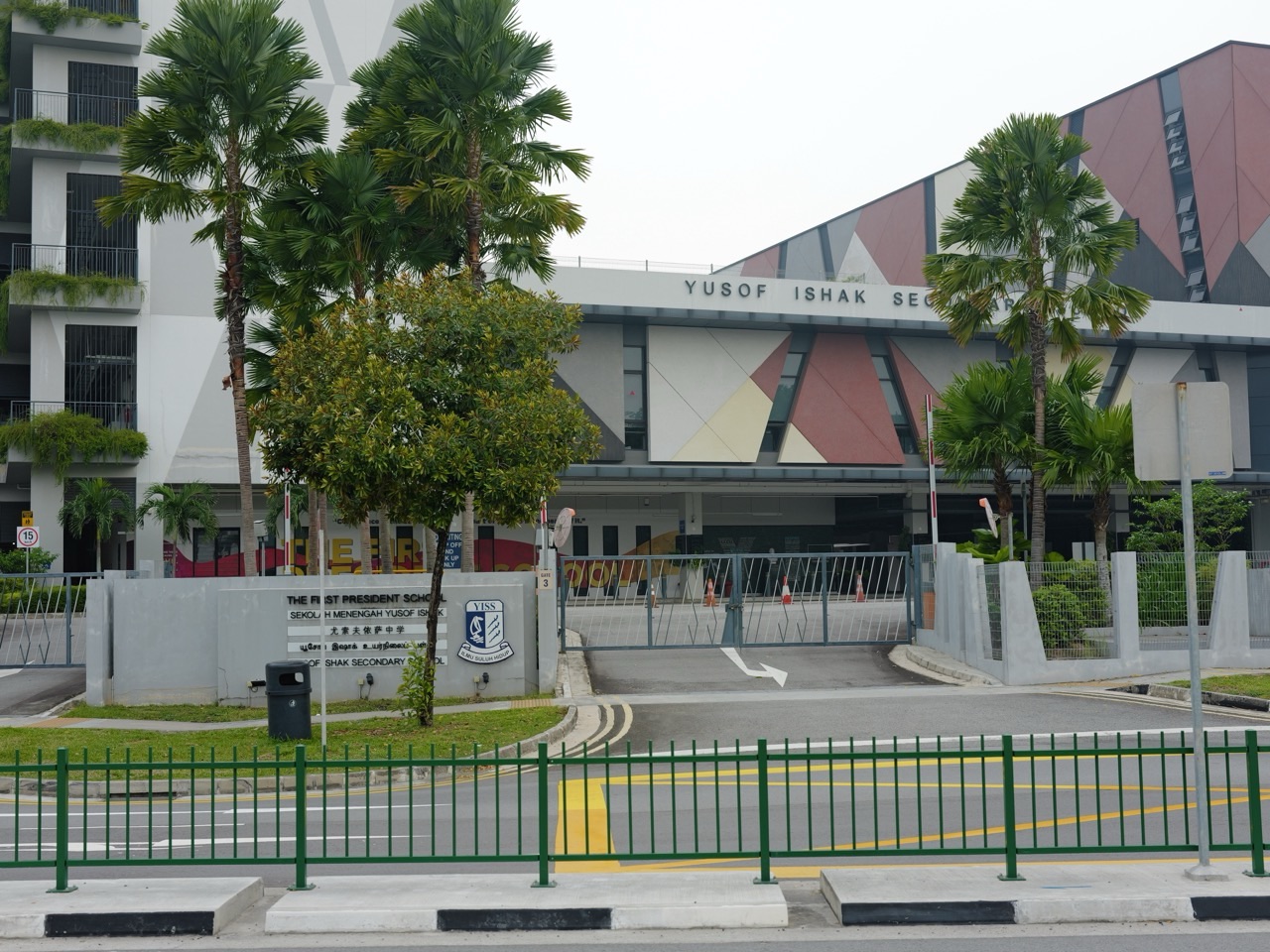
Yusof Ishak Secondary School is at 8 Sumang Walk, Singapore 828676, in Punggol. Its official 2026 contact page names Soo Teck LRT (PW7), Sumang LRT (PW6) and Punggol MRT (NE17) as transport references, as well as bus services near Soo Teck station and Block 315B. New October 2026 eduKatePunggol photographs show the secondary school exterior and entrance-facing buildings. They make the school recognisable for a new family, but they are not a live record of visitor access, classroom locations or an individual student’s reporting schedule.
The school’s principal said in July 2026 that this is the fifth year at the Sumang Walk campus. The institution dates back to 1965 and marked its sixtieth anniversary in 2025. That mixture of an established school and a relatively new Punggol campus is worth understanding. This guide focuses on first-time orientation: finding the right school, navigating transport, distinguishing a general-office appointment from daily student arrival, and preparing a Secondary 1 pupil for a more independent routine without using the photographed entrance as a shortcut around official rules.

Yusof Ishak Secondary School: quick facts for 2026
- Full name: Yusof Ishak Secondary School, a government secondary school in Punggol.
- Address: 8 Sumang Walk, Singapore 828676.
- Official phone: +65 6500 9800; email yiss@moe.edu.sg.
- Office hours: Monday to Friday, 8am–5.30pm according to the July 2026 contact page. These are not pupil reporting hours.
- Rail approach: Punggol MRT NE17 and Soo Teck PW7 or Sumang PW6 on the Punggol LRT, as officially listed.
- Bus stops by Soo Teck station: the school names 39, 43, 118 and 381.
- Bus stops near Block 315B: the school lists 34 and 382W on one side, 34 and 382G on the other, subject to live direction and route changes.
- Campus history: the principal describes 2026 as the fifth year at Sumang Walk, following an earlier campus chapter.
- Learning context: the school’s 2026 curriculum page describes a Full Subject-Based Banding common lower-secondary curriculum for subjects including D&T, FCE, Art and Music.
- Photo and safety boundary: exterior images do not establish the opening of a particular gate, permission to enter or the identities of pupils.
Core references: Yusof Ishak Secondary — official Contact Us and Getting Here, 2026 Principal’s Welcome, 2026 Design and Aesthetics curriculum, and Parent and Student Links. Our Yusof Ishak Secondary school profile already owns programmes and broad school information. This new article owns the first-visit photo, directions and practical transition to daily Punggol journeys.
Getting the school name and address right
Yusof Ishak Secondary is named after Singapore’s first president, but its current campus is in Punggol, not at every building associated with its long history. Search for 8 Sumang Walk and check that your map identifies the secondary school rather than another Sumang Walk education facility.
Share the full school name and address with anyone arranging transport. A photo of a school facade can aid recognition, but a school’s public address is the authoritative location reference.
Why the 2026 exterior photographs matter
Several media files depict the campus entrance and its buildings from the outside. They are useful for a family visiting the neighbourhood for the first time and for recording the appearance of an established school’s newer campus.
However, an exterior photo cannot tell a parent where a particular student reports in the morning or whether a visitor may enter at any particular gate. Avoid treating its camera angle as an access procedure.
Punggol MRT and the two local LRT references
The school’s official contact page identifies Punggol MRT NE17 plus Soo Teck LRT PW7 and Sumang LRT PW6. Those references are helpful because the correct approach may depend on the origin of the journey and the pedestrian route chosen.
Don’t assume an LRT platform is the same as the MRT station, or that every visible exit provides an accessible direct path. Use current SBS Transit and LTA maps, then follow public crossings and school directions.
Soo Teck LRT versus Sumang LRT
The school lists two nearby LRT station names. They aren’t identical places, so a family should compare their own origin and appropriate public walking route before choosing one. The nearest stop in straight-line terms may not be the most comfortable route for every visitor.
A parent carrying heavy bags or a caregiver needing a step-free approach should check actual conditions rather than rely on an image of the school. A short supervised practice journey is often worthwhile before an important first-day appointment.
Bus choices near Soo Teck
Yusof Ishak Secondary’s 2026 contact page lists services 39, 43, 118 and 381 near Soo Teck station. That provides a concrete starting point but doesn’t determine the bus direction from every housing estate.
Find the correct side of the road and destination with the current operator. A secondary student can practise verifying number, stop and direction rather than simply recognising a familiar route number.
Bus choices at Block 315B
The school also identifies services 34 and 382W at a Block 315B stop and 34 and 382G on the opposite side. This illustrates how the same area can have different directions and service variants.
Don’t send a child across a road merely because the number on the opposite sign appears more familiar. A safe route includes crossing infrastructure as well as the intended bus service. Timetables and diversions need current verification.
Why 2025 bus network changes still matter
LTA’s Punggol Coast interchange opened in June 2025, changing the termini of some services including 34. That is a reminder that a historical screenshot may be accurate for its date but no longer suitable for a current commute.
The school’s July 2026 transport list is later than the change, but a traveller should still check the real stop and direction. A good route plan is based on present official information, not an old map copied without dates.
Office hours are not school reporting time
Yusof Ishak Secondary lists Monday–Friday office hours of 8am to 5.30pm. That is an administrative service window, not a statement that students start lessons at 8am. The school controls pupil reporting and class timetables through its own communications.
Parents shouldn’t use office hours as an excuse to arrive late. Check the actual 2026 timetable or the child’s current notice before planning daily departures. This guide deliberately does not invent a universal first-bell time.
A careful first-day timetable
A new Secondary 1 student may need time to recognise the correct public transport route, find the authorised school arrival point, and attend whatever orientation the school has arranged. These steps can take longer than a normal journey once the route becomes familiar.
Build a little margin into the morning without turning it into pressure to travel dangerously. A route should work even when a bus arrives late or a pedestrian crossing takes another signal cycle.
From Primary 6 to Secondary 1
The transition changes subjects, school routines and expectations for personal organisation. A student may begin travelling farther and be responsible for more books, materials and deadlines. That doesn’t mean every child is immediately ready to handle a new route independently.
Practise the journey and develop a manageable preparation routine. The school itself owns reporting and orientation arrangements. Parents can help by confirming the practical details rather than inventing academic or access rules based on the exterior.
Why parents should not turn the gate into a daily confrontation
A school gate serves many students, staff and families, so crowded movement may occur around the start and end of the day. Standing in an entrance to argue about directions or taking photographs of other pupils can obstruct people and create privacy concerns.
Use the right visitor or parent communication channel for questions. A family that understands where to wait and when to contact staff makes the shared public area more predictable for everyone.
Road safety on Sumang Walk
A road may seem quiet at one moment but still have buses, cars, turning movements and pedestrians. Teach students to use designated crossings and remain alert near vehicle entrances. An adult escorting a teenager should follow the same safe habits.
The original photograph is not a live traffic survey and doesn’t tell us which junction is currently closed for works. The legal public path and current signage take precedence over a straight-line shortcut.
How to travel with a schoolbag
Secondary students often carry textbooks, water, devices and CCA equipment. A long journey is easier when belongings are organised and the bag isn’t overloaded unnecessarily. Heavy equipment can make stairs, escalators and bus boarding harder.
A parent can help the student plan what is needed for the day and choose a route suited to the actual load. Transport convenience depends on the whole journey, not just the station closest to the school.
The school’s long history and its Punggol chapter
Yusof Ishak Secondary’s principal writes that the school celebrated sixty years in 2025 and is in its fifth year at Sumang Walk during 2026. That combines an institutional heritage beginning in 1965 with a more recent presence in Punggol.
The building picture documents the current campus context; it doesn’t tell the entire historical story. Readers wanting the move and construction timeline can follow the site’s dedicated Yusof Ishak Secondary relocation history.
A new campus needn’t mean a new institution
Parents unfamiliar with the school’s earlier chapters may see a modern facade and assume the institution itself opened only a few years ago. The principal’s message corrects that misunderstanding: the school has been operating for decades, with the Punggol campus representing a later chapter.
This is a good example of why image appearance and historical fact need separate sources. A building’s age cannot establish a school’s founding date, traditions or achievements.
Full Subject-Based Banding in the school context
The 2026 Design and Aesthetics page describes a common lower-secondary curriculum under Full Subject-Based Banding, including Design and Technology, Food and Consumer Education, Art and Music. That means students learn some subjects together in common settings while subject-level arrangements for other areas require the school’s guidance.
Don’t infer the details of a particular child’s G1, G2 or G3 subjects from the school sign or age. Families should consult the official timetable and MOE or school guidance for personal subject allocation.
Why D&T and Food & Consumer Education belong in a daily transition guide
A Secondary 1 pupil may encounter subjects with practical projects, making, design or food work that differ from their Primary 6 experience. The school’s official curriculum page discusses design thinking, visual-spatial learning and informed food decisions.
Such subjects can affect the materials a child needs on a particular day. Parents can support organisation without treating all lower-secondary timetables as identical. Check current course and teacher instructions, not an invented generic packing list.
Learning Art and Music at secondary level
The same 2026 school source lists Art and Music in the common curriculum, with creative work, listening and performance or making activities. This is a useful example of how secondary education extends beyond a single examination subject.
An exterior school photograph cannot demonstrate what happens in those classes, but the official curriculum description can tell parents the broad learning intentions. Use it to ask informed questions rather than assuming a school day is only Mathematics and English.
School counsellor and ECG resources
The school’s parent-and-student resource page links to counselling and Education and Career Guidance appointment information. A teenager may eventually need help with social, wellbeing or subject and career choices. Recognising that support exists is practical school literacy.
Don’t assume a particular appointment slot is available or that any staff member can accept a walk-in visitor. Follow current school booking and communication instructions, and respect a student’s privacy.
SLS and classroom resources
The school links the Singapore Student Learning Space and Google Classroom among its useful student resources. They have their own account and school instructions. They are not accessed by entering a campus building without authorisation.
Families should use legitimate logins and the correct teacher guidance. If access fails, follow the school’s support process rather than sharing private credentials in a public group or photographing another student’s screen.
An older student’s independence needs a contingency
By secondary school, some students may travel on their own, but a route isn’t safe merely because the student has memorised bus numbers. They should know what to do if their usual bus is diverted, an LRT platform changes or a public path is blocked.
Plan an age-appropriate means of contacting a known adult or authorised staff member. A missed connection should not lead to crossing roads unsafely or following a stranger to a supposed shortcut.
A simple route model for a Mathematics lesson
Imagine a hypothetical journey with an eight-minute walk, fifteen-minute rail ride and seven-minute connection. The sum is thirty minutes. Add a buffer for an appointment and discuss why the full journey may take longer than the sum of nominal moving times.
These are invented figures, not measured travel times to 8 Sumang Walk. The exercise teaches that real-life Mathematics needs assumptions and a sensible contingency, not false precision.
English writing: give clear instructions
Ask a Secondary 1 student to revise a vague text such as ‘Meet me at Yusof Ishak school near Punggol’. The revised message should name the full school, 8 Sumang Walk, the intended visitor purpose and the need to follow official directions.
Keep personal student reporting details in private family messages. Good situational writing conveys enough information for the reader to act without exposing unnecessary data.
A Geography observation from the exterior
The photo locates an education campus within a residential new-town environment. A student can observe the building frontage and consider how rail and bus services relate to the school’s location in Punggol.
However, the photograph cannot tell us the school’s catchment boundaries, transport ridership or the precise walking time from every estate. Those claims require current maps and data. Local research becomes stronger by labelling the evidence limits.
Photo privacy at a secondary school
A publicly visible school facade is a suitable broad architectural subject, but photos of identifiable pupils in uniform deserve care. Avoid publishing their names, regular routes, CCA times or the specific gate at which they wait for a parent.
The purpose of the image is to make the campus recognisable, not to identify individuals. Respect school photography rules and keep sensitive communication private.
Visitor access is a different question from recognition
An appointment with a staff member, school event or authorised collection may have distinct reporting rules. Seeing a doorway in an exterior photo doesn’t grant a visitor permission to walk in.
Contact the school or event organiser for the current visitor arrangement, then follow signs and authorised staff guidance. Do not use a photograph to derive alternative entry routes.
Why a school profile can’t answer every journey question
The main site school profile describes broad programmes, educational direction and Punggol context. A first-time transport question is different: which LRT, bus or road approach will a family use, and what information must be confirmed?
This article owns the journey and external photo orientation, leaving detailed curriculum, admissions and history to their separate canonical articles. Keeping each answer focused helps readers find information quickly.
A short checklist before a school appointment
Confirm the exact purpose and time, full 8 Sumang Walk address, the intended bus or rail connection and any visitor registration instruction. Leave room for finding the correct public path from Soo Teck or Sumang LRT.
On arrival, follow current signs, respect security boundaries and ask authorised staff for help if uncertain. A smooth visit begins with clear information rather than guessing from an attractive exterior image.
A practical checklist for a new pupil
Before the first day, check the official reporting time, actual class programme, transport direction, weather and appropriate bag contents. A supervised practice journey may make unfamiliar station names and the school facade easier to recognise.
After a week, review which part of the journey feels difficult and adjust one habit at a time. A repeatable safe routine builds confidence better than rushing through a complicated plan every morning.
What the 2026 photo record will mean later
A dated external photograph preserves how Yusof Ishak Secondary’s Punggol campus looked in October 2026. New signage, route changes or entrance works in future won’t make the picture inaccurate if its date is clear.
What must not happen is copying a historical photo caption as a current operating instruction. The school continues to own its access rules, curriculum and student support as they evolve.


Frequently asked questions
Where is Yusof Ishak Secondary School?
8 Sumang Walk, Singapore 828676.
What is the school phone?
6500 9800, as officially published.
What are the office hours?
Monday to Friday, 8am to 5.30pm. These are not the student’s school reporting hours.
Which LRT stations are listed?
Soo Teck PW7 and Sumang PW6.
Is Punggol MRT an option?
The official directions list Punggol NE17, though the onward trip depends on the starting point.
Which buses serve Soo Teck?
The school names 39, 43, 118 and 381 near Soo Teck station.
What buses serve Block 315B?
The school lists 34 and 382W on one side, 34 and 382G on the other.
Did the school move to Punggol recently?
The principal states that 2026 is the school’s fifth year at Sumang Walk.
Is the school newly founded?
No. The school marked its sixtieth anniversary in 2025, tracing a much longer history.
Does the school use Full SBB?
Its 2026 curriculum describes common lower-secondary subjects under Full Subject-Based Banding.
Which subjects are described as common curriculum?
Its page names Design and Technology, Food and Consumer Education, Art and Music.
Can I photograph students at the gate?
Follow school rules and protect children’s privacy. This page uses broad exterior images.
Can I enter through the pictured gate?
A photo doesn’t confer visitor permission. Contact the school for current authorised entry.
When must Secondary 1 students report?
Check the school’s current student-specific timetable and orientation notice; office hours are not reporting time.
Is this the same as Punggol Secondary School?
No. Yusof Ishak Secondary at Sumang Walk is a separate school.
Are school counsellor resources available?
The school’s useful-links page provides counsellor and ECG appointment information.
Can a pupil travel independently?
That depends on individual readiness, safe route practice and the family’s plan.
Are current bus routes guaranteed unchanged?
No. Verify live transport information and official updates.
Can the school photo tell us PSLE cut-off points?
No. Admissions and educational data require current official school/MOE information.
Where can I read about the relocation history?
See the existing Yusof Ishak Secondary relocation and 2022 campus article.
Sources and connected Punggol reading
- Yusof Ishak Secondary School — Contact and Getting Here.
- Yusof Ishak Secondary — Principal’s 2026 Welcome.
- Yusof Ishak Secondary — Common Curriculum and Design & Aesthetics.
- Yusof Ishak Secondary — Parent/Student Resources.
- LTA — Punggol LRT.
- Yusof Ishak Secondary School Profile.
- Yusof Ishak Secondary Relocation and History.
- Complete Punggol Guide
Reviewed 23 October 2026. Original October school exterior photographs are from eduKatePunggol’s media library. Address, phone, 2026 office hours, transport and school programme details have been checked against the institution’s official site. No school gate, photo, or article grants visitor entry or reveals individual student routines; current school directions take priority.


