
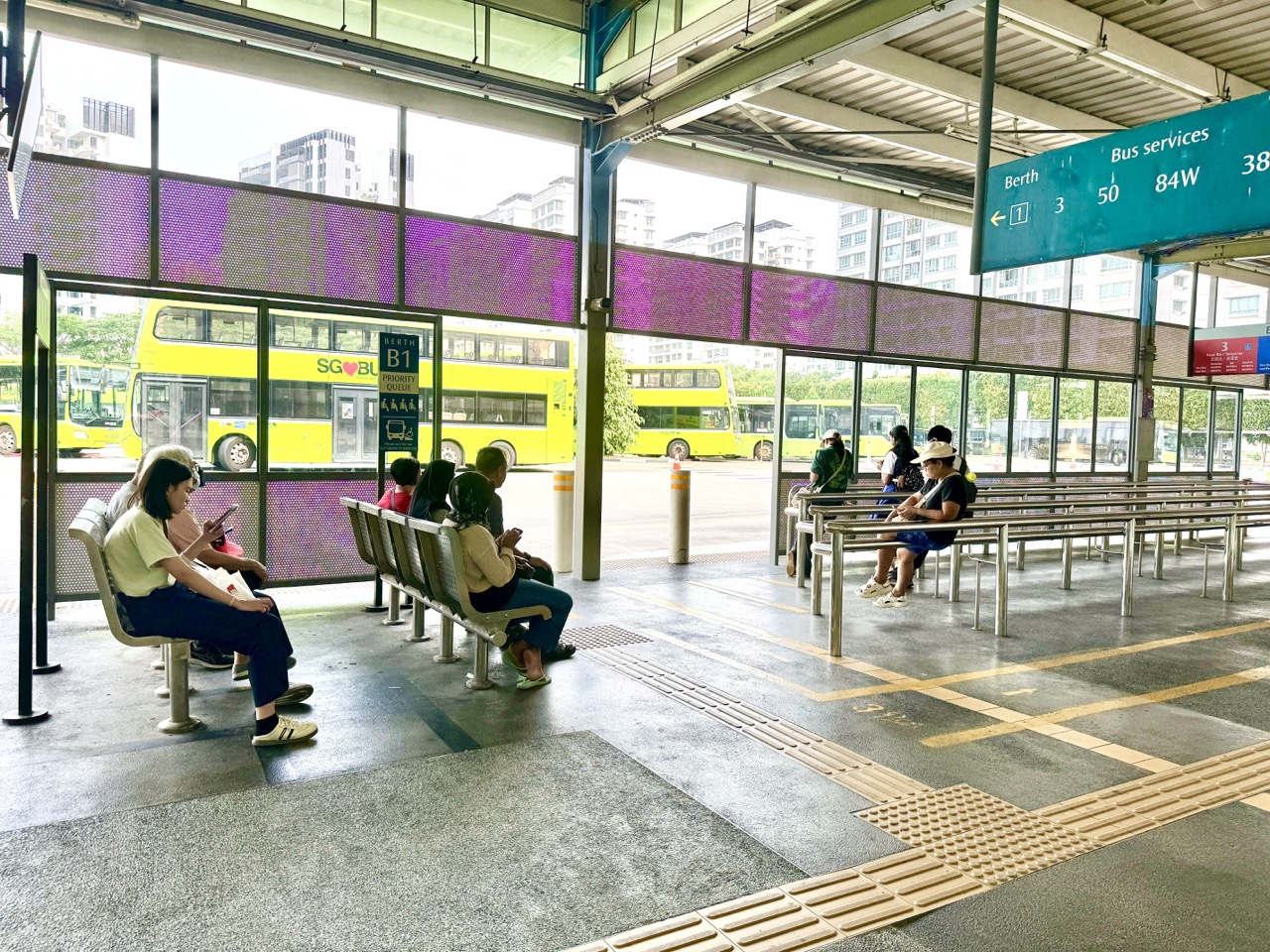
Punggol Bus Interchange is beside Punggol MRT/LRT station at Punggol Place. It is a different location from Punggol Coast Bus Interchange, which opened at Punggol Digital District in June 2025. Our newest October 2026 photographs show people waiting at the older Punggol bus interchange and passengers alighting from a bus. If you’re catching a bus after the North East Line or planning a pickup with children, this is the distinction to get right before reading any service number or trying to work out where to queue.
You may still see the older name ‘Punggol Temporary Bus Interchange’ on photographs, search results and historical guides. Specialist transport records say the word ‘Temporary’ was dropped from the interchange’s name when Punggol Coast Bus Interchange began service on 29 June 2025. The old facility continues to be referred to as Punggol Bus Interchange in LTA’s August 2026 announcement about upgrades beginning in 2027. In other words, two Punggol interchanges exist, and the older ‘temporary’ label must not be mistaken for an instruction to travel to Punggol Coast.

Punggol Bus Interchange: quick answers for commuters
- Current working name: Punggol Bus Interchange, historically called Punggol Temporary Bus Interchange.
- Location: adjacent to Punggol MRT/LRT, in the Punggol Place town-centre area.
- Published address in specialist transport reference: 70A Punggol Place, Singapore 828865; use current operator and LTA signage for live directions.
- Different station: Punggol Coast Bus Interchange serves the Punggol Digital District and is integrated with Punggol Coast MRT, one North East Line station farther along the line.
- Major 2025 change: bus services 34 and 117/117M moved from Punggol Bus Interchange to Punggol Coast Bus Interchange on 29 June 2025, according to LTA.
- 2026 update: LTA announced on 18 August 2026 that enhancement works at Punggol Bus Interchange will begin in 2027.
- New photographs: people seated or waiting, passengers alighting and everyday use of the bus station.
- Important limit: bus routes, boarding berths, diversions, first and last service times and accessibility details should be checked on current operator and LTA information.
- Best first step: identify the correct interchange before selecting the bus service or boarding berth.
The source owners are clear: LTA’s 20 May 2025 announcement confirms the separate Punggol Coast opening and moved services, while LTA’s 18 August 2026 announcement identifies Punggol as an interchange receiving works from 2027. For detailed current route tables and an explanation of why the names differ, use our existing Punggol versus Punggol Coast Bus Interchange guide. This new photo-led article focuses on how a commuter experiences the older terminal.
Why the word ‘temporary’ can mislead readers
Punggol’s older bus interchange was created to serve the developing town and was originally known as Punggol Temporary Bus Interchange. The name reflected the facility’s history and construction approach; it did not mean commuters were using a pop-up stop that might disappear overnight. The old label has survived in media files and online descriptions, which is why people still search for it in 2026.
For a visitor, the practical distinction is that ‘temporary’ is part of an older name. The current station is not the new Punggol Coast interchange just because another, more permanent-looking building has opened. A photograph metadata label may be historically recognisable but should not determine which place appears on your journey. Read the bus destination board, station name and live route information instead.
Why Punggol Coast was not simply a replacement
LTA’s 2025 announcement explained that Punggol Coast Bus Interchange opened as an integrated transport hub for the Punggol Digital District. It is connected with Punggol Coast MRT and Punggol Coast Mall, while the older Punggol Bus Interchange remains beside Punggol MRT/LRT. The two transport nodes serve overlapping regional travel needs but are different destinations.
The distinction matters because a family may travel to the older interchange expecting to board a service that moved to Punggol Coast. Some routes and bus stops changed in 2025, and further adjustments can occur later. A current route planner is much more reliable than copying a printed list from before the new interchange opened. If you only remember one rule, remember to check the interchange name as well as the service number.
What happened to services 34 and 117/117M
The 20 May 2025 LTA news release announced that services 34 and 117/117M would transfer from Punggol Bus Interchange to Punggol Coast Bus Interchange when the latter opened on 29 June. Their routes were also adjusted to serve other parts of Punggol. This is not an obscure transport-enthusiast detail: it affects parents, students and travellers who learned a route before the transfer.
If an old blog still tells you to go to the older Punggol interchange for one of those routes, treat it as out of date and consult the live service. The exact current stopping points can be confirmed through LTA’s journey-planning information or the relevant operator. A person who remembers a route from several years ago may be perfectly familiar with Punggol yet still need to update this one part of the journey.
The photographs show a real interchange, not its full network
Our October photo collection includes passengers waiting behind railings or near seats and commuters alighting from a bus. These are useful human-scale records: they show the place as a working part of everyday travel, not a stylised computer rendering. A local reader can recognise the kind of space they will pass through when transferring between road and rail.
But the images do not provide the full service list, actual berth assignments or the timing of a particular vehicle. One photograph cannot establish how many buses arrive in an hour or whether the pictured passengers use the MRT next. We should not infer private travel plans, occupations or names from people’s clothing or posture. The value lies in the shared public environment.
Arriving by Punggol MRT or LRT
The older interchange is beside Punggol MRT/LRT, which makes it part of the town’s main transfer node. Punggol MRT is on the North East Line, and the LRT network serves neighbourhood stops within Punggol. A commuter arriving by rail should follow current bus-interchange signs rather than exit in an arbitrary direction and assume every bus is nearby.
For a family with a stroller or heavy bags, a little extra attention to lifts and wayfinding can prevent unnecessary walking. Current station directions are more reliable than a 2026 photograph because entrances and internal routing can change. Allow comfortable transfer time, especially when the whole group is unfamiliar with the interchange. A short journey becomes frustrating if the first five minutes are spent discovering you took the wrong exit.
The first decision: which interchange are you using?
Before looking for a bus, check the full name printed on your route result. ‘Punggol’ and ‘Punggol Coast’ are not interchangeable labels. An MRT destination of Punggol Coast should lead you towards the newer integrated hub, while a route terminating at Punggol Bus Interchange refers to the older station beside Punggol MRT.
Tell other people in the group exactly which one you mean. A message saying ‘meet me at Punggol bus interchange’ can still be misread if somebody only knows the new Punggol Coast terminal. Add the relevant MRT station to the instruction. A precise meeting message is kinder than asking a grandparent to search an entire town for the right boarding point.
What a departure board can and cannot do
At an operating bus interchange, boards and service signs help passengers identify their routes and waiting points. Read the current name, number and direction. A bus can share a service number while its current route or boarding point changes during works. The display in front of you, together with current operator information, matters more than an old online table.
If a sign seems inconsistent with the journey planner, ask the interchange staff or operator channel rather than joining the nearest queue on a guess. This is especially important when a family needs a service at a particular time. Avoid taking photographs of staff screens or restricted work areas while trying to settle the question. A calm request for directions is usually the better route.
Waiting behind railings is part of the system
Our waiting-area photograph shows passengers near railings and seats. Those features help organise human movement, but a photo cannot establish the current designated priority zone or accessible boarding procedure for every berth. Follow the queue configuration actually in use. Do not climb over a barrier to reach a bus that appears ready to depart.
Parents can explain why queues matter. They make it easier for passengers to board in order and for the bus captain to see the group being served. Even if another passenger is moving slowly, crowding and jostling are not solutions. Leave room for people who need more time, including older commuters and those using mobility aids. Courtesy is not an optional extra; it is part of safe boarding.
Why a bus alighting photograph is different from a boarding photograph
Two of the new images show passengers alighting from a bus. Alighting and boarding may take place at different parts of an interchange, or a platform may have more than one operational use depending on current arrangements. A visitor should not assume that the stop where passengers are leaving a bus is also the correct point for their own departure.
After alighting, clear the bus doorway and move towards the appropriate pedestrian route, making room for others behind you. If you need to check your phone or find the correct rail connection, stop at a suitable place away from active movement. The small choice not to stand in a narrow exit helps everyone, especially travellers carrying bags or accompanying children.
Using a phone without forgetting your surroundings
One October photograph includes a person looking at a phone after getting off a bus. That is an ordinary public scene. A phone can help with map directions, bus arrival information or messages to family. It also takes attention away from the immediate environment, which matters near moving vehicles, platform edges or crowded doorways.
Teach children to step aside before checking an app rather than walking with their eyes on a screen. Adults should do the same. A route-planning tool is useful only when the traveller remains aware of the real place. Don’t post screenshots containing another person’s face or private messages simply to demonstrate the interchange. The information you need is the route, not a stranger’s identity.
Choosing a meeting point for a family
An interchange is designed for movement, and a point that seems convenient for one person may obstruct several others. Choose a lawful, identifiable waiting area that does not block boarding lines, exit doors, staff access or pedestrian paths. Share the name of the specific interchange and a clear public landmark with everyone in the group.
For small children, agree that they stay with the responsible adult rather than moving between queues to find somebody. If a teenager is travelling independently with permission, establish a family contingency for delays or changed services. Do not require a child to approach an unknown person just because that person is waiting in the same bus area. Safe meeting arrangements are simple, specific and rehearsed.
When a bus is running late
A timetable is a planning guide, but traffic, operations and weather can alter actual arrival times. If a bus has not appeared when expected, check a live source and the information at the interchange. Resist the temptation to run across active lanes because a different bus is pulling away. A missed service is inconvenient; an unsafe crossing can be much worse.
For appointments, leave a sensible margin based on the journey’s importance and variability. A school pickup or clinic visit may need more buffer than an optional leisure trip. If the delay changes the plan, inform the relevant person through a safe channel. Do not encourage a child to leave an agreed waiting area and improvise a route without the responsible adult’s knowledge.
The difference between scheduled service and a one-off diversion
Public bus routes can be adjusted permanently or diverted temporarily. A route moved to a new interchange in 2025 is a lasting service change unless later amended, while a weekend road event can produce a one-day diversion. These two kinds of information should not be blended into a single general sentence saying ‘the bus has moved’. Readers need the date and nature of the change.
Check whether a notice says ‘from’, ‘until’, ‘temporary’ or ‘permanent’. The distinction helps parents and students avoid treating a festival diversion as the normal route. A photo from October 2026 can document that buses were using the older interchange at a particular moment, but it cannot reveal whether another service had a short-lived change elsewhere.
A 2027 interchange-upgrade announcement is not a closure notice
On 18 August 2026, LTA announced that enhancement works at six bus interchanges, including Punggol, would begin in 2027. The announcement describes improvements to commuter facilities, accessibility and staff spaces, with works phased to minimise disruption. It does not say that the whole Punggol interchange closed in August 2026.
This matters because people can hear ‘upgrade works’ and assume they must travel to another interchange immediately. LTA’s statement points to future phased works. As those begin, individual boarding points or routes may be adjusted and should be checked on current notices. Do not publish an imagined construction schedule or platform closure before the operator confirms it.
What the LTA improvements are meant to address
LTA’s August 2026 announcement mentions a programme including improved lighting and ventilation, priority queue areas, seating, family or accessible facilities and features that support people with different mobility needs. These are goals for the relevant enhancement work, not proof that every listed feature was already installed at the older Punggol interchange when our photos were taken.
A thoughtful reader keeps three categories separate: facilities visible in an October 2026 photograph, improvements announced for 2027 and amenities confirmed as operating at a particular date. That prevents an ‘upcoming improvement’ from being advertised as a current facility. The distinction is particularly important when somebody needs an accessible toilet or commuter-care space and cannot safely rely on guesswork.
Why construction phasing matters for a daily commuter
An interchange upgrade has to consider passengers who keep using the facility while works take place. LTA says enhancements are designed to be carried out in phases so as to minimise disruption. That is a planning intention, but the exact locations and dates of temporary boarding adjustments should come from future official notices.
A parent using a particular berth daily should watch for changes once works start, rather than assume the same waiting place remains available. Building a habit of reading prominent new signs is often more reliable than memorising one platform for years. The child or caregiver should know how to ask for help if signage changes rather than following another commuter blindly.
The comfort of waiting is a real transport issue
An interchange is not only where a bus stops; it is where people spend minutes standing, sitting, making decisions and navigating crowds. For an older person, seating and accessible routes may strongly affect how manageable a trip feels. For a parent with a toddler, the ability to keep the child nearby while reading a service board matters. For a worker returning late, clear lighting and safe movement matter.
These needs help explain why LTA invests in commuter amenities rather than treating transport as just a fleet of vehicles. The October images show waiting as part of the public travel experience. They cannot measure everyone’s comfort, but they make the human side of the transport system visible. A good guide takes that experience seriously.
What a passenger with limited mobility should check
Individual access needs vary. A wheelchair user may need a suitable boarding route; another commuter may need rest breaks, clear signs or sufficient time to board. Ask the person what works and use current official facility and service information. Do not declare that the older Punggol interchange has every amenity named in LTA’s future upgrade programme.
On arrival, look for designated assistance points or appropriate staff when guidance is needed. If a planned transfer is awkward or a route changes unexpectedly, seek help rather than trying a potentially unsafe shortcut through vehicle areas. Good planning is about actual access on the day, not the assumption that all transport spaces serve all users identically.
How to travel with a stroller
A stroller is useful for a family journey but can become difficult in a crowded boarding queue. Keep it within the supervised family group, out of others’ path, and follow bus operator rules about boarding and stroller positioning. Do not assume every bus or berth follows exactly the same procedure; current staff and operator instructions apply.
An adult handling a stroller should not also try to carry several hot drinks or supervise children scattered across the waiting area. Choose a manageable arrangement before the bus arrives. The goal is to board safely without rushing other passengers. A missed bus is frustrating, but pressuring a caregiver to move unsafely makes the situation worse.
A child’s first trip on the bus
A first independent or semi-independent bus journey requires more than knowing a service number. The child needs to recognise the correct interchange, identify the boarding area, understand the intended destination and know what to do if the bus is missed or an expected stop is unavailable. Their readiness depends on judgement and the family’s agreed supervision plan.
Start with supervised practice rather than sending the child alone as a test. Show how to confirm that a bus is going in the correct direction and how to stay aware while waiting. Do not teach children to photograph other passengers as proof of where they are. A safe contingency is more valuable than a social-media record of every stop.
A simple bus-to-MRT transfer routine
On alighting, follow the signed pedestrian route to Punggol MRT/LRT and check the train direction before entering. Avoid stopping in the alighting area to organise every detail; move first to a safe public place. If carrying luggage, allow more time to find an appropriate lift or accessible route. Exact walking time will differ by berth, crowds and individual mobility.
A family should agree who leads and who keeps the group together. For a teenager learning transfers, ask them to name the next destination before boarding the train. This helps prevent a common mistake: reaching the correct station but taking the wrong train direction. A calm, sequential plan beats a rushed itinerary that assumes one transfer is always effortless.
A simple MRT-to-bus transfer routine
Before reaching Punggol MRT, note the intended bus service and destination in a current route app or official information source. Once at the interchange, check current signs and go to the right berth. If the route requires Punggol Coast instead, travel to that separate interchange rather than assuming both sets of boarding areas are in one building.
Travellers should allow a margin for finding the correct waiting point. The right service number is not enough if the selected bus has multiple route patterns or short trips. Read the displayed destination and ask for clarification when uncertain. A parent can teach a child to identify three things: bus service, destination and correct interchange.
Why one bus number can have several variations
Singapore bus networks may include main services, route variants and short trips that do not travel the full route. A suffix or letter can change which stops are served. A commuter should never rely only on the first two or three digits seen from a distance. Read the complete service designation and destination board.
For a family with a child, explain the principle before an actual trip: a similar-looking number does not guarantee the same destination. Use current operator information to check whether a variant reaches the needed stop. This article deliberately avoids maintaining its own comprehensive live route table, which would duplicate the specialised interchange guide and risk becoming stale as services change.
The 2025 changes as a lesson in checking dates
A person who lived in Punggol before 2025 may have a strong mental map of the older interchange. When the new Punggol Coast node opened in June 2025, that map needed updating for some routes. It is entirely possible to know a town well yet be wrong about one route after a network change. This is not a failure of memory; it is a normal reason to check current information.
Help children practise a good question: ‘How old is the route information?’ A screenshot from 2024 can be useful for transport history but unsuitable for boarding in late 2026. A current LTA notice and the operator’s live service listing are better sources for the actual trip. Learning to update a mental map is part of growing travel independence.
What the photos reveal about commuter behaviour
One image shows people waiting, while the others capture alighting and movement away from a bus. These scenes illustrate how a bus interchange is a sequence of small activities: passengers arrive, wait, board, alight, transfer and leave. Each stage has its own safety and flow needs. A family visiting the interchange can observe these stages without conducting intrusive interviews or identifying people.
An older student can draw a simple flow diagram from the photos, making clear which steps are observed and which are inferred. For example, seeing someone alight is an observation. Saying that the person then went to Waterway Point is speculation unless the journey was actually documented. This exercise trains careful thinking from everyday public evidence.
Why long queues do not always mean poor service
A queue can grow because several passengers arrive together from a train, because a bus is due soon or because a particular service is highly used at that moment. A photo of a line is not a measure of lateness or an operator’s overall performance. Without time-series data, departure schedules and actual passenger counts, an accurate punctuality judgement cannot be made.
Students interested in statistics could observe broad, anonymised movement in a lawful public area, if doing so without disruption, and record the limitations of the sample. A single ten-minute interval will not represent a whole week. Parents need not conduct such an exercise during a rushed journey; it is enough to know that photographs and impressions have evidence limits.
A tiny calculation for a child learning travel time
Imagine a hypothetical bus journey taking 18 minutes and a transfer taking 7 minutes. The planned travel portion is 25 minutes before adding walking, queueing or unexpected delays. The arithmetic is simple; the more interesting question is what was left out. A child who can name the missing steps understands time planning more deeply than one who only adds two numbers.
Do not substitute the hypothetical numbers for a real route from Punggol. Record actual observations from your own journey or use a reliable trip planner. The difference between an estimate and a guarantee should remain clear. A family can develop a buffer based on experience, particularly for appointments, school starts and other time-sensitive obligations.
Transport accessibility as a planning question
An interchange may be judged not only by the number of routes but by whether people can comfortably move between them. Seating, queue design, clear information, accessible toilets and appropriate assistance can make transfers easier. LTA’s planned enhancement programme recognises these needs, while the separate Punggol Coast integrated hub has its own published accessibility features.
But do not transplant Punggol Coast’s features to the older Punggol interchange merely because both have the word ‘Punggol’ in their names. LTA’s 2025 Coast opening announcement lists specific new-hub facilities. The 2026 Punggol enhancement statement lists future works. A careful guide labels every facility claim by the correct place and date.
How to avoid the wrong terminus on airport journeys
Some travellers associate Punggol buses with connections to the airport or eastern Singapore. Since route 34 was moved to Punggol Coast Bus Interchange in June 2025, relying on an old Punggol Interchange instruction can send a traveller to the wrong starting point. For a flight, that mistake can be particularly expensive in time.
Before setting out, check the exact current route, terminal and departure time using official transport information. Build an appropriate margin for luggage, traffic and airport processing. Do not use this photo guide as a flight-transfer timetable; its job is to alert readers to the two-interchange distinction and provide a reliable verification path.
School journeys deserve a clear meeting plan
Punggol has several primary and secondary schools, and families use buses, LRT and MRT for school trips. A child who needs the older interchange should know its name and a family-approved route rather than only ‘the bus station near the mall’. If the student’s service has changed, verify the new terminus and stop before the school week begins.
A school-arrival time is a real constraint, so parents should consider crowding and transfer variability. A child should not be asked to sprint across an interchange lane when running late. Teach the approved contingency instead. The correct response to a missed connection is to use safe communication and transport options, not to invent a dangerous shortcut.
Visitors unfamiliar with Punggol’s development
Someone visiting the town after several years away may be surprised to find more rail, shopping and bus options than they remember. The older interchange still relates closely to the original Punggol MRT/LRT town-centre node, while Punggol Coast serves newer parts of the district. Thinking of them as different nodes in a growing network makes the geography easier to understand.
Start with a current map and identify your destination. If going to One Punggol, the older Punggol station area may be relevant depending on the selected route. If going to the SIT campus or Punggol Digital District, Punggol Coast connections may be more direct. Do not rely on a blanket statement that one station is always best for every destination.
What to do when a berth is changed
During future works or temporary operational adjustments, an operator may move a service to a different berth. Watch for official signs, announcements and staff directions. Do not assume the last berth photographed by a visitor remains correct. A bus number and current destination matter more than the physical location that used to serve it.
If a caregiver or child is confused, pause in a safe waiting area and ask an appropriate staff member. Avoid cutting across bus lanes or jumping a railing to reach the new point. Interchanges organise movement for a reason, and a short detour through the permitted path is preferable to a direct but unsafe crossing.
If a bus captain or staff member is helping someone
Frontline transport workers may be assisting a passenger, directing a queue or coordinating a boarding procedure. Allow them space to do so. A commuter who sees an unusual delay should not assume negligence from a ten-second observation. The full reason may not be visible, particularly when staff are helping somebody with an accessibility need.
Children can learn that patience has a practical value. Waiting while a person boards safely is part of sharing public transport. If your own situation is urgent, communicate respectfully and follow the operator’s available assistance process. Do not pressure another passenger to hurry beyond their capability for the sake of keeping an informal schedule.
Privacy in public interchange photographs
The new photographs include members of the public waiting and alighting. Their presence in a public place does not establish their identity, occupation or travel purpose. A responsible article describes the scene without claiming that any pictured person is a student, delivery worker or tourist unless independently known and appropriately relevant.
A family taking its own pictures can focus on the interchange’s layout, signs or broad architectural context. Avoid intrusive close-ups of children, identifiable screens or someone who may not welcome attention. When a photograph is published, do not attach claims about how the person travels every day. Local documentation should make a place intelligible without exposing private routines.
A short observation visit for younger children
For a supervised child curious about public transport, a short look at the designated public waiting area can help explain where buses arrive and why queues form. Stay out of boarding flows and do not treat the interchange as a playground. A child can learn to recognise service numbers and the difference between boarding and alighting without running between bays.
Keep the activity brief if the space is busy. A parent can ask: ‘What do we check before we board?’ The useful answers include route number, destination and the right stop. These habits become valuable later when the child starts using transport with greater independence. The lesson should never interfere with actual passengers or staff.
A route-reading exercise for a secondary student
Ask the student to compare an official 2025 route-change announcement with a current journey-planning result. Which service moved? When did the change take effect? Does the current route match the historical notice, or has it changed again? This helps a student recognise that public information has a date and that different documents answer different questions.
The student can then write one clear correction to a hypothetical outdated sentence: ‘Bus 34 starts at Punggol Bus Interchange.’ The correction should be supported by the current operator’s live route listing and LTA’s historical transfer announcement. If another amendment occurs later, the student learns to update the statement again rather than defending an old answer out of habit.
A town-planning question: two interchanges, one growing town
The opening of Punggol Coast Bus Interchange illustrates how a public transport network adapts as new housing, employment and education centres develop. The older interchange remains tied to the long-established town centre, while the new integrated hub serves a different part of Punggol. This helps residents reach changing destinations without assuming the original node must handle everything.
That is a general planning explanation, not proof that any one route is now optimal. Transport planning balances coverage, connectivity, travel time and operations. Residents experience those trade-offs differently depending on where they live and travel. A student can compare the two interchange roles while noting that only live route data can settle a particular door-to-door journey.
What a transport ‘upgrade’ does not mean
An upgrade announcement is not necessarily an instruction that passengers will receive an entirely new bus fleet, new fares or direct service to every desired destination. The LTA 2026 announcement concerns interchange facilities and systems, including commuter and staff amenities. Do not inflate it into route promises or claim that all delays will disappear.
Good public information distinguishes infrastructure changes from service planning. Improved lighting or seating may make waiting more comfortable, but it does not by itself change which bus reaches a school. Route amendments need their own official notices. A photo-led article can explain that difference without pretending the upgrade will solve every transport problem in the town.
How to use the interchange without rushing the last bus
If travelling late, confirm the current last service time from an official or operator source rather than relying on a general statement that buses run until midnight. Different routes and directions can have different operating hours. A family should not plan its return on an unverified last-bus assumption.
Have a reasonable alternative in mind when a journey is time-sensitive. But do not let urgency lead to risky road crossings or conflicts with staff. If the service has ended, confirm the available legal transport choices and communicate the change to people expecting you. The right plan is one that can be followed safely when the timetable does not cooperate.
A commuter checklist before leaving home
Confirm the correct interchange, bus service, direction and live status. If travelling with a child or older relative, allow a sensible transfer margin and decide how you will meet. Bring what the journey requires without overloading yourself, and use suitable accessible routes where needed. A screenshot of an old route table is not enough if the service may have been amended.
At the interchange, read the actual signs, queue in the designated area and avoid obstructing boarding or alighting. Once on the bus, check that the displayed destination and route fit your plan. After alighting, move clear of the bus first before consulting your phone. These habits are ordinary but valuable. They make transport more predictable for the people sharing the journey.
Why the photo record will remain useful after 2027
LTA’s upgrade programme may change the appearance of the Punggol Bus Interchange over time. The October 2026 images will remain a record of how the waiting and alighting areas looked before those future works. That historical value is different from a live navigation function. The photos should continue to carry their capture context even if the berth layout changes later.
An article can preserve the record while directing travellers to updated route and station information. That is why the captions describe what they show rather than promising permanent configurations. After 2027 works start, the canonical route guide should absorb verified operational changes. This photo article should keep its observational role and link readers to the right current source.
A better way to describe the Punggol bus network
Instead of saying ‘Punggol has one bus interchange’, say that Punggol has the older Punggol Bus Interchange beside Punggol MRT and the newer Punggol Coast Bus Interchange beside Punggol Coast MRT. Some routes were moved when the second hub opened, and current services should be checked on LTA or operator sources. That description is short, practical and resistant to common misunderstanding.
The experience of the older interchange is still worth documenting. People wait, transfer and return home there every day. Its future upgrades matter to real commuters, and the new photographs show that everyday usefulness without making exaggerated claims. The most important lesson is simple: read the full place name and source date before you move.


Frequently asked questions
Is Punggol Temporary Bus Interchange still in use?
The older interchange continues to appear in 2026 official planning references as Punggol Bus Interchange. ‘Temporary’ is the historical name, not a sign that the station is the same as Punggol Coast.
Why did the name change?
Specialist transport coverage records that the word ‘Temporary’ was dropped effective 29 June 2025, the day Punggol Coast Bus Interchange began operations. Use current official signage for the current place name.
Where is the older Punggol Bus Interchange?
It is beside Punggol MRT/LRT in the Punggol Place town-centre area. Specialist transport sources list 70A Punggol Place, but actual boarding details belong to LTA and current operator signs.
Where is Punggol Coast Bus Interchange?
It is integrated with Punggol Coast MRT in Punggol Digital District, serving a different town node from the older interchange.
Is Punggol Coast a replacement for Punggol Bus Interchange?
No. LTA’s 2026 announcement separately names Punggol Bus Interchange for future upgrades, and Punggol Coast has its own integrated hub.
Which interchange does service 34 use?
LTA moved service 34 from the older Punggol interchange to Punggol Coast on 29 June 2025. Confirm its current origin and boarding berth before travel.
What about service 117 or 117M?
LTA’s 2025 announcement likewise moved 117/117M to Punggol Coast. Use current operator information for the exact route, stops and variants.
Are the old Punggol Bus Interchange photos showing Punggol Coast?
No. The new eduKatePunggol photo library labels them as the older temporary interchange, now more appropriately described as Punggol Bus Interchange.
Will the older interchange close in 2027?
The August 2026 LTA statement announced enhancement works beginning in 2027, phased to minimise disruption. It was not a notice of permanent closure.
What improvements are planned?
LTA outlined better comfort, accessibility and commuter amenities across the six interchanges scheduled for upgrades. Specific completed features must be confirmed during or after the work.
Can I use the old photo to find a berth?
No. Berths and temporary diversions are operational details that can change. Follow live signage and operator announcements.
Does the new Punggol Coast hub have priority seating?
LTA’s 2025 opening release describes priority queue zones with seating at the newer Punggol Coast integrated hub. Do not automatically attribute every Coast feature to the older station.
How should I plan a journey with children?
Confirm service, interchange, direction, safe transfer and a family meeting plan. Use age-appropriate supervision and do not rush across vehicle areas.
What if my bus is diverted?
Follow current notices and operator directions, check alternate stops and allow extra time. Do not treat an old standard route map as a diversion plan.
Are there live arrival times in this article?
No. This page is a fact-checked photo and commuter-practice guide, not a live timetable. Check current LTA and operator sources.
Can I photograph people at the interchange?
Be respectful of privacy, especially for children. Avoid intrusive images, private screens or published speculation about strangers’ travel routines.
Do route changes affect airport journeys?
They can. Route 34’s 2025 move to Punggol Coast is especially relevant to people relying on old instructions. Confirm current routing and leave appropriate travel margin.
Where can I learn the full list of routes?
Use the existing Punggol and Punggol Coast Bus Interchange Routes Guide and current LTA/operator information.
Why are the photos useful if they cannot provide timetables?
They show the everyday public place, waiting and alighting as observed in October 2026. That visual record complements, but does not replace, live transport data.
Where should I ask for help at the interchange?
Use the current station’s appropriate staff or operator assistance arrangements and follow displayed instructions rather than approaching vehicle lanes or restricted areas.
Official sources and onward Punggol transport guides
- LTA — Punggol Coast Bus Interchange Opens 29 June 2025 (the separate new hub and route moves for 34 and 117/117M).
- LTA — Integrated Transport Hubs (the distinct Punggol Coast transport hub).
- LTA — Six Bus Interchanges to Be Enhanced, 18 August 2026 (works planned from 2027, including Punggol).
- Land Transport Guru — Punggol Bus Interchange (secondary transport history and older ‘Temporary’ name).
- Punggol Bus Interchange versus Punggol Coast (the canonical decision guide).
- Punggol and Punggol Coast Bus Interchanges: Routes (the broader routes page).
- Understanding Punggol Public Transport (complete system context).
- History of Punggol Bus Interchange (the separate historical timeline).
- Complete Punggol Guide (neighbourhood reference hub).
Editorial record: 23 October 2026. New October 2026 images from eduKatePunggol document passengers at the older Punggol Bus Interchange, historically called Punggol Temporary Bus Interchange. Photo captions describe observable scenes, not passengers’ identities, public access guarantees or fixed berth assignments. Service routes and operational arrangements change; current LTA and bus-operator information always takes priority. The 2027 works are announced plans, not present-day closures.


