
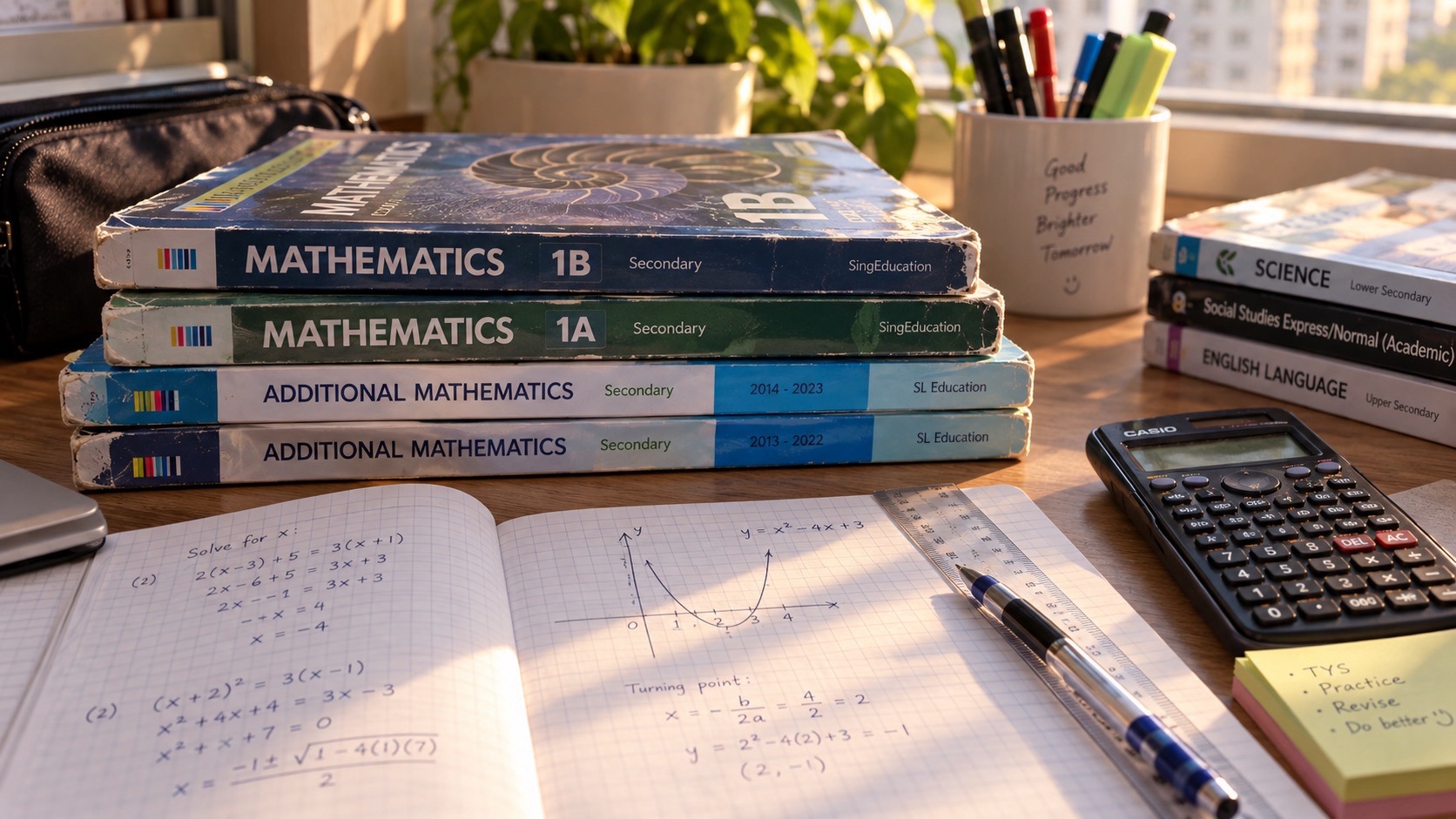
Quick answer. A guided progression from sample spaces and fair games to conditional probability, combinations, expected value and university statistics. Punggol families follow the relevant Singapore MOE Mathematics curriculum and the student’s actual school subject level. The important progression is from concrete quantities and clear representations towards general reasoning, equations, graphs and independent verification. This guide provides original worked illustrations, common errors, parent questions and a learning sequence, without claiming that a particular tuition method guarantees an examination grade.
A mathematical method is secure only when the learner can explain why it works and apply it to a changed problem without a prompt. Rather than memorising keywords or rushing into advanced notation, students should identify the unknown, name the whole or reference set, choose a diagram or equation, calculate accurately and check the meaning of the result. Different school stages require different depth, and examples from later stages are extensions rather than universal requirements for young pupils.
Reviewed October 2026. National syllabus details and SEC examination requirements should be checked against the current official MOE and SEAB documents. Every exercise in this article is an independently written illustration and not an official examination item.
What readers should know first
- Start with meaning: represent quantities with objects, drawings, tables or symbols.
- State the relationship: name the known values and the unknown before calculating.
- Check the domain: fractions, probability and algebra may impose different conditions.
- Use school-level expectations: Primary, Secondary G1/G2/G3 and pre-university are not one examination.
- Explain a misconception: find the first invalid reasoning step.
- Revisit after a gap: a changed independent task is better evidence than copying a model.
- Keep progress realistic: school feedback, individual readiness and sustainable practice matter.
Jump to the mathematical concept
- 1. Certain and impossible events
- 2. Sample spaces
- 3. Fair dice
- 4. Independent trials
- 5. Dependent events
- 6. Tree diagrams
- 7. Tables of outcomes
- 8. Complement rule
- 9. Addition rule
- 10. Multiplication rule
- 11. Arrangements
- 12. Selections
- 13. Permutations
- 14. Combinations
- 15. Pigeonhole principle
- 16. Conditional probability
- 17. Bayes examples
- 18. Expected value
- 19. Variance
- 20. Modelling assumptions
1. Certain and impossible events
Understand the mathematical structure. Certain and impossible events should be connected to a clearly stated quantity, relationship or pattern. At an introductory level, a learner can show the idea with objects and a labelled picture. At a more advanced level, the same relationship can be written with variables, a table or a graph, and the student should identify the conditions under which the representation is valid. A mathematical statement must be supported by reasoning, not only by repeated numerical examples.
Worked example and explanation. Consider 3 equal groups containing 2 objects per group. The total is 3 × 2 = 6 objects. If the total and number of groups are known, the group size is 6 ÷ 3 = 2. If the total and group size are known, the group count is 6 ÷ 2 = 3. These three related equations demonstrate how changing the unknown changes the operation while preserving the same underlying structure. In certain and impossible events, the student should similarly name each mathematical object and test whether a proposed calculation answers the stated question.
A contrasting example. Suppose the number of groups increases from 3 to 4 while the group size stays 2. The new total is 8, not 7, because one entire group of 2 objects was added. If the objects are rearranged without adding or removing any, the total stays 6. These two changes reveal the difference between an invariant quantity and one that changes under a stated operation. This habit of explaining what changes is useful in patterns, equations, graphs, fractions and probability.
Common misconception. A pupil might add 3 and 2 merely because both numbers appear, or might obtain 6 but describe the answer as groups rather than objects. More generally, errors in certain and impossible events arise when the reference whole, direction of comparison, unit, domain or assumption is not identified. Diagnose the first incorrect decision. Repeating a correct-looking procedure without repairing that decision can reinforce a fragile shortcut.
Practice and transfer. Ask the student to explain the first example in words, draw a representation and verify it by an inverse operation. Then change one condition: use 5 groups of 2 objects for 10 total objects, or 3 groups of 3 objects for 9. Do not reveal which operation to use. Later select a new certain and impossible events problem from the child’s actual syllabus, with altered wording or a rotated diagram, and ask for an independent solution.
Parent’s observation. Note whether the learner identified the unknown, selected a valid model, justified the calculation, used correct units and checked the result without prompting. A student who needs a cue to start has a different learning need from one who understands the relationship but makes a copying slip. Keep the original attempt, correction and a dated independent retest.
2. Sample spaces
Understand the mathematical structure. Sample spaces should be connected to a clearly stated quantity, relationship or pattern. At an introductory level, a learner can show the idea with objects and a labelled picture. At a more advanced level, the same relationship can be written with variables, a table or a graph, and the student should identify the conditions under which the representation is valid. A mathematical statement must be supported by reasoning, not only by repeated numerical examples.
Worked example and explanation. Consider 4 equal groups containing 3 objects per group. The total is 4 × 3 = 12 objects. If the total and number of groups are known, the group size is 12 ÷ 4 = 3. If the total and group size are known, the group count is 12 ÷ 3 = 4. These three related equations demonstrate how changing the unknown changes the operation while preserving the same underlying structure. In sample spaces, the student should similarly name each mathematical object and test whether a proposed calculation answers the stated question.
A contrasting example. Suppose the number of groups increases from 4 to 5 while the group size stays 3. The new total is 15, not 13, because one entire group of 3 objects was added. If the objects are rearranged without adding or removing any, the total stays 12. These two changes reveal the difference between an invariant quantity and one that changes under a stated operation. This habit of explaining what changes is useful in patterns, equations, graphs, fractions and probability.
Common misconception. A pupil might add 4 and 3 merely because both numbers appear, or might obtain 12 but describe the answer as groups rather than objects. More generally, errors in sample spaces arise when the reference whole, direction of comparison, unit, domain or assumption is not identified. Diagnose the first incorrect decision. Repeating a correct-looking procedure without repairing that decision can reinforce a fragile shortcut.
Practice and transfer. Ask the student to explain the first example in words, draw a representation and verify it by an inverse operation. Then change one condition: use 6 groups of 3 objects for 18 total objects, or 4 groups of 4 objects for 16. Do not reveal which operation to use. Later select a new sample spaces problem from the child’s actual syllabus, with altered wording or a rotated diagram, and ask for an independent solution.
Parent’s observation. Note whether the learner identified the unknown, selected a valid model, justified the calculation, used correct units and checked the result without prompting. A student who needs a cue to start has a different learning need from one who understands the relationship but makes a copying slip. Keep the original attempt, correction and a dated independent retest.
3. Fair dice
Understand the mathematical structure. Fair dice should be connected to a clearly stated quantity, relationship or pattern. At an introductory level, a learner can show the idea with objects and a labelled picture. At a more advanced level, the same relationship can be written with variables, a table or a graph, and the student should identify the conditions under which the representation is valid. A mathematical statement must be supported by reasoning, not only by repeated numerical examples.
Worked example and explanation. Consider 5 equal groups containing 4 objects per group. The total is 5 × 4 = 20 objects. If the total and number of groups are known, the group size is 20 ÷ 5 = 4. If the total and group size are known, the group count is 20 ÷ 4 = 5. These three related equations demonstrate how changing the unknown changes the operation while preserving the same underlying structure. In fair dice, the student should similarly name each mathematical object and test whether a proposed calculation answers the stated question.
A contrasting example. Suppose the number of groups increases from 5 to 6 while the group size stays 4. The new total is 24, not 21, because one entire group of 4 objects was added. If the objects are rearranged without adding or removing any, the total stays 20. These two changes reveal the difference between an invariant quantity and one that changes under a stated operation. This habit of explaining what changes is useful in patterns, equations, graphs, fractions and probability.
Common misconception. A pupil might add 5 and 4 merely because both numbers appear, or might obtain 20 but describe the answer as groups rather than objects. More generally, errors in fair dice arise when the reference whole, direction of comparison, unit, domain or assumption is not identified. Diagnose the first incorrect decision. Repeating a correct-looking procedure without repairing that decision can reinforce a fragile shortcut.
Practice and transfer. Ask the student to explain the first example in words, draw a representation and verify it by an inverse operation. Then change one condition: use 7 groups of 4 objects for 28 total objects, or 5 groups of 5 objects for 25. Do not reveal which operation to use. Later select a new fair dice problem from the child’s actual syllabus, with altered wording or a rotated diagram, and ask for an independent solution.
Parent’s observation. Note whether the learner identified the unknown, selected a valid model, justified the calculation, used correct units and checked the result without prompting. A student who needs a cue to start has a different learning need from one who understands the relationship but makes a copying slip. Keep the original attempt, correction and a dated independent retest.
4. Independent trials
Understand the mathematical structure. Independent trials should be connected to a clearly stated quantity, relationship or pattern. At an introductory level, a learner can show the idea with objects and a labelled picture. At a more advanced level, the same relationship can be written with variables, a table or a graph, and the student should identify the conditions under which the representation is valid. A mathematical statement must be supported by reasoning, not only by repeated numerical examples.
Worked example and explanation. Consider 6 equal groups containing 5 objects per group. The total is 6 × 5 = 30 objects. If the total and number of groups are known, the group size is 30 ÷ 6 = 5. If the total and group size are known, the group count is 30 ÷ 5 = 6. These three related equations demonstrate how changing the unknown changes the operation while preserving the same underlying structure. In independent trials, the student should similarly name each mathematical object and test whether a proposed calculation answers the stated question.
A contrasting example. Suppose the number of groups increases from 6 to 7 while the group size stays 5. The new total is 35, not 31, because one entire group of 5 objects was added. If the objects are rearranged without adding or removing any, the total stays 30. These two changes reveal the difference between an invariant quantity and one that changes under a stated operation. This habit of explaining what changes is useful in patterns, equations, graphs, fractions and probability.
Common misconception. A pupil might add 6 and 5 merely because both numbers appear, or might obtain 30 but describe the answer as groups rather than objects. More generally, errors in independent trials arise when the reference whole, direction of comparison, unit, domain or assumption is not identified. Diagnose the first incorrect decision. Repeating a correct-looking procedure without repairing that decision can reinforce a fragile shortcut.
Practice and transfer. Ask the student to explain the first example in words, draw a representation and verify it by an inverse operation. Then change one condition: use 8 groups of 5 objects for 40 total objects, or 6 groups of 6 objects for 36. Do not reveal which operation to use. Later select a new independent trials problem from the child’s actual syllabus, with altered wording or a rotated diagram, and ask for an independent solution.
Parent’s observation. Note whether the learner identified the unknown, selected a valid model, justified the calculation, used correct units and checked the result without prompting. A student who needs a cue to start has a different learning need from one who understands the relationship but makes a copying slip. Keep the original attempt, correction and a dated independent retest.
5. Dependent events
Understand the mathematical structure. Dependent events should be connected to a clearly stated quantity, relationship or pattern. At an introductory level, a learner can show the idea with objects and a labelled picture. At a more advanced level, the same relationship can be written with variables, a table or a graph, and the student should identify the conditions under which the representation is valid. A mathematical statement must be supported by reasoning, not only by repeated numerical examples.
Worked example and explanation. Consider 7 equal groups containing 6 objects per group. The total is 7 × 6 = 42 objects. If the total and number of groups are known, the group size is 42 ÷ 7 = 6. If the total and group size are known, the group count is 42 ÷ 6 = 7. These three related equations demonstrate how changing the unknown changes the operation while preserving the same underlying structure. In dependent events, the student should similarly name each mathematical object and test whether a proposed calculation answers the stated question.
A contrasting example. Suppose the number of groups increases from 7 to 8 while the group size stays 6. The new total is 48, not 43, because one entire group of 6 objects was added. If the objects are rearranged without adding or removing any, the total stays 42. These two changes reveal the difference between an invariant quantity and one that changes under a stated operation. This habit of explaining what changes is useful in patterns, equations, graphs, fractions and probability.
Common misconception. A pupil might add 7 and 6 merely because both numbers appear, or might obtain 42 but describe the answer as groups rather than objects. More generally, errors in dependent events arise when the reference whole, direction of comparison, unit, domain or assumption is not identified. Diagnose the first incorrect decision. Repeating a correct-looking procedure without repairing that decision can reinforce a fragile shortcut.
Practice and transfer. Ask the student to explain the first example in words, draw a representation and verify it by an inverse operation. Then change one condition: use 9 groups of 6 objects for 54 total objects, or 7 groups of 7 objects for 49. Do not reveal which operation to use. Later select a new dependent events problem from the child’s actual syllabus, with altered wording or a rotated diagram, and ask for an independent solution.
Parent’s observation. Note whether the learner identified the unknown, selected a valid model, justified the calculation, used correct units and checked the result without prompting. A student who needs a cue to start has a different learning need from one who understands the relationship but makes a copying slip. Keep the original attempt, correction and a dated independent retest.
6. Tree diagrams
Understand the mathematical structure. Tree diagrams should be connected to a clearly stated quantity, relationship or pattern. At an introductory level, a learner can show the idea with objects and a labelled picture. At a more advanced level, the same relationship can be written with variables, a table or a graph, and the student should identify the conditions under which the representation is valid. A mathematical statement must be supported by reasoning, not only by repeated numerical examples.
Worked example and explanation. Consider 8 equal groups containing 7 objects per group. The total is 8 × 7 = 56 objects. If the total and number of groups are known, the group size is 56 ÷ 8 = 7. If the total and group size are known, the group count is 56 ÷ 7 = 8. These three related equations demonstrate how changing the unknown changes the operation while preserving the same underlying structure. In tree diagrams, the student should similarly name each mathematical object and test whether a proposed calculation answers the stated question.
A contrasting example. Suppose the number of groups increases from 8 to 9 while the group size stays 7. The new total is 63, not 57, because one entire group of 7 objects was added. If the objects are rearranged without adding or removing any, the total stays 56. These two changes reveal the difference between an invariant quantity and one that changes under a stated operation. This habit of explaining what changes is useful in patterns, equations, graphs, fractions and probability.
Common misconception. A pupil might add 8 and 7 merely because both numbers appear, or might obtain 56 but describe the answer as groups rather than objects. More generally, errors in tree diagrams arise when the reference whole, direction of comparison, unit, domain or assumption is not identified. Diagnose the first incorrect decision. Repeating a correct-looking procedure without repairing that decision can reinforce a fragile shortcut.
Practice and transfer. Ask the student to explain the first example in words, draw a representation and verify it by an inverse operation. Then change one condition: use 10 groups of 7 objects for 70 total objects, or 8 groups of 8 objects for 64. Do not reveal which operation to use. Later select a new tree diagrams problem from the child’s actual syllabus, with altered wording or a rotated diagram, and ask for an independent solution.
Parent’s observation. Note whether the learner identified the unknown, selected a valid model, justified the calculation, used correct units and checked the result without prompting. A student who needs a cue to start has a different learning need from one who understands the relationship but makes a copying slip. Keep the original attempt, correction and a dated independent retest.
7. Tables of outcomes
Understand the mathematical structure. Tables of outcomes should be connected to a clearly stated quantity, relationship or pattern. At an introductory level, a learner can show the idea with objects and a labelled picture. At a more advanced level, the same relationship can be written with variables, a table or a graph, and the student should identify the conditions under which the representation is valid. A mathematical statement must be supported by reasoning, not only by repeated numerical examples.
Worked example and explanation. Consider 9 equal groups containing 8 objects per group. The total is 9 × 8 = 72 objects. If the total and number of groups are known, the group size is 72 ÷ 9 = 8. If the total and group size are known, the group count is 72 ÷ 8 = 9. These three related equations demonstrate how changing the unknown changes the operation while preserving the same underlying structure. In tables of outcomes, the student should similarly name each mathematical object and test whether a proposed calculation answers the stated question.
A contrasting example. Suppose the number of groups increases from 9 to 10 while the group size stays 8. The new total is 80, not 73, because one entire group of 8 objects was added. If the objects are rearranged without adding or removing any, the total stays 72. These two changes reveal the difference between an invariant quantity and one that changes under a stated operation. This habit of explaining what changes is useful in patterns, equations, graphs, fractions and probability.
Common misconception. A pupil might add 9 and 8 merely because both numbers appear, or might obtain 72 but describe the answer as groups rather than objects. More generally, errors in tables of outcomes arise when the reference whole, direction of comparison, unit, domain or assumption is not identified. Diagnose the first incorrect decision. Repeating a correct-looking procedure without repairing that decision can reinforce a fragile shortcut.
Practice and transfer. Ask the student to explain the first example in words, draw a representation and verify it by an inverse operation. Then change one condition: use 11 groups of 8 objects for 88 total objects, or 9 groups of 9 objects for 81. Do not reveal which operation to use. Later select a new tables of outcomes problem from the child’s actual syllabus, with altered wording or a rotated diagram, and ask for an independent solution.
Parent’s observation. Note whether the learner identified the unknown, selected a valid model, justified the calculation, used correct units and checked the result without prompting. A student who needs a cue to start has a different learning need from one who understands the relationship but makes a copying slip. Keep the original attempt, correction and a dated independent retest.
8. Complement rule
Understand the mathematical structure. Complement rule should be connected to a clearly stated quantity, relationship or pattern. At an introductory level, a learner can show the idea with objects and a labelled picture. At a more advanced level, the same relationship can be written with variables, a table or a graph, and the student should identify the conditions under which the representation is valid. A mathematical statement must be supported by reasoning, not only by repeated numerical examples.
Worked example and explanation. Consider 10 equal groups containing 2 objects per group. The total is 10 × 2 = 20 objects. If the total and number of groups are known, the group size is 20 ÷ 10 = 2. If the total and group size are known, the group count is 20 ÷ 2 = 10. These three related equations demonstrate how changing the unknown changes the operation while preserving the same underlying structure. In complement rule, the student should similarly name each mathematical object and test whether a proposed calculation answers the stated question.
A contrasting example. Suppose the number of groups increases from 10 to 11 while the group size stays 2. The new total is 22, not 21, because one entire group of 2 objects was added. If the objects are rearranged without adding or removing any, the total stays 20. These two changes reveal the difference between an invariant quantity and one that changes under a stated operation. This habit of explaining what changes is useful in patterns, equations, graphs, fractions and probability.
Common misconception. A pupil might add 10 and 2 merely because both numbers appear, or might obtain 20 but describe the answer as groups rather than objects. More generally, errors in complement rule arise when the reference whole, direction of comparison, unit, domain or assumption is not identified. Diagnose the first incorrect decision. Repeating a correct-looking procedure without repairing that decision can reinforce a fragile shortcut.
Practice and transfer. Ask the student to explain the first example in words, draw a representation and verify it by an inverse operation. Then change one condition: use 12 groups of 2 objects for 24 total objects, or 10 groups of 3 objects for 30. Do not reveal which operation to use. Later select a new complement rule problem from the child’s actual syllabus, with altered wording or a rotated diagram, and ask for an independent solution.
Parent’s observation. Note whether the learner identified the unknown, selected a valid model, justified the calculation, used correct units and checked the result without prompting. A student who needs a cue to start has a different learning need from one who understands the relationship but makes a copying slip. Keep the original attempt, correction and a dated independent retest.
9. Addition rule
Understand the mathematical structure. Addition rule should be connected to a clearly stated quantity, relationship or pattern. At an introductory level, a learner can show the idea with objects and a labelled picture. At a more advanced level, the same relationship can be written with variables, a table or a graph, and the student should identify the conditions under which the representation is valid. A mathematical statement must be supported by reasoning, not only by repeated numerical examples.
Worked example and explanation. Consider 11 equal groups containing 3 objects per group. The total is 11 × 3 = 33 objects. If the total and number of groups are known, the group size is 33 ÷ 11 = 3. If the total and group size are known, the group count is 33 ÷ 3 = 11. These three related equations demonstrate how changing the unknown changes the operation while preserving the same underlying structure. In addition rule, the student should similarly name each mathematical object and test whether a proposed calculation answers the stated question.
A contrasting example. Suppose the number of groups increases from 11 to 12 while the group size stays 3. The new total is 36, not 34, because one entire group of 3 objects was added. If the objects are rearranged without adding or removing any, the total stays 33. These two changes reveal the difference between an invariant quantity and one that changes under a stated operation. This habit of explaining what changes is useful in patterns, equations, graphs, fractions and probability.
Common misconception. A pupil might add 11 and 3 merely because both numbers appear, or might obtain 33 but describe the answer as groups rather than objects. More generally, errors in addition rule arise when the reference whole, direction of comparison, unit, domain or assumption is not identified. Diagnose the first incorrect decision. Repeating a correct-looking procedure without repairing that decision can reinforce a fragile shortcut.
Practice and transfer. Ask the student to explain the first example in words, draw a representation and verify it by an inverse operation. Then change one condition: use 13 groups of 3 objects for 39 total objects, or 11 groups of 4 objects for 44. Do not reveal which operation to use. Later select a new addition rule problem from the child’s actual syllabus, with altered wording or a rotated diagram, and ask for an independent solution.
Parent’s observation. Note whether the learner identified the unknown, selected a valid model, justified the calculation, used correct units and checked the result without prompting. A student who needs a cue to start has a different learning need from one who understands the relationship but makes a copying slip. Keep the original attempt, correction and a dated independent retest.
10. Multiplication rule
Understand the mathematical structure. Multiplication rule should be connected to a clearly stated quantity, relationship or pattern. At an introductory level, a learner can show the idea with objects and a labelled picture. At a more advanced level, the same relationship can be written with variables, a table or a graph, and the student should identify the conditions under which the representation is valid. A mathematical statement must be supported by reasoning, not only by repeated numerical examples.
Worked example and explanation. Consider 12 equal groups containing 4 objects per group. The total is 12 × 4 = 48 objects. If the total and number of groups are known, the group size is 48 ÷ 12 = 4. If the total and group size are known, the group count is 48 ÷ 4 = 12. These three related equations demonstrate how changing the unknown changes the operation while preserving the same underlying structure. In multiplication rule, the student should similarly name each mathematical object and test whether a proposed calculation answers the stated question.
A contrasting example. Suppose the number of groups increases from 12 to 13 while the group size stays 4. The new total is 52, not 49, because one entire group of 4 objects was added. If the objects are rearranged without adding or removing any, the total stays 48. These two changes reveal the difference between an invariant quantity and one that changes under a stated operation. This habit of explaining what changes is useful in patterns, equations, graphs, fractions and probability.
Common misconception. A pupil might add 12 and 4 merely because both numbers appear, or might obtain 48 but describe the answer as groups rather than objects. More generally, errors in multiplication rule arise when the reference whole, direction of comparison, unit, domain or assumption is not identified. Diagnose the first incorrect decision. Repeating a correct-looking procedure without repairing that decision can reinforce a fragile shortcut.
Practice and transfer. Ask the student to explain the first example in words, draw a representation and verify it by an inverse operation. Then change one condition: use 14 groups of 4 objects for 56 total objects, or 12 groups of 5 objects for 60. Do not reveal which operation to use. Later select a new multiplication rule problem from the child’s actual syllabus, with altered wording or a rotated diagram, and ask for an independent solution.
Parent’s observation. Note whether the learner identified the unknown, selected a valid model, justified the calculation, used correct units and checked the result without prompting. A student who needs a cue to start has a different learning need from one who understands the relationship but makes a copying slip. Keep the original attempt, correction and a dated independent retest.
11. Arrangements
Understand the mathematical structure. Arrangements should be connected to a clearly stated quantity, relationship or pattern. At an introductory level, a learner can show the idea with objects and a labelled picture. At a more advanced level, the same relationship can be written with variables, a table or a graph, and the student should identify the conditions under which the representation is valid. A mathematical statement must be supported by reasoning, not only by repeated numerical examples.
Worked example and explanation. Consider 13 equal groups containing 5 objects per group. The total is 13 × 5 = 65 objects. If the total and number of groups are known, the group size is 65 ÷ 13 = 5. If the total and group size are known, the group count is 65 ÷ 5 = 13. These three related equations demonstrate how changing the unknown changes the operation while preserving the same underlying structure. In arrangements, the student should similarly name each mathematical object and test whether a proposed calculation answers the stated question.
A contrasting example. Suppose the number of groups increases from 13 to 14 while the group size stays 5. The new total is 70, not 66, because one entire group of 5 objects was added. If the objects are rearranged without adding or removing any, the total stays 65. These two changes reveal the difference between an invariant quantity and one that changes under a stated operation. This habit of explaining what changes is useful in patterns, equations, graphs, fractions and probability.
Common misconception. A pupil might add 13 and 5 merely because both numbers appear, or might obtain 65 but describe the answer as groups rather than objects. More generally, errors in arrangements arise when the reference whole, direction of comparison, unit, domain or assumption is not identified. Diagnose the first incorrect decision. Repeating a correct-looking procedure without repairing that decision can reinforce a fragile shortcut.
Practice and transfer. Ask the student to explain the first example in words, draw a representation and verify it by an inverse operation. Then change one condition: use 15 groups of 5 objects for 75 total objects, or 13 groups of 6 objects for 78. Do not reveal which operation to use. Later select a new arrangements problem from the child’s actual syllabus, with altered wording or a rotated diagram, and ask for an independent solution.
Parent’s observation. Note whether the learner identified the unknown, selected a valid model, justified the calculation, used correct units and checked the result without prompting. A student who needs a cue to start has a different learning need from one who understands the relationship but makes a copying slip. Keep the original attempt, correction and a dated independent retest.
12. Selections
Understand the mathematical structure. Selections should be connected to a clearly stated quantity, relationship or pattern. At an introductory level, a learner can show the idea with objects and a labelled picture. At a more advanced level, the same relationship can be written with variables, a table or a graph, and the student should identify the conditions under which the representation is valid. A mathematical statement must be supported by reasoning, not only by repeated numerical examples.
Worked example and explanation. Consider 14 equal groups containing 6 objects per group. The total is 14 × 6 = 84 objects. If the total and number of groups are known, the group size is 84 ÷ 14 = 6. If the total and group size are known, the group count is 84 ÷ 6 = 14. These three related equations demonstrate how changing the unknown changes the operation while preserving the same underlying structure. In selections, the student should similarly name each mathematical object and test whether a proposed calculation answers the stated question.
A contrasting example. Suppose the number of groups increases from 14 to 15 while the group size stays 6. The new total is 90, not 85, because one entire group of 6 objects was added. If the objects are rearranged without adding or removing any, the total stays 84. These two changes reveal the difference between an invariant quantity and one that changes under a stated operation. This habit of explaining what changes is useful in patterns, equations, graphs, fractions and probability.
Common misconception. A pupil might add 14 and 6 merely because both numbers appear, or might obtain 84 but describe the answer as groups rather than objects. More generally, errors in selections arise when the reference whole, direction of comparison, unit, domain or assumption is not identified. Diagnose the first incorrect decision. Repeating a correct-looking procedure without repairing that decision can reinforce a fragile shortcut.
Practice and transfer. Ask the student to explain the first example in words, draw a representation and verify it by an inverse operation. Then change one condition: use 16 groups of 6 objects for 96 total objects, or 14 groups of 7 objects for 98. Do not reveal which operation to use. Later select a new selections problem from the child’s actual syllabus, with altered wording or a rotated diagram, and ask for an independent solution.
Parent’s observation. Note whether the learner identified the unknown, selected a valid model, justified the calculation, used correct units and checked the result without prompting. A student who needs a cue to start has a different learning need from one who understands the relationship but makes a copying slip. Keep the original attempt, correction and a dated independent retest.
13. Permutations
Understand the mathematical structure. Permutations should be connected to a clearly stated quantity, relationship or pattern. At an introductory level, a learner can show the idea with objects and a labelled picture. At a more advanced level, the same relationship can be written with variables, a table or a graph, and the student should identify the conditions under which the representation is valid. A mathematical statement must be supported by reasoning, not only by repeated numerical examples.
Worked example and explanation. Consider 15 equal groups containing 7 objects per group. The total is 15 × 7 = 105 objects. If the total and number of groups are known, the group size is 105 ÷ 15 = 7. If the total and group size are known, the group count is 105 ÷ 7 = 15. These three related equations demonstrate how changing the unknown changes the operation while preserving the same underlying structure. In permutations, the student should similarly name each mathematical object and test whether a proposed calculation answers the stated question.
A contrasting example. Suppose the number of groups increases from 15 to 16 while the group size stays 7. The new total is 112, not 106, because one entire group of 7 objects was added. If the objects are rearranged without adding or removing any, the total stays 105. These two changes reveal the difference between an invariant quantity and one that changes under a stated operation. This habit of explaining what changes is useful in patterns, equations, graphs, fractions and probability.
Common misconception. A pupil might add 15 and 7 merely because both numbers appear, or might obtain 105 but describe the answer as groups rather than objects. More generally, errors in permutations arise when the reference whole, direction of comparison, unit, domain or assumption is not identified. Diagnose the first incorrect decision. Repeating a correct-looking procedure without repairing that decision can reinforce a fragile shortcut.
Practice and transfer. Ask the student to explain the first example in words, draw a representation and verify it by an inverse operation. Then change one condition: use 17 groups of 7 objects for 119 total objects, or 15 groups of 8 objects for 120. Do not reveal which operation to use. Later select a new permutations problem from the child’s actual syllabus, with altered wording or a rotated diagram, and ask for an independent solution.
Parent’s observation. Note whether the learner identified the unknown, selected a valid model, justified the calculation, used correct units and checked the result without prompting. A student who needs a cue to start has a different learning need from one who understands the relationship but makes a copying slip. Keep the original attempt, correction and a dated independent retest.
14. Combinations
Understand the mathematical structure. Combinations should be connected to a clearly stated quantity, relationship or pattern. At an introductory level, a learner can show the idea with objects and a labelled picture. At a more advanced level, the same relationship can be written with variables, a table or a graph, and the student should identify the conditions under which the representation is valid. A mathematical statement must be supported by reasoning, not only by repeated numerical examples.
Worked example and explanation. Consider 16 equal groups containing 8 objects per group. The total is 16 × 8 = 128 objects. If the total and number of groups are known, the group size is 128 ÷ 16 = 8. If the total and group size are known, the group count is 128 ÷ 8 = 16. These three related equations demonstrate how changing the unknown changes the operation while preserving the same underlying structure. In combinations, the student should similarly name each mathematical object and test whether a proposed calculation answers the stated question.
A contrasting example. Suppose the number of groups increases from 16 to 17 while the group size stays 8. The new total is 136, not 129, because one entire group of 8 objects was added. If the objects are rearranged without adding or removing any, the total stays 128. These two changes reveal the difference between an invariant quantity and one that changes under a stated operation. This habit of explaining what changes is useful in patterns, equations, graphs, fractions and probability.
Common misconception. A pupil might add 16 and 8 merely because both numbers appear, or might obtain 128 but describe the answer as groups rather than objects. More generally, errors in combinations arise when the reference whole, direction of comparison, unit, domain or assumption is not identified. Diagnose the first incorrect decision. Repeating a correct-looking procedure without repairing that decision can reinforce a fragile shortcut.
Practice and transfer. Ask the student to explain the first example in words, draw a representation and verify it by an inverse operation. Then change one condition: use 18 groups of 8 objects for 144 total objects, or 16 groups of 9 objects for 144. Do not reveal which operation to use. Later select a new combinations problem from the child’s actual syllabus, with altered wording or a rotated diagram, and ask for an independent solution.
Parent’s observation. Note whether the learner identified the unknown, selected a valid model, justified the calculation, used correct units and checked the result without prompting. A student who needs a cue to start has a different learning need from one who understands the relationship but makes a copying slip. Keep the original attempt, correction and a dated independent retest.
15. Pigeonhole principle
Understand the mathematical structure. Pigeonhole principle should be connected to a clearly stated quantity, relationship or pattern. At an introductory level, a learner can show the idea with objects and a labelled picture. At a more advanced level, the same relationship can be written with variables, a table or a graph, and the student should identify the conditions under which the representation is valid. A mathematical statement must be supported by reasoning, not only by repeated numerical examples.
Worked example and explanation. Consider 17 equal groups containing 2 objects per group. The total is 17 × 2 = 34 objects. If the total and number of groups are known, the group size is 34 ÷ 17 = 2. If the total and group size are known, the group count is 34 ÷ 2 = 17. These three related equations demonstrate how changing the unknown changes the operation while preserving the same underlying structure. In pigeonhole principle, the student should similarly name each mathematical object and test whether a proposed calculation answers the stated question.
A contrasting example. Suppose the number of groups increases from 17 to 18 while the group size stays 2. The new total is 36, not 35, because one entire group of 2 objects was added. If the objects are rearranged without adding or removing any, the total stays 34. These two changes reveal the difference between an invariant quantity and one that changes under a stated operation. This habit of explaining what changes is useful in patterns, equations, graphs, fractions and probability.
Common misconception. A pupil might add 17 and 2 merely because both numbers appear, or might obtain 34 but describe the answer as groups rather than objects. More generally, errors in pigeonhole principle arise when the reference whole, direction of comparison, unit, domain or assumption is not identified. Diagnose the first incorrect decision. Repeating a correct-looking procedure without repairing that decision can reinforce a fragile shortcut.
Practice and transfer. Ask the student to explain the first example in words, draw a representation and verify it by an inverse operation. Then change one condition: use 19 groups of 2 objects for 38 total objects, or 17 groups of 3 objects for 51. Do not reveal which operation to use. Later select a new pigeonhole principle problem from the child’s actual syllabus, with altered wording or a rotated diagram, and ask for an independent solution.
Parent’s observation. Note whether the learner identified the unknown, selected a valid model, justified the calculation, used correct units and checked the result without prompting. A student who needs a cue to start has a different learning need from one who understands the relationship but makes a copying slip. Keep the original attempt, correction and a dated independent retest.
16. Conditional probability
Understand the mathematical structure. Conditional probability should be connected to a clearly stated quantity, relationship or pattern. At an introductory level, a learner can show the idea with objects and a labelled picture. At a more advanced level, the same relationship can be written with variables, a table or a graph, and the student should identify the conditions under which the representation is valid. A mathematical statement must be supported by reasoning, not only by repeated numerical examples.
Worked example and explanation. Consider 18 equal groups containing 3 objects per group. The total is 18 × 3 = 54 objects. If the total and number of groups are known, the group size is 54 ÷ 18 = 3. If the total and group size are known, the group count is 54 ÷ 3 = 18. These three related equations demonstrate how changing the unknown changes the operation while preserving the same underlying structure. In conditional probability, the student should similarly name each mathematical object and test whether a proposed calculation answers the stated question.
A contrasting example. Suppose the number of groups increases from 18 to 19 while the group size stays 3. The new total is 57, not 55, because one entire group of 3 objects was added. If the objects are rearranged without adding or removing any, the total stays 54. These two changes reveal the difference between an invariant quantity and one that changes under a stated operation. This habit of explaining what changes is useful in patterns, equations, graphs, fractions and probability.
Common misconception. A pupil might add 18 and 3 merely because both numbers appear, or might obtain 54 but describe the answer as groups rather than objects. More generally, errors in conditional probability arise when the reference whole, direction of comparison, unit, domain or assumption is not identified. Diagnose the first incorrect decision. Repeating a correct-looking procedure without repairing that decision can reinforce a fragile shortcut.
Practice and transfer. Ask the student to explain the first example in words, draw a representation and verify it by an inverse operation. Then change one condition: use 20 groups of 3 objects for 60 total objects, or 18 groups of 4 objects for 72. Do not reveal which operation to use. Later select a new conditional probability problem from the child’s actual syllabus, with altered wording or a rotated diagram, and ask for an independent solution.
Parent’s observation. Note whether the learner identified the unknown, selected a valid model, justified the calculation, used correct units and checked the result without prompting. A student who needs a cue to start has a different learning need from one who understands the relationship but makes a copying slip. Keep the original attempt, correction and a dated independent retest.
17. Bayes examples
Understand the mathematical structure. Bayes examples should be connected to a clearly stated quantity, relationship or pattern. At an introductory level, a learner can show the idea with objects and a labelled picture. At a more advanced level, the same relationship can be written with variables, a table or a graph, and the student should identify the conditions under which the representation is valid. A mathematical statement must be supported by reasoning, not only by repeated numerical examples.
Worked example and explanation. Consider 19 equal groups containing 4 objects per group. The total is 19 × 4 = 76 objects. If the total and number of groups are known, the group size is 76 ÷ 19 = 4. If the total and group size are known, the group count is 76 ÷ 4 = 19. These three related equations demonstrate how changing the unknown changes the operation while preserving the same underlying structure. In bayes examples, the student should similarly name each mathematical object and test whether a proposed calculation answers the stated question.
A contrasting example. Suppose the number of groups increases from 19 to 20 while the group size stays 4. The new total is 80, not 77, because one entire group of 4 objects was added. If the objects are rearranged without adding or removing any, the total stays 76. These two changes reveal the difference between an invariant quantity and one that changes under a stated operation. This habit of explaining what changes is useful in patterns, equations, graphs, fractions and probability.
Common misconception. A pupil might add 19 and 4 merely because both numbers appear, or might obtain 76 but describe the answer as groups rather than objects. More generally, errors in bayes examples arise when the reference whole, direction of comparison, unit, domain or assumption is not identified. Diagnose the first incorrect decision. Repeating a correct-looking procedure without repairing that decision can reinforce a fragile shortcut.
Practice and transfer. Ask the student to explain the first example in words, draw a representation and verify it by an inverse operation. Then change one condition: use 21 groups of 4 objects for 84 total objects, or 19 groups of 5 objects for 95. Do not reveal which operation to use. Later select a new bayes examples problem from the child’s actual syllabus, with altered wording or a rotated diagram, and ask for an independent solution.
Parent’s observation. Note whether the learner identified the unknown, selected a valid model, justified the calculation, used correct units and checked the result without prompting. A student who needs a cue to start has a different learning need from one who understands the relationship but makes a copying slip. Keep the original attempt, correction and a dated independent retest.
18. Expected value
Understand the mathematical structure. Expected value should be connected to a clearly stated quantity, relationship or pattern. At an introductory level, a learner can show the idea with objects and a labelled picture. At a more advanced level, the same relationship can be written with variables, a table or a graph, and the student should identify the conditions under which the representation is valid. A mathematical statement must be supported by reasoning, not only by repeated numerical examples.
Worked example and explanation. Consider 20 equal groups containing 5 objects per group. The total is 20 × 5 = 100 objects. If the total and number of groups are known, the group size is 100 ÷ 20 = 5. If the total and group size are known, the group count is 100 ÷ 5 = 20. These three related equations demonstrate how changing the unknown changes the operation while preserving the same underlying structure. In expected value, the student should similarly name each mathematical object and test whether a proposed calculation answers the stated question.
A contrasting example. Suppose the number of groups increases from 20 to 21 while the group size stays 5. The new total is 105, not 101, because one entire group of 5 objects was added. If the objects are rearranged without adding or removing any, the total stays 100. These two changes reveal the difference between an invariant quantity and one that changes under a stated operation. This habit of explaining what changes is useful in patterns, equations, graphs, fractions and probability.
Common misconception. A pupil might add 20 and 5 merely because both numbers appear, or might obtain 100 but describe the answer as groups rather than objects. More generally, errors in expected value arise when the reference whole, direction of comparison, unit, domain or assumption is not identified. Diagnose the first incorrect decision. Repeating a correct-looking procedure without repairing that decision can reinforce a fragile shortcut.
Practice and transfer. Ask the student to explain the first example in words, draw a representation and verify it by an inverse operation. Then change one condition: use 22 groups of 5 objects for 110 total objects, or 20 groups of 6 objects for 120. Do not reveal which operation to use. Later select a new expected value problem from the child’s actual syllabus, with altered wording or a rotated diagram, and ask for an independent solution.
Parent’s observation. Note whether the learner identified the unknown, selected a valid model, justified the calculation, used correct units and checked the result without prompting. A student who needs a cue to start has a different learning need from one who understands the relationship but makes a copying slip. Keep the original attempt, correction and a dated independent retest.
19. Variance
Understand the mathematical structure. Variance should be connected to a clearly stated quantity, relationship or pattern. At an introductory level, a learner can show the idea with objects and a labelled picture. At a more advanced level, the same relationship can be written with variables, a table or a graph, and the student should identify the conditions under which the representation is valid. A mathematical statement must be supported by reasoning, not only by repeated numerical examples.
Worked example and explanation. Consider 21 equal groups containing 6 objects per group. The total is 21 × 6 = 126 objects. If the total and number of groups are known, the group size is 126 ÷ 21 = 6. If the total and group size are known, the group count is 126 ÷ 6 = 21. These three related equations demonstrate how changing the unknown changes the operation while preserving the same underlying structure. In variance, the student should similarly name each mathematical object and test whether a proposed calculation answers the stated question.
A contrasting example. Suppose the number of groups increases from 21 to 22 while the group size stays 6. The new total is 132, not 127, because one entire group of 6 objects was added. If the objects are rearranged without adding or removing any, the total stays 126. These two changes reveal the difference between an invariant quantity and one that changes under a stated operation. This habit of explaining what changes is useful in patterns, equations, graphs, fractions and probability.
Common misconception. A pupil might add 21 and 6 merely because both numbers appear, or might obtain 126 but describe the answer as groups rather than objects. More generally, errors in variance arise when the reference whole, direction of comparison, unit, domain or assumption is not identified. Diagnose the first incorrect decision. Repeating a correct-looking procedure without repairing that decision can reinforce a fragile shortcut.
Practice and transfer. Ask the student to explain the first example in words, draw a representation and verify it by an inverse operation. Then change one condition: use 23 groups of 6 objects for 138 total objects, or 21 groups of 7 objects for 147. Do not reveal which operation to use. Later select a new variance problem from the child’s actual syllabus, with altered wording or a rotated diagram, and ask for an independent solution.
Parent’s observation. Note whether the learner identified the unknown, selected a valid model, justified the calculation, used correct units and checked the result without prompting. A student who needs a cue to start has a different learning need from one who understands the relationship but makes a copying slip. Keep the original attempt, correction and a dated independent retest.
20. Modelling assumptions
Understand the mathematical structure. Modelling assumptions should be connected to a clearly stated quantity, relationship or pattern. At an introductory level, a learner can show the idea with objects and a labelled picture. At a more advanced level, the same relationship can be written with variables, a table or a graph, and the student should identify the conditions under which the representation is valid. A mathematical statement must be supported by reasoning, not only by repeated numerical examples.
Worked example and explanation. Consider 22 equal groups containing 7 objects per group. The total is 22 × 7 = 154 objects. If the total and number of groups are known, the group size is 154 ÷ 22 = 7. If the total and group size are known, the group count is 154 ÷ 7 = 22. These three related equations demonstrate how changing the unknown changes the operation while preserving the same underlying structure. In modelling assumptions, the student should similarly name each mathematical object and test whether a proposed calculation answers the stated question.
A contrasting example. Suppose the number of groups increases from 22 to 23 while the group size stays 7. The new total is 161, not 155, because one entire group of 7 objects was added. If the objects are rearranged without adding or removing any, the total stays 154. These two changes reveal the difference between an invariant quantity and one that changes under a stated operation. This habit of explaining what changes is useful in patterns, equations, graphs, fractions and probability.
Common misconception. A pupil might add 22 and 7 merely because both numbers appear, or might obtain 154 but describe the answer as groups rather than objects. More generally, errors in modelling assumptions arise when the reference whole, direction of comparison, unit, domain or assumption is not identified. Diagnose the first incorrect decision. Repeating a correct-looking procedure without repairing that decision can reinforce a fragile shortcut.
Practice and transfer. Ask the student to explain the first example in words, draw a representation and verify it by an inverse operation. Then change one condition: use 24 groups of 7 objects for 168 total objects, or 22 groups of 8 objects for 176. Do not reveal which operation to use. Later select a new modelling assumptions problem from the child’s actual syllabus, with altered wording or a rotated diagram, and ask for an independent solution.
Parent’s observation. Note whether the learner identified the unknown, selected a valid model, justified the calculation, used correct units and checked the result without prompting. A student who needs a cue to start has a different learning need from one who understands the relationship but makes a copying slip. Keep the original attempt, correction and a dated independent retest.
Four extended reasoning clinics
A pattern needs a general rule
The sequence 3, 6, 9, 12 increases by three. Its nth term is 3n for positive integer n. Checking the first four terms suggests the rule, but a complete explanation should define how the sequence is generated. A different sequence can share the first few values and later diverge; therefore observed examples alone do not prove an unrestricted general claim.
To check understanding, change the numbers or conditions, ask for a second representation, and require a brief explanation of why the original method still applies or must change. This separates genuine transfer from a memorised answer.
A percentage must name its whole
A fictional S$80 item discounted by 25% has a saving of S$20 and a final price of S$60. If S$60 is the price after a 25% discount, recovering the original requires dividing by 0.75, giving S$80. Applying 25% to the final S$60 would use the wrong reference amount. The calculation is meaningful only after identifying which quantity represents 100%.
To check understanding, change the numbers or conditions, ask for a second representation, and require a brief explanation of why the original method still applies or must change. This separates genuine transfer from a memorised answer.
A graph needs a scale and interpretation
The equation y=2x+1 gives points (0,1), (1,3) and (2,5). A graph through these points has gradient two and vertical intercept one. The value at x=3 is seven. A student who confuses gradient with intercept may draw a plausible-looking but incorrect line; checking the equation against two known points exposes the mistake.
To check understanding, change the numbers or conditions, ask for a second representation, and require a brief explanation of why the original method still applies or must change. This separates genuine transfer from a memorised answer.
Probability needs a complete sample space
Two independent fair coin tosses have four equally likely ordered outcomes: HH, HT, TH and TT. Exactly one head occurs in HT and TH, so the probability is 2/4=1/2. Counting only HT gives an incorrect 1/4. This demonstrates why listing possible outcomes and defining an event precede applying a formula.
To check understanding, change the numbers or conditions, ask for a second representation, and require a brief explanation of why the original method still applies or must change. This separates genuine transfer from a memorised answer.
Six-week learning and revision plan
Week 1. Diagnose two current misconceptions from authentic school work and verify the learner’s actual syllabus level. A short explanation from the learner is more informative than the number of pages completed. Where the concept is not yet understood, return to explicit teaching rather than adding more timed drills.
Week 2. Teach the relationships using objects, diagrams, tables and clear mathematical language before accelerating. A short explanation from the learner is more informative than the number of pages completed. Where the concept is not yet understood, return to explicit teaching rather than adding more timed drills.
Week 3. Provide a worked example, then fade prompts and require a changed independent attempt. A short explanation from the learner is more informative than the number of pages completed. Where the concept is not yet understood, return to explicit teaching rather than adding more timed drills.
Week 4. Revisit the concept after several days and mix it with two secure topics so the learner must select the method. A short explanation from the learner is more informative than the number of pages completed. Where the concept is not yet understood, return to explicit teaching rather than adding more timed drills.
Week 5. Use one longer unfamiliar problem requiring interpretation, calculation and an independent check. A short explanation from the learner is more informative than the number of pages completed. Where the concept is not yet understood, return to explicit teaching rather than adding more timed drills.
Week 6. Review the first error, corrected explanation and delayed transfer, then agree on a sustainable next goal. A short explanation from the learner is more informative than the number of pages completed. Where the concept is not yet understood, return to explicit teaching rather than adding more timed drills.
Frequently asked parent questions
Does Punggol have a different national Mathematics syllabus?
No. Relevant mainstream schools follow Singapore’s national MOE curriculum, with school-level arrangements and subject levels determined under official rules.
Does this guide replace school assessment requirements?
No. Check the current MOE and SEAB syllabuses and the school’s actual taught topics and examination entry.
Should Primary pupils complete all the advanced extensions?
No. Extensions are for appropriate readiness; foundational number meaning and confidence should be secure first.
What if the student knows a formula but chooses it incorrectly?
Teach what the quantities and units represent, compare a correct and incorrect application, then use an unfamiliar problem.
What if a learner makes repeated errors?
Record the earliest wrong step, provide a targeted explanation and check a changed independent question after a delay.
Can these examples guarantee PSLE AL1 or a G3 SEC grade?
No. Learning activities cannot guarantee national examination grades or admission outcomes.
How should families work with teachers?
Bring a small number of authentic attempts, ask which prerequisite needs repair and agree on a measurable next step.
Why are some examples repeated across concepts?
A shared simple relationship helps demonstrate how different representations, assumptions and unknowns alter the mathematical task; the child’s own level-specific examples should provide deeper practice.
Official Mathematics references and connected learning
- MOE Primary curriculum and Mathematics syllabus
- SEAB Singapore-Cambridge Secondary Education Certificate syllabuses
- Mathematics teaching and learning reference
- 24-question Punggol Mathematics diagnostic
- Spaced retrieval and mixed Mathematics practice
- Reading Mathematics word problems
Mathematical understanding develops when a student can explain a relationship, choose a valid representation, calculate accurately and verify the result on a changed problem. The strongest long-term progress is independent thinking supported by clear feedback and an appropriate curriculum.


