
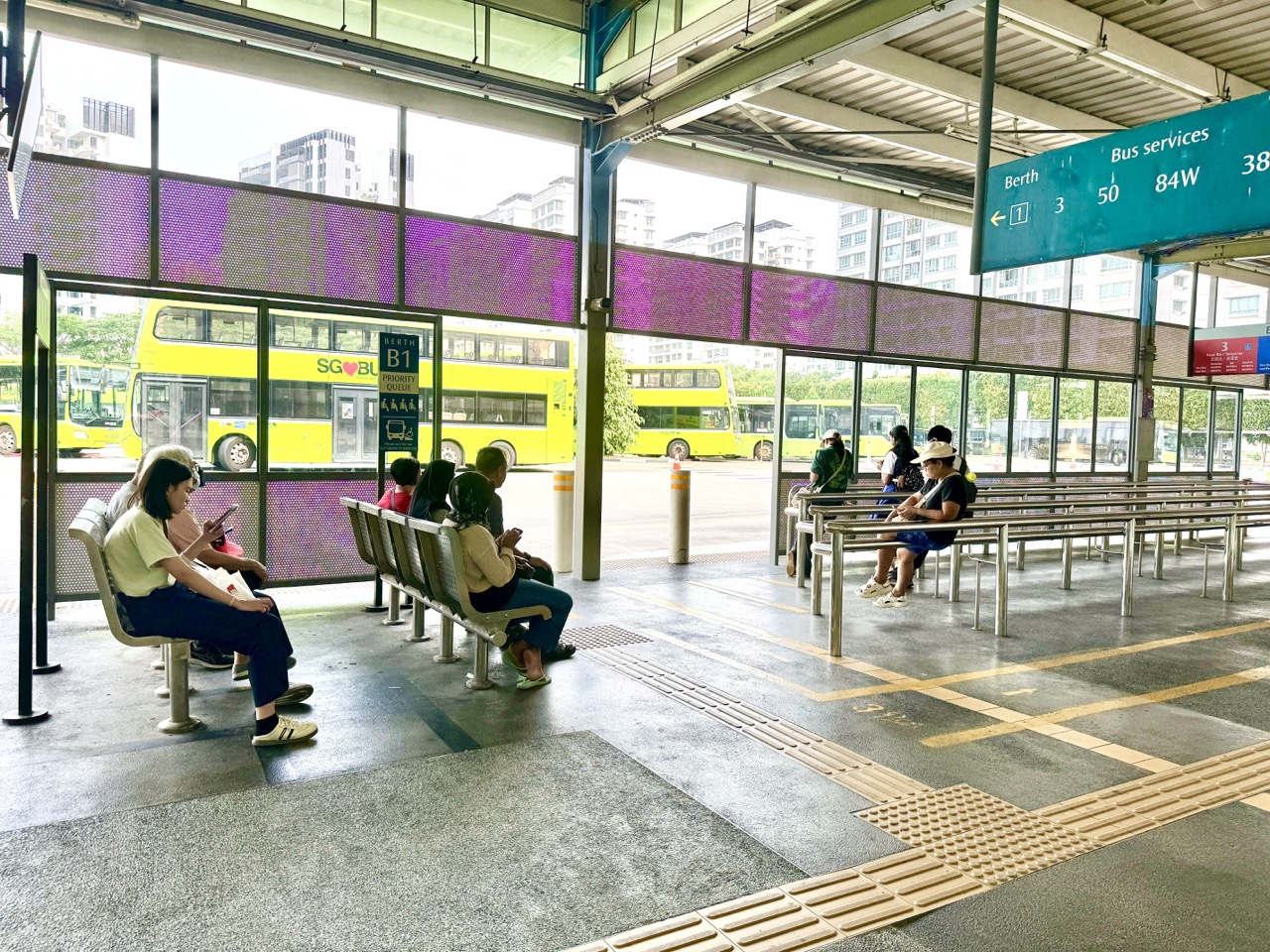
Punggol Bus Interchange is the bus terminal beside Punggol MRT/LRT in the town centre, at 70A Punggol Place. It is not Punggol Coast Bus Interchange, which opened in the newer Punggol Digital District on 29 June 2025. If you are arriving at the older town-centre interchange for the first time, the most useful things to understand are simple: where you alight, why boarding queues are in different areas, how to check that your bus departs from this interchange, and how to transfer safely to Punggol MRT or LRT. Our newly uploaded October 2026 photographs show passengers waiting and alighting at the Punggol town-centre bus facility.
A 2026 name correction matters. Some old sources and even our fresh photo-library captions call this the ‘Punggol Temporary Bus Interchange’. That was its former name. Transport reference Land Transport Guru records the removal of ‘Temporary’ from the interchange name effective 29 June 2025. The facility’s historical temporary design is a different fact from its current displayed name. This photo guide uses Punggol Bus Interchange, and it treats the 2025 opening of Punggol Coast Bus Interchange as an important reason to check routes rather than assume every Punggol-bound or Punggol-originating service starts from one location.

Punggol Bus Interchange: the quick reference
- Town-centre location: 70A Punggol Place, beside Punggol MRT/LRT station, according to contemporary transport reference information.
- Current name: Punggol Bus Interchange; it was historically called Punggol Temporary Bus Interchange.
- Separate newer facility: Punggol Coast Bus Interchange in Punggol Digital District opened 29 June 2025.
- Historical route change: LTA moved bus services 34 and 117/117M from Punggol Bus Interchange to Punggol Coast when the newer interchange opened. Check today’s routes for any later changes.
- What our new images show: a waiting area, bus passengers alighting and ordinary movement around the interchange.
- Before boarding: verify the service number, direction, destination and actual assigned berth using current signs or an operator/SimplyGo travel guide.
- Safety rule: stay behind designated markings, use pedestrian crossings and never cut through the bus park.
- Accessibility: seek the currently marked priority waiting and boarding arrangements where relevant; don’t assume every facility at Punggol Coast exists at the older interchange.
- After alighting: move into the designated public area and follow current MRT/LRT, exit or bus-transfer signs, rather than standing by the bus doors to consult your phone.
Why a photo guide instead of another long list of routes?
Our existing Punggol and Punggol Coast Interchanges: Key Routes already owns the service-number directory. Another Punggol Bus Interchange versus Punggol Coast article explains the two-terminal distinction. A historical article covers the opening of the older interchange. We should not write a competing route directory with stale timetables merely because a new photograph is available.
This article has a narrower job. It follows the human experience of arriving, alighting, finding the correct place to wait, boarding and making a safe transfer. The photographed waiting area is the starting point. Readers who need the current full list of buses should check the official operator and SimplyGo information; readers who want to understand the sequence of actions can use the practical framework here.
Two Punggol interchanges: the most important distinction
Punggol Bus Interchange serves the established town centre next to Punggol MRT/LRT. Punggol Coast Bus Interchange is a newer integrated transport hub serving the Punggol Coast MRT area and Punggol Digital District. A person who simply says ‘I’m at the Punggol interchange’ may unintentionally name either facility. The difference matters when a family arranges collection, when an older person travels to an appointment or when a bus service starts from the newer terminus.
Use the full proper name when giving directions. If a route planner says Punggol Coast Interchange, do not travel to Punggol Bus Interchange and assume the bus will eventually turn up there. The same principle applies in reverse. LTA’s 2025 news release is clear about services 34 and 117/117M moving to Punggol Coast with the opening; later route changes must be verified on the day.
Why the word ‘temporary’ still appears online
The original Punggol town-centre bus interchange was designed at a time when Punggol was developing. The ‘temporary’ description reflected how the structure could be removed or altered in future land-use plans. Land Transport Guru’s current reference notes that the qualifier was removed from the official interchange name on 29 June 2025. Older blog articles, maps and photo captions can preserve the original term because they were written before the change or copied historical descriptions.
Readers benefit when an article handles this without erasing the past. ‘Formerly Punggol Temporary Bus Interchange’ is an accurate historical note; calling it the present official name is misleading. Our October image metadata uses the older wording, but this article corrects that in its headline and captions. A dated photo can document a current scene while retaining an out-of-date filename or title. File names are not the final authority for public transport terminology.
What the original bus interchange did for Punggol
The town-centre facility began operation in 2003, during an earlier stage of Punggol New Town’s growth. It provided a central place for different bus routes to connect with local journeys and the developing rail network. Over time, housing areas, LRT operations and travel patterns expanded. The original interchange remains part of that story even after the Punggol Coast node opened.
That history is useful context, but it should not be confused with live operating information. A 2003 bus route map cannot tell you where to board in October 2026. Our History of Punggol Bus Interchange owns the development chronology. This guide uses only enough history to explain the confusing word ‘temporary’ and the continued importance of the town-centre interchange.
Arriving at the interchange by bus
When your bus reaches Punggol Interchange, prepare to alight calmly. Make sure the vehicle has fully stopped and follow the bus captain’s and operator’s directions. Gather your belongings before walking down the aisle. If you are travelling with a child, agree that nobody leaves the bus ahead of the supervising adult without a clear plan. Do not try to photograph the bus doors while people are still moving out.
After stepping onto the designated passenger area, move away from the immediate alighting point so those behind can leave safely. Check your direction only once you are clear of the flow. This small pause protects others as well as you: a line of people carrying bags or using mobility aids should not have to stop suddenly because one passenger is deciding which map application to open.

Alighting areas and boarding berths have different jobs
At an interchange, some spaces are designed for passengers leaving a bus, while others manage people waiting to board a bus at its starting or stopping point. Confusing the two can lead a newcomer to stand at an alighting bay expecting a departure. The correct boarding location is determined by the current berth signs and route information, not by the fact that a bus has just dropped passengers nearby.
A good first-time visitor asks one clear question: ‘Am I in the place where people get off, or where my service boards?’ Once that is settled, finding the correct service becomes much easier. Do not cross the bus driveway to take a shorter path between the two. Use the interchange’s legal pedestrian route and follow the visible wayfinding.
Why the same bus can appear at more than one point
A bus reaching its terminus may use one bay to discharge passengers and another to begin its next trip. It may also move through the interchange for operational reasons. Seeing its route number while it is alighting does not mean you can board at that door or location. The route may need to proceed to an assigned boarding berth first.
If you are watching from the public waiting area, there is no need to chase the vehicle. Check where the service is supposed to board, then wait there. This simple distinction can save a family from the common mistake of following the moving bus instead of the fixed passenger signs.
The first question at the departure board
Start by checking the destination or service you actually need, not just a number you remember from a previous year. A service may have different directions, variants or changed starting points. The route number is necessary but not always sufficient. Look for the official berth assignment and any current notice about temporary operations.
If a service has been moved to Punggol Coast, no amount of waiting at the old interchange will bring it back simply because the number was printed in an old guide. Use today’s route information and ask an authorised staff member if you are uncertain. A short question is better than a long speculative walk among buses.
How to recognise the correct boarding queue
Follow the floor markings and signage at the boarding area. SBS Transit’s published interchange safety guidance says passengers should queue in an orderly manner, respect queue guide-lines and remain behind the yellow safety line at boarding berths. These principles are straightforward, but they become especially important when several services depart near one another.
Check the displayed service number before joining a line, and check again before boarding. A queue that appears close to your route’s bay may belong to the next berth. Do not push past others to reach the front simply because you believe the bus is about to leave. Safe, orderly boarding helps everyone, including people who move more slowly.
Why you should never cross the bus park
Bus manoeuvring areas are designed for large vehicles with limited visibility and turning paths that differ from a person’s walking line. SBS Transit’s safety information explicitly prohibits crossing within the bus park and directs passengers to designated pedestrian crossings. A short cut across the tarmac may look tempting when the desired berth is visible, but it is not a safe alternative to the proper pedestrian path.
Children need a clear explanation: being able to see the bus does not mean the shortest straight line is an allowed route. Adults should model the rule consistently rather than making an exception when running late. If you realise you are at the wrong side of the interchange, use the proper public circulation route, even if it takes longer.
The yellow line is more than a painted suggestion
Standing behind the marked safety line creates a boundary between waiting passengers and operating buses. A person leaning forward to look for a service can accidentally obstruct the berth edge. A child may be drawn toward a moving bus. Keep the waiting area clear and follow the markings, especially during busy periods when everybody wants to know whether the arriving vehicle is theirs.
If you have luggage, a stroller or a school bag, keep it with you rather than placing it beyond the line. Make room for others to queue without forcing anyone toward the driveway. People with mobility aids need sufficient space to turn and board through an appropriate route.
A first-time visitor’s five-minute orientation
Imagine arriving at the town-centre interchange and needing another bus. In the first minute, step away from the alighting point and identify the public waiting area. Next, check the service number and current departure information. Then locate the assigned boarding berth through signs, not guesswork. If you have time, confirm the route direction on the destination display or operator guide. Finally, join the correct queue and stay behind safety markings.
These are five logical steps, not a promise that orientation always takes exactly five minutes. A person needing accessible assistance, a route diversion or a language explanation may take longer. The value of the framework is that it replaces aimless wandering with a sequence. When uncertain, stop in a safe area and ask for help.
If your first plan turns out to be wrong
Perhaps the service you expected moved to another berth or terminal. Don’t run across the interchange hoping to catch a disappearing vehicle. Stop, read the current notice and decide the correct next action. You may need to use the rail network, find a different bus or travel to Punggol Coast. The route depends on your destination and present timetable, not a universal rule.
A child can learn that making a mistake about a queue is manageable. The goal is to correct it safely. A family should avoid blaming the child for following a confusing sign, especially when adults were also uncertain. Fix the information first; discuss how to check more carefully afterwards.
How Punggol MRT and LRT fit into the transfer
Punggol MRT is on the North East Line, and the Punggol LRT connects local residential areas through its loops. The bus interchange provides an additional network of services that can be useful for neighbourhood journeys and trips beyond Punggol. A transport interchange works because people can switch between modes rather than expecting one vehicle to cover every destination.
However, the apparent closeness of entrances in a photo is not proof of the exact walking route or transfer time. Follow current signs to the correct station entrance and allow sufficient time for lifts, escalators and ticketing if needed. Our Punggol transport system guide owns the wider network explanation.
What to do when transferring from bus to MRT
After alighting, move to the public pedestrian area and follow signs toward the rail station. Confirm which railway line you need and the direction of travel. A child may be excited to see trains, but the adult should maintain supervision through doors, escalators and busy corridors. If you are carrying bags, allow room for other people moving between systems.
At the station, use the current operator instructions for fares and entry. Do not assume an old photo or route article supplies live train service status. The bus-to-rail transfer is a separate part of the journey, and delays on one mode may require a new plan for the other.
What to do when transferring from rail to bus
Arriving at Punggol MRT, do not follow the first crowd you see without checking that it leads to the bus interchange you want. Read the destination and berth information. If your service starts from Punggol Coast, the correct route may differ from simply walking to the adjacent town-centre bus interchange.
Try to avoid making the decision at a moving escalator or narrow doorway. Step to a suitable side area, check the route and then move purposefully. It is a small habit, but it helps prevent collisions and reduces stress for someone who is using the interchange for the first time.
When the bus service has a loop pattern
Some neighbourhood buses operate loop routes rather than travelling between two clearly different terminal names. A display may name the starting interchange even though the bus serves several stops before returning. The service number alone does not tell you that every stop along its path will be reached in the direction you expect. Review the current stop list and direction.
For example, SimplyGo’s eGuide publishes the current route structure for individual services such as 384. The point is not to memorise 384 or assume it fits your destination; it is to show what a reliable route resource looks like. Search the actual service you need and confirm that your intended stop appears in the right sequence.
Why a timetable is not a live arrival guarantee
Published first and last bus times and operating frequencies describe the planned service pattern. The actual wait depends on traffic, operational conditions, time of day and disruptions. A route’s advertised frequency should not be treated as a countdown to the next vehicle unless the source supplies appropriate live arrival information. An app screenshot can become outdated within minutes.
If you are travelling to a timed appointment, leave a sensible margin and check current notices. Don’t publish a calculated ‘next bus at exactly 3:12pm’ based only on a general frequency range. The distinction between a schedule and observed live operation is one of the most practical transport-literacy skills families can teach.
Waiting with a small child
A bus interchange can be visually exciting for young children because large vehicles arrive and depart one after another. Explain that the bus park is not a play area. Keep children within appropriate supervision, away from the roadway edge and clear of boarding lines that belong to other services. Make the wait manageable with conversation rather than allowing free running.
If there is suitable seating, use it without blocking a priority area. Teach children to stand up and prepare calmly when it is time to board. A child who has been told the plan is less likely to dash toward a vehicle simply because it has familiar colours. Reassurance and clear boundaries work better than last-second shouting.
Waiting with an older family member
Ask what the person needs rather than assuming. A senior may prefer to sit while waiting, may use a mobility aid or may be happy to stand. Priority queues and seats exist within Singapore’s inclusive public-transport framework, but facility-specific arrangements differ. Identify the current marked waiting location and ask staff for assistance if the path or boarding procedure is unclear.
Do not rush a person who needs more time to stand or board. Make sure they know which service they are taking, especially when two similarly named Punggol interchanges could cause confusion. The most useful family gesture may simply be confirming the correct terminal and staying until the person is comfortable with the route.
Travelling with a wheelchair user
Accessible public transport requires a coordinated route through waiting areas, boarding equipment and vehicle space. LTA describes priority queue zones and assistance for commuters with mobility needs, but readers should not assume that the features of the 2025 Punggol Coast integrated hub are identical to those at the older Punggol town-centre interchange. Verify the actual accessible boarding arrangements for the chosen service.
If assistance is needed, ask the relevant transport staff or bus captain. Do not attempt to manoeuvre a wheelchair over unsuitable kerbs or around barriers just because the bus is close. When a designated space is occupied, the next safe option may be to wait or use the staff’s guidance. Dignity and safety matter more than catching one particular departure.
Travelling with a stroller
Strollers take space and can create difficulties in tightly packed queues or aboard a busy bus. Keep children secure and follow the operator’s current rules on stroller use and folding. LTA notes that circumstances can require a stroller to be folded and carried when a vehicle is crowded or priority space is needed. Do not treat a stroller as a reason to push through a narrow queue.
Plan who will handle the child and who will manage bags, especially when only one adult is present. Avoid standing at the yellow line while rearranging the stroller. Move to a safe waiting position, prepare before the bus arrives and seek appropriate help if needed.
People who need a seat may not look unwell
Not every disability or health condition is visible. LTA’s inclusive transport guidance includes a Helping Hand scheme and priority access concepts intended to support a range of commuters. A passenger who requests a seat may have needs that others cannot see. It is better to respond respectfully than to demand a personal medical explanation.
Parents can teach children that priority seating is about giving way when someone needs support. That is not a judgement about age alone. At an interchange, the same principle applies to waiting areas: keep designated spaces available and use them appropriately. Courtesy makes public transport work more comfortably for different people.
Making the boarding step safer
Wait until the bus is properly positioned and boarding is permitted. Let passengers or staff follow the appropriate movement sequence. On board, tap your fare medium as required, move away from the entrance and hold a stable handrail or take a seat. Do not stop in the doorway to search a bag while others are trying to board.
If a child is learning to use a fare card, practise before the bus arrives. The bus entrance is not the ideal location for a prolonged explanation of balance or payment. A calm, prepared boarding sequence helps reduce pressure on the child and everyone behind them.
Alighting at the correct stop
Before travelling, identify the stop you actually want, ideally by an official stop name or code rather than a vague landmark. Watch the route progression and use the stop-request system in time. Bus operators recommend signalling early and moving carefully. For passengers who need more time, assistance or a seat near the exit, plan accordingly.
A child should be taught what to do if the expected stop is missed: remain calm, stay on the vehicle until a safe next stop and use the family’s agreed contact or help process. Do not run toward doors or try to force an unsafe last-second exit.
Paying fares and understanding transfers
Singapore’s bus and rail fare system uses recognised payment media and fare rules that depend on current policy and the specific journey. A commuter may use a supported SimplyGo card or other approved contactless method where accepted. The important practical habit is to use the fare reader correctly at entry and exit, and to consult current SimplyGo or LTA information for fare and concession questions.
This article does not invent a fare table for every Punggol journey. A specific trip cost can change with distance, card type, eligibility or fare policy. Our Punggol SimplyGo and public transport fares guide owns the larger payment topic.
What if the fare card or phone does not work?
First move safely away from the entry reader or queue so other passengers are not blocked. Follow staff instructions or the operator’s approved fare assistance process. Do not share private card details or banking passwords with an unfamiliar person who offers unsolicited help. A child should know which trusted adult or staff member to ask rather than attempting random payment experiments while boarding.
If an account-related issue requires later investigation, use the official SimplyGo support channel. Keep transaction details private. A public transport problem is frustrating enough without turning it into an accidental disclosure of personal financial information.
What if you board the wrong bus?
Recognise the mistake calmly. Check where the vehicle is going and identify a safe place to alight using official route information. Avoid treating every different-looking street as an emergency. If you are travelling with a child, stay together and follow the agreed plan. A teenager should have a trusted contact arrangement and know not to share home details with strangers while seeking help.
The next step depends on the current bus route, time and destination. There is no universal instruction to immediately cross the road and take a bus back. Make sure any crossing is lawful and suitable. Sometimes a transfer is easier; sometimes returning toward the interchange is sensible. Use present information rather than improvising from an old guide.
What if you wait at the wrong Punggol interchange?
If you are at the town-centre interchange and discover the service starts from Punggol Coast, don’t assume a bus will eventually be diverted to your waiting berth. Confirm the current route and work out a safe, permitted connection between the two nodes. The North East Line links Punggol and Punggol Coast as neighbouring stations, but the correct overall route depends on where you are and what service you need.
A rushed attempt to correct the mistake can create a second mistake. Take a moment to check the terminal name and platform or stop before moving. If you are assisting an older person, explain the correction clearly and avoid making them walk repeatedly between unrelated exits.
Why services 34 and 117/117M are useful historical examples
LTA’s official 20 May 2025 announcement described services 34 and 117/117M moving from Punggol Bus Interchange to the new Punggol Coast Bus Interchange from 29 June 2025. That announcement provides a concrete example of how a transport network changes when a new interchange opens. It also shows why a 2024 photograph of a service number at the old terminus cannot establish its 2026 starting point.
Do not use this fact to infer every subsequent route adjustment. The government explicitly noted that new routes and other changes would follow as developments were completed. The responsible action is to check the current service guide. This article provides the reasoning for that habit rather than attempting to freeze all route changes in one blog post.
Bus stop codes versus interchange names
A bus stop code gives a precise identifier within the transport system, while a place name may be used more loosely in conversation. SimplyGo’s eGuide lists Punggol Int as stop 65009 on some routes, which is a useful example of coded route information. But a person should verify that the code appears in the current service direction before relying on it.
When two stations have similar names, codes can help resolve ambiguity. They are not decorative details. A child learning public transport can practise saying both the stop name and the code from an official display. Avoid memorising an entire list of numbers; focus on the ones relevant to the family’s actual journey.
What the queue photo does and does not reveal
The new waiting-area image shows passengers near railings and seats. We can observe waiting and the built environment, but we cannot determine from one frame exactly how long anyone has waited, whether their bus is delayed or which stop each person will use. A commuter looking at a phone could be checking a map, reading a message or doing something unrelated. The photograph does not justify an invented personal story.
Local photography becomes more informative when captions stay modest. ‘Passengers waiting at Punggol Bus Interchange’ is enough. If a current service update matters, attach an official timetable or operator notice separately rather than presenting a public snapshot as proof.
Why people sometimes look in different directions
A waiting area combines multiple tasks: checking route signs, watching for an arriving bus, moving toward a designated berth and waiting for companions. People may be looking at displays or one another, and their posture does not reveal the destination of their trip. A photograph of a line facing one way should not be treated as a diagram of where everybody must walk.
Readers can use the image to notice the physical separation of passenger areas from the bus operating space. The picture supports a discussion of safe circulation, not individual route planning. For the latter, current floor signs and official service information are essential.

How to keep a phone from becoming a walking hazard
Travel apps are useful, but looking at a screen while stepping off a bus or crossing a crowded concourse can lead to collisions. Stop in a safe spot before reading a detailed route map. Keep a hand free for a rail or bag when necessary. Children should learn that checking the next bus is something to do while stationary, not while drifting into a vehicle or pedestrian path.
Even if an arrival prediction changes suddenly, do not sprint into a moving queue. The next safe bus is more useful than catching one vehicle through a risky manoeuvre. A family can build a little time into transfers so no one feels forced to move faster than conditions permit.
A practical plan for the school morning
Punggol’s bus network serves many residential areas, so students and parents may use it as part of a school journey. The correct service and stop depend on the actual school and family address. Confirm the route before the school morning; do not assume the bus that passed a school once in a photograph will be the correct option today. For Punggol View Primary, consult its current contact and gate information separately.
A child’s school journey should include a contingency for a delayed bus or missed stop. Avoid burdening a young pupil with complicated route changes that have not been practised. The travel plan should make school attendance more reliable without encouraging unsafe rushing.
After-school peak hours and crowd movement
Bus interchanges can feel different when large groups finish school or work at similar times. A person with heavy bags may need extra room, while younger commuters may arrive in excited groups. Keep queue entrances clear and avoid blocking pedestrian routes while chatting. If a bus is crowded, follow the operator’s boarding and priority instructions.
Parents can prepare children for the social side of the journey: speak at a respectful volume, keep bags close and give way to people who need assistance. A long wait is easier when expectations are clear. The interchange is shared by neighbours, not an extension of the school playground.
A weekend family bus outing
A simple transport outing can help a child learn to read signs and understand how the town fits together. Choose a current service, verify the route and plan one manageable destination. At the interchange, point out the difference between arriving and departing passengers, then find the correct boarding area. Keep the activity age-appropriate and avoid treating staff or other commuters as props in a lesson.
A child who can describe ‘we got off here, checked the sign, queued over there and took the next bus’ has learnt something useful. The Punggol bus-ride discovery day owns the broader family outing idea. This article remains a practical guide to the photographed town-centre interchange.
A ten-minute exploration for a primary pupil
If you are travelling anyway, turn a short wait into an observation exercise. Identify a bus service number, a place to queue and a safe walking boundary. Ask which direction passengers leave the bus and which area is used for boarding. Don’t cross into restricted spaces or interrupt staff to gather extra evidence for the exercise.
After the journey, ask the child to draw a simple three-step sequence: wait safely, board and alight. Correct any part that confuses the bus park with the passenger area. The drawing need not be artistic. What matters is a safer mental model of how public transport works.
A Maths problem using a bus timetable
Suppose a hypothetical bus is scheduled every 12 minutes and one has just departed. Under perfectly regular operation, the next scheduled interval would be 12 minutes, but a frequency range is not a live promise and departures may vary. A Primary 4 pupil can still practise adding time intervals, while the adult explains why the result is an estimate dependent on assumptions.
For a Secondary 1 student, introduce a timetable with different intervals during peak and off-peak periods. Ask why a service might run more frequently during busy hours. This is a discussion of planned capacity, not a claim that any specific Punggol route currently follows your example. Use actual posted schedules for real travel decisions.
A second Maths problem: choosing between two journeys
Imagine two hypothetical options. Journey A has a 7-minute walk, a 6-minute expected wait and a 15-minute bus ride, totalling 28 minutes before extra crossings or transfers. Journey B has a 4-minute walk, a 10-minute wait and a 13-minute ride, totalling 27 minutes. Based on those assumptions B is one minute shorter, but it may be less predictable or harder to navigate with a stroller.
Ask what other factors matter: weather, route reliability, accessibility and whether a child can follow the instructions independently. The fastest arithmetic sum is not automatically the best route for every person. These numbers are illustrative and should not be mistaken for real Punggol travel times.
A geography question about interchanges
A transport interchange functions as a node in a network, connecting routes that extend in different directions. When a new interchange opens, some starting points and transfers change. Punggol’s two interchanges provide an accessible real example of network expansion: the town-centre node continues serving residents while the Punggol Coast node supports a developing district.
Students can create a simple conceptual diagram with two nodes and the rail link, then add arrows showing the idea of transfers. Avoid drawing exact bus routes without current official maps. The valuable lesson is that a network changes when the locations and functions of its nodes change.
A social studies question about public space
Bus interchanges are public infrastructure used by people with different needs and schedules. Their rules balance efficient movement with the safety of commuters and bus staff. Queue discipline, designated crossings and priority access are examples of a shared system in which small individual choices affect others. A person crossing the bus park to save time can impose risk on drivers and passengers.
Ask students what ‘fair access’ means when somebody needs extra time to board. A good answer acknowledges that treating everyone identically is not always sufficient. Priority arrangements can help provide meaningful access for people whose mobility or health needs differ, while all users remain responsible for safe behaviour.
An engineering question: why buses need their own space
A large bus has a turning radius and blind spots that differ from those of a person walking. Drivers must manoeuvre among fixed berths, other buses and operating lanes. A designated bus park separates that vehicle activity from the passenger areas as far as the facility design allows. This is why stepping across an empty-looking driveway is not an innocent shortcut.
A secondary student could compare the footprint of a bus with the space needed to turn. The actual interchange geometry should be read from appropriate plans, not measured by standing in a restricted area. The intellectual point is to understand that safe access is a design and operations problem, not simply a matter of placing a bus near a bench.
Why accessibility is part of transport planning
A transfer only works well if the commuter can use it. LTA’s accessibility materials discuss barrier-free access, priority waiting zones, bus ramps and the needs of families and seniors. These are not decorative additions; they influence whether the system is practical for a person who uses a wheelchair, walks slowly or travels with a child.
At a particular interchange, current conditions still matter. A planned accessible route can be blocked temporarily by maintenance or crowding. Ask staff if you cannot locate the suitable path. Do not assume that the newer Punggol Coast hub’s facilities are physically present at the older town-centre interchange simply because both share the Punggol name.
Helping someone who seems uncertain
If another commuter asks for directions, you can point them toward an official display or staff member, but avoid guessing a route you have not verified. A wrong confident answer may be worse than admitting uncertainty. If someone seems vulnerable, ask respectfully whether they would like assistance instead of taking over their journey without permission.
Children should know that giving directions to strangers is optional and that their own personal safety comes first. They can refer someone to uniformed staff or a passenger information point. Helping responsibly means offering accurate information within your ability, not promising to escort somebody along an unfamiliar route.
What to do when a service is disrupted
Service disruptions can change the intended journey and may bring temporary notices, staff directions or route adjustments. Check the operator’s current announcements and follow them. Don’t assume an old blog page provides a working diversion map, even if it was carefully researched when published.
If the change affects an appointment, contact the destination when practical and revise the route calmly. A parent can reassure a child that disruptions are normal challenges to manage, not reasons to run through restricted areas. A simple fallback plan is often more useful than memorising every possible transport combination.
When the interchange gets crowded
Crowding changes the way public space feels. A family may need more time to reach the queue and a mobility-aid user may need a wider route. Avoid gathering in the centre of passageways, stopping at narrow doors or walking against designated flows. If a specific queue is full, follow the current staff arrangement and do not force your way into a nearby berth.
A photograph of a busy-looking line does not establish crowd levels for every hour. If the family needs a quieter journey, examine current travel conditions and choose a suitable time where possible. The correct alternative will depend on the purpose of the trip and individual needs.
What if a child becomes separated from the adult?
Teach a child a simple safety plan before travelling. They should stay in a safe public area, seek an appropriate uniformed staff member or known help point, and use the family’s agreed contact method. A young child should not chase buses or try to travel to another interchange alone. Adults should first check the immediate area and follow relevant staff guidance.
Do not publish a child’s live location, identifiable photo or detailed travel routine to public social media as a routine way to find them. In an actual emergency, seek appropriate immediate assistance. Good preparation involves practising what to do calmly, not frightening the child with unlikely scenarios.
What if something is lost on the bus?
First make sure everyone is safe and out of the vehicle’s path. Check the current bus operator’s lost-property process and provide the relevant service and trip details where possible. Do not chase a departing bus across the interchange. The operator may need information such as approximate time, service number and direction; personal account details should be shared only through trusted official channels.
If the lost item contains payment cards or sensitive information, take appropriate protective steps through the relevant issuer as needed. Our Punggol lost keys and phones family plan covers the broader household response. This guide focuses on the safer first actions at the interchange.
What if the bus arrives while you’re still checking the route?
If you’re not sure the service goes where you need, don’t board simply because the doors are open and people are moving. A mistaken boarding can create more delay than waiting for a later verified service. Step aside, finish checking and approach the correct queue when ready. Avoid holding up the doorway while conducting a lengthy map search.
This is particularly important for a young child following an adult’s instruction. Explain that ‘we’re not sure yet’ is a perfectly acceptable reason to let one bus go. Good travel decisions are about reaching the right place safely, not boarding every available vehicle.
How to read a photo of alighting commuters responsibly
Our October photographs show passengers, railings and the interchange environment. They are evidence that the scene was photographed, not evidence about the private reasons people were travelling. A person with a phone could be checking a route, messaging family or reading; we do not know. An older-looking passenger is not necessarily in need of assistance, and a commuter walking alone may not be unfamiliar with the area.
Respect privacy in captions. The best use of the picture is to explain the sequence of alighting and moving into the public concourse. Avoid drawing conclusions about personal circumstances or publishing identifying details. A local article becomes more trustworthy when it says less about strangers and more about the public system readers can verify.
A simple photo checklist for visitors
If you photograph the interchange, do it from a lawful public place without obstructing queues or staff operations. Avoid close-up images of identifiable commuters, particularly children, unless you have appropriate permission. Don’t step into the driveway for a better view of a bus. Read site rules and respect any photography restrictions.
Frame the infrastructure if the article is about transport: route displays, general waiting areas and the relationship between passenger paths and bus stands. Even then, captions should not claim that a sign or service was unchanged on a later date. The photograph’s date and the current operating information are two different facts.
A model of the passenger journey
The interchange experience can be described as a sequence with branches. First the commuter arrives, either by bus, rail or pedestrian route. Next they identify the desired departure or destination. They choose the correct public path, then wait in the assigned area. At boarding, they follow safety and fare procedures. On arrival, they alight and complete the journey. Each stage has possible uncertainty, but the order reduces confusion.
An older student can draw this as a flowchart. The decision boxes might be ‘Is the route still operating from this interchange?’ and ‘Is the berth confirmed?’ If the answer is no, the chart directs the commuter to current official information instead of guessing. This is a genuinely useful application of systems thinking.
Why transfer points need good signs
At an ordinary bus stop, a commuter may need to choose among a small number of services. At an interchange, they may need to interpret multiple berths, directions, priority routes and connections to rail. Good wayfinding reduces the amount of information a person must keep in memory. An unfamiliar commuter should be able to find the next step without needing to know the building’s entire history.
If a sign is unclear, ask staff for the present arrangement. Do not assume an online diagram is newer than the physical notice. The photo guide can explain how to use signs, but it cannot substitute for the specific sign you see in front of you.
The difference between a journey plan and a live journey
A planned trip might look neat: leave home, take service X, transfer to rail, arrive at an appointment. The live journey includes unknown waiting times, crowding, weather and occasionally a change in service. That doesn’t mean planning is useless; it means a good plan contains checks at decision points. For Punggol Bus Interchange, the critical check is the current origin and berth for the service.
A family should identify which parts are fixed, such as the address of the destination, and which parts are variable, such as the next arrival time. This distinction is valuable in almost every daily logistics problem, not just public transport.
Planning a route with a deadline
If the destination has a fixed appointment time, work backwards. Allow time for the walk to the interchange, current expected waiting conditions, the bus journey, any transfer and the final walk. Add a sensible margin based on how important punctuality is and the likely variability. Do not copy a generic ‘Punggol to anywhere in 20 minutes’ figure from an unrelated article.
With a young child or someone needing assisted travel, include time for safe boarding and moving between modes. A plan that demands sprinting between berths is too fragile. The best route is not always the one with the smallest idealised travel-time sum.
Why two routes can be equally sensible
One journey may involve less walking but a longer bus ride. Another may use MRT plus a bus with a transfer. A person carrying groceries may prefer fewer transfers, while a student going to a new destination may prefer clearer signs. Weather, accessibility and the traveller’s confidence can change which option works best.
Teach children to ask ‘Which route is safer and easier to follow for us?’ alongside ‘Which route is fastest?’ That is not an excuse to ignore timetables. It simply recognises that a real journey is completed by real people, not by a calculator in perfect conditions.
When a neighbour asks which interchange is meant
Give the full name and a supporting landmark. For the town-centre facility, name Punggol Bus Interchange near Punggol MRT/LRT. For the newer one, name Punggol Coast Bus Interchange at the Punggol Coast MRT and Digital District area. If the person needs a particular bus, check the current route instead of relying solely on where the two facilities are located.
This little habit is especially valuable when arranging to meet somebody who does not travel to Punggol often. The new interchange did not merely add another building; it created a genuine naming and wayfinding distinction that writers and residents should handle carefully.
A note on service numbers and version dates
Route lists are time-sensitive. LTA introduced changes with the Punggol Coast opening, and subsequent service changes can occur. A 2025 launch announcement is evidence of what changed then, while a 2026 SimplyGo or operator guide is more suitable for current routing. The correct source depends on the question: history, present service or live arrival.
An article should state its review date and avoid displaying a static route list without checking that it remains current. This guide intentionally concentrates on behaviours and verification methods that remain useful even when a service number changes.
What the interchange means for Punggol families
Punggol Bus Interchange is more than a starting point for a bus route. It is part of the way residents connect homes, schools, workplaces, healthcare, shops and community life. The value of an interchange lies in enabling different kinds of trips to come together in one accessible transport network. That usefulness depends on accurate information and safe habits every day.
Our photographs capture the ordinary side of this system: waiting, getting off a bus and moving toward the next destination. There is no staged dramatic scene, and that’s exactly why the images are useful. They remind readers that transport planning eventually becomes a very human sequence of small decisions.
The family’s final pre-journey check
Before setting out, identify whether you need Punggol Bus Interchange or Punggol Coast Bus Interchange. Check the correct route and its departure location. Make sure the group understands the public-transport payment method and any accessible support needed. If travelling with children, confirm supervision and a plan for delays. Pack only what is necessary and avoid carrying items in a way that obstructs boarding.
At the interchange, read current signs, stay in the appropriate passenger area and use designated crossings. Once the service is confirmed, wait safely, board without rushing and look after fellow commuters. A good public transport journey does not need a dramatic story; it simply gets people to the right place with dignity and care.
Frequently asked questions
Is Punggol Temporary Bus Interchange still its current name?
No. Transport reference information records the name change to Punggol Bus Interchange effective 29 June 2025. ‘Temporary’ belongs to its former name and historical construction context.
Where is Punggol Bus Interchange?
At 70A Punggol Place beside the Punggol MRT/LRT town-centre station, according to contemporary transport references.
Is it the same as Punggol Coast Bus Interchange?
No. Punggol Coast Bus Interchange opened in the newer Punggol Coast / Punggol Digital District area in June 2025.
Did every bus route move to Punggol Coast?
No. LTA announced specific route moves with the new hub’s opening, including 34 and 117/117M. Check the current guide for the service you actually need.
Where do I board a bus?
Use the designated boarding berth shown in current interchange signs or official service information. An alighting bay is not automatically a boarding point.
Can I cross the bus park to reach my bus?
No. Follow the designated pedestrian routes and crossings. Bus-operator safety guidance prohibits crossing within bus operating areas.
What is the yellow line for?
It marks a safety boundary at the boarding area. Wait behind current safety markings and follow queue guides.
What if I am waiting at the wrong interchange?
Check the current service origin, identify a safe route between the relevant nodes and make a deliberate transfer. Don’t chase buses or take unsafe shortcuts.
Where can I check a service number or route?
Use SimplyGo’s eGuide, LTA and the relevant bus operator’s current information. Verify the destination and service direction as well as the number.
Do the new photos show today’s bus arrival times?
No. The October 2026 images show people waiting and alighting, not live timetables or route changes.
Can I use the interchange to reach Punggol MRT?
The town-centre interchange is next to Punggol MRT/LRT. Follow current public pedestrian wayfinding to the appropriate station entrance.
Are there seats for older commuters?
Singapore interchanges generally provide waiting and priority arrangements, but check the specific current seating and accessible route at Punggol Bus Interchange rather than assuming every feature is identical across facilities.
Can wheelchair users travel by bus?
Singapore’s public bus network includes accessibility measures and assistance arrangements. Confirm the chosen bus and interchange’s current accessible procedures and seek staff help if necessary.
What should a parent teach a child before a first trip?
Teach the full interchange name, correct queue, safety line, authorised pedestrian routes and what to do if delayed, separated or uncertain.
Can a child use a phone while walking through the interchange?
It is safer to stop in an appropriate public area before checking a detailed map, instead of watching a screen near bus lanes or active queues.
What if a bus service is delayed?
Use current operator information and follow any on-site notices. Allow for changes and do not invent an exact arrival from a general timetable frequency.
Are the photos proof of the operator’s present schedule?
No. A photograph documents a moment and should be used as visual context only. Current timetables come from transport operators and official journey planners.
What if I lose something on a bus?
Follow the relevant operator’s official lost-property procedure with safe, relevant trip details. Never chase a departing bus through a vehicle area.
Why does the article not list every Punggol route?
The route directory already belongs to the existing Punggol interchanges guide. A static second list could become outdated and compete with the more focused reference page.
Where can I learn about both Punggol interchanges together?
Read the linked Punggol and Punggol Coast interchange comparison and route guide, then verify your service’s current details.
Sources and related Punggol transport guides
- Land Transport Authority — Punggol Coast Bus Interchange opening and 2025 service moves.
- Land Transport Guru — Punggol Bus Interchange, current name and historical ‘Temporary’ usage.
- SimplyGo eGuide — example of current individual bus service information.
- SBS Transit — bus interchange and bus stop safety guidance.
- LTA — Inclusive Public Transport System, priority queues and accessible travel.
- Go-Ahead Singapore — example operator bus-service page.
- Punggol Bus Interchange versus Punggol Coast — choose the correct terminus.
- Punggol and Punggol Coast Bus Interchanges — route reference.
- History of Punggol Bus Interchange — 2003 beginning.
- Understanding Punggol Transport — wider multimodal connections.
- Complete Punggol Guide.
Photo note and editorial review: the new October 2026 media-library images labelled ‘Punggol Temporary Bus Terminal’ show public passenger waiting and alighting scenes. The article uses the current town-centre interchange name and distinguishes the separate Punggol Coast interchange. Reviewed 22 October 2026. Routes, berths, service times, accessibility arrangements and disruptions must be checked with current signage and operators; the photographs are not a live timetable. No individual commuter is identified or assigned a personal story.


