
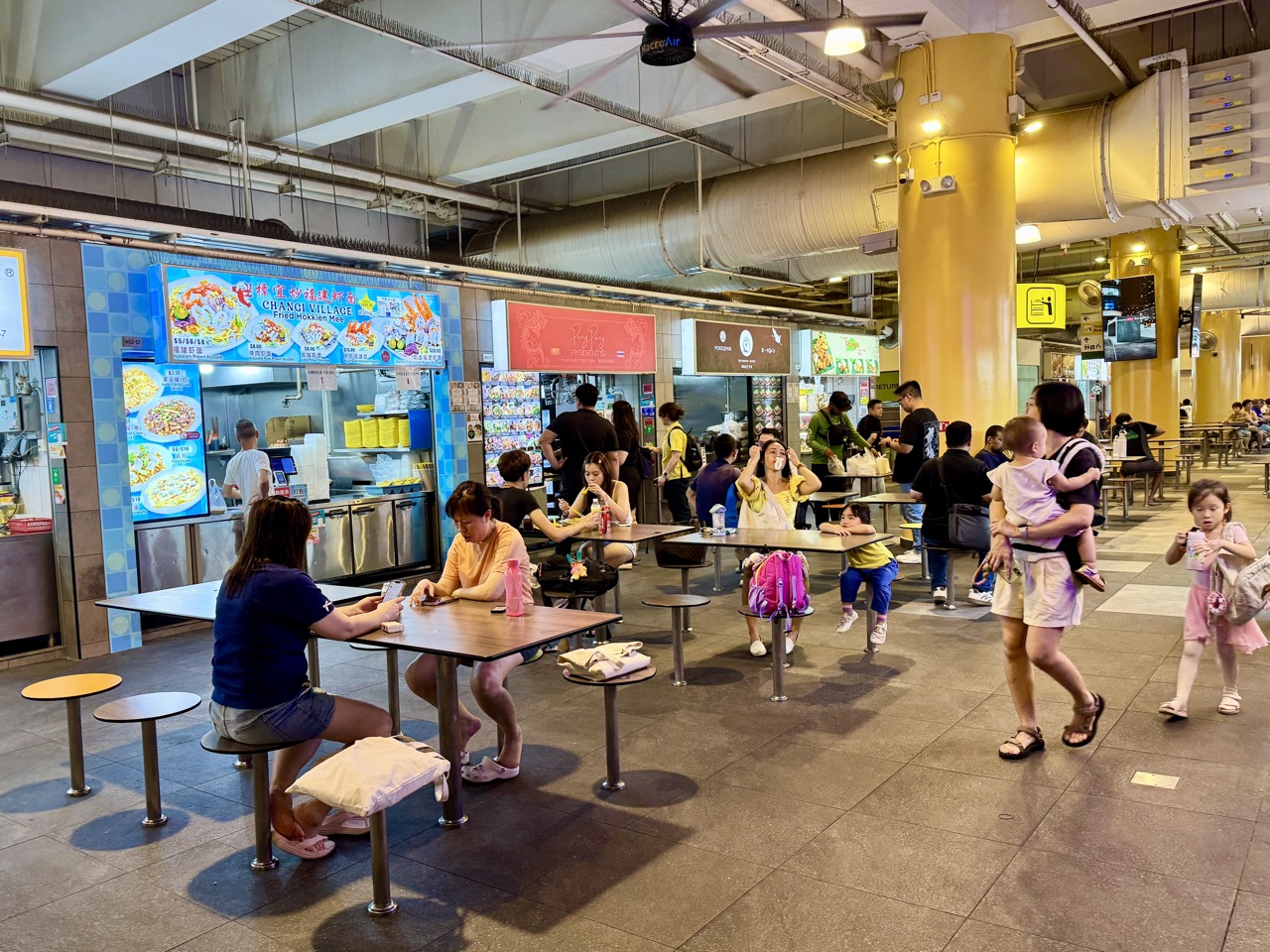
One Punggol Hawker Centre’s Level 2 dining hall is not only a place where people queue and eat. It is also a collection point for some takeaway and delivery orders. Our freshly uploaded October 2026 photographs show customers at stalls, dining tables and people described in the image metadata as delivery workers collecting food. That public scene offers a useful way to understand how a meal moves from order to preparation, packing, collection and eventual delivery—and why that process has to work around diners, staff and safe food handling.
The essential fact is that delivery is a chain of responsibilities, not simply a person on a bicycle. A participating food stall prepares the meal; an order and collection process identifies what is ready; an assigned delivery worker may collect and transport it; and the customer receives the food. The exact steps, fees, availability and who performs each task vary by stall and service. The photograph cannot prove which app anybody uses or establish that every One Punggol stall offers delivery. This article explains the workflow and consumer decisions, not a current directory of delivery-app partners.

One Punggol food delivery: quick answers
- Where: One Punggol Hawker Centre, Level 2, One Punggol, 1 Punggol Drive.
- 2026 management: Hawkermania was appointed to operate the centre from 15 August 2026, following Timbre+ Hawkers’ tenure ending on 14 August.
- Delivery availability: check each current stall or delivery service directly; a photo cannot verify that all stalls accept orders online.
- Workflow: customer order → confirmation → food preparation → packing and identification → verified collection → transport → recipient handover, with variations.
- Food safety: SFA’s food-delivery guidance requires businesses to transport ready-to-eat food without compromising safety; hot and cold handling matters.
- Transport safety: riders must obey Singapore’s relevant road and active-mobility rules; shortcuts across pedestrian areas are not authorised.
- Work protections: MOM’s Platform Workers Act may apply to qualifying workers, but an image of a person collecting food does not prove their employment classification.
- Useful reader question: if a delivery is delayed, which stage needs checking—and which person has the information to resolve it?
For a wider food-centre visit, see One Punggol Hawker Centre: Level 2, Queues and the New Operator. Its reader purpose is dining and family logistics. This page owns delivery flow, safe handover and the relationship between digital orders and a public food hall. The Working in Punggol: Delivery Riders and Platform Protections is the separate career and law guide.
Start with the right place, not just the right app
One Punggol Hawker Centre is on Level 2 of the One Punggol community hub. A delivery worker heading to the site needs to identify the correct building, appropriate public entrance and collection counter. A customer ordering from home needs the actual participating stall or store to be selectable on the current service. The site address alone does not establish that the worker is assigned to a particular stall.
The People’s Association lists One Punggol at 1 Punggol Drive, but a multi-level development has different user routes and operational areas. An order pickup should use current lawful access routes and directions from the outlet or service. A photograph of the Level 2 hall doesn’t tell us where bikes may legally park, whether an internal shortcut is authorised or which doorway staff have chosen for collections.
Why the order begins before a rider appears
A customer may place an order through a delivery platform, a stall’s own channel or another permitted arrangement. The seller must receive and confirm the order within its own system. Different businesses use different methods, so a general guide cannot promise one exact software sequence. What matters is that the order information reaches the people preparing the food without being lost among dine-in requests.
Think of the order as a small bundle of instructions: selected items, variations, collection identity and destination details handled through the relevant service. Accurate information is essential. If a family requests no chilli or another important modification, it needs to be reflected in the actual accepted order, not assumed because the shopper remembers selecting it in an earlier screen.
Order confirmation is a different event from kitchen completion
A customer seeing ‘order accepted’ may think the food is already on its way. In many workflows, acceptance simply means the business has acknowledged the order. Ingredients must still be prepared, cooked and packaged, and a suitable delivery or collection arrangement made. Treating confirmation as completion can create unrealistic expectations about how long the journey will take.
The distinction is helpful when interpreting an app’s status messages. A delay might reflect preparation rather than a rider’s movements. Instead of assuming someone is neglecting the order, use the service’s current help or status channel. The photograph shows a busy food hall, but does not allow us to diagnose any specific order’s timing.
How dine-in and delivery orders can share kitchen capacity
A food stall may have customers waiting in person while receiving takeaway or delivery orders. Both types of demand can need the same cooking equipment and staff. If many orders arrive together, the queue visible in the hall may not represent the entire workload. A person seeing only the dine-in line therefore cannot accurately judge how many meals the counter is preparing.
At the same time, it would be misleading to assert that all stalls prioritise app orders or that every dine-in customer waits because of delivery traffic. Those practices vary. A systems-thinking student can model combined demand in a hypothetical example. Actual queueing discipline and order priorities belong to the participating business and operator.
What a collection code is for
Many delivery workflows use an order number, name or code to match the prepared package with the correct person. That identifier helps prevent the wrong bag being collected, particularly when several similar-looking meals are ready. The relevant app or outlet determines the precise method. A visitor should not infer an actual customer’s order number from the photograph or expose their private receipt information online.
For a fictional teaching scenario, imagine packages A102 and A120 waiting side by side. Collecting A120 when the task says A102 is not a small cosmetic mistake: the wrong meal may reach an unintended household. Reading the identifier carefully is part of accuracy. Do not publish real order numbers, customer addresses or private screens in a blog post.
The packaging step belongs to food safety
A cooked meal being carried away must remain protected from contamination and leakage. SFA’s food-delivery guidance says ready-to-eat food should be packed in clean, sanitised areas separated from raw-food preparation, and food should be transported in ways that maintain safe hot or cold conditions. Those standards concern the handling and delivery process, not the attractiveness of the takeaway photograph.
A soup container may need different packaging from dry rice, and a chilled dessert has different temperature considerations from freshly cooked noodles. These are general examples. We cannot verify an individual One Punggol stall’s equipment, packaging or safety performance from the wide Level 2 image. Consumers should use current, reliable information if an allergy or other serious safety condition matters.
Hot food and cold food should not be treated identically
SFA explains that delivery businesses are responsible for ensuring food safety during transport, including maintaining appropriate temperatures. Its guidance references Singapore Standard SS 672:2021 for delivery of ready-to-eat food. Food safety is not guaranteed by calling something ‘freshly cooked’ if it then spends an unsuitable period in uncontrolled conditions.
For families, the practical response is to receive food promptly, follow storage or reheating instructions as appropriate and make sensible choices if a delivery appears unsafe. Do not use a blog paragraph as a substitute for official food-safety instructions or individual medical advice. The aim is to recognise a real responsibility, not invent a universal number of minutes for every dish.
A photograph of a rider is not an employee record
The photo library describes people collecting food for delivery, but we cannot know which platforms they use, whether they are independent couriers, employees or another category of worker. Clothing and a delivery bag do not establish legal classification. Singapore’s Platform Workers Act provides specific rights and protections to people who meet its definitions, and not everyone moving food automatically falls into that category.
Under MOM’s guidance, qualifying platform workers have protections relating to work injury compensation, CPF and representation. The exact coverage depends on their work relationship and the law’s criteria. For details, read MOM rather than asking strangers to reveal their earnings, accounts or contractual status. Respectful local reporting does not make assumptions about an individual from a photograph.
The collection area is part of the public dining room
A busy hawker centre has overlapping movements: diners seeking a table, customers placing orders, staff carrying food, cleaners maintaining tables and people collecting takeaway meals. If pickup activity blocks an aisle, other visitors may struggle to move through it. A well-functioning collection process needs clear waiting behaviour and respect for any designated handover instructions.
Customers and couriers can help by avoiding crowding at the counter while waiting for an order that is not ready. Stand in an appropriate public area, follow staff directions and move aside once the collection is complete. Do not assume the photograph’s visible position is the official pickup zone for every stall. On-site instructions may change.
What to do when the food is not ready
An assigned collector may arrive before a meal is complete. This can happen for legitimate scheduling reasons, and the photo does not reveal whether it occurred in any pictured transaction. The appropriate response depends on the platform or outlet process, but should involve waiting lawfully, checking the status through the authorised channel and communicating clearly when needed.
Pressuring a cook to hand over underprepared food, blocking a walkway or quarrelling with staff does not make the chain work better. A family waiting at home can also avoid treating every delay as an individual’s failure. The real question is which step requires attention and how the service can resolve it safely.
The difference between dispatch and delivery
Food leaving the counter has completed the pickup stage, not the recipient stage. A worker may still need to travel, reach the correct building, access an appropriate handover area and confirm delivery. Conditions on the road, the route’s permitted paths and the building’s access arrangements can affect the journey. Static map estimates do not guarantee an exact arrival time.
An order marked ‘picked up’ should therefore not be interpreted as proof the rider is already outside the customer’s door. The recipient should follow the current service’s normal tracking and communication rules. If an app location appears inaccurate, there may be ordinary technical or timing explanations; do not publish accusations about a person from one screen.
Safe cycling, power-assisted bicycles and footpaths
LTA differentiates ordinary bicycles, power-assisted bicycles, personal mobility devices and other mobility aids. A power-assisted bicycle is not permitted on footpaths, and the rules for each device and type of path matter. Delivering food does not exempt a person from restrictions at pedestrian areas or traffic crossings. Riders should use lawful routes even when a shortcut would save a little time.
One Punggol is in a mixed public environment with pedestrian routes, nearby traffic and LRT structures. A delivery worker and a parent with a stroller may need to use adjacent but legally distinct paths. A safe handover plan respects both. The photo of a food hall gives no grounds to claim which particular rider uses what vehicle.
Road safety also protects the food order
A spill, collision or abrupt braking can damage packaging as well as injure people. Keeping containers secure and selecting a safe route are therefore related responsibilities. The delivery worker’s task is not merely to travel quickly; the journey must remain lawful and safe for the rider, pedestrians, other road users and the food.
Customers can help by providing accurate delivery instructions and avoiding pressure to perform unsafe manoeuvres. A vague message saying ‘come to the back door’ could send someone toward a restricted or vehicle-only area. Use the permitted entrance and building access process that applies to the address. Where an access arrangement is unclear, seek official clarification.
Why a food order needs careful personal-data handling
Delivery instructions may contain a home address, contact information or notes about access. Those details serve a narrow purpose: getting the purchased food to the correct recipient. They should not be photographed, copied into an unrelated social-media post or shared with someone who has no role in the transaction. An image of a phone screen or receipt can reveal more than the photographer intended.
Families should check the information they enter, use the service’s designated communication channel and avoid sending unnecessary sensitive details. Children should not be instructed to share passwords, identity documents or household security information with a courier. The right amount of information is enough to complete the delivery through the authorised process.
A good handover is not always at the customer’s door
Building access rules, personal safety and the customer’s choice may lead to an agreed lobby or other permitted collection point. What is appropriate depends on the delivery address and service terms. A person living in an HDB flat, condominium or student residence may face different access arrangements, and this guide cannot promise one universal procedure.
The important point is mutual clarity. Use the correct address, check instructions and avoid obstructing fire exits, lift doors or common corridors. Food should not be left in a hazardous or unsanitary spot simply because a digital marker suggests the task is complete. SFA’s food-delivery guidance places importance on protecting meals from contamination during the process.
What if the customer is not available?
A recipient may be delayed, miss a call or have an unexpected change of plan. The rider should use the relevant service’s prescribed procedure rather than invent an unauthorised way into the building. The customer should communicate through the appropriate channel and not expect a worker to wait indefinitely in a restricted area.
A good family plan recognises that food safety and delivery arrangements have limits. Don’t ask a stranger to enter a home without an appropriate basis or leave a meal next to a refuse point. If handover fails, the service’s current refund, redelivery or support policy will be the relevant source, not a generic third-party promise.
Food delivery and food takeaway are not the same process
A customer who orders takeaway and collects it personally controls the journey from the stall to home. A delivery arrangement introduces another person or service between the food outlet and recipient. Both require appropriate safe handling, but the timing, communication and responsibility chain differ. Not every takeaway counter necessarily participates in every delivery service.
An older child can draw two flowcharts and compare them. Takeaway: order, prepare, pay or confirm, collect, transport home. Delivery: order, confirm, prepare, pack, assign and collect, transport, hand over. The actual sequence can vary, but this comparison helps students understand why a small change in business model creates additional coordination needs.
One Punggol’s 2026 operator transition belongs in the chronology
MSE said in January 2026 that Timbre+ Hawkers and NEA had agreed to end Timbre’s tenure on 14 August. NEA announced Hawkermania’s appointment from 15 August 2026. These are management facts, not evidence about the technical delivery systems used by every individual stall. A change in hawker-centre operator does not automatically prove that all app menus, partnerships or collection rules changed in the same way.
Some older directories still name Timbre because they predate the transition. For current stall relationships, check the participating business and relevant service. This article includes the date so readers are not misled by an old operator name, while leaving the detailed management story to the existing One Punggol guide.
What a customer can check before ordering
Verify that the desired stall is shown as available through the current service, read the actual menu and total checkout price, confirm the delivery address and inspect any stated preparation or arrival estimate. For allergies, religious dietary requirements or other essential restrictions, ask the business through an appropriate channel rather than rely on a photograph or a dish name.
Do not assume that because a stall exists in the food hall, its entire menu appears in every app. Digital availability, sold-out items and service coverage may change by day. The price charged for a delivered order may also differ from the in-person experience. Read the actual order screen and terms before confirming a purchase.
Avoiding the wrong-order problem
A customer may receive a package missing an item, containing the wrong meal or not matching the accepted customisation. Before assuming who caused the issue, document the relevant order information privately and use the app or outlet’s customer-support process. A shared food hall can have several people involved in one meal, making guesswork about fault unhelpful.
For families, the practical lesson is to compare the received items with the confirmed order while preserving privacy. Do not post another person’s address, receipt token or picture online to demand help. A clear private report is more likely to lead to a useful resolution than an accusation based on incomplete information.
A ten-step process map students can draw
Create ten boxes: customer chooses; order submitted; business receives; order confirmed; ingredients prepared; meal cooked; meal safely packed; collection matched; transport; handover. Then draw arrows. This is a general teaching model, not a statement that every One Punggol outlet follows identical software timing. Some boxes overlap and some systems reverse minor administrative steps.
Now ask where errors can occur. An item might be unavailable, a modifier might not transfer, packaging could be incorrect or the recipient might enter an incomplete address. Each error needs a different repair. Systems thinking is about identifying the broken connection, not repeating ‘please be more careful’ to everybody involved.
Hypothetical Mathematics: preparation capacity
Suppose an imaginary stall receives an average of 18 new orders every 15 minutes, but can complete 12 in that period under the assumed conditions. The uncompleted backlog grows by six orders per 15 minutes while those rates persist. After four such intervals with no starting backlog, the simplified backlog reaches 24 orders. Those numbers are not observations of the photographed outlet.
This explains why a dining queue may lengthen even when cooks are busy. But a real kitchen handles differing orders, and demand rates can change from minute to minute. The student should state the assumption of constant average arrivals and service rate, then explain why actual data would be needed before predicting a customer’s wait.
Hypothetical Mathematics: checking a time estimate
Imagine an illustrative order taking 12 minutes to prepare, 3 minutes for collection coordination and 18 minutes in transit, with no overlap. Adding them gives 33 minutes. If the service overlaps preparation and dispatch, the actual elapsed time may be shorter than a simple sum; a delay can make it longer. The model is deliberately basic.
Ask the student to explain why ’33 minutes’ is not a reliable prediction for a meal from One Punggol. We have not measured the stall, assigned a route or checked present traffic. Accurate modelling requires both arithmetic and trustworthy input data. A rounded app estimate should also not be confused with a guaranteed deadline.
Hypothetical Mathematics: what if a rider carries two orders?
A simplified delivery example can compare one stop and two stops. Suppose the route to the first destination takes 8 minutes, the additional journey to the second takes 6 minutes and each handover takes 2 minutes. Under this invented sequence, the first customer’s handover takes 10 minutes after starting the delivery leg, while the second occurs after 18 minutes.
These are fictional times, and actual delivery policies or routing practices vary. The purpose is to demonstrate how multiple stops affect timing, not to assert that the photographed workers accepted several orders. A pupil who understands the model can also ask whether hot and cold food handling changes the safe operating choices.
The difference between a food worker and a delivery worker
A stall employee preparing a meal generally has responsibilities tied to food handling and the employer’s arrangements. A courier primarily collecting and transporting packed food may have a different role and regulatory category. SFA says food delivery workers who do not directly handle or prepare food in the prescribed sense are not required to attend the WSQ Food Safety Course Level 1 solely for delivery work. The duty to transport food safely nevertheless remains.
This difference is important for fair public discussion. Calling everyone in a food hall a ‘hawker’ erases different kinds of labour. Calling every person with a bag a platform worker may also be wrong. Use the right role when verified, and describe only visible collection activity when the individual’s employment status is unknown.
Why speed is not the only performance measure
A delivery process can be evaluated through more than elapsed minutes. Correct order contents, safe temperature handling, courteous communication, lawful transport and successful handover all matter. A meal delivered quickly but to the wrong address is not a success; nor is a meal left in an unsafe place simply because an app timer stopped.
A thoughtful student can suggest several measures and discuss trade-offs. For example, packing time may improve accuracy while adding a little preparation time. The real world is not always a race to minimise one number. Effective service balances speed with accuracy, safety and customer needs.
If a delivery person is injured, use the proper support route
MOM’s Platform Workers Act and WICA framework can apply to eligible platform workers, including parts of their pickup and delivery tasks. Work injury compensation coverage began in 2025 for qualifying workers. A blog photograph, however, cannot show whether somebody meets the legal definition or whether a particular incident would be covered.
Workers should use official MOM and relevant platform procedures for current rights, reporting and support. This article does not replace employment or legal guidance. Its purpose is to remind readers that the delivery stage is real work with safety implications; respecting workers’ time and physical safety is part of good customer behaviour.
The street outside One Punggol matters too
One Punggol is surrounded by pedestrian paths, roads and elevated LRT structures. The delivery journey must use appropriate access and transport facilities. A person collecting food should not park a vehicle where it blocks a crossing or ride a prohibited device through a crowded walkway. The photo of a public dining floor cannot establish the lawful vehicle location outside.
Our Punggol Drive crossing guide handles street access and pedestrian safety. For a current route, consult LTA and the actual building’s posted rules. This separation prevents a general food guide from pretending to be a precise traffic-control plan.
Public dining tables are not delivery staging areas
A delivery collector may need somewhere safe to wait, but occupying a dining table for long periods while others need to eat can create tension. The appropriate waiting and collection arrangements depend on the hawker centre and stall instructions. Avoid placing transport bags or orders on tables in a way that contaminates surfaces or blocks diners.
Diners also need to leave queues and corridors clear for people collecting meals. A well-run shared space requires behaviour from more than one group. The photograph reveals that several kinds of activity occur in the same hall, not that one group has priority over every other user.
How a family can receive food responsibly at home
An adult or appropriate family member should know when a delivery is expected and be ready to collect it from the agreed safe handover location. Check that hot containers can be carried without spills and that packaging is intact. Keep young children away from very hot food and avoid leaving perishable meals uncollected for an extended period.
If the delivery arrives while nobody is home, follow the service’s accepted handover process rather than improvising an unsafe location. After receipt, store or consume food appropriately according to SFA guidance and any provider instructions. These are practical food-safety habits, not claims that every household has the same routine.
What the image cannot tell us about delivery fees
A rider collecting a food package does not reveal the customer delivery fee, platform commission, worker earnings, bonus structure or the amount retained by the stall. These are distinct financial quantities that depend on service terms and the actual transaction. Inventing them from a photograph would be both inaccurate and unfair.
If a student needs an economic example, use a fictional order and label every assumed fee. Never treat gross customer payment as the delivery worker’s wage or the seller’s profit. A business process becomes clearer when each participant’s role and financial measure are kept distinct.
A simple customer-service conversation for primary children
A child may be curious why someone collects a meal without eating at the hawker centre. Explain that some customers order food for home, and somebody may transport it for them. The food must be matched to the right order and delivered safely. The child can practise using terms such as ‘order’, ‘collect’, ‘confirm’ and ‘deliver’ in sentences.
A useful question is, ‘Why would it matter if the wrong order number was collected?’ The child may recognise that another person could receive the wrong meal. This is a concrete lesson in accuracy and responsibility. Keep it friendly, and do not ask actual workers to take time out of their duties to teach the class.
A secondary student’s systems diagram
Older students can draw two parallel flows: information and food. The information moves from customer request to kitchen acceptance, order identity, collector assignment and confirmation. The food moves from ingredients to cooking, packaging, collection, transport and handover. Errors can occur when these flows lose alignment—for instance when the information identifies a meal that is not ready.
This diagram makes a strong introduction to operations, computing and logistics. It does not require knowledge of a proprietary app backend. The exact digital systems used by any named service are not visible in the photograph, so the diagram should be labelled an illustrative process rather than a technical description of an operator’s software.
How to compare dine-in, takeaway and delivery
Choose the same fictional meal and compare three routes. Dine-in ends at a seat in the public dining room. Takeaway ends after the buyer collects and transports the package. Delivery adds an external transport and handover stage. Each route has different information needs, waiting patterns and potential risks.
The exercise helps students understand that the word ‘food’ describes the product, while the service model shapes the journey. A family can select the option that suits its budget, time and comfort. The October photographs illustrate some stages, but are not evidence of the full three-way comparison in every pictured stall.
One thoughtful conclusion about public food delivery
Food delivery connects private homes to public kitchens through the work of cooks, collectors, transport networks and information systems. It is convenient when the stages line up, but it has genuine safety, accuracy and human considerations. Seeing collection activity in an ordinary hawker-centre photo helps make that invisible chain more understandable.
For customers, the best habits are checking the correct order, providing usable delivery instructions, respecting workers and receiving food promptly. For students, the opportunity is to learn how systems operate without pretending to know private worker details. For the hawker centre, delivery is one activity among many that must coexist in a shared public space.


Where is the pictured hawker centre?
Level 2 of One Punggol at 1 Punggol Drive, Singapore.
Do all the hawker stalls offer delivery?
Not established by the photos. Check the individual outlet and current ordering service.
Which delivery app do the people in the photo use?
The images do not verify individual apps or personal work arrangements.
Who runs the hawker centre in October 2026?
NEA appointed Hawkermania to operate the centre from 15 August 2026.
Does an accepted order mean food is ready?
Not necessarily. Acceptance, preparation, packing and collection are distinct stages.
How can a worker match the correct meal?
Use the identification and collection method required by the actual business or service, without exposing customers’ private details.
Does SFA regulate food delivery safety?
Yes. SFA says food delivery businesses must transport ready-to-eat food without compromising its safety.
Must every delivery worker attend a food-handler course?
SFA says delivery workers who do not directly handle or prepare food in the prescribed way are not required to take WSQ Food Safety Course Level 1 solely because they deliver food.
Can hot food and chilled food travel under the same conditions?
They have different temperature needs; follow SFA guidance and appropriate service practices.
Can a courier ride a power-assisted bicycle on a footpath?
No. LTA prohibits PABs on footpaths; permitted roads and shared paths have distinct rules.
Are all couriers covered by the Platform Workers Act?
No blanket inference is possible. Legal coverage depends on the worker’s actual qualifying arrangement.
Can a photo establish workers’ earnings?
No. It shows collection activity, not pay, fees, contracts or personal financial information.
Why might delivery take longer than a kitchen wait?
Collection coordination, transport, building access and handover add stages.
What if food is missing?
Use the responsible outlet or service’s support process and preserve receipt or order details privately.
What should a family check before placing an order?
Current stall availability, accepted menu, restrictions, final charge, delivery address and service terms.
Is pickup the same as successful delivery?
No. Pickup is followed by transport and appropriate handover to the recipient.
What if the customer isn’t available to collect?
Use the service’s prescribed procedure and avoid unsafe or unsanitary drop-off locations.
Do diners still need to return trays?
Yes, the applicable dine-in tray-return rules remain separate from takeaway and delivery logistics.
Can a student observe workers for a project?
Only respectfully, without obstructing or collecting identifiable or private information without appropriate permission.
Where is the separate platform-worker rights guide?
The linked Working in Punggol article covers legal and career questions in more detail.
Primary references and related Punggol articles
- Singapore Food Agency — Requirements for Food Delivery Businesses.
- Ministry of Manpower — Who Is a Platform Worker and Relevant Protections.
- MOM — Work Injury Compensation for Platform Workers.
- Land Transport Authority — Active Mobility Rules.
- MSE — One Punggol Hawker Centre’s 2026 Tenancy Transition.
- One Punggol Hawker Centre — Family Dining, Queues and Operator.
- Working in Punggol — Delivery Riders and Platform Rights.
- Punggol in Pictures — October 2026 Photo Archive
Editorial date: 23 October 2026. The article uses verified October images from eduKatePunggol’s media library to illustrate public food collection at One Punggol. It does not infer workers’ platform affiliations, employers, individual incomes, customers’ addresses or private orders. All step-by-step flows and worked figures are explanatory examples; real stall, app and venue procedures may differ. Current SFA, MOM, LTA and outlet instructions take precedence.


