
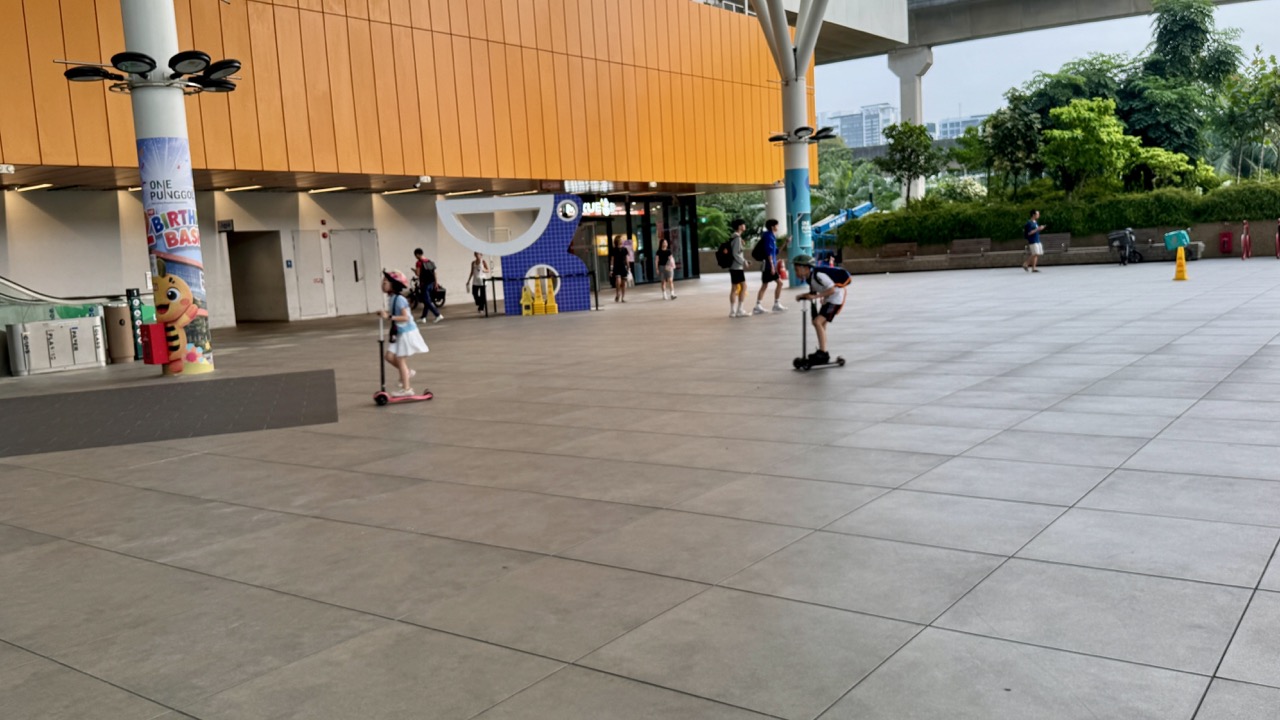
Our October 2026 photo library contains a scene of children riding scooters in an open space at One Punggol. The photograph makes a useful safety question visible: where may a child ride a non-motorised kick scooter, and when should the family slow down, stop or choose another place? This article distinguishes Singapore’s general LTA path categories from the actual rules of a community hub. A photo of an activity does not prove that every part of the venue permits it.
Our new October 2026 photographs show children on kick scooters in an open space at One Punggol, the community hub at 1 Punggol Drive. The picture gives parents a practical question: where can children use a scooter without getting in the way of walkers, diners, older residents or people moving between facilities? The answer begins with current ground signs and the venue’s rules. A photograph of children riding is not a guarantee that scooter riding is permitted in every part of the hub.
For public paths in Singapore, LTA treats non-motorised kick scooters as personal mobility devices. Its 2025–2026 path framework distinguishes ordinary footpaths, cycling and shared paths from converted Pedestrian-Only Paths, where bicycles and non-motorised PMDs are generally not permitted to be ridden. A public plaza can also have site-specific rules. Families should identify the actual type of space before assuming that a rule for a nearby shared route automatically applies inside the hub.

One Punggol and kick scooters: the quick answers
- Building: One Punggol, 1 Punggol Drive, Singapore 828629.
- Photographed: children with scooters in the open public area under the high roof, October 2026.
- Device: a human-powered kick scooter is a non-motorised personal mobility device under LTA’s public-path classification.
- Pedestrian-Only Paths: these are different from ordinary footpaths and shared paths; LTA has enforced restrictions on active mobility devices on the converted paths from 1 July 2025.
- Inside One Punggol: follow the managing venue’s current signs or staff instructions; the photograph does not establish a blanket right to ride.
- Safety: supervise children, keep exits and dining circulation clear, move at a safe speed and stop when space is unsuitable.
Why a photograph and a permission rule answer different questions
The photo tells us that children with scooters were present at the time of capture. It does not tell us the exact local rule, whether a staff member directed the activity, whether a programme had special permission or where the boundaries of a permitted riding area might have been. Looking at the picture and deciding ‘the whole building must allow scooters’ would be an unsupported inference.
A parent planning a real outing needs the current instructions for the actual place. A non-motorised scooter may be permitted on one public path category while restricted in an adjacent pedestrian-only zone or by a building operator. The responsible approach is to read signs, observe the flow of people and ask staff when uncertain. If the space is not appropriate, carrying or walking the scooter to another lawful location is a sensible choice.
Why children enjoy the open space
A high roof and a broad-looking open area can make a public building feel welcoming. One Punggol is designed to bring community services and activities together, and its open spaces help people move, meet and pause. Children may see space for movement where an adult sees a route between the library, community club and hawker centre.
Those different perceptions can clash if everybody assumes the area is intended primarily for their own use. Parents can explain that an attractive public plaza is a shared setting. The family should confirm whether an activity is actually permitted, then ensure that any riding remains suitable for other users. A wide-looking photo does not prove unrestricted play space.
The difference between a kick scooter and an e-scooter
A non-motorised kick scooter is propelled by the rider pushing against the ground, while an electric scooter uses a motor. They fall within different practical regulatory considerations, although both relate to the broad category of personal mobility devices. LTA’s device table distinguishes motorised and non-motorised PMDs and shows where they may be used on public paths.
This article concerns ordinary human-powered children’s scooters, not an electric vehicle or a mobility aid designed for a person with walking difficulties. Parents should not use its explanations to determine the rules for e-scooters or mobility scooters. Those devices have different technical, safety and legal requirements. Check the appropriate current LTA category rather than infer it from the appearance of wheels.
A public footpath is not the same as a Pedestrian-Only Path
Under LTA’s framework, an ordinary standalone footpath differs from a path converted to Pedestrian-Only status alongside a dedicated cycling path. LTA’s 2025 changes restricted bicycles and non-motorised PMDs from the converted pedestrian-only sections. Path markings matter: familiar pavement colours alone may not reliably tell a family what the status is.
A person should look for pedestrian-only wording, cyclist logos, edge markings and local signage. The fact that a scooter can be used on a certain ordinary footpath does not authorise riding on every area described conversationally as a pavement. These distinctions can be difficult for a child, so the adult should decide the route before riding begins.
Shared paths require shared attention
A shared path can be used by more than one category of lawful path user, but that does not give the fastest traveller priority over everybody else. Pedestrians may move slowly, stop unexpectedly or need extra room. Children on scooters need to recognise that other users cannot reliably predict their sudden turns.
A family can practise riding at a controlled pace, looking ahead and stopping at a safe edge before talking or checking directions. If the path is crowded, dismounting and walking may be the considerate solution even where riding is ordinarily permitted. Rules are a baseline; real shared-space safety also requires judgement.
The plaza may not be classed as a public cycling path
A community hub’s open gathering space has a different purpose from a dedicated cycle path. The October photograph does not prove whether the photographed surface has a particular statutory classification or a venue-specific permitted-use policy. Do not assume that the LTA rules for a neighbourhood footpath settle the management arrangements of every indoor-adjacent public plaza.
The correct action is to follow current One Punggol notices and staff direction. If the space is reserved for an event, filled with seating or otherwise unsuitable, choose another location. A family should not insist that the photograph grants permission. A good outing remains flexible enough to change activities without confrontation.
Children on scooters and the library entrance
A library welcomes people who may be carrying books, guiding younger children or using mobility aids. If a scooter moves quickly across a route people expect to walk, the risk of a surprise collision increases. That is why entrance areas and crossing points deserve extra care, irrespective of whether scooters are generally allowed somewhere nearby.
Before approaching the Punggol Regional Library, check the appropriate storage or carrying arrangements for the scooter. Do not leave it in a doorway or block a lift. The library’s own operational rules matter once the family enters. The image of the hub cannot tell us whether a particular scooter may be taken into a named library area.
The hawker centre and hot food make movement different
One Punggol Hawker Centre is on Level 2. People carry hot soups, drinks and trays between counters and tables. A public route leading toward food service may have different pedestrian movement from an open court or park connector. Children should not ride into a crowd of diners simply because the surrounding building also has a large open space.
A parent can give a clear rule that is easy to remember: stop, step off and move the scooter appropriately when approaching crowded food or entry areas, subject to site instructions. The purpose is not to scold a child for enjoying movement. It is to teach how to recognise when other people’s needs change the safe behaviour.
A scooter is not a toy to leave across an exit
When a child becomes interested in a playground, book or snack, the scooter may be left behind casually. On a shared path or public plaza, that can obstruct wheelchairs, strollers, cleaning operations or emergency movement. An adult should take responsibility for appropriate storage, especially if the child is too young to judge the effect on others.
If a suitable parking or storage location is not available, the family may need to carry the scooter or leave the area. Do not lock it to a handrail or barrier without permission. Shared space is still shared when the device is not moving. The object can become a hazard simply by being left in the wrong place.
Watching for people who move differently
A person using a walking frame, wheelchair or stroller may need more room and a more predictable route than a confident adult walking alone. Some disabilities are not visible. Children can learn not to judge who ‘deserves’ space from appearance but to notice that faster movement should not intimidate or pressure someone moving slowly.
Parents can model giving way courteously, choosing an appropriate speed and avoiding sudden manoeuvres near others. If somebody asks for room, respond calmly. Safety is not only compliance with speed limits; it is a shared understanding of vulnerability, space and courtesy.
Why speed is more than a number on a sign
LTA sets speed limits for different kinds of public paths, and the device table provides the relevant categories. But a maximum legal speed is not a recommended target in a crowded place. Conditions matter: density of pedestrians, sightlines, children, wet surfaces and turns can make a much lower speed necessary.
For a young child, ‘ride slowly enough to stop safely’ is often a more useful initial habit than trying to estimate kilometres per hour. Adults still need to know the actual current legal limits. On an uncertain or unsuitable plaza surface, the correct action may be to dismount rather than debate whether a numerical limit is technically being obeyed.
A family meeting point is not a riding course
An open area at One Punggol may be used for people meeting before a class, appointment or meal. Groups can cluster near entrances while looking for relatives. A child riding in circles through that congregation may surprise people, even if the area appeared empty moments earlier.
Agree on the meeting point first and keep scooters stationary and out of pedestrian flow while waiting. After the group has assembled, decide whether a suitable permitted riding location is available. One Punggol’s role as a community hub comes before any one family using the plaza for a particular activity.
The actual rules can change during events
Community hubs host activities that can rearrange the public space. Temporary booths, chairs, queues or barriers may alter a route that looked open in an earlier photograph. The image is a record of October 2026, not a permanent floor plan or guarantee that the same area will be clear tomorrow.
If a staff member redirects movement during an event, follow that instruction. Do not ride through a cordoned area or move barriers to preserve a preferred route. Families can plan a quieter alternative when the open space is occupied. Public buildings are versatile precisely because their use can change.
Why a high roof does not guarantee safe weather conditions
The architecture may provide shade or some shelter, but a large roof does not mean that every adjoining outdoor route is protected from rain or lightning. Wet surfaces can reduce control, and gusting wind may affect a child’s comfort or balance. A photograph taken in fine weather cannot establish conditions on the next visit.
Check current weather, and be willing to end an outing when conditions are unsuitable. During thunderstorms, follow appropriate safety guidance and avoid exposed outdoor activity. The aim is to enjoy movement safely rather than prove the child can continue in poor conditions.
A simple practice routine for first-time scooter users
If an appropriate, permitted space has been verified, young beginners can practise starting, slowing, stopping and keeping a straight line with an adult supervising. It is more useful to control the scooter at low speed than to attempt sharp turns near other people. Helmets and other suitable protective equipment may be advisable according to the device, age and activity.
The family should not improvise a riding lesson in a crowded walkway. If a safe practice area is unavailable, postpone or use another venue that permits the activity. A few calm, controlled minutes can be enough for a child; there is no need to create an obstacle course where strangers must pass.
The value of dismounting without embarrassment
Children sometimes see stopping and walking as a failure when they want to ride like older friends. Parents can instead teach that choosing to dismount is a sign of good judgement. At a busy entrance, narrow shared area or uncertain path marking, it may be the safest and most considerate decision.
An adult who routinely dismounts or slows appropriately models behaviour more effectively than a lecture. Explain the reason briefly: there are people carrying food, somebody needs room, or the surface is wet. The child can enjoy riding later in a suitable place without treating the adjustment as a punishment.
How to speak to children about path signs
Use concrete words rather than a complicated legal summary. ‘This sign is for people walking’; ‘This mark shows a cycling path’; ‘We stop and check when the sign changes.’ A child can recognise symbols while an adult remains responsible for reading and applying the rules correctly.
Practise during a supervised, low-pressure outing. Do not send a young child to test which paths allow scooters by riding through them alone. Path literacy develops over time. Clear habits are more valuable than memorising penalties or trying to move at the maximum possible speed.
A photo cannot establish whether a child was breaking a rule
Seeing a child on a scooter does not automatically tell us whether the activity was permitted at that moment. We do not know any special event arrangements, staff instructions or the precise classification of the photographed area. It would be irresponsible to accuse identifiable people of wrongdoing without adequate evidence.
The article uses the image to ask how families can check rules before acting. It avoids naming the children, speculating about their schools or making an enforcement judgement. The correct focus is public-space education and responsible visitor behaviour.
One Punggol and Sam Kee LRT are not the same kind of space
The elevated LRT corridor near Sam Kee has shared paths and recreation areas documented elsewhere in the photo collection. One Punggol is a community hub with a covered public plaza and indoor-adjacent services. A riding route lawful on a specific marked public path is not automatically permitted throughout the hub.
Our Punggol Green under the LRT guide covers the separate path and park setting. This article concentrates on understanding the scooter image and the choices a family must make around the hub’s shared public areas.
Why the correct destination matters before bringing a scooter
A family heading to the library, hawker centre or community-club activity may not need the scooter at all. Bringing it creates storage and supervision questions once the family enters a busy building. Decide whether the device helps the actual trip rather than assuming every outing should include riding.
If the main purpose is to practise riding, choose a verified permitted location and conditions suited to the child. If the main purpose is reading or a meal, a walk may be simpler. A little planning protects the child’s enjoyment and reduces friction with other users.
A thoughtful final habit for parents
Before allowing riding, check the current sign, path category, local venue direction, pedestrian flow, weather and the child’s ability to stop. These checks are easier when treated as a short routine rather than a list recited after an incident. A child can gradually take part in the decision.
The key principle is simple: permission depends on the actual place and rules, while safety depends on the behaviour and conditions. A photograph is a useful reminder of the question, not a substitute for the answer on the day.
How Singapore marks a Pedestrian-Only Path
LTA introduced the Pedestrian-Only Paths initiative for certain footpaths running alongside dedicated cycling paths, with enforcement from 1 July 2025. These converted paths carry pedestrian-only markings, and non-motorised kick scooters are among the active mobility devices generally prohibited from being ridden on them. The adjacent cycling paths serve the faster-moving devices.
Parents should read the actual pavement signs rather than rely on descriptions such as ‘ordinary pavement’ or ‘open space’. A child may see a smooth strip of concrete and assume it is a suitable route. The adult’s job is to distinguish the formal path type and any venue conditions before allowing riding.
A standalone footpath has a different rule
LTA’s general public-path table allows non-motorised kick scooters on ordinary footpaths, subject to the applicable restrictions and maximum speeds, while excluding them from converted Pedestrian-Only Paths. A normal footpath is not necessarily wide or empty enough for a child to ride comfortably at a given moment. Permission and suitability are different questions.
The public-path categories should not be applied mechanically inside every shopping or community building. Even where an ordinary footpath permits a kick scooter, the responsible behaviour may be to walk the device around crowds. The adult should follow current signs, including any specific venue rule that limits riding.
Cycling paths and shared paths are not identical either
A dedicated cycling path is marked for cycling and permitted active mobility uses, whereas a shared path is designed for different permitted user groups. LTA provides markings and speed rules for these categories. The exact marking on the ground matters more than a visitor’s memory of how a similar surface was labelled in another estate.
A family moving between One Punggol and the nearby neighbourhood paths should check whenever a path changes. The safest route is not automatically the shortest or fastest one. Younger children may need to dismount near junctions or crowded crossings even after the adults have confirmed that their particular device is allowed on the surrounding route.
What the 10 km/h ordinary footpath limit means
LTA’s July 2025 device table shows a maximum speed of 10 km/h for the ordinary footpath category and 25 km/h on cycling and shared paths for devices permitted there. Those are maximum limits, not suggested speeds for children. The conditions and category must be checked in the current applicable rules.
A child on a kick scooter may have difficulty judging exact speed without instrumentation. Parents can teach stopping, giving way and never racing past pedestrians. In a busy place, going much slower or walking the device is a better choice than trying to travel close to any published maximum. The legal ceiling does not remove the responsibility to avoid harm.
Why a plaza is a place rather than a speed category
A public community plaza can serve as a meeting area, events space, passage, waiting zone and occasionally a venue for activities. It is not automatically a cycling track because it looks wide. One Punggol’s large open roof is architecturally impressive, but its appearance does not establish that riders may use every metre of floor.
When visiting, read the venue’s actual signs and ask the managing staff if necessary. Do not insist on treating the public-path speed table as permission to ride through a food queue or event. If a part of the plaza is closed, arranged for a programme or heavily crowded, adjust rather than claiming the photo proves otherwise.
The wide roof can make space appear deceptively empty
An architectural photograph compresses time and frames a particular angle. It may capture a patch of floor with plenty of room even though other areas are busy. Families should not judge today’s suitability from the broad appearance of the photo. Densities can change quickly as people enter for food, a library programme or a community event.
That matters for children who are learning to turn and stop. A clear straight path may become crowded halfway through. Choose a suitable permitted riding area where the adult can supervise and the child can stop safely, not one where other users have to move out of the way.
Safe stopping takes priority over turning tricks
A child who is learning may be excited to attempt fast turns or sudden stops. In a public shared environment, those movements can become unpredictable to pedestrians. Start with controlled slowing, straight travel and stopping before experimenting with direction changes, and only do so where permitted and safe.
Riding skills are not measured by how quickly a child reaches a visible landmark. Good control includes deciding not to ride when a route is crowded. An adult should reinforce safe choices positively: getting off a scooter to pass an older person is evidence of judgement, not a failure to be adventurous.
How parents can teach giving way without conflict
A child may struggle to understand why someone walking slowly needs room. Describe the shared problem rather than blaming the pedestrian: other people cannot know where the scooter will turn, and everybody needs an appropriate route. Giving way is a practical choice that prevents a collision and makes public space more comfortable.
If another person asks the child to slow or move aside, respond courteously while checking the actual local rule. The purpose is not to win a debate in the plaza. A short explanation and change of direction can preserve a pleasant family visit and model respectful behaviour.
An after-school visit should have a clear main purpose
A family may be stopping at One Punggol after school for a library book, food or a community-club programme. Adding a scooter changes the plan because the device must be supervised, possibly stored and kept out of circulation routes. Decide whether it genuinely helps the outing before leaving home.
If the child expects an active riding session, say clearly whether the family has verified a suitable place. Avoid promising ‘you can ride all around the big hall’ merely because the photograph shows children with scooters. A predictable plan helps children cope if the current venue rules or conditions require a change.
Why lift lobbies deserve a no-rush approach
Lift areas are used by people moving between floors, often with strollers, mobility aids, luggage or trays. They need space to enter and leave without a scooter cutting across the doors. A child riding toward an opening lift can create a collision risk, even if the path before the lobby is otherwise clear.
Keep scooters under control, and follow current lift and building rules. Where appropriate, carry or walk the device rather than riding near the doors. This is a general safety consideration, not a claim that any photographed child used a lift improperly. The images do not show a full journey through the building.
Escalators require particular care with carried equipment
A scooter can be awkward on moving stairs. A family should check the site’s applicable instructions and select a safe route suitable for the equipment and users. An occupied device should not be rolled or ridden onto an escalator. People with mobility aids may need lifts and clear approaches.
Do not improvise a risky workaround just because someone is late for a class or meal. A few extra minutes for a suitable path are better than a fall. The photograph of the open plaza says nothing about which vertical-transport method is approved for scooters on each floor.
The library’s quiet purpose changes the behaviour needed
Punggol Regional Library is a public learning destination within the community hub. Children may arrive excited from outdoor play, but reading spaces and entrances require attention to other visitors’ comfort. The family should check the library’s current rules about bringing or storing wheeled items before entering.
A child can understand that places have different functions. The same behaviour that is appropriate in an allowed active recreation area may be unsuitable in a reading space. Changing how we move is part of learning to share a town, not a statement that one activity is superior to another.
A hawker meal involves hot food and moving trays
Diners may be carrying soups, drinks and plates in a crowded Level 2 hall. A fast-moving scooter could make their route less predictable. Even if someone has seen scooter activity elsewhere in the hub, it would be wrong to infer permission to ride between dining tables or through the ordering area.
Parents can decide on an appropriate method for storing or transporting the child’s scooter before collecting meals. The priority is safe circulation and supervision. The existing One Punggol hawker-centre guide covers dining and tray-return behaviour separately.
How to handle a child who becomes disappointed
Sometimes the family arrives and discovers that the open space is being used for an event or that the applicable rule does not allow riding. A child who expected to practise may be upset. Explain the change plainly rather than blame staff or other users. The family can choose an allowed alternative or return another day.
Give the child one realistic choice, not a long list of activities that are also unavailable. ‘We can walk with the scooter to an appropriate path, or take it home and read a book today’ is clearer than insisting that the child immediately feel cheerful. The goal is flexibility grounded in real permission and safety.
Shared space can be crowded without being badly designed
A community hub is intended to attract people for several purposes. At certain times there may be crowds, queues or temporary installations. That does not automatically prove poor management or inadequate architecture. The building’s use changes through the day, and each activity places different demands on movement routes.
A respectful visitor adapts to the actual situation. A family that planned a scooter outing may find a different space more suitable that afternoon. Rather than treating every inconvenience as a failure, recognise that public facilities work through shared rules and consideration for other people.
Photographing children raises distinct privacy questions
The October media image includes children in public space. A scene-setting photo can illustrate the character of an area, but it does not give the writer permission to identify a child, guess their school or publish personal details. When making new photographs, avoid intrusive close-ups of identifiable children without appropriate permission.
A parent’s own photograph should also respect other families. Frame architecture and movement where lawful, and check any venue photography rules. The fact that somebody appears in the background does not make them a public figure. Accurate, considerate captions can preserve a neighbourhood memory without making personal information the subject.
Does the photo prove that somebody broke a rule?
No. A still image lacks the exact current site-use policy, the instructions in effect that day and the context of any organised activity. It would be irresponsible to allege wrongdoing merely because scooters are visible in an open area. That distinction is particularly important when children are pictured.
The article focuses on the actions a family can take: read signs, know the current LTA categories, ask staff and choose safe behaviour. An editor should not turn a public safety explainer into an accusation based on a photo that was never taken as an enforcement record.
A child can practise reading route markings
An older primary pupil can learn to recognise pedestrian-only logos, cycling symbols and shared-path markings. Begin with an adult present and discuss the meaning of each sign before riding. The child can compare the markings in public information graphics with those on real paths without turning the exercise into a race.
This is a useful life skill because Punggol has multiple transport and recreational corridors. But knowing one symbol does not make the child ready for independent travel. The family should continue supervising and adjust the route based on the child’s judgement and actual conditions.
A Mathematics example about speed is not a riding target
Suppose, purely as a classroom problem, a person travels 100 metres in one minute at constant speed. The average speed is 100 metres per minute, or 6 kilometres per hour. That conversion is instructive but is not a recommended speed for a child to aim for in One Punggol’s plaza.
A real trip includes slowing, stopping and giving way, and the legal path category must be identified first. Students should understand the units and the limits of the calculation. Accurate arithmetic must not be confused with permission to ride fast around other people.
A Science lesson about friction and wet surfaces
A scooter needs suitable contact between its wheels and the ground for steering and braking. Wet, dirty or uneven surfaces can change how reliably a child controls movement. This is a useful way to discuss friction without creating a dangerous demonstration. A family should not deliberately practise sudden braking on wet flooring to test the concept.
Use drawings or controlled educational materials for a formal experiment instead. The photograph records an observed public setting, not the coefficient of friction of its floor. A sensible conclusion is that surface condition should be checked before any allowed riding activity.
A Social Studies question: who is the public space for?
One Punggol serves people going to a library, hawker centre, community activities and other facilities. Children on scooters are one potential user group in and around the precinct; they are not the only ones. A shared space must consider people of different ages, speeds and access needs.
A student can list possible conflicts and imagine a more legible sign or route arrangement without claiming the management has failed. The useful skill is balancing legitimate interests based on evidence. Respect for slower-moving people should not depend on whether those people’s needs are visible.
A design-thinking project should not rearrange real signage
Older students might propose a better hypothetical wayfinding graphic that helps families distinguish a cycling path from a pedestrian-only route. They can test the design on paper or through a classroom exercise. They must not install signs, paint symbols or move barriers at One Punggol without permission.
The project can compare actual LTA pictograms with ideas for clearer child-friendly explanations, then discuss whether a visitor could misunderstand them. That makes an authentic learning activity without interfering with a real facility. Responsible creativity respects the authority of the actual site and its users.
What to do when someone uses a mobility scooter nearby
A mobility scooter used as a personal mobility aid is not the same device category as a child’s non-motorised kick scooter. Singapore’s 2026 PMA regulations address medical need and speed requirements in particular circumstances. It would be wrong to apply the child-scooter rules mechanically to somebody using a mobility aid.
Avoid assuming why a person needs the device or interrogating them about eligibility. Give adequate room, obey relevant path markings and use the current LTA guidance for the specific device category. This is an important part of inclusive space: legal distinctions exist for reasons that are not always visible from appearance.
A short family outing may be better without any riding
Sometimes the best One Punggol plan is to leave the scooter at home, visit the library and eat together. The community hub offers several activities, and adding a wheeled device can complicate supervision and storage. There is no requirement to make every public visit a sport session.
Parents can explain the choice in positive terms: today is a reading or community day, while scooter practice can happen in a suitable permitted place at another time. A happy outing does not have to use every possible activity or turn a public plaza into a personal training course.
What future readers should know about these October photographs
The images document a particular setting in October 2026. Rules, events, floor layouts and permitted activities may change. A photo essay should keep the date visible and link readers to current LTA and venue instructions instead of claiming permanent site permission. The same caution applies to other public places photographed in Punggol.
That distinction makes the article more durable. The image will remain a useful record, while a family reading it later can still understand how to check the real path and choose appropriate behaviour. Good local information answers today’s question without pretending that nothing will ever change.


Frequently asked questions about One Punggol and children’s scooters
Can my child ride a scooter anywhere inside One Punggol?
No blanket permission is established. Read current venue signs and ask staff for the permitted areas.
What device is discussed here?
A human-powered, non-motorised kick scooter, not an electric scooter or a mobility aid.
Is a non-motorised kick scooter a PMD?
Yes. LTA classifies kick scooters among non-motorised personal mobility devices.
Can a kick scooter use an ordinary footpath?
LTA’s public-path framework generally permits non-motorised PMDs on ordinary footpaths, subject to rules and conditions.
Can it ride on a converted Pedestrian-Only Path?
Generally no. LTA restricts active mobility devices on those pedestrian-only paths, subject to statutory exceptions.
When did enforcement begin?
Enforcement on converted Pedestrian-Only Paths began on 1 July 2025.
Can children use dedicated cycling paths?
Non-motorised PMDs are permitted on qualifying cycling paths, with applicable limits and considerate behaviour.
What is a shared path?
A public path intended for different allowed user groups, with markings and rules that must be checked.
Is the plaza itself a dedicated cycling path?
The photographs do not establish that classification or a blanket riding permission.
Are path speed limits targets?
No. They are ceilings, and safe speed can be much lower depending on conditions.
What is the footpath speed limit in LTA’s device table?
The table lists 10 km/h for permitted users of ordinary footpaths. Always confirm the applicable current path category.
Why slow near the hawker centre?
People may be carrying hot food and crossing busy pedestrian aisles.
Can I ride through a lift lobby?
Follow current venue instructions; choose a safe approach and avoid obstructing lifts or other people.
Should children carry helmets?
Use suitable protective equipment according to the device, activity and age; it does not replace lawful riding and supervision.
What if the space is used for an event?
Follow barriers and staff directions, and choose another permitted area or activity.
Does the October photo prove every scooter was allowed?
No. It records an activity but not the exact rules, permissions or event circumstances.
Can I leave the scooter beside a doorway?
Do not block exits, circulation routes, lifts or wheelchair access.
Is a motorised e-scooter the same as a kick scooter?
No. LTA imposes different restrictions on motorised devices.
Is a mobility scooter a child’s kick scooter?
No. Personal mobility aids are a different category with separate rules.
What if it rains?
Assess surface condition and weather; stop or postpone riding when unsuitable.
What if a child is disappointed about not riding?
Explain the actual rule and offer a realistic permitted alternative or another visit.
Do I need to identify children in the photo?
No. Respect privacy and avoid inventing their personal details.
Can a photo show whether a path is legally classified?
Not reliably without signs and current official information.
Can families use the images for school work?
Yes, to discuss path literacy, design and courtesy without profiling photographed people.
Where is One Punggol?
At 1 Punggol Drive, Singapore 828629.
Which source explains the path rules?
The Land Transport Authority’s Rules and Code of Conduct and device-permission chart.
Which source governs activity within the hub?
The current venue signs and responsible One Punggol management or authorised staff.
Can the family simply choose walking?
Yes. Walking the scooter or leaving it at home can be the better option.
What is the most important skill for a new rider?
Knowing how to stop, slow down, give way and recognise where riding is actually allowed.
Is this a legal ruling about the photographed children?
No. This is an educational family guide, not an enforcement finding about individuals.
Official path rules and connected Punggol reading
- LTA — Rules and Code of Conduct for Active Mobility
- LTA — Where Active Mobility Devices Are Allowed (July 2025 Table)
- LTA — Pedestrian-Only Path Enforcement From 1 July 2025
- Ministry of Transport — Active Mobility Infrastructure
- People’s Association — One Punggol Community Hub
- Under One Punggol’s High Roof — Public Space and Architecture
- Punggol Green — Shared Paths Under the LRT
- Understanding Punggol — Cycling, PMDs and Active Mobility
Editorial review: 23 October 2026. The October 2026 photographs document children with scooters and the One Punggol public setting; they do not establish whether individual activity was permitted, nor identify the children. LTA’s statutory public-path rules and any current venue-specific directions must be considered separately. This is a family safety and path-literacy guide, not an enforcement judgement.


