
A wooded lane in Punggol became the setting for a waste-enforcement story in January 1995. On 18 January, The Straits Times published an illustrated report about illegally dumped garbage in the area. The article said the Ministry of the Environment was suspending a waste-collection company’s licence for three months after it was caught dumping illegally. The reported disciplinary action helps reveal a side of old Punggol that waterfront nostalgia often overlooks: rubbish, environmental accountability and the risks of treating a quiet rural road as a convenient disposal site.
This is a guide to that specific 1995 episode. It is not a claim that today’s landscaped Punggol Waterway Park was itself the illegal dumping site, nor a claim that the incident took place inside the former Lorong Halus landfill. Those are different locations and different waste-management categories. Precise site identification requires the original article’s location details and archival mapping.
Key facts from the 18 January 1995 report
- Publication: The Straits Times, Wednesday 18 January 1995.
- Article: “Can this be in Singapore?”, reported by Julie Kee, about dumping along a wooded lane in Punggol.
- Issue: rubbish had been illegally deposited in a place not presented as an authorised disposal facility.
- Reported authority: the Ministry of the Environment, the agency named in the 1995 account.
- Reported response: a three-month suspension of the offending waste-collection company’s licence was being imposed or announced.
- Important limitation: a newspaper summary is not a full enforcement case file, and it does not license us to invent an address, contractor name or exact weight of waste.
Why was a wooded lane such an attractive target?
Picture Punggol in the mid-1990s. The large-scale new-town identity that now shapes the area was still being planned. Portions of the district contained older roads, greenery, open land and vestiges of its agricultural and industrial past. Quiet roads can be tempting dumping spots precisely because they seem out of sight. But being less visible is not the same as being empty, unowned, unused or harmless.
A pile of discarded material may block a verge, contaminate soil, attract pests, harm a watercourse or make a public route unpleasant. Even if a site appears to have no nearby homes, other people use the landscape: workers, cyclists, residents, visitors, maintenance teams and wildlife. Dumping transfers the burden of disposal from the person paid to remove rubbish onto somebody else, often the public.
A licensed collector is not automatically entitled to dump anywhere
The striking feature of the 1995 report is its attention to the operator’s licence. A waste-collection licence concerns permission to carry out a regulated service; it does not turn random verges, vacant land and wooded tracks into approved dumping areas. The proper chain includes collection, transport and lawful disposal or processing at an authorised destination.
The exact legislation and licensing conditions in force at a particular historical date should be studied using period documents. Modern National Environment Agency requirements are useful for understanding the continuing principle, but they should not be pasted backwards as if a 2026 fee schedule or enforcement practice applied unchanged in 1995.
What does a three-month suspension actually mean?
A suspension affects the ability of a licensed operator to carry out its regulated activity for a defined period. That is qualitatively different from warning an individual not to litter, and different from proving that an entire company permanently ceased trading. The 1995 report specifically described a three-month licence suspension. It should not be rewritten as a permanent licence revocation or a criminal conviction unless a separate record proves one.
For readers who want to examine the wording, start with the digitised newspaper issue of 18 January 1995. Newspaper archives show how the official action was reported at the time; modern summaries often leave out the procedural verb that tells you whether an action was proposed, announced, ordered or completed.
The larger 1995 problem: waste kept growing
The same year, Parliament debated Singapore’s waste system in detail. In the 22 March 1995 Committee of Supply debate, the Environment Minister explained that the country generated roughly 1.5 million tonnes of waste in 1984 and 2.4 million tonnes in 1994. These figures are national totals, not quantities dumped at Punggol. They show the scale of the service system that had to keep up with a growing population and economy.
That growth creates a simple policy dilemma. Rubbish must be removed reliably from homes, workshops, shops and institutions, but every extra load also needs an approved destination. If collection grows without sound disposal logistics, the temptation to cut corners becomes more serious. Enforcement against illegal dumping is one way the system protects the integrity of the whole process.
Legal landfill and illegal roadside dumping are not the same thing
A nearby geographical detail can confuse readers. Lorong Halus was an established landfill site for decades. PUB’s historical learning materials date its landfill phase to roughly 1970–1999. That was part of Singapore’s formal waste-disposal infrastructure. A rubbish pile illegally left beside a Punggol wooded lane is an entirely different proposition. The mere presence of waste in both places does not make their legal and environmental histories equivalent.
Today, Lorong Halus Wetland treats water flowing through the former landfill to protect Serangoon Reservoir. That engineered response to a legacy waste site tells us how seriously waste history matters. It does not prove the 1995 Punggol lane dumping happened there, and this article does not claim it did.
What old newspaper photographs can and cannot tell us
A historic press photograph can establish that a photographer recorded a particular visible situation. It may show the vegetation, road condition, discarded material and road edge as framed on the day. It does not automatically reveal the entire extent of contamination, who deposited every item, the ownership of the land or the outcome of later clean-up. Those questions need case records, enforcement notices, maps or subsequent reporting.
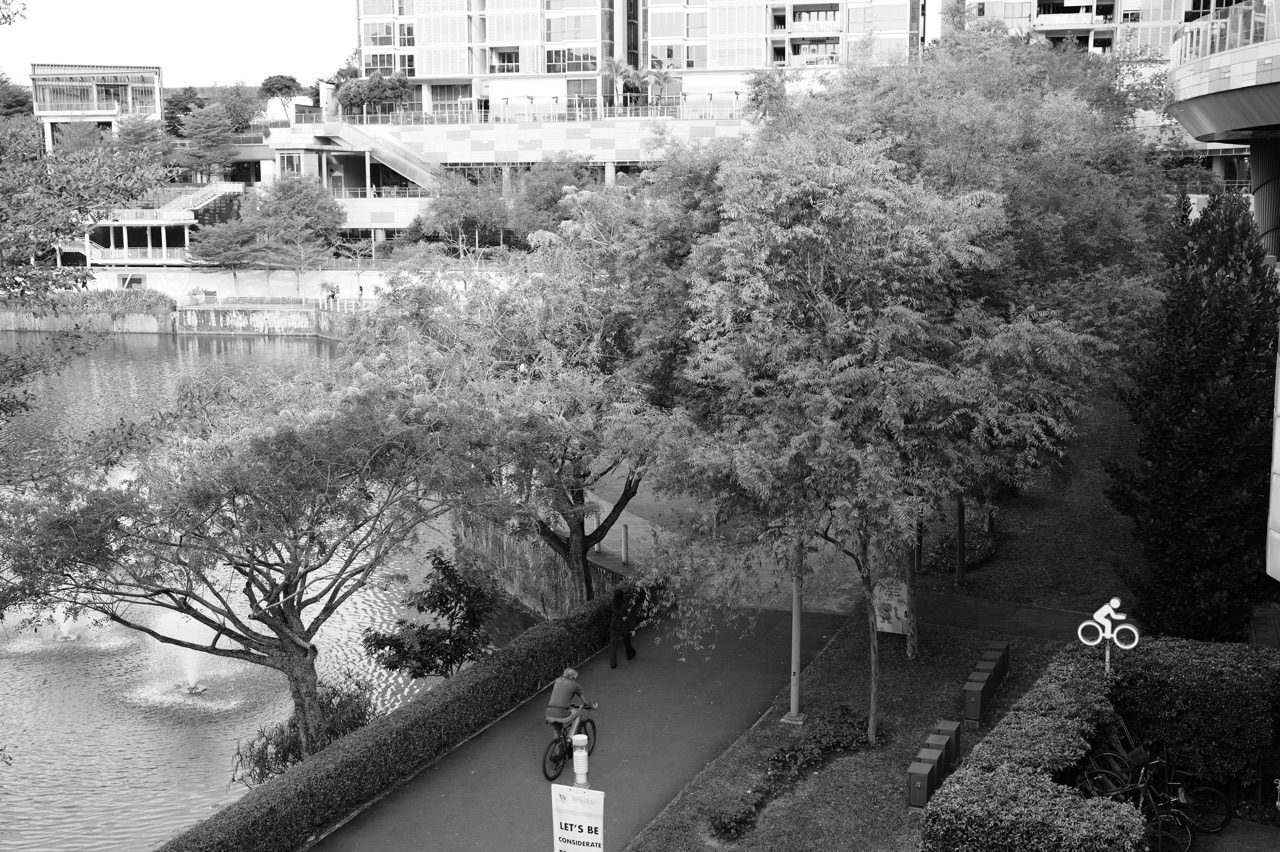
There is another trap: using a beautiful current Punggol photo as though it illustrated 1995 evidence. Modern scenery may help a young reader recognise that the area once had greener, less developed edges, but it is not a time machine. The feature photograph attached to this article shows present-day Punggol parkland as a geographical illustration, not the undocumented 1995 dumping location.
1995 versus 2026: the enforcement chain changed, but the public interest remains
The ministry named in 1995 was the Ministry of the Environment. In 2026, Singapore’s National Environment Agency explains that illegal dumping pollutes the environment and threatens public health. NEA provides public reporting channels and regulated requirements for general waste collectors. These modern references establish present-day practice; they do not replace the 1995 document.
The practical idea is steady: when someone accepts money or responsibility to take waste away, proper removal must include an authorised destination. A collection truck leaving your street is the beginning of a lawful disposal chain, not proof that the material has already been managed correctly.
A simple chain-of-custody diagram for a history lesson
- Source: household, construction job, restaurant, business or another waste generator.
- Collector: a person or company accepts waste and assumes transport responsibility.
- Transport: load travels along roads subject to relevant rules.
- Destination: waste is lawfully processed or disposed of at the appropriate site.
- Records: contracts, delivery records, receipts or enforcement files may help establish where a load actually went.
- Failure point: illegal roadside disposal breaks the chain and shifts costs to landowners, authorities and the environment.
This diagram is an analytical learning tool, not a claim that the archived 1995 newspaper published every one of these steps for that specific operator.
What the 1995 episode tells us about early Punggol redevelopment
History books commonly describe the transformation of Punggol from farms and kampongs to an HDB town. Yet redevelopment also required mundane but essential work: land clearance, waste regulation, roads, drainage and the protection of places that had not yet been built over. A scenic waterfront cannot be planned independently of the services that keep it safe and healthy.
The illegal dumping report therefore belongs in the same long story as old road upgrades and the later water-management projects. It captures a tension between a space treated by some as ‘out of the way’ and a government system increasingly committed to managing pollution and public hygiene.
How to research the episode without inventing details
- Read the original 18 January 1995 issue, paying attention to the article headline, photograph and the ministry’s reported action.
- Record any company or road names only if they are legible and supported by the source. Do not infer them from modern roads.
- Distinguish the date of an alleged act from the date of a newspaper article and the start or end of any suspension.
- Use the March 1995 parliamentary debate for countrywide waste context, not a precise tally for this Punggol case.
- Use PUB’s Lorong Halus account to understand the nearby formal landfill’s separate chronology.
Frequently asked questions
Was the dumping reported at Lorong Halus landfill?
The historical item refers to a wooded lane in Punggol. This article does not identify it as the authorised Lorong Halus landfill, and the two should not be equated without site-specific evidence.
Did a waste-collection company lose its licence forever?
No such conclusion follows from the cited report. It describes a three-month suspension, not a permanent cancellation.
Did the 1995 article say how many tonnes were illegally dumped?
Do not confuse the national waste totals of 1984 and 1994 with the volume at this particular lane. This guide does not attribute a site-specific tonnage that it cannot establish.
How can residents report illegal dumping now?
Current reporting information is provided by NEA’s official illegal-dumping page. Record the location, date, time and any safely observable evidence; avoid confronting the offender.
Why study a single episode from 1995?
Because an individual enforcement event gives us a concrete way to understand abstract topics such as licensing, public health, rural-to-urban transition, shared environmental costs and the difference between a photograph and proof.
Evidence and recommended reading
- The Straits Times, 18 January 1995 — “Can this be in Singapore?”, on an illegally used Punggol wooded lane and a reported three-month waste-collection licence suspension.
- Singapore parliamentary debate, 22 March 1995 — nationwide waste quantities and disposal issues at the time.
- PUB, Lorong Halus Wetland — formal former landfill and water-treatment setting.
- NEA, Illegal Dumping — present-day regulations and reporting guidance.
- Related Punggol history: why Lorong Halus matters — the wider environmental change beyond the 1995 roadside case.
The lasting lesson: a place becomes liveable not only through new housing and attractive parks, but also through the quiet work of making sure rubbish does not simply disappear into somebody else’s neighbourhood.


