
Kampung Wak Sumang at Punggol Point took in families from the Johor villages of Ayer Biru, Pasir Merah and Pulau Tukang during the turmoil of the Japanese Occupation and the Malayan Emergency. The newcomers settled further inland and became known locally as orang darat, or land people. The older village families and Wak Sumang’s descendants described themselves as orang laut, or sea people. These were local distinctions within the community—not evidence that one group had never worked at sea.
This detail comes from National Library Board historian Hannah Yeo’s history of Kampong Wak Sumang and the National Heritage Board’s Punggol waterfront account. Their research also connects the arrival of skilled fishermen from Johor to the village’s kupang, or mussel, trade. The story is about movement, work, local naming, family life and the ways a community changed before today’s housing estates appeared.
There is an important chronological distinction. NLB refers to arrivals during both the Japanese Occupation and the Malayan Emergency, while a shorter NHB summary highlights the Emergency. It would be inaccurate to force every migrant family into a single year or claim all came in one boat. The evidence is strongest for three places of origin, a broad period of arrival and the later integration of fishing livelihoods into village life.
Explore the chapters
- Where was Kampung Wak Sumang?
- The three Johor villages named in the sources
- Japanese Occupation and Malayan Emergency are different periods
- A village that had already experienced wartime upheaval
- What did orang darat mean locally?
- What did orang laut mean in this story?
- The difference between newcomers and strangers
- Kupang: the mussel trade that changed village work
- How mussels were gathered and processed
- Why households mattered to the cottage industry
- The business could be rewarding and dangerous
- New arrivals, school and the next generation
- The mosque and public spaces were part of belonging
- Awang Osman and the role of oral history
- Village life did not stay unchanged
- A careful timeline of the story
- Are orang darat and Orang Seletar the same?
- How to research migration without making up family stories
- Frequently asked questions
- Sources and further reading
Where was Kampung Wak Sumang?
Kampung Wak Sumang, also known as Kampung Punggol, stood near Punggol Point at Singapore’s northeastern edge. It occupied a landscape shaped by the sea and by families whose livelihoods and everyday movements depended on the coast. In historical accounts, the village long predates Punggol’s present HDB town.
The modern Sumang street names preserve a connection to the village founder, but the current road network is not an exact map of the older homes. The coastline, settlement patterns and land uses changed substantially through reclamation and redevelopment. It is better to begin a history lesson with a dated map and source caption than with a present-day housing block and a guess about who once lived there.
NLB’s 2023 study combines maps, family histories, oral interviews, photographs and newspaper reporting. That mixture of sources is especially valuable for a kampung because many everyday memories were passed on orally rather than recorded as formal government announcements.
The three Johor villages named in the sources
The National Library Board names Ayer Biru, Pasir Merah and Pulau Tukang as places from which families came. The National Heritage Board uses the spelling Air Biru for the first location. Both appear in reputable heritage material and should be recognised as spelling variants in this context rather than treated as two unrelated villages.
These are locations in Johor, across the water from Singapore. Their presence in the historical record connects Punggol’s social history to the wider Straits of Johor and to movement between neighbouring communities. A political border did not erase the maritime skills, family connections or everyday geographies of people living around the coast.
The published accounts do not supply a complete list of individual migrant families, the number who arrived from each village or an exact date for every departure. Readers should not transform the naming of three settlements into a fictional passenger manifest.
Japanese Occupation and Malayan Emergency are different periods
The Japanese Occupation of Singapore lasted from 1942 to 1945. The Malayan Emergency is generally dated from 1948 to 1960. Those periods belong to related but distinct historical contexts; a family arriving in one should not automatically be described as arriving in the other.
NLB’s longer account says Kampung Wak Sumang took in refugees from the three Johor villages during the Occupation and the Emergency. NHB’s concise waterfront overview particularly mentions the Emergency. The appropriate history-writing response is to retain the broader wording, not silently delete the earlier period or assign a specific year without documentary support.
For the wider emergency chronology, see NLB’s Infopedia account of the Malayan Emergency. It gives the 1948–1960 dates. But that broad national chronology should not be mistaken for an individual migrant’s documented journey.
A village that had already experienced wartime upheaval
Punggol was deeply affected by the Japanese invasion and occupation. NLB records that village headman Awang Osman described fleeing inland as Japanese forces arrived in February 1942. The Punggol Beach massacre forms another grave part of the area’s wartime history. These events should be treated respectfully and not reduced to colourful background for a lifestyle article.
After the war, villagers rebuilt parts of their community. NLB describes restoration of Masjid Wak Sumang and other shared spaces. The later arrival or settlement of Johor families therefore occurred in a place already negotiating its own traumatic changes.
An account of refugee arrival should not imply that the older residents had lived undisturbed until newcomers appeared. Both local and migrant families were connected to a wider period of uncertainty. The historical sources allow this context but do not supply each household’s personal experience.
What did orang darat mean locally?
Orang darat literally means land people. In these Punggol accounts, the label described Johor newcomers who had settled further inland than the older seafront families. It expressed a social and spatial distinction within Kampung Wak Sumang.
It does not mean the newcomers were incapable of fishing or came from an entirely land-based way of life. NLB explicitly explains the seeming paradox: despite their nickname, the Johoreans spent much of their time out at sea. Their fishing experience was central to changes in the village economy.
Local words can record relationships that modern maps cannot. In this case, where a household settled and how established residents understood its place in village life helped create everyday labels. Those terms should be explained in their particular setting instead of used as universal classifications of every maritime group in Southeast Asia.
What did orang laut mean in this story?
The older inhabitants and Wak Sumang’s descendants referred to themselves as orang laut, sea people. Here, the phrase helps describe an established coastal community and its identity in relation to more recent inland settlers.
It would be a mistake to assume this use of the term proves that every person so described belonged to a particular officially classified ethnic group. ‘Orang Laut’ is also used in broader regional histories of sea-oriented communities. This Punggol story draws on a local contrast preserved in specific sources; it should not erase the diverse identities associated with that larger terminology.
The most productive educational question is what the two terms reveal about belonging. ‘Sea people’ and ‘land people’ show how neighbours could describe different relationships to space while sharing the same village and, importantly, similar maritime livelihoods.
The difference between newcomers and strangers
The words ‘refugees’ and ‘migrants’ in historical writing identify a context of movement, but do not explain the feelings or circumstances of every family. The sources establish that people came from three Johor villages during periods of upheaval. They do not provide an individual testimony from everyone involved.
Within Kampung Wak Sumang, the Johor arrivals did not simply appear as an anonymous population count. They brought experience, especially in fishing, and participated in an evolving local economy. A village changes not only when streets are built but when people with new networks and practices make homes there.
The ‘luxury’ in the article’s title is therefore not an assertion that refugee life was comfortable. It refers to the community value of space for additional families and the skills they contributed. Displacement can involve hardship even where a later local history remembers adaptation.
Kupang: the mussel trade that changed village work
The kupang trade is the clearest economic link in the institutional histories. NLB and NHB say the Johor arrivals, skilled in fishing, helped initiate or expand a mussel cottage industry at Kampung Wak Sumang. Kupang refers to mussels, which could be gathered, cooked, removed from shells and sold.
This work combined physical knowledge of the sea with labour around the home. It differed from going out to catch fish for immediate sale, because processing mussels created another set of tasks before the product was ready for customers.
The story should not be made artificially exclusive. Sources identify the influence of Johor fishermen on mussel work; they do not show that every village household abandoned other fishing or that no one in Punggol had handled shellfish before their arrival. ‘Helped start the trade’ is not the same as ‘single-handedly invented all shellfish harvesting’.
How mussels were gathered and processed
NHB describes mussel farming involving divers near a kelong, a wooden offshore fishing platform, collecting mussels from wooden poles. NLB adds concrete information about the labour of shelling: approximately six to eight people could spend three hours processing a full sampan load.
Those figures have an important unit. They refer to one described processing workload, not the daily output of every family, and the size of a ‘sampan load’ is not specified as a uniform weight. They demonstrate the intensive manual work involved but should not be converted into an annual village production total without further data.
For a mathematics activity, students can calculate six people working three hours as eighteen person-hours, or eight people as twenty-four person-hours, under a simple constant-time assumption. They should then explain why the result does not establish a measured productivity rate in kilograms per hour: the load weight, tools, experience and tasks differ.
Why households mattered to the cottage industry
A cottage industry links household labour and local commercial production. The work may include collecting, sorting, boiling, shelling, packing and selling, but the archival photograph and textual accounts must be checked before ascribing each step to a named family. NLB records that whole families were often involved in the deshelling process.
An archival image of villagers handling piles of mussels can tell us about equipment, posture, teamwork and the physical setting. It cannot automatically tell us their incomes or individual identities. An ethical caption uses the source’s date and credited collection, then identifies only what is supported.
This is an especially useful example for children who see modern food in neat packets or restaurant bowls. The apparent simplicity of a serving of shellfish conceals the knowledge, handling and many hands involved in getting it there.
The business could be rewarding and dangerous
NLB’s history cites mussel farmer Jantan Rani telling the Straits Times in 1984 about smoke coming from his home when business was good. He used discarded wooden planks as fuel. The same account records a 1981 house fire in which he lost property and family possessions.
The significance is not merely dramatic. Processing food with open fires required fuel, space and heat. Home-based production could offer income while exposing families to fire risk. This specific incident gives a human dimension to a cottage industry that might otherwise be presented as a neat diagram of seafood production.
The article also reports that some mussel farmers could earn substantially more in a day than they previously earned as fishermen. That is a retrospective source’s characterisation, not audited income records for every Johor family. It should remain attributed and should not be used to calculate a fictional modern salary.
New arrivals, school and the next generation
Kampung Wak Sumang opened Sekolah Melayu Ponggol in 1955, with support from the Rotary Club and private contributors. NLB places this within a discussion of the village’s changing community and the desire to educate children. The school later came under government responsibility and moved to Track 13 in 1963.
The school is not evidence that every child of a Johor refugee attended or that it was established solely for newcomers. It is part of a broader story of an expanding village investing in learning for younger residents. Family settlement, work and schooling were linked aspects of community continuity.
Parents and pupils can compare the older school with today’s Punggol education landscape, but should preserve the chronology. For more context, consult the Punggol history directory and its individual school-history chapters.
The mosque and public spaces were part of belonging
Masjid Wak Sumang was a religious and community focal point in the old village. NLB records that residents restored shared spaces after the war. This history helps explain why community life was more than houses along a road: places of worship, classrooms and shared activities supported relationships across households.
It does not establish the religious affiliation of every person who arrived from Johor. A historical article must avoid assigning private beliefs to individuals simply because a mosque was central to the village’s shared story.
The mosque survived into a later phase of redevelopment and was demolished in 1995. That date belongs to a different chapter from the wartime and Emergency movement. Connecting the two across decades is appropriate in a timeline, but treating them as one event is not.
Awang Osman and the role of oral history
Awang Osman served as the village headman from 1932 until its demolition in 1985, according to NLB. His extensive oral history interviews, recorded in 1984 and 1985, form an important source of local knowledge. They help preserve details not always found in national planning documents.
Oral history is valuable because the speaker can describe relationships, terms and memories that a map leaves out. At the same time, an interview recorded forty years after wartime events has different strengths and weaknesses from a document written at the time.
A rigorous researcher identifies who spoke, when the interview was recorded and which claim is supported by the speaker’s recollection. NLB’s published synthesis is a useful starting point; anyone preparing a detailed family history should follow its footnotes to the relevant interviews and documents.
Village life did not stay unchanged
During the 1960s, NLB records improvements such as piped water, electricity, paved roads and drainage. Punggol Point also became a destination for seafood dining, boat storage and water sports. A family’s livelihood and experience of the coast could change substantially within one generation.
Some village residents provided services to recreation visitors, while others continued fishing or sold catches at local markets. These different occupations complicate any simple story that all residents lived the same life. The Johor migration is an important strand, not the entire fabric of Punggol’s economy.
By the 1980s, reclamation and resettlement brought another major transition. The village’s earlier ability to absorb new families did not mean it could remain on the same land forever. The old settlement and many businesses were required to move.
A careful timeline of the story
1942–45: Japanese Occupation and upheaval in Punggol and the wider region. 1948–60: Malayan Emergency in Malaya; the published histories place Johor arrivals in the broader wartime-and-Emergency period. 1955: opening of Sekolah Melayu Ponggol. 1963: government takeover and relocation of the school. 1981: the house fire recalled in the mussel-farming account. 1984: contemporary reporting on mussel production. 1985: archival photographs of villagers shelling mussels and the end of the old kampung.
Each entry should be checked against its own evidence. A photograph from 1985 shows that a particular kind of labour was being documented then; it does not prove the trade started that year. Similarly, a school opened in 1955 does not determine the arrival date of all its potential pupils.
The timeline tells a longer story of movement, adaptation, work and eventual relocation rather than a single dramatic ‘founding day’.
Are orang darat and Orang Seletar the same?
No such equivalence is established in the sources used here. Punggol’s wider history includes the Orang Seletar and other seafaring communities along the Tebrau Strait, but the local labels orang darat and orang laut in this account refer to the internal distinctions described in Kampung Wak Sumang.
Conflating labels would flatten different communities into one identity. Good heritage writing should preserve the particular word, the people who used it, the place and the period. Consult the NHB overview of Punggol history for the separate account of the Orang Seletar.
A respectful classroom discussion can ask why similar words can carry different meanings in different contexts. The answer is to use an original source rather than assume a dictionary translation captures all history.
How to research migration without making up family stories
Begin with the NLB article, which identifies three Johor origins and explains the local naming. Then consult the NHB heritage text for the related narrative of mussel production. Record any difference in spelling, such as Ayer Biru and Air Biru, rather than arbitrarily declaring one wrong.
Next, search the National Archives for oral interviews and photographs, checking catalogue captions before drawing conclusions about identities. To identify individual journeys, seek family papers, recorded testimony or contemporary documents. Do not fabricate routes, boat dates, citizenship status, exact numbers or personal quotations.
For a family-history assignment, students can prepare a source table with columns for person, origin, period, occupation, evidence and uncertainty. Leaving a cell blank when the evidence is absent is a sign of good historical judgement, not a failure.
Frequently asked questions
Where did the Johor newcomers come from? Ayer/Air Biru, Pasir Merah and Pulau Tukang, according to NLB and NHB. When did they arrive? The published accounts place arrivals during the Japanese Occupation and Malayan Emergency, without a complete date for each family. What does orang darat mean? Literally land people, used locally for the newcomers who settled inland.
Were the orang darat inland farmers rather than fishers? Not necessarily; NLB says many spent much of their time at sea and were skilled fishermen. What did the established families call themselves? Orang laut, sea people, in this local village context. Did the Johor arrivals contribute to mussel production? Yes, the heritage sources credit their skills with helping establish the kupang cottage industry.
Do we know how many people migrated? Not from these summaries. Was the school founded only for refugees? That is not established. Is Kampung Wak Sumang still a standing traditional village? No; it was cleared during the 1980s, while street names and heritage records preserve its memory.
Sources and further reading
Read Hannah Yeo’s NLB BiblioAsia feature, Remembering Punggol’s Kampong Wak Sumang, especially its Changing Communities section. Compare the NHB Waterfront Living at Punggol account and the NLB history of the Malayan Emergency.
For the longer village origin story, see Wak Sumang and Kampung Punggol. For the food economy, read Kupang mussels and the family food economy, and use the complete Punggol history timeline to connect the story to later change.
The heart of this episode is that Punggol was never a place with only one unchanging community. During difficult decades, new families arrived, made homes, worked the sea and helped reshape the local economy. Their history survives in the names of three Johor villages, two local terms for belonging, and the labour of people processing kupang together.
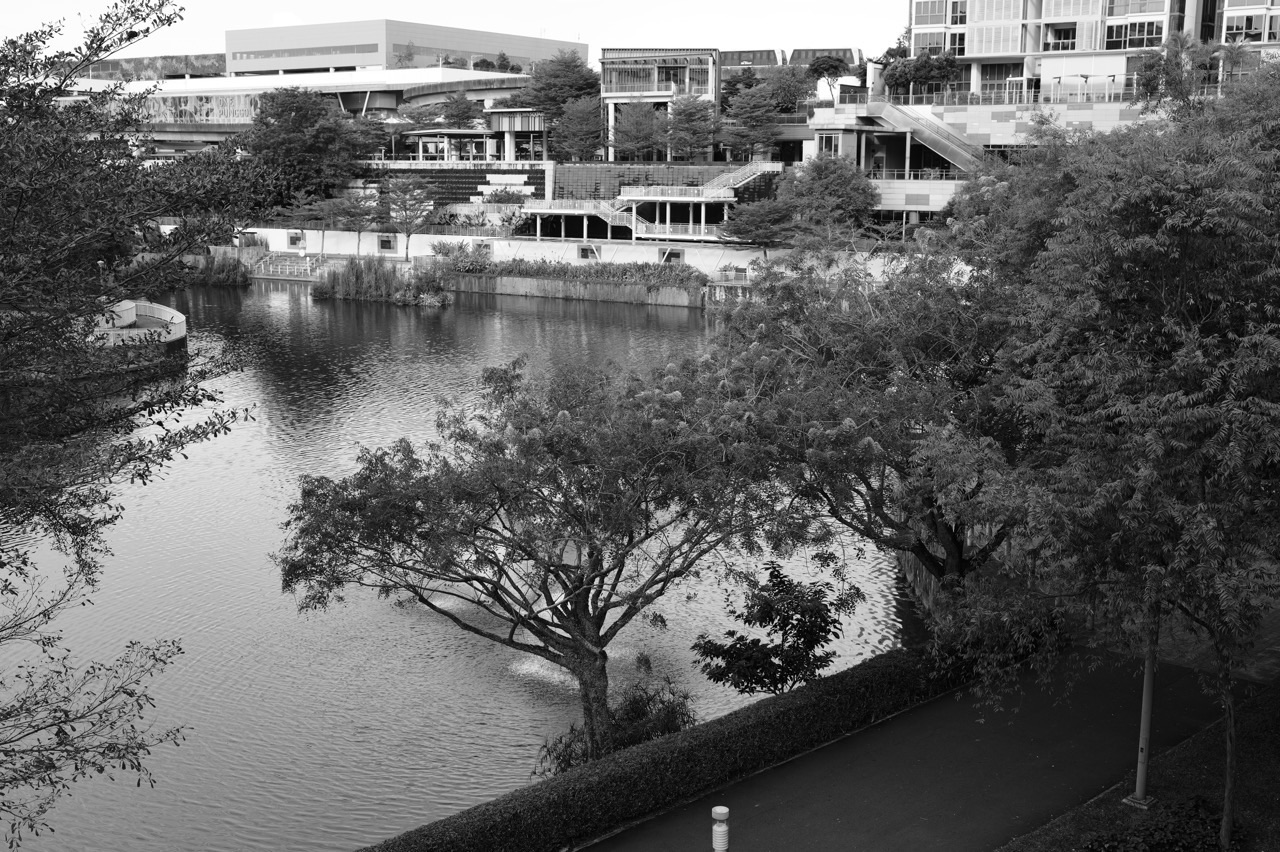
Photo note: The featured photograph shows the modern Punggol Waterway Park area in 2026 as a present-day geographic contrast. It is not a historical photograph of Kampung Wak Sumang or of Johor migrant families.


