
On Sunday, 3 April 1983, the Singapore Powerboat Association held an Easter Regatta at Punggol, and three newly appearing Eliminator racing boats dominated the major events. The next day’s Singapore Monitor sports page reported on the competition, naming two of the drivers as Dr John Lai and former racing-car driver John D’Crus. The account gives a rare, precise glimpse of Punggol’s coastline as a venue for organised powerboat racing—not simply a beach for seafood dinners, private fishing trips or weekend water-skiing.
The newspaper report appeared on Monday, 4 April 1983, under the heading Eliminators sweep the major events. Its reference to the regatta occurring ‘yesterday’ makes 3 April the event date. The digitised issue, page 23, preserved by the National Library Board, is the essential contemporary source. The National Heritage Board independently documents Punggol’s broader watersports era, including an earlier 1982 regatta, a 1983 water-ski series and an Easter Boat Show.
This article follows the specific April 1983 contest. It separates the event from similarly named occasions, explains why old Punggol had the boating infrastructure to host competitive sport, and shows readers how a short newspaper report can illuminate a much bigger local history without just inventing the missing race results. For the wider chronology, see eduKate’s Punggol history and heritage directory.
Explore the historical chapters
- The result first: what the 4 April newspaper actually reported
- How we know the regatta happened on 3 April 1983
- A named organiser, not simply ‘people racing at the beach’
- The Eliminators: three racing boats in the headlines
- Dr John Lai and John D’Crus: people crossing sporting worlds
- Why this was powerboat racing, not water-skiing
- The 1982 regatta is a different dated reference
- The 1983 Easter Boat Show needs its own source trail
- The 7-Up Water Ski Series belongs in another column
- Why Punggol Point could support a watersports scene
- Eight boatels by 1986: evidence of a working recreation economy
- The older Punggol community-centre regattas were different events
- Competition, engineering and the physical challenge of the water
- What we do not know about the race course
- Recreation was flourishing as redevelopment approached
- The 1985 water-ski warning and the narrowing old coastline
- From the old boatels to Punggol Marina in 1996
- How to read a 190-word newspaper item responsibly
- An evidence table for the Punggol Easter Regatta
- Questions families and students can investigate
- Sources, related histories and why this little race matters
The result first: what the 4 April newspaper actually reported
The Singapore Monitor, 4 April 1983, second edition, page 23, carried an item titled Eliminators sweep the major events. Its visible opening describes three Eliminator racing boats making their first appearance on Singapore waters and overcoming their rivals at the Singapore Powerboat Association’s Easter Regatta at Punggol the previous day.
The report names Dr John Lai and John D’Crus, whom it identifies as a former racing-car driver. It also identifies a third Eliminator driver by occupation as an outboard-motor importer, although that person’s name is not available in the public issue-level excerpt used here. Rather than guess, we leave the third name unresolved.
The article’s title establishes success across the major events. It does not give us a reliable complete finishing table, speeds, course lengths or class definitions from the accessible excerpt. A sound historical summary can celebrate the reported dominance while being exact about the limits of the evidence.
How we know the regatta happened on 3 April 1983
One small word in old newspapers makes a big difference: ‘yesterday’. Because the issue was dated Monday, 4 April 1983, the article’s description of events at Punggol the previous day places the race on Sunday, 3 April 1983.
That is a dating inference drawn directly from a contemporaneous publication, not a date copied from an undated modern blog. It is also a good reason to record the newspaper edition, publication day and page number. When a newspaper item says ‘last Sunday’, ‘tomorrow’ or ‘yesterday’, researchers should work from its own publication date rather than the day they discover it online.
The record identifies an Easter Regatta. That name provides a seasonal identity for the event, but it does not by itself document every activity in an Easter-weekend programme. We should not automatically treat a boat show, a race series and a single regatta as identical occasions.
A named organiser, not simply ‘people racing at the beach’
The report identifies the Singapore Powerboat Association as the organisation behind the Easter Regatta. That is more informative than the generic label ‘Punggol boat race’ because it distinguishes competitive motorboat sport from privately arranged excursions and from events organised by a community centre.
An organised regatta ordinarily requires entrants, divisions or classes, rules, safety arrangements and a recognised course. These are features of how such competitions generally work; the accessible newspaper excerpt does not disclose the association’s precise 1983 rule book or the Punggol event’s detailed course.
This boundary matters. The historical fact is that an association held a regatta at Punggol. A present-day explanation of powerboat racing can help readers understand why this is notable, but should not be written as an eyewitness description of barriers, rescue craft, buoys or marshals whose presence has not been documented.
The Eliminators: three racing boats in the headlines
The newspaper calls the three craft ‘Eliminators’. That is a name used for racing boats in the report, not a label for a team proven to have won an international championship. The pun in the headline centres on their sweep of major events.
We do not have a verified model number, engine displacement, hull specification or imported purchase price for those particular craft. Readers may find modern performance boats bearing the same name, but it would be historically unsafe to apply today’s specifications to boats operating in April 1983.
What the source does establish is a noteworthy first appearance on Singapore waters. That point makes the article more interesting than an ordinary score roundup. Equipment newly introduced to local racing could draw attention because it allowed spectators and competitors to compare unfamiliar craft with those already competing.
Dr John Lai and John D’Crus: people crossing sporting worlds
Two named drivers allow the episode to be followed beyond an anonymous reference to high-powered boats. Dr John Lai appears in the newspaper’s brief report. John D’Crus is described there as an ex-racing-car driver, making his participation an example of interest crossing between different motor-sport disciplines.
That does not mean racing a car and piloting a powerboat are the same. Each involves speed and technical judgement, but a boat moves through water, responds to wind and waves, and depends on different steering and stability conditions from a road car. The transferable skills are an interpretation; the report does not supply personal interviews explaining why either man took up the sport.
The third driver’s occupational description, an outboard-motor importer, hints at the connection between competition and the marine-equipment trade. We should not invent their full name or assume they supplied every engine used at the event.
Why this was powerboat racing, not water-skiing
Powerboat racing places the competitive emphasis on a motor-driven craft and its operator. Water-skiing involves a person on skis being towed by a boat; the athlete’s balance, turns and performance on the water are evaluated under the particular discipline’s rules.
Punggol hosted both kinds of sport during its waterfront recreation heyday. That shared setting makes headlines easy to confuse. Someone searching for the 1983 7-Up Water Ski Series may encounter references to the Easter Regatta, but the newspaper’s April account concerns the Singapore Powerboat Association and its racing boats.
A family preparing a short educational presentation should keep the photographs and vocabulary appropriate to each sport. A modern skier behind a boat is an illustrative image of water-skiing, not evidence that the person pictured participated in the 1983 powerboat event.
The 1982 regatta is a different dated reference
In Punggol: Waves of Recreation, National Heritage Board researcher Michelle Chan Yun Yee identifies a 1982 Singapore Powerboat Association Regatta among notable events held at Punggol Beach. This is evidence that the association’s connection with the location predates the April 1983 newspaper item.
The two records are related, but they do not describe the same date. The 1982 regatta should not be accidentally relabelled ‘the 3 April 1983 event’. Nor should a result from one competition be treated as the result from the other merely because the organiser and venue are similar.
Together, the sources support a broader pattern: Punggol was used for organised powerboat competition across more than one year. The precise number of annual editions and whether a uniform series format existed would require additional programmes or association records.
The 1983 Easter Boat Show needs its own source trail
The same NHB heritage article lists the 1983 Easter Boat Show alongside the 1982 regatta and the 1983 7-Up Water Ski Series. A boat show may highlight equipment, displays and businesses, whereas a regatta is a competition, but an Easter programme could potentially include multiple kinds of activity.
From those listings alone, we cannot confirm whether the Easter Boat Show and the Easter Regatta were different independently ticketed events, connected parts of one programme, or merely had overlapping seasonal names. The right research method is to seek dated programmes, advertisements and newspaper accounts before collapsing the two labels.
The 4 April report explicitly calls its event the Singapore Powerboat Association’s Easter Regatta. This article therefore uses that name when discussing the Eliminator results, while preserving NHB’s different ‘Easter Boat Show’ wording for the separate heritage reference.
The 7-Up Water Ski Series belongs in another column
The National Heritage Board records a 1983 7-Up Water Ski Series at Punggol. Contemporary reports also document later water-ski competition there in the mid-1980s. These accounts reveal a busy recreational coastline in which different sports organisations could stage their own events.
The 7-Up branding helps identify a sponsored water-ski event, not a powerboat racing class in the April 1983 Easter Regatta. Calling an Eliminator driver the winner of a 7-Up skiing contest would turn two distinct sports records into a false combined result.
A useful student exercise is to construct a simple event ledger: date, organiser, discipline, place, named competitors, source and unresolved details. Placing ‘1982 powerboat regatta’, ‘April 1983 Easter powerboat regatta’ and ‘1983 water-ski series’ on separate rows makes the differences immediately visible.
Why Punggol Point could support a watersports scene
Punggol Point had long been associated with working boats and leisure boating. The NHB waterfront history describes seafront seafood restaurants, boatels and rentals for fishing, sightseeing and water-skiing. Boatels provided places for pleasure-boat owners to keep or service their craft.
This infrastructure helps explain why the coast could also attract organised competitions. People already travelled to Punggol to use the water, and businesses already understood the practical needs of boats. That makes a racing event there plausible in the context of the local economy without requiring us to invent the exact berth or launch ramp used in April 1983.
It also distinguishes the waterfront from a purpose-built stadium. A coast with several businesses and recreational uses might host spectators, competitors, diners and workers on the same day, but their exact numbers and movements at the Easter Regatta are not documented in the accessible snippet.
Eight boatels by 1986: evidence of a working recreation economy
NHB reports that eight boatels operated in Punggol by 1986, including Marina Beach Resort. Some operations provided boat docking, storage and rental services. This is a count for 1986, three years after the Easter Regatta, and therefore should not be copied as the exact count on 3 April 1983.
Still, it provides valuable near-period context. Competitive sport does not take place in a vacuum. Boats need maintenance, storage and people skilled in transport and water-based work. The industry’s presence makes it easier to understand why Punggol emerged as a place where racers and water-sport enthusiasts gathered.
The connection is economic as well as recreational. Boatels, seafood restaurants, equipment businesses and local service providers could form a practical network serving different users of the coast. The 1983 newspaper account is one visible moment within that larger environment.
The older Punggol community-centre regattas were different events
Punggol’s recreational history did not begin with powerboat racing in the early 1980s. The NHB waterfront account records a regatta hosted by Punggol Point Community Centre in 1966. It also records 1974 Sea Games organised to raise money for the community centre’s rebuilding project.
Those early community events show a civic side of waterside recreation: local organisations could use competitions and gatherings to build relationships or support a shared facility. The April 1983 event, by comparison, has a named specialist powerboat association as organiser.
Keeping the organisational histories separate prevents the false claim that the same community centre ran every Punggol regatta. For more on the earlier events, read Punggol Point Community Centre, Regattas and Village Recreation.
Competition, engineering and the physical challenge of the water
Why would different boat designs matter? A motor-driven vessel must balance power, weight, hull shape and control. In water, resistance rises with speed and depends on how the hull interacts with waves. A boat that performs well in one condition may behave differently in rougher water.
These principles help students appreciate why a trio of newly appearing boats attracted a sports headline. The result suggests that their performance, combined with the drivers’ skills, was notable at the event. But the source does not contain experimental measurements isolating equipment quality from driver decisions or weather.
A school science project can compare paper hull shapes in a controlled water tray or analyse safe, classroom-scale models. That is a teaching analogy, not a reconstruction of what the 1983 Eliminators looked like. The historical boats should not be assigned unverified designs or speeds.
What we do not know about the race course
The report identifies Punggol as the location. It does not give a modern GPS position, detailed circuit map, buoy plan or spectator viewing map in the accessible summary. Calling the course ‘off today’s Punggol Settlement’ or drawing an exact line around modern reclamation land would create false precision.
Punggol’s shoreline has changed because of reclamation, infrastructure and settlement redevelopment. A current marina photograph shows the area’s later waterside character, but its coastline and facilities cannot simply be mapped backwards onto 1983.
A researcher wishing to locate the racing area more accurately should look for original programmes, association newsletters, contemporary press photographs and maps showing the old coastline. Without those, ‘at Punggol’ or ‘at Punggol Beach’ where supported by the corresponding source is enough.
Recreation was flourishing as redevelopment approached
The timing of the regatta is poignant. National Heritage Board research notes that redevelopment plans for Punggol were announced in 1982 and that later reclamation disrupted waterfront businesses and occupations. Punggol could still host energetic water-sport events while its long-term physical future was becoming uncertain.
This was not an overnight disappearance. Different government plans, clearance notices and business adjustments unfolded across the 1980s and 1990s. NHB records that boatels, seafood restaurants and residents along parts of Punggol’s tracks had to relocate, with important deadlines extending into 1994.
A race on 3 April 1983 is therefore a snapshot of active coastal recreation shortly before far-reaching landscape change. The article does not prove that competitors foresaw all later outcomes; it lets us understand the event with knowledge of what happened to the waterfront afterward.
The 1985 water-ski warning and the narrowing old coastline
A 5 April 1985 Straits Times issue includes a report headed The days of water skiing are numbered, about redevelopment pressures on Punggol’s traditional watersports scene. That report appeared two years after the Easter Regatta.
It should not be treated as a cancellation notice for the April 1983 competition. Instead, it offers a later contemporary glimpse of the uncertainty that waterfront users faced when land was needed for reclamation and future development.
The sequence is worth preserving: an active competition in 1983; a public discussion about the sport’s future in 1985; the subsequent relocation and restructuring of waterfront operations. Those are different events within a connected history, not one event that lasted for years.
From the old boatels to Punggol Marina in 1996
NHB’s history records that Punggol Marina Club opened in 1996, with involvement from former boatel operators including Awang Boat Sheds, Zainal Water-ski Centre, Marina View and Yap Boatel. That later institutional chapter explains why some maritime expertise and networks survived the clearing of older premises.
It does not mean Punggol Marina Club operated the 1983 Easter Regatta. The club’s opening came thirteen years later. We can discuss continuity of local boating knowledge while refusing to place a later business into an earlier event.
For the people and businesses behind that transition, continue to Punggol Marina’s 1996 opening and boatel roots, which has its own documentary basis distinct from the April 1983 race report.
How to read a 190-word newspaper item responsibly
The online issue index gives the Easter Regatta article a length of about 190 words and preserves the headline and an opening excerpt. That is enough to establish several robust facts, but not enough to reconstruct an entire day of racing.
A historian should note that an indexed newspaper excerpt may contain imperfect text recognition. Names and numbers should be checked against a clear scan or an authoritative full-text source before publication. The spelling of John D’Crus and Dr John Lai is supported by the visible excerpt used here; the third driver’s name remains unconfirmed in this guide.
Original newspaper content also remains subject to rights and access conditions. Linking to the NLB issue allows readers to navigate the source while this article supplies a short factual synthesis rather than copying the original sports report in full.
An evidence table for the Punggol Easter Regatta
Directly recorded: a Singapore Powerboat Association Easter Regatta took place at Punggol, reported on 4 April 1983 as happening the previous day; three Eliminator racing boats swept major events; Dr John Lai and John D’Crus were among the named drivers.
Supported by different contextual sources: Punggol had an established waterfront recreation industry; NHB lists other major powerboat, water-skiing and boating events in 1982–83; boatels were present in significant numbers by 1986; redevelopment later changed the coast.
Not established from the accessible excerpt: the exact racecourse, all class winners, engine specifications, crowd size, weather, race times, ticket prices, third driver’s name and whether the Easter Boat Show shared the same programme. Good historical work makes these boundaries visible rather than padding the story with imagined precision.
Questions families and students can investigate
When was the race? Sunday, 3 April 1983, inferred from the Monday newspaper’s ‘yesterday’. Who organised it? The Singapore Powerboat Association. Where? At Punggol, according to the contemporaneous sports account. What happened? Three newly appearing Eliminator racing boats dominated the major events.
Was it the 7-Up Water Ski Series? No, the name identifies another watersports programme. Was it the 1982 powerboat regatta? No, this newspaper report refers to April 1983. Was the Easter Boat Show part of the same event? The accessible evidence is insufficient to say; the names and original programmes need checking.
Can the exact racecourse be retraced today? Not responsibly from the known report alone, especially after reclamation. Does ‘first appearance’ mean the boats were built in 1983? No. It means the reporter described their first appearance on Singapore waters, not their manufacturing date.
Sources, related histories and why this little race matters
Start with The Singapore Monitor, 4 April 1983, page 23, and locate the sports item Eliminators sweep the major events. Then read the National Heritage Board’s Punggol: Waves of Recreation for the wider 1982–83 series of coastal events, boatels and later reclamation. The NHB Waterfront Living at Punggol profile provides additional community-centre and occupational context.
For related local histories, continue with boatels and old Punggol watersports, community-centre regattas and the later marina story.
The 1983 Easter Regatta is memorable because a single sports item catches Punggol at work as a competitive sporting coast. Behind the three racing boats were a named association, drivers with different backgrounds and an established waterfront economy. Much of the shoreline would later change, but the newspaper preserves a precise moment when people came to Punggol not just to look at the water, but to race on it.
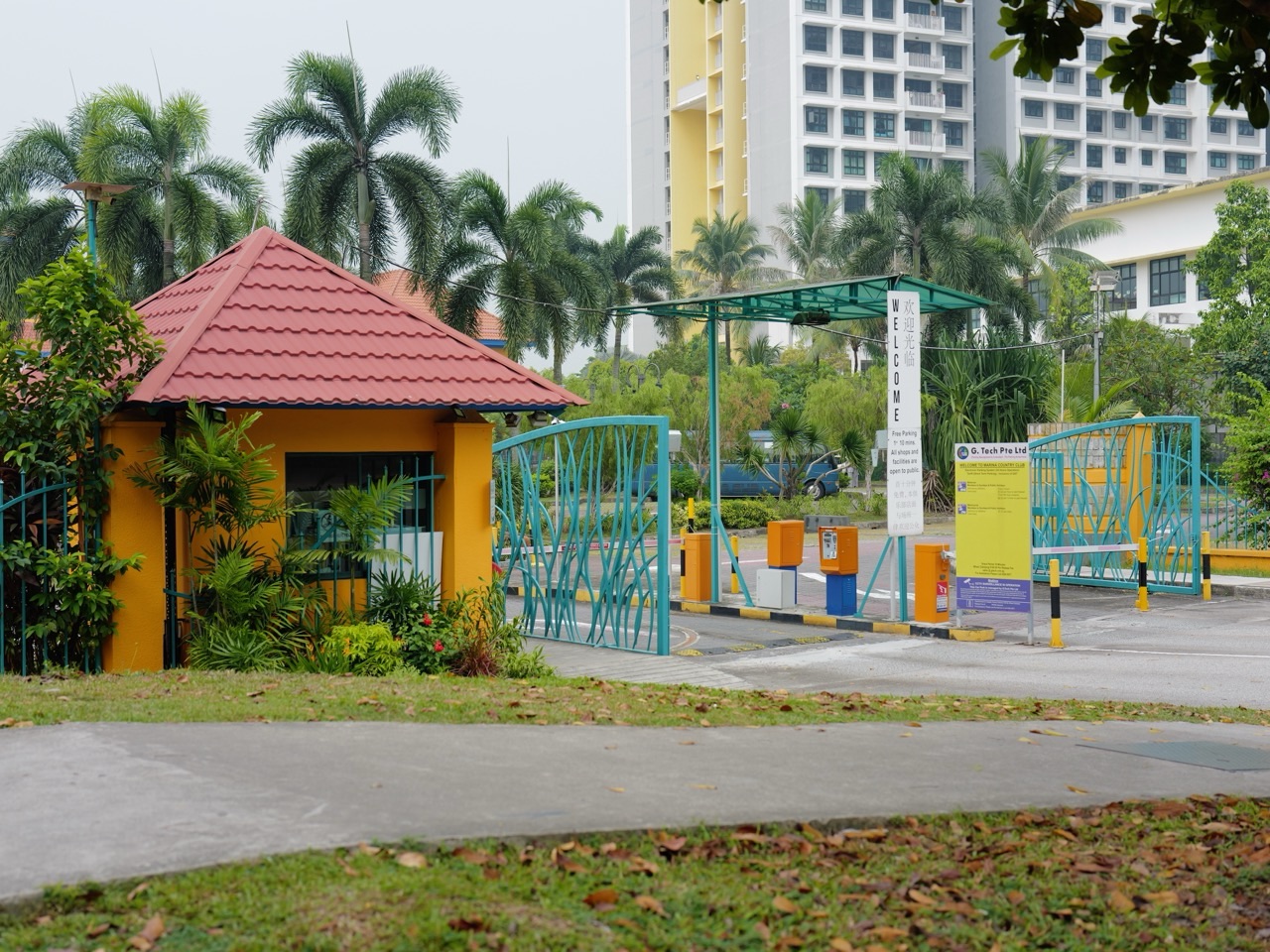
Photo note: The featured image is an eduKate photograph of Marina Country Club at Punggol in October 2026. It illustrates the modern district’s boating-related landscape; it does not depict the 1983 Easter Regatta, any Eliminator racing boat or the original racing course.


