
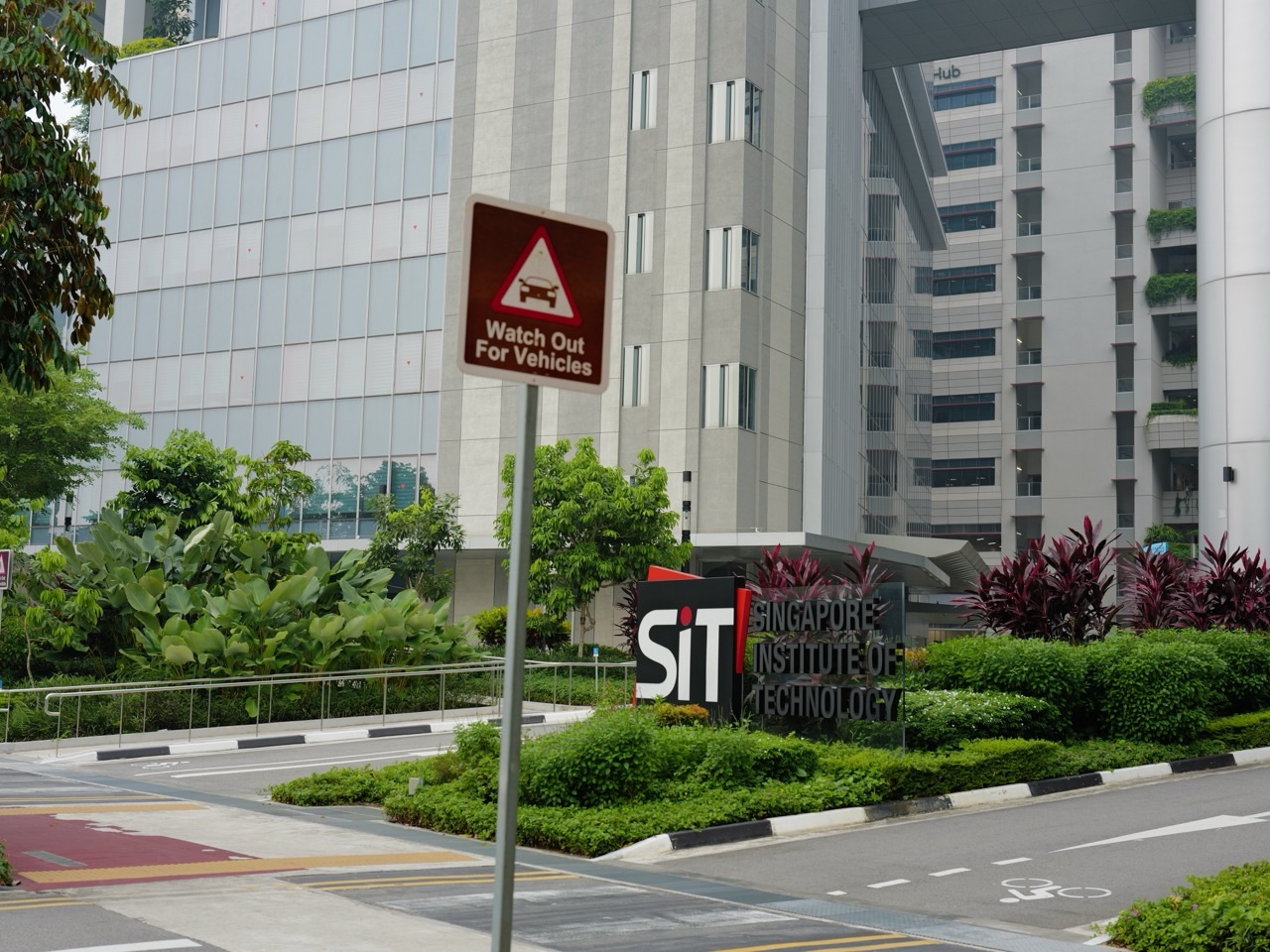
Quick answer: Punggol is becoming a place where a student can study robotics through a real urban planning question rather than only a classroom diagram. In May 2026, Singapore’s IMDA, JTC and Singapore Institute of Technology (SIT) announced an autonomous-robot testbed at Punggol Digital District (PDD), with companies designing and testing robot-enabled delivery, security and cleaning services. For families, the best education opportunity is to study the science, mathematics, safety, human needs and evidence behind such systems. It is not unrestricted access to robots or private research facilities.
Status as at 23 October 2026: JTC’s 20 May 2026 announcement described a first multi-operator public-area testbed as planned for later in 2026, with further launch details to be shared. The announcement alone does not establish that every proposed deployment is operating or publicly visitable today. Treat observations of an actual robot as optional; the school projects below work without seeing, touching, photographing or controlling a robot at PDD.
Primary references: JTC’s 20 May 2026 Physical AI announcement, JTC’s Lab to Life robotics feature and SIT’s description of the Smart Playground and campus learning spaces. They establish the confirmed development; the classroom investigations in this guide are proposed learning activities, not advertised admissions or access schemes.
What is Physical AI, and why is Punggol different from a robot exhibition?
Ordinary software can process data and give an answer on a screen. Physical AI refers to intelligence operating through a physical system that must sense its surroundings, decide what to do and act in the world. That means uncertainty immediately becomes visible. A delivery robot might have to distinguish a clear walkway from a temporary obstacle; a cleaning machine may need to recognise where it should stop; a system coordinating several operators must consider different machines and human users.
A staged showroom demonstration can control conditions. A mixed-use district introduces changing light, rain, people, deliveries, narrow routes, signage and unexpected behaviour. These complications are precisely why studying the district is educationally useful. A model is never identical to the environment it represents, so researchers need to measure how real systems behave without assuming every success in a controlled room will repeat outside.
JTC says the proposed PDD testbed brings together IMDA, JTC, SIT and eight industry leaders. Initial design partners named include Certis, DHL, Grab and QuikBot for robot-enabled public-space services. The broader research collaboration includes knowledge and robotics partners, while the National Robotics Programme is involved in exploration. The objective is not merely to display exciting hardware; it is to test how several operators and services can work around actual people.
JTC also explains that the public-path regulatory arrangements are subject to safeguards and conditions. A research trial framework for authorised operators must not be interpreted as an exemption that lets members of the public experiment with motorised robots on footpaths. Any school-built device should stay in an authorised, supervised test environment.
At a glance: six subjects that a robotics project connects
| School subject | Question a learner can investigate | Evidence of learning |
|---|---|---|
| Primary / secondary mathematics | How much distance does a model cover, and how reliable is a result? | Measured lengths, simple tables, averages and explained uncertainty |
| Physics and engineering | How do wheels, loads, friction, slopes and stopping work? | Safe toy experiment with a controlled variable |
| Computing and AI literacy | How does a sensor report lead to a decision? | Readable decision flowchart and tests against sample cases |
| Geography and planning | Where could different users meet or obstruct one another? | Hypothetical site map with pedestrian priority and assumptions |
| English and communication | How do you explain a technical limitation clearly? | Plain-language explanation, poster and evidence-linked report |
| Ethics and social studies | Who benefits, who takes the risk and whose consent matters? | Stakeholder map, safeguards and a reasoned recommendation |
Notice the difference between memorising the words ‘autonomy’ and ‘sensors’ and actually explaining why a system should not enter an obstructed path. The second task requires reasoning. That is where school mathematics, science and language become useful in a modern workplace.
What students can and cannot access at SIT Punggol
SIT describes a Smart Playground dedicated to STEM digital exploration. Its official page says the space is open to the public to discover, visualise and contribute to research projects, using digital interactions and citizen-science concepts. This is distinct from controlled robotics laboratories, testbed operations, workshops, university classes and private tenant spaces.
A public-facing feature does not mean every station is active every day, every programme accepts walk-ins or every research area welcomes unregistered visitors. Before arranging a class excursion, check opening arrangements, programme registration, consent and the current rules for school groups. If there is no suitable public session, use official images, public information and a well-designed classroom model.

A family can still build valuable familiarity by reading SIT’s publicly available information, exploring genuinely public district areas at an appropriate time and asking staff which visitor experiences are available. No one needs to enter a restricted room to form a meaningful robotics question.
The critical distinction: what was announced, what exists and what students propose
| Category | Example | How to write it accurately |
|---|---|---|
| Official announcement | The mixed-use testbed was planned for later 2026 | “JTC announced a planned testbed” |
| Operational observation | A particular robot is seen on a public path on a given date | “A robot was observed at a named location and time, without assuming its operator or mission” |
| Educational hypothesis | A delivery robot might need to yield at a crowded junction | “Our class hypothesised a pedestrian-first rule” |
| Classroom prototype | A toy robot stops when a cardboard obstacle is detected | “In our controlled model, a stop rule succeeded in the recorded tests” |
The distinction is important for teachers preparing learning-journey reports and parents reading an enthusiastic child’s presentation. The same word ‘robotics’ may refer to an existing laboratory, a future project, a student simulation or a live service. Blending them can accidentally turn a school idea into a false claim about public infrastructure.
Project 1 — How much room should a delivery robot leave for pedestrians?
Suitable for: Primary 5–6 under supervision, Secondary 1–2 mathematics, and mixed-age family projects. Learning objective: use measurement and estimation while keeping pedestrian safety at the centre.
The investigation
Create an imaginary corridor on paper or with masking tape in a school hall. Place cardboard cut-outs representing a pedestrian, a person with a walking aid, a stroller and a hypothetical robot. The class must decide whether a proposed shared route is suitable. Use a deliberately simplified model; do not declare measurements to be legal access standards.
Students measure model widths and consider what is missing: moving people are not rigid rectangles, people may turn, the space must accommodate comfort and emergencies, and a robot’s stopping distance matters. A drawing that allows objects to fit exactly side by side is not necessarily a safe design.
Worked mathematical example
Suppose a fictional demonstration route is 2.4 metres wide and a model robot occupies 0.65 metres of width. If the class sets aside 0.25 metres as a theoretical side clearance on each side of the robot, the robot and its two clearances occupy 1.15 metres. That leaves 1.25 metres on a perfectly clear section of the imaginary route. The arithmetic is 2.40 − (0.65 + 0.25 + 0.25) = 1.25 metres.
This is a teaching example, not an approved operating clearance. Even when the calculation is correct, a real safety decision needs validated operating requirements, the actual shape of obstacles, human factors, speed and regulations. Students should be encouraged to ask whether the model is too simple, rather than proudly interpreting the number as permission to operate anything.
What to submit
- A labelled scale drawing and measurement table.
- An explanation of how the remaining width was calculated.
- At least three realistic limitations of the paper model.
- A revised proposal prioritising people with diverse mobility needs.
- A one-paragraph conclusion that separates arithmetic from the real-world safety decision.
Project 2 — Build a cardboard route planner that recognises failure
Suitable for: Secondary 1–3, coding clubs and introductory design-and-technology groups. Learning objective: plan routes with obstacles, constraints and error handling before writing advanced code.
Draw a small grid of fictional rooms and corridors. Assign a robot a starting cell and destination cell. Add static hazards such as a staircase, blocked junction or restricted doorway. Students must find a route that obeys the rules, then explain whether the shortest route is also the safest.
This can be an unplugged activity. A student may draw arrows and decision diamonds or write a small program that works with a grid. No access to a real autonomous vehicle is needed. If using a supervised educational robot kit, keep it on a tabletop or marked school floor within the programme’s safety rules.
A simple decision sequence
- Read the current cell and verify the destination has not already been reached.
- Identify available neighbouring cells from the class’s hypothetical map.
- Exclude any cell marked inaccessible, unsafe or outside the agreed testing area.
- If more than one option remains, choose one using a rule the student can explain.
- If no safe option remains, stop and ask for human assistance; do not invent permission to continue.
- Update the map when a fictional obstacle is introduced, and record whether the original route remains appropriate.
Testing matters more than making the robot move. Let one test introduce an obstacle the route planner did not anticipate. Another test may create a blocked destination. A successful response can be to stop, report uncertainty and request help. ‘Cannot proceed safely’ is often a better technical outcome than forcing the machine to continue.
Project 3 — Measure reliability without pretending one success proves everything
Suitable for: Secondary mathematics and science, older students interested in data science. Learning objective: distinguish a single trial from a rate with an explicit denominator.
Use a small toy rover, a simulated program or a paper-based activity with predefined randomised obstacle cards. In each run, ask whether the model navigates an authorised route without hitting an obstacle. Repeat the exercise under the same stated conditions and record outcomes. If using physical kits, have the teacher set safe speeds and clear test boundaries.
Imagine a classroom model completes 18 of 20 designed runs without violating the classroom rule. Its observed completion proportion is 18/20 = 0.90, or 90%. Students should not announce, ‘The robot is 90% safe in Punggol.’ They have measured 90% success in twenty classroom trials under defined conditions. Those conditions do not represent every crowd level, surface, weather condition or machine.
Ask the class to repeat trials with a changed obstacle pattern and report both results. Why might a lower score appear? Did the test become harder, did the rules change, was there measurement error or was the sample small? This is the beginning of experimental discipline.
| Test set | Successful runs | Observed proportion | What may be concluded |
|---|---|---|---|
| Classroom A: fixed route | 18 of 20 | 90% | Performance of that model in that classroom scenario |
| Classroom B: moved obstacle | 14 of 20 | 70% | Lower observed success when the route conditions changed |
| Real PDD public route | Not measured | Not available | No reliability claim may be made from these classroom results |
The two result sets above are illustrative numbers, not measurements from SIT, JTC, PDD, or any real operator. They demonstrate why collecting and describing evidence accurately is part of AI literacy.
Project 4 — Where does physics enter an autonomous robot’s journey?
A robot is not pure intelligence. It has mass, wheels, motors, batteries and material limits. Students may learn about force, friction, energy and braking by observing an ordinary toy vehicle roll down a teacher-prepared ramp. Keep the activity slow, contained and away from people and stairs.
Set a fixed ramp height and change only the surface material: smooth card, textured card or a soft fabric. Measure travel distance after release. Repeat trials. Why did the result change? Would a different toy mass, wheel material or ramp incline alter the behaviour? These are controlled variables, not claims about a company’s proprietary robot.
Older students can represent measured distance against a change in one independent variable, then discuss measurement uncertainty. A graph with correct labels, units and a description of outliers is more educational than a dramatic demonstration that produces no usable data.
Real autonomous-robot stopping depends on many factors including sensing, control response, speed, surface conditions, braking characteristics and certification requirements. A toy ramp exercise helps learners formulate questions; it is not a safety certification method.
Project 5 — A thought experiment about batteries, deliveries and energy
PDD’s proposed uses include services such as parcel delivery and cleaning. These services raise an energy question: does moving tasks to robots necessarily save energy? Not always. The answer depends on the baseline they replace, route length, load, charging losses, operating hours and how the service changes human activity.
Create a hypothetical model with explicit invented numbers. A machine consumes 0.12 kilowatt-hours (kWh) per hour while operating for five hours, so direct operating electricity is 0.60 kWh. If the simplified model assumes a charging efficiency of 80%, the grid electricity associated with replacing that 0.60 kWh is 0.60 ÷ 0.80 = 0.75 kWh. This excludes standby energy, manufacturing impacts and other uses.
The mathematics teaches units, multiplication, percentages and energy losses. It does not prove that a robot is greener than a human courier or conventional vehicle. A proper comparison must define the alternative, service delivered, time period and full relevant system boundary.
Students can improve the experiment by writing down which additional information is needed and which claims cannot be decided. That is a valuable sustainability skill: a green claim should carry evidence rather than relying on attractive technology.
Project 6 — Design a human-first interaction for a busy footpath
Suitable for: Secondary English, social studies, art, computer studies and interdisciplinary projects. Learning objective: explain how an unfamiliar automated service should behave around humans, including people who may have visual, hearing or mobility challenges.
Give students a fictional situation: a compact delivery robot reaches a sheltered junction while a parent with a stroller and an older adult approach. Ask the group to propose a simple interaction: stop where, indicate what, and which human has priority? How should the robot avoid confusing people with flashing signals or unclear speech?
Invite participants to make two mock-up signs or audio-message scripts. Test them with consenting classmates acting as fictional pedestrians, not with random members of the public. Ask whether the message is understood without technical knowledge and whether it appears at the right time. A prototype that needs a two-minute explanation is probably not yet a good sign.
An excellent project submission includes alternative cases. What if it rains? What if the robot cannot sense a stroller? What if a person declines to move? What if its speaker is inaudible? In safety-critical situations, not operating may be the acceptable design decision.
Project 7 — Write a Punggol robotics news report that fact-checks its own title
Technology announcements give students an opportunity to practise English and media literacy. Offer three pieces of evidence: the JTC press release, a dated campus photograph and a fictional student proposal. Ask the class to identify which evidence supports the headline ‘Robots are coming to Punggol’ and which evidence would be required for the stronger claim ‘Robots deliver every parcel in Punggol today’.
A reliable report should name the source, publication date, announced status and limits. Reporters must not imply that an image of SIT’s campus exterior depicts an active robot trial. If a robot is actually visible during a lawful public observation, describe precisely what was seen; avoid asserting company ownership, reliability, task success or operational approval without verification.
- Use a specific, accurate headline rather than a sensational one.
- Place the answer in the first paragraph: announced, planned, running or unknown.
- Distinguish quotes from an official source from student speculation.
- Use dates for time-sensitive operational claims.
- Explain when an image is illustrative rather than documentation of a trial.
- Use at least one paragraph explaining what is still unverified.
- End with a practical question a resident could ask the responsible organisation.
What Primary 1 to university students should learn differently
| Learner stage | Appropriate starting activity | What not to rush |
|---|---|---|
| Primary 1–2 | Classify familiar objects by human or machine control; discuss safe sharing of paths | Programming complex sensors or describing unverified local robot trials |
| Primary 3–4 | Map a cardboard route; measure toy travel; explain why an obstacle changes the plan | Presenting a classroom result as urban safety certification |
| Primary 5–6 | Use scale drawings, averages and tables; discuss fairness in shared spaces | Advanced autonomous-vehicle trials outside school |
| Secondary 1–2 | Model routes and test simple algorithms with error handling | Using private real-world telemetry without permission |
| Secondary 3–4 | Carry out controlled design investigations and report limitations | Assuming impressive jargon is evidence of mastery |
| JC / ITE / Polytechnic | Prototype, model probability and compare realistic use cases | Treating a campus or industry partnership as guaranteed internship access |
| University and working adults | Study sensing, control, software assurance, robotics policy and applied research | Assuming any outside student can enrol in or enter a specialist research lab |
The role of artificial intelligence: perception, planning and safe action
A helpful teaching diagram has four steps: sense, interpret, decide and act. In the simplest model, a sensor reports something ahead; the program estimates whether the way is clear; a control rule chooses to stop or continue; the motors respond. The next observation should check whether the action had the intended effect.
But every arrow in that diagram hides uncertainty. A sensor can be noisy, a perception model can mistake an object, maps can be stale and actuators can behave differently from expectations. This is why human oversight, limits on operating conditions and clear handover or stop rules are as important to serious engineering as the model that produces the decision.
Some AI systems use learned patterns, while other useful robotics behaviour comes from carefully engineered rules. A student should not label every motor or proximity sensor ‘AI’. Ask exactly which part is learned from data, which part is programmed, which part is mechanical and how each has been tested.
This vocabulary prevents the common error of imagining intelligence as a magical addition that removes physics or accountability. When a robot operates near people, its design must remain understandable to the people responsible for deploying and supervising it.
A six-week family or school learning journey
Week 1 — Read the real announcement
Start with JTC’s 20 May 2026 page. Summarise what was committed, who the organisations are and which activities were proposed. Underline future-tense words. Ask the student to explain why the announcement alone is not a live-service timetable.
Week 2 — Define an engineering question
Choose one narrow question: safe path width in a fictional corridor, route-finding with blocked cells, surface friction, public communication or sample-size reliability. Define the outcome that would count as useful evidence.
Week 3 — Build the simplest possible model
Use paper, cardboard, a spreadsheet, a toy car or a legal classroom robot. A simple complete model with accurate documentation teaches more than an ambitious proposal that is never tested.
Week 4 — Collect and test
Measure at least twice and keep a record of all runs, not just successes. Log units, conditions, observations and failures. Protect privacy: do not collect real pedestrian identities, identifiable photographs or device signals without a lawful, justified process.
Week 5 — Challenge the conclusion
Change one condition and compare outcomes. Ask a classmate to find a counterexample. Check whether a stated conclusion is supported by the available data. If not, revise it openly.
Week 6 — Present for a non-specialist audience
Write a 200-word overview explaining the problem, method, evidence, limitations and next step. Ask someone unfamiliar with robotics to describe the result back in their own words. Communication is part of the engineering outcome, not a decoration at the end.
Responsible fieldwork: public space is not a research permit
Schools and families should observe public rules and use only areas open to visitors. Do not chase or obstruct deployed machines, put items in their path, attach devices, use unapproved radios, impersonate an operator, enter control areas or try to defeat sensing systems. A trial device is doing real work under someone’s responsibility, even when its form seems inviting.
No child needs to identify the operator by following a robot into a restricted area. A paper classroom simulation is preferable to unsafe curiosity. If there is a public demonstration, follow organiser instructions and supervision requirements.
Photography brings a second issue. Other people may appear in a public-area photograph, but classroom publication still requires appropriate school policy, sensitivity and privacy safeguards. Avoid recording faces, conversations and personal details when the learning objective is route geometry. Where photos are unnecessary, use diagrams.
For accessibility projects, never assume that a student understands the needs of wheelchair users, blind pedestrians or older adults simply by watching them. Work from credible accessibility guidance and, where suitable, consultation with consenting participants through an approved school process. Do not invent a universal ‘user’ from one person’s experience.
How a robotics investigation supports Singapore education pathways
A Primary student may leave this exercise more comfortable with measurements, diagrams and explaining choices. A Secondary student may discover an interest in physics, design, code or social impact. An ITE or polytechnic learner can turn it into a properly scoped technical portfolio project. A university applicant can investigate applied robotics, systems engineering, computing or human-centred design as distinct but connected fields.
Robotics is not a single career. Mechanical engineers work on form, motors and durability; electrical and electronics engineers support sensing and control; software engineers build and test systems; operations staff maintain services; interaction designers translate human needs; safety and policy specialists help define suitable deployment conditions. The district’s value for education is that it makes these overlapping professions easier to imagine.
SIT’s Punggol campus overview and learning-spaces guide are useful starting points, but a prospective applicant must check the specific course and current admissions requirements. See also eduKatePunggol’s SIT applied-degrees and work-study guide for the higher-education pathway.
How to evaluate a robotics enrichment class
- Does the instructor specify an age-appropriate learning objective beyond assembling a kit?
- Will students test assumptions and record failed trials?
- Can the learner explain sensors, rules and motion without repeating advertisements?
- Are devices used only in safe, approved settings?
- Does the class teach units, uncertainty and ethical boundaries?
- Is the instructor clear about whether a final product is a simulation, a toy or a certified operational machine?
- Are charges, materials, supervision, insurance and the programme calendar transparent?
- Does the resulting portfolio show the student’s own work and reasoning?
- Are the claims about PDD partnerships, industry projects or campus access verified by the actual named organiser?
A good class makes children curious, careful and more capable. An expensive robot kit is not evidence of good learning by itself. Likewise, a simple ruler, spreadsheet and cardboard model can teach fundamental engineering habits if the questions and feedback are demanding.
Frequently asked questions
Has the Punggol Physical AI Testbed already launched?
JTC’s 20 May 2026 release described launch as planned for later in 2026 and further details to follow. As at 23 October 2026, this guide does not treat the announcement as proof of specific deployments or unrestricted public activity. Check JTC and IMDA’s latest official notices for operational changes.
Can children control or touch robots at PDD?
Not merely because the district hosts a testbed. Public visits, authorised demonstrations and classroom kits are separate experiences. Follow operator and organiser permissions and keep clear of working equipment.
Is the SIT Smart Playground the same as a robotics research laboratory?
No. SIT describes the Smart Playground as a public-facing STEM digital-exploration space. That does not mean the public has open access to dedicated university labs, trial control rooms or robotics equipment.
Can a primary-school student learn from Physical AI?
Yes. Mapping a safe route, measuring a toy vehicle and explaining why machines should yield to people are age-appropriate applications of mathematics and science. Specialist AI programming is unnecessary at the beginning.
What if no robots are visible during our visit?
The project can still succeed. Read an official source, draw a hypothetical route, complete controlled classroom measurements and explain the limits. Seeing a robot is optional; learning to reason is the goal.
Are JTC’s announced robots used for food delivery?
JTC’s initial announced use cases include food and parcel delivery, alongside security patrolling and cleaning. They are proposed services for the testbed framework; confirm current operations before describing a service as available.
Do students need to learn Python before doing robotics projects?
No. Unplugged route planning, mathematics, flowcharts, diagrams and simple controlled physics experiments establish foundations. Programming becomes useful when a learner is ready to automate or test a meaningful rule.
Will the project help with university applications?
It may become one piece of evidence of initiative and technical thinking, but admissions criteria vary. Do not promise a particular offer, scholarship or internship on the basis of a school investigation.
Is AI automatically better than a human operator?
No. Performance, reliability, cost, accessibility, safety and the intended service all need evidence. Some tasks benefit from automation, while human judgement, supervision and intervention remain important.
Which organisations are involved in the planned PDD testbed?
JTC’s May 2026 announcement names IMDA, JTC and SIT alongside industry partners. The initial service-design partners include Certis, DHL, Grab and QuikBot, and related exploration mentions additional technical partners. The authoritative list and participation scope come from the official release.
Punggol families: how to turn an announcement into genuine education
An exciting headline has value only if a child can do something thoughtful with it. In Punggol, that might mean learning to calculate a route rather than merely photographing a vehicle; reading a press release critically rather than repeating its future plans as facts; or designing an accessible path that respects how different residents use public space.
The most useful outcome is a disciplined learner who asks: What is the problem? What do we know? How could we test it safely? Who might be affected? Which claim does the evidence support? Those questions are transferable far beyond robots and should form the spine of every school project tied to the district.
A family-friendly model of uncertainty in a robotic decision
Students often imagine a robot as a machine that receives a perfectly true description of the world. In reality, sensors provide measurements, not absolute knowledge. A system may detect an object at a certain distance, but the estimate can be affected by lighting, reflections, dirt, weather, movement and the type of sensor. The distinction between measurement and certainty is one of the most valuable science lessons a Punggol student can learn from the Physical AI story.
A classroom can investigate the idea without building a robot. Place a small cardboard object at a fixed distance from a toy vehicle, then give learners five independently made ruler measurements. Record the readings with units. Even careful students may report slightly different values because they choose different endpoints or viewing angles. Calculate the mean and range, then explain what caused the variation. The aim is not to make a sensor from scratch; it is to teach why any physical measurement needs a method and an uncertainty statement.
Suppose five illustrative measurements in centimetres are 19.8, 20.0, 20.1, 19.9 and 20.2. Their mean is 20.0 cm and the range is 0.4 cm. Neither result establishes that the true distance is known to infinite precision. The exercise should explicitly label these as invented classroom numbers, not data from the PDD testbed.
Now ask a design question. If a vehicle’s decision depends on whether an object is closer than a threshold, would students want it to proceed when the measurements are uncertain and people may be nearby? The ethically sound discussion begins with a conservative stop-or-seek-help rule and the limits of student knowledge. This is reasoning about safety, not permission to configure an actual machine.
Why a clever prototype is not the same as a deployable public service
In school, success may mean a toy reaches the correct cell on a paper grid. In a public district, deployment decisions involve many other duties: operator authorisation, technical reliability, emergency procedures, accessibility, protection of data, maintenance, insurance and the effect on pedestrians. Students should learn this difference early because contemporary technology marketing often presents a controlled demonstration as if it were already a robust service.
A helpful exercise is to prepare two columns. The first says what a prototype has demonstrated: perhaps it follows painted lines in good lighting on a dry school floor. The second says what remains untested: wet conditions, busy pedestrian routes, unexpected obstacles, noise, device failure and interactions with people of different mobility needs. An intellectually honest project can succeed by identifying these unknowns accurately.
The same distinction appears in English comprehension and science examinations: a conclusion must not claim more than the evidence supports. A strong student can say, ‘Our model worked in this environment, but we have not shown that it would behave safely in a public space.’ That sentence reflects scientific understanding rather than weakness.
An inclusion-focused learning challenge for Punggol families
Invite children to design an imaginary service that communicates clearly without assuming everyone can hear, see, move quickly or read small English text. Students may sketch a low-speed delivery robot’s information display, a fictional service-request kiosk or a pedestrian-first interaction sign. Require them to explain how the system would remain understandable when one communication channel is unavailable.
For example, a purely visual flashing indicator may be unusable for someone who cannot see it; an audio-only message may fail in a noisy area or for someone with hearing difficulties. A student can compare two or three alternative designs and justify why a combination of simple language, legible visual cues and appropriate accessible options would better serve diverse users. This is a conceptual design exercise; accessibility compliance requires more rigorous standards and user engagement.
Students should seek approved guidance rather than making assumptions about disabled people. If working with an actual community group, follow school ethics procedures, consent and safeguarding requirements. Real interviews are not necessary to complete a sound initial project. It is more respectful to use credible guidance and state the limits of the classroom model than to treat people in public as unsolicited research subjects.
A short school-report template after any approved learning journey
- Context: identify the date, source and what was confirmed about the district, avoiding speculation about future services.
- Question: state one problem clearly, such as how a hypothetical robot should respond to a blocked path.
- Model: explain the classroom materials, assumptions and how the relevant variables were measured.
- Results: provide the actual readings, including all unsuccessful trials, with units and a transparent denominator.
- Interpretation: separate what the observations support from what they cannot establish.
- People affected: consider users with different mobility and information needs.
- Safety and privacy: state how the activity remained authorised and how personal data were avoided.
- Next step: identify one specific improvement that can be tested safely.
A student who can complete that report has practised mathematics, science, English, social responsibility and evidence evaluation. The educational value does not depend on meeting a robot company or entering a research facility. Punggol offers meaningful real-world questions; careful teaching turns them into transferable knowledge.


