
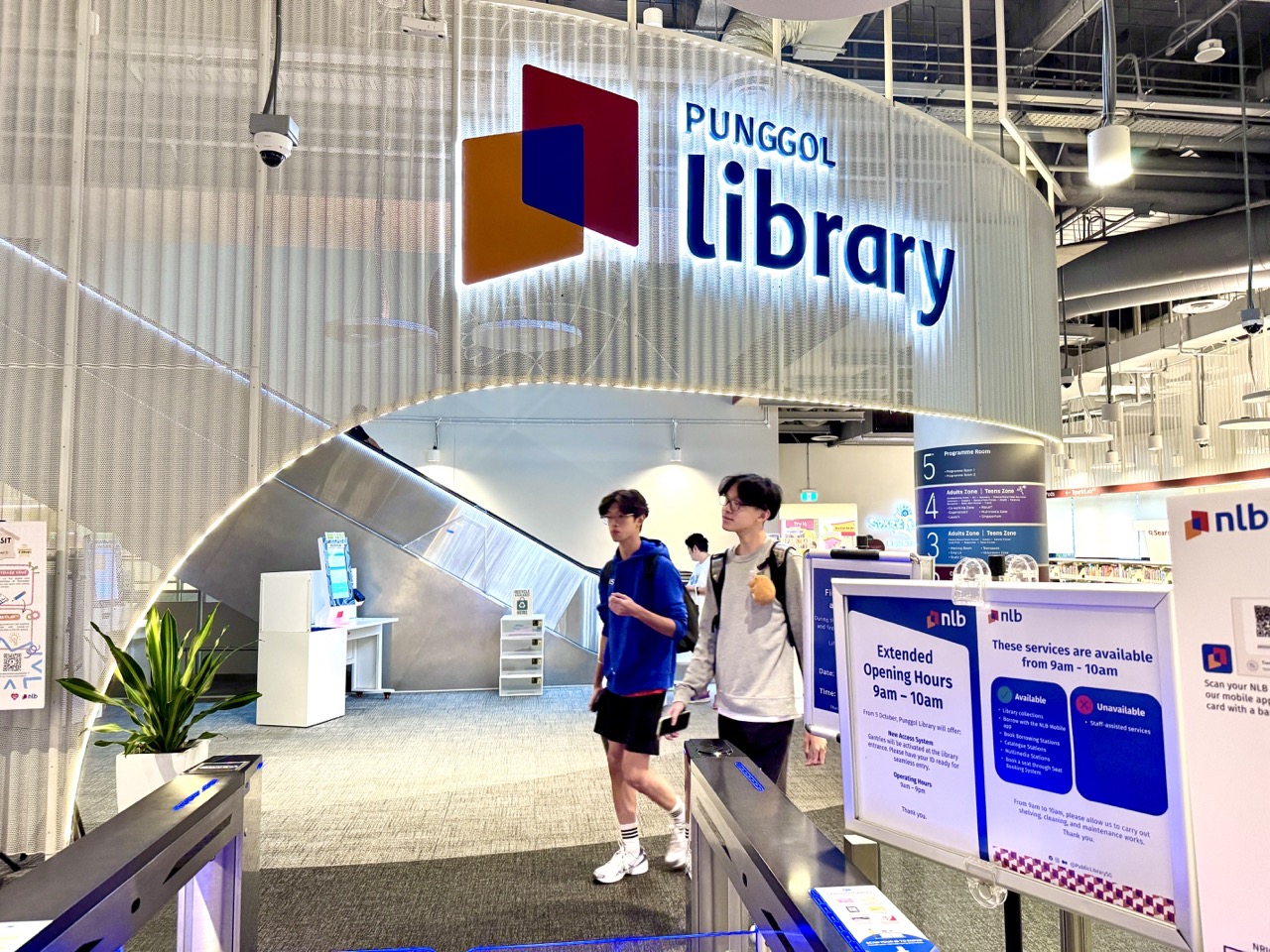
The top 10 things to do in Punggol for students are a properly planned session at Punggol Regional Library’s Level 3 Study Zone; guided research among its nonfiction books; an evidence-based visit to the Punggol Stories exhibition; a writing activity at The Lens of Literature; an age-suitable Spark!Lab invention challenge; a correctly registered MakeIT workshop; a Waterway Park science observation; a Lorong Halus Wetland systems study; a Punggol Digital District design walk; and a planned reading-and-games afternoon at the Comics & Games Library. Each has a different learning purpose. None should be confused with tuition or a guaranteed exam-score improvement.
For students searching for study places in Punggol, the most immediately useful fact is that NLB’s current page lists the regional library’s Level 3 Study Zone from 9am to 10pm daily, accessible via One Punggol Lift Lobby B, while ordinary library services have their own main operating hours. For hands-on making, MakeIT at Punggol Library Level 4 separately lists Wednesday to Sunday, noon to 8.30pm, with closed days and programme registration conditions. Never assume an educational room is operating merely because the building is open.
This guide serves Primary, Secondary, Polytechnic, JC, ITE and university-age readers but does not pretend that all ten activities suit everyone. Spark!Lab’s invention challenges are associated with school-aged children and its actual eligibility and session rules must be checked. MakeIT requires more deliberate equipment and booking checks. A Secondary student who wants to revise algebra may prefer a quiet study block; a university student exploring sustainability may get more from public district design and a scientific field note.
The benefit of a Punggol learning day is a clear task and an observable result: one solved problem, one evidence-backed paragraph, one original observation, one prototype idea or a thoughtful conversation. Bring the right materials and plan a reasonable finish. A weekend should not be turned into an endless revision march simply because Punggol contains libraries, university buildings and attractive outdoor places.
Students’ quick decisions: the ten experiences at a glance
- 1. Independent revision — Punggol Library Level 3 Study Zone; Extended daily 9am–10pm, current rules.
- 2. Topic research — Level 4 nonfiction collection; Use NLB catalogue, current hours.
- 3. History evidence — Punggol Stories at Singaporium; Permanent exhibition Levels 1, 3, 4.
- 4. Writing and literature — The Lens of Literature; Interactive Sing Lit at Level 3.
- 5. School-age invention — Spark!Lab Punggol Library; Confirm age, timetable and format.
- 6. Making and prototyping — MakeIT at Punggol, Level 4; Wed–Sun noon–8.30pm, session rules.
- 7. Primary–Secondary science outdoors — Waterway Park aquatic-plant notes; 4.2km nature walk optional.
- 8. Geography and environmental systems — Lorong Halus Wetland learning trail; PUB explains former-landfill treatment.
- 9. University and future careers — Punggol Digital District public design walk; No private teaching-lab access.
- 10. Games plus reading — Comics & Games Library at Punggol Coast; NLB ID, eCard or day-pass process.
The list includes facilities designed for different ages and educational objectives. An undergraduate with a research question and a Primary pupil who wants to prototype a toy should not be sent to the same room merely because both are learners. Use age guidance, present-day availability and the intended output to decide.
How to turn a Punggol destination into genuine learning
Define the learner’s job before travelling
Start with the learner’s question. ‘Where can I spend four hours?’ is less useful than ‘Which chapter must I understand, what evidence will prove I understood it and how long should the task reasonably take?’ The physical destination should make that task easier. A quiet zone is for focus; an invention lab is for hands-on experimentation; an outdoor trail is for observation. Mixing all three in one afternoon may create motion without productive learning.
Read the NLB floor map correctly
Use the NLB floor map accurately. The Study Zone on Level 3 has an extended-access entrance and hours distinct from the broader regional library. The Level 4 nonfiction, MakeIT and Punggol Stories resources serve different purposes, and interactive exhibition components may have their own timetable. Respect quiet areas, staff directions, booked rooms and table availability. A public seat is not the same as a private reservation.
Respect age, eligibility and equipment safety
Age and equipment suitability are part of educational planning. The Smithsonian’s Lemelson Center documents Spark!Lab as a children’s invention-learning space in Punggol Library. MakeIT is a separate maker service; NLB lists session and equipment conditions. A caregiver should verify programme age, supervision, registration and materials before promising a particular hands-on challenge. A named workshop in a historical article may have already closed.
Separate field observation from unsupported claims
Work with honest academic standards. Research means noting where a claim came from; taking a photograph is not the same as collecting scientific measurements. A Waterway Park aquatic planting gives a way to discuss environmental design, but you cannot infer local water quality from the colour of a photograph. A university campus may be publicly visible without providing visitor access to teaching labs or class lectures. Distinguish observing a system from testing it.
Protect the value of breaks and leisure
Make breaks part of the plan. Learning is often more sustainable when a defined focus task is followed by food, water and light movement. A short outdoor break can be pleasant but should not become forced training or an endurance challenge. Students have different abilities, routines and family commitments. A useful study outing ends with a clear next task and enough energy for tomorrow.
Plan transport and weather from the outset
Check the weather and return route. Punggol MRT, One Punggol and the newer Punggol Coast MRT serve different activity clusters. Lorong Halus is a more deliberate field destination. Use NEA’s current warnings for lightning, rain, heat and haze. During a storm, a public library or indoor space can be an alternative only if the journey to it is safe. A good learner knows when to postpone field observations.
Ten Punggol student activities with worked examples
1. Set a single focused revision target in the Level 3 Study Zone
Location: Study Zone, Level 3, Punggol Regional Library, via One Punggol Lift Lobby B.
What this resource offers
NLB’s Punggol Library information lists the dedicated Study Zone from 9am to 10pm daily, including holidays under its separate access arrangements, while the library’s ordinary operating hours differ. This makes it an appealing independent study space, not an entitlement to a guaranteed empty desk. Students should check current crowding, seating and behaviour rules. The most useful activity is to finish one defined learning objective while protecting library quiet.
Step-by-step activity
Before leaving, choose a concrete task: complete and check six algebra questions, review two science definitions through explanations or outline one essay. Bring necessary stationery, charge devices without obstructing routes and work in a suitable permitted area. Begin by writing a question you are trying to answer, work for a realistic period, then do a short self-check before leaving. Avoid claiming one public table as a permanent study base.
Worked learning example
A Secondary 2 pupil spends forty minutes resolving an algebra sign-error pattern, then tests understanding with two new questions without notes. The result is not just ‘I studied two hours’: it is ‘I can expand brackets and explain why a negative sign affects every term.’ The student records one error to revisit at home.
Pitfalls and access rules
A library is shared. Do not hold lengthy group discussions in a quiet zone, leave belongings unattended to reserve seats, or assume charging sockets and rooms are always available. Longer hours for the Study Zone do not mean every other Level 3 service or library floor is open throughout that window. Don’t pressure a tired learner to extend the session for its own sake.
What to take away
Create a three-line exit record: what I learned, what is still confusing, and one question to ask my teacher or tutor. This gives a real bridge from independent learning to school without turning the visit into a tuition promotion.
The activity should end with an identifiable result that the learner can explain. A correct new answer, an improved model, an original paragraph or a careful observation is more informative than the number of hours spent at the venue. Ask what changed between the beginning and end. If the answer is unclear, reduce the task and identify a concrete question for a teacher, parent or peer.
The official or primary educational source supports this venue’s role. It does not guarantee a seat, workshop place, equipment access, a current event or special opening today. Where the activity requires a booking or age eligibility, verify it directly with the provider before travelling.
2. Research a question using the library’s nonfiction collections
Location: Punggol Regional Library, Level 4 Adults and Teens Nonfiction area.
What this resource offers
NLB’s Punggol Regional Library social story maps an Adults and Teens Non-Fiction collection on Level 4, alongside other facilities. The attraction is not merely looking at shelves: it is learning to select an appropriate book, compare a claim with its source and distinguish a primary explanation from an unsourced search snippet. Students can use a subject-specific section whether they study technology, nature, language, geography or everyday economics.
Step-by-step activity
Start with a question small enough to answer in one sitting, such as ‘Why do wetlands help protect reservoirs?’ Search the catalogue or explore the relevant nonfiction shelves, then select one credible book. Write a short claim and the page or source from which it came. Compare the explanation with an official Singapore authority source before using it in homework or a project.
Worked learning example
A student planning a geography presentation chooses a reference on Singapore’s water system and uses PUB’s Lorong Halus information to cross-check a claim about engineered wetlands. They replace a vague statement like ‘plants clean all pollution’ with a qualified explanation about the function of the specific treatment landscape. One correction improves the whole assignment.
Pitfalls and access rules
A library’s collection includes works published at different times; older technology or policy information may be outdated. Borrowing rights depend on membership and account conditions. Avoid using one dramatic quote without context or presenting a borrowed book as a current official rulebook. Quiet, respectful usage remains necessary.
What to take away
Create a two-source note: one explanatory book and one current official page, with a sentence identifying where the sources agree or require qualification. This is practical information literacy and supports every school subject.
The activity should end with an identifiable result that the learner can explain. A correct new answer, an improved model, an original paragraph or a careful observation is more informative than the number of hours spent at the venue. Ask what changed between the beginning and end. If the answer is unclear, reduce the task and identify a concrete question for a teacher, parent or peer.
The official or primary educational source supports this venue’s role. It does not guarantee a seat, workshop place, equipment access, a current event or special opening today. Where the activity requires a booking or age eligibility, verify it directly with the provider before travelling.
3. Build an evidence-based local history paragraph from Punggol Stories
Location: Singaporium Level 4, Punggol Regional Library.
What this resource offers
NLB’s permanent Punggol Stories exhibition is organised around Punggol Pioneers, Seaside Solace, Farm to Fable and Winding Waterways. The display draws on NLB collections about kampungs, coastal leisure, pig farming and urban change. It is an excellent prompt for learning the difference between a descriptive claim, a dated historical source and a present-day interpretation. The exhibition broadly lists 10am–9pm hours, subject to service and component availability.
Step-by-step activity
Pick one section and write a precise research question, such as how residents experienced Punggol’s agricultural past. Read the signage and note the dates and captions of any historical images used. Write a paragraph with one main claim, two supporting details and a final sentence explaining what remains uncertain. Do not treat an image alone as evidence for an exact location or personal memory.
Worked learning example
A student sees an exhibition photograph and initially writes ‘Punggol was always a modern waterfront town’. Reading the dated farming section shows why that claim is wrong. They rewrite it to explain the shift from rural production and leisure to modern housing and the new digital district, distinguishing the period shown by the photograph from today’s view.
Pitfalls and access rules
Permanent exhibitions may have interactive parts under maintenance. Photographs and archival objects have attribution and rights conditions. Don’t reproduce large amounts of exhibit text in an assignment or share a historical image without checking credit. Oral contributions should be labelled as memories rather than unchallengeable chronology.
What to take away
Take one exhibition theme and connect it to an original photograph of a modern public Punggol location. Caption both with dates and sources. This builds an accountable before-and-after argument instead of a nostalgic guess.
The activity should end with an identifiable result that the learner can explain. A correct new answer, an improved model, an original paragraph or a careful observation is more informative than the number of hours spent at the venue. Ask what changed between the beginning and end. If the answer is unclear, reduce the task and identify a concrete question for a teacher, parent or peer.
The official or primary educational source supports this venue’s role. It does not guarantee a seat, workshop place, equipment access, a current event or special opening today. Where the activity requires a booking or age eligibility, verify it directly with the provider before travelling.
4. Write an original poem after exploring The Lens of Literature
Location: Level 3 Sing Lit area, Punggol Regional Library.
What this resource offers
The Lens of Literature is part of the permanent Punggol Stories trail and presents curated Singapore literary excerpts in English, Chinese, Malay and Tamil. NLB describes an interactive table and the opportunity to compose an original poem as a digital souvenir. Students can use the exhibit to see how language conveys place, memory and urban change. It is not an English exam practice classroom or a guarantee of a scheduled facilitated workshop.
Step-by-step activity
Choose one short excerpt and identify its central image, setting and point of view. Instead of copying the original, write three original lines about something seen in today’s Punggol. Then revise one verb so the image becomes more precise. If the digital table is unavailable, a notebook works equally well. Check the relevant interactive room’s current rules and be considerate of other users.
Worked learning example
A Primary 6 learner writes ‘Punggol has many nice buildings’ and then revises it to ‘Glass towers catch the evening light above the waterway.’ The second version communicates a specific visual scene. The revision is a useful writing lesson without claiming that the library exhibit alone improves exam scores.
Pitfalls and access rules
A literary excerpt is copyrighted, and a creative exercise does not give unlimited permission to reproduce it. Interactive stations can be occupied or undergoing maintenance. Different age groups may prefer different poem lengths; do not insist on sophisticated metaphor where clear concrete language is more appropriate.
What to take away
Compare your original sentence with one photograph you personally took. Does the sentence evoke the scene without requiring the photo? If not, replace a vague adjective with a meaningful action or object. This approach transfers to composition writing.
The activity should end with an identifiable result that the learner can explain. A correct new answer, an improved model, an original paragraph or a careful observation is more informative than the number of hours spent at the venue. Ask what changed between the beginning and end. If the answer is unclear, reduce the task and identify a concrete question for a teacher, parent or peer.
The official or primary educational source supports this venue’s role. It does not guarantee a seat, workshop place, equipment access, a current event or special opening today. Where the activity requires a booking or age eligibility, verify it directly with the provider before travelling.
5. Try an age-suitable Spark!Lab invention problem
Location: Spark!Lab, Punggol Regional Library, subject to current entry and session rules.
What this resource offers
The Smithsonian Lemelson Center reports that Spark!Lab opened at Punggol Regional Library in January 2023 as part of its international network. Its open-ended invention challenges encourage children to sketch, prototype, test and revise ideas using ordinary materials and structured prompts. That is a different educational purpose from quiet revision: failure during a prototype can be useful evidence. Current staff availability, age guidance and any time slot must be verified with NLB.
Step-by-step activity
Choose a challenge actually available during the visit. Ask the learner to predict what will happen, build one solution, test it and describe the result. Instead of a parent providing the answer, ask ‘What one change would you try next?’ A child who prefers to watch can begin with observation before using materials. Respect any restrictions on tools and objects.
Worked learning example
A child builds a simple structure that tips over. Rather than call the first attempt wrong, they notice the top is heavier than the base. They widen the base in a second version and test again. The worked learning sequence is claim, trial, observed failure, revised design and evidence that the new structure is more stable.
Pitfalls and access rules
Do not assume every piece of equipment is free to use any time the library is open. A stated age range or supervision requirement has priority over a parent’s enthusiasm. Some materials may be temporarily unavailable. Do not describe Spark!Lab as a general robotics class or promise the same project from a 2023 photograph in 2026.
What to take away
Keep a one-page invention log: problem, first idea, what happened, change and next question. This format is reusable for school Science and Design & Technology activities without turning free play into exam drills.
The activity should end with an identifiable result that the learner can explain. A correct new answer, an improved model, an original paragraph or a careful observation is more informative than the number of hours spent at the venue. Ask what changed between the beginning and end. If the answer is unclear, reduce the task and identify a concrete question for a teacher, parent or peer.
The official or primary educational source supports this venue’s role. It does not guarantee a seat, workshop place, equipment access, a current event or special opening today. Where the activity requires a booking or age eligibility, verify it directly with the provider before travelling.
6. Plan a legitimate MakeIT at Punggol maker session
Location: MakeIT, Level 4, Punggol Regional Library, One Punggol.
What this resource offers
NLB lists MakeIT at Punggol Library Level 4 with ordinary hours Wednesday through Sunday from noon until 8.30pm and closure on Mondays, Tuesdays and specified public holidays or eves. The makerspace introduces technology-based creation and may involve specific training, bookings or age conditions. It is not the same as Spark!Lab, and an old workshop listing should not be treated as an available reservation.
Step-by-step activity
First decide a clear making objective—learn basic digital cutting, understand the workflow of 3D printing or prototype a simple design. Then read the current NLB programme calendar and rules to see whether the equipment and session suit the learner. Complete any required registration before travelling. Arrive early enough for orientation and work within staff instructions.
Worked learning example
A Secondary student wants to print a design tomorrow but discovers the desired 3D starter event is full and the library is not a walk-in manufacturing service. They study how slicing software converts a digital model into instructions, register for a later legitimate starter session and spend the current outing researching design ideas instead.
Pitfalls and access rules
Do not enter equipment areas without permission or claim all NLB maker services have the same age limits. Tools have safety and operational requirements, and equipment downtime can interrupt a planned project. A successful public visit may result in learning the requirements rather than taking a physical object home immediately.
What to take away
Before attending, write a specification for an object you want to make: purpose, user, approximate constraints and how success could be tested. This makes limited workshop time productive and teaches disciplined design thinking.
The activity should end with an identifiable result that the learner can explain. A correct new answer, an improved model, an original paragraph or a careful observation is more informative than the number of hours spent at the venue. Ask what changed between the beginning and end. If the answer is unclear, reduce the task and identify a concrete question for a teacher, parent or peer.
The official or primary educational source supports this venue’s role. It does not guarantee a seat, workshop place, equipment access, a current event or special opening today. Where the activity requires a booking or age eligibility, verify it directly with the provider before travelling.
7. Turn Waterway Park into a measured but non-invasive Science field exercise
Location: Punggol Waterway Park, public nature-walk paths along Sentul Crescent.
What this resource offers
NParks describes a 4.2-kilometre easy nature walk and highlights aquatic plants including Red Thalia, Bulrush and Swamp Cabbage, chosen to help remove pollutants from environmental media. It also mentions birds and themed park zones. This creates authentic observation opportunities for students learning adaptations, environmental design or scientific method. It does not give visitors permission to sample reservoir water or claim a treatment efficiency from a photograph.
Step-by-step activity
Choose one safe public viewpoint with aquatic plants and write a research question such as how plant placement relates to waterway design. Record what you can observe: plants near the bank, shade, the presence of water and visible structural barriers. Mark inferences explicitly and compare with NParks’ explanation afterward. Do not collect leaves, water or soil; the activity is observation only.
Worked learning example
A student sees reeds by a bank and writes ‘These plants remove 100% of pollution.’ Their teacher asks what data they measured; the student has none. They replace the claim with ‘NParks says selected aquatic plants help remove pollutants; this visit documents their presence but does not measure water quality.’ The corrected field note shows genuine scientific reasoning.
Pitfalls and access rules
Outdoor conditions can become unsafe during heavy rain or lightning, and shared paths need to remain open. A student should never lean over a barrier to obtain a water sample. Route length, humidity and transport may be too much for young learners; use a short selected section with adult supervision when needed.
What to take away
Make a diagram with observed features in one colour and official explanatory claims in another. This keeps evidence and theory separate, a useful habit in practical Science as well as Geography.
The activity should end with an identifiable result that the learner can explain. A correct new answer, an improved model, an original paragraph or a careful observation is more informative than the number of hours spent at the venue. Ask what changed between the beginning and end. If the answer is unclear, reduce the task and identify a concrete question for a teacher, parent or peer.
The official or primary educational source supports this venue’s role. It does not guarantee a seat, workshop place, equipment access, a current event or special opening today. Where the activity requires a booking or age eligibility, verify it directly with the provider before travelling.
8. Explain the engineered wetland system at Lorong Halus
Location: Public Lorong Halus Wetland learning trail near the eastern side of Serangoon Reservoir.
What this resource offers
PUB explains that Lorong Halus Wetland treats water that passes through the former landfill before it reaches the reservoir. It provides a self-guided learning trail about water sustainability, bioengineering and biodiversity. For students, the meaningful task is to explain the purpose of the system with a cause-and-effect model, not to enter infrastructure or handle water. This location calls for more route planning than a central library outing.
Step-by-step activity
Download or read PUB’s trail resources before travel. Choose a safe public route and use interpretation boards to identify the sequence of sources, treatment landscape and reservoir protection. Sketch a simple system diagram and distinguish what the site states from what you can directly see. Return by a known path before heat and weather make the walk uncomfortable.
Worked learning example
A group writes ‘the wetland is just a natural swamp’ because they see plants and water. On reading PUB’s material they learn that it is an engineered environmental treatment landscape. Their diagram changes to include the former-landfill context, treatment function and receiving reservoir. That is a much more accurate explanation of how urban infrastructure can resemble nature.
Pitfalls and access rules
Do not carry out improvised chemical sampling, enter reed beds or treat the wetland as a safe paddling area. The PCN and the wetland’s technical infrastructure have separate permissions. Lightning, sun and insects can affect fieldwork. A student with no appropriate supervision or transport should use online materials instead.
What to take away
Write a one-paragraph report that begins with the problem, names the designed intervention and specifies what would need measuring to evaluate its effectiveness. Avoid inventing data or claiming a causal result from one short walk.
The activity should end with an identifiable result that the learner can explain. A correct new answer, an improved model, an original paragraph or a careful observation is more informative than the number of hours spent at the venue. Ask what changed between the beginning and end. If the answer is unclear, reduce the task and identify a concrete question for a teacher, parent or peer.
The official or primary educational source supports this venue’s role. It does not guarantee a seat, workshop place, equipment access, a current event or special opening today. Where the activity requires a booking or age eligibility, verify it directly with the provider before travelling.
9. Observe the public urban-design systems of Punggol Digital District
Location: Public walkways and Campus Boulevard in Punggol Digital District near Punggol Coast MRT.
What this resource offers
JTC describes an integrated district combining its business park and SIT campus, using sustainable urban strategies such as sheltered pedestrian routes, connected public spaces, district cooling and careful siting of infrastructure. It is relevant to students exploring built-environment design, sustainability, technology and career pathways. University laboratories, classrooms and business offices remain subject to their own access conditions; the public realm is the actual observation site.
Step-by-step activity
Start at Punggol Coast MRT and select a signed public route. Record three design choices, such as shade, a pedestrianised segment or separation of service activity from public space. Read JTC’s official descriptions before assigning purposes to unfamiliar engineering structures. Complete a two-column worksheet: observed physical feature versus stated intended benefit.
Worked learning example
A student sees a large overhead canopy and assumes it is only decorative. JTC’s sustainability information explains that rooftop and shaded-ground design supports environmental comfort and building performance. The student learns to connect visible architecture with an explicit design rationale rather than judging only appearance.
Pitfalls and access rules
Do not claim entry to the SIT curriculum, industry labs or learning talks without an invitation or confirmed public programme. Announced future business and research activities may not be available to visitors. The planned 1.3-kilometre Heritage Trail is not entirely available simply because part has opened. Follow current public-access signs.
What to take away
Propose a small improvement to one observable public feature, including the benefit, who might gain from it and the possible cost or trade-off. That creates an original design-thinking result rather than merely repeating marketing language.
The activity should end with an identifiable result that the learner can explain. A correct new answer, an improved model, an original paragraph or a careful observation is more informative than the number of hours spent at the venue. Ask what changed between the beginning and end. If the answer is unclear, reduce the task and identify a concrete question for a teacher, parent or peer.
The official or primary educational source supports this venue’s role. It does not guarantee a seat, workshop place, equipment access, a current event or special opening today. Where the activity requires a booking or age eligibility, verify it directly with the provider before travelling.
10. Learn collaboration through board games and graphic storytelling
Location: Comics & Games Library at Punggol Coast Mall, Tower 7, 88 Punggol Way.
What this resource offers
NLB’s Comics & Games Library is a pop-up node with comics, graphic novels and board games rather than a conventional quiet reading floor. The operator describes a dedicated game area and specific entry methods using an eligible ID, eCard or day pass. For students, choosing a game can introduce rules, strategy, communication and interpretation of visual narratives. It is a leisure-learning activity, not evidence that playing a game will automatically improve examination performance.
Step-by-step activity
Before travel, confirm the current entrance and available visitor credentials. Choose one age-suitable game or graphic work, then set a modest participation goal: explain the rules clearly, note a decision that changed the result or analyse how a visual page tells a story. Respect communal equipment and seats. If the room is busy or the group cannot meet entry requirements, switch to general library reading or an appropriate public area.
Worked learning example
Three friends play a cooperative strategy game and make a poor first decision. At the end they discuss what information they overlooked and how they divided responsibilities. The useful result is a conversation about decisions and evidence, not a claim that the game was a formal Mathematics lesson.
Pitfalls and access rules
Do not confuse the pop-up library’s 10am–10pm advertised opening with guaranteed availability of specific games or tables. Follow current entry, noise and content rules; the venue is not a pay-to-play arcade. Students should not monopolise the space for private tuition or paid tutoring sessions.
What to take away
Write a short review explaining a game’s objective, two strategies and a moment when a rule created an unexpected result. This gives practice in precise explanatory writing without making leisure compulsory homework.
The activity should end with an identifiable result that the learner can explain. A correct new answer, an improved model, an original paragraph or a careful observation is more informative than the number of hours spent at the venue. Ask what changed between the beginning and end. If the answer is unclear, reduce the task and identify a concrete question for a teacher, parent or peer.
The official or primary educational source supports this venue’s role. It does not guarantee a seat, workshop place, equipment access, a current event or special opening today. Where the activity requires a booking or age eligibility, verify it directly with the provider before travelling.
Three one-day study plans by learning purpose
A calm exam-preparation day without overload
Arrive at the Level 3 Study Zone after checking NLB hours and access. Work on one difficult school topic in a defined block. Spend five minutes testing knowledge without notes. Take a realistic break and return home with a short list of what needs repair. Avoid adding an unplanned long walk to another district simply because you want the day to look productive.
A creative and literacy-focused afternoon
Begin with Punggol Stories at Singaporium, write one factual historical paragraph, then visit The Lens of Literature for a short original poem if the station is available. These activities are within the same library building and can be adapted to a student’s age and interest. Do not attempt a maker session unless its own requirements and timetable have been verified.
A planned outdoor inquiry day
Choose either a short Waterway Park aquatic-plant observation or a Lorong Halus wetland study. Read the relevant NParks or PUB information beforehand, record only what is seen, and check explanations after returning. The most important safety rule is not to collect water, enter vegetation or continue during lightning. A single reliable field note is a valuable outcome.
A worked learning system: question, evidence, attempt, correction
Imagine a student reads that certain aquatic plants help remove pollutants. The first question is, ‘What role do these plants play in a designed waterway?’ The evidence comes from NParks, not from the student’s own guess. The student then observes plants near a public bank and draws their approximate placement. This records the existence of plants at that point, not a measured pollutant reduction. The correction is to separate authority explanation from what the student personally documented.
The same reasoning works in Mathematics. A student might begin with an incorrect algebra solution, check each sign and isolate the first invalid operation. The correction is more useful than repeating ten similar questions mechanically. In English, a student can replace a vague phrase in a composition with a precise detail after viewing a Punggol landscape. In History, a learner can update an oversimplified timeline using NLB dates. This makes Punggol a place for transferring learning, not merely collecting information.
For an independent learning day, keep the evidence trail short and clear. Record the page or authority for each external factual claim, the part you actually observed or calculated, and the uncertainty that remains. Never create fictional data to make a report feel more scientific. If a school requires an experiment, follow its teacher’s safety protocol rather than improvising with public water or infrastructure.
Student checklist before leaving
- Choose one specific academic or creative objective.
- Select an appropriate Punggol learning venue for the student’s age.
- Check exact Study Zone or library-floor hours, not only the building’s general time.
- Confirm any Maker, Spark!Lab or workshop booking and eligibility.
- Bring essential materials without occupying shared space unnecessarily.
- Use official authority sources for scientific or historical claims.
- Keep observation and personal interpretation separate in notes.
- Plan an indoor fallback for rain, lightning, heat or haze.
- Choose a nearby food or rest stop and a simple return route.
- Write down what was learned and one next step before leaving.
Common mistakes that turn a learning outing into wasted effort
A common mistake is confusing being present in a study location with learning. A student may spend three hours in a quiet library but leave unable to explain the topic. A useful visit begins with a small task and ends with a self-test. The goal is not to fill a table with stationery or produce attractive ‘study with me’ photos.
Another is mistaking a venue’s existence for live availability. MakeIT’s equipment and Spark!Lab’s programmes have use conditions. A school holiday workshop described in an older article may already have ended. Check the actual operator’s session listing and bring a research fallback rather than demanding access to a room that is closed or full.
A third is turning a scientific field trip into a claim of experiments that never happened. Waterway Park and Lorong Halus are public environmental spaces, not unregulated school laboratories. Visitors can learn from signs, observe from safe paths and compare authoritative explanations, but cannot infer water quality or energy performance from one image.
A fourth is forgetting the needs of other library users. Quiet zones are not private tuition rooms, and the Comics & Games Library is not a commercial arcade. Respect seating, equipment, noise, staff and other visitors. Protect the freedom to use public learning space by treating it responsibly.
Finally, students should avoid planning every facility into one day. Central Punggol library and the Punggol Coast digital district are distinct clusters, and Lorong Halus requires another route. The time used travelling repeatedly may be better invested in reading, reflection or rest.
Frequently asked questions
What is the best place to study in Punggol?
Punggol Regional Library’s Level 3 Study Zone is a practical starting point. NLB lists extended 9am–10pm daily hours with access via One Punggol Lift Lobby B. Availability of seats is not guaranteed.
Can students use the Punggol library study area on public holidays?
NLB’s current Punggol Library page lists the separately accessed Study Zone as 9am–10pm daily including public holidays. Check current exceptional closure notices before travelling; the main library has different rules.
What is the difference between Spark!Lab and MakeIT?
Spark!Lab is an invention-challenge setting documented by the Smithsonian in Punggol Library, while MakeIT is NLB’s maker programme and equipment service on Level 4. Eligibility and bookings differ.
When is MakeIT at Punggol open?
NLB lists Wednesday to Sunday from noon to 8.30pm, with Monday, Tuesday and certain holiday/eve closures. Specific workshops and equipment access require current confirmation.
Is there a free STEM trail near Punggol?
The public Waterway Park nature walk and PUB’s Lorong Halus learning materials offer observation opportunities without an ordinary attraction ticket. Do not enter restricted water or conduct unapproved sampling.
Can I visit SIT labs as a tourist or secondary student?
Do not assume so. Punggol Digital District has publicly accessible spaces, but academic labs and teaching facilities have separate permissions. Attend only a specifically advertised, properly registered public event if one is available.
What can Primary pupils learn in Punggol?
Age-suitable library resources, a confirmed Spark!Lab challenge, a supervised Waterway Park nature observation and a short heritage story can work. Match the task to the child’s age and stamina.
What can Secondary students do beyond tuition?
Independent revision with a clear target, literature and history exhibit analysis, environmental field observation and original writing are strong options. None substitutes for school instruction where a student needs specialised curriculum help.
What do I do if a planned maker workshop is full?
Do not assume walk-in access. Choose a legitimate alternative like nonfiction research or a shorter public observation activity, and register for a future event through NLB if available.
Where can I find a budget meal during a study outing?
One Punggol and Punggol Coast have hawker centres. Pick the venue near your actual learning activity, compare current menus and leave enough time and money to return home.
How do I use Punggol’s features in a Science assignment?
State what you observed, identify the official explanation and separate both from conclusions that would require measurements. Photographs of plants or water cannot establish water quality.
How long should a student spend on these activities?
Long enough to reach one useful outcome, not an arbitrary maximum. Focus time, breaks, age, transport and school workload vary. A short accurate field note can be more useful than an exhausting multi-stop trip.
Official sources and eduKatePunggol learning connections
The principal sources are NLB, the Smithsonian Lemelson Center, NParks, PUB and JTC. The local links provide related eduKatePunggol guidance. Hours, workshop availability and outdoor conditions must be checked when planning a specific visit; no public learning venue guarantees academic results.
- NLB current Punggol Library hours and Study Zone
- NLB floor and accessibility map
- NLB MakeIT at Libraries
- Smithsonian Spark!Lab Punggol report
- NLB Punggol Stories permanent exhibition
- NParks Waterway Park nature walk
- PUB Lorong Halus learning trail
- JTC Punggol Digital District sustainable design
- NLB Comics & Games Library
- NLB education ecosystem local MakeIT guide
- Punggol Waterway Science Trail companion
- Punggol P3–P6 Science education companion
The next useful move for a Punggol student
Choose one learning outcome, not every possible facility. If you need concentration, start with the NLB Study Zone. If you want to build something, check MakeIT or Spark!Lab eligibility first. If you want a field inquiry, plan Waterway Park or Lorong Halus with a precise observation task. Leave with a clear result, a source and a question worth pursuing. That is how local activities support learning beyond the classroom.


