
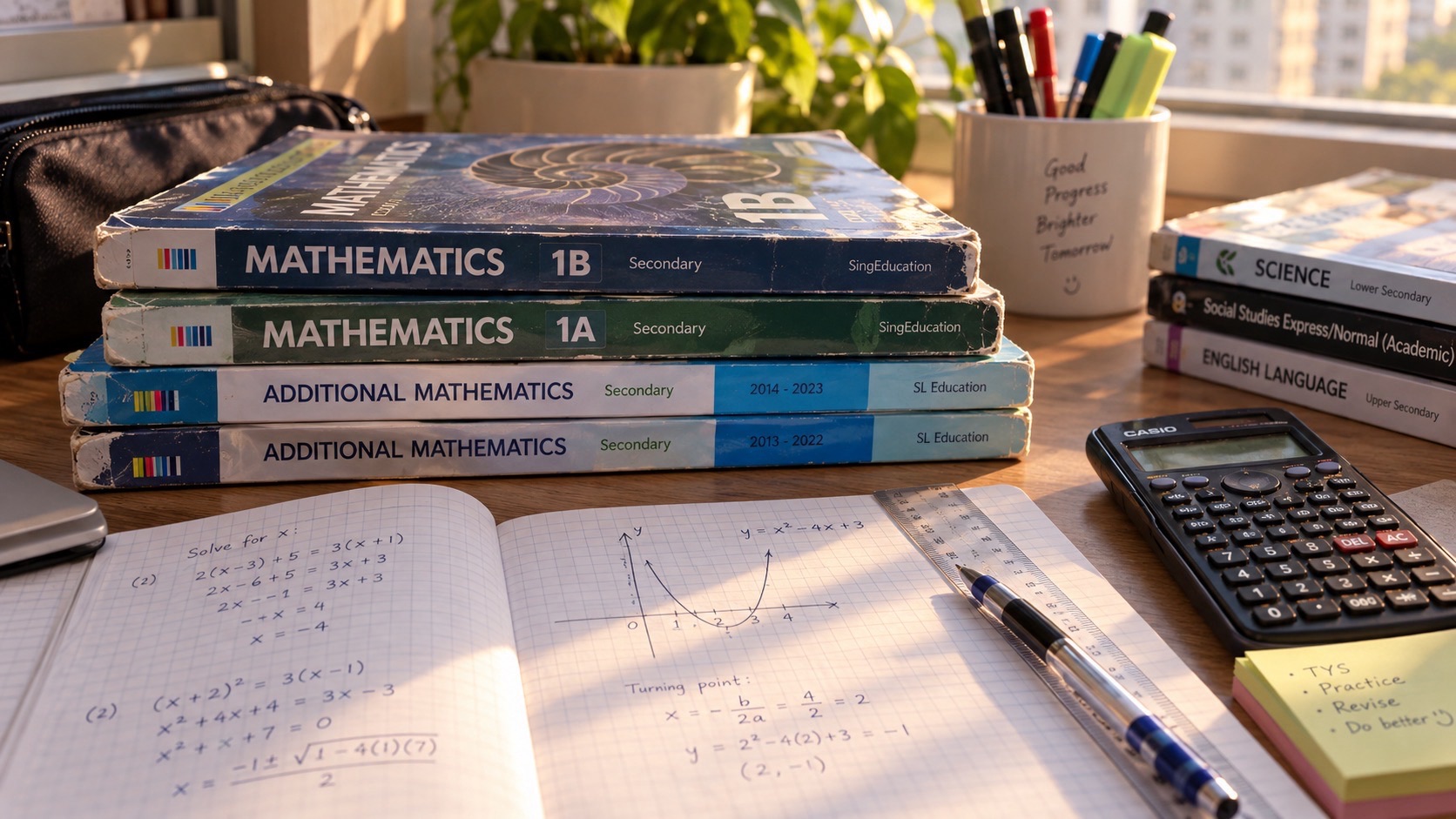
Calculus in Additional Mathematics answers two big questions: how fast is something changing now, and how much change has accumulated across an interval? Differentiation answers the first through the gradient of a tangent; integration addresses the second through antiderivatives and definite integrals. Punggol students make better progress when they understand these meanings before memorising mechanical rules.
In the 2027 Singapore-Cambridge Secondary Education Certificate, G2 Additional Mathematics K232 and G3 Additional Mathematics K341 both include calculus: the power, product, quotient and chain rules, stationary points, connected rates, and integration. The G3 K341 syllabus additionally specifies derivatives of trigonometric, exponential and logarithmic functions; integrals of specified trigonometric and exponential functions; areas below the x-axis; and straight-line particle motion. Follow the exact list for the learner’s subject level rather than assuming that every old O-Level practice question has the same syllabus status.
This parent-friendly guide explains the system from Secondary readiness to the wider Primary-to-University route, demonstrates twenty original worked questions and makes every step retrievable through clear headings. The teaching aim is independence: a student who can select the correct tool, show why it works, interpret the answer and check it.
QUICK FACTS | Differentiation: instantaneous change | Integration: reverse derivative or signed accumulation | Both 2027 SEC levels: power, product, quotient and chain rules, rates, integration | G3 adds named trigonometric, exponential, logarithmic and motion applications | Parent action: ask ‘what does the derivative/integral mean?’
Punggol Additional Mathematics | Series Article Index
Jump directly to the right stage, 2027 SEC requirement or mathematical topic. All eight entries below are published guides; the Primary-to-University overview is the series hub.
Find the concept or worked example
- A one-minute map: gradient, derivative, integral and area
- From Primary arithmetic to upper-secondary rates
- What K232 and K341 list for the 2027 SEC
- Before calculus: functions and algebraic domains
- The derivative is a tangent gradient, not just a symbol
- The power rule and rational exponents
- Chain rule: identify the inside before differentiating
- Product and quotient rules: do not differentiate by distributing symbols
- Tangents and normals need coordinates as well as gradients
- Stationary points: minimum, maximum or inflexion
- Optimisation demands a realistic domain
- Connected rates: relate variables before changing time
- Integration as undoing a derivative
- Definite integrals and the meaning of the endpoints
- Signed integral versus geometric area
- Curve areas and the specified syllabus boundary
- G3 additional derivatives and integrals
- G3 particle motion: displacement is not distance
- Revision system: turn one wrong line into a learning result
- A sustainable Punggol Primary-to-University continuation
- 20 worked calculus checks
- Parent questions
- Official sources and related guides
A one-minute map: gradient, derivative, integral and area
An average gradient compares changes between two points, such as the rise in a graph divided by the horizontal movement. A derivative asks for the gradient at one point on a smooth curve. In applications it can describe instantaneous velocity, marginal change or sensitivity to an input, provided the model and units are meaningful.
Integration reverses differentiation when recovering an antiderivative. A definite integral uses endpoints to calculate a signed accumulation. Area between a graph and an axis may be related to that integral, but the sign of an integral and the magnitude of a geometric area are not always identical.
These ideas are connected rather than separate chapters. A student who sees that differentiating a position function produces velocity and integrating velocity can recover a change in position is doing genuine mathematical reasoning. The rules have a purpose beyond a line of symbols.
From Primary arithmetic to upper-secondary rates
A Primary-school pupil calculates an average speed from distance and time, or compares a growing total from a table. In lower secondary, the same relationships may be graphed and expressed with algebraic formulas. Upper-secondary Additional Mathematics makes the rate at an instant accessible through the derivative.
Consider a toy distance function s(t) = t² + 2t metres, with t in seconds. The average rate from t = 2 to t = 3 is [s(3) − s(2)]/(3 − 2) = (15 − 8)/1 = 7 metres per second. The instantaneous rate at t = 2 is the derivative 2t + 2 evaluated at two, or 6 metres per second.
Different answers are appropriate because one describes an interval and the other one instant. A child should not be told that a differing numerical result necessarily means an algebra error. The first skill is to read what the question measures.
What K232 and K341 list for the 2027 SEC
Both official 2027 subject documents describe a derivative as a tangent gradient and a rate of change. They include the derivative of powers xⁿ for rational n, sums and differences, product and quotient rules, the chain rule, increasing and decreasing functions, stationary points including stationary points of inflexion, second-derivative tests and applications such as tangents, normals, connected rates and optimisation.
Both include integration as reverse differentiation, integration of powers and specified linear-composite powers, definite integrals and areas bounded by a curve and line or lines, with the stated exclusion of area between two curves. The G3 K341 document additionally includes the derivatives of sin x, cos x, tan x, eˣ and ln x; several matching integration forms; areas below the x-axis; and straight-line particle motion.
A child needs the correct PDF for their actual level. A topic appearing in a G3 practice book does not automatically belong to the G2 K232 content list. Conversely, connected rates are included at G2, so labelling every application as G3-only would be misleading.
Before calculus: functions and algebraic domains
Differentiation begins with a function. The student must recognise what x represents, where the function is defined and which transformations preserve equality. For example, the expression 1/(x − 2) is undefined at x = 2. Its derivative cannot restore that excluded input.
Indices are a necessary tool. Students need to rewrite √x as x^(1/2) and 1/x² as x^(−2) on appropriate real domains before applying the rational-power differentiation rule. An incorrect algebra rewrite turns a correct derivative rule into a wrong result.
Use a small preparation check: simplify 2x(x + 3), rearrange 3x + 4 = 16, factorise x² − 9 and state where 1/(x − 4) is undefined. These may look elementary, but they are exactly the procedures that complex derivative questions build upon.
The derivative is a tangent gradient, not just a symbol
The gradient of the tangent to y = x² at x = 3 is six because the derivative is 2x. A secant joining two nearby points approaches that gradient as the points become close. The intuitive limiting process is what makes the derivative an instantaneous rate rather than a new type of average.
A sketch helps: mark the point (3,9), draw a plausible upward-sloping tangent and ask whether a negative derivative would make sense. The student does not need to derive formal limit theory to benefit from this graphical interpretation.
Show the difference between y, dy/dx and a numerical derivative value. The first is a function output, the second a function describing rates, and the third a rate at a particular input. Mixing them leads to answers with the wrong mathematical meaning or units.
The power rule and rational exponents
For y = xⁿ, the derivative is n x^(n−1) where the formula applies. Hence d/dx(x⁴) = 4x³ and d/dx(√x) = (1/2)x^(−1/2) = 1/(2√x) on the appropriate positive domain. For a sum, differentiate each term and leave constants with zero derivative.
Suppose y = 3x⁴ − 5x² + 7. Then dy/dx = 12x³ − 10x. The original seven is a constant vertical shift, so it changes the graph’s height but not its gradient at a fixed input.
Students often apply the rule to a function while forgetting the input restriction. A formula containing √x or a reciprocal power is not defined for every real x. Ask for both the derivative and the permitted values whenever the original question raises a domain concern.
Chain rule: identify the inside before differentiating
The chain rule handles a function built from another function. For y = (2x − 1)⁵, differentiate the outside power and then multiply by the derivative of the inside, giving dy/dx = 5(2x − 1)⁴ × 2 = 10(2x − 1)⁴.
An answer of 5(2x − 1)⁴ is almost correct in appearance but misses the inner derivative of two. This is precisely why the first wrong line is informative. More straightforward power-rule questions will not fix the conceptual failure to recognise composition.
A simple learner prompt is ‘What is the outer operation? What is the inside expression? How does the inside change?’ Once a student can answer those questions, the rule stops being an arbitrary extra coefficient.
Product and quotient rules: do not differentiate by distributing symbols
For two differentiable factors u(x) and v(x), the product rule is (uv)’ = u’v + uv’. If y = x²(x + 3), the derivative becomes 2x(x + 3) + x² = 3x² + 6x. Expanding y first to x³ + 3x² gives the same answer, a useful independent check.
The quotient rule is (u/v)’ = (u’v − uv’)/v² where v is non-zero. It does not allow the student to divide two separately obtained derivatives. For y = (x² + 1)/(x + 1), this gives [(2x)(x + 1) − (x² + 1)]/(x + 1)² = (x² + 2x − 1)/(x + 1)².
Teach the child to choose between expanding, simplifying, product rule and quotient rule rather than applying one technique mechanically. Sometimes simplifying first is much safer; sometimes the quotient form is unavoidable. The choice is itself mathematical reasoning.
Tangents and normals need coordinates as well as gradients
A derivative at x = a gives the tangent gradient, but the tangent equation also requires the point on the curve. For y = x² − 4x + 5 at x = 3, the point is (3,2), and the derivative 2x − 4 gives tangent gradient two. The tangent is y − 2 = 2(x − 3), or y = 2x − 4.
The normal line is perpendicular to the tangent, so its gradient is −1/2. Its equation through the same point is y − 2 = −(x − 3)/2. A learner who obtains the correct gradient but uses a different point has not answered the geometry question.
Ask for a quick sketch showing which line runs in the direction of the curve and which is perpendicular. The visual meaning makes it harder to swap tangent and normal gradients under exam pressure.
Stationary points: minimum, maximum or inflexion
A stationary point is where the first derivative equals zero. This condition alone does not guarantee a maximum or minimum. The student must consider how the gradient behaves around the point or use an appropriate second-derivative test.
For y = x³ − 3x, the derivative is 3x² − 3, so stationary points occur at x = −1 and x = 1. Their coordinates are (−1,2) and (1,−2). The second derivative is 6x: negative at −1, indicating a local maximum, and positive at one, indicating a local minimum.
For y = x³, both the first and second derivatives vanish at zero, but it is a stationary point of inflexion, not an extremum. The second derivative being zero gives an inconclusive test; examine the behaviour of the first derivative or the curve. This distinction prevents a false ‘maximum’ classification.
Optimisation demands a realistic domain
An optimisation task asks what choice makes an objective largest or smallest under explicit constraints. Imagine a rectangle with perimeter twenty metres. If its width is 10 − l when the length is l, its area is A(l) = l(10 − l) for 0 < l < 10. Differentiating gives A'(l) = 10 − 2l.
Setting the derivative to zero yields l = 5, so width also equals five and area is twenty-five square metres. The negative second derivative A” = −2 confirms a maximum. Completing the square gives the same conclusion, illustrating the connection to quadratic functions.
The domain is not optional. Length and width must be positive, and a model that produces negative dimensions outside the interval has no useful geometric meaning. Good teaching writes the constraint beside the equation before differentiating.
Connected rates: relate variables before changing time
Connected-rates problems involve two quantities changing together. Start by finding an equation connecting them, then differentiate both sides with respect to time. The chain rule appears because each spatial quantity is itself a function of time.
For a growing circle with area A = πr², differentiation with respect to t gives dA/dt = 2πr(dr/dt). If r = 5 cm and dr/dt = 0.4 cm/s at an instant, then dA/dt = 2π(5)(0.4) = 4π cm²/s. The number and unit both convey meaning.
A common wrong line is to differentiate πr² with respect to r and stop at 2πr, omitting dr/dt. Ask what the question requests: change per centimetre of radius or change per second. The requested denominator determines whether another rate factor is needed.
Integration as undoing a derivative
An indefinite integral describes a family of antiderivatives. If the derivative of x³ is 3x², then ∫3x² dx = x³ + C. The constant C is necessary because every vertical shift of x³ has the same derivative.
For a polynomial such as 6x² − 4x + 3, integrate term by term to get 2x³ − 2x² + 3x + C. Differentiating the result recovers the original integrand. This is the fastest reliable check of a straightforward indefinite integral.
When integrating (ax + b)ⁿ, the coefficient inside matters. For ∫(2x + 3)⁴ dx, the answer is (2x + 3)⁵/10 + C, because differentiating multiplies by five and then by two. The same chain-rule awareness that protects derivatives protects integrals.
Definite integrals and the meaning of the endpoints
A definite integral accumulates a signed quantity from a specified lower input to an upper input. For ∫ from 0 to 2 of 3x² dx, the antiderivative is x³ and the value is 2³ − 0³ = 8. Unlike an indefinite integral, there is no arbitrary integration constant in the final numerical difference.
Explain the notation: the lower and upper limits do not simply label where the learner should begin the working. They determine exactly which interval is accumulated. Reversing the limits reverses the integral’s sign. This distinction is crucial for later graphs and physical interpretations.
A student should estimate whether the answer makes sense. Because 3x² is non-negative on the interval from zero to two and grows toward twelve, a positive finite integral of eight is plausible. A negative answer would signal a sign or endpoint error.
Signed integral versus geometric area
For y = x on the interval −2 to 0, the signed integral is [x²/2] from −2 to 0, equal to −2. The triangle between the line and the x-axis, however, has positive geometric area two square units. The sign describes the orientation of accumulation, not ‘negative space’.
The 2027 G3 K341 calculus content explicitly covers areas of regions below the x-axis; the G2 K232 content wording should be read on its own terms rather than assuming identical extensions. Students at any level benefit conceptually from knowing that a negative signed integral does not itself state a negative physical area.
Before calculating a question that asks for area, sketch the graph and mark the portion above or below the axis. If the interval crosses the axis, splitting at the root may be required to find geometric area. The diagram prevents the learner from blindly reporting a signed accumulation as a non-negative area.
Curve areas and the specified syllabus boundary
Both 2027 Additional Mathematics levels include finding the area of a region bounded by a curve and line or lines, with the subject-content wording excluding the area between two curves. This explicit limitation helps parents choose exam-aligned practice rather than random advanced calculus exercises.
For y = 4 − x² from x = 0 to x = 2, the curve is non-negative, so the region under the curve and above the x-axis has area ∫(4 − x²) dx over those limits. The result is [4x − x³/3] from 0 to 2, or 8 − 8/3 = 16/3 square units.
A student who writes a negative area here has likely reversed limits or changed a sign in the antiderivative. Return to the sketch: the graph is above the axis over the stated interval, so the area must be positive. Geometric reasoning serves as a basic audit.
G3 additional derivatives and integrals
The K341 document lists differentiation of sin x, cos x, tan x, eˣ and ln x alongside rational powers. It also includes integration of specified trigonometric and exponential expressions. K232 has its own listed power-function scope; do not silently transfer the G3 list into the G2 assessment.
For example, d/dx sin(3x) = 3cos(3x), and d/dx e^(2x) = 2e^(2x). Also, for x > 0, d/dx ln x = 1/x. The inner multipliers in the first two examples again come from the chain rule, not from a new trigonometry-specific trick.
An integration example is ∫sin(2x) dx = −(1/2)cos(2x) + C. Differentiate to verify. Students can avoid many errors by matching a known derivative pattern and checking that any inner coefficient has been accounted for.
G3 particle motion: displacement is not distance
K341 specifies applications to displacement, velocity and acceleration of a particle moving in a straight line. These are mathematical models. A position or displacement function s(t) gives velocity v(t) = ds/dt and acceleration a(t) = dv/dt.
Take s(t) = t³ − 6t² + 9t metres with t in seconds. Then v(t) = 3t² − 12t + 9 and a(t) = 6t − 12. At t = 2, velocity is −3 m/s while acceleration is 0 m/s². The negative velocity means motion in the chosen negative direction; speed is the non-negative magnitude, 3 m/s.
Distance travelled is not always final displacement. If direction changes during an interval, total distance requires considering separate parts of the motion. Ask the learner what each function and unit represents before treating all integrals or differences as physical distances.
Revision system: turn one wrong line into a learning result
Begin each week with a short mixed recall set, not merely the chapter currently being taught. Include one prerequisite algebra problem, one derivative selection problem, one application and one integral. Ask the student to annotate why the chosen rule applies before calculating.
Keep a repair record that distinguishes product-rule errors from chain-rule errors, and signed-area errors from integration errors. The same final mark can hide different causes. A good teacher spots the earliest incorrect mathematical decision, teaches its underlying mechanism and then tests another form independently.
Every fortnight, select a previously failed question that the pupil has not seen for several days. A genuine improvement is a new independent success, not a correct answer copied immediately after a model solution. This retrieval approach also protects against the busy weeks around CCAs and school examinations.
A sustainable Punggol Primary-to-University continuation
A learner in Punggol does not need calculus in Primary school. The foundational journey is number sense, algebra, functions, graphs and trigonometry, leading eventually to differentiation and integration in an appropriate upper-secondary Additional Mathematics subject. Strong earlier foundations shorten later repair time.
The next educational choice depends on subject offers, actual SEC results, interests and current admissions requirements. Calculus may support advanced mathematics, science, engineering, computing or data-intensive studies, but no single calculus topic is a universal guarantee of a JC, polytechnic, ITE or university offer.
Parents can use the Punggol algebra and trigonometry companion guides to repair missing ideas and the 2027 SEC comparison for paper-specific boundaries. Before deciding on more tuition, ask what error will be repaired and what the student will be able to demonstrate without help. That is a sound reason to invest time.
20 worked calculus checks from rate to accumulation
These are original worked teaching questions and are not presented as official paper items. Some illustrate prerequisite ideas and some are explicitly marked as G3 additions. Match each exercise to the student’s actual level and ask for a later independent retry.
1. Differentiate a polynomial
Question: Find dy/dx for y = 3x⁴ − 5x² + 7.
Worked route: Differentiate termwise: dy/dx = 12x³ − 10x.
Common false move: The derivative of the constant seven is zero, not seven.
Independent check: Differentiate the result’s proposed antiderivative or test its gradient trend.
2. A fractional power
Question: Differentiate y = √x for x > 0.
Worked route: Rewrite as x^(1/2); derivative is (1/2)x^(−1/2) = 1/(2√x).
Common false move: The power decreases by one; it is not 1/(2x).
Independent check: At x = 4 the derivative is 1/4, positive and smaller than at x = 1.
3. A reciprocal square
Question: Differentiate y = x^(−2) for x ≠ 0.
Worked route: Use the power rule: y’ = −2x^(−3) = −2/x³.
Common false move: The negative sign belongs to the derivative coefficient, not just the base.
Independent check: Take x = 1 and compare slopes with a nearby numerical value.
4. A linear inside power
Question: Differentiate (2x − 1)⁵.
Worked route: Chain rule: 5(2x − 1)⁴ times 2, giving 10(2x − 1)⁴.
Common false move: Missing the inner derivative two is a composition error.
Independent check: At x = 1, the derivative is 10.
5. A square of a quadratic
Question: Differentiate (x² + 1)³.
Worked route: Chain rule: 3(x² + 1)² × 2x = 6x(x² + 1)².
Common false move: Replacing the inner derivative by one ignores the x² term.
Independent check: Expand for a separate check if appropriate.
6. A product
Question: Differentiate y = x²(x + 3).
Worked route: Product rule gives 2x(x + 3) + x² = 3x² + 6x.
Common false move: Multiplying separate derivatives would give 2x, an incorrect shortcut.
Independent check: Expand y to x³ + 3x² and differentiate again.
7. A quotient
Question: Differentiate (x² + 1)/(x + 1), x ≠ −1.
Worked route: Quotient rule yields (x² + 2x − 1)/(x + 1)².
Common false move: The top derivative divided by bottom derivative is not the quotient rule.
Independent check: Substitute a value other than −1 into both equivalent forms and compare.
8. A tangent line
Question: Find tangent to y = x² − 4x + 5 at x = 3.
Worked route: Point (3,2); gradient y’ = 2x − 4 gives two, so tangent y − 2 = 2(x − 3), or y = 2x − 4.
Common false move: The slope alone is not the complete line equation.
Independent check: Check (3,2) lies on y = 2x − 4.
9. A normal line
Question: Find the normal to the same curve at x = 3.
Worked route: Normal gradient is −1/2, hence y − 2 = −(x − 3)/2.
Common false move: Taking gradient −2 would be negative rather than negative reciprocal.
Independent check: Multiply tangent and normal gradients: 2 × (−1/2) = −1.
10. Stationary points
Question: Find stationary points of y = x³ − 3x.
Worked route: y’ = 3x² − 3; set zero to get x = −1,1 and coordinates (−1,2),(1,−2).
Common false move: Stopping at x-values omits y-coordinates when points are requested.
Independent check: Compute y” = 6x to classify maximum at −1, minimum at 1.
11. Stationary inflexion
Question: Classify the stationary point of y = x³ at x = 0.
Worked route: y’ = 3x² = 0 at zero and y” = 6x = 0 there. The curve increases through zero and changes concavity, so it is a stationary inflexion.
Common false move: Second derivative zero is inconclusive, not proof of a maximum.
Independent check: Check first derivative is positive on both sides except at the point.
12. Optimise a rectangle
Question: For perimeter 20 m, maximise rectangle area.
Worked route: Let width = 10 − l and A = 10l − l² for 0 < l < 10. A’ = 10 − 2l = 0 gives l = 5 and area 25 m².
Common false move: Ignoring positive-dimension constraints can invent nonsensical lengths.
Independent check: A” = −2 confirms maximum; compare with completing the square.
13. A growing circle
Question: Given A = πr², dr/dt = 0.4 cm/s when r = 5 cm, find dA/dt.
Worked route: Differentiate with respect to time: dA/dt = 2πr dr/dt = 4π cm²/s.
Common false move: Stopping at 2πr gives derivative with respect to radius, not time.
Independent check: Check cm × cm/s = cm²/s.
14. A growing cube
Question: Given V = s³, ds/dt = 0.2 cm/s when s = 4 cm, find dV/dt.
Worked route: Differentiate: dV/dt = 3s² ds/dt = 3 × 16 × 0.2 = 9.6 cm³/s.
Common false move: Treating dV/dt as 3s² omits the time dependence of s.
Independent check: Check the units give volume per second.
15. Integrate a polynomial
Question: Find ∫(6x² − 4x + 3) dx.
Worked route: Answer 2x³ − 2x² + 3x + C.
Common false move: Omitting C loses the family of antiderivatives.
Independent check: Differentiate the result to recover the integrand.
16. Integrate a composite power
Question: Find ∫(2x + 3)⁴ dx.
Worked route: Answer (2x + 3)⁵/10 + C.
Common false move: Dividing by five alone ignores the inner slope two.
Independent check: Differentiate: (5/10)(2x + 3)⁴ × 2 gives the integrand.
17. A definite integral
Question: Evaluate ∫ from 0 to 2 of 3x² dx.
Worked route: Antiderivative x³; 2³ − 0³ = 8.
Common false move: The limits are substitution points for the antiderivative, not multipliers of the function.
Independent check: Sketch 3x² to verify the signed accumulation is positive.
18. A curve area
Question: Find area under y = 4 − x² from x = 0 to 2.
Worked route: Area ∫₀²(4 − x²) dx = 8 − 8/3 = 16/3 square units.
Common false move: An area under a non-negative curve on this interval cannot be negative.
Independent check: Estimate as smaller than rectangle area 8 but larger than zero.
19. G3 trigonometric calculus
Question: Differentiate sin(3x) and integrate sin(2x).
Worked route: Derivative 3cos(3x). Integral −cos(2x)/2 + C.
Common false move: Both operations require accounting for the coefficient inside the trigonometric function.
Independent check: Differentiate the integral expression and recover sin(2x).
20. G3 velocity and acceleration
Question: For s(t) = t³ − 6t² + 9t, find velocity and acceleration at t = 2.
Worked route: v = 3t² − 12t + 9 gives v(2) = −3 m/s; a = 6t − 12 gives a(2) = 0 m/s².
Common false move: Velocity −3 is not negative speed; speed is 3 m/s.
Independent check: State units and the chosen positive direction explicitly.
Parent questions, answered
Do both SEC G2 and G3 Additional Mathematics have calculus?
Yes. K232 and K341 each include differentiation, integration, rules of products and quotients, chain rule, stationary points and connected rates, subject to the specific syllabus wording.
Does G2 include connected rates?
Yes. The 2027 K232 differentiation applications explicitly include connected rates of change; describing all related-rate problems as G3-only would be inaccurate.
What calculus topics differ at G3?
K341 names additional trigonometric, exponential and logarithmic differentiation and integration, areas below the x-axis, and straight-line particle-motion applications. Read the exact PDFs for details.
Why can the second derivative test be inconclusive?
If the second derivative is zero at a stationary point, the test alone does not classify that point. Use the first derivative or further analysis to distinguish alternatives.
Does a negative definite integral mean negative area?
Not necessarily. A definite integral is signed accumulation; a geometric region has non-negative area. Sketch the curve and read the command carefully.
Why must integration answers include C?
Indefinite integrals represent families of antiderivatives differing by constants. The constant cancels when evaluating a definite integral with endpoints.
Is differentiation just a faster form of graph drawing?
No. It provides a precise tangent gradient and rate of change and can answer questions about extrema, normal lines, optimisation and connected quantities.
Are areas between two curves on the listed K232/K341 content?
Both 2027 subject PDFs explicitly exclude area of the region between two curves from the named area subtopic. Do not confuse optional extension with standard exam scope.
Does calculus help with further education?
It helps build mathematical thinking for relevant advanced or quantitative courses. Admission always depends on actual qualifications and programme requirements, not one calculus chapter.
How can a family measure improvement?
Look for an independently selected rule, correct units, a justified final answer and a fresh problem solved after a delay. A copied correct method is only evidence of guided work.
Extended case study: connected rates, displacement and distance
Calculus is most useful when its symbols are attached to quantities, time and units. Consider a fictional expanding circular water feature. Let its radius r be measured in metres, its area A in square metres, and suppose its radius is increasing at 0.1 metre per minute at the instant when r=3 metres. Since A=πr², differentiation with respect to time gives dA/dt=2πr(dr/dt). Substitution yields dA/dt=2π×3×0.1=0.6π square metres per minute. The rate of change of area is not simply 0.1, because a larger radius changes the circumference along which new area is added.
A typical wrong solution first differentiates A=πr² correctly with respect to r, obtaining dA/dr=2πr, but reports that result as dA/dt. The mathematical omission is the chain factor dr/dt. Asking the student to name the units catches it: dA/dr has square metres per metre, while dA/dt has square metres per minute. A reliable correction requires labelling what changes, deciding which derivative the question wants, drawing an arrow between related rates and only then applying the chain rule. This is within the connected-rates applications listed for K232 and K341.
Now consider a separate G3 K341 motion extension. Let a particle’s signed velocity be v(t)=3t²−4t metres per second, where t is measured in seconds. The signed displacement from t=0 to t=2 is the definite integral of v: [t³−2t²] between zero and two, which equals (8−8)−0=0 metres. This does not establish that the particle stayed still. For 0<t<4/3, velocity is negative; for 4/3<t<2, velocity is positive. The negative and positive displacements cancel. The total distance travelled requires separating intervals at t=4/3 and integrating the absolute value of velocity, rather than reporting zero distance.
This contrast supplies a useful parent conversation: is the student answering a rate, displacement or distance question? Have them sketch the sign of velocity, identify the physical unit and check whether the result is plausible. A tuition provider can demonstrate conceptual progress by letting the learner solve a fresh version independently several days later. The aim is not to memorise these exact numbers but to preserve meaning when the notation changes.
Primary sources, date and internal learning links
Fact-check date: 18 October 2026. Content boundaries checked against official 2027 SEAB K232 and K341 syllabuses and school-candidate lists. Mathematical teaching cases are original. School-offered subject levels and later course entry requirements must be verified for the individual cohort.
- SEAB 2027 G2 Additional Mathematics K232 full subject PDF
- SEAB 2027 G3 Additional Mathematics K341 full subject PDF
- SEAB G2 2027 school-candidate syllabus listing
- SEAB G3 2027 school-candidate syllabus listing
- Punggol Additional Mathematics: Primary-to-University roadmap
- Punggol Additional Mathematics: algebra foundations
- Punggol Additional Mathematics: quadratic functions and geometry
- Punggol Additional Mathematics: trigonometry and radians
- Punggol 2027 SEC G2/G3 syllabus-and-paper guide
- Immutable Clementi Secondary Mathematics quality reference
Series: Understanding the Additional Mathematics Education System of Punggol. Use the linked guides to navigate from Primary preparation and Secondary algebra to trigonometry, calculus, the 2027 SEC and post-secondary decisions.


