
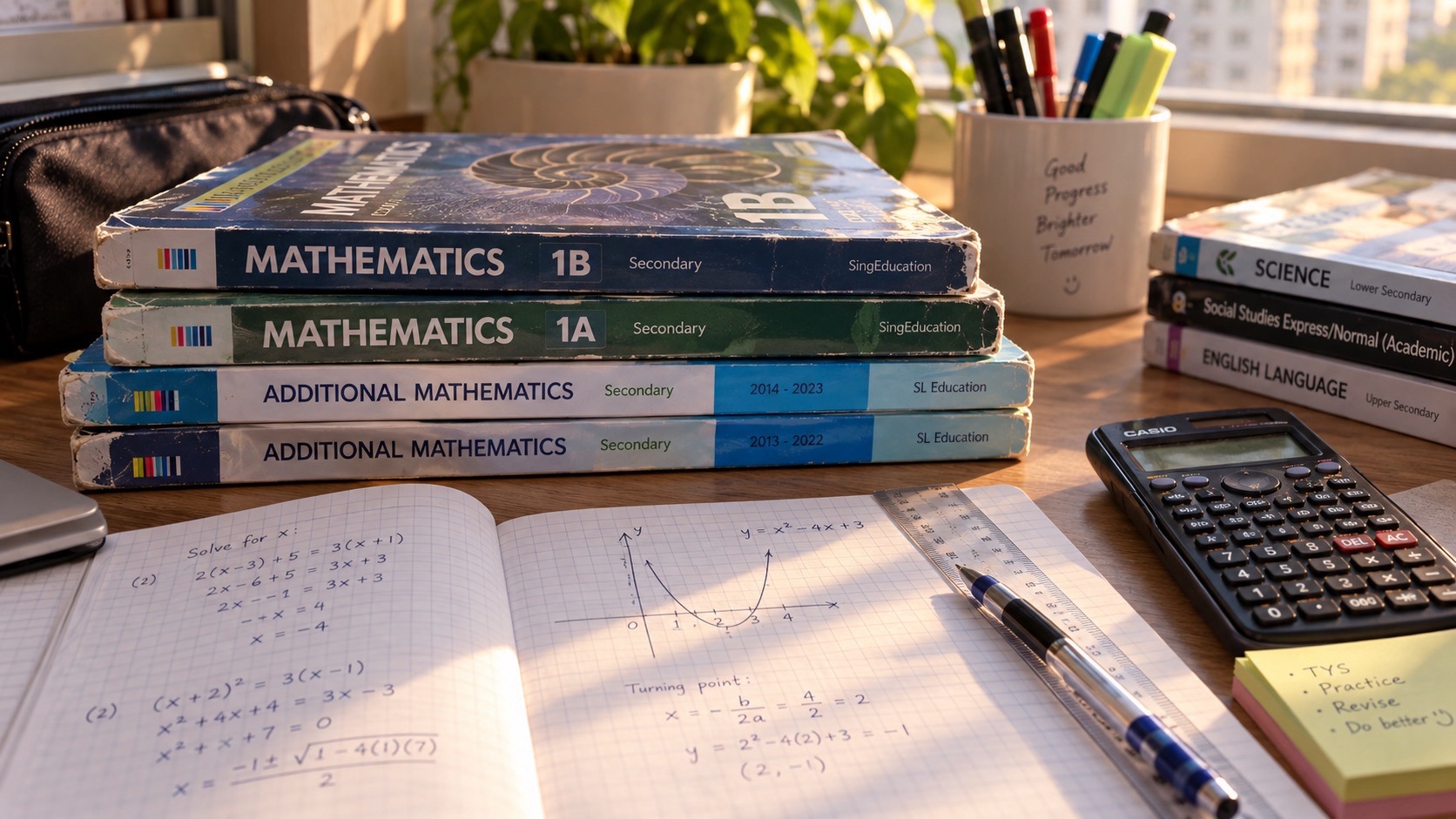
Algebra is the backbone of Additional Mathematics in Punggol. The key learning difference is not that students suddenly encounter harder numbers: they must understand when a transformation is valid, what an equation claims, and whether a method preserves every possible answer. The best immediate preparation is to make those decisions visible in each line of working.
For the 2027 Singapore-Cambridge Secondary Education Certificate, SEAB lists Additional Mathematics at G2 (K232, corresponding to reference code 4051) and G3 (K341, reference code 4049). Both contain quadratic functions, equations and inequalities, surds, polynomials and partial fractions. The G3 K341 syllabus also lists binomial expansions and exponential and logarithmic functions. These distinctions are drawn from the actual official syllabuses, not a generic A-Math topic checklist.
This reader-first guide separates Secondary 1–2 prerequisite repair from upper-secondary A-Math content, supplies twenty fully reasoned examples, and gives parents a practical way to ask for evidence of understanding. It describes the national curriculum used by schools in Punggol; the student’s available subject combination and level must still be confirmed with the individual school.
AT A GLANCE | Where: national Additional Mathematics used in Punggol | When: upper secondary, normally Sec 3–4 | Official 2027 codes: G2 K232, G3 K341 | Core skills: equivalence, exact form, factorisation and proof | Biggest parent action: diagnose the first wrong line.
Punggol Additional Mathematics | Series Article Index
Jump directly to the right stage, 2027 SEC requirement or mathematical topic. All eight entries below are published guides; the Primary-to-University overview is the series hub.
Read by what you need
- The answer in thirty seconds: where algebra belongs
- The real syllabus boundary: G2 K232 and G3 K341
- Before the elective: close Secondary 1 and 2 gaps
- Know the object: expression, equation, identity or inequality
- Equality must survive every line
- Indices are prerequisite grammar, not a separate shortcut collection
- Surds: preserve exact value before approximating
- Completing the square connects algebra to geometry
- Discriminants: answer the question before solving more than necessary
- Polynomial remainders and factors
- Polynomial division is a structural explanation
- Partial fractions: decompose only after checking the form
- G3-only algebra extensions: binomial expansion
- G3-only extensions: exponential and logarithmic models
- A practical six-week algebra reset for Secondary 3
- Teaching quality: diagnosis, mechanism, transfer and independence
- Punggol-specific decisions: schools, journeys and workload
- A home evidence sheet that survives changing syllabuses
- 20 worked algebra diagnostics
- Parent FAQ
- Source documents and related guides
The answer in thirty seconds: where algebra belongs
Primary school provides arithmetic structure; lower secondary introduces variables, equality and graphs; upper-secondary Additional Mathematics requires deeper transformations, polynomial reasoning and exact representations. There is no separate compulsory Primary-school A-Math subject. Early acceleration is optional enrichment and should not be confused with a national examination entry.
For a child entering Secondary 3, the most useful algebra-readiness questions are direct. Can the student expand and factorise reliably? Can the student maintain the solution set while rearranging an equation? Can the student tell an expression from an equation? Can the student explain why division by a variable requires checking whether it could be zero?
For a child already taking Additional Mathematics, begin with the first wrong line in a recent school question. A page of perfect answers copied from worked solutions does not prove mastery. Independent explanation, reconstruction after a week, and transfer to a differently framed question are stronger indicators.
The real syllabus boundary: G2 K232 and G3 K341
The 2027 G2 Additional Mathematics K232 syllabus assumes knowledge of G2 Mathematics and specifically notes some prerequisite linear inequalities and sketches of quadratic functions. Its upper-secondary algebra content covers completing the square, root conditions, simultaneous equations, quadratic inequalities, surds, polynomial division, factor and remainder theorems, and specified partial-fraction cases.
The G3 Additional Mathematics K341 syllabus assumes G3 Mathematics. Its core algebra includes the corresponding quadratic, surd, polynomial and partial-fraction topics, plus the binomial theorem for positive integers and exponential and logarithmic functions. A book labelled ‘Additional Mathematics’ without a clear year and subject-level mapping is not enough to identify what a particular student should revise.
Both official syllabuses emphasise more than routine technique. AO1 concerns methods; AO2 concerns selection and application; AO3 concerns reasoning and communication. A teacher or tutor who only counts worksheet completion is not measuring the whole intended competence. Compare practice against the published outcomes and assessment objectives for the pupil’s level.
Before the elective: close Secondary 1 and 2 gaps
An algebra lesson may fail because the student never secured arithmetic with negative values. When −3(2x − 5) becomes −6x − 15, later quadratic errors are almost guaranteed. The accurate expansion is −6x + 15 because each term inside the bracket is multiplied by negative three. Ask the learner to verify by choosing x = 0.
Fractions create a different bottleneck. To solve x/3 + 2 = 5, one must subtract two and multiply by three; careless cross-multiplying a single term changes the equation. The parent does not need specialist calculus knowledge to check a solution: substitute the proposed value into the original question.
Reasoning transfers only when the child knows why the move works. A tutor may demonstrate five expansions quickly, but if the student cannot explain one without prompting, the pace needs to change. Two short independent problems at increasing intervals can show whether repair has lasted beyond the lesson.
Know the object: expression, equation, identity or inequality
An expression such as 2x² − 5x + 3 may be simplified, factorised or evaluated for a selected x. An equation such as 2x² − 5x + 3 = 0 asks which values satisfy a claim. The identity (x + 1)² ≡ x² + 2x + 1 holds for every real x. An inequality such as x² − 4 > 0 asks for a region of values.
Confusing these objects causes mistakes that appear advanced but are fundamentally about language. Students sometimes write an equals sign between two expressions that are not equal, or treat a factorisation as a solution even though no equation has been given. A competent explanation should name what the task requires before manipulating symbols.
Try giving a child x² − 9 and asking four different instructions: factorise, substitute x = 5, solve x² − 9 = 0, and solve x² − 9 > 0. These are related, but their answers have different shapes. That comparison teaches more than repeatedly practising a single pattern.
Equality must survive every line
Operations applied equally to both sides preserve an equation. Some operations, however, are not reversible without conditions. Squaring can generate an extra apparent solution; multiplying by an expression that might be zero can affect solution-set equivalence; cancelling a variable can discard a valid root.
Consider x(x − 4) = 0. If a student divides by x, the answer x = 0 disappears and only x = 4 survives. The correct reasoning is the zero-product property: either x = 0 or x − 4 = 0. The student should verify both in the original equation and be able to explain exactly what was lost through division.
Require the student to write the condition alongside any potentially dangerous division. This is not decorative mathematical formality. The habit pays off in rational equations, surd equations, trigonometric manipulations and calculus expressions with excluded inputs. A domain note may save more marks than an extra memorised formula.
Indices are prerequisite grammar, not a separate shortcut collection
Indices describe repeated multiplication. The expression a³ × a² becomes a⁵ when the same base is multiplied, but a³ + a² does not become a⁵. The addition instead has a common factor a²(a + 1). A small numerical test at a = 2 exposes the incorrect rule immediately.
Negative exponents are not negative values: a⁻² means 1/a² when a is non-zero. A fractional exponent encodes roots, subject to the number system and conditions being used. These distinctions matter when algebra contains powers such as x^(3/2) or when differentiation later uses the power rule.
Make a three-column page headed multiply, add and raise a power. Put visually similar terms in each column. Ask students to classify the operation before using an index law. The goal is to prevent a familiar-looking symbol from triggering the wrong algorithm.
Surds: preserve exact value before approximating
A surd such as √18 is exactly 3√2. Replacing it with a calculator decimal too early hides structure and may introduce avoidable rounding discrepancies. The G2 and G3 syllabuses include arithmetic with surds, rationalising denominators and solving equations involving surds, so exactness is central rather than optional decoration.
Rationalising 1/(√5 − 2) means multiplying numerator and denominator by √5 + 2. The denominator becomes 5 − 4 = 1, so the result is √5 + 2. This works because the multiplier is one written as a ratio of equal non-zero expressions.
A student needs to see both the calculation and the reason. When rationalising a denominator, the numerator must be multiplied too. When solving an equation that contains a square root, extraneous solutions need to be excluded by substituting into the original. The act of checking is part of the method.
Completing the square connects algebra to geometry
Factorisation is useful when simple rational roots appear, but the completed-square form of a quadratic exposes its turning point whether or not factorisation is convenient. For x² − 6x + 11, rewrite it as (x − 3)² + 2. Because a square is never negative for real x, the minimum value is two at x = 3.
That same expression shows why the graph does not cross the x-axis. The equation (x − 3)² + 2 = 0 has no real solution. Algebra, a graph, a minimum-value question and the nature of the roots are four views of one object rather than unrelated exam chapters.
Give the learner a quadratic and ask for its factorised form if suitable, completed-square form, roots if any, y-intercept and shape. Require an explanation of how the forms agree. The student who can move between these views has learned a durable mathematical representation.
Discriminants: answer the question before solving more than necessary
For ax² + bx + c = 0 with a non-zero, the discriminant is D = b² − 4ac. When D > 0 there are two distinct real roots; when D = 0 there is one repeated real root; when D < 0 there are no real roots. The same test describes whether a line meets a quadratic curve twice, touches it or misses it.
Take x² − 8x + k = 0. The discriminant is 64 − 4k. Two distinct real solutions occur when k < 16, equal roots when k = 16, and no real roots when k > 16. Solving the quadratic formula for the roots first would add work without helping the requested classification.
The important diagnostic is whether the learner names a, b and c correctly after rearrangement. If the student computes a negative discriminant for an equation with a = 0, the question is not even quadratic. Method selection comes before the substitution.
Polynomial remainders and factors
For a polynomial P(x), division by x − a leaves the remainder P(a). If P(a) = 0, x − a is a factor. These are not disconnected facts: they arise from the division relationship P(x) = (x − a)Q(x) + r. Substituting x = a makes the product vanish and leaves r.
Suppose P(x) = x³ − 4x² + x + 6. Since P(2) = 8 − 16 + 2 + 6 = 0, x − 2 is a factor. Factoring completely gives (x − 3)(x − 2)(x + 1). The roots are 3, 2 and −1; expand the factors to verify the cubic.
Students often confuse a negative root with a factor sign. If the root is −1, the corresponding factor is x + 1, not x − 1. A quick substitution catches the mistake. Keep a factor-root pair column until the relationship becomes automatic.
Polynomial division is a structural explanation
Long division or an appropriate algebraic division process determines what remains when a polynomial is divided by a lower-degree polynomial. It requires organising descending powers and recording any missing terms. The common missing x² coefficient in a cubic causes alignment errors if students do not write a placeholder zero.
To divide x³ + 2x² − x − 2 by x + 2, one can group: x²(x + 2) − 1(x + 2) = (x + 2)(x² − 1). The quotient is x² − 1 and remainder zero. The result can be checked in one expansion: (x + 2)(x² − 1) reproduces the original cubic.
A good tutor asks whether the student can reconstruct the result using dividend = divisor × quotient + remainder. If the answer is wrong, inspect whether the error came from sign control, a missing power, or multiplication. Those are different repair targets and should not be labelled collectively as carelessness.
Partial fractions: decompose only after checking the form
The partial-fractions topic asks students to separate certain rational expressions into simpler fractions. One must inspect the denominator’s factors and multiplicities, as well as whether the numerator’s degree is lower than the denominator’s. The official K232 and K341 descriptions specify particular denominator forms; not every rational fraction belongs in the same template.
For example, (5x + 1)/((x + 1)(x + 2)) can be represented as A/(x + 1) + B/(x + 2). Multiplying through by the common denominator gives 5x + 1 = A(x + 2) + B(x + 1). Setting x = −1 gives A = −4; setting x = −2 gives B = 9.
The resulting identity is −4/(x + 1) + 9/(x + 2), with x ≠ −1 and x ≠ −2. Check by recombining. A student who can produce the constants but never states restrictions may have mistaken an algebraic identity on its valid domain for a formula that works at excluded points.
G3-only algebra extensions: binomial expansion
The G3 K341 syllabus includes the binomial theorem for positive integer powers. This is a syllabus distinction, not an invitation to assume that the same official outcome is listed in K232. The theorem provides an organised way to identify coefficients and terms without multiplying every bracket separately.
For (1 + 2x)⁴, the x² term comes from choosing two copies of 2x from four factors. Its coefficient is 6 × 4 = 24, so the term is 24x². A check with a full expansion gives 1 + 8x + 24x² + 32x³ + 16x⁴.
Learning binomial notation means learning to interpret position, coefficients and powers, not merely pressing the combinations button. A student should be able to explain why the total degree remains four and why the first and last terms are easy to identify. Ask for the coefficient of x³ only, then the full expansion.
G3-only extensions: exponential and logarithmic models
K341 also lists exponential and logarithmic functions, laws of logarithms, change of base and modelling. These are more than index laws with unfamiliar notation: logarithms express inverse relationships. If 2ˣ = 16, then x = 4; the equivalent logarithmic statement is log₂ 16 = 4.
A frequent error is to write log(a + b) = log a + log b. The valid product law concerns log(ab), for positive inputs and a valid fixed base: log(ab) = log a + log b. A numerical counterexample is enough to expose the false addition law. Mathematical language matters: the operation inside the logarithm governs the rule.
A growth model may be useful for interpreting data, but it is not proof that real costs, populations or learning progress always grow exponentially. State the model, domain and assumptions. This is precisely the type of conceptual care that helps a student move from exam manipulation to useful later mathematics.
A practical six-week algebra reset for Secondary 3
Week one is an evidence audit. Take two independently completed questions each on negative brackets, factorisation, equations and graphs. Do not diagnose by the total mark alone. Mark whether the first failure was in reading, choosing, transforming, calculating or checking. Store one example of each recurring error.
Weeks two and three repair the smallest causes. If negative brackets are wrong, use drawings and quick numeric checks before advancing to polynomials. If zero-product solutions are lost, contrast product equations with ordinary linear equations. Put old errors back into retrieval exercises after a few days rather than treating one successful correction as permanent mastery.
Weeks four and five transfer each repaired idea to an unfamiliar form: simple factorisation to cubic factors, equations to parameter conditions, and surd arithmetic to rationalising a denominator. Week six is a short independent mixed assessment plus an oral explanation. Record what the student now handles without prompts, what remains unstable and what the next teaching decision will be.
Teaching quality: diagnosis, mechanism, transfer and independence
Additional Mathematics teaching is most effective when the explanation changes the student’s mental model. Diagnosis isolates the wrong move; mechanism explains why it is invalid; repair gives a correct model; transfer checks a fresh question; retrieval tests retention later. This is a stronger outcome than merely increasing weekly worksheet counts.
For example, a learner who keeps cancelling x from x(x − 4) = 0 does not primarily need twenty more quadratic exercises. They need the conceptual distinction between a product being zero and a denominator being permitted to be zero. Once that is repaired, ask the learner to solve a new product equation without a tutor nearby.
A 3-pax small group can be useful for comparing two valid routes, provided that every child is independently checked. One-to-one lessons can be appropriate for concentrated remediation. Neither format automatically guarantees better understanding. A parent should ask to see anonymised sample feedback, the tutor’s syllabus mapping and the child’s independently redone question.
Punggol-specific decisions: schools, journeys and workload
Punggol students may attend different schools and travel different distances. The local choice involves schedule, travel, study time, CCAs and family routines. None of these changes the national SEAB subject definition. A family should confirm whether its particular school offers the applicable subject level, the correct combination and any current entry criteria.
Because Additional Mathematics often adds algebraic homework beyond core Mathematics, adding unlimited external drilling can reduce the time available for sleep and error review. Schedule a short same-day check, a later independent retry and enough time for the student to explain an unfamiliar question. This is more informative than comparing how many tuition centres classmates use.
Punggol’s transport and neighbourhood services can make weekly lessons easier to arrange, but the tutor’s teaching method still matters more than convenience alone. Select a sustainable journey, then ask what actually changes in the student’s understanding. A sustainable system is one the child can keep using when school assessments become busy.
A home evidence sheet that survives changing syllabuses
Keep one page with the learner’s subject code and examination year, the current algebra objective, the last independently solved example and the next mistake to revisit. Link it to the appropriate official SEAB PDF. When a tuition worksheet and the examination document disagree, ask the provider why the lesson is relevant to that learner’s actual syllabus.
Collect three pieces of evidence monthly: the learner’s original incorrect line, a corrected explanation in the learner’s own words, and a transfer question answered without assistance at least several days later. These three records show a direction of learning that a percentage alone may conceal.
Finally, make room for student agency. Ask what the child finds interesting in algebra as well as what is difficult. The aim is to understand the system, make sensible subject-level decisions and build competence that remains useful beyond the next test.
20 worked algebra diagnostics with error explanations
These original examples are learning checks, not a claim that each problem appears on an examination. Select them according to the learner’s present subject level. G3-only examples are identified; prior-syllabus repair problems are not misrepresented as stand-alone A-Math objectives.
1. Distributivity after a negative sign
Question: Simplify −2(3x − 4) + x.
Worked route: Expand every term: −6x + 8 + x = −5x + 8.
Spot the false move: The typical error is −6x − 8 because the student forgets that negative two times negative four is positive eight.
Independent check: Substitute x = 2 into the original and simplified forms; both equal −2.
2. A sum of cubes
Question: Factorise x³ + 8.
Worked route: Use a³ + b³ = (a + b)(a² − ab + b²). Here b = 2, so (x + 2)(x² − 2x + 4).
Spot the false move: The middle term of the quadratic is negative; students sometimes copy the sign from the first factor.
Independent check: Expand the two factors and recover x³ + 8.
3. A difference of cubes
Question: Factorise 8x³ − 27.
Worked route: Recognise (2x)³ − 3³ and write (2x − 3)(4x² + 6x + 9).
Spot the false move: Trying to subtract the cube roots separately gives an incomplete answer.
Independent check: Explain why the resulting quadratic is not factorised further over the reals.
4. A basic surd simplification
Question: Simplify 3√12 − √27.
Worked route: Since √12 = 2√3 and √27 = 3√3, the answer is 6√3 − 3√3 = 3√3.
Spot the false move: It is not valid to replace √12 − √27 by √(12 − 27).
Independent check: Estimate √3 to see whether the exact expression’s size makes sense.
5. Rationalising a simple denominator
Question: Simplify 4/√2 exactly.
Worked route: Multiply top and bottom by √2 to obtain 4√2/2 = 2√2.
Spot the false move: Writing 4/√2 = 4√2 forgets to multiply the denominator.
Independent check: Square both positive expressions as a quick equivalence check.
6. A conjugate denominator
Question: Simplify 1/(√7 − √3).
Worked route: Multiply by (√7 + √3)/(√7 + √3). The denominator is 7 − 3 = 4; answer (√7 + √3)/4.
Spot the false move: Multiplying by √7 − √3 again does not produce a rational difference of squares.
Independent check: Approximate the answer and compare with the original division.
7. An equation with a surd
Question: Solve √(x + 4) = x − 2.
Worked route: Require x ≥ 2. Squaring gives x + 4 = x² − 4x + 4, so x(x − 5) = 0. Of the candidates, only x = 5 meets the original equation.
Spot the false move: The algebraic candidate x = 0 is extraneous because the original right side is negative.
Independent check: Check the original: √9 = 3 and 5 − 2 = 3.
8. A root lost through division
Question: Solve (x + 1)(x − 5) = 0.
Worked route: Use zero-product reasoning to obtain x = −1 or x = 5. Dividing by either factor could discard a valid root.
Spot the false move: The mistake is not primarily arithmetic; it is an illegal assumption that the factor cannot be zero.
Independent check: Substitute both roots into the untouched product.
9. Completing a square
Question: Find the minimum of 2x² − 8x + 11.
Worked route: Rewrite as 2(x − 2)² + 3. The minimum value is 3, attained when x = 2.
Spot the false move: Taking the leading coefficient outside and forgetting to scale the constant is a frequent slip.
Independent check: Expand the completed-square expression to recover the original polynomial.
10. A quadratic inequality
Question: Solve (x − 1)(x − 4) < 0.
Worked route: The product is negative between its distinct roots, so 1 < x < 4.
Spot the false move: Listing only x = 1 and x = 4 confuses an inequality with a zero equation.
Independent check: Test x = 2 inside and x = 5 outside; the product signs should differ.
11. Parameter and discriminant
Question: For x² + 2x + k = 0, find k for two distinct real roots.
Worked route: D = 2² − 4k = 4 − 4k. Require D > 0, giving k < 1.
Spot the false move: The condition is strict; k = 1 produces a repeated root, not two distinct ones.
Independent check: Try k = 0, k = 1 and k = 2 to see the three regions.
12. Polynomial remainder
Question: Find the remainder when x³ − 2x + 7 is divided by x − 2.
Worked route: Use the remainder theorem: P(2) = 8 − 4 + 7 = 11.
Spot the false move: The learner may substitute −2 because the divisor contains a minus sign; the correct root of x − 2 is 2.
Independent check: Explain P(x) = (x − 2)Q(x) + 11 and evaluate at x = 2.
13. Confirming a polynomial factor
Question: Is x + 3 a factor of x³ + 2x² − 9x − 18?
Worked route: Compute P(−3) = −27 + 18 + 27 − 18 = 0, so x + 3 is a factor.
Spot the false move: Using P(3) instead of P(−3) reverses the factor-root relationship.
Independent check: Group the original as x²(x + 2) − 9(x + 2) for an independent factorisation.
14. Polynomial grouping
Question: Factorise x³ + 2x² − x − 2.
Worked route: Group as x²(x + 2) − 1(x + 2) = (x + 2)(x² − 1) = (x + 2)(x − 1)(x + 1).
Spot the false move: The student who ignores the common binomial may start unnecessary long division.
Independent check: Check all three roots, −2, 1 and −1, in the original.
15. Two linear partial-fraction factors
Question: Decompose (5x + 1)/((x + 1)(x + 2)).
Worked route: Write A/(x + 1) + B/(x + 2); identity gives A = −4 and B = 9. The result is −4/(x + 1) + 9/(x + 2).
Spot the false move: The cover-up substitutions are legal in the polynomial identity after denominators are cleared, not as substitutions into the undefined original fraction.
Independent check: Combine the answer using a common denominator and specify x ≠ −1, −2.
16. A repeated denominator
Question: Decompose (3x + 5)/(x + 1)².
Worked route: Write A/(x + 1) + B/(x + 1)², so 3x + 5 = A(x + 1) + B; comparison gives A = 3, B = 2.
Spot the false move: Using only one fraction over x + 1 cannot represent the repeated-factor structure.
Independent check: Recombine and state x ≠ −1.
17. G3 binomial coefficients
Question: Find the coefficient of x² in (1 − 3x)⁴.
Worked route: Choose two copies of −3x from four brackets: C(4,2) × (−3)² = 6 × 9 = 54.
Spot the false move: Two negative factors make a positive term; skipping the power sign changes the answer.
Independent check: Find the coefficient of x³ and explain why it is negative.
18. G3 logarithm interpretation
Question: Solve log₃ x = 4.
Worked route: Rewrite as x = 3⁴ = 81. The logarithm asks for the exponent on the base.
Spot the false move: The symbol log₃ x is not log 3 multiplied by x.
Independent check: Check the statement 3⁴ = 81 and require x > 0.
19. G3 log law versus false law
Question: Simplify log₂ 8 + log₂ 4.
Worked route: The sum is log₂ 32 = 5; individually, 3 + 2 = 5.
Spot the false move: Do not use log₂(8 + 4): logarithms turn products into sums, not sums into sums.
Independent check: Give a counterexample to log(a + b) = log a + log b.
20. A model must declare assumptions
Question: A simplified quantity starts at 100 and doubles every three time units. Find its value after nine units.
Worked route: Nine units contains three doubling intervals, so 100 × 2³ = 800. This assumes the stated doubling model applies throughout.
Spot the false move: This is a mathematical illustration, not a prediction of any real tuition result, population or cost.
Independent check: Write the expression 100 × 2^(t/3) and explain what t represents.
Frequently asked parent questions
Does Primary school teach Additional Mathematics?
No separate Primary-school Additional Mathematics national subject exists. Primary numeracy and lower-secondary algebra establish the prerequisite habits. Avoid making an early accelerated workbook the main educational goal.
What is the most important Secondary 2 algebra skill?
Control over equivalent transformations: expanding, factorising, solving and checking while explaining why each operation is legal. This skill supports quadratics, surds and rational expressions.
Are indices named as a separate K232 or K341 A-Math core section?
Index manipulation is a vital prerequisite drawn from earlier mathematics. The 2027 subject-specific algebra lists should be read from the official PDFs before labelling any exercise as an A-Math examination objective.
What is the difference between K232 and K341?
They are the 2027 SEC G2 and G3 Additional Mathematics syllabuses. K341 has additional named algebra topics, including binomial expansions and exponential/logarithmic functions; check the PDFs for exact outcomes.
Why does my child lose a root after cancelling?
Division by a factor that could equal zero silently imposes a condition and can remove a solution. Use the zero-product property before dividing.
Can a calculator check an exact-surds answer?
It can help estimate and detect impossible magnitudes, but exact algebraic answers should remain exact where required. A decimal approximation is not always an appropriate substitute.
Is the remainder theorem the same as factor theorem?
The factor theorem is a special case of the remainder theorem: if P(a) = 0, then x − a divides the polynomial exactly. Ask the child to explain the connection.
How should a parent choose between G2 and G3 practice?
First confirm the child’s school-offered subject level and the official examination year. Build compulsory knowledge securely before selectively extending into another level.
Will six weeks of lessons guarantee an A grade?
No. The six-week framework is a transparent diagnostic and repair cycle, not a guarantee about examination outcomes. Evidence is a corrected error and independent transfer.
What should a parent ask after a tuition lesson?
Ask which initial misconception was found, which explanation corrected it, what task the student completed independently and when the teacher will re-check it without prompts.
Official documents, date and related learning routes
Checked against the SEAB 2027 K232 and K341 syllabuses and official listing, 18 October 2026. The PDF documents govern exact examined scope; school-specific subject availability and any timetable or assessment arrangements require direct confirmation.
- 2027 G2 Additional Mathematics K232 official subject PDF
- 2027 G3 Additional Mathematics K341 official subject PDF
- SEAB G2 school-candidate syllabus list
- SEAB G3 school-candidate syllabus list
- MOE Full Subject-Based Banding announcements
- Clementi mathematical teaching quality reference
- Complete Punggol A-Math Primary-to-University Roadmap
- Punggol Secondary 2 subject-level decision guide
- Punggol SEC 2027 G2 and G3 syllabus comparison
- Punggol post-SEC 2028 pathway guide
Series: Understanding the Additional Mathematics Education System of Punggol. Start with the pathway overview, read this algebra guide for prerequisite repair, and then continue to the topic and examination guides as each becomes relevant.


