
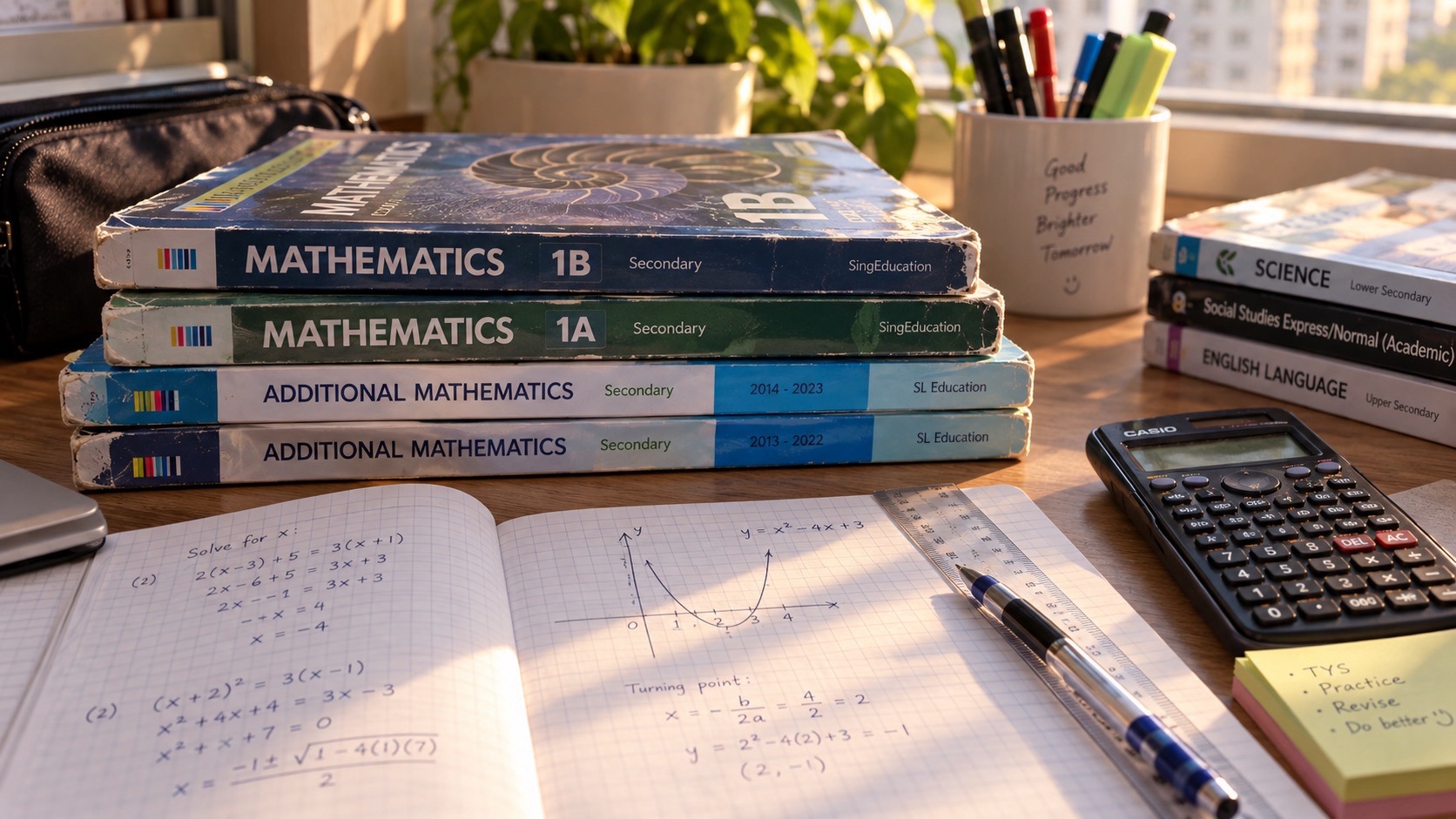
Students in Punggol taking Additional Mathematics in the 2027 Singapore-Cambridge Secondary Education Certificate (SEC) face two published subject levels. G2 is syllabus K232, with two 70-mark papers of 1 hour 45 minutes each. G3 is syllabus K341, with two 90-mark papers of 2 hours 15 minutes each. Each paper carries 50% of the subject assessment. These are different specifications; use the correct one before buying a book or preparing mock examinations.
Both official syllabuses organise content under algebra, geometry and trigonometry, and calculus. Both require students to reason, interpret questions and show essential working. G2 is not simply ‘easy arithmetic’, and G3 is not merely G2 done faster. For a family in Punggol, the useful task is to discover which mathematical idea is secure, which first step fails, and which examination level applies.
This guide provides a source-checked comparison of the 2027 subject documents, original worked questions with reasons, a revision system and a parent-friendly checklist. It describes the SEC examination rather than claiming a special Punggol syllabus. Always refer to the official PDF for the complete assessable boundaries and school-specific arrangements.
QUICK REFERENCE — 2027 G2 K232: 70 marks × 2 papers, 1h45 each; 2027 G3 K341: 90 marks × 2 papers, 2h15 each; all questions compulsory. Both permit approved calculators. The relevant PDFs and original worked examples appear below.
Punggol Additional Mathematics | Series Article Index
Jump directly to the right stage, 2027 SEC requirement or mathematical topic. All eight entries below are published guides; the Primary-to-University overview is the series hub.
Contents
- The official 2027 examination at a glance
- The assessment objectives explain why good working matters
- G2 is built on its own prerequisite base
- G3 assumes G3 Mathematics and extends the range
- Algebra is a language, not just a speed contest
- Surds, polynomials and partial fractions
- Trigonometry connects triangles, periodicity and identities
- Coordinate geometry turns pictures into testable statements
- Calculus begins with meaning before procedures
- The additional G3 calculus applications need separate practice
- How to choose between textbooks and examination papers
- A weekly plan for an eight-week learning cycle
- Common exam losses arise before the arithmetic
- How parents can use the official PDF without teaching every topic
- The next step after mastering the syllabus
- 23 worked mathematics checkpoints
- Parent questions
- Official syllabus PDFs and Punggol reading
The official 2027 examination at a glance
The G2 specification K232 gives Paper 1 a duration of one hour and forty-five minutes, 13–15 questions and 70 marks. Paper 2 also lasts one hour and forty-five minutes, contains 8–10 questions and carries 70 marks. Both must be answered in full, with each worth half the examination.
The G3 specification K341 sets Paper 1 at two hours and fifteen minutes, 12–14 questions and 90 marks; Paper 2 has the same duration, 9–11 questions and 90 marks. Both are compulsory in full and each is worth 50%. G3 questions can have marks up to ten in Paper 1 and twelve in Paper 2.
In either level, essential working earns marks; final answers without the necessary mathematical steps may lose marks. The documents permit an approved calculator in both papers and state the standard rounding convention: non-exact results generally to three significant figures, and angles in degrees to one decimal place unless otherwise specified.
A family should print the cover and assessment-scheme pages of the correct SEC syllabus. The same official PDF can then anchor the student’s textbook, practice papers and tuition homework. Without that foundation, revision folders quickly accumulate attractive but unsuitable questions.
The assessment objectives explain why good working matters
The G2 weighting is approximately AO1 standard techniques 50%, AO2 problem solving 40%, and AO3 mathematical reasoning and communication 10%. G3 allocates approximately AO1 35%, AO2 50%, and AO3 15%. These are syllabus-level approximations, not the percentages assigned to each exercise.
AO1 includes facts, terminology, reading graphs or tables and routine mathematical procedures. AO2 requires deciding what mathematics a situation needs, selecting a method, connecting representations and interpreting results. AO3 requires justification and clear mathematical arguments.
The implication for learning is substantial. A student may practise differentiation rules accurately but still need to interpret which derivative a word problem requests. Another may reach the correct number but be unable to justify a domain restriction. Both are teachable issues that cannot be fixed by memorising additional formulae alone.
Use three colours when reviewing a script if helpful: one for a technique error, one for a problem-selection or context error, and one for missing explanation. The objective is not to pretend to know the examiner’s actual marks allocation, but to identify the type of thinking the student should improve.
G2 is built on its own prerequisite base
The G2 K232 syllabus explicitly assumes the content of G2 Mathematics plus two additional prerequisite areas: solving linear inequalities in one variable and particular sketches of quadratic graphs. These assumed topics may be required indirectly even when not assessed directly as separate syllabus sections.
That makes the relationship between core Mathematics and Additional Mathematics essential. Students who cannot isolate a variable, interpret a graph or reason about a quadratic function will struggle even when a new chapter begins with a familiar formula.
The syllabus’s stated intention is to prepare learners adequately for G3 Additional Mathematics. That statement should not be rewritten as a guarantee of automatic subject-level transfer or admission to a particular post-secondary course.
A practical readiness check is to ask a student to solve 3x − 5 < 10, draw the resulting set on a number line, then explain the direction of the inequality. It produces x < 5. That three-part task checks algebra, representation and justification at the same time.
G3 assumes G3 Mathematics and extends the range
The G3 K341 syllabus explicitly assumes G3 Mathematics knowledge. Compared with the G2 Additional Mathematics subject-content list, G3 includes additional strands such as the binomial theorem for positive integer powers, exponential and logarithmic functions, proof topics in plane geometry and particle motion applications of calculus.
Its calculus content also includes differentiation and integration involving named trigonometric, exponential and logarithmic functions, and applications involving displacement, velocity and acceleration. Those are significant additions in modelling and technical scope rather than merely a larger number of identical drills.
The G3 syllabus introduction says it prepares students adequately for A-Level H2 Mathematics, where strong algebraic manipulation and mathematical reasoning are needed. It does not claim that taking G3 guarantees that a particular junior college will place the student in H2 Mathematics; institutions have their own subject requirements.
A student moving from one topic list to another should compare the exact official content, not infer exclusions from a publisher’s chapter headings. The syllabus boundaries, including what is excluded, matter most when choosing problem sets or diagnosing examination gaps.
Algebra is a language, not just a speed contest
Quadratic functions bring together algebraic form, graph shape, roots and turning points. Completing the square shows the maximum or minimum directly; factorisation shows zeros when available; the discriminant reveals the number of real roots without finding their values.
For example, x² − 6x + 11 becomes (x − 3)² + 2, so its minimum is 2. This immediately implies the function is strictly positive for every real x. It also implies x² − 6x + 11 = 0 has no real solution; the discriminant 36 − 44 = −8 confirms the result.
A teenager who remembers that ‘the discriminant must be positive’ but cannot say which case requires strict positivity may be practising a slogan. Ask the student to sketch a curve that crosses, touches or misses the x-axis and label the three discriminant cases.
Parents do not need to become exam tutors. Asking ‘what does this answer represent?’ and ‘how could you check?’ is enough to promote the habit of mathematical meaning. That habit is valuable at both subject levels.
Surds, polynomials and partial fractions
A surd can preserve an exact result such as 3√2 rather than an approximation. Rationalising a denominator is an equivalent transformation, but students should still check that the denominator was not zero and that the numerical value has not changed.
Polynomial division and factor or remainder theorems build another reversible way of thinking. If substituting x = 2 makes p(x) equal zero, x − 2 is a factor of that polynomial. But if p(2) is not zero, the value has meaning as a remainder instead of a licence to invent a factor.
Partial fractions reverse the operation of combining rational expressions into a single fraction. The denominators and their factor structure determine an appropriate decomposition. A student must check that the proposed fractions recombine to the original expression over a common denominator.
Both 2027 G2 and G3 contain polynomials, surds and partial fractions in the published subject-content lists. Presenting these as automatically G3-only topics would be wrong and could cause G2 learners to skip assessed skills. The correct differentiation comes from reading the actual lists, not assumptions about names.
Trigonometry connects triangles, periodicity and identities
The two syllabuses include trigonometric functions in degrees and radians, exact values for notable angles, graph properties and identities. This means a student’s calculator mode is part of mathematical interpretation rather than a housekeeping detail.
Consider sin(π/6). In radian measure π/6 is thirty degrees, so the exact result is one half. A student who enters π/6 under degree mode has asked the calculator a different question. The solution is to label the unit before pressing keys.
Identities need explanation. The statement sin² θ + cos² θ = 1 holds for every valid angle, but sin θ + cos θ = 1 is not a general identity. Substituting a familiar angle such as 45 degrees quickly exposes the second claim as false.
For trig equations the interval is essential: an expression can repeat at different angles, but the required answer set is the solutions inside the stated range. Revision should make students check interval endpoints and periodicity rather than memorise a single calculator output.
Coordinate geometry turns pictures into testable statements
The gradient of a line is a rate of change; its sign and magnitude are linked to the coordinates and scale. Parallel lines have equal gradients where those gradients are defined, while non-vertical perpendicular lines have gradients whose product is −1.
Circles introduce the geometry of a constant distance from a fixed point. A circle centred at (2, −3) with radius 5 has equation (x − 2)² + (y + 3)² = 25. Substituting its centre or a point five units away gives a quick correctness check.
Both syllabuses include coordinate geometry of circles, and their content lists exclude problems involving two circles. The G3 syllabus additionally lists linearising certain relationships with straight-line graphs, so a G3 student should recognise what a transformed graph’s gradient represents.
Graphing accuracy starts long before Secondary 4. Students need to name axes, identify units, read intercepts and choose an appropriate scale. An attractive graph without a meaningful scale can conceal a mathematically wrong conclusion.
Calculus begins with meaning before procedures
Differentiation measures how a quantity changes. For y = x² + 4x, dy/dx = 2x + 4. At x = 3 the tangent gradient is 10. The number ten is not automatically a distance, speed or price; its interpretation follows from the original variable definitions.
The product, quotient and chain rules appear in both G2 and G3 Additional Mathematics. A learner who can differentiate x² may still err on (3x + 1)² because the inner derivative matters. The correct derivative is 6(3x + 1), not 2(3x + 1).
Integration reverses suitable differentiation operations and can represent accumulated quantities or signed area. A student who memorises an antiderivative without evaluating the supplied limits has not completed a definite integral.
A key G2 and G3 syllabus boundary is that the definite-integral area section excludes finding areas between two curves. Families should honour this exclusion when deciding what is compulsory preparation, while recognising that additional applications can be taught for enrichment.
The additional G3 calculus applications need separate practice
G3’s syllabus extends calculus to derivatives of sin x, cos x, tan x, e^x and ln x, and to stated corresponding integration forms. It also explicitly includes particle motion in a straight line through displacement, velocity and acceleration.
For a simple model s(t) = t³ − 6t² + 9t, the velocity is v(t) = 3t² − 12t + 9, and acceleration is a(t) = 6t − 12. A student must distinguish which quantity the question asks for and use the proper units.
At t = 2, v(2) = 12 − 24 + 9 = −3. A negative velocity represents direction relative to the chosen positive direction, not automatically ‘negative speed’. Speed is the magnitude of velocity and is three units per second in this simplified model.
G2 includes gradients, connected rates and optimisation too, so the decision is not whether G2 has ‘no calculus’. It does. The difference is the exact coverage and applications laid out in the syllabus PDFs. That is what practice needs to follow.
How to choose between textbooks and examination papers
Start every purchase or download by checking the printed subject code, examination year and assessed content. A resource may be educationally sound yet aligned to a different level or prior examination specification.
Then inspect the solutions, not just the number of pages. An answer key with only final numbers is less useful for independent diagnosis than solutions that identify why each algebraic transformation is permitted. Essential working is assessed, so learners must practise recording it.
A topic practice book should provide graduated reasoning: first recognise the method, then apply it without the method announced, and then explain a novel question. If every problem is pre-labelled ‘chain rule’, the student never learns to decide when to use the chain rule.
Full papers belong later in the cycle when topic misconceptions have been addressed. Timed testing is good for building retrieval and managing time; it is a poor substitute for explaining an idea the learner never understood.
A weekly plan for an eight-week learning cycle
Week one creates a diagnostic profile with carefully selected questions from the student’s examined syllabus. Record which part first goes wrong and how much help was required. Identify two major misconceptions, not ten.
Weeks two and three repair algebra and equation reasoning. Weeks four and five address either trigonometry or calculus according to the student’s demonstrated needs and school pacing. During these weeks, ask for a short explanatory sentence after every important result.
Week six uses mixed-topic questions without chapter labels. Week seven introduces timed sections resembling the actual paper’s duration and the correct number of marks, without promising exact future question distributions. Week eight revisits the week-one problems after a gap and includes a new transfer question.
This cycle is a model, not a SEAB-prescribed timetable. Adapt it to the child’s school scheme of work, upcoming CCAs and tests. Revision should remain compatible with rest, sleep and independent reading rather than taking over the whole week.
Common exam losses arise before the arithmetic
Students frequently lose marks when they decide too quickly what a problem is asking. They may find a root when the command is to discuss the nature of roots, calculate signed integral when asked for geometrical area, or differentiate once when the task calls for acceleration.
A second cluster involves silent assumptions: dividing by an algebraic expression that could be zero, taking a square root without considering domain conditions, or overlooking the stated interval for a trig equation. These can invalidate otherwise tidy working.
A third cluster involves presentation. The final line should answer the actual question, give suitable units or exact form when required, and match the requested accuracy. Both syllabus PDFs warn that omitted essential working can cost marks.
After each paper, record a mistake by its first wrong line and its cause. Labels such as ‘careless’ are often too broad to guide revision. ‘Forgot to change from degrees to radians’ or ‘lost a zero root by dividing both sides by x’ gives a teacher or tutor something concrete to fix.
How parents can use the official PDF without teaching every topic
The syllabus is most helpful as a checklist for scope, not as a demand to push the learner through topics before school. Read the introduction, assessment objectives, paper scheme and the subject-content list. Place a simple tick next to topics already taught and a question mark next to uncertain boundaries.
When a child says a question is unfairly difficult, compare it with the correct syllabus and the school’s taught scheme. Sometimes it is extension material; sometimes it is examined content presented in a novel context. The response changes with that distinction.
Ask the learner to demonstrate one successful independent solution and one error corrected with explanation. If you use a tutor, request the same evidence. Number of worksheets and tuition hours are less informative than retained competence.
Punggol’s transport, study spaces and family routines affect the practical schedule but not the official content or paper weightings. A reliable teaching plan is therefore national-syllabus accurate and locally realistic.
The next step after mastering the syllabus
Doing well in Additional Mathematics can strengthen the habits needed for further Mathematics in JC, polytechnic and other programmes. But a good examination grade is only one item within the requirements of a later course.
A G3 pupil interested in H2 Mathematics can use the upper-secondary syllabus’s calculus and algebra as a foundation while still checking the JC’s current admission and subject allocation rules. A G2 pupil can work productively with their own syllabus and discuss subsequent opportunities with school staff.
The SEC first examination is in 2027, with new post-secondary admissions arrangements announced for 2028. These updates make year-specific documents especially important. Do not use a prior admission exercise or an old O-Level worksheet as if it were an unchanged legal promise.
The educational goal is a child who can choose a method, show why it works, communicate an answer and adjust when a problem looks unfamiliar. The subject certificate records a performance; the deeper mathematical habit is what lasts beyond the examination.
23 worked mathematics checkpoints, with reasons and common errors
These are original teaching examples, not transcriptions of SEC papers. Each mathematical solution is designed to be checked independently. Examples explicitly labelled ‘G3 addition’ concern areas in G3 K341 that do not appear as separate subject content in G2 K232; the other checkpoints illustrate shared foundations or skills at an appropriate point of learning.
1. Quadratic minimum
Question: Find the minimum of x² − 8x + 19.
Worked solution: Complete the square: (x − 4)² + 3. Because a real square is never negative, the minimum value is 3 at x = 4.
Understand the reasoning: Writing x = 3 as the minimum confuses the input coordinate with the function value.
Independent check: Ask for both the turning point (4, 3) and the minimum value 3.
2. Nature of roots
Question: For x² − 2x + k = 0, identify k giving equal roots.
Worked solution: D = (−2)² − 4k = 4 − 4k. Set D = 0, giving k = 1. The repeated root is x = 1.
Understand the reasoning: The discriminant condition answers the question without requiring two full quadratic-formula calculations.
Independent check: For k = 0 expect two distinct roots; for k = 2 expect no real roots.
3. Quadratic inequality
Question: Solve x² − 5x + 6 < 0.
Worked solution: Factor: (x − 2)(x − 3) < 0. The upward parabola is below zero between its roots, so 2 < x < 3.
Understand the reasoning: The sign interval matters; writing x < 2 or x > 3 would solve the opposite sign.
Independent check: Test x = 2.5 and x = 4 in the original expression.
4. Surd simplification
Question: Simplify √18 + √8 exactly.
Worked solution: √18 = 3√2 and √8 = 2√2; therefore the sum is 5√2.
Understand the reasoning: The coefficients combine because both terms are multiples of the same irrational quantity.
Independent check: Square neither sum term separately; confirm an approximate value only at the end.
5. Surd denominator
Question: Simplify 3/√3 without a radical denominator.
Worked solution: Multiply numerator and denominator by √3, giving 3√3/3 = √3.
Understand the reasoning: Changing the expression’s form must preserve its value; the denominator was nonzero.
Independent check: Check with a calculator before and after.
6. Remainder theorem
Question: Find the remainder when p(x) = x³ − 4x + 7 is divided by x − 2.
Worked solution: Use p(2) = 8 − 8 + 7 = 7. The remainder is 7; x − 2 is not a factor.
Understand the reasoning: A common confusion is treating every substitution value as evidence of a factor.
Independent check: Show that a factor would require a remainder of zero.
7. Factor theorem
Question: Check whether x + 1 is a factor of x³ + 2x² − x − 2.
Worked solution: Substitute x = −1: −1 + 2 + 1 − 2 = 0, so x + 1 is a factor.
Understand the reasoning: For a divisor x + 1 the substitution is −1, not +1.
Independent check: Factor by grouping to get (x + 1)(x + 2)(x − 1).
8. Polynomial root check
Question: Solve x³ − 4x = 0.
Worked solution: Factor x(x² − 4) = x(x − 2)(x + 2) = 0. Solutions are −2, 0 and 2.
Understand the reasoning: Cancelling x at the first step would lose the legitimate zero solution.
Independent check: Substitute all three into the original cubic.
9. Partial fractions
Question: Write 3/((x + 1)(x + 2)) as A/(x + 1) + B/(x + 2).
Worked solution: 3 = A(x + 2) + B(x + 1). Put x = −1 to find A = 3; put x = −2 to find B = −3.
Understand the reasoning: The restriction x ≠ −1, −2 remains part of the original expression.
Independent check: Recombine 3/(x + 1) − 3/(x + 2) to check.
10. Radians
Question: Convert 150 degrees into radians.
Worked solution: 150 × π/180 = 5π/6 radians. This exact value is preferable to an early decimal approximation.
Understand the reasoning: Calculator settings and written units must agree.
Independent check: Check that 5π/6 is between π/2 and π.
11. Exact trig
Question: Evaluate sin 30 degrees × cos 60 degrees.
Worked solution: sin 30° = 1/2, cos 60° = 1/2; the product is 1/4.
Understand the reasoning: Multiplication of two exact trig values is not the same as sin(30° + 60°).
Independent check: Compare it with sin 90° = 1.
12. Trig identity
Question: Show 1 − sin² θ = cos² θ.
Worked solution: Rearrange the Pythagorean identity sin² θ + cos² θ = 1.
Understand the reasoning: An identity is true on its domain, not a claim about one special measured angle.
Independent check: Verify numerically at 45 degrees.
13. Line slope
Question: Find the gradient through (−1, 2) and (3, 10).
Worked solution: Gradient = (10 − 2)/(3 − (−1)) = 8/4 = 2.
Understand the reasoning: Subtracting one x-coordinate from another must be matched by the same order of y-subtraction.
Independent check: Reverse both point orders and confirm the same gradient.
14. Circle from centre
Question: Give the equation for centre (−2, 5), radius 3.
Worked solution: (x + 2)² + (y − 5)² = 9.
Understand the reasoning: Parentheses encode displacement from the centre; signs reverse inside the brackets.
Independent check: Substitute (1,5), a point at distance three from the centre.
15. Product rule
Question: Differentiate y = x²(x + 1).
Worked solution: Use expansion y = x³ + x², so y’ = 3x² + 2x. Product rule gives the same result.
Understand the reasoning: A student can use two valid methods to check each other.
Independent check: Use both methods to detect a missing factor.
16. Chain rule
Question: Differentiate y = (2x − 1)³.
Worked solution: Derivative = 3(2x − 1)² × 2 = 6(2x − 1)².
Understand the reasoning: The inner derivative 2 is essential; the power rule alone is insufficient.
Independent check: Expand at x = 1 or use a numerical estimate to check.
17. Stationary point
Question: Find the turning point of y = x² − 6x + 1.
Worked solution: Differentiate: y’ = 2x − 6, zero at x = 3. Then y(3) = −8. Second derivative 2 > 0 shows a minimum.
Understand the reasoning: A stationary x-coordinate is not itself the turning-point y-value.
Independent check: Check with completing square: (x − 3)² − 8.
18. Definite integral
Question: Evaluate the integral of 2x from x = 1 to x = 3.
Worked solution: Antiderivative x²; evaluate 3² − 1² = 8.
Understand the reasoning: Remember to subtract the lower endpoint evaluation.
Independent check: Interpret positive area as 8 square units here.
19. Area below axis
Question: Find the geometric area between y = x and x-axis from −2 to 0.
Worked solution: The signed integral is [x²/2] from −2 to 0 = −2, while the geometric area is 2 square units.
Understand the reasoning: A negative integral is not a negative physical region.
Independent check: Sketch the triangular region before integrating.
20. Binomial expansion: G3 addition
Question: Find coefficient of x² in (1 + x)^5.
Worked solution: Use C(5,2) = 5×4/2 = 10, so coefficient of x² is 10.
Understand the reasoning: The positive-integer binomial theorem is listed explicitly in G3 K341 subject content, not G2 K232.
Independent check: Check by expanding or considering combinations of two x-choices.
21. Logarithms: G3 addition
Question: Solve 2^x = 16.
Worked solution: Since 16 = 2^4, x = 4, equivalently log base 2 of 16 equals 4.
Understand the reasoning: The inverse relationship between exponentials and logs is explicit in G3 K341.
Independent check: Check by substituting 4 back into the original equation.
22. Trigonometric derivative: G3 addition
Question: Differentiate sin x + 2e^x with respect to x.
Worked solution: Derivative is cos x + 2e^x when x is measured in radians.
Understand the reasoning: The G3 calculus syllabus includes derivatives of trig and exponential functions, so units and rules matter.
Independent check: Check the coefficient 2 remains attached to the exponential term.
23. Motion: G3 addition
Question: For s(t) = t² − 2t, find velocity at t = 3 and acceleration.
Worked solution: Velocity v = 2t − 2 gives v(3) = 4. Acceleration a = 2 (in corresponding units per second squared).
Understand the reasoning: G3 lists one-dimensional motion and the distinction among displacement, velocity and acceleration.
Independent check: Check the units after assigning position and time units in the model.
Frequently asked parent questions
Is G2 Additional Mathematics an actual 2027 SEC paper?
Yes. The school-candidate syllabus is K232 and has two 70-mark papers.
How long are the G3 Additional Mathematics papers?
Two hours and fifteen minutes each, with 90 marks each. Both carry half the examination.
Are calculators allowed?
The syllabus states an approved calculator may be used in both papers at both levels.
Do both levels study calculus?
Yes. Both published subject-content lists include differentiation and integration, though their specified coverage differs.
Is the binomial theorem in the G2 K232 content list?
It is explicitly in G3 K341, not in the G2 K232 subject-content list; do not confuse the general mathematical notation appendix with assessed content.
Are exponential and logarithmic functions in the G3 list?
Yes. These are included in the G3 algebra strand.
Can I use a 2026 O-Level book for SEC 2027?
Possibly for a shared concept, but check level, year and assessed content before treating it as a complete SEC revision guide.
Will a formula sheet do all the work?
No. Relevant formulae are provided but the student must choose and apply methods, explain reasoning and show essential working.
What is the usual answer rounding?
Unless specified otherwise, the syllabus generally requires non-exact numerical answers to three significant figures and angles in degrees to one decimal place.
Does Punggol have different exam papers?
No. The SEC is a national examination. School internal tests and offered subject combinations can vary.
How do I identify the first mistake?
Find the earliest wrong assumption, transformation, sign, unit or method choice; then require an independent correction and a transfer problem.
What is the one most useful study change?
Compare all practice against the current official SEC syllabus and review incorrect working, not merely final marks.
Official references and related Punggol articles
Evidence review: 18 October 2026. The official PDFs are the primary references for subject codes, content, papers, marks, duration, AO proportions, notation and exclusions. Consult updated papers for later examination years; the syllabus document has a separate mathematical-notation glossary, which is not a substitute for its examinable subject-content list.
- Official K232 G2 2027 Additional Mathematics syllabus PDF
- Official K341 G3 2027 Additional Mathematics syllabus PDF
- SEAB 2027 G2 syllabus list
- SEAB 2027 G3 syllabus list
- 2027 SEC national examination overview
- Punggol primary-to-university Additional Mathematics guide
- Punggol G2 vs G3 Secondary 2 subject choice
- Punggol G2 discriminant tuition example
- Punggol G3 area below x-axis explanation
Part of the 100-guide series Understanding the Additional Mathematics Education System of Punggol. This guide describes taught content and assessment, complementing separate articles on the full education journey and on Secondary 2 subject selection.


