
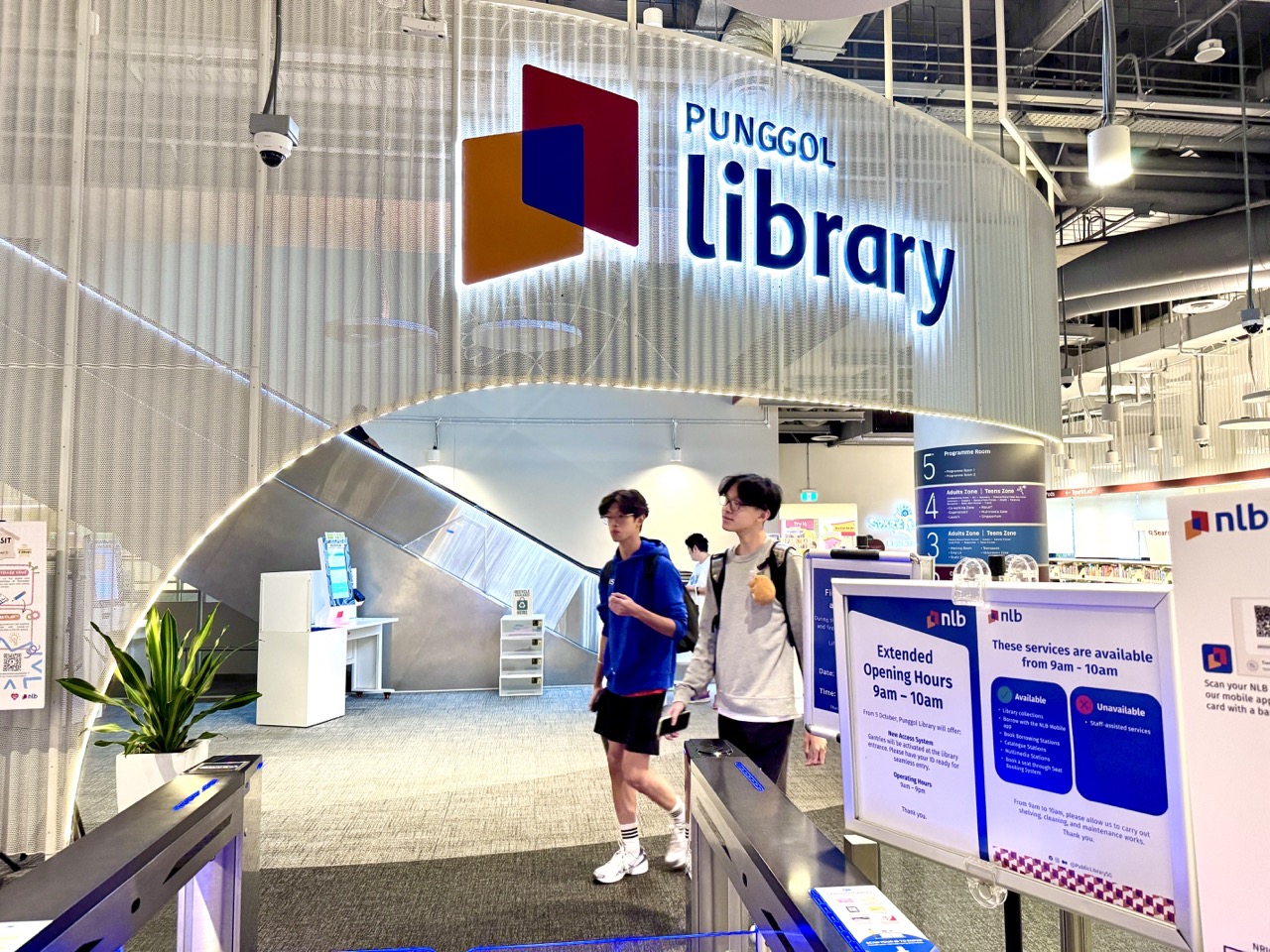
Tinkering at Spark!Lab, Punggol Library‘s Smithsonian-designed invention space, is one of the most satisfying things to do in Punggol during the school holidays: build something, test it, watch it wobble, and make it better.
“What if it falls down?” asks the eight-year-old, holding up a tower of card and tape. The best answer in the whole library is: “Then we’ll find out why.”
This is idea #62 in eduKate Punggol’s Top 100 Things to Do in Punggol During the School Holidays. Here you will find what the lab is, who it suits, how to plan a visit around the library’s hours, and how to help your child think like an inventor without taking the scissors out of their hands.
Most holiday activities reward getting it right.
This one rewards trying again.
That small difference is why children walk out of a tinkering session taller than they walked in.
This idea is perfect for families who want to:
- give a curious 7-to-12-year-old something real to build;
- swap screen time for hands-on problem-solving;
- try a Science-flavoured activity that feels like play;
- spend a rainy or hazy morning somewhere cool and indoors;
- pair building with reading, so one feeds the other; or
- watch a child bounce back from a wobbly first attempt.
Quick look
- Best for: children aged 7 to 12, with a parent nearby
- Time needed: 45 minutes to 1.5 hours, plus time to browse books
- Cost: library entry is free; check any workshop listing for its own terms
- Best time: a weekday morning soon after the library opens at 10am
- Nearest MRT/LRT: Punggol MRT (NE17) and Sam Kee LRT
- Rain plan: it is indoors, on Level 2 of Punggol Regional Library
See all 100 school-holiday ideas · Chat with eduKate Punggol on WhatsApp · Visit eduKate Punggol on Facebook
A Tinkering Session Is Bigger Than It First Appears
From the outside, it can look like children fiddling with bits and pieces. Up close, something more interesting is going on.
NLB created this Level 2 space with the Smithsonian Institution in the United States, and describes it as a hands-on tinkering area where children aged 7 to 12 solve challenges on their own or with their families. When the library opened in 2023, NLB noted that it was one of the most popular spaces among the 90,000-plus visitors in the first two months.
Why would a library, of all places, have an invention lab?
Because reading and making are closer cousins than they look. A HealthHub page describing NLB’s screen-lite programmes says children in the lab’s exploration activity learn to think like inventors, using ideas from Singapore literature to design inventions that solve real problems. A story raises a problem. The child builds a possible answer. Then the child tests it.
That is not fiddling. That is thinking with your hands.
The Hidden Lesson in a Wobbly Invention
Here is a made-up example, because challenges change from visit to visit.
Say a child is asked to build a paper bridge that can hold coins. Her first bridge is a flat sheet across two books. Three coins, and it sags to the table.
“It doesn’t work.”
“What did it do?”
“It bent in the middle.”
So she folds the same sheet into a zigzag and tries again with the same books and the same coins. This time it holds eight.
She has just run a fair test.
She changed one thing, kept everything else the same, and compared the results. That is exactly the habit that Primary Science asks for from Primary 3 onwards: observing, predicting and testing fairly. She also learnt something even more valuable: a failed first try is not a dead end. It is information.
Our family visit guide to the lab puts it neatly: when something does not work, ask what changed and what your child wants to try next.
Why Punggol Families Love Spark!Lab
Some outings need a car, a booking and a budget. This one needs a library card in your pocket and a little patience.
For Punggol families it sits right in the middle of town, inside One Punggol, so it slots easily into a day that already includes errands, lunch or a sibling’s activity.
The joys of a tinkering morning
- It is designed for exactly the 7-to-12 age band that can be hardest to entertain
- Children can work alone, with a sibling or with a parent
- The challenge gives the visit a clear purpose, so nobody wanders aimlessly
- It links books and building, which suits readers and non-readers alike
- Mistakes are part of the fun, not a reason to give up
- It is indoors and air-conditioned, ideal on hot, wet or hazy days
- The rest of Level 2, from storybooks to world cultures, is a few steps away
The best part is the look on a child’s face when the second attempt works better than the first.
What to Expect on Level 2
The lab is part of a working children’s floor, so it helps to know how the pieces fit together. Here is what we could confirm from NLB and HealthHub at the time of checking in October 2026.
Where it is and who it is for
You will find it on Level 2 of Punggol Regional Library (NLB also calls it Punggol Library), inside One Punggol. NLB’s age guidance is 7 to 12. Follow the Level 2 signs or ask staff on a first visit.
Self-directed exploration
The HealthHub page on NLB screen-lite programmes describes an exploration activity in which ideas from Singapore books inspire inventions, with a Challenge Card that asks book-related questions and practises hands-on skills. Start with whatever challenge is displayed on the day, and let your child explain what it asks before choosing any materials.
The Inventors’ Workshop
HealthHub also mentions an Inventors’ Workshop, where children present their inventions. This is a separate programme with its own registration. We could not find any dates published for November or December 2026 at the time of checking, so check NLB’s programme listings live before promising it to anyone.
Shared materials and house rules
Materials are shared by every family who visits. Follow the material-use rules on display, leave enough pieces for the next child and help your child return items as directed. A two-minute tidy-up is part of being a good inventor.
Neighbours on the same floor
Level 2 also has the children’s collection, the World and Us Zone (ages 4 to 12) with books on geography and cultures, and Storyteller Cove (ages 7 to 12) for story-making. A tinkering session followed by ten minutes of browsing makes a beautifully balanced visit.
How to Plan a Brilliant Tinkering Morning
Children do their best building when they arrive fresh, curious and not too hungry. A few small decisions make that happen.
1. Check the listings and the air
Look at NLB’s current programme listings in case a facilitated session is running, and read its age guidance and registration instructions. If you are walking over, check haze.gov.sg first, since October 2026 brought unhealthy haze readings to Singapore.
2. Read first, build second
Borrow or browse one Singapore picture book or short story on the way in. Ask your child, “What problem does the character have?” That question is the perfect warm-up for an invention challenge.
3. Choose one challenge, not five
A first visit works best with one main task. If your child is still keen afterwards, allow a second attempt rather than starting something new.
4. Agree on the helper’s role
Decide together what you will do. A good rule: you may read instructions aloud and ask questions, but your child holds the materials. Our lab guide suggests helping with reading and sketching without taking over.
5. Bring a notebook
A small notebook and pencil let your child sketch an idea before building and note what changed after each test. It also makes a lovely souvenir.
6. Plan a calm finish
End with a snack or lunch and one question: “What would you change if you built it again tomorrow?”
A Sample Holiday Day, Hour by Hour
9.30am: Breakfast and a mini-mission
Over breakfast, ask your child to guess what kind of thing an inventor might build today. Pack the notebook.
10am: Into the library
Head to Level 2 and choose one short Singapore book together. Read it, or part of it, in a quiet corner.
10.30am: Build, test, improve
Visit the lab and pick the challenge on display. Build a first version, test it, talk about what happened, then try again.
11.30am: Sketch and browse
Sit down and draw the best version, with arrows showing what changed. Then browse the children’s shelves for a book about how things work.
12.15pm: Lunch at One Punggol
One Punggol Hawker Centre is on Level 2 of the same building. Let your child explain the invention to whoever is paying for lunch.
Afternoon: The kitchen-table sequel
At home, offer clean recyclables, tape and string. Children often want to rebuild their library invention, and the second home version is frequently the most creative of all.
Three Ways to Enjoy It
Tinkering suits every age, but the way you guide it should change.
For little explorers (Primary 1–3)
NLB’s guidance starts at age 7, so check that a younger Primary 1 child fits the age band. Keep the challenge short and celebrate every attempt. Ask simple questions: “Is it taller now?” “Did it hold more coins?” If a preschool sibling comes along, Level 1 has the Toy Library and TinkerTots for children aged 6 and below, with a parent supervising.
For big kids (Primary 4–6)
Older primary children can plan before they build. Ask them to predict what will happen, then test and record the result. Challenge them to change only one thing at a time and explain why. Primary 6 children taking a break after the PSLE often enjoy the freedom of a problem with no marks attached.
For teens (Secondary 1–4)
The lab’s age guidance ends at 12, so teens are better as patient helpers for a younger sibling than as participants. If your teenager loves making things, NLB’s MakeIT space on Level 4 recommends its equipment for ages 13 and above, with its own hours and booking rules.
The Learning Bridge: Science Without the Worksheet
Tinkering is not a lesson, but it quietly rehearses skills children use in school.
- Science: Primary Science, a formal subject from Primary 3, values observing, questioning, predicting and fair testing. Changing one thing at a time and comparing results practises exactly that habit.
- English: Explaining “I tried this, it did that, so I changed this” builds clear, logical speaking, the kind that helps later in oral conversations and in writing procedures.
- Mathematics: Counting coins, measuring heights and comparing results are everyday practice in measurement and number sense.
Keep it gentle. One “What did you notice?” is worth more than a written report. For a wider view of holiday Science, our article on repairing, consolidating or preparing ahead in Science explains how to keep the break balanced.
Little Hiccups and How to Dodge Them
The challenge isn’t what you expected
Challenges and materials change. Treat whatever is on display as the adventure of the day rather than looking for something you saw online.
Frustration after the first try
Some children crumple when the first version fails. Name it kindly (“That was annoying”), then ask one curious question. Stopping for a snack before trying again works wonders.
Parents who build too much
It is very tempting to fix the bridge yourself. Sit on your hands, ask questions and let the child own the result.
A sibling who is too young
Children under 7 may find the challenges hard and the waiting harder. Plan a parallel stop at the Level 1 play spaces for them, with a second adult if possible.
Busy times and full workshops
Weekend afternoons and rainy days can be busy. If a registered workshop is full, choose another date rather than turning up hoping for a place.
Holiday closures and the walk there
The library closes at 5pm on 24 and 31 December and is closed on 25 December and 1 January. The walk from the MRT is outdoors, so check haze.gov.sg, and wait indoors if the MSS lightning alert page shows activity nearby. On high-haze days, our Punggol Haze Indoor Activity Planner has more ideas.
What a Great Day Looks Like
You will know the morning went well when your child:
- explains what the challenge asked in their own words;
- tries at least twice, without being pushed;
- says “I changed this, and it worked better”;
- tidies up the materials without a long reminder;
- wants to build a new version at home; and
- asks, “When can we go back?”
That last question is the sound of a young inventor being born.
When to Go
For MOE primary and secondary schools, the 2026 year-end break begins on Saturday 21 November and ends on Thursday 31 December 2026, according to MOE’s 2026 calendar. For later breaks, MOE’s 2027 calendar lists the March holidays (13 to 21 March), June holidays (29 May to 27 June), September holidays (4 to 12 September) and a year-end break from 20 November 2027.
The main library is open 10am to 9pm daily and closed on public holidays. Weekday mornings are usually the calmest time, when children are fresh and the floor is quieter. Library hours do not set a separate timetable for the lab, so check NLB’s listings for any facilitated session.
Getting There from Around Punggol
The lab is on Level 2 of Punggol Regional Library, inside One Punggol. NLB puts the library about five minutes’ walk from Exit A of Punggol MRT, with Sam Kee LRT and Punggol Bus Interchange also nearby. From Waterway Point, it is about five minutes on foot via Punggol Green, according to NLB. There is parking at One Punggol; see our guide on getting to One Punggol for details.
Location: Level 2, Punggol Regional Library, 1 Punggol Drive, One Punggol #01-12, Singapore 828629
Nearest MRT/LRT: Punggol MRT (NE17) and Sam Kee LRT
Entry: free library entry; check listings for facilitated sessions
Quick Details
Activity: hands-on invention challenges in the library’s Smithsonian-designed tinkering lab
Where: Level 2, Punggol Regional Library (Punggol Library), One Punggol
Best ages: 7 to 12 (NLB’s guidance)
Cost: library entry is free; no fee for self-directed exploration was stated on the official pages we checked, and workshops follow their own listings
Time needed: 45 minutes to 1.5 hours
Booking: self-directed visits follow the library’s hours; registered workshops need sign-up
Accessibility: NLB lists a range of accessible features at the library; ask staff about access and support on the day
Status checked: October 2026, NLB library page (the lab is listed; no closure notice at the time of checking)
What to Bring
- An NLB card or the NLB app, in case you borrow books
- A small notebook and pencil for sketches
- A water bottle
- Patience, and a promise to let your child hold the materials
- A snack for afterwards, eaten outside the library
- Clean recyclables waiting at home for the sequel
- An umbrella for the walk
Frequently Asked Questions
What ages is the lab for?
NLB’s guidance is ages 7 to 12. Younger children can enjoy the Toy Library and TinkerTots on Level 1, which are for ages 6 and below.
Where exactly is it?
On Level 2 of Punggol Regional Library, inside One Punggol at 1 Punggol Drive.
Do we need to book?
For self-directed exploration, follow what is displayed on the day. Registered workshops, such as the Inventors’ Workshop HealthHub describes, need sign-up through NLB’s listings.
Is it free?
Library entry is free. The official pages we checked did not state a fee for self-directed exploration. Any workshop will show its own terms in the listing.
Can parents join in?
Yes. NLB says children can solve challenges on their own or with family. The best parent role is asking questions, not building.
Are there holiday workshops in November and December 2026?
We could not find any published at the time of checking in October 2026. NLB usually lists programmes a few weeks ahead, so check live.
What if my child gets frustrated?
Take a short break, then ask, “What did it do, and what could we change?” A second try after a snack often goes much better.
Helpful Reading for Punggol Families
- Top 100 Things to Do in Punggol During the School Holidays
- Punggol School Holiday Guide: A Week-by-Week Plan for the Year-End Break
- The Library’s Tinkering Lab: Ages, Location and Hands-On Family Visits
- Punggol Regional Library Guide 2026
- Storyteller Cove at Punggol Library
- Screen-Free Things to Do in Punggol
- School Holiday Science Plan: Repair, Consolidate or Prepare Ahead?
- HealthHub: NLB Screen-Lite Programmes for Children
- NLB: Punggol Regional Library Official Launch
Spark!Lab for Punggol Families
A wobbly tower is not a failure.
It is the first draft of a better one.
A sagging bridge is not a mistake.
It is a clue.
For little ones, the lab is a place to try.
For big kids, it is a place to test and explain.
For teens, it is a chance to coach a younger sibling and remember how good it feels to figure something out.
And for parents, it is a gentle reminder that the most important thing we can hand a child is not the answer, but the next question.
Plan the Rest of Your School Holidays
Browse the full Top 100 Things to Do in Punggol During the School Holidays for more ideas, or stay on Level 2 for idea #63, story-making at the library, where your young inventor can become a young author.
And if a calm, small-group learning block is also on your holiday list, eduKate Punggol teaches English, Mathematics and Science in classes of three. Come find out more.
Book a consultation · Chat on WhatsApp
eduKate Punggol
Small-group English, Mathematics and Science
Primary and Secondary
By appointment · +65 8823 1234
Properly taught kids shine a bright light into the future.
← Previous: #61 A morning at Punggol Regional Library · All 100 ideas · Next: #63 Story-making at the library →
Checked October 2026. Opening hours, prices, programmes and closures change, so please confirm with the official source before you go.


