
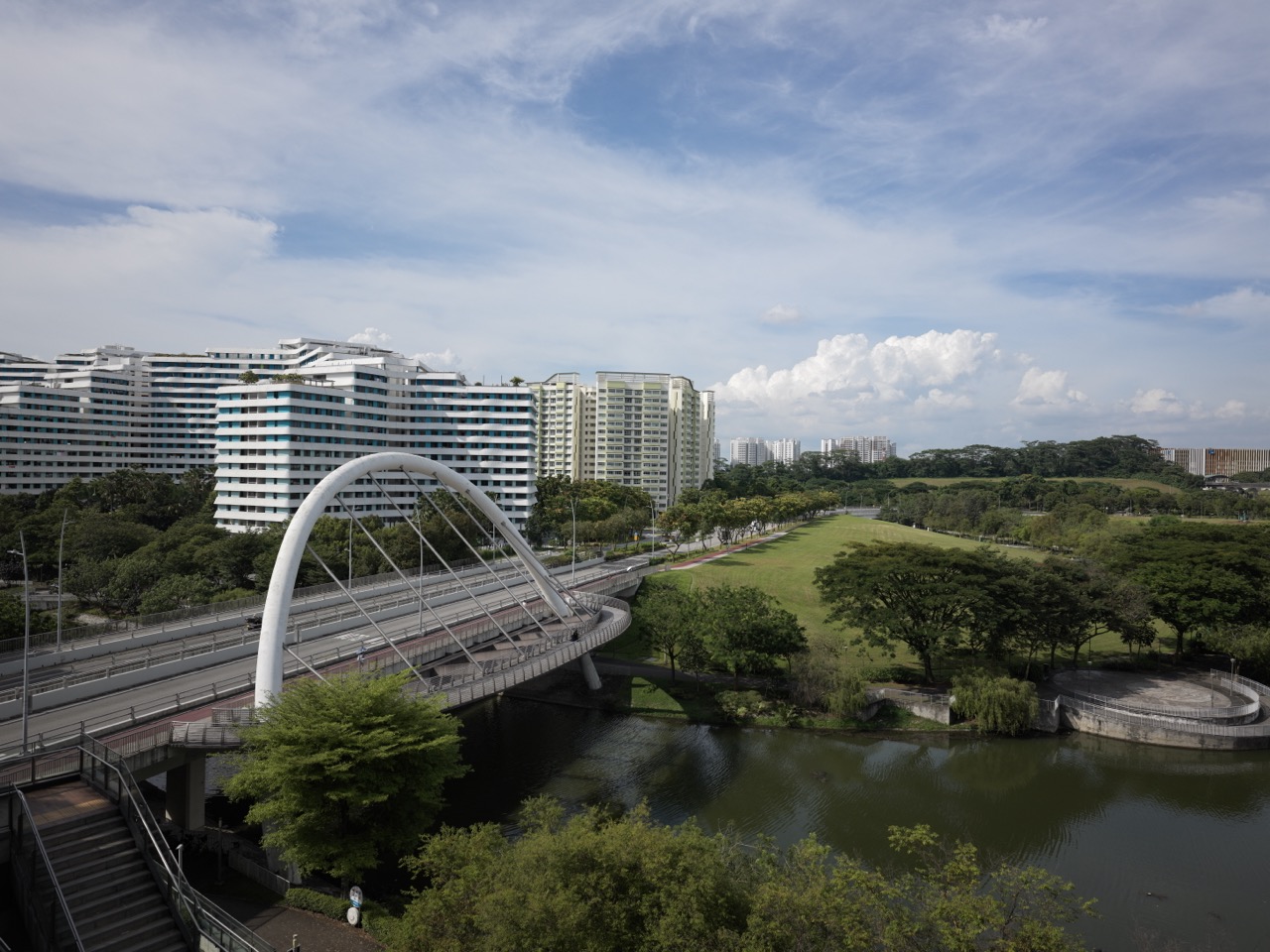
Urban sketching in Punggol is one of the calmest, cheapest things to do in Punggol during the school holidays: sit somewhere safe beside the Waterway, pick one bridge or block, and spend ten quiet minutes turning it into lines on a page.
Eight-thirty on a weekday morning. A girl on a bench by the Waterway frowns at her notebook. “My bridge is wobbly.” Her father looks at the real bridge, then at hers. “Yours looks happier.”
This is idea #72 in eduKate Punggol’s Top 100 Things to Do in Punggol During the School Holidays. This guide gives you a ten-minute method any child can follow, the best things to draw along the Waterway and around town, a simple plan for a sketching morning, and the small rules that keep it safe and pleasant for everyone.
A sketch is not a photograph.
It is a record of attention.
The wobbly bridge in that notebook shows exactly where a child looked hardest, and that is worth more than a perfect copy.
This idea is perfect for families who want to:
- try a creative outing that costs almost nothing;
- slow down and really look at a place they pass every day;
- give a busy child something calm and absorbing to do outdoors;
- share an activity where parents and children start as equals;
- fill a holiday journal with drawings instead of only words; or
- discover that “I can’t draw” is usually untrue.
Quick look
- Best for: Primary 1 to Secondary 4, and any parent willing to have a go
- Time needed: 30 to 90 minutes, in ten-minute sketches
- Cost: free if you already have a pencil and a notebook
- Best time: 7.30am to 10am, or after 5pm when the light softens
- Nearest MRT/LRT: Punggol MRT, Damai LRT or Sam Kee LRT for the Waterway
- Rain plan: sketch from a window, or from your own photos at the library
See all 100 school-holiday ideas · Chat with eduKate Punggol on WhatsApp · Visit eduKate Punggol on Facebook
Sketching a Bridge Is Bigger Than It First Appears
Punggol is full of drawable things. Curving bridges. Rows of HDB windows. Trees leaning over water. LRT tracks sweeping between blocks. Most of us see them a thousand times and never once look closely.
Sketching changes that, almost instantly.
To draw a bridge, you have to notice how it actually works: where it curves, where it touches the ground, which lines are straight and which bend. To draw an HDB block, you have to count floors, see the pattern of windows and notice that the roofline is not quite what you thought. Ten minutes of drawing gives you more knowledge of a place than an hour of walking past it.
Urban sketching simply means drawing real places on location, and it needs very little. No easel, no paints, no lessons. Just a pencil, a page and a willingness to look.
For a child in the school holidays, it offers something rare: a quiet, absorbing activity outdoors that does not involve a screen, a ticket or a queue.
The Hidden Lesson in a Ten-Minute Sketch
Sit a nine-year-old in front of Kelong Bridge with a pencil, and the first attempt is usually a straight line over some water.
Ten minutes later, the drawing changes, and so does the talk. “It has legs, like a table.” “The legs are in pairs.” “It looks like the fishing huts in my history book.”
That last sentence is the prize.
Kelong Bridge was designed to resemble a kelong, the wooden fishing platforms on stilts that once stood off Punggol’s coast. A child who notices the “legs” has discovered the design idea for themselves, before anyone told them. That is the hidden lesson in sketching: observation leads to understanding. You look carefully, you notice a pattern, and the pattern makes you ask why.
The same habit of mind powers Science (observe, then explain), Mathematics (spot the pattern, then generalise) and English (notice the detail, then describe it). The bridge simply makes it visible.
Why Punggol Families Love Urban Sketching
Some places are pretty but hard to draw. Punggol is generous. Its bridges have clear, bold shapes, its blocks have strong repeating lines, and the Waterway gives every scene a horizon.
Better still, most of it is free, public and close to home.
The joys of a sketching morning
- It costs nothing beyond a pencil and paper
- Five named bridges along the Waterway give you a ready-made subject list
- Children and parents start at the same level, which feels wonderfully fair
- It is calm enough for a child who needs a quiet morning
- Sketches can go straight into a holiday journal
- There is no wrong answer, only different ways of seeing
- A ten-minute sketch fits around a toddler’s attention span
- You can repeat the same bridge in different light and see your improvement
What You’ll Find to Draw
Here are the best subjects in and around Punggol, with tips for each. Choose one per outing rather than trying to collect them all.
The five Waterway bridges
NParks guides name five bridges along the Punggol Waterway. Jewel Bridge, at the western end where the Waterway meets Sungei Punggol, is named for its dome-shaped structure. Adventure Bridge is a steel suspension bridge in the recreation area, full of cables to count. Kelong Bridge is designed to look like a kelong on wooden stilts. Wave Bridge lies further east, and Sunrise Bridge, near the eastern end, is the early riser’s choice. Each has a different “big shape”: a dome, a web of cables, a row of legs. Use the park signs and map to find them.
HDB blocks and rooftops
Punggol’s blocks make brilliant practice for simple shapes. Start with one block as a tall rectangle. Add a roofline, then just a few rows of windows. You do not need every floor. Three rows suggest the rest, and the viewer’s eye fills in the gaps.
Trees beside water
A tree leaning over the Waterway is a lovely contrast to straight buildings. Draw the canopy as two or three big cloud-like shapes and the trunk as two lines. Avoid stepping into planted beds for a better angle; the path is close enough.
One Punggol and the Town Centre
The One Punggol building, home to Punggol Regional Library and a hawker centre, has bold outlines that suit a building sketch. Draw it from an open public space outside, and keep the sketch to its big shapes. It is also a handy place to finish, with food and toilets nearby.
Punggol Digital District
Around Punggol Coast MRT, the newer district offers tall, crisp modern buildings and the first open stretch of the Punggol Heritage Trail, where NParks has kept features of Old Punggol Road and a recreated old-style bus stop near Campus Boulevard. Only the first 400 metres of the trail is confirmed open, so stay on signed public paths. The district is also home to Our Punggol Story, a long public mural by artists Simeon Tan and Ezra Chan Yi with other collaborators. If a child sketches a motif from it, help them write the artists’ names beside the drawing.
How to Plan a Brilliant Sketching Day
Sketching outings work best when they are short, focused and comfortable. These steps take five minutes to plan.
1. Check the sky and the air
Look at the weather forecast and the latest readings on haze.gov.sg before you set out. Sitting outdoors is gentle, but you are breathing the outside air for an hour. If readings are high, sketch indoors from photos.
2. Pick one subject, not five
Choose a single bridge or one building for the day. A child who has one clear target settles faster than one dragged between landmarks.
3. Find a safe, legal seat
Benches along the Waterway, open public steps or a quiet corner of a plaza are ideal. Never sit on a cycling path, a narrow bridge or a railing. Remember that cycling and riding are not allowed on Kelong, Wave and Adventure Bridges or on the park’s boardwalk, so those spots are full of pedestrians; sketch them from beside, not on, the bridge.
4. Use the ten-minute method
This simple routine works for any subject:
- Minute 1: name the one thing you want to draw;
- Minutes 2 to 3: lightly draw the biggest shape (an arch, a box, a dome);
- Minutes 4 to 6: add two or three main lines, such as supports or a roofline;
- Minutes 7 to 8: add the ground or the water’s edge underneath;
- Minute 9: add one texture, such as ripples, leaves or windows; and
- Minute 10: write the date, the place and one sentence about what you noticed.
5. Draw more than once
Encourage two or three quick ten-minute sketches rather than one long one. The second sketch of the same bridge is almost always better, and children love seeing their own progress on the same page.
6. Finish before the fun runs out
Stop while everyone is still enjoying it. A short, happy session makes children ask to go again. A long, hot one makes them hide the notebook.
A Sample Holiday Day, Hour by Hour
Here is a gentle rhythm for a weekday morning sketching trip along the Waterway.
7.30am: Breakfast and a kit check
Pencils sharpened, notebooks in bags, water bottles filled. Let each child choose their “bridge of the day” from the list of five.
8.15am: The first sketch
Walk to the chosen bridge and find a bench with a clear view. Do the ten-minute method together. Parents draw too. No comparing, only sharing.
9am: A second angle
Move to a different safe spot with a new view of the same bridge, or turn round and draw a tree or a block. Ten more minutes.
9.45am: The detail challenge
Each person picks one tiny detail, such as a lamp, a railing pattern or a cable, and draws only that, as big as possible. Close-ups are fun and often surprisingly beautiful.
10.30am: Lunch somewhere cool
Head to Waterway Point or One Punggol for an early lunch out of the heat. Lay the sketches out and let everyone choose a favourite.
Afternoon: Colour at home
If you like, add colour pencils at home in the afternoon, when showers are common in the monsoon season. If the sky clears and the air is good, an evening sketch of the sunset from Jewel Bridge makes a lovely final page.
Three Ways to Enjoy It
Every age sees a different bridge. Here is how to pitch the outing.
For little explorers (Primary 1–3)
Keep sketches short (five minutes is plenty) and celebrate bold shapes. Play “shape spotting” first: “Can you find a triangle on this bridge? A circle?” Then draw only those shapes. Let them use colour freely. A purple bridge is perfectly acceptable. Preschool siblings can make “rubbing” drawings at home later with crayons over textured paper.
For big kids (Primary 4–6)
Introduce the idea of proportion: “Is the bridge wider than it is tall? How many times wider?” Let them use a pencil held at arm’s length to compare sizes. Ask them to sketch the same bridge twice, once from close up and once from far away, and talk about what changes. Primary 6 children enjoying a post-PSLE breather often love the calm of it.
For teens (Secondary 1–4)
Teens can try simple perspective along a long path, where two lines meet at a vanishing point, or a quick “five-minute, two-minute, thirty-second” challenge on the same subject. A sketchbook of Punggol’s architecture, from old-style features on the Heritage Trail to the Digital District’s new towers, can become a genuine personal project, and a thoughtful one to show in a portfolio if they are interested in design or architecture.
The Learning Bridge: Mathematics and English Without the Worksheet
Sketching is an art activity first. But it quietly exercises skills children use every day in school.
- Mathematics: the primary Mathematics syllabus includes a Measurement and Geometry strand. Spotting the shapes inside a bridge, comparing lengths with a pencil and drawing lines that are parallel or meet at a point all practise the same visual thinking, in a real setting.
- English: a sketch with a one-sentence caption is the seed of descriptive writing. “The bridge’s legs stand in pairs, like a row of herons” is the kind of image that makes a composition memorable. Children who draw a scene first often find it much easier to describe it afterwards.
- Science: sketching is observation, and careful observation is at the heart of Primary Science from Primary 3 onwards. Noticing that shadows shift or reflections ripple is the start of asking why.
Keep it playful: one question at the end, such as “What did you notice today that you had never noticed before?”, is enough. If your child loves turning scenes into words, our Primary Composition guide explains how description and detail work in school writing.
Little Hiccups and How to Dodge Them
A sketching morning is gentle, but a few small problems can spoil it. Here is how to avoid them.
“I can’t draw”
Almost everyone says this. Answer with the ten-minute method and the rule that sketches are about looking, not perfection. Draw badly yourself, cheerfully. Children relax when they see a parent’s wobbly bridge.
The midday heat
Sitting still in the sun is surprisingly tiring. Go early or late, choose shaded benches and drink water often. On very hot days, check the heat stress advisory and keep sessions short.
Rain and lightning
The year-end holidays fall in the Northeast Monsoon season, and afternoon thundery showers are common. If you hear thunder, pack up and head indoors. Keep the MSS lightning information page handy, because a bridge or open shelter is no place to wait out a storm.
Haze days
When readings on haze.gov.sg are high, sketch from photos at home or at the library. More options are in our Punggol Haze Indoor Activity Planner.
Blocking the path
Shared paths are busy with cyclists, joggers and strollers. Sit well to the side, keep bags tucked in and never stop in the middle of a bridge. A good sketcher is almost invisible.
Drawing people without asking
Sketching passers-by is a classic urban-sketching exercise, but keep it to quick, distant figures and never make a close portrait of a stranger, especially a child. Bridges and buildings do not mind being stared at.
What a Great Day Looks Like
You will know the morning worked when your children:
- want to show you their sketch before you ask;
- point out a detail on the bridge they had never noticed;
- say their second sketch is better than their first, and mean it;
- start sketching something else, uninvited, on the way home;
- ask which bridge they can draw next time; and
- stop saying “I can’t draw”.
If you see only one of these, hope it is the last. A child who believes they can draw has learnt that looking carefully is a skill, and skills can grow.
When to Go
This year’s long break for MOE primary and secondary schools starts on Saturday 21 November and ends on Thursday 31 December 2026, according to MOE. The 2027 calendar, published by MOE, adds shorter breaks in March (13 to 21 March), June (29 May to 27 June) and September (4 to 12 September), all good chances to return to the same bridge.
Weekday mornings are quieter on the paths than weekends. From about 7.30am to 10am the light is soft and the benches are cool. After 5pm, the light turns golden, and NParks highlights Jewel Bridge for sunset views and Sunrise Bridge for sunrise. Avoid the middle of the day.
Getting There from Around Punggol
NParks lists Punggol MRT and Damai LRT as the nearest stations for Punggol Waterway Park, which is open 24 hours. From Punggol MRT, walk past Waterway Point to reach the Waterway. Sam Kee LRT is handy for the western side, towards Jewel Bridge. Many families can simply walk from home; OneMap shows the shortest route from your block.
For Digital District sketching, take the North East Line to Punggol Coast MRT and stay on signed public paths.
Location: Punggol Waterway Park, along Sentul Crescent; Punggol Digital District near Punggol Coast MRT
Nearest MRT/LRT: Punggol MRT (NE17), Damai LRT, Sam Kee LRT; Punggol Coast MRT (NE18)
Entry: free
Quick Details
Activity: a self-guided urban sketching outing using a ten-minute drawing method
Where: Punggol Waterway Park bridges, HDB streetscapes, One Punggol and Punggol Digital District public spaces
Best ages: Primary 1 to Secondary 4, plus adults
Cost: free
Time needed: 30 to 90 minutes
Booking: none for personal sketching; group events in parks may need NParks permission
Accessibility: NParks lists Punggol Waterway Park as wheelchair accessible and elderly friendly; many benches sit beside paved paths
Status checked: October 2026, NParks Punggol Waterway Park page (no closures listed for the park at the time of checking)
What to Bring
- A small A5 sketchbook or notebook for each person
- Two or three pencils (a soft one is lovely for shading) and an eraser
- A pencil sharpener in a zip bag
- A few colour pencils, if you want colour later
- A bulldog clip to stop pages flapping in the breeze
- Water bottles, hats and sunscreen
- Insect repellent for the greener stretches
- A light umbrella for sudden showers
Frequently Asked Questions
Do we need drawing experience?
Not at all. The ten-minute method starts with one big shape. Everyone can draw an arch or a box, and that is enough to begin.
What is the easiest Punggol bridge to sketch?
Jewel Bridge’s dome and Kelong Bridge’s row of stilts both have bold, simple shapes that suit beginners. Pick whichever is closer to home.
Can we sketch on the bridges?
It is better to sketch them from the side. Bridges are narrow, shared spaces, and cycling and riding are not allowed on Kelong, Wave and Adventure Bridges, so they are busy with walkers.
Can we sketch the Our Punggol Story mural?
Yes, as a personal response. Write the artists’ names beside your sketch and avoid presenting the design as your own.
What should we do if it rains?
Pack up, head indoors and finish the sketch from memory or a photo you took earlier. If there is thunder, leave open areas straight away.
Is sketching good for children who find writing hard?
Many children who struggle to start writing find it easier after drawing a scene. A sketch plus one caption sentence is a friendly first step.
Helpful Reading for Punggol Families
- Top 100 Things to Do in Punggol During the School Holidays
- Punggol School Holiday Guide: A Week-by-Week Plan for the Year-End Break
- Urban Sketching in Punggol for Beginners
- Punggol Waterway Park Guide
- Things to Do in Punggol for Architecture and Design Lovers
- Public Art and Creative Walks in Punggol
- Creative Things to Do in Punggol
- Primary Composition Tuition and Creative Writing in Punggol
- NParks: Punggol Waterway Park
Urban Sketching for Punggol Families
The bridge on your way to the MRT has been waiting to be drawn.
A pencil makes you look.
Looking makes you notice.
Noticing makes you wonder.
For little ones, a sketch is a game of shapes.
For big kids, it is a puzzle of proportion.
For teens, it is a way to see their town like a designer.
Parents get something too: a quiet morning side by side, comparing wobbly bridges and laughing, which may turn out to be the best picture of all.
Plan the Rest of Your School Holidays
Once you have a notebook full of bridges, there are ninety-nine more ideas to explore. Browse the full Top 100 Things to Do in Punggol During the School Holidays, or carry straight on to idea #73, a photo walk, where your family tells a Punggol story in twelve pictures.
And if a calm, small-group learning block is also on your holiday list, eduKate Punggol teaches English, Mathematics and Science in classes of three. Come find out more.
Book a consultation · Chat on WhatsApp
eduKate Punggol
Small-group English, Mathematics and Science
Primary and Secondary
By appointment · +65 8823 1234
Properly taught kids shine a bright light into the future.
← Previous: #71 Holiday journal · All 100 ideas · Next: #73 Photo walk →
Checked October 2026. Opening hours, prices, programmes and closures change, so please confirm with the official source before you go.


