
Kitchen science for kids is one of the most delicious things to do in Punggol during the school holidays: no tickets, no travel, just your own kitchen, a few everyday ingredients and a child discovering that recipes are secretly full of maths and science.
The pancake recipe made twelve. There were only three of them. “So we divide everything by four,” said the nine-year-old, then stopped. “But how do you divide two eggs by four?”
This is idea #80 in eduKate Punggol’s Top 100 Things to Do in Punggol During the School Holidays. This guide gives you safe, simple kitchen experiments, real maths you can practise while cooking, a plan for a rainy afternoon, and ideas for every age from Primary 1 to secondary school.
That question about the eggs is the best maths lesson of the week.
Nobody set it.
The recipe did. And because the answer mattered, there were pancakes at stake, she worked harder on it than on any worksheet.
This idea is perfect for families who want to:
- turn a rainy afternoon into something useful and fun;
- practise fractions, measuring and money in real life;
- try safe science experiments with things already in the cupboard;
- teach children practical kitchen skills and independence;
- spend time together that ends with something to eat; or
- show a maths-shy child that numbers can be friendly.
Quick look
- Best for: Primary 1 to Secondary 2, with an adult always present
- Time needed: 30 minutes per experiment; 1 to 2 hours for a full afternoon
- Cost: mostly ingredients you already have
- Best time: rainy or hazy afternoons, when outdoor plans are off
- Nearest MRT/LRT: none needed; your own kitchen
- Rain plan: this idea is the rain plan
See all 100 school-holiday ideas · Chat with eduKate Punggol on WhatsApp · Visit eduKate Punggol on Facebook
Kitchen Science Is Bigger Than It First Appears
A kitchen looks like a place for meals. Look again, and it is a laboratory.
There are scales for measuring mass, jugs for measuring volume, a clock for timing, a fridge that cools, a stove that heats, and cupboards full of substances that dissolve, melt, mix, fizz and change colour. Every recipe is a set of instructions with exact quantities. Every meal is a series of changes caused by heat.
Children who would groan at “Let’s practise fractions” will happily halve a recipe. Children who find Science abstract will be fascinated to see sugar vanish in warm water faster than in cold.
The kitchen also teaches something school sometimes struggles to: why it matters to get it right. A mistake in a worksheet is a red cross. A mistake in a recipe is a flat cake. The feedback is immediate, honest and usually edible.
And for Punggol families facing a monsoon afternoon of thundery showers, the kitchen is warm, dry, close and always open.
The Hidden Lesson in Halving a Recipe
Back to those eggs.
The recipe for twelve pancakes needed 200 grams of flour, 300 millilitres of milk and 2 eggs. For three people, the family wanted a quarter of the recipe.
Flour: 200 ÷ 4 = 50 grams. Easy.
Milk: 300 ÷ 4 = 75 millilitres. A bit trickier.
Eggs: 2 ÷ 4 = half an egg. Hmm.
“We could beat one egg and use half of it,” she suggested. “Or make half the recipe instead, with one whole egg, and save some batter for tomorrow.”
That is the hidden lesson: proportional thinking. Scaling a recipe means every ingredient changes by the same factor, so the pancakes still taste right. Children meet this idea in school as fractions, then as ratio in upper primary. But in the kitchen, they meet it as a real problem with a real decision, and they discover that maths is not just about getting an answer. It is about choosing a sensible one.
Why Punggol Families Love Kitchen Maths and Science
It is cheap, it is close, and it works on exactly the days when everything else is rained off.
The joys of a kitchen laboratory
- It uses things you already have at home
- It works on rainy, hazy and stormy days alike
- Children practise real maths: measuring, fractions, money and time
- Simple experiments show genuine science in action
- Children learn practical life skills along the way
- Siblings of different ages can each take a role
- It ends with something to eat, or at least something to laugh about
- Grandparents often have recipes and kitchen wisdom to share
What You’ll Find: Five Kitchen Experiments and Maths Missions
Here are five tried-and-tested activities. Each one is safe with adult supervision and uses everyday ingredients. Treat each as a small investigation: predict first, then test, then explain.
1. The dissolving race
Put the same amount of water into two clear glasses, one cold from the tap and one warm (an adult prepares the warm water so it is comfortably warm, not hot). Add one teaspoon of sugar to each at the same time and stir the same number of times. Which dissolves first? Then ask the real scientist’s question: “What did we keep the same, and what did we change?” Only the temperature should change. That is a fair test.
2. The ice-cube challenge
Place identical ice cubes in different places: on a plate, in a bowl of water, wrapped in a tea towel and wrapped in foil. Predict which will melt fastest and which will last longest, then check every ten minutes. Children are often surprised by which wins. It opens a wonderful conversation about how heat moves and how some materials slow it down.
3. The cooling curve
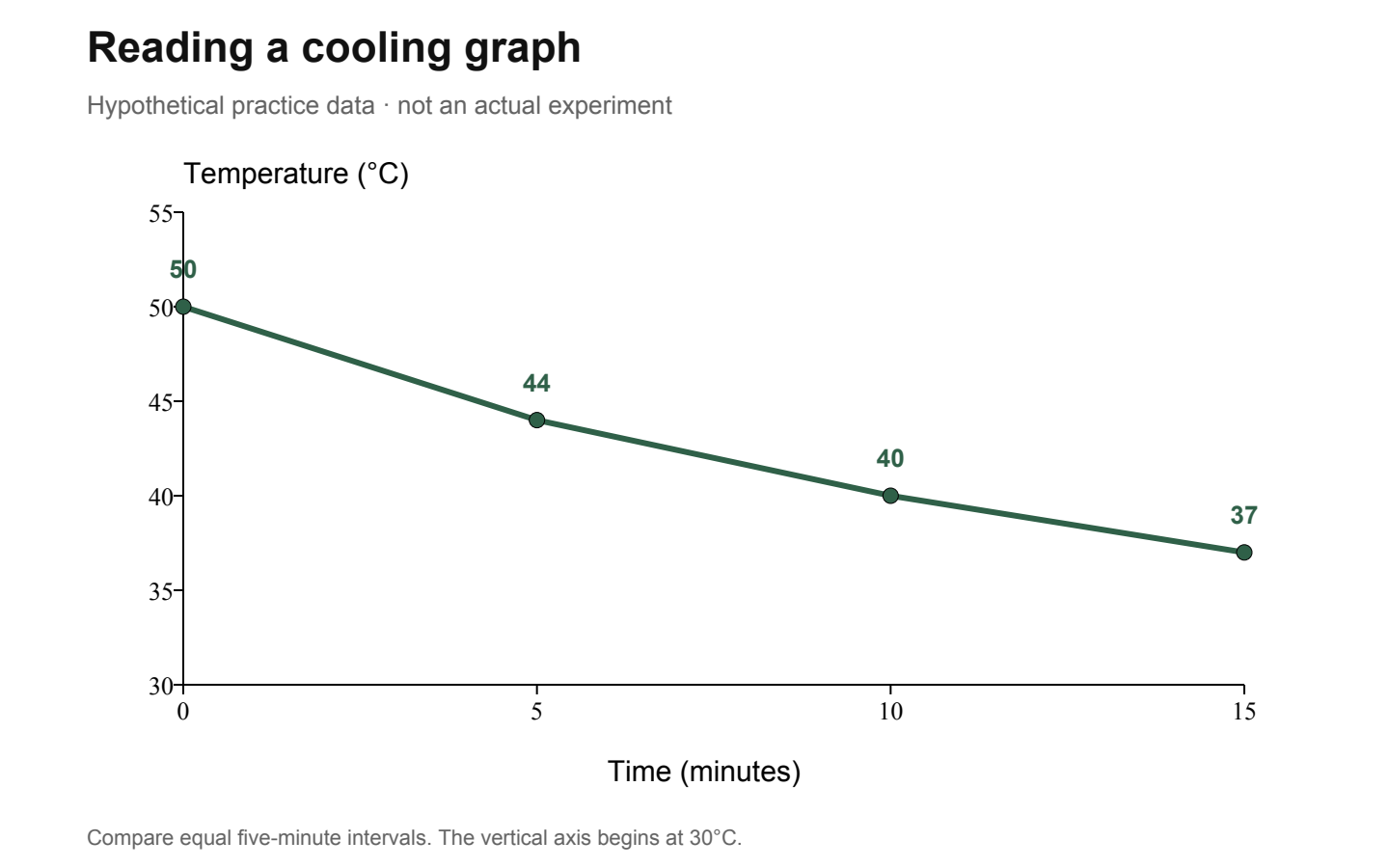
If you have a kitchen thermometer, an adult pours warm water into a mug. Your child reads the temperature every five minutes for half an hour and writes the readings in a table. Then plot them on a graph: time along the bottom, temperature up the side. Most children are amazed that the line is not straight. The water cools quickly at first, then more slowly as it gets closer to room temperature. That curve is real data they made themselves.
4. The floating egg
Fill two glasses with water. Stir several spoonfuls of salt into one. Gently lower a raw egg into the plain water, then into the salty water, using a spoon. Predict first, then watch. Talk about why salt might make a difference. Afterwards, wash hands well, because raw eggs and hands should not mix with snacks.
5. The shopping maths mission
Take your child to your nearest supermarket or market with a short list. Their job: compare two sizes of the same product and work out which is better value, using the price and the weight on the label. Back home, they check the receipt, add up the total and work out the change. If you would like ideas for a market trip around Punggol, our market-to-table family day guide has more.
How to Plan a Brilliant Kitchen Afternoon
A little preparation makes the afternoon calm rather than chaotic.
1. Set the safety rules first
Adults handle knives, the stove, the oven, the kettle and anything hot. Children wash hands before and after. Nobody tastes an experiment unless an adult says it is food. Check for allergies if friends are joining.
2. Choose one recipe and one experiment
Pick a simple recipe your child enjoys, such as pancakes, a fruit salad or overnight oats, plus one experiment from the list. Two activities are plenty for one afternoon.
3. Give your child a job title
“Head of Measuring”, “Chief Timekeeper”, “Lab Recorder” or “Quality Taster”. Titles make children feel trusted, and trusted children concentrate.
4. Predict before you test
Before each experiment, ask everyone to write down a prediction and a reason. “I think the warm water will win because…” This is the step that turns play into science.
5. Record everything
Keep a “lab notebook” for the holidays: date, experiment, prediction, what happened and one sentence of explanation. Tables and simple graphs make the results visible.
6. Clean up together
Wiping, washing and putting away are part of the job. Children who help clean up learn that a lab, like a kitchen, works best when it is left ready for the next person.
A Sample Holiday Day, Hour by Hour
Here is how a kitchen day might run on a typical monsoon weekday.
9.30am: The shopping mission
While the morning is still bright, head out for the shopping maths mission. Your child carries the list, compares two prices and checks the total at the counter.
11am: Recipe maths
Back home, choose a recipe and decide how many people you are feeding. Your child scales the recipe up or down and writes the new quantities. Adults check before anything is mixed.
11.30am: Cook together
Your child weighs the flour, measures the milk and times each step. An adult handles the stove. Talk about what changes as the batter cooks: colour, texture, smell.
12.30pm: Lunch and a review
Eat what you made. Ask, “If we made this again, what would we change?” That is evaluation, the last step of any good investigation.
2.30pm: Storm-time science
When the afternoon showers arrive, set up the dissolving race or the ice-cube challenge. Predict, test and record in the lab notebook.
4pm: Make the graph
If you did the cooling curve, plot the readings. Stick the graph on the fridge, next to the recipe card, as proof of a very productive rainy day.
Three Ways to Enjoy It
Every age can be a kitchen scientist, with the right job.
For little explorers (Primary 1–3)
Keep it hands-on and simple. Let them count spoonfuls, pour water to a line on a jug and read whole numbers on the scale. The dissolving race and the floating egg are perfect, with lots of “What do you think will happen?” For Primary 1 and 2, the goal is curiosity, not science vocabulary. Preschool siblings can wash the fruit and count the strawberries.
For big kids (Primary 4–6)
Give them the recipe-scaling job, with fractions and decimals. Ask them to design a fair test: which things must stay the same? Let them draw a table and a bar graph or line graph of their results. Primary 6 children can try the price-per-100-grams comparison at the shop and explain which pack is better value.
For teens (Secondary 1–4)
Teens can take charge of a whole meal: plan a menu for the family, set a budget, scale the recipes, write a shopping list and cook with an adult nearby. For science, they can repeat the cooling curve with a lid and without a lid and explain the difference, or research why salt changes whether an egg floats. Cooking a full meal for the family is also a confidence boost few teens forget.
The Learning Bridge: Mathematics and Science Without the Worksheet
Kitchen afternoons are about fun and food. But they quietly practise many real school skills.
- Measurement: lower primary Mathematics includes measuring mass in grams and kilograms and volume in millilitres and litres. Weighing flour and pouring milk is exactly that, with a delicious reason to be accurate.
- Fractions and ratio: halving, quartering and doubling a recipe practises fractions, and upper primary children can see ratio at work when every ingredient scales together.
- Money and decimals: comparing prices and checking change practises adding and subtracting dollars and cents.
- Science, fair testing and observing: Primary Science, a formal subject from Primary 3, emphasises observing, predicting and fair testing. The dissolving race and ice-cube challenge link to learning about matter and heat.
Keep it light: one question per experiment is enough. If you are thinking about how to use the holidays for Mathematics more broadly, our guide to holiday Mathematics: repair, consolidate or prepare ahead explains how to choose the right focus without overloading a child.
Little Hiccups and How to Dodge Them
Kitchen afternoons go wrong in small, predictable ways. Here is how to avoid them.
Hot things and sharp things
Adults handle the stove, oven, kettle, knives and hot liquids, every time. Keep pan handles turned inwards and children at a safe distance from heat.
The mess
Lay out a tray or old tablecloth before you start, and agree that cleaning up is part of the experiment. A little mess is a sign of learning; a flood is a sign of too many jobs at once.
Food safety
Wash hands before and after, especially after touching raw eggs. Do not taste experiment mixtures. Check for allergies if friends join in.
Experiments that “fail”
Sometimes the result is not what anyone predicted. Celebrate it. A surprising result is the most interesting kind, and asking “Why did that happen?” is real science.
Too much maths at once
If your child is getting frustrated, take over the hardest calculation and let them do the measuring. The goal is a happy cook, not a perfect worksheet.
Heading out on stormy or hazy days
If the shopping mission falls on a thundery afternoon, wait for the storm to pass and check the MSS lightning page for live alerts first. On very hot days, check the heat stress advisory and shop early. October 2026 brought unhealthy haze readings, so check haze.gov.sg before going out; on high-reading days, use what is already in the cupboard. For more, see our Punggol Haze Indoor Activity Planner.
What a Great Day Looks Like
You will know the afternoon worked when your children:
- make a prediction and give a reason without being asked;
- measure carefully because they want the recipe to work;
- explain what they kept the same in a fair test;
- spot a fraction or a price comparison on their own;
- help clean up without too much persuasion; and
- ask, “What can we test next time?”
That final question is the best thing to come out of the kitchen. A child who wants to test something new has discovered that the world is full of experiments waiting to happen.
When to Go
Six weeks of holiday lie ahead: MOE primary and secondary schools are on their year-end break from Saturday 21 November to Thursday 31 December 2026. The Northeast Monsoon usually begins around the end of November, bringing thundery showers on many afternoons, so kitchen science is a natural fit for the second half of the day. MOE’s 2027 calendar adds March (13 to 21 March), June (29 May to 27 June) and September (4 to 12 September) breaks for new experiments.
Weekday afternoons work well, especially after a morning outing. Avoid starting a big kitchen project just before dinner, when everyone is hungry and the stove is busy.
Getting There from Around Punggol
This one starts at home. Your kitchen is the lab, your dining table is the recording desk and your fridge door is the exhibition wall.
For the shopping mission, choose the supermarket or market closest to you so the trip stays short, and walk if you can. For recipe books and science-experiment books, Punggol Regional Library is inside One Punggol at 1 Punggol Drive, near Punggol MRT and Sam Kee LRT. NLB lists it as open 10am to 9pm daily, closing at 5pm on 24 and 31 December and closed on 25 December and 1 January.
Location: your own kitchen, plus your nearest shop for the maths mission
Nearest MRT/LRT: none needed; Punggol MRT (NE17) and Sam Kee LRT for the library
Entry: free
Quick Details
Activity: kitchen maths missions and safe home science experiments
Where: at home, with an optional trip to a nearby shop
Best ages: Primary 1 to Secondary 2, always with an adult
Cost: everyday ingredients you mostly already have
Time needed: 30 minutes per experiment, or 1 to 2 hours for an afternoon
Booking: none
Accessibility: home-based; adapt worktop heights and jobs to each child
Status checked: October 2026, MOE school terms and holidays for 2026 and NLB Punggol Regional Library
What to Bring
- Kitchen scales and a measuring jug
- Measuring spoons and a few clear glasses
- Sugar, salt, ice cubes and an egg
- A kitchen thermometer, if you have one
- A timer or clock
- A lab notebook, pencil and graph paper
- A tray or old tablecloth for spills
- Aprons, and plenty of patience
Frequently Asked Questions
What is the easiest kitchen science experiment for kids?
The dissolving race. Two glasses of water, one warm and one cold, a spoonful of sugar in each, and a prediction. It is quick, safe and shows a clear result.
Is kitchen science safe for young children?
Yes, with an adult in charge of anything hot or sharp, and a rule that nobody tastes experiments unless an adult says it is food.
How does cooking help with Mathematics?
It practises measuring mass and volume, scaling with fractions and ratio, telling time and handling money, all with a real purpose.
Do we need special equipment?
No. Scales, a jug, spoons and glasses are enough. A kitchen thermometer is a nice extra for the cooling-curve experiment.
What if my child is not interested in maths?
Start with the cooking and let the maths appear naturally. Ask for help weighing or counting rather than announcing a “maths lesson”.
Can teens do this too?
Absolutely. Teens can plan, budget and cook a whole family meal, and run more careful experiments with repeated measurements.
What should we do with the results?
Keep a lab notebook, make simple graphs and stick the best ones on the fridge. Looking back at them at the end of the holidays is a lovely reminder of what your child discovered.
Helpful Reading for Punggol Families
- Top 100 Things to Do in Punggol During the School Holidays
- Punggol School Holiday Guide: A Week-by-Week Plan for the Year-End Break
- School Holiday Science Plan: Repair, Consolidate or Prepare Ahead?
- School Holiday Mathematics Plan: Repair, Consolidate or Prepare Ahead?
- Punggol Market-to-Table Family Day
- Before Primary Science Starts: P1 Observation and Curiosity
- Primary 3 Science in Punggol
- Things to Do in Punggol on a Rainy Day
- MOE: School Terms and Holidays for 2026
Kitchen Maths and Science for Punggol Families
A recipe is a set of instructions.
A teaspoon is a unit of measurement.
A glass of warm water is a laboratory.
For little ones, the kitchen is a place to pour, count and wonder.
For big kids, it is a place to scale, predict and test.
For teens, it is a place to plan, budget and cook for the people they love.
And for parents, it is proof that some of the best learning of the holidays happens on a rainy afternoon, with flour on the table and laughter in the air.
Plan the Rest of Your School Holidays
Experiments done, pancakes eaten. Browse the full Top 100 Things to Do in Punggol During the School Holidays, or carry straight on to idea #81, volunteering as a family, a warm way to spend time giving back together.
And if a calm, small-group learning block is also on your holiday list, eduKate Punggol teaches English, Mathematics and Science in classes of three. Come find out more.
Book a consultation · Chat on WhatsApp
eduKate Punggol
Small-group English, Mathematics and Science
Primary and Secondary
By appointment · +65 8823 1234
Properly taught kids shine a bright light into the future.
← Previous: #79 Monsoon weather diary · All 100 ideas · Next: #81 Volunteer as a family →
Checked October 2026. Opening hours, prices, programmes and closures change, so please confirm with the official source before you go.


