
HAN@Punggol launched in June 2025 as Singapore’s third Heritage Activation Node, following Katong-Joo Chiat and Clementi in 2024. The National Heritage Board partnered with arts organisation OH! Open House on a three-year initiative to help residents and community groups explore the town’s fishing, farming, waterfront, nature and neighbourhood stories through locally organised heritage activities.
The opening programme ran from 6 to 15 June 2025. Its best-known event was Colours on Shore, an interactive installation by artist Mit Jai Inn at Waterway Point, The Cove, where families could paint on soft canvas sculptures that evoked Punggol’s coastline. Other announced activities included Where Punggol Meets Plate, Attuning to Nature and a neighbourhood story-collection effort planned for July–August 2025.
This is a history of the 2025 launch, not a 2026 event listing. Dates, historic ticket prices, announced programmes and volunteer recruitment are labelled by their source period. The guide explains what a Heritage Activation Node is, who organised the initiative, why it matters for Punggol’s changing identity, and how readers can separate recorded activity from hoped-for future outcomes.
Choose your reading route
Dates and organisers · Colours on Shore · Neighbourhood stories · Heritage Champions · Family history learning
Complete guide contents
- 1. The 2025 milestone at a glance
- 2. What is a Heritage Activation Node?
- 3. Why Punggol was selected after Katong-Joo Chiat and Clementi
- 4. Who organised the launch and what a three-year partnership meant
- 5. Colours on Shore: the headline installation
- 6. 6–15 June 2025: the time-limited programme and ticket information
- 7. Where Punggol Meets Plate: food as a route into heritage
- 8. Attuning to Nature: learning through sound and drawing
- 9. Neighbourhood Story-Collection: the July–August 2025 plan
- 10. Heritage Champions: volunteering is more than signing a form
- 11. The July–September 2025 Call for Collaboration
- 12. What makes HAN different from a heritage trail or archive
- 13. Punggol’s shoreline: memory, artistic interpretation and evidence
- 14. How the programme fits Punggol’s recent town transformation
- 15. How to evaluate a heritage programme beyond visitor numbers
- 16. A family-friendly local-history learning plan
- 17. Frequently asked questions about HAN@Punggol
- 18. Official sources, programme evidence and open questions
1. The 2025 milestone at a glance
The National Heritage Board’s media release describes HAN@Punggol as the third Heritage Activation Node in Singapore. The first two neighbourhood initiatives were launched in Katong-Joo Chiat and Clementi during 2024. In 2025 Punggol joined the programme with a special emphasis on its coastal, natural and community heritage. This chronology is important because the node is not the start of local history itself; it is a new method for discovering and sharing that history.
The launch activities ran from 6 to 15 June 2025. The headline installation, Colours on Shore, was hosted at The Cove within Waterway Point. The NHB announcement placed the opening within a three-year collaboration with OH! Open House, rather than describing a one-off art display unrelated to wider heritage work.
The launch media release also planned additional engagement beyond the festival window. Neighbourhood Story-Collection was scheduled for July and August 2025, and a public collaboration call was set for 21 July to 28 September 2025. These are the intentions and dates stated in the launch record. They should not be treated as proof of the final participation totals, project selections or outcomes without follow-up reports.
The heritage node’s purpose is broader than a single exhibition. NHB’s national programme seeks to involve residents, volunteers and community groups in creating activities that preserve and communicate their area’s distinctive histories. For Punggol, this meant bringing attention to a place often marketed mainly through new flats, parks and business developments.
The useful short answer is simple: HAN@Punggol was launched in June 2025 with NHB and OH! Open House, and its opening festival used art and participatory workshops to explore the area’s waterfront and everyday heritage. The remainder of this article explains how that answer can be checked and why it matters.
2. What is a Heritage Activation Node?
The acronym HAN stands for Heritage Activation Node. According to NHB, the national initiative creates opportunities for community members to co-develop projects that celebrate neighbourhood heritage. It involves institutions, local organisations and volunteers rather than leaving all interpretation to a museum’s central staff.
The phrase ‘activation’ signals that heritage is treated as something people can encounter, discuss and contribute to. A conventional archive might preserve records in a repository. A heritage node might bring those records into public places through walking tours, art installations, local conversations, exhibitions or workshops. These approaches are complementary; the node is not a replacement for preserving original evidence.
NHB began launching such nodes in 2024 as part of Our SG Heritage Plan 2.0. Its official materials describe neighbourhood-specific programmes, with training for participants and opportunities for communities to take greater ownership of local stories. Punggol was one iteration of a wider national design, not a separate government ministry or an independent township authority.
A node also differs from a fixed heritage building. It does not require every activity to happen under one roof. Community organisations can work in public spaces, malls, neighbourhood centres or suitable other venues, depending on the approved programme. That flexibility matters in a rapidly changing residential town with new and old audiences sharing the same landscape.
For readers, the key question is not merely ‘Where is the HAN building?’ It is ‘Which local people and programmes help make the town’s history visible and accessible?’ The difference shifts attention from a structure to the social process of discovering, interpreting and discussing a place.
3. Why Punggol was selected after Katong-Joo Chiat and Clementi
The National Heritage Board’s 2025 release identified Punggol as the third node after earlier launches in Katong-Joo Chiat and Clementi in 2024. The NHB described Punggol as a town known today for new waterfront homes, cycling routes and cafes, while pointing out its deeper fishing, farm, coastal and kampong histories. That contrast shaped the programme’s public rationale.
Punggol is particularly suitable for examining change because its built environment has altered so visibly. The older road-and-track landscape, former farming industries and coastal villages are not obvious to someone arriving by MRT and walking towards Waterway Point. A heritage node can put those less visible histories back into conversation with the town’s current residents.
The site’s physical changes also offer a challenge. A visitor cannot necessarily see the old fishing village or farms from a modern photograph. Memory must be reconstructed from maps, archival images, oral testimony and accurate interpretation. Art, walks and workshops can make people curious, but evidence still matters if the activity is to teach reliable history.
Different neighbourhoods naturally need different interpretive choices. Katong-Joo Chiat has its own built and cultural heritage, while Clementi’s stories emerge from another set of housing, transport and community developments. NHB did not present the nodes as identical replicas. Punggol’s emphasis on water, green areas and evolving communities reflects its particular record.
A high-quality local history therefore recognises both the national framework and the local variation. ‘Third node’ is a useful chronology fact; the content of the Punggol activities explains what made that milestone distinctive for residents and families.
4. Who organised the launch and what a three-year partnership meant
The official launch identifies the National Heritage Board and OH! Open House as the principal partnership. NHB is Singapore’s government heritage agency. OH! Open House is an arts organisation known for presenting art and heritage experiences in neighbourhood and unconventional spaces, often encouraging people to encounter everyday places differently.
The three-year partnership described in 2025 matters because the initiative was planned to last beyond a ten-day festival. A longer collaboration can support the development of volunteers, local partners, story-collection methods and repeated programmes. Those are the project’s ambitions, not proof that every scheduled activity was completed exactly as planned.
The launch release quotes NHB’s education and community-outreach leadership discussing the experience of earlier nodes and the emergence of volunteer Heritage Champions. It also quotes OH! Open House’s artistic director, Alan Oei, explaining the interest in stories found outside conventional museums. Such statements are direct evidence of institutional intention and public positioning.
A press release is strongest for the partners, announced schedule and stated objectives. It is weaker evidence for whether all later community ambitions were realised. An independent assessment of impact would require data on participation, satisfaction, continuation, documentation and project outputs after the opening months. This article does not invent those results.
The relationship between agency and arts partner offers an example of cultural collaboration: government supplies heritage direction and coordination, while an arts organisation can devise creative public experiences. Residents and volunteers bring local knowledge and lived experience. The meaningful question is how those roles support one another without assuming any actor owns the neighbourhood’s past.
5. Colours on Shore: the headline installation
Colours on Shore was the most prominent art-based experience associated with the June 2025 launch. NHB’s programme listing credits internationally known artist Mit Jai Inn and describes soft canvas sculptures inspired by the shoreline of Punggol Beach. Visitors could contribute by applying colour to the sculptures, making the work participatory rather than something to be viewed only from a distance.
The location was Waterway Point, The Cove, with an official listed period of 6 to 15 June 2025. The venue choice is significant. A shopping mall brings heritage activity into a place residents visit for ordinary errands, food and socialising. It reduces the separation between history and everyday life, one of the stated ambitions of Heritage Activation Nodes.
The work did not attempt to recreate Punggol Beach as an archaeological reconstruction. Its shapes and materials used artistic interpretation to invite reflection on the shore. A visitor’s painted mark could become part of the communal surface. The historical idea was a coastline shared through memory and imagination rather than a precision scale model of any single past year.
This distinction is important for evidence literacy. An artwork inspired by old Punggol is not proof that the coastline looked exactly like the installation. It may communicate mood, change and participation effectively while remaining interpretive. For factual map work, students still need dated photographs, planning documents or survey maps.
The value of Colours on Shore as a historical event lies both in its appearance and in its method. Residents were invited to help create an artwork about their area instead of only listening to a completed story. That change from audience to participant was part of the initiative’s approach to building interest in heritage.
6. 6–15 June 2025: the time-limited programme and ticket information
The NHB’s programme page lists Colours on Shore between 6 and 15 June 2025, with times and conditions for registered sessions. It described a charge of S$10 per parent-child pair. The terms included supervision requirements for younger participants, washable paint, aprons and restrictions on shoes within the installation area. Those details show how a participatory artwork operated at the time.
They must be treated as historical details, not a 2026 purchase offer. A past booking link may still appear in search results after a session has ended. It would be irresponsible to tell a present-day family to book for June 2025 as though those dates were upcoming. The page is valuable now because it records the form and accessibility considerations of the original event.
The supervision rule is historically informative. The organisers treated the activity as involving children, materials and shared space, with adults responsible for accompanying younger participants. This distinguishes an open participatory installation from a conventional exhibition where visitors must avoid touching displays.
The ticket price also needs interpretation. A listed parent-child pair price describes one programme’s admission conditions, not the funding of the entire heritage node or the price of all activities. Nor does it establish how many people attended. Revenue estimates based on imagined attendance would be fictional.
For a student comparing event sources, an official programme listing serves a different function from the press release. The release sets out the broader purpose; the programme page specifies participant instructions. Both contribute to a fuller reconstruction of what the June launch was intended to offer.
7. Where Punggol Meets Plate: food as a route into heritage
Another announced element of HAN@Punggol was Where Punggol Meets Plate, a workshop designed to make participants think about local identity through food. The 2025 release places it within the cultural engagement programme. Contemporary reporting describes a three-course food experience involving local ingredients and links to Punggol’s landscape, including the Nipah palm.
The idea was well matched to the area’s history. Older Punggol supported fishing communities, seafood businesses, farming and markets. Today’s families encounter food through very different shops and dining places. A workshop can open discussion about what ingredients reveal, who grew or harvested them and why foodways survive or change.
However, a modern tasting activity is not direct evidence of exactly what families in Kampong Wak Sumang ate every day. Recipes can be newly devised, adapted or inspired by older traditions. The historical claim must follow a documentary source rather than simply being inferred from the ingredients used at an artistic event.
There is also a need to avoid overclaiming continuity. A contemporary activity involving a native plant does not prove that a specific historical restaurant served a particular dish or that an entire community had the same food habits. Households and groups differ, and food culture evolves through migration, markets and personal choices.
For education, the workshop’s method is instructive: begin with a sensory object, such as a plant or ingredient, and ask historical questions about work, environment and community. Follow up with photographs, oral histories or written records. This connects curiosity with evidence rather than treating the sensory activity as sufficient proof on its own.
8. Attuning to Nature: learning through sound and drawing
The launch programme also announced Attuning to Nature, a listening and drawing workshop associated with Punggol and Coney Island. Rather than focusing only on visible heritage buildings, the activity invited participants to notice environmental histories and the experience of natural spaces. That makes sense in a town where waterways and coastal habitats are part of everyday identity.
Listening can help people discover aspects of a place that photographs overlook: birds, insects, human movement, vehicles, water, vegetation and changing weather. Drawing encourages focused observation and the selection of details. As a learning method, this is valuable because a participant has to slow down and pay attention.
It is also necessary to distinguish observation from historical proof. Hearing a bird in 2025 does not establish that the same individual bird or species occupied a particular site in 1950. A drawing of Coney Island is an interpretive record of the artist’s observation. A reliable ecological-history claim still requires dated surveys or other documented evidence.
Punggol offers many possible subjects: present-day planted landscapes, older coastal ecosystems, river modification and the conservation of Coney Island. A workshop can encourage curiosity about these connections without requiring the participants to become professional ecologists in one session.
For families adapting the idea at home, choose a safe public place, write down the time and conditions, listen briefly and draw only what can be observed. Add a separate line for questions that require research. This makes a useful bridge between art and science while respecting the limits of personal perception.
9. Neighbourhood Story-Collection: the July–August 2025 plan
NHB’s June 2025 launch announcement said that Neighbourhood Story-Collection would begin from July to August 2025. The project was intended to involve HAN Heritage Champions and encourage meaningful exchanges with Punggol residents. Its inclusion shows that the initiative aimed to collect lived experiences, not simply display information already published.
Oral history and neighbourhood memory are particularly important where buildings have been demolished or land use has changed. A resident may remember the route to an old school, the appearance of a market or the social atmosphere around a former seaside attraction. These are valuable leads that can supplement maps, newspapers and government records.
Yet the source used here is a launch plan. Without a later completion report, it cannot establish the exact number of stories collected, the identities of participants or whether every planned activity occurred on the advertised schedule. This article deliberately labels the collection as a stated initiative rather than presenting invented results.
Good community story-collection also requires ethical care. Contributors should understand why their memories are being recorded, what material will be made public and whether they can correct information. Personal memories may contain private details about neighbours or family circumstances, so publishing every remark without consent would not be responsible.
For History students, interviewing a relative about Punggol can be a meaningful project when done carefully. Record the interview date, the period remembered, and the difference between direct observation and something the speaker was told by someone else. Preserve uncertainty. A story is more useful when later readers can understand whose memory it represents.
10. Heritage Champions: volunteering is more than signing a form
NHB’s Heritage Champions programme supports the nodes through residents who help facilitate activities, engage visitors, research and write heritage content, and welcome participants. The 2025 Punggol launch linked the story-collection effort to such volunteers. This element matters because a living neighbourhood’s knowledge is distributed among many people.
The volunteer documentation clarifies that submitting an expression of interest does not make someone an appointed Heritage Champion. Candidates may be shortlisted, assigned an appropriate role and asked to acknowledge a code of conduct. Training and programme-specific preparation may be provided. This distinction prevents a casual participant from assuming they automatically speak on behalf of NHB.
At launch, NHB mentioned the experience of the two earlier nodes and the number of volunteers who had stepped forward across them. Such a figure describes broader programme interest, not a confirmed count of Punggol volunteers alone. Careful reporting preserves that scope.
The value of volunteer participation lies in local knowledge and sustained relationships. Residents may know details that an external researcher overlooks, but familiarity with a neighbourhood does not eliminate the need for verification. Heritage Champions can improve public history when they combine lived insight with source evaluation and respectful listening.
This is a useful civic-learning topic. Students can compare casual enthusiasm, formal volunteering and the responsibilities of representing an institution. Good heritage work involves both excitement about stories and discipline about what may be publicly claimed or published.
11. The July–September 2025 Call for Collaboration
The NHB press release also announced a public Call for Collaboration scheduled from 21 July to 28 September 2025. It invited community groups and individuals to propose projects for consideration. This belonged to the longer development of HAN@Punggol beyond the festival’s first ten days.
A collaboration call is evidence that organisers sought new ideas. It is not proof that every applicant was selected or that every suggested project took place. A full account would need later public announcements, programme reports or records of the chosen proposals. Those materials may be collected separately from the initial media release.
Why does the call matter historically? It attempted to widen authorship of heritage activities. Rather than treating neighbourhood residents only as spectators, the model invited people with relevant knowledge, creative ideas or community relationships to participate in the next stage of programming. That is a deliberate institutional approach to cultural ownership.
Such processes also face practical constraints. Space, safety, funding, permissions and volunteer capacity determine what can be delivered. An idea that is valuable to a community may still require adaptation before it becomes a public activity. A thoughtful history of the programme recognises the difference between invitation and implementation.
For readers, the archived 2025 dates should not be presented as a currently open grant application. The durable information is that NHB established a participation channel with a published window. Anyone seeking present-day collaboration must check the agency’s current opportunities and eligibility separately.
12. What makes HAN different from a heritage trail or archive
Punggol already has heritage resources and public places that help readers understand its past. The National Heritage Board and other organisations have documented local communities, roads, farming, seafront recreation and environmental changes. A heritage trail can locate markers or features on a route; an archive can preserve records; a library can help readers discover material.
A Heritage Activation Node serves a different function. It encourages people to produce, encounter and share place-based activities over time. A workshop can begin with existing knowledge but invite participants to explore personal memories, sensory observations or creative interpretation. The combination is not an alternative to factual research; it can be an entry point into it.
That is why the June 2025 artwork and subsequent story-collection plans belong in the same programme. The opening installation drew attention to the coastline, while the longer partnership could provide ways to continue conversations and build capacity. A single event might generate curiosity, but the node concept aims for repeated engagement.
The distinction matters when evaluating success. A trail might be assessed through wayfinding, clarity and historical accuracy. An archive might be judged by preservation and accessibility. An activation programme might also ask whether people participate, gain confidence, contribute stories and continue activities. These criteria overlap but are not identical.
Local-history pages should support this division of labour. A specific article can answer when HAN@Punggol launched, while separate histories can explain the underlying Punggol communities and locations. Cross-links make the whole knowledge system usable without copying the same paragraphs everywhere.
13. Punggol’s shoreline: memory, artistic interpretation and evidence
The choice of Punggol Beach as inspiration for Colours on Shore connected the project to a coast with more than one history. The area is associated with fishing, leisure, seafood businesses, maritime work and profound wartime loss. Its physical edge has also changed through reclamation and redevelopment. A modern resident may know only one version of that coastline.
Art can make these layers approachable because it invites a personal response rather than beginning with a long textbook chapter. Painting on canvas sculptures may help a child imagine changing land and water. But the artwork should not be treated as a literal archive photograph or an accurate 1940s shoreline map.
The historical method starts when participants ask questions after the creative experience. Where was the old shore? Which villages lived nearby? How did boatels operate? What do maps and oral accounts say about reclamation? What memorial significance does Punggol Beach carry? Each question needs the appropriate historical evidence.
There is also a responsibility to handle sensitive history respectfully. A playful installation about the sea need not be an exhibition about wartime atrocities, but a broader neighbourhood history should not erase those events from the location’s record. Different programmes can focus on different aspects while making careful connections possible.
The important achievement of a heritage activation is not that it supplies one final definition of Punggol. It can enable residents to recognise that a place has multiple, sometimes difficult histories. Factual accuracy and creative participation reinforce one another when their roles remain clear.
14. How the programme fits Punggol’s recent town transformation
Modern Punggol’s public image often revolves around waterfront housing, recreational spaces, transport infrastructure and the Digital District. These are real components of its development, but they do not exhaust the area’s identity. Earlier fishing communities, farms, institutions and livelihoods have histories that deserve equal attention as subjects of investigation.
A 2025 heritage initiative arrived at a moment when many residents had grown up in newer housing and might never have seen the Punggol of numbered rural tracks. Others retained memories of old village life or the transformation from farmways to roads and estates. The programme offered a way to bring those different generations into conversation.
NHB and OH! Open House’s partnership was designed to make such conversations possible through multiple formats. A food workshop could connect the landscape with ingredients, a listening workshop could foreground environments, and a story-collection effort could document memories. Each approach addressed a different way people relate to place.
This is not evidence that every participant became a historian or that the town’s social cohesion increased by a measured amount. Those would be outcome claims requiring evaluation. The evidence supports a concrete public initiative with named organisers, activities, dates and intentions.
For Punggol history, the node’s significance is therefore methodological. It marks a moment when residents were explicitly invited to help interpret the neighbourhood’s past, rather than seeing heritage only as information supplied by an agency or tourist guide.
15. How to evaluate a heritage programme beyond visitor numbers
A history article should distinguish what an initiative planned from what it achieved. The 2025 NHB release offers dates, partners and proposed work. The official event page supplies booking and participation conditions. Contemporary newspaper reporting describes the opening installation and public response. Together these can establish a strong account of the launch, but they do not replace a programme evaluation.
If researchers want to measure outcomes, the first question is what counts as success. Participation totals may show reach. Repeat attendance may indicate sustained interest. Recorded oral histories may show preservation of information. Partnerships that continue beyond the opening festival may suggest capacity. Accuracy of published material is another important but less visible outcome.
These measures are not interchangeable. A large crowd at a mall installation does not prove that residents learned detailed historical chronology. A smaller interview project might create records useful for decades. An attractive art installation can be valuable as an entry point without claiming to substitute for archival study.
Researchers should also ask whom the programme reaches. Do elderly residents, young children, newer residents, long-time households and different language communities find an accessible route to participate? Are there barriers involving cost, timing, mobility or familiarity with the organisers? These are questions to investigate rather than results to invent.
The strongest future history of HAN@Punggol will combine launch documents with later activity records and the voices of participants. Until those are verified, a responsible account describes the 2025 start precisely and identifies ongoing evaluation as a separate task.
16. A family-friendly local-history learning plan
Families can use the 2025 launch as a starting point without pretending the time-limited installation is still available. Begin by reading NHB’s programme description and identifying the artistic idea: a shared coastal memory represented through soft canvas sculptures. Ask what this communicates and what it cannot prove about the actual shoreline.
Next, choose a documented Punggol location such as a public part of Punggol Waterway, a visible historic-road segment or the outside of a known community facility. Use current official access information before travelling. Observe the modern landscape and compare it with a dated archive photograph. Keep the photograph’s original location and time attached.
A second activity is a small family oral-history conversation. Ask a relative whether they remember an older market, school, road or beach visit. Record the year approximately if exact recall is impossible. Do not pressure the person to produce a vivid story. A simple recollection that says ‘I am unsure of the date’ is valuable evidence of a memory with a visible limitation.
A third activity combines art and source checking. A child can sketch or build a model inspired by the town’s coast, then write two captions: one describing their creative choice and one citing the historical fact that inspired it. The captions should not be interchangeable. This is an accessible way to teach imagination and truthfulness together.
Finally, make a short reading route through the Punggol history master directory. The node is an invitation to explore the town; the source documents help the family make sense of what they discover. End with a question for future investigation instead of declaring that one activity explains every part of the neighbourhood.
17. Frequently asked questions about HAN@Punggol
What does HAN stand for? Heritage Activation Node, an NHB initiative involving communities in local heritage projects.
When did HAN@Punggol launch? The opening programme took place in June 2025, with a public festival running 6–15 June.
Was Punggol the first node? No. It was the third, after Katong-Joo Chiat and Clementi, launched in 2024.
Who were the main partners? The National Heritage Board and OH! Open House.
How long was their planned partnership? The June 2025 press release describes a three-year partnership.
What was Colours on Shore? An interactive soft-canvas installation by Mit Jai Inn, inspired by Punggol Beach.
Where was it held? Waterway Point, The Cove, during the June 2025 dates.
Could children paint on it? The official programme invited families to contribute to the sculptures under event conditions.
What did the workshop cost? The original programme listing stated S$10 per parent-child pair; that is a historic price, not a current booking rate.
What was Where Punggol Meets Plate? A food-oriented cultural engagement workshop linked to local landscape and heritage.
What was Attuning to Nature? A listening and drawing activity exploring Punggol’s environmental history and Coney Island.
Was there an oral-history component? A neighbourhood story-collection effort was announced for July–August 2025.
What are Heritage Champions? Volunteers who support heritage activities, research and participant engagement, subject to official assignment and training.
Was there a public collaboration call? The launch record scheduled one from 21 July to 28 September 2025.
Are those 2025 activities available to book today? Historic programme pages do not establish any 2026 booking availability. Consult current organiser information.
Why is it important? It made neighbourhood heritage a participatory activity with residents, institutions and community groups, rather than only a fixed display.
18. Official sources, programme evidence and open questions
NHB’s June 2025 media release is the primary account of the launch, naming the organisers, partnership, sequence of programmes and planned follow-up. The NHB Colours on Shore page supplies dates, location and participation rules for that specific installation. The broader HAN programme page explains what a heritage node is and how the national initiative developed.
NHB’s Heritage Champions FAQ gives further evidence about volunteering, eligibility and role allocation. Contemporary reporting supplies descriptions from people involved at the festival, but it must be distinguished from the agency’s planned activity schedule. Where a source described an intention, this article labels it an intention.
Important outcomes remain beyond the available launch evidence: how many Punggol stories were ultimately collected, which public collaboration proposals were selected, and what programmes continued into later years. These require later records. The 2025 launch should not be inflated into an audited three-year impact report.
Related Punggol articles document old roads, fishing, farms, the zoo, seaside activities and later community institutions. Those histories are the subjects the node sought to make more visible. Readers can follow them through the site’s master directory without having to guess which modern landmark corresponds to which older place.
The enduring fact is that in June 2025, Punggol joined a national programme built around residents helping tell the stories of their neighbourhood. The event was temporary; the invitation to treat local places as historically meaningful is the larger idea preserved in the record.
Quick-answer FAQ
Is HAN@Punggol the same as a new museum building?
No. It is a programme framework using community participation and activities across suitable neighbourhood venues.
What is the definitive 2025 festival period?
The launch activities were advertised for 6–15 June 2025.
Was an April 2025 date ever mentioned?
Some earlier planning announcements discussed April; the actual public launch programme documented by NHB ran in June.
Did painting prove the shape of the old beach?
No. The installation was artistic interpretation and collaborative creation, not archaeological reconstruction.
Are 2025 programme prices current?
No. They describe a closed period and must not be reused as live booking advice.
Can anyone become a Heritage Champion by filling a form?
NHB says formal onboarding requires selection, assignment and acknowledgement of volunteer obligations.
Did every July–August story-collection plan happen?
The launch release documents the plan; a completion audit needs later reports.
What is the best original source?
NHB’s 2025 Punggol launch media release and the official programme page.
Does HAN replace official archives?
No. Public activities can encourage interest and contributions; archival records remain essential for factual verification.
Why was the mall used?
It provided an everyday public venue for the installation, helping heritage appear in places residents already visit.
Which past does the programme focus on?
Punggol’s fishing, farming, waterfront, nature, road and community histories, without reducing the neighbourhood to one story.
How can students learn from it?
Compare a creative interpretation, a press announcement and a dated historical source, and explain what each can establish.
Official records and related Punggol history
- NHB: official June 2025 HAN@Punggol media release (PDF)
- NHB: Colours on Shore – official 6–15 June 2025 programme
- NHB: About Heritage Activation Nodes
- NHB: Heritage Champions FAQ (May 2025 PDF)
- NHB: Heritage Champions – current programme overview
- NHB: Heritage x Community – Our SG Heritage Plan 2.0
- Punggol history master timeline and directory
- Punggol Heritage Trail Guide
- Things to Do in Punggol for History Lovers
- History of Punggol Green community park
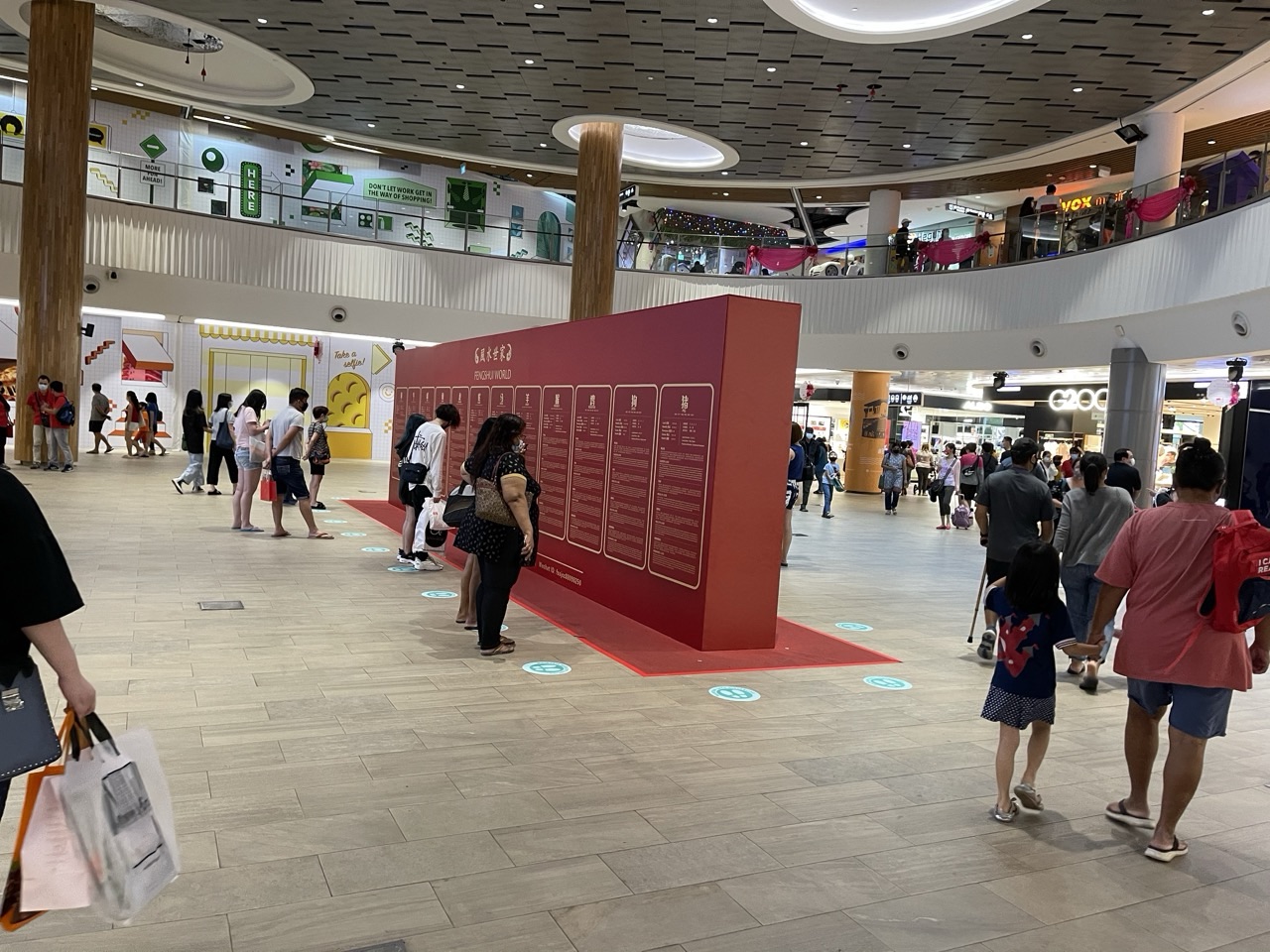
Evidence and image note: all ticket prices, schedules and calls for participation quoted from the 2025 sources are historical. The featured contemporary photograph of Waterway Point illustrates the venue, not an archival image of Mit Jai Inn’s installation.


