
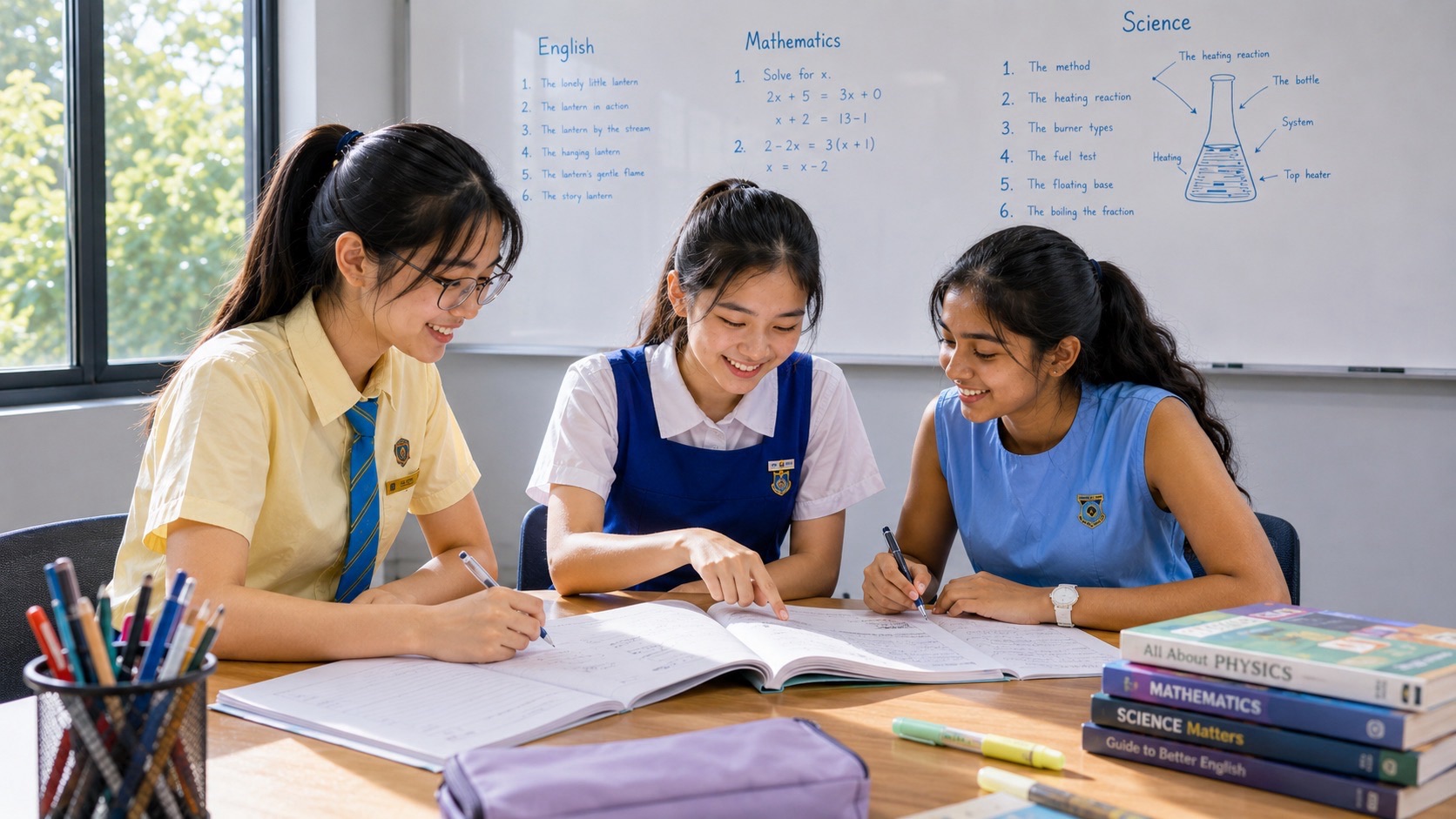
Secondary 4 English tuition in Punggol should do more than add another stack of examination papers to an already busy final secondary year. At this stage, the real work is to help a student turn years of reading, vocabulary, grammar, writing, listening and oral practice into reliable performance. For parents searching for Secondary 4 English tuition in Punggol, G3 English tuition or SEC English preparation, the important question is not simply how much content a class covers. It is whether the student can now make good language decisions independently when the passage, topic, audience and time pressure are unfamiliar.
The core aim of Secondary 4 English tuition is independent exam control. A strong Secondary 4 student should be able to understand the task quickly, select evidence precisely, paraphrase without changing meaning, write for audience and purpose, edit recurring language errors, sustain continuous writing, listen actively, speak with structure and recover calmly when a question is difficult. The tutor’s job is not to become more necessary as the examination approaches. It is to make the student less dependent.
At eduKatePunggol, Secondary 4 is treated as the year of consolidation, transfer and reliability. The programme looks for repeated patterns in school papers and writing, repairs the first unstable link, and then tests whether the correction survives a fresh task. A student who understands a correction only while the tutor is explaining it has not finished learning it yet.
For the detailed programme route, see Punggol Secondary 4 English Tutor | 3-Student Small-Group Tutorials and Inside a 3-Student Secondary 4 G3 English Tutorial in Punggol.
Secondary 4 Is About Reliability, Not Reinvention
By Secondary 4, most students have already encountered the major components of Secondary English. The problem is rarely that everything is completely new. The challenge is making the known skills work consistently.
A student may understand summary in class but lose points under time. Another may know how to plan continuous writing but choose a weak example. Another may recognise grammar errors in worksheets yet miss them in their own writing. Secondary 4 tuition should close those gaps between knowledge and performance.
The final-year shift
- from tutor-led correction to self-correction;
- from isolated skill practice to integrated paper control;
- from familiar examples to fresh transfer;
- from broad comprehension to precise evidence use;
- from writing fluently to writing appropriately for audience and purpose;
- from knowing vocabulary to selecting it naturally;
- from completing papers to managing time strategically;
- from confidence based on familiarity to confidence based on method.
The year should feel less like collecting new tricks and more like sharpening a working system.
The 2027 SEC English Context
Singapore’s Full Subject-Based Banding has been fully implemented from the 2024 Secondary 1 cohort, and the Singapore-Cambridge Secondary Education Certificate begins from 2027. English continues to be offered at subject levels, including G3.
SEAB’s official 2027 G3 listing identifies English Language as K300, with the earlier 1184 code retained as a reference for 2026 and before. The G3 English assessment continues to require students to perform across writing, comprehension, listening and oral communication.
Parents can refer to the official 2027 SEC G3 Syllabuses for School Candidates.
The examination label changes, but the core preparation remains recognisable: understand language precisely, communicate appropriately and execute under time.
A Final-Year Diagnostic Should Be Brutally Useful
The most useful Secondary 4 diagnostic is not “English is weak”. It is a map of where marks are repeatedly lost.
- Editing: article and preposition errors recur.
- Situational writing: required details are included but register is inconsistent.
- Continuous writing: ideas are relevant but examples are underdeveloped.
- Comprehension: inference answers overclaim.
- Summary: points are selected correctly but paraphrase changes meaning.
- Vocabulary: close synonyms are confused.
- Listening: details are missed when information is dense.
- Oral: first answers are clear but follow-up responses become repetitive.
- Timing: one section consumes too much of the paper.
Once patterns are visible, practice can become selective. That is far more efficient than doing full papers continuously and hoping the score rises.
Writing Paper: Three Different Jobs
Final-year writing demands several kinds of control. Editing requires error detection. Situational writing requires audience and purpose. Continuous writing requires sustained development.
These are connected by language, but they should not be taught as one undifferentiated “writing” skill.
Editing
Students should know their personal error profile and scan deliberately. A learner who repeatedly mishandles articles should not use the same checking routine as one who struggles with subject–verb agreement.
Situational Writing
The central question is: what does this reader need from me? Format matters, but communication matters more. Required information should be integrated naturally, not copied mechanically.
Continuous Writing
The student needs a clear direction, relevant development, coherent paragraphing and language that fits the task. The final year is not the time to force every memorised “good phrase” into an essay.
Situational Writing: Purpose Controls the Language
A Secondary 4 student should be able to identify role, audience, purpose and context quickly. Those four variables shape almost every language decision that follows.
A persuasive email to a school leader requires a different register from a personal message to a friend. A speech needs a different relationship with the reader-listener than a report. The same information can be reorganised depending on the communicative goal.
The strongest students do not merely “include all bullet points”. They make the response useful to the recipient.
For focused practice, see Secondary Situational Writing — Audience, Purpose, Register and SEC Readiness.
Continuous Writing: Make Every Paragraph Earn Its Place
Secondary 4 continuous writing is a test of judgement. The student must choose what to develop and what to leave out.
For narrative writing, strong control means causality, pacing and believable consequence. For discursive or argumentative writing, it means claims, explanations, evidence and examples that actually support the point.
A paragraph should not exist merely because the student remembers a related idea. It should move the whole piece forward.
For the wider composition framework, see The Core Aim of Punggol English Tuition | English Composition.
Comprehension: Precision Is the Mark-Saver
Final-year comprehension is often decided by precision. Students may understand the broad passage but lose marks because the answer is too general, too narrow or unsupported.
A strong routine remains simple: Question → Evidence → Thinking → Answer → Check. The power lies in using it consistently.
Students should ask whether the question wants literal retrieval, inference, language effect, comparison or explanation. The response should be matched to that demand.
For the deeper reading system, see The Core Aim of Punggol English Tuition | Reading Comprehension.
Language Effect: Explain the Local Impact
Weak language-effect answers often name a technique without explaining what it does. “The writer uses a metaphor” is identification, not analysis.
Students need to connect the selected word or phrase to the immediate context. What does it suggest? What quality does it emphasise? How does it frame the situation? Why is that wording stronger than a neutral alternative?
This is where vocabulary depth becomes analytical power.
For vocabulary precision, see The Core Aim of Punggol English Tuition | English Vocabulary.
Summary: Selection First, Paraphrase Second
Summary remains one of the clearest demonstrations of mature comprehension. The student must identify the relevant ideas, distinguish them from examples and repetition, then compress them without changing meaning.
Trying to select and paraphrase at the same time can overload weaker students. A better sequence is: identify the points first, check coverage, then rewrite compactly.
Paraphrase should preserve meaning. Replacing words mechanically with synonyms can distort the idea.
For focused practice, see Secondary Summary Writing — Selection, Paraphrase, Word Limit and G3 SEC Control.
Editing: Your Error Profile Should Be Getting Smaller
By Secondary 4, students should know which grammar errors belong to them.
A personal editing checklist might include tense consistency, articles, prepositions, pronoun reference, agreement and sentence boundaries. Another student’s list will be different.
The goal is not to eliminate every slip instantly. It is to reduce repeated avoidable errors and increase self-detection.
See Secondary Editing — Grammar Patterns, Error Diagnosis and SEC Time Control.
Oral: Respond, Develop, Adapt
A strong final-year oral student does not depend on memorised scripts. The learner understands the prompt, takes a position where needed, develops it with relevant examples and responds to follow-up questions.
Adaptability matters because spoken interaction changes in real time. Students need to listen as actively as they speak.
A useful structure is direct answer → reason → example → consequence or connection. It should guide thinking without making every response sound identical.
See Secondary Oral — Planned Response, Spoken Interaction and SEC Readiness.
Listening: Stay With the Meaning
Listening comprehension challenges students because the information moves on. There is no easy reread.
Students need to distinguish main idea from detail, anticipate what the question requires, recognise distractors and retain enough meaning to choose accurately.
Listening practice should therefore include reflection on why an answer was missed. Was the student distracted by a familiar word? Did they record the wrong detail? Did they misunderstand the speaker’s purpose?
See Secondary Listening — Main Idea, Detail, Note-Taking and SEC Exam Control.
Timed Practice: Speed Without Panic
Secondary 4 students need timing, but timing should be trained intelligently.
The sequence should be accuracy first, then timed components, then mixed sections, then full-paper performance. Starting with relentless full papers can hide the real cause of slowness.
A student may be slow because vocabulary is weak, because they overthink every answer, because planning is inefficient, or because they reread unnecessarily. Different causes need different fixes.
A useful timing review
- Where did time disappear?
- Was the student stuck or simply slow?
- Did checking improve the answer or become repetitive?
- Was enough time protected for writing?
- Did panic create avoidable rereading?
- Could one section be made more automatic through targeted practice?
Full Papers Are Measurement Tools
Full papers are useful because they reveal stamina, timing and integration. They are not always the best teaching tool.
If the same summary error appears in three papers, the student needs a targeted summary lesson more than a fourth full paper.
A productive final-year cycle often looks like: full paper → diagnose → targeted repair → fresh component transfer → delayed review → another full paper.
This turns practice into information.
The Secondary 4 Error Log
Every recurring error should have a name. Naming patterns helps students notice them earlier.
- Inference too broad.
- Evidence incomplete.
- Language-effect explanation vague.
- Summary point selected but not paraphrased accurately.
- Situational-writing tone too casual.
- Continuous-writing example underdeveloped.
- Article error.
- Comma splice.
- Oral answer repetitive.
- Listening distractor chosen.
- Spent too long on one comprehension question.
The error log should shrink or change over time. If it never changes, the correction process is not working.
Revision Should Become More Selective Near the Examination
As the final examination approaches, students often respond by trying to revise everything. That can create noise rather than progress.
A better plan prioritises the highest-impact recurring weaknesses. If the student’s writing is already stable, do not abandon it, but spend more repair time where marks are consistently lost.
The final weeks are for consolidation, retrieval and confidence through evidence. They are not ideal for introducing a completely new writing personality.
Confidence Comes From a Recovery Plan
Secondary 4 students will meet difficult questions. The aim is not to eliminate surprise. The aim is to know what to do when surprise happens.
A strong student can reread a difficult sentence, identify the connector, simplify the question, mark uncertain items, move on temporarily and return later. In writing, they can adjust a plan without abandoning the piece.
That ability to recover is one of the most valuable forms of examination confidence.
What Parents Can Do in the Final Year
Parents can protect the conditions under which learning works: sleep, routine, reasonable practice loads and a calm place to review mistakes.
Ask about patterns rather than only scores. “What type of mistake cost you marks this week?” is often more useful than “Why wasn’t this an A?”
Encourage your child to explain one correction. If the student can explain the principle and apply it again, the learning is becoming durable.
Avoid flooding the final months with extra materials. More resources do not automatically create more learning.
How Small-Group Tuition Helps in Secondary 4
A three-student tutorial can preserve enough interaction for discussion while still allowing close inspection of each student’s work.
The tutor can compare two comprehension interpretations, hear why one is better supported, inspect individual writing and question each student directly. Students also benefit from seeing that strong answers can take different forms while still meeting the same evidence and language constraints.
The small group becomes particularly useful in oral practice, live editing and timed review because every learner remains visible.
What Parents Should Look For
- A clear diagnosis of the student’s current error profile.
- Evidence that corrections are tested on fresh tasks.
- Writing feedback that addresses purpose and development.
- Summary teaching that separates selection from paraphrase.
- Comprehension teaching anchored in evidence.
- A personal editing checklist.
- Oral practice with genuine follow-up questions.
- Timed practice that is progressive rather than constant.
- Full papers used diagnostically.
- A decreasing need for tutor prompts.
The best Secondary 4 tuition should make the student more independent as the examination gets closer.
How to Tell Whether Secondary 4 English Tuition Is Working
- Scores become less volatile.
- The student identifies mistakes before the tutor does.
- Comprehension answers are more tightly scoped.
- Summary points are selected faster.
- Paraphrase preserves meaning more reliably.
- Situational writing sounds appropriate to the audience.
- Continuous writing develops ideas instead of merely decorating them.
- Grammar errors repeat less often.
- Oral answers adapt to follow-up questions.
- Timed work feels calmer.
- The student recovers more quickly when stuck.
- Fresh tasks require less scaffolding.
The strongest sign is repeatability. One good paper can happen. Reliable performance is built.
Frequently Asked Questions
Is Secondary 4 too late to improve English?
No. There is still time to improve significantly when the bottleneck is identified precisely. The key is targeted repair rather than restarting everything.
Should my child do full papers every week?
Full papers are useful, but targeted work is often more efficient for repairing recurring weaknesses. A balanced cycle works better.
What if only summary is weak?
Use a focused summary intervention while maintaining the other components. Equal time across everything is not always necessary.
What if my child is already scoring well?
Strong students can work on reliability, nuance, summary efficiency, language-effect analysis and timed control rather than basic repair.
Is memorising model essays useful?
Study models for decisions, organisation and language. Avoid depending on fixed scripts that may not fit a new question.
How should a student prepare for G3 SEC English?
Build the durable abilities behind the official papers, then practise the format progressively under realistic timing.
Helpful Reading for Punggol Families
- Punggol Secondary 4 English Tutor | 3-Student Small-Group Tutorials
- Inside a 3-Student Secondary 4 G3 English Tutorial in Punggol
- The Core Aim of Punggol English Tuition | Secondary 3 English Tuition
- Secondary Summary Writing
- Secondary Situational Writing
- Secondary Continuous Writing
- Secondary Editing
- Secondary Oral
- SEAB 2027 SEC G3 Syllabuses for School Candidates
The Core Aim of Secondary 4 English Tuition
The core aim is independence under pressure.
Read precisely. Select evidence. Paraphrase carefully. Write for the reader. Develop ideas. Edit intelligently. Listen actively. Speak responsively. Manage time. Recover when stuck.
Secondary 4 should not end with a student who knows more model answers. It should end with a student who knows how to think through unfamiliar English tasks.
For Punggol families, this is the Secondary 4 English tuition standard worth looking for: fewer rescue prompts, sharper diagnosis, deliberate transfer and reliable performance.
At eduKatePunggol, the final goal is simple: the student walks into the examination carrying a method, not a dependency.
Arrange a Parent–Student Consultation
Bring recent Secondary 4 papers, compositions, summary work, oral feedback and any component that feels inconsistent. We can identify whether the next step should be targeted repair, timed integration, exam strategy or consolidation.
Visit eduKatePunggol for the wider English, Mathematics and Science learning routes.
eduKatePunggol
83 Punggol Central
Singapore 828761
Near Punggol MRT and Waterway Point
Premium small-group tuition
By appointment
Properly taught kids shine a bright light into the future.


