
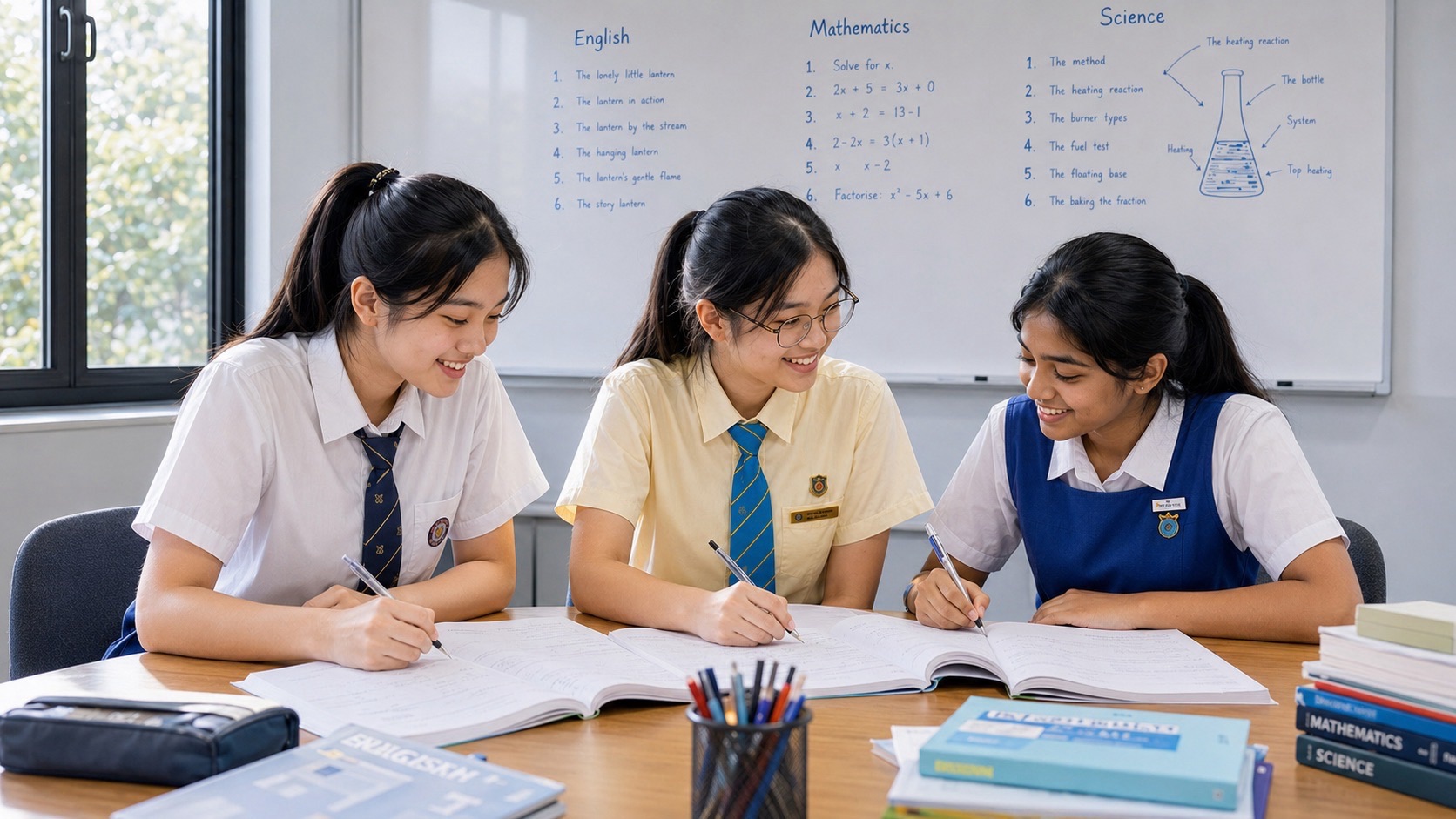
Punggol Science Tuition in Secondary 3 should help a student do something more demanding than learn harder chapters. Families searching for Secondary 3 Science Tuition are usually entering the year when Science becomes more specialised, the volume rises sharply, practical reasoning matters more and assessment begins to feel closer to the final certificate route.
The core aim of Secondary 3 Science tuition in Punggol is to build upper-secondary control. In 2026, Secondary 3 students are part of the Full Subject-Based Banding cohort that will move into the Singapore-Cambridge Secondary Education Certificate in 2027. That makes this year especially important: students must learn the exact subject level and combination they are taking, build strong disciplinary models, keep lower-secondary foundations alive and develop exam-ready habits before Secondary 4 compresses the runway.
Explore related Science guides and choose your next reading step.
Secondary 3 Is the Year Science Becomes a Portfolio
By Secondary 3, Science is no longer one broad subject experience for every learner. Students may take different subject combinations and levels, and their work may separate more clearly into Physics, Chemistry, Biology or Combined Science pathways.
This means students need to manage several things at once: the content itself, the distinct habits of each science, practical work, quantitative reasoning, school tests and the growing need to retain older topics.
Tuition should therefore help the learner build a portfolio rather than a pile. Each subject needs its own methods, but all of them should fit inside one broader scientific system: retrieve, represent, reason, apply, check and correct.
The Core Aim: Build Upper-Secondary Science Control Before the Final Year
Secondary 3 is often the best year to fix learning systems because there is still time to repair without the full pressure of the final year. A student can improve retrieval, graph reading, calculation habits, practical reasoning and written explanations before those weaknesses become expensive in Secondary 4.
The best question is not “How far ahead can tuition get?” It is “What must become reliable this year?”
- Core concepts can be explained without notes.
- Equations and processes can be reconstructed rather than copied.
- Graphs, tables and diagrams are read accurately.
- Practical methods are understood rather than memorised.
- Units and quantitative relationships are controlled.
- The student can switch among topics and disciplines.
- Corrections lead to stable change.
- Past-paper work begins to reveal patterns rather than just scores.
- The learner can work independently for longer stretches.
2027 SEC Makes Secondary 3 a Transition Cohort
For Secondary 3 students in 2026, the next year is not simply another version of the older O-Level pathway. The Full SBB transition leads into the Singapore-Cambridge Secondary Education Certificate in 2027, with subjects offered at relevant G1, G2 and G3 levels.
Tuition should therefore use current syllabus information and the student’s actual school programme. Older search terms remain useful for finding resources, but the student should be taught for the course they are genuinely taking.
The educational core remains stable: concept models, evidence, practical reasoning, calculations, retrieval, transfer and precise scientific communication.
Physics in Secondary 3: Relationship Before Formula
Physics can feel intimidating because the equation count grows. The strongest response is not to memorise more formulae. It is to see the relationships underneath them.
Students should be able to identify the system, draw a useful diagram, name the relevant quantities, select the relationship, convert units, calculate and sense-check.
If the formula is known but the student cannot decide when to use it, the problem is model selection rather than memory.
Chemistry in Secondary 3: Connect Observation, Particles and Symbols
Chemistry becomes deeper because students increasingly move between visible evidence, microscopic models and symbolic equations.
A student should be able to see an observation and propose a particle explanation, read an equation and explain what it represents, or use the Periodic Table and reaction patterns to make a prediction.
This three-level movement is one of the most important Chemistry habits to build in Secondary 3.
Biology in Secondary 3: Trace Systems, Not Paragraphs
Biology can become memory-heavy if students collect terms without connecting them.
A better method organises content into systems, pathways, structure-function relationships and cause chains. Ask what enters, what changes, where it goes next and what happens if one stage is disrupted.
This reduces dependence on memorised model paragraphs and improves transfer.
Combined Science: Switching Is Part of the Challenge
Combined Science students need to switch between two scientific modes within one overall course. That switching should be practised, not left to exam day.
Mixed retrieval can place a calculation beside a particle explanation or a practical-design question beside a biological process. Before solving, the student names the relevant model.
This builds the ability to change scientific gears quickly.
Pure Science: Depth Needs Better Organisation
Students taking separate sciences face a larger content and representation load. The danger is creating three giant note systems that are difficult to maintain.
Tuition should help compress topics into core maps: central model, equations or processes, key representations, practical ideas and recurring errors.
Depth becomes manageable when details are attached to structure.
Practical Science Should Be Weekly, Not Seasonal
Students often think practical skills belong only in the laboratory or before a practical assessment. In reality, written papers also test variables, methods, measurement, evaluation and evidence.
One short practical-thinking task each week can keep those skills alive. Design a fair test. Choose an instrument. Identify a limitation. Explain why repetition helps. Decide whether an improvement targets precision, accuracy or reliability.
This regular rhythm is more effective than last-minute practical cramming.
Graph Fluency Becomes a Core Upper-Secondary Skill
Graphs appear across all sciences. Students should stop treating them as topic-specific decorations.
The reading routine should be automatic: axes, variables, units, scale, pattern, anomaly, then explanation.
A student who reads the graph incorrectly has already compromised the scientific reasoning that follows.
Tables and Data: Evidence Before Memory
Data questions should begin with the evidence supplied, not with the chapter notes the student remembers.
What comparison is valid? What values matter? What trend is visible? What claim is supported? Only after that should the student bring in the scientific model to explain.
This order prevents memorised knowledge from overpowering the actual data.
Calculations: Secondary 3 Is Where Bad Habits Become Expensive
Upper-secondary calculations are less forgiving because there are more formulas, more units and more multi-step relationships.
Tuition should insist on visible working: relationship, unit conversion, substitution, calculation, unit and sense-check.
Skipping the setup may feel faster but makes errors harder to diagnose and easier to repeat.
Unit Discipline Is a Cross-Subject Skill
Units appear in Physics, Chemistry and data-rich Biology. A student who handles them poorly can lose marks across several subjects.
This makes unit conversion a high-value repair. If it is weak, fix it early and retest across different contexts.
Scientific Vocabulary Must Become More Precise
Secondary 3 demands greater precision. Everyday words may no longer be enough.
Students should learn terms in contrast: oxidation versus reduction, current versus potential difference, respiration versus breathing, accuracy versus precision.
Clear boundaries reduce plausible but wrong answers.
Command Words Become More Important
State, describe, explain, compare, calculate, suggest and evaluate require different kinds of responses.
Tuition should train students to identify the command before writing. A correct fact that does not match the task can still lose marks.
The Error Ledger Should Now Be Subject-Specific and Cross-Cutting
By Secondary 3, students benefit from tracking both subject errors and shared habits.
- Physics: wrong formula family or unit.
- Chemistry: particle model or equation error.
- Biology: process chain or structure-function gap.
- Cross-subject: graph misread.
- Cross-subject: vague scientific writing.
- Cross-subject: practical variables.
- Cross-subject: poor time allocation.
- Cross-subject: old knowledge not retrieved.
One cross-cutting repair can improve several subjects at once.
Retrieval Must Become Cumulative
Secondary 3 content accumulates too quickly for revision to remain chapter-by-chapter.
Every week should include old material. A five-minute closed-book retrieval block can include one formula, one diagram, one definition, one practical decision and one explanation from previous topics.
The aim is to keep the whole portfolio available.
Interleaving: Learn to Identify the Question Type
A student who only practises labelled worksheets can become dependent on topic cues.
Mixed practice should gradually remove those cues. Before solving, the learner states the model or question family being tested.
This develops classification, one of the most important exam skills.
Past Papers Should Begin Before Secondary 4—Carefully
Secondary 3 students can benefit from selected past-paper style questions and timed sections, but full-paper volume should not replace concept building.
Use papers as measurement instruments. Which models are weak? Which questions are slow? Which correct answers were uncertain?
The goal is to learn from the paper, not simply to finish it.
The First Major Upper-Secondary Test Is a Diagnostic Goldmine
A disappointing first test can feel alarming, but it often reveals the student’s true transition problem.
Was the difficulty content depth, retrieval, timing, calculations, unfamiliar contexts or scientific language?
Classify before reacting. A targeted repair is more useful than immediately doubling worksheet volume.
Strong Students Need Novelty, Not Just More Chapters
A strong Secondary 3 student can be extended through unfamiliar data, competing explanations, experimental design and cross-topic transfer.
This develops scientific judgement while keeping the learner aligned to the syllabus.
Acceleration can be useful when foundations are secure, but depth should come first.
A Weekly Secondary 3 Science Rhythm
- Mixed retrieval from old topics.
- Current school priority.
- One subject-specific deep block.
- One practical or data question.
- Independent application without immediate hints.
- One changed-context transfer problem.
- Error-ledger update.
- Delayed retest of a repaired weakness.
A Term Rhythm: Learn → Connect → Simulate → Repair
The beginning of a term should allow deep learning. Mid-term should increase connections and retrieval. Before assessments, timed and mixed work can rise. After assessments, diagnosis should drive the next cycle.
A tuition programme that never changes rhythm can be inefficient. The calendar and evidence should shape the emphasis.
Secondary 3 Is the Year to Build a Personal Checking Routine
Students should know their own recurring risks. One learner forgets units. Another misreads graph scales. Another overwrites explanations. Another rushes MCQ.
A personal checking routine should target those risks explicitly. Generic “check your work” advice is too vague.
The Student Should Start Needing Fewer Hints
Secondary 3 tuition should gradually fade support. The tutor may first ask, “Which model applies?” Later, the student should ask that internally.
If the learner performs only when prompted, the lesson may look successful while exam independence remains weak.
Productive struggle is part of the transition.
Preparing for Secondary 4 Should Begin With Stability, Not Panic
The best preparation for Secondary 4 is not a December rush through the whole final-year syllabus. It is stable Secondary 3 knowledge, strong retrieval and a clear error map.
A student who enters Secondary 4 with intact foundations has more cognitive capacity for final-year integration and exam control.
How Parents Can Support Secondary 3 Science
- Ask which subject currently has the biggest recurring error.
- Ask what old topic was retrieved this week.
- Ask whether recent papers were analysed, not just scored.
- Bring school tests and practical feedback to tuition.
- Protect sleep and a realistic weekly schedule.
- Watch whether one science is being quietly avoided.
How the eduKate Ecosystem Connects
For the broad route, use The Core Aim of Punggol Science Tuition | Secondary Science Tuition. For separate sciences, see Pure Science Tuition, Physics Tuition, Chemistry Tuition and Biology Tuition.
Students can also use Secondary 3 Science Study Guide | Pure & Combined Science Routes and The Core Aim of Punggol Science Tuition | Science Exam Preparation.
Frequently Asked Questions
What is the main aim of Secondary 3 Science tuition?
To build upper-secondary control: deeper subject models, practical reasoning, calculations, retrieval, mixed-question selection and independent exam habits before the final year.
Is Secondary 3 too early for exam preparation?
No, but preparation should be selective. Use timed sections and past-paper style questions to diagnose skills while continuing to build concepts deeply.
How important is the 2027 SEC transition?
Very important for the cohort. Students should prepare according to their current subject level and syllabus under the Full SBB framework rather than relying only on older stream labels.
Should Secondary 3 students do full papers every week?
Usually not by default. Mixed sections and targeted past-paper work may produce more learning while the syllabus is still being built.
What if one science is much weaker than another?
Give the weaker subject more targeted repair while keeping short retrieval blocks for the stronger subjects so they do not decay.
How do we know the student is ready for Secondary 4?
Old topics remain retrievable, mixed questions are manageable, practical reasoning is stable, calculations are organised and the learner can correct errors with fewer prompts.
Should tuition teach ahead into Secondary 4?
A modest preview can help when Secondary 3 foundations are secure. If current weaknesses remain, repair usually has higher value.
How can parents support without increasing pressure?
Focus on evidence and process: recurring errors, retrieval, sustainable scheduling and what has been successfully repaired.
The Core Aim, in One Sentence
The core aim of Punggol Science Tuition for Secondary 3 Science is to turn upper-secondary Science into a controllable portfolio of models, representations, practical skills, calculations and retrieval habits before the final year compresses the runway.
When that happens, Secondary 3 becomes more than the year the syllabus gets harder. It becomes the year the student learns how to manage hard Science: choose the model, read the evidence, use the right representation, calculate carefully, explain precisely and carry the knowledge forward.


