
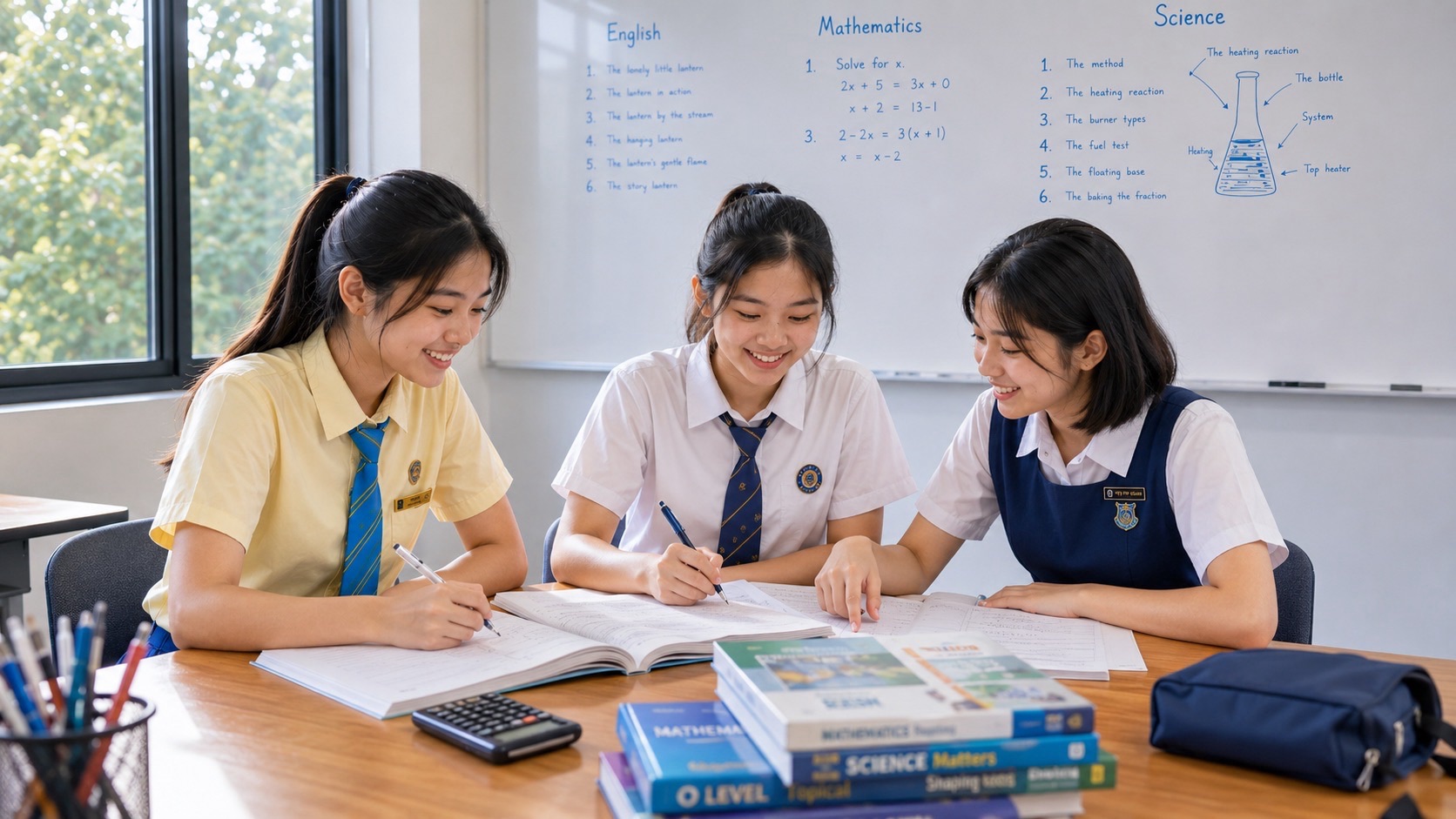
Secondary 3 English tuition in Punggol should do more than increase worksheet volume before upper-secondary examinations. At this stage, students need to turn earlier English knowledge into a connected system for G3 English tuition, reading comprehension, situational writing, continuous writing, editing, summary, oral communication and the coming SEC English pathway. For parents searching for Secondary 3 English tuition in Punggol, the key question is not “How much practice is assigned?” but “Can my child now use language independently when the text, topic and question are unfamiliar?”
The core aim of Secondary 3 English tuition is to convert language knowledge into upper-secondary control. By Secondary 3, students should increasingly be able to analyse a question, locate evidence, paraphrase without changing meaning, write for audience and purpose, sustain an argument or narrative, edit recurring grammar errors and speak with developed ideas. The year matters because it is where earlier foundations must begin functioning reliably under more demanding G3 English and SEC-style expectations.
Explore related English guides and choose your next reading step.
At eduKatePunggol, Secondary 3 is treated as a bridge between foundation and final-year independence. The tutor diagnoses the first unstable link, repairs it, then requires transfer into fresh work. A weak summary may actually begin with comprehension. A weak situational writing response may begin with audience awareness. A weak continuous writing piece may begin with idea selection rather than vocabulary.
For the wider programme route, see Punggol Secondary 3 English Tutor | 3-Student Small-Group Tutorials and Inside a 3-Student Secondary 3 G3 English SEC Tutorial in Punggol.
Secondary 3 Is Where English Becomes a Performance System
In Secondary 1 and 2, students are still adapting to the language demands of secondary school. By Secondary 3, the expectation changes. Skills need to work together under less support.
A student may understand vocabulary in isolation but fail to use it in writing. They may know grammar rules but miss errors in editing. They may understand a passage but produce vague comprehension answers. They may have ideas for oral but lack structure.
The task of tuition is therefore integration. The learner must connect knowledge with execution.
The Secondary 3 shift
- from recognising language features to explaining their effect;
- from understanding a passage broadly to selecting precise evidence;
- from writing correctly to writing for audience, purpose and context;
- from memorising vocabulary to using precise language naturally;
- from teacher-led correction to self-editing;
- from prepared oral responses to flexible spoken interaction;
- from component practice to controlled performance under time.
This is why Secondary 3 should not be treated as “Secondary 2 with harder worksheets”.
G3 English: Precision Becomes More Important
At G3 level, the difficulty is often not that every passage contains impossible vocabulary. The difficulty is that questions demand finer distinctions.
Students need to notice tone, implication, contrast, purpose, evidence and language effect. In writing, they must make choices about register, organisation and development. In summary, they must preserve meaning while compressing language.
Search Console data on eduKatePunggol in September–October 2026 shows visibility around queries including “english tuition for secondary 3”, “g3 english tuition”, “g3 english tuition for sec 3 and 4” and “secondary 3 english tuition”. These searches reflect a useful parent concern: Secondary 3 is often the point where general English ability must become examination-ready language control.
The 2027 SEC Context
Singapore has fully implemented Full Subject-Based Banding from the 2024 Secondary 1 cohort, with subjects offered at G1, G2 and G3 levels. From 2027, the Singapore-Cambridge Secondary Education Certificate replaces the earlier N- and O-Level certificates.
SEAB’s official 2027 G3 listing identifies English Language as K300, with 1184 shown as the reference code for 2026 and earlier. The published G3 English syllabus requires candidates to sit four papers, including Writing, Comprehension, Listening and Oral Communication.
Parents can refer to the official 2027 SEC G3 Syllabuses for School Candidates.
The label changes, but the educational aim remains durable: students need language knowledge that transfers across unfamiliar tasks.
Paper 1 Writing: Editing, Situational Writing and Continuous Writing
The 2027 G3 English syllabus lists Paper 1 Writing at 1 hour 50 minutes, with three sections: Editing, Situational Writing and Continuous Writing.
This structure reinforces an important teaching principle: writing is not one skill. The student must detect errors, communicate to an audience and sustain a longer piece of writing.
Editing
Editing requires pattern recognition. Students should know their recurring grammar weaknesses: tense, agreement, articles, prepositions, word form, pronouns and sentence structure.
The best correction routine identifies the error type, explains why the original fails, fixes it and then tests the same principle in a fresh sentence.
Situational Writing
Situational writing is real communication under examination constraints. Students need to understand purpose, audience and context, then organise required information into a coherent text.
A strong response should not feel like bullet points copied into complete sentences. The information should be transformed into communication.
Continuous Writing
The G3 syllabus requires candidates to choose one of four topics and write continuous prose. The durable skill is flexibility: students need to interpret the question, choose a viable direction, develop ideas and sustain relevance without forcing a memorised essay.
Situational Writing: Audience Changes Language
Secondary 3 students should be able to change tone depending on who is receiving the text and why.
A message to a friend, a speech to schoolmates, a report to a school leader and a formal email do not use identical language. Vocabulary, sentence structure, degree of formality and organisation all change.
The useful question is not “Which format do I memorise?” but “What does this reader need from me?”
For a focused route, see Secondary Situational Writing — Audience, Purpose, Register and SEC Readiness.
Continuous Writing: Structure Before Decoration
Secondary 3 writing becomes stronger when students learn to control development rather than decorate sentences.
For narrative writing, events should cause later events and the turning point should be earned. For argumentative or expository writing, each paragraph should advance a clear claim supported by explanation and relevant examples.
Vocabulary matters, but precise ordinary vocabulary is stronger than rare language used approximately.
The wider writing framework is explained in The Core Aim of Punggol English Tuition | English Composition.
Comprehension: Evidence Is the Centre of the Answer
Secondary 3 comprehension increasingly rewards disciplined evidence use. Students need to separate what the passage states from what they infer.
A useful routine is Question → Evidence → Thinking → Answer → Check. The student identifies exactly what is being asked, finds the relevant evidence, decides whether interpretation is required, writes to the correct scope and then checks that the answer does not claim more than the passage supports.
This reduces two common errors: copying an accurate but irrelevant sentence, and writing a plausible inference that the text does not justify.
See How to Judge Whether Evidence Is Relevant and Sufficient in Reading Comprehension.
Language Effect: Why This Word, Here?
Secondary English students must increasingly explain not only what a word means but what it does.
A writer may choose a verb to make an action seem sudden, an adjective to frame a person negatively, repetition to create emphasis or a contrast to change the reader’s expectation.
The strongest answers connect technique to local meaning. “The writer uses a strong verb” is incomplete. Which verb? What does it suggest in this context? How does that affect the reader’s understanding?
This is where vocabulary depth, grammar and comprehension meet.
Summary Writing: Preserve Meaning While Compressing
Summary is one of the clearest tests of whether a student really understands a passage. The student must identify relevant points, exclude examples or repetition where appropriate, paraphrase carefully and stay within the required word limit.
Paraphrase does not mean replacing every word with a synonym. It means expressing the same idea differently without adding or losing meaning.
A good summary routine separates selection from expression. First identify the points. Then compress and paraphrase. Students who try to do both simultaneously often omit information or distort meaning.
See Secondary Summary Writing — Selection, Paraphrase, Word Limit and G3 SEC Control.
Vocabulary: Build Precision, Not Bombast
By Secondary 3, vocabulary should support analysis and argument as well as narrative writing.
Students benefit from distinctions such as claim, evidence, assumption, implication, consequence, effective and efficient. These words organise thinking.
Vocabulary learning should include collocation, register and connotation so students can use words naturally.
See The Core Aim of Punggol English Tuition | English Vocabulary.
Grammar: Self-Editing Should Grow Before Secondary 4
Secondary 3 is an ideal year to move from teacher correction toward self-editing.
Students should know their own error patterns and carry a personal checklist into writing. One learner may repeatedly shift tense. Another may have article errors. Another may overuse comma splices.
The aim is not to check every grammar rule after every draft. It is to identify the two or three recurring patterns that cost the most clarity and marks.
For the wider system, see The Core Aim of Punggol English Tuition | English Grammar.
Oral Communication: Develop, Do Not Recite
Secondary oral requires students to organise ideas quickly and respond to follow-up questions. Memorised scripts become fragile because the interaction changes.
A useful oral structure is: answer directly, explain the reason, give a relevant example, consider another perspective when useful, and connect back to the question.
Students should also practise listening. A strong speaker who misses the examiner’s actual question is still off-task.
See Secondary Oral — Planned Response, Spoken Interaction and SEC Readiness.
Listening: Hold Meaning While Information Moves
Listening comprehension tests attention, working memory and interpretation in real time. Students cannot simply reread the sentence.
Practice should therefore focus on identifying main ideas, discriminating important details, recognising distractors and keeping concise notes where appropriate.
The goal is active listening rather than passive exposure.
See Secondary Listening — Main Idea, Detail, Note-Taking and SEC Exam Control.
The Secondary 3 Error Log
A useful Secondary 3 student should begin maintaining an error log that records patterns rather than isolated wrong answers.
- Comprehension: inference too broad.
- Summary: selected example instead of main point.
- Editing: article error.
- Situational writing: omitted required detail.
- Continuous writing: paragraph lacks explanation.
- Vocabulary: word fits meaning but not collocation.
- Oral: answer relevant but undeveloped.
- Timing: spent too long on first comprehension question.
Patterns allow targeted practice. Without categorisation, revision becomes “do more English”.
Timed Practice Comes After Method
Students should not be rushed before the thinking process is stable. Speed built on confusion only produces faster errors.
A useful progression is untimed accuracy, then timed sections, then mixed components, then full-paper performance.
When timing breaks down, diagnose the cause. Is the student reading too slowly because vocabulary is weak? Overplanning writing? Overchecking? Getting stuck on one question? Each cause needs a different solution.
Why Secondary 3 Should Not Become an Endless Exam Year
Secondary 3 matters because it prepares Secondary 4, but constant full-paper drilling can crowd out the deeper learning needed to improve.
Students still need time to read, discuss, revise paragraphs, compare word choices and understand why a sentence works. These activities build the language that later supports examination performance.
A healthy programme alternates between skill-building, targeted repair and periodic assessment.
What Parents Can Look for
- The tutor can identify a specific error profile.
- Comprehension feedback refers to evidence and scope.
- Summary work separates point selection from paraphrase.
- Writing feedback addresses purpose and development, not only grammar.
- Vocabulary is taught through context and collocation.
- Grammar correction becomes increasingly self-directed.
- Oral practice includes follow-up questions.
- Timing is trained deliberately rather than imposed immediately.
- Fresh tasks are used to test transfer.
- The student can explain what they are trying to improve.
Secondary 3 tuition should make the learner more aware of their own language system.
How to Tell Whether Secondary 3 English Tuition Is Working
- The student can identify what a question is really asking.
- Comprehension answers become more precise.
- Summary selection becomes more disciplined.
- Paraphrasing preserves meaning more reliably.
- Situational writing reflects audience and purpose.
- Continuous writing has clearer development.
- Editing catches recurring grammar patterns.
- Vocabulary becomes more natural and precise.
- Oral answers extend with relevant examples.
- Timed work becomes more stable.
- Corrections transfer into fresh tasks.
- The student needs fewer prompts from the tutor.
The strongest sign is not one unusually high test score. It is increasing reliability.
Frequently Asked Questions
Is Secondary 3 too late to repair weak English foundations?
No, but diagnosis becomes important. Repair the specific foundation affecting current work rather than restarting the entire Primary syllabus.
Should Secondary 3 students start doing full G3 papers every week?
Not necessarily. Full papers are useful for integration and timing, but targeted practice is more efficient for repairing specific weaknesses.
What if writing is strong but comprehension is weak?
Use a targeted reading and evidence programme while maintaining writing. Equal time across all components is not always efficient.
What if my child gets good marks but still needs tuition?
A strong student may benefit from reliability, extension, sharper language effect analysis, better summary control or stronger timed performance. Tuition should have a clear purpose.
Does G3 English require “advanced vocabulary”?
It requires precise and appropriate language. Rare vocabulary is not automatically better.
How should Secondary 3 prepare for 2027 SEC?
Build the durable skills underlying the papers: writing for purpose, comprehension, summary, editing, listening and oral communication, then practise the official format progressively.
Helpful Reading for Punggol Families
- Punggol Secondary 3 English Tutor | 3-Student Small-Group Tutorials
- Inside a 3-Student Secondary 3 G3 English SEC Tutorial in Punggol
- Secondary Summary Writing
- Secondary Situational Writing
- Secondary Continuous Writing
- Secondary Vocabulary in Context & Language Effect
- Secondary Editing
- Secondary Oral
- SEAB 2027 SEC G3 Syllabuses for School Candidates
The Core Aim of Secondary 3 English Tuition
The core aim is to make the student increasingly independent before the final secondary year.
Read precisely. Select evidence. Paraphrase carefully. Write for audience. Develop ideas. Edit recurring errors. Speak with structure. Listen actively. Work under time. Learn from mistakes.
Those habits turn Secondary 3 from a year of increasing difficulty into a year of increasing control.
For Punggol families, this is the Secondary 3 English tuition standard worth looking for: diagnosis before drilling, connected language before isolated tricks, and fresh-task transfer before confidence is assumed.
At eduKatePunggol, the goal is a student who enters Secondary 4 knowing not only more English, but how to use it.
Arrange a Parent–Student Consultation
Bring recent Secondary 3 school papers, compositions, summary work or oral feedback. We can identify whether the main bottleneck is comprehension, summary, writing, vocabulary, grammar, oral, listening or timed execution.
Visit eduKatePunggol for the wider English, Mathematics and Science learning routes.
eduKatePunggol
83 Punggol Central
Singapore 828761
Near Punggol MRT and Waterway Point
Premium small-group tuition
By appointment
Properly taught kids shine a bright light into the future.


