
Secondary 1 English tuition in Punggol is most useful when it helps a student cross the gap between Primary English and the more independent language demands of secondary school. Families searching for Sec 1 English tuition, English tuition for Secondary 1 students, Secondary English tuition or a Punggol English tutor are often seeing the same pattern: the child can read, write and speak English, yet the new school tasks suddenly require more interpretation, more evidence, more structure and more independent judgement.
The core aim of Secondary 1 English tuition is to make that transition deliberate. By the end of a strong Secondary 1 runway, the learner should be able to approach an unfamiliar text, identify what a question is really asking, separate evidence from inference, organise writing for purpose and audience, retrieve vocabulary with greater precision, edit recurring grammar errors, speak in developed responses and continue working even when the task does not look exactly like the examples practised before.
Explore related English guides and choose your next reading step.
This is a bigger goal than surviving the first few weighted assessments. Secondary 1 is where English begins changing from a collection of familiar Primary-school components into a more connected system of meaning, evidence, audience, reasoning and control.
At eduKatePunggol, this article owns that target state. The existing Secondary 1 programme page remains the service and lesson-detail owner, while the wider Secondary English, comprehension, writing, vocabulary, grammar, oral and listening pages continue to teach their specialised skills.
Secondary 1 English Tuition in Punggol
The Core Aim: Build the Secondary English Operating System Early
Secondary 1 English is often treated as a gentle continuation of Primary 6.
That is only partly true.
The learner still reads passages, answers questions, writes, listens and speaks. Grammar and vocabulary still matter. Clear sentences still matter. However, the student is now expected to coordinate those abilities with increasing independence.
The useful shift is from:
- finding information to judging which information matters;
- understanding a sentence to following an argument or idea across paragraphs;
- knowing vocabulary to selecting the precise word for a context;
- knowing grammar to editing language while writing under time pressure;
- telling a story to writing for a defined purpose and reader;
- giving an answer to supporting an answer;
- speaking confidently to developing a response coherently;
- following a model to adapting a principle; and
- waiting for correction to noticing and repairing mistakes independently.
If these habits begin in Secondary 1, later English becomes easier to organise. If they remain weak, the student may continue passing for a while but experience increasing difficulty as texts become denser, writing becomes more demanding and examination timing becomes less forgiving.
The Transition Is Larger Than the New Textbook Makes It Look
A student can arrive in Secondary 1 with a respectable Primary English result and still feel unsettled.
That does not automatically mean the Primary foundation was poor.
The student may simply be encountering a new type of language work.
Primary English gives students essential tools: reading fluency, vocabulary, grammar, comprehension, writing, oral communication and listening. Secondary English increasingly asks the student to use those tools in combination.
Consider a comprehension question that asks what a character’s reaction suggests.
The learner may need to:
- understand the literal event;
- locate a relevant phrase;
- interpret the phrase;
- infer the attitude or emotion;
- avoid an overclaim;
- write the answer precisely; and
- do all of this without copying the passage mechanically.
Nothing in that chain is impossible. The difficulty comes from coordinating several decisions quickly.
This is why Secondary 1 is an excellent year for explicit strategy teaching. The student has enough language to work with, but there is still time to make the thinking visible before upper-secondary pressure arrives.
The Hidden Secondary 1 Problem: Familiar English Can Hide New Weaknesses
Mathematics often announces a transition loudly. Algebra appears and everyone knows a new language has arrived.
English can be quieter.
The words still look like English. The passages are readable. The student can complete homework. That familiarity can hide a growing gap between understanding the surface and controlling the deeper task.
A Secondary 1 learner may:
- read every word but miss the writer’s main point;
- find evidence but not explain its significance;
- write fluent paragraphs that are only loosely relevant;
- know a large vocabulary but choose words imprecisely;
- score well in grammar exercises yet repeat grammar errors in compositions;
- speak confidently but give short undeveloped answers;
- highlight heavily without knowing what the highlighting is for; or
- depend on answer keys because the logic behind answers still feels invisible.
These are not reasons for panic.
They are reasons for diagnosis.
Secondary 1 tuition is most useful when it identifies the first unstable link instead of responding to every low mark with more worksheets.
What Secondary 1 English Tuition Actually Teaches
1. Reading for structure
Students learn that a text is more than a sequence of sentences. Paragraphs have jobs. Ideas connect through cause, contrast, example, sequence, qualification and explanation. Recognising these relationships makes comprehension more efficient.
2. Evidence and inference
The learner distinguishes what the text states directly from what the reader can reasonably conclude. This helps prevent both under-answering and imaginative over-reading.
3. Vocabulary in context
Secondary vocabulary becomes increasingly dependent on nuance, collocation and register. Students learn to use surrounding information, word families and contrast to determine meaning rather than rely only on memorised definitions.
4. Sentence control
Students strengthen sentence boundaries, tense control, agreement, reference, conjunctions, modifiers and punctuation. The important step is carrying this knowledge into real writing.
5. Paragraph architecture
A paragraph should develop one meaningful unit of thought. Students learn how to introduce, develop, support and close a paragraph without turning every sentence into a separate idea.
6. Writing for purpose and audience
The learner begins asking who will read the text, why the text exists, what information matters and what tone fits the situation.
7. Oral development
Students practise moving beyond one-sentence opinions. A useful spoken response makes a point, develops it, supports it with an example or reason and remains responsive to the question.
8. Listening and note-taking
Students learn to listen for main ideas, detail, sequence, contrast and emphasis. Simple notes help hold information in working memory without trying to write down everything.
9. Editing and self-correction
The goal is not simply to accept the tutor’s correction. Students learn recurring personal error patterns and use targeted checks to find them independently.
10. Learning how to recover
Strong students are not students who are never confused. They are students who know what to do next when comprehension breaks, vocabulary is unfamiliar or the writing plan stalls.
Why Small-Group Secondary 1 English Can Be Useful
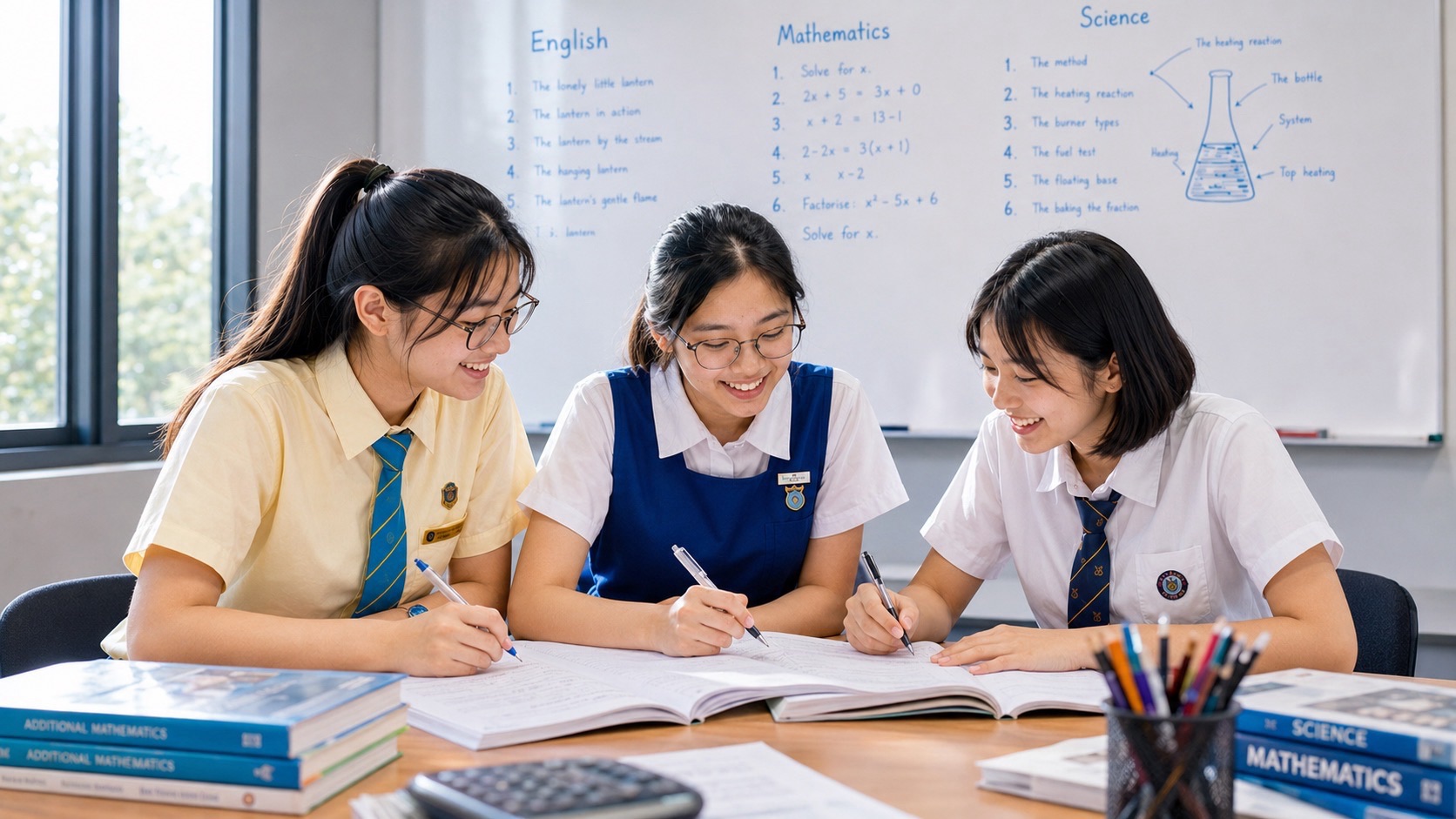
A class of three creates a particular kind of English lesson.
There is enough variation for students to hear another interpretation or writing approach, but the group is still small enough for the tutor to notice individual reasoning.
This matters because English errors are often plausible.
A comprehension answer may sound intelligent but lack evidence. A sentence may be grammatical but inappropriate for the audience. A vocabulary choice may be understandable but unnatural. A composition may be enjoyable to read but only weakly connected to the prompt.
In a very small class, the tutor can ask the question behind the answer:
- Why did you choose that phrase as evidence?
- What does the pronoun refer to?
- What is this paragraph trying to achieve?
- Why is this word stronger than the alternative?
- Which part of the prompt does this event answer?
- What would make this oral point more convincing?
The student is therefore not only corrected.
The student is trained to inspect the decision.
For the separate format comparison, see 3-Pax Small Group vs 1-to-1 vs Large Class.
Our First-Principles Secondary 1 Method
1. Diagnose the exact transition problem
We begin with evidence. A student who loses marks through weak inference needs a different intervention from a student who understands the passage but writes vague answers. A student with strong ideas but unstable grammar needs a different lesson from a student who cannot generate ideas at all.
2. Rebuild from the first unstable link
We do not add sophisticated techniques on top of a missing foundation. If vocabulary prevents comprehension, vocabulary receives attention. If sentence boundaries prevent clear writing, sentence control comes first.
3. Fence the task
Students identify what the question allows and requires. They mark the relevant text, audience, purpose, evidence or prompt boundary before expanding the answer.
4. Make thinking visible
The student explains the choice. This is important because a lucky correct answer and a well-reasoned correct answer look identical on the page.
5. Move from model to principle
When we use a model answer or model paragraph, the class identifies why it works. Students then use the principle on a different text or topic.
6. Reduce prompting gradually
Support is useful only if it can later be removed. The tutor therefore moves from modelling to prompting, from prompting to questioning and from questioning to independent application.
7. Retrieve earlier learning
Old skills return. A vocabulary item reappears in reading. A grammar relationship reappears in writing. Evidence reasoning reappears in oral discussion. Retrieval helps students build one connected English system.
8. Test transfer
The student meets a fresh task with the surface changed. If the method still works, the learning is becoming portable.
What Happens During a 90-Minute Secondary 1 Lesson
Lessons vary with the school week, but a stable rhythm helps learners become more independent.
Warm-up retrieval
A short task recalls earlier vocabulary, grammar, inference, paragraphing or editing. The tutor can see whether last week’s learning is still available.
Fresh text or prompt
Students encounter unfamiliar material. This prevents success from depending entirely on rehearsal.
Concept teaching
The tutor isolates one high-value principle: perhaps evidence selection, language effect, paragraph focus, register, sentence boundaries or vocabulary nuance.
Guided practice
Students attempt selected tasks while explaining their reasoning. Prompts are given only where they reveal or repair the bottleneck.
Independent application
The learner attempts a fresh item without step-by-step support.
Error review
Mistakes are classified. Was the problem comprehension, evidence, vocabulary, grammar, structure, expression, task reading or time?
Transfer close
A final short task uses the same principle in another context. The student leaves with one concrete method to carry into schoolwork.
The intention is not to fill ninety minutes with worksheets.
It is to make the learning cycle visible: retrieve, understand, practise, apply, diagnose and transfer.
Three Secondary 1 Student Pathways
The repair pathway
This learner arrives with a significant Primary-school gap or begins Secondary 1 and quickly falls behind.
Signs may include slow reading, limited vocabulary, incomplete answers, weak sentence control, short compositions, avoidance of oral tasks or heavy dependence on answer keys.
The priority is to stop the gap from widening.
We rebuild the earliest missing skill while keeping the learner connected to current school work. The student should not spend the whole year permanently revisiting Primary exercises. Repair should create a bridge back into Secondary learning.
The stabilisation pathway
This student is coping, but performance varies.
The learner may score well on one comprehension passage and poorly on the next, write strongly when the topic is familiar and weakly when it is not, or understand grammar but fail to edit the same errors in real writing.
The priority is to make successful behaviour repeatable.
We vary texts, delay support, revisit earlier skills and teach short checking routines so performance depends less on topic familiarity.
The extension pathway
This learner is already secure and needs depth.
Extension may involve denser non-fiction, competing interpretations, finer vocabulary distinctions, stronger argument, tighter synthesis, more sophisticated writing choices and more demanding oral discussion.
The priority is not to race through Secondary 2 material for the sake of speed.
It is to deepen judgement.
Secondary 1 English Under Full Subject-Based Banding
Secondary 1 students now learn within Singapore’s Full Subject-Based Banding system rather than the old stream-label structure.
MOE has fully implemented Full Subject-Based Banding in secondary schools since 2024. Subjects can be offered at G1, G2 and G3 subject levels, allowing a student’s English level to be considered as a subject-level decision rather than a permanent label attached to the whole learner.
This matters for tuition because “Secondary 1 English” is not one identical workload for every student.
Teaching should consider:
- the student’s current English subject level;
- the school’s text and assessment sequence;
- the learner’s Primary 6 foundation;
- reading fluency and vocabulary;
- writing independence;
- oral and listening control;
- the type of errors appearing in schoolwork; and
- the amount of independent practice the student can manage well.
The national examination structure is also changing. SEAB states that the Singapore-Cambridge Secondary Education Certificate replaces the former N(T), N(A) and O-Level certificates from 2027, with students sitting subjects at their respective G1, G2 and G3 levels. Current published 2027 English Language references list K100 for G1, K200 for G2 and K300 for G3.
A Secondary 1 student in 2026 will reach the final Secondary 4 examination in a later year, so families should always check the SEAB syllabus for the student’s actual examination year. The important planning principle is stable: build the language system early enough that future exam preparation can focus on calibration rather than emergency repair.
Official references: MOE Full Subject-Based Banding, SEAB Secondary Education Certificate, SEAB G1 2027, SEAB G2 2027 and SEAB G3 2027.
Reading Comprehension: Move From Answer Hunting to Meaning
Many students enter Secondary 1 with a practical Primary-school habit: read the question, scan for matching words and retrieve the nearby sentence.
That method still works sometimes.
The difficulty is that Secondary comprehension increasingly rewards understanding relationships rather than locating repeated vocabulary.
Students need to ask:
- What is happening in this paragraph?
- Why is this detail included?
- What changed between these two sentences?
- What does the phrase imply?
- Which evidence is strongest?
- What interpretation would go beyond the text?
This turns comprehension into disciplined reading rather than keyword matching.
For the deeper reading owner, see The Core Aim of Punggol English Tuition | Reading Comprehension.
Writing: The Reader Cannot See What the Writer Knows
Secondary 1 writing often reveals a new problem: the writer can see the idea in the mind, but the reader receives only the words on the page.
This is why a student can insist that a story “makes sense” even when several causal steps are missing.
Writing tuition teaches the learner to build the path deliberately.
- What does the reader need to know first?
- What is the central change?
- Which details are necessary?
- Which paragraph owns this idea?
- What can be removed?
- What needs explanation?
- Does the ending follow from what came before?
The aim is not to make every Secondary 1 student sound like the same model essay.
It is to make the writing understandable, purposeful and increasingly self-controlled.
For the writing system, see The Core Aim of Punggol English Tuition | English Composition Tuition.
Vocabulary: Precision Beats Size
Secondary 1 vocabulary grows quickly because students meet more abstract topics across English, Science, Humanities and everyday reading.
The wrong response is to turn vocabulary into an endless list of impressive words.
The more useful target is control.
Students should learn:
- what a word means;
- what it does not mean;
- which words commonly appear beside it;
- how formal or informal it is;
- what emotional or evaluative nuance it carries;
- which word family it belongs to; and
- how to retrieve it in speaking and writing.
A smaller active vocabulary is often more useful than a larger passive list that cannot be used naturally.
See The Core Aim of Punggol English Tuition | English Vocabulary.
Grammar: Make the Rule Travel Into Real Writing
Secondary 1 students frequently know more grammar than their writing shows.
That gap matters.
Knowing the correct answer in a ten-question grammar exercise is useful. The stronger skill is noticing the same relationship while writing a paragraph about something else.
Grammar tuition should therefore move through three stages:
- understand the relationship;
- recognise it in context; and
- use and edit it independently.
The goal is not perfect technical terminology.
The goal is reliable sentence control.
See The Core Aim of Punggol English Tuition | English Grammar.
Oral English: Confidence Is Only the Beginning
A confident speaker can still give a weak oral response if the ideas are thin.
Secondary 1 oral work should therefore develop both delivery and thinking.
Students learn to:
- answer the actual question;
- make a clear point;
- develop it with a reason or example;
- respond to follow-up prompts;
- avoid memorised speeches that collapse when the wording changes; and
- use language that is natural enough for spontaneous communication.
The aim is organised thought in spoken form.
See The Core Aim of Punggol English Tuition | English Oral.
How We Reduce “Careless” Secondary 1 English Errors
Carelessness is often a bundle of different problems hiding under one word.
Question-reading errors
The student answers a nearby question rather than the actual one. Repair: underline the command, scope and target before answering.
Evidence errors
The answer is plausible but weakly supported. Repair: return to the exact phrase and explain how it justifies the conclusion.
Reference errors
The student loses track of who or what a pronoun refers to. Repair: trace reference deliberately through the sentence or paragraph.
Vocabulary errors
The learner selects a near-synonym that is wrong in tone, collocation or nuance. Repair: compare alternatives inside complete sentences.
Sentence errors
A run-on, fragment, tense shift or agreement mistake appears repeatedly. Repair: practise the exact pattern and then return it to real writing immediately.
Checking errors
The student “checks” by rereading the whole piece quickly and noticing nothing. Repair: use a narrow checklist based on actual personal error patterns.
Once the mistake is classified, the correction becomes teachable.
Teaching Ahead Without Rushing Through Secondary 2
Teaching ahead can be useful in Secondary 1, but the purpose should be familiarity rather than speed.
Students can encounter future ways of thinking early:
- purpose and audience;
- register;
- evidence sufficiency;
- language effect;
- paraphrase;
- more abstract vocabulary;
- paragraph argument; and
- more independent revision.
When these ideas later appear more heavily in school, the learner recognises the thinking pattern.
Teaching ahead becomes unhelpful when it ignores the current weak link. A student who cannot follow paragraph relationships does not need a denser passage simply because it belongs to a later level. A student who cannot build a complete paragraph does not need more sophisticated essay structures first.
The strongest acceleration is often better sequencing.
What Progress Should Look Like in Secondary 1
Progress is not limited to one English test score.
Parents may first notice that the student:
- starts homework with less uncertainty;
- can explain what a question is asking;
- uses evidence more precisely;
- distinguishes what is stated from what is inferred;
- reads unfamiliar words with better contextual reasoning;
- writes paragraphs with clearer focus;
- uses fewer forced vocabulary choices;
- catches recurring grammar errors;
- speaks for longer without losing structure;
- asks more precise questions;
- depends less on model answers; and
- handles new tasks with less visible panic.
Later, the school results should begin reflecting those stronger habits.
Responsible tuition should not promise an exact grade after a fixed number of lessons. Improvement depends on the size of the existing gap, attendance, reading habits, practice, school demands, willingness to revise and the amount of time available.
The tutor’s job is to make the improvement process visible enough that the student can participate in it.
A Simple Weekly Secondary 1 English Routine
Students do not need a full paper every day.
A balanced week can include:
- short daily reading from varied text types;
- a small vocabulary retrieval set;
- one evidence-and-inference exercise;
- one paragraph-writing or revision task;
- one grammar or editing repair based on actual errors;
- one short spoken explanation or discussion;
- one listening or note-taking activity; and
- one fresh task that tests whether the week’s skill transfers.
The exact amount should fit the student’s school workload.
The principle is more important than the volume: retrieve the skill, use it in context, receive feedback, then try it again without help.
When Should a Secondary 1 Student Get More Structured Support?
Support may be useful when a student:
- was already weak in Primary 6 English;
- reads slowly enough that school tasks become difficult to finish;
- understands passages but cannot explain answers;
- uses quotations without interpretation;
- has a limited active vocabulary;
- knows grammar rules but repeats the same errors in writing;
- writes fluently but drifts off-topic;
- avoids oral participation;
- depends heavily on model answers or AI-generated wording without understanding it;
- cannot identify why marks were lost; or
- has begun describing English as “random”.
Parents do not have to wait for a major failure.
Secondary 1 is a useful time to repair small structural weaknesses before they become upper-secondary habits.
Class Details at eduKatePunggol
eduKatePunggol’s current English programme pages describe very small three-student classes with 1.5-hour lessons. The small-group format is intended to keep participation frequent, make reasoning visible and allow feedback to stay close to each learner’s actual work.
A Secondary 1 student may spend different proportions of lesson time on comprehension, vocabulary, grammar, writing, oral or listening depending on school evidence and the first unstable link.
Current timetable, fees and available places should be confirmed when enquiring.
Secondary 1 English Tuition at eduKatePunggol
Ask about current English tuition at eduKatePunggol
What Parents Can Bring to a Secondary 1 English Consultation
The best starting point is the learner’s actual work.
- a recent English test or weighted assessment;
- one comprehension passage with the student’s answers;
- one recent writing sample;
- teacher comments;
- an editing or grammar section if sentence accuracy is a concern;
- recent Primary 6 work if the transition gap is unclear; and
- the student’s own explanation of what feels difficult.
The last item matters.
“I do not understand the passage” is different from “I understand it but do not know how to answer.” “I know the word but cannot use it” is different from “I have never seen the word.” “I have ideas but cannot start the essay” is different from “I do not know what the prompt means.”
A precise description creates a better intervention.
Frequently Asked Questions
My child did well for PSLE English. Is Secondary 1 tuition still necessary?
Not automatically. Strong students may adjust well without tuition. Support becomes useful when school evidence shows a recurring gap, when the learner needs deeper extension or when the transition demands are not becoming independent quickly enough.
What is the biggest difference between Primary 6 and Secondary 1 English?
The language foundation remains connected, but Secondary English increasingly expects interpretation, evidence, abstraction, register control and independent judgement. Students must coordinate several skills at once.
Should Secondary 1 tuition focus on school homework?
Schoolwork is useful evidence and should be supported when necessary. Tuition should also repair the underlying skill so that the student becomes less dependent on help with future homework.
Should students start doing full examination papers in Secondary 1?
Some timed practice is useful, but endless full papers are not necessary. Smaller tasks often teach more efficiently when the goal is to repair a specific reading, vocabulary, grammar or writing weakness.
Is vocabulary the most important Secondary 1 skill?
Vocabulary is important because it affects reading, writing, listening and speaking. It still works inside a larger system that includes grammar, comprehension, evidence, organisation, audience and metacognition.
How should G1, G2 and G3 English affect tuition?
The task complexity and expected independence should match the student’s subject level. The underlying capabilities remain connected: comprehension, vocabulary, grammar, writing, listening, speaking and self-correction.
How quickly should improvement appear?
Small behavioural changes may appear before large grade changes: clearer evidence, better questions, stronger paragraph focus, more independent checking and less panic with unfamiliar tasks. The rate depends on the starting gap and how consistently the learner practises between lessons.
What is the best sign that Secondary 1 tuition is working?
The student needs less help when the surface changes. A fresh passage, prompt or oral question still feels manageable because the learner recognises the underlying method.
Helpful Reading in the eduKate Ecosystem
- Secondary 1 English Tuition in Punggol
- Secondary 1 English Tuition at eduKatePunggol
- Secondary English Tuition in Punggol
- The Core Aim of Punggol English Tuition | Secondary English Tuition
- The Core Aim of Punggol English Tuition | Reading Comprehension
- The Core Aim of Punggol English Tuition | English Composition Tuition
- The Core Aim of Punggol English Tuition | English Vocabulary
- The Core Aim of Punggol English Tuition | English Grammar
- The Core Aim of Punggol English Tuition | English Oral
- The Core Aim of English Mastery | Reading Comprehension
- The Core Aim of English Mastery | Writing Skills
The Secondary 1 Principle
The best Secondary 1 English tuition does not try to make the first year look artificially easy.
It teaches the student how to handle difficulty.
The learner reads and asks what the paragraph is doing. The learner checks whether an inference is supported. The learner notices when a word is too vague. The learner knows why a paragraph belongs in the composition. The learner hears when a sentence is incomplete. The learner speaks, develops and responds instead of reciting.
Little by little, the questions that once came from the tutor begin to come from the student.
That is the core aim of Secondary 1 English tuition in Punggol: not simply to get through Secondary 1, but to install the habits that make Secondary 2, upper-secondary English and the eventual national examination more manageable.
A good transition does not remove every challenge.
It gives the student a reliable way to meet the next one.


