
Inequalities are different from equations because the answer is usually a region, not a single value. That small change requires Punggol students to think about direction, intervals, number lines and sign behaviour rather than only finding one unknown.
Advanced Mathematics uses inequalities to describe where conditions are true. The skill therefore connects algebra to graphs, domains and optimisation.
An equation asks where two things are equal; an inequality asks where one side is larger or smaller
That means the answer may stretch across an interval. A number line or graph often communicates the solution more clearly than a single symbolic statement.
The sign reversal rule needs meaning
When an inequality is multiplied or divided by a negative number, the direction reverses. This is not a mysterious exception. It preserves the truth of the comparison.
Testing a simple example helps students understand why the reversal is necessary.
Quadratic inequalities are graph questions in disguise
If a quadratic is positive, we are asking where its graph lies above the x-axis. If it is negative, we are asking where it lies below.
Factorisation finds important boundary points; the graph or sign analysis identifies the intervals between them.
Sign diagrams reduce guesswork
- Move everything to one side.
- Factorise if possible.
- Find the critical values.
- Mark them on a number line.
- Determine the sign in each interval.
- Select the intervals that satisfy the inequality.
- Check whether endpoints are included.
Restrictions and inequalities belong together
A rational inequality may contain values that make the denominator zero. Those points divide the number line and must be excluded even if another step seems to simplify them away.
This links naturally to Domain Restrictions — Mathematics Starts by Asking What Is Allowed.
Why interval notation and number lines matter
Different representations help students see whether the boundary is included, whether the solution is one continuous interval or several separated regions, and whether the answer matches the graph.
A Punggol route metaphor
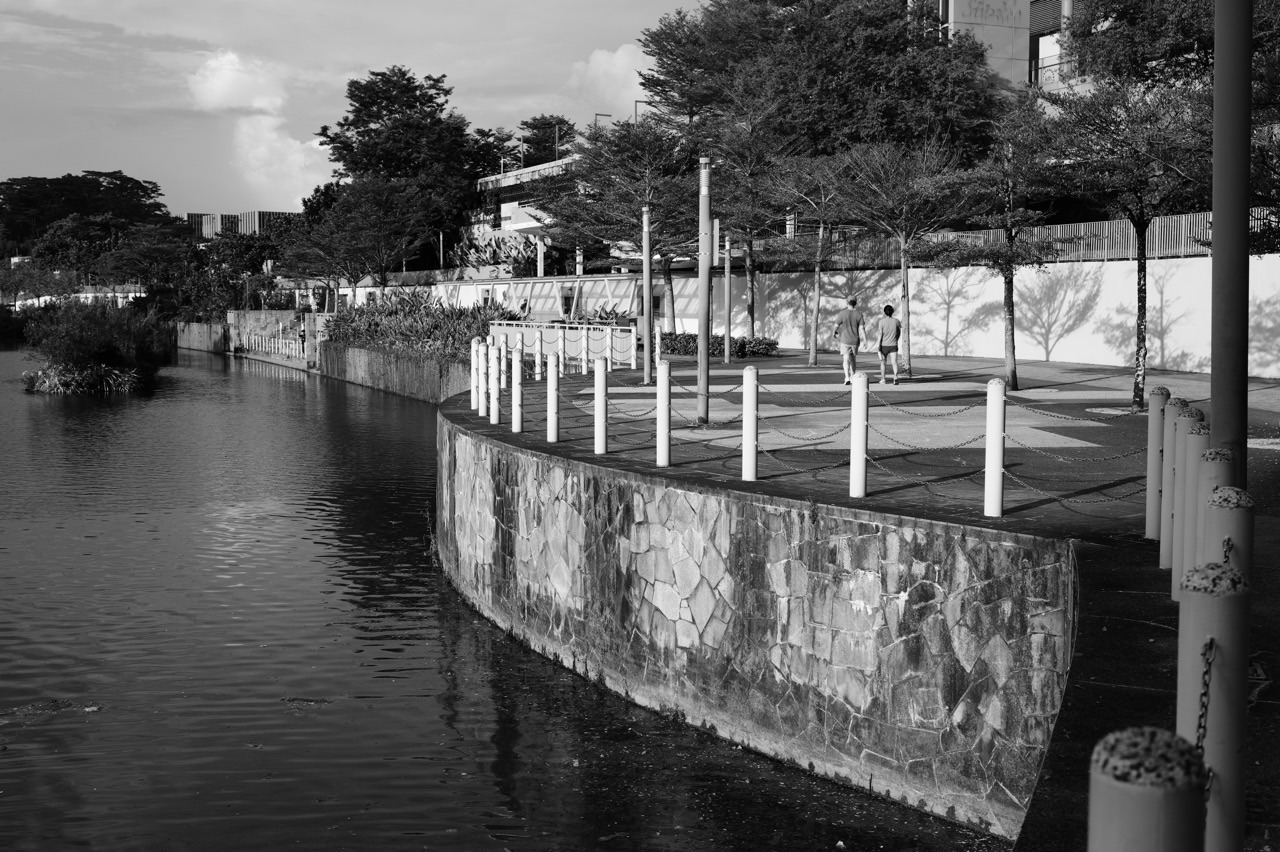
A route is not only a destination. It can be an allowed stretch of path between boundaries. Inequality solutions work similarly: the Mathematics tells us which region of the number line is valid.
A Punggol Waterway path image fits this topic naturally because intervals are about where movement is allowed, not just one endpoint.
Continue the Punggol Advanced Mathematics journey
- The Long Journey From Primary Number Sense to SEC Additional Mathematics
- Secondary 3 — Build One Connected Map
- Secondary 4 and SEC — Independent Exam Control
- Domain Restrictions — What Values Are Allowed
- Parameter Thinking — Families and Thresholds
- Linearisation — Curved Relationship to Straight Line
- Algebraic Fractions and Partial Fractions
Continue through the wider eduKate Punggol ecosystem
- Mathematics Tuition at eduKatePunggol
- Punggol Mathematics Reading Library
- Additional Mathematics Tuition in Punggol
- Additional Mathematics Article Index
- The Secondary Pathway
- Science Tuition at eduKatePunggol
- eduKatePunggol Atlas
Inequalities train students to think in regions, boundaries and sign changes. That makes them a bridge from equation solving into deeper graph, domain and optimisation reasoning.


