
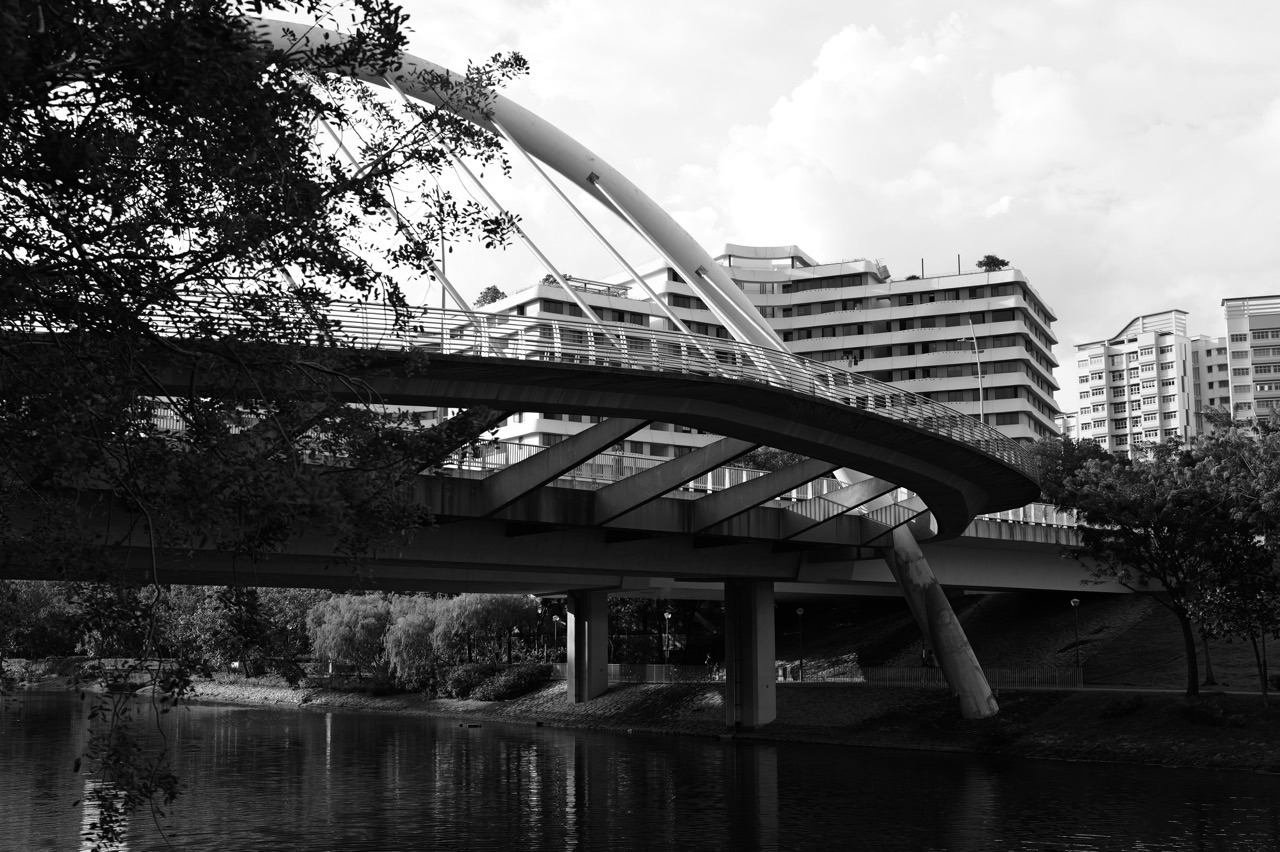
A bridge looks still, but it is full of forces.
A bicycle stays upright through a changing balance of motion, steering and body position. A signboard resists wind. A railing carries loads. A lamp post stands because its structure, base and material keep the forces under control.
Punggol gives students many everyday examples of mechanics, and that makes it an excellent place to move beyond simple force arrows into moments, stability and structural reasoning.
This article continues the Journey of Learning Advanced Science in Punggol by connecting textbook Physics to bridges, bicycles and the built environment.
For the wider local route, see Punggol as a Classroom, The Science of Movement and Transport and Materials and Structures in Punggol.
A Force Is an Interaction
Students often begin with a simple definition: a force is a push or pull.
That is useful, but advanced understanding asks where the force comes from and what it acts on.
- Gravity acts between masses.
- A surface can exert a normal contact force.
- Friction acts along a contact surface.
- A stretched material can exert tension.
- A fluid can exert pressure forces.
- A moving object can experience drag.
Once students identify the interacting bodies correctly, force diagrams become much easier to draw.
Balanced Forces Do Not Mean No Forces
An object at rest may have several forces acting on it.
A bridge deck is pulled downward by gravity while supports exert upward forces. If the forces balance and the structure is not accelerating, the overall motion can remain unchanged.
This is one of the most important corrections in early mechanics: equilibrium is not the absence of force. It is the balance of effects.
Moments Explain Turning
A force can also create a turning effect around a pivot.
The moment depends on the force and the perpendicular distance from the pivot to the line of action of that force.
That is why a longer spanner can make a bolt easier to turn, and why the position of a load matters on a beam or seesaw.
Bridges Are Moment Problems at Full Scale
A bridge carries its own weight plus the loads placed on it.
The structure must transmit those loads safely into supports and foundations. Different bridge forms manage tension, compression, bending and shear in different ways.
Students do not need civil-engineering mathematics to learn the core idea: where a force acts can matter just as much as how large the force is.
Centre of Mass and Stability
An object is generally more stable when its centre of mass is lower and its base of support is wider.
Toppling becomes likely when the vertical line through the centre of mass moves beyond the base of support.
| Change | Likely effect on stability |
| Lower centre of mass | generally more stable |
| Wider base | generally more stable |
| Load shifted to one side | may reduce stability |
| Higher centre of mass | generally easier to topple |
This principle appears in vehicles, furniture, sports and structural design.
Cycling Shows Dynamic Stability
A bicycle adds an interesting complication because stability changes while the bicycle is moving.
The rider steers, shifts body position, responds to disturbances and uses forward motion to keep the system under control.
A student does not need to reduce bicycle stability to one single mechanism. The useful lesson is that real systems can depend on several interacting effects at once.
Friction Makes Movement Possible
Without enough friction between tyre and ground, a bicycle cannot accelerate, turn or brake effectively.
This is why friction should not be treated only as an unwanted force. Sometimes it is exactly what gives us control.
The useful scientific question is always: is this friction helping the system or wasting energy?
Structure and Material Work Together
Mechanics cannot be separated completely from materials.
A beam may be strong enough in one orientation but bend too much in another. A material may be strong but brittle. A joint may fail before the main beam does.
This is why the Materials and Structures branch belongs beside force analysis.
A Simple Force Audit Around Punggol
- Choose one structure such as a bridge railing, shelter or sign.
- Identify the main loads acting on it.
- Sketch where the supports are.
- Predict which parts may be in tension or compression.
- Look for wide bases, bracing or repeated supports.
- Ask what would change under stronger wind or a heavier load.
The aim is not to calculate the real engineering design. It is to practise seeing the force pathways.
From Force Diagram to Engineering Decision
Advanced Science grows when students move from “what force acts?” to “what design choice controls the force?”
- Increase the base width.
- Add bracing.
- Use a stronger material.
- Move a load closer to a support.
- Reduce drag with a different shape.
- Spread a load across more supports.
That transition is where Physics begins to turn into engineering.
How eduKate Can Teach Mechanics Through Local Structures
A Punggol photograph can become the opening problem. Students identify forces, choose a system boundary, draw a diagram, predict a failure mode and suggest a design improvement.
In a three-student class, one learner can model the forces, one can challenge the assumptions and one can connect the result to materials.
This creates a much deeper lesson than memorising isolated formulae.
Continue the Journey
- Next: Chemical Change — Reactions, Acids, Bases, Oxidation and Rates.
- Then: Genetics and Inheritance — DNA, Variation and Evolution.
- Then: Earth and Space Science — Sun, Moon, Satellites, Tides and the Night Sky.
- Return to the Punggol Science Tuition hub.
Once a student learns mechanics, a bridge is no longer simply standing still. It is continuously balancing forces, moments, materials and geometry.


