
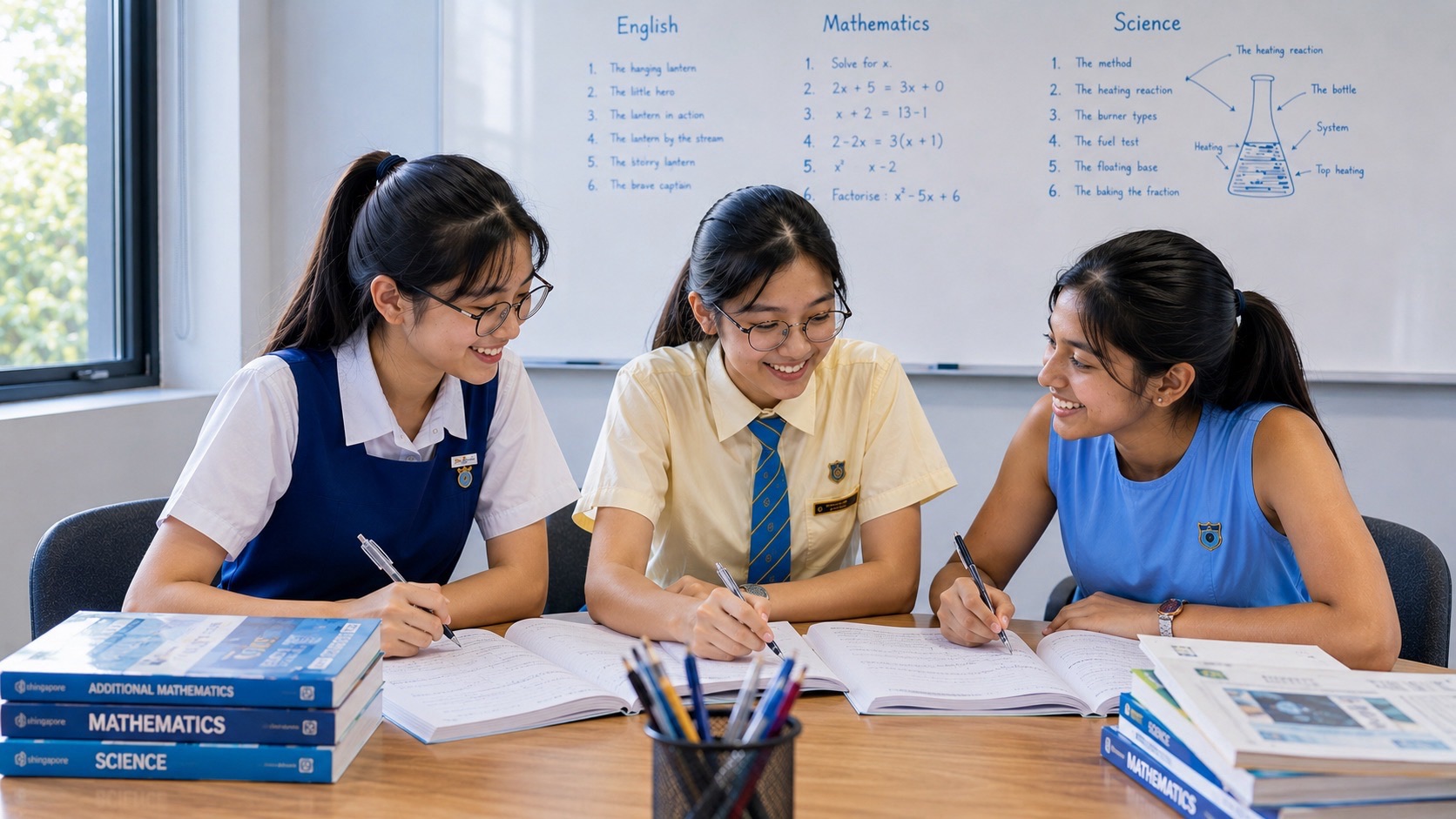
Homework is often treated as if it has one natural location: the desk at home. Real Punggol school weeks are more complicated. A child may have student care, CCA, tuition in Punggol, a long transport gap, time at Punggol Regional Library, a parent finishing work late, or a sibling whose schedule changes when the family can get home.
The useful question is therefore not simply “Did you do your homework?” It is “Where should this particular work happen so that the child can do it properly?” A ten-minute spelling review, a difficult Mathematics problem set, a composition draft and a school project do not need the same environment.
This guide is about homework geography: matching the task to the place. It does not argue that one venue is universally best. It gives Punggol families a framework for deciding when home, library, student care, a waiting gap or the period around tuition can support useful work—and when they cannot.
Start with the task, not the venue
Parents often begin with the available place: “You are at the library, so do homework.” The stronger sequence begins with the work. What does this task require?
- Short recall can happen almost anywhere reasonably calm.
- Routine practice needs enough focus for accuracy.
- Difficult problem solving needs sustained attention and scratch space.
- Writing needs time to plan, draft and revise.
- Project work may need materials, devices or collaboration.
- Correction needs the original work, feedback and enough calm to think.
Once the task is named, the place becomes easier to choose.
Home is strongest when the task needs continuity
Home is usually the best place for work that benefits from familiar materials, a stable desk and the possibility of staying with the task without needing to leave at a fixed minute.
Long Mathematics sets, composition writing, test corrections and work that requires several books are often easier at home than in a transitional public space.
But home is not automatically focused. Noise, siblings, devices, hunger, household activity and fatigue can make a nominal study desk a poor learning environment.
A home desk is only useful if the home sequence supports it
If the child reaches home at 8pm, eats at 8.30pm and begins homework at 9pm, the problem may not be the desk. The problem may be the evening route.
Our Punggol Evening Return Home guide looks at that chain from activity end to dinner, homework and sleep. Homework geography begins with the same principle: the place cannot compensate for a badly assembled timetable.
Student care is good for defined work with known boundaries
Student care can be useful because the child is already in a supervised after-school setting. Routine homework may be completed before the child returns home, reducing the evening load.
The limitation is that parents should not assume every kind of work receives the same conditions. The child may be in a shared environment, have a fixed schedule or need help that is not available for a particular subject.
The right parent question is not “Was homework time provided?” It is “Which homework can my child reliably complete there, and what still needs another environment?”
The library is powerful when the child has enough time to settle
Punggol Regional Library can be a strong option for reading, research, written work and calm independent study when the child has a genuine block of time.
The key phrase is “block of time”. A forty-five-minute gap that includes walking in, finding a place, unpacking, working, packing and leaving may contain much less than forty-five minutes of usable attention.
Our Punggol Waiting Places for Families guide separates short gaps from long gaps for exactly this reason.
Do not take deep work to a place designed for movement
A mall, food court or busy transport node can be excellent for eating, waiting and meeting. It is usually less suited to demanding work that needs sustained concentration.
A student may technically complete a worksheet there, but completion is not the only measure. Accuracy, reasoning, retention and the amount of correction needed later matter too.
Our Best Study Spots in Punggol guide compares study environments. Homework geography stays narrower: choose the environment according to the work.
Use travel gaps for low-setup work
Some work can use the spaces between activities without turning the child into a permanently studying passenger. Vocabulary review, reading a short text, checking a timetable, organising a to-do list or reviewing a few flashcards can fit naturally into certain waiting periods.
The family should avoid tasks that require large books, complex writing or deep reasoning when the child is about to move again.
The purpose of using a gap is to reduce later load, not to make every unoccupied minute academically productive.
Before tuition is usually a preparation window, not a second lesson
If the child has twenty minutes before a small-group class, the best use may be to eat, settle, locate the relevant worksheet and identify one question to ask.
Trying to finish a difficult school assignment in the final minutes before tuition can place the child into the lesson already frustrated or hurried.
For parents choosing tuition in Punggol, this is another reason to consider the total route. A lesson can fit the timetable while the pre-lesson period remains badly designed.
After tuition is often a capture window, not a full practice block
Immediately after tuition, the child may benefit from capturing one or two things while they are still fresh: what was corrected, what remains unclear, what practice needs to happen next.
That does not mean completing another full worksheet before going home. The heavier reinforcement can happen in the next planned study block.
A useful learning system separates capture from practice.
Match task depth to environment depth
| Task | Useful environment | What to avoid |
|---|---|---|
| Quick recall | Waiting gap, home, quiet public space | Turning it into a long session |
| Routine worksheet | Home, student care, library | High-distraction transit space |
| Difficult Mathematics | Home or stable quiet study block | Repeated interruption |
| Composition / extended writing | Home or quiet library block | Short fragmented gaps |
| Corrections | Place with original work and feedback available | Guessing from memory later |
| Project planning | Home, library or collaborative space | Venue without required materials |
The child’s state can overrule the ideal venue
A quiet library does not make a hungry, exhausted child ready for hard work. A home desk does not make a distressed child focused. A parent should therefore consider both task and state.
Food, movement, recovery and sleep are not separate from homework. They determine whether the child can use the environment well.
The school-day food guide and after-school decompression guide cover those adjacent pieces.
Primary 1 to Primary 3: keep homework geography simple
Younger primary children benefit from stable places. If routine homework is done at student care, let that be the default. If reading happens at home after dinner, keep that sequence recognisable.
Moving every task between different places creates more transitions than the child needs. At this age, consistency often matters more than optimisation.
Primary 4 to Primary 6: teach place-task matching
Upper-primary students can begin asking: is this a short task or deep task? Do I have the right materials? How much time do I really have? Should I start now or save it for home?
These decisions are valuable because PSLE preparation can otherwise expand into every available gap. The child needs to learn that good work is not the same as constant work.
Secondary students should choose environments deliberately
Secondary students often have more freedom to use libraries, malls, transport and time before or after CCA. That freedom should include environmental judgment.
A student who chooses to do difficult work in a noisy place and then needs to redo it has not saved time. A student who uses a short gap for light review and protects deep work for a better environment has made a stronger decision.
The best homework geography changes through the week
Monday may be a home-work day. Tuesday CCA may make home too late, so routine work is better handled earlier. Wednesday tuition may make the pre-lesson gap useful only for food and preparation. Thursday may have a long library window. Friday may be deliberately lighter.
There is no need to force one location to do every job.
Use the family calendar to assign deep-work windows
Some homework can float. Deep work should not. If the week has one or two reliable windows for writing, corrections or difficult Mathematics, protect them on the family calendar.
This reduces the chance that every demanding task lands on the latest evening because it had no earlier home.
Do not send unfinished work to tuition by default
A tutor can help with a genuine difficulty. That is different from using tuition as the default location where every unfinished school task is completed.
If school homework repeatedly spills into tuition time, inspect the homework geography and weekly schedule. The problem may be earlier in the system.
A three-question homework location test
- What kind of thinking does this task require?
- How much uninterrupted time is realistically available here?
- What condition is the child in right now?
If the answers conflict, choose a different task or a different place.
Run a one-week homework map
For one week, note where important work was attempted and whether it was finished well. Do not track every ten-minute worksheet. Track the tasks that created friction, took too long or needed to be redone.
You may discover that the issue is not weak homework habits. The issue may be that difficult work repeatedly begins in poor environments or at poor times.
Different subjects create different geography
Homework location becomes clearer when families notice that subjects make different demands on space. English reading can travel easily. Composition may need quiet and a longer block. Mathematics often needs paper, working space and concentration. Science may require diagrams, reference material or careful correction. Project work may need devices, materials or collaboration.
This means a family should not ask one place to be “the homework place” for everything. The better question is which tasks travel well and which tasks need a home base.
English: separate reading from extended writing
Reading is relatively portable. A student can often read in the library, in a quiet waiting period or at home. Extended writing is less portable because planning, drafting and revision benefit from continuity.
For composition or situational writing, repeated interruptions can damage the structure of thought even when the student remains technically “on task”. Protect a block long enough for the student to hold the whole piece in mind.
Mathematics: protect scratch space and error correction
Routine Mathematics can work in several environments. Difficult Mathematics usually needs room to write, cross out, represent, compare methods and inspect errors. The student should not be balancing a worksheet on a knee while waiting to move again if the task requires serious reasoning.
When a student repeatedly gets stuck, the important question is not only where help is available. It is whether the environment allows enough independent attempt before help arrives.
Science: keep evidence and explanation together
Science homework often becomes weak when the child separates the answer from the evidence needed to build it. A good environment should allow the student to keep the worksheet, notes, diagrams and corrections together long enough to reason through the relationship.
This can happen at home, in student care or at a library table. The location matters less than whether the materials and attention are available together.
Use devices according to task, not habit
A device may be essential for a school platform, research or document. It may be unnecessary for a printed worksheet. Opening the device automatically can introduce messages, tabs and other attention demands that the task never required.
Homework geography therefore includes digital geography. Decide whether the task needs a screen before choosing a place built around one.
Group work needs coordination space, not pretend quiet
A group project has a different job from silent homework. Students may need to speak, divide work and compare ideas. A space that is ideal for private study may be unsuitable for active collaboration.
Choose the environment that matches the social task and respect the rules of the place. Good study behaviour includes understanding that shared public spaces have other users.
Parent help should happen where the child still owns the work
At home, parental availability can be useful, but it can also become too available. If every hesitation immediately brings an adult answer, the child may complete homework efficiently while learning less independence.
A simple boundary is to let the child mark questions, continue with what they can do and ask for help after a meaningful attempt. The environment should support independence before intervention.
Use tuition for diagnosis, not routine rescue
When school work exposes a genuine misunderstanding, bringing the relevant attempt to a tutor can be valuable. The tutor can see what the student tried, where the reasoning changed direction and what prerequisite may be unstable.
That is different from arriving with an untouched pile of work because there was no other homework system. Parents comparing tuition classes in Punggol should preserve this distinction. Tuition should strengthen learning, not become the default administrative endpoint for unfinished tasks.
Track redo rate, not only completion rate
A venue can look productive because many pages are completed there. Check how much work must later be corrected, explained again or redone. A high redo rate may indicate that the environment is too distracting, the task was too difficult for independent completion or the child was simply too tired.
This gives the family a better measure than “homework finished”. The strongest location is the one where the work is completed at an appropriate quality for that stage of learning.
Build one portable kit and one deep-work base
A useful family system can have two layers. The portable kit contains what supports light work between activities: a book, small notebook, reading material or compact revision resource. The deep-work base contains the fuller materials for writing, Mathematics, corrections and longer tasks.
This prevents the child from carrying the entire school day everywhere while still making short gaps usable when appropriate.
Homework geography should shrink stress, not spread school everywhere
The purpose of using several environments is not to turn every Punggol space into a classroom. It is to place work where it can be completed with less friction and better attention.
A family has succeeded when homework stops leaking unpredictably into late evenings—not when the child starts doing schoolwork in every available public place.
The Real Decision Is Not Home Versus Library
The strongest homework decision is not a contest between locations. It is a fit problem. Home, library, student care, tuition, a waiting area and a short travel gap each offer a different combination of time, quiet, supervision, materials, movement and interruption. The useful question is which combination matches the work that must happen now.
This is why a family can have a beautiful desk at home and still benefit from Punggol Regional Library on some days. It is also why a child can sit inside a library and still do poor work if the task is badly matched to the available time. Location changes the conditions for learning; it does not remove the need to choose the right task.
Use Five Variables Before Choosing the Place
Before deciding where homework should happen, score the situation informally across five variables:
- Depth: how much uninterrupted thinking does the task require?
- Setup: how many books, devices, files or materials must be opened before useful work begins?
- Duration: how long is the usable block after travel, eating, unpacking and packing?
- Support: does the learner need supervision, a tutor, a parent or nobody at all?
- State: is the student alert, hungry, rushed, frustrated, socially distracted or ready to work?
A good location is one that does not fight these variables. Deep work with high setup needs a stable base. Short recall with almost no setup can travel. Work that requires a tutor belongs in the lesson rather than being forced into a waiting gap. Work that can be done independently should not automatically consume a supported environment.
Calculate Usable Time, Not Clock Time
A ninety-minute gap on the family calendar is not automatically ninety minutes of study. The child may need to walk to the venue, eat, find a seat, connect a device, unpack, settle, pack again and travel to the next activity. A forty-five-minute gap can become twenty useful minutes very quickly.
This is a common source of planning error. Parents see an empty block and assign a large task. The child experiences a sequence of transitions and never receives the uninterrupted time the task actually needs.
Use a simple rule: subtract transition cost before assigning work. If the remaining block is short, choose low-setup work. If the remaining block is long enough to settle, deep work becomes possible.
Setup Cost Is the Hidden Enemy of Waiting-Gap Homework
Some tasks consume attention before the student even begins. A composition may require the question paper, planning notes, vocabulary references and enough space to draft. Mathematics corrections may need the original paper, worked solutions, calculator and scratch paper. A school project may require a laptop, charger, shared files and physical material. If the child has to rebuild this environment for a twenty-minute gap, the setup cost can exceed the learning value.
Low-setup work behaves differently. Vocabulary retrieval, reading a short passage, organising a task list, checking a formula card or reviewing a few marked errors can begin quickly and stop cleanly. These tasks are more portable.
Homework geography becomes efficient when families stop treating all work as equally portable.
Build a Deep-Work Base and a Portable-Work Kit
Instead of trying to make every place support every task, create two modes. The deep-work base is the location where the learner can spread out, stay long enough, access the necessary materials and complete demanding work. For many families this is home; for some students, a library block works better on selected days.
The portable-work kit contains tasks that can move: one small notebook, a short reading, a vocabulary set, a formula list, a few retrieval questions or a digital task that does not require many windows and files. The kit should be deliberately small.
This split protects the student from carrying an entire school day everywhere. It also gives waiting time a useful role without turning every transition into an improvised classroom.
Home Works Best When Continuity Matters More Than Novelty
Home has a major advantage: continuity. Books can remain available. Corrections can pause and resume. A draft can stay open. The student can use familiar stationery and switch between school notes and reference material without carrying everything across Punggol.
This makes home strong for long Mathematics sets, full composition drafts, test-paper corrections, project assembly and work that must be integrated across several resources. Home can also support repeated routines because the child learns how the environment works.
The weakness is that familiarity can also contain distraction. The same space may include a bed, television, siblings, phone, snacks, household noise and unfinished chores. A family should therefore judge home by actual output, not by the idea that home ought to be the natural homework location.
The Library Works Best When the Student Can Arrive With a Defined Job
Punggol Regional Library can be valuable when the learner arrives knowing exactly what to do. “Study” is too vague. “Read chapters 3 and 4 and create six retrieval questions” is a job. “Finish the first composition draft” is a job. “Correct questions 5, 8 and 11 from the Mathematics paper and write why each error occurred” is a job.
The library becomes less useful when the student spends the first part of the block deciding what to study, searching through files, messaging classmates for missing instructions or discovering that a required textbook is at home.
The strongest library sessions therefore begin before arrival. The student chooses the task, packs the materials and knows the stopping point.
Use the Library for Separation When Home Has Too Many Competing Signals
Some students work better when the study environment is separated from the rest environment. A trip to the library can create a clean start: travel there, sit down, complete the defined block, leave. That boundary may be useful for a learner who repeatedly drifts at home.
But separation has a cost. Travel consumes time. Meals and family schedules still exist. If the student needs only thirty minutes of work, a full outing may be inefficient. The family should use the library because the environment materially improves the work, not because the word “library” automatically sounds educational.
For a wider local view, see Punggol Regional Library as the Family’s Second Learning Room.
Student Care Works Best for Routine Completion and Predictable Boundaries
Student care can remove a large amount of routine work from the evening when the environment supports it. The advantage is not only supervision. It is timing: the child can complete defined school tasks before home becomes the final part of the day.
The family should still distinguish routine completion from deep repair. A student may finish a worksheet at student care and still need later help with one misunderstood concept. That does not mean the student-care block failed. It means the task exceeded what that environment was meant to solve.
Use the handover rule from One Child, Three Views: record whether work was independent, prompted or stuck. Then route only the unresolved part.
A Waiting Gap Is a Transition Space, Not a Free Study Period
A waiting gap between school, CCA and tuition can be useful, but its first purpose may be transition. The child may need to eat, cool down, use the washroom, move between locations or simply stop talking for a few minutes. If the family assigns work to every gap, the day can become academically continuous from school dismissal to bedtime.
A better sequence is to decide whether the gap is recovery, preparation or light work. Recovery protects the next demanding block. Preparation may involve finding the right worksheet and identifying one question for tuition. Light work may involve short retrieval. Only a long, stable gap should receive deep homework.
The Punggol Waiting Places for Families guide develops this distinction across short and long gaps.
Before Tuition, Protect the Lesson
Families sometimes use the pre-tuition period to push through unfinished school homework. This can be sensible if the work is directly relevant and the student is calm. It becomes counterproductive when the child arrives at tuition already rushed, hungry or frustrated by a problem they could not solve.
Before a 3-pax lesson, the highest-value preparation may be simple: eat, settle, bring the correct materials, mark the question that caused difficulty and recall the last lesson’s target. That gives the tutor useful evidence and preserves attention for the lesson itself.
The goal is not to maximise the number of questions completed before class. It is to arrive ready to learn.
After Tuition, Capture Before You Expand
Immediately after tuition, the student may remember the corrected idea more clearly than they will later at home. Use that moment to capture the next action. Write the two questions to retry. Note the concept that remains unstable. Place the relevant sheet where it will be found again.
This is different from doing another full practice set. The post-lesson window is often better for preserving information than for extending workload. Heavy practice can wait for a planned deep-work block.
Different Subjects Need Different Geography
English, Mathematics and Science do not create identical environmental demands. A student can read a short article in a portable setting but may need a stable desk for composition planning. Mathematics often needs scratch space, diagrams and correction visibility. Science may require notes, diagrams, evidence tables or access to a device for a research component.
Even within one subject, task type matters more than the label. English vocabulary retrieval can travel; an argumentative writing draft may not. Mathematics facts can be reviewed quickly; an unfamiliar multi-part problem needs time. Science terminology can be retrieved from flashcards; a structured-response correction needs the original paper and careful explanation.
Choose geography by cognitive job, not by subject name alone.
Use a Task–Place Matrix Instead of a Fixed Rule
| Task | Best conditions | Likely locations |
|---|---|---|
| Short retrieval | Low setup, short block | Waiting gap, home, before tuition |
| Routine worksheet | Moderate focus, clear instructions | Student care, home, library |
| Composition draft | Long block, low interruption | Home or library |
| Mathematics correction | Original paper, scratch space, time | Home, tuition, library |
| Research reading | Quiet, device or books, note-taking | Library or home |
| Project assembly | Materials, space, tolerance for mess | Home or suitable project space |
| Question for tutor | Relevant evidence available | Tuition lesson |
| Planning tomorrow | Five minutes, calendar visible | Home or end of day |
The Child’s State Can Override the Perfect Location
A theoretically ideal environment cannot rescue a learner who is no longer ready for the task. A tired child in a quiet library may produce worse work than an alert child at home. A hungry student before tuition may need food rather than a retrieval quiz. A student who has spent the whole afternoon in structured activity may need twenty minutes of recovery before another demand.
State should not become an excuse for avoiding all difficult work. It should change sequencing. Families can move a demanding task to the next protected block and use the current period for a lower-load action.
This is scheduling, not surrender.
Do Not Reward a Bad Location by Extending the Task Forever
If a child has spent forty minutes producing poor work in an unsuitable place, the answer is not always another forty minutes in the same place. Stop and inspect the environment. Was the student interrupted? Was the table too small? Was the device becoming entertainment? Was the child waiting for transport? Was the task too deep for the time available?
Move the work when the environment is the problem. Repair the skill when the skill is the problem. Do not confuse the two.
Use Location Changes as a Diagnostic Test
Families can learn from controlled changes. If homework repeatedly takes ninety minutes at home, try one defined library block for the same type of task. If the child works faster, ask why. Was the difference noise, phone access, sibling interruption, parent prompting or simply the psychological boundary of leaving home?
Then test the mechanism rather than copying the location blindly. If the real improvement came from phone separation, home may be repairable. If the improvement came from uninterrupted time, the family can protect a similar block at home. If the child needs the external boundary of the library, keep it for the tasks that justify the travel.
Good homework geography turns place into evidence.
A One-Week Homework Geography Audit
For one normal school week, record only five things for substantial homework blocks: task, place, planned duration, actual duration and whether the student finished independently. Do not change everything during the audit. Observe first.
At the end of the week, look for repeated mismatches. Perhaps composition is always pushed too late at night. Perhaps library visits are used for work that could have been completed in student care. Perhaps waiting gaps are wasted because the child has no portable task ready. Perhaps tuition evenings carry too much post-lesson homework.
Change one pattern for the following week and compare. The family is looking for a more sustainable map, not a perfect schedule.
Punggol Travel Time Belongs Inside the Homework Decision
Punggol families often move through a network of school gates, LRT or MRT connections, buses, walking routes, malls, library spaces, student care and tuition. Travel is not outside the learning system. It consumes time and changes the student’s state.
The Punggol Route Planning for Students guide treats transfers, weather and the last mile as real variables. Homework planning should do the same. A location that saves twenty minutes of travel may create more learning value than a theoretically quieter location that adds two transfers.
Weather Can Change Homework Geography Without Changing the Learning Goal
Rain, heat and transport disruption can make a planned study stop inconvenient. The learning goal does not need to disappear. The location can change. A library block can become a home block. A short waiting review can become recovery while the family uses a slower route. A project meeting can move online when physical travel no longer makes sense.
A robust homework plan has a backup location for the important task. This is especially useful during assessment periods when losing one deep-work block creates pressure later in the week.
Digital Devices Should Follow the Task, Not Lead It
A laptop or tablet can make work portable, but it also changes the distraction environment. Families should decide first whether the task genuinely needs the device. If the answer is no, leave it closed. If the answer is yes, define the file, platform or output before the session begins.
The Punggol Digital School Readiness guide covers charging, files and submission. Homework geography adds one more question: does the device make this location more capable, or merely more distracting?
Parents Should Audit Output, Not Patrol Every Location
Older students need room to learn where they work best. A parent does not need to sit beside a Secondary student at the library or repeatedly message during a study block. Agree on the job before the session and inspect the output afterwards.
If the student said the goal was to correct ten Mathematics questions, the evidence is the corrected paper and the ability to explain the errors. If the goal was to draft a composition, the evidence is the draft. If the goal was revision, ask what can now be retrieved without notes.
Output creates accountability without turning study location into surveillance.
A Worked Example: Primary 5 With Student Care and One Tuition Evening
Suppose a Primary 5 student has student care on Monday to Thursday and English tuition on Wednesday. Routine school worksheets are usually completed at student care. The child needs two longer blocks each week for composition and Mathematics correction.
A poor plan keeps everything until home and then discovers that Wednesday ends too late. A stronger map leaves routine work in student care, reserves Tuesday evening at home for Mathematics correction, uses Saturday morning for a composition draft and treats the twenty minutes before Wednesday tuition as food, settling and one question to ask. If a library visit happens on Friday, it is used for reading and project research rather than for work already well supported elsewhere.
The week feels lighter not because there is less learning, but because each task has a better home.
A Worked Example: Secondary 3 With CCA, Library and Independent Travel
A Secondary 3 student may travel independently, have two CCA afternoons and carry several subject demands. The student can use a library block effectively, but only if it solves a real scheduling problem. Thursday may contain a ninety-minute gap before meeting a parent for dinner. After travel and a short snack, sixty useful minutes remain.
The student chooses one high-value task before leaving school: complete an Additional Mathematics correction set using the marked paper and notes already packed. Phone notifications are silenced. When the sixty minutes end, the student records the two remaining questions and stops. Those questions become the next tuition or home-repair job.
The block succeeds because the task, materials and stopping point were defined. The library is not magic. The decision architecture is what makes the place useful.
When to Move a Task Instead of Forcing Completion
Move the task when the environment has become the main bottleneck. Warning signs include repeated interruption, no room for necessary materials, a deadline to leave that encourages rushing, device distraction the student cannot presently manage, or a level of noise that materially changes accuracy.
Do not move a task simply because it is difficult. Difficulty belongs inside learning. The family is trying to remove unnecessary friction, not protect the student from productive struggle.
What Progress Should Look Like
A better homework map should produce visible changes. The student starts faster because materials are ready. Long tasks receive longer blocks. Waiting gaps carry only portable work. Tuition begins with better questions. Home evenings contain fewer emergency completions. Library trips have defined outputs. Parents spend less time telling the child where to sit and more time checking whether the chosen environment worked.
- Fewer half-started tasks moved from place to place.
- Less unnecessary carrying of heavy materials.
- More independent completion in the environment chosen for the task.
- Fewer late-night deep-work sessions caused by poor earlier placement.
- Clearer distinction between recovery time and study time.
- Better use of tuition for diagnosis rather than routine homework rescue.
- More student ownership of choosing an appropriate place.
The Punggol Library Study Decision in One Minute
Before leaving home or school for a library study block, ask: What exactly will be completed? Do we have enough usable time after travel? Are the required materials already packed? Does the task benefit from the library environment more than from home or student care? What is the stopping point?
If the family cannot answer these questions, stay with the simpler location until the job is clear. If the answers are clear, the library can become a purposeful second learning room rather than a place where the child merely appears to be studying.
Teach the Student to Choose the Place, Then Explain the Choice
The long-term goal is not for parents to become better at assigning locations. It is for the learner to become better at matching work to conditions. A student who can say, “I should do this at home because I need my marked paper and enough time to correct it,” is developing useful self-regulation. A student who says, “I can use the twenty-minute gap for vocabulary because it starts and stops cleanly,” is learning to plan rather than merely obey a timetable.
Ask the child to justify the choice before the session and review it afterwards. Was the place quiet enough? Was the usable time realistic? Did the student bring the correct materials? Did the task finish at the intended depth? If not, what should change next time?
This small explanation step prevents location from becoming superstition. “I work better at the library” becomes a claim that can be tested. “I cannot study at home” becomes a problem that can be decomposed. The student learns which environmental features actually help.
Keep One Protected Block That Is Not Available for Homework
A map can become too efficient. If every home period, travel gap, library stop and pre-tuition minute is assigned to work, the student loses recovery and the family loses normal life. Homework geography should reduce friction, not colonise the entire week.
Protect at least one meaningful period that is not automatically converted into study simply because other work ran late. This creates a useful constraint: the family must place demanding tasks earlier and more intelligently instead of borrowing endlessly from sleep and recovery.
The Best Map Is the One the Family Can Repeat
A complicated plan that works once is less valuable than a simple pattern the family can sustain. If Tuesday home study, Thursday library work and Saturday project time repeatedly fit the household, keep them. If a particular waiting gap consistently creates rushed work, stop pretending it is a study block. If student care reliably clears routine homework, protect that advantage rather than duplicating the same work at home.
Homework geography becomes powerful when it settles into a small number of dependable patterns. The student knows where different kinds of work belong, the parent knows which blocks need protection and tuition receives better evidence instead of emergency homework. The result is not a busier child. It is a week in which the right work has a realistic place to happen.
Frequently asked questions
Is Punggol Regional Library good for homework?
It can be, especially for reading, writing and independent study when the child has enough time to settle. The usefulness depends on the task, available time and the child’s ability to work independently.
Should homework be finished before tuition?
Not as a universal rule. Relevant unfinished work can sometimes reveal a genuine difficulty, but repeated spillover into tuition may signal a scheduling or homework-environment problem.
Can students do homework in malls or food courts?
Light work may be possible. Deep work usually benefits from a quieter, more stable environment. Match the task to the place rather than judging the venue by whether a table is available.
What if home is too distracting?
First improve the home setup if possible. If the environment remains unsuitable for certain tasks, deliberately assign those tasks to a better public or supervised study block rather than relying on repeated improvisation.
The quiet standard
A local education site should understand that learning happens in places, and places change what is possible. Punggol families have homes, student-care rooms, libraries, malls, stations, tuition rooms and waiting gaps available to them. Those spaces are not interchangeable.
The strongest homework system does not ask the child to work everywhere. It teaches the child to recognise where a particular kind of work can be done well.
Current Library Access Is a Provider Fact
When the student chooses Punggol Regional Library or another NLB space, the study decision and the access decision are separate. This article owns the task-to-place choice. The Punggol Regional Library Guide and the National Library Board’s current library information own changing opening hours, closures, programme access and facility details. Check the current provider before building a fixed study routine around a public space.
Punggol also has newer NLB access points such as the Comics & Games Library at Punggol Coast Mall. That can be useful for reading and exploration, but it should not silently become the assumed deep-work venue for every student. Match the place to the task, then verify the current access conditions.


