
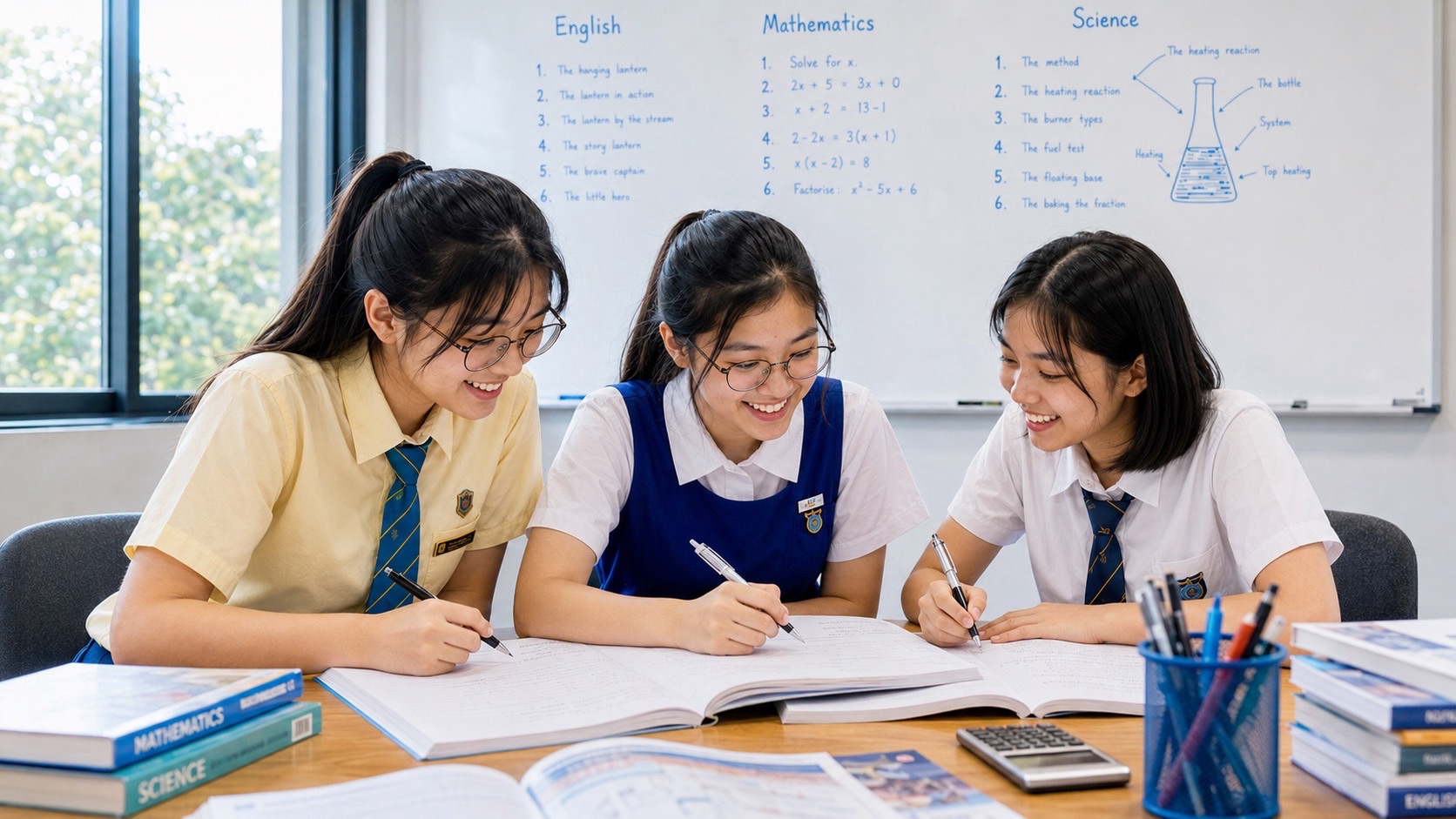
Education in Punggol does not happen in neat blocks. A child may move from classroom to bus or LRT, from school to student care, from CCA to tuition, and finally from travel into homework. The hour after school is therefore not empty time. It is a transition between demanding systems.
For families managing Punggol schools, Punggol tuition, CCA, student care and evening homework, a short decompression window can protect the rest of the day. This is not an argument for avoiding responsibilities. It is a recognition that attention, emotion and self-control are finite resources, especially after a long school day.
A child who gets twenty or thirty useful minutes to eat, wash, sit quietly, walk, read casually or simply stop may return to homework more capable than a child pushed immediately into the next demand.
1. School Ends Before the School Day Leaves the Body
When the bell rings, the student may still be carrying unfinished social interactions, tests, instructions, noise, heat, hunger, frustration and the need to remember what comes next.
The child is physically out of class, but cognitively still transitioning.
2. Decompression Is Not the Same as Entertainment
A decompression window is not necessarily thirty minutes of high-intensity gaming or rapid social media. Those activities may be enjoyable, but they can also introduce another stream of stimulation.
Useful decompression lowers demand. Food, water, a shower, a short walk, music, quiet reading or simply sitting without questions can all work.
3. Hunger Often Arrives Disguised as Irritability
Parents sometimes interpret a child’s poor mood after school as laziness or attitude. Sometimes the more immediate explanation is physical: hunger, thirst, heat, carrying a heavy bag or fatigue.
Meeting basic needs before demanding more output can improve the quality of the next hour.
4. The Right Window Depends on the Day
A normal school day may need a short reset. A CCA day may need more. A day with tuition immediately after school may offer only a small meal and quiet travel time.
The principle matters more than a fixed number of minutes: do not treat every transition as if the child has infinite cognitive capacity.
5. Quiet Time Can Improve Homework Quality
Starting homework immediately can look disciplined. But if the child is mentally saturated, the first thirty minutes may be slow, argumentative and error-prone.
A short pause can sometimes produce a faster total evening because the child begins work with more usable attention.
6. Decompression Should Have an End Point
Rest becomes avoidance when it has no boundary. Families can use a simple transition cue: snack, shower, twenty minutes off, then begin one defined task.
The child should know when recovery ends and responsibility resumes.
7. Avoid the Interrogation at the Door
“How was school?” “Any homework?” “What did you score?” “Did your teacher say anything?” are reasonable questions. Asked all at once, they can make home feel like another checkpoint.
Some children talk more after they have eaten and settled. Timing changes the answer.
8. Student Care Can Include Decompression Too
For working families, the after-school window may happen in student care rather than at home. The same logic applies. Food, predictable routine, some movement and a clear separation between school and homework can help.
Parents should understand what the child’s afternoon actually looks like rather than assuming that “student care” is one undifferentiated block.
9. Tuition Immediately After School Needs Special Attention
A convenient tuition slot may be poor educationally if the child arrives hungry, rushed and unable to concentrate. The class may still be excellent; the timing may simply be wrong.
Families should evaluate fit using the real child in the real timetable.
10. Screens Can Expand the Transition Instead of Closing It
Some children use a device to relax and then struggle to disengage. If the decompression window regularly becomes a ninety-minute negotiation, the method is not working.
The family can choose lower-friction forms of rest on heavy weekdays and reserve longer screen use for other times.
11. A Short Walk Can Be Useful
Punggol’s local environment gives families access to walking routes, parks and open spaces. A short walk home, where practical and safe, can become a natural transition between school and evening work.
Movement changes the rhythm without requiring another organised activity.
12. The Child Should Learn to Recognise the Need for Recovery
As students mature, they should be able to say, “I need twenty minutes before I can work properly,” without using the phrase as an unlimited escape route.
That is self-regulation: recognising current capacity and choosing an action that restores it.
13. Do Not Confuse Tiredness With Weak Character
Persistent exhaustion deserves system analysis. Is the child sleeping late? Is the commute long? Is the week overloaded? Is CCA heavy? Is tuition adding too much homework?
Repeated fatigue should not be solved only with louder motivation.
14. A Simple After-School Sequence
- Arrive and put materials in one place.
- Eat and drink.
- Use a short low-demand recovery period.
- Check what must be done tonight.
- Begin the first defined task.
- Leave heavy decisions for after the child has settled.
15. Education in Punggol Includes the Spaces Between Lessons
Punggol families often focus correctly on school quality, tuition quality and study routines. Yet the transitions between those activities can determine whether the child arrives ready to learn.
A short decompression window is not wasted time if it protects the evening. It is part of the learning system because recovery is one of the conditions under which learning remains possible.


