
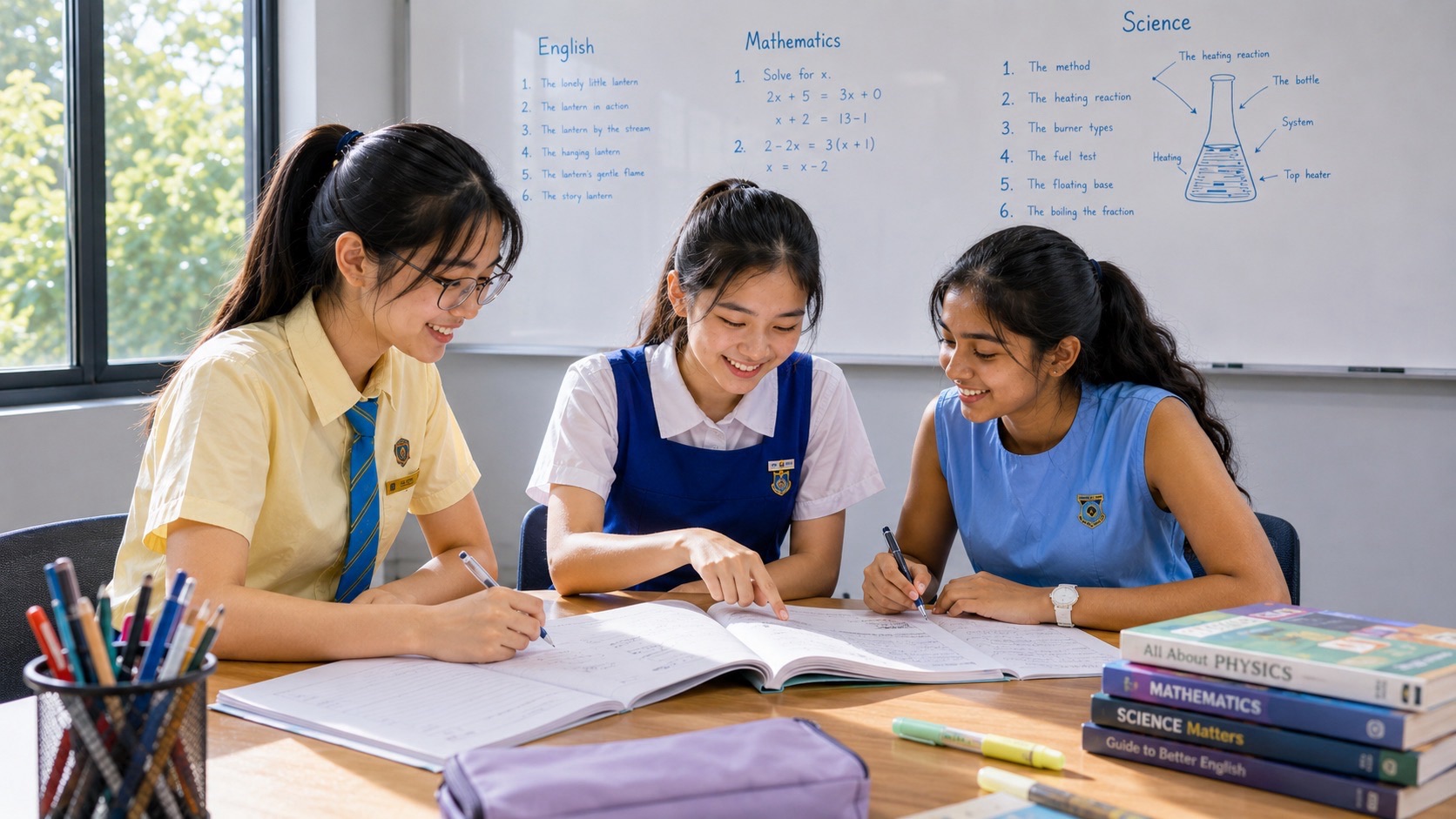
Should students explain Mathematics to one another in a 3-pax tuition class? Parents searching for peer teaching in Maths, small-group Mathematics tuition, 3-pax Math tuition or Mathematics tuition in Punggol may see value in students learning from each other—but also worry that one child will simply copy another student’s method.
Both outcomes are possible. Peer explanation is useful when it forces the explaining student to make reasoning explicit and the listening student to evaluate the explanation. It becomes low-value when one student supplies the full route before the other has attempted the question, or when the listener copies steps without being able to reproduce them independently. Structured collaboration works because every learner remains accountable for their own understanding.
At eduKatePunggol, Mathematics is taught in groups of up to three students for 1.5 hours near Punggol MRT. The useful question is: does the peer interaction create more thinking for both students, or does it transfer the thinking from one student to another?
The short answer: attempt first, explain second, prove independently third
- Each student attempts independently.
- One student explains a decision or method.
- The listener asks or answers a comparison question.
- Both students solve a fresh problem independently.
The final independent problem is what prevents peer learning from becoming copying.
Peer explanation helps the student who is explaining
Explaining can expose whether the student truly understands:
- why the operation fits;
- why the representation works;
- which condition makes the formula valid;
- where the key mathematical decision occurs.
A student who can execute quickly may discover gaps when asked to articulate the reasoning.
Recent math-talk guidance similarly emphasises explanation as a way to deepen mathematical sense-making and communication.
Peer explanation helps the student who is listening—if they must evaluate it
The listener should not be passive.
Ask them to decide:
- Which step is most important?
- Would the method still work if the numbers changed?
- Is there another valid route?
- Where could the method fail?
This turns listening into mathematical judgment.
When peer help becomes copying
Warning signs include:
- one student dictates every line;
- the listener writes without asking why;
- the listener cannot solve a fresh question afterwards;
- the faster student always becomes the unofficial tutor;
- the same student repeatedly waits for a peer before starting.
At that point, the collaboration is reducing independence.
Do not make the strongest student teach the class
Occasional explanation can deepen the strong student’s learning.
But the faster or stronger child should not be given a permanent assistant role while the tutor works elsewhere.
That student’s tuition time also needs:
- stretch;
- new variation;
- independent challenge;
- feedback on their own errors.
See What Should a Faster Student Do After Finishing Early?.
Useful peer-explanation prompts
- Explain only the first decision, not the whole solution.
- Show why this operation fits.
- Compare your method with the other student’s method.
- Find the first line where your methods differ.
- Explain what would change if one condition changed.
These prompts keep the focus on reasoning rather than answer transfer.
The no-copy barrier
After peer discussion:
- close or cover the other student’s work;
- change the numbers;
- change the wording;
- ask both students to solve independently.
If the listener can now solve the fresh problem, the explanation transferred understanding rather than just steps.
Primary Mathematics: concrete explanations can work well
Primary students can explain:
- why a bar is longer;
- why groups are equal;
- how a fraction represents part of a whole;
- why one operation fits a word problem.
The tutor should keep the explanation short and then return both students to their own work.
PSLE Mathematics: compare representations, not final answers
Two Primary 6 students can compare:
- bar model versus arithmetic;
- ratio units;
- which quantity is the whole;
- where a change occurs.
The comparison should end with a fresh independent problem.
Secondary Mathematics: peer explanation can expose invalid algebra
Secondary students can compare algebraic chains and ask:
- Is each equality valid?
- Why was this expression factorised?
- Could the same result be reached another way?
- Which method is easier to verify?
This can sharpen symbolic reasoning without turning the group into answer-sharing.
Peer learning requires individual accountability
EEF’s 2026 collaborative-learning guidance states that effective collaborative work should ensure all learners think carefully and remain accountable for demonstrating their own understanding.
That principle is especially important in Mathematics because copied working can look convincing even when the listener cannot reproduce the method alone.
The peer-explanation protocol
- Attempt alone.
- Share one decision or method.
- Listener evaluates the reasoning.
- Tutor corrects misconceptions if needed.
- Both students solve a fresh form independently.
Frequently asked questions
Is peer teaching good for Mathematics?
It can be, when both students remain cognitively active and each later demonstrates independent understanding. Unstructured answer-sharing is different.
Will the stronger student lose learning time?
They should not be used as a permanent tutor. Short explanation can deepen understanding, but their own stretch and feedback must remain protected.
Mathematics Tuition in Punggol: peers can share reasoning, but each student must still own the Mathematics
Attempt alone. Explain briefly. Evaluate the reasoning. Change the question. Prove the learning independently.
Families who want to discuss how peer learning works inside a 3-pax Mathematics class can WhatsApp eduKatePunggol.
Research references
- Education Endowment Foundation (2026) | Collaborative Learning Approaches
- Edutopia (2026) | Math Talk and Peer Reasoning
- Edutopia (2026) | Participation in Math Group Work
Continue through the Punggol Mathematics route
- Hearing Another Student’s Question
- Self-Explanation in Maths
- Faster Student Finishes Early
- Mathematics Tuition at eduKatePunggol
Explore the Punggol Mathematics reading library for related guides.


