
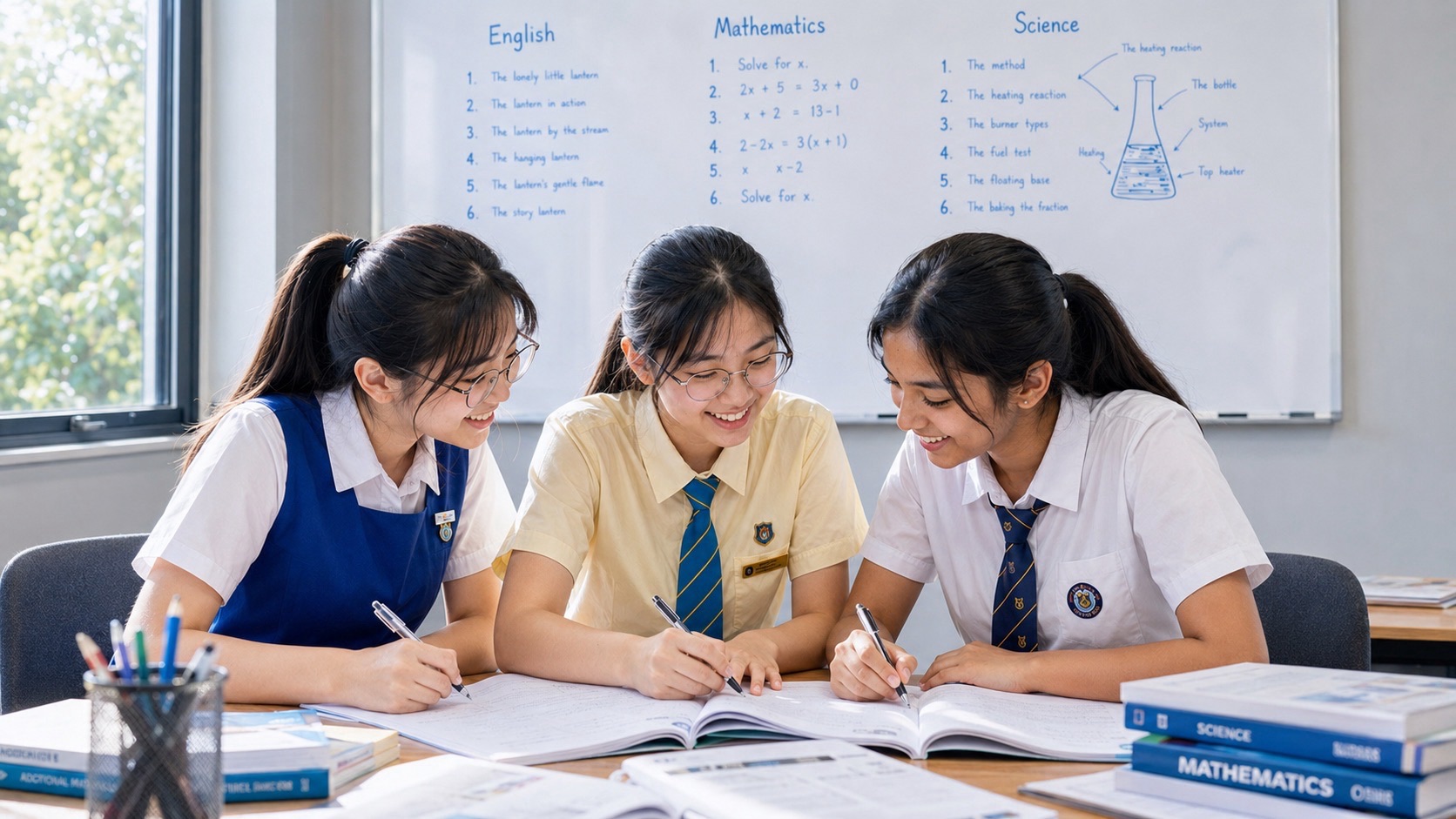
Is it useful for students in a 3-pax Mathematics tuition class to hear each other’s questions? Parents searching for small-group Math tuition, peer learning in Mathematics, 3-pax tuition or Mathematics tuition in Punggol may wonder whether another student’s question is a distraction or an additional learning opportunity.
It can be either. A useful peer question exposes a misconception, comparison, alternative method or boundary that matters to the shared topic. An unrelated question can interrupt concentration. The tutor’s job is to decide when a question should become shared learning and when it should remain a short individual intervention.
At eduKatePunggol, Mathematics is taught in groups of up to three students for 1.5 hours near Punggol MRT. The practical question is: does this student’s question reveal something the other two learners would benefit from noticing?
Some questions are valuable to the whole group
Examples include:
- Why does this ratio change after adding the same amount?
- Why can’t these algebraic terms be combined?
- Why does this geometry property apply here?
- Why is this percentage question different from the previous one?
These questions expose mathematical structure, so the tutor can briefly bring the group together.
Other questions should stay local
Examples include:
- a copied digit error;
- one student’s specific school worksheet;
- a personal arithmetic slip;
- a prerequisite issue that the other two students have already mastered.
Turning every local error into a group lecture wastes time and can reduce attention.
Hearing another student’s misconception can sharpen discrimination
Suppose one student says:
“I used division because the word ‘each’ is in the question.”
The tutor can ask the group whether that rule is always valid.
Now the other students are not merely listening to an error. They are testing the boundary of a mathematical shortcut.
Alternative methods can become shared learning
Two students may solve the same problem differently:
- bar model versus equation;
- arithmetic versus algebra;
- table versus graph;
- direct calculation versus proportional reasoning.
The tutor can compare the methods briefly:
- Are both valid?
- Which is easier to check?
- Which scales better to harder numbers?
- Which makes the relationship clearer?
This creates mathematical flexibility without forcing everyone to use one route.
Peer questions should not replace independent thinking
The danger is that one student hears another student’s method before attempting the problem independently.
When the question is intended as a cold-start test, students should attempt first before the group discusses methods.
This protects individual evidence.
The tutor can use a pause-before-share rule
- Everyone attempts first.
- The tutor checks the initial thinking.
- One useful question or method is selected.
- The group compares reasoning.
- Everyone then solves a fresh question independently.
This gives students the benefit of peer thinking without losing accountability.
Primary Mathematics: another child’s question can normalise uncertainty
Young students often believe being confused means they are weak.
Hearing a peer ask a useful question can show that good learners also pause, clarify and revise their thinking.
PSLE Mathematics: compare problem-solving decisions
For Primary 6, peer questions are especially useful around:
- problem representation;
- ratio changes;
- percentage bases;
- speed and units;
- when to move on and return.
Secondary Mathematics: compare symbolic routes
Secondary students can learn from seeing different valid algebraic methods, provided they still demonstrate their own understanding afterwards.
Recent mathematics discussion guidance highlights that explaining reasoning and learning from peers can deepen conceptual understanding when the discussion is deliberately structured.
When peer questions become distracting
The tutor should keep the question local when:
- the other students are deep in independent work;
- the issue is highly individual;
- the question would reveal an answer before others attempt it;
- the discussion is becoming longer than the mathematical value justifies.
The shared-question test
Before opening a question to the group, ask:
- Does this reveal a common misconception?
- Does it compare useful methods?
- Does it clarify an important boundary?
- Can the other students still think independently afterwards?
If yes, the question may deserve thirty seconds of shared attention.
Frequently asked questions
Will my child be distracted by another student’s questions?
Not if the tutor is selective. Shared questions should be used only when they add mathematical value to the group’s current learning.
Can students learn from different methods?
Yes. Comparing valid methods can strengthen flexibility, as long as each student later proves they can solve independently.
Mathematics Tuition in Punggol: another student’s question can become another student’s insight
Attempt first. Share selectively. Compare reasoning. Return to independent work. Use peer thinking to deepen—not replace—personal understanding.
Families who want to discuss how shared questions work inside a 3-pax Mathematics class can WhatsApp eduKatePunggol.
Research references
- Education Endowment Foundation (2026) | Collaborative Learning Approaches
- Edutopia (2026) | Math Talk and Learning From Peers
- Edutopia (2026) | Discussion-Centered Mathematics
Continue through the Punggol Mathematics route
- Three Students Learning at Different Speeds
- Self-Explanation in Maths
- Quiet Child Who Never Asks Questions
- Mathematics Tuition at eduKatePunggol
Explore the Punggol Mathematics reading library for related guides.


