
Parents connected with Punggol Cove Primary School who search for English tuition in Punggol are usually trying to solve a specific stage problem. The learner may be building reading foundations in Primary 1, developing fluency in Primary 2, reading to learn in Primary 3, entering upper-primary comprehension and composition in Primary 4, building a PSLE runway in Primary 5, or calibrating final-year performance in Primary 6.
The correct tuition plan should therefore follow the child’s actual English profile. Reading fluency, vocabulary, grammar, comprehension, composition, oral communication, listening and examination execution are connected, but the same overall mark can hide very different causes. A learner who misreads the question needs a different intervention from one who understands the task but writes too vaguely.
This page is an independent parent-routing guide and does not imply affiliation with Punggol Cove Primary School. Families can use the existing Punggol Cove Primary School parent guide for school-specific context. The canonical tuition owner remains English Tuition at eduKatePunggol, while the adjacent local route is Punggol Way & Cove.
Primary 1–2: build reliable access to English
Lower-primary English should become progressively more automatic. Reading common words, understanding instructions, retrieving vocabulary, spelling familiar patterns and writing complete sentences should require less conscious effort over time.
The strongest sign of progress is not simply harder work. It is that the child can begin, attempt and complete familiar language tasks with less adult help.
Use Primary 1 English Tuition and Primary 2 English Tuition.
Primary 3–4: identify the first break in the chain
Primary 3 and Primary 4 increase the amount of meaning the child must carry through English. Reading supports Science and denser school instructions. Comprehension requires more inference. Composition requires more structure. Grammar has to remain stable while the learner is managing longer ideas.
| What parents see | What tuition should test |
|---|---|
| Child reads but cannot explain the passage | Meaning integration and vocabulary |
| Child understands but loses comprehension marks | Question scope and answer expression |
| Composition lacks a clear direction | Prompt interpretation and causality |
| Grammar disappears in writing | Transfer under load |
Use Primary 3 English Tuition and Primary 4 English Tuition.
Primary 5: turn repeated errors into a PSLE training map
Primary 5 is the last full year before the final examination calendar compresses. It should be used to identify recurring English weaknesses and repair them while there is still enough time for retrieval and transfer.
- inference without enough evidence;
- answers that are broadly right but incomplete;
- composition that drifts from the prompt;
- vocabulary that is recognised but not retrieved;
- grammar that breaks under writing load;
- oral answers that stop too early;
- timing that causes unfinished sections.
Primary 6: let school evidence decide the final priorities
By Primary 6, especially after prelims, tuition should become selective. School scripts should tell the tutor whether the main loss is knowledge, retrieval, interpretation, expression or execution.
That classification determines whether the child needs reteaching, faster retrieval, better question interpretation, clearer answer writing or stronger time control.
Use Primary 6 PSLE English Tuition, PSLE English Tuition and Prelims to PSLE Final English Calibration.
Schoolwork should reveal the learning problem, not become the whole tuition programme
Returned school compositions, comprehension papers and teacher comments are valuable because they show the child’s performance under real school conditions. Tuition should use them diagnostically, then move into fresh practice so the learner has to apply the repair independently.
Use Should School Homework Be Done During Tuition?.
3-pax: enough individual visibility to diagnose precisely
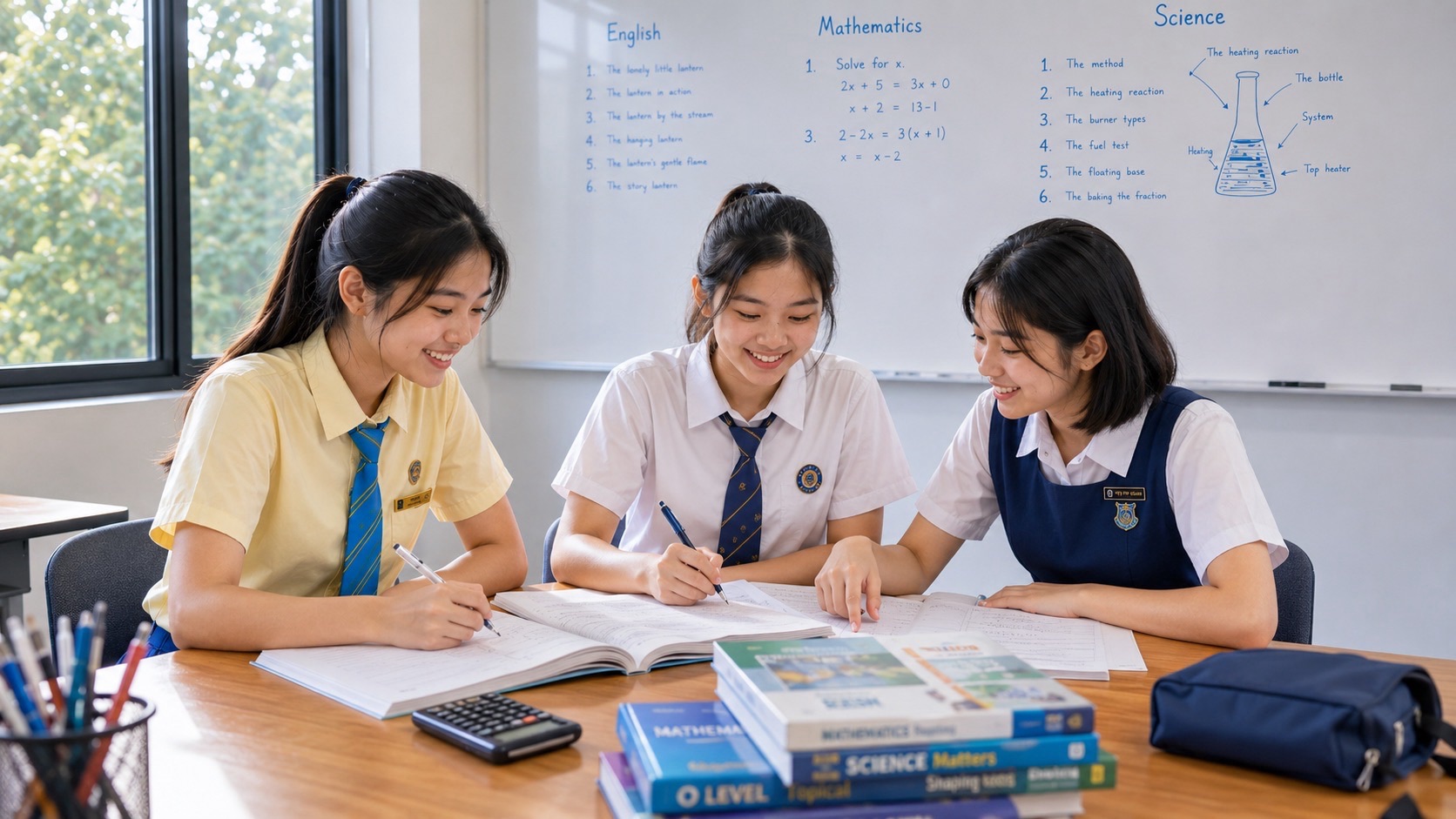
eduKatePunggol uses three-student English classes so the tutor can hear each learner read, inspect writing and compare comprehension reasoning while keeping the lesson socially interactive.
The group should be matched by year, reading access, writing demand, pace and independence. Use How Should a 3-Pax English Class Be Matched?.
After PSLE: build a Secondary learner, not a larger Primary 6 student
Secondary English broadens into more mature reading, abstract vocabulary, functional writing, tone, viewpoint and greater independence. The transition should therefore change the learning architecture rather than simply increase worksheet difficulty.
Use Secondary 1 English Tuition and G1, G2 and G3 English under Full Subject-Based Banding.
Punggol Cove Primary parent checklist
- What is the earliest unstable English capability?
- Is the class aligned to the correct Primary year?
- Does tuition use current school evidence?
- Can the child transfer feedback to unfamiliar tasks?
- Is independent reading protected?
- Are adult and tutor prompts decreasing?
- Is Primary 5 building a clearer error profile?
- Is Primary 6 prioritising rather than adding indiscriminate practice?
For Punggol Cove Primary families, the school-neighbourhood page is useful when it turns a local search into a sharper educational decision. The standard is not proximity alone. It is whether the learner is diagnosed accurately, taught at the right stage, able to transfer the learning and increasingly capable without permanent adult support.


