
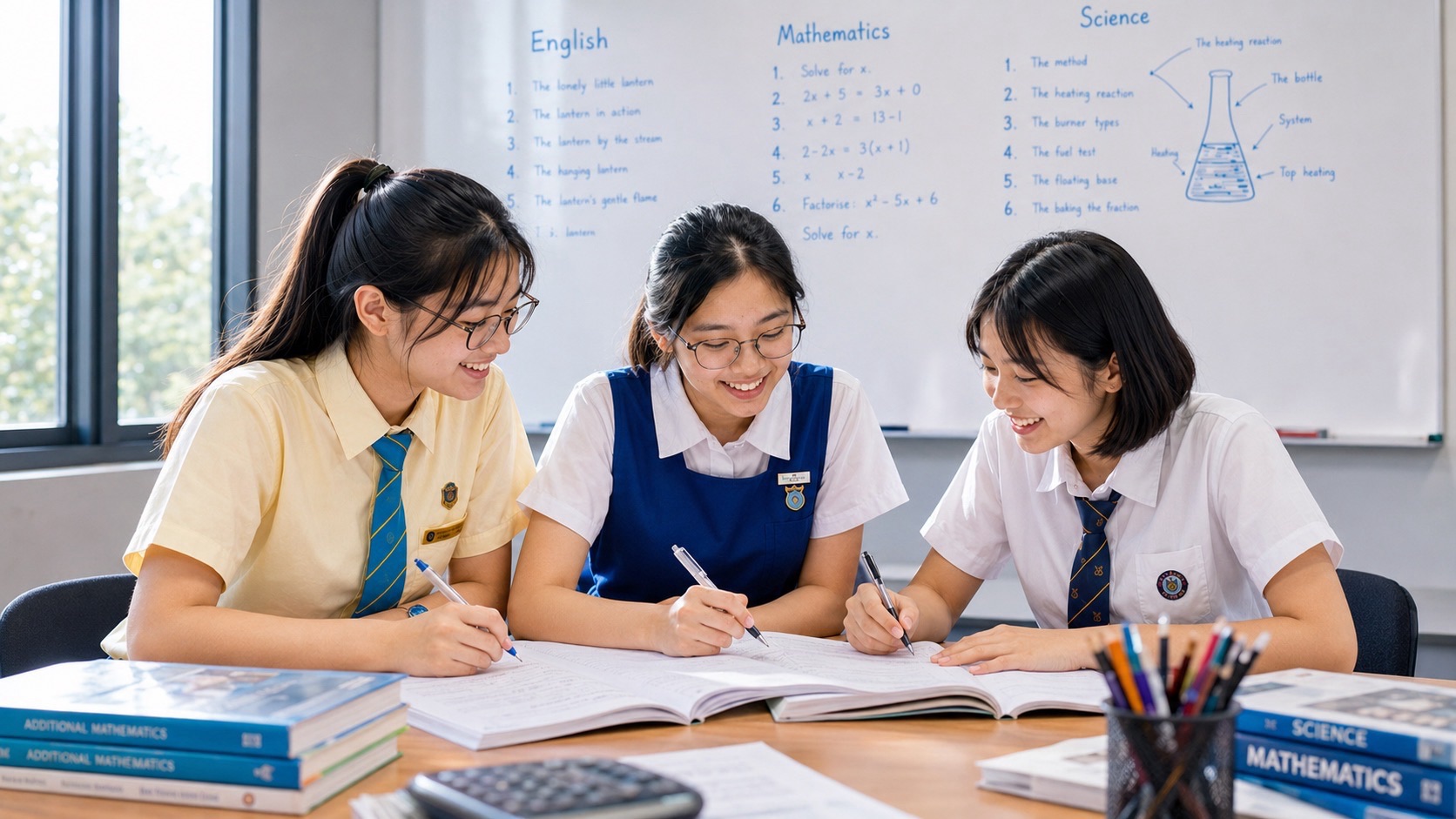
Families around Punggol Way, Cove and the residential areas feeding into Punggol town centre searching for English tuition in Punggol are often looking for a combination of proximity, small-group visibility and a clear learning route from Primary through PSLE and Secondary English. The local search phrase may be simple, but the educational decision is not. A Primary 2 learner with fragile reading needs a different system from a Primary 6 student losing Paper 2 marks, or a Secondary G3 student who reads well but cannot sustain argument and register in writing.
Cove is part of the Punggol LRT East Loop, giving families in this corridor a direct connection back toward Punggol town centre. That can reduce weekly travel friction, but location only becomes an advantage when the class itself is correctly matched and the teaching solves the right problem. Strong local English tuition should help parents answer three questions quickly: What stage is my child in? What is the first unstable English layer? What evidence would show that the intervention is working?
This page is the micro-location English route for Punggol Way and Cove. It sits under the canonical English Tuition at eduKatePunggol owner, routes into eduKatePunggol Atlas V2.0, and links families to the correct year-level, PSLE and Full Subject-Based Banding owners. Current Punggol LRT routing can be checked against the official LTA Sengkang-Punggol LRT guide.
Punggol Way and Cove families should begin with the learning route, not the nearest worksheet
Parents often enter tuition through a visible symptom: low marks, slow homework, weak composition, careless mistakes or a sudden drop in confidence. Those symptoms matter, but they are not diagnoses. A useful tuition system should identify the earliest unstable mechanism that can explain the problem.
| What parents see | Possible first weak link |
|---|---|
| Child avoids reading | Fluency, vocabulary, text difficulty or attention |
| Comprehension marks are inconsistent | Question decoding, evidence, inference or expression |
| Composition contains many ideas but feels messy | Planning, causality or paragraph purpose |
| Grammar is correct in drills but wrong in writing | Transfer under production load |
| Performance drops only in exams | Timing, recovery, checking or pressure |
The broader diagnostic route is the English Diagnostic Routing Map.
Primary 1: reading, classroom language and sentence control come first
Primary 1 English should not be treated as early exam preparation. The learner needs enough reading access, vocabulary, spelling, oral language and sentence control to participate in school. A child who still spends too much attention decoding every word may have little attention left for comprehension.
For Punggol Way and Cove families, the useful role of a local class is to keep the literacy routine sustainable. Tuition should not consume all the time that could otherwise become reading, sleep or conversation.
Use Primary 1 English Tuition at eduKatePunggol for the full year-level route.
Primary 2: fluency should begin freeing attention for meaning
By Primary 2, the child should be moving from effortful early literacy toward greater automaticity. Reading becomes more useful when word recognition is fast enough that attention can shift toward meaning, vocabulary and sentence relationships.
One sign that support is working is that the child needs less adult prompting to read, answer and write. The relevant route is Primary 2 English Tuition at eduKatePunggol.
Primary 3–4: reading becomes infrastructure
Primary 3 and Primary 4 are where English increasingly carries the wider curriculum. Science requires precise vocabulary and explanation. Mathematics word problems rely on language. Comprehension requires a stronger mental model. Composition expands into paragraph-level control.
At this stage, parents should ask whether the child can:
- read a longer passage without meaning collapsing;
- identify the main change or main idea;
- support an inference with evidence;
- use grammar accurately inside a fresh paragraph;
- plan a story around cause and consequence;
- work with less adult prompting.
Use Primary 3 English Tuition and Primary 4 English Tuition for the canonical year routes.
Primary 5: build a stable runway into the final year
Primary 5 is the right year to identify the few English weaknesses that would become expensive under Primary 6 time pressure. A student who repeatedly over-infers in comprehension, drifts off prompt in composition or loses grammar under writing load should repair those mechanisms before the final year compresses the timetable.
The detailed route is Primary 5 PSLE Runway for Comprehension, Composition and Oral.
Primary 6: use the final year as calibration, not panic
Primary 6 tuition should increasingly use school evidence. Returned papers and prelims reveal what survives under real conditions. A student may know the content but run out of time. Another may misunderstand the question. Another may understand but write too little.
Those are different problems. The final weeks should prioritise recurring, high-impact and repairable weaknesses.
Use Primary 6 PSLE English Tuition, PSLE English Tuition and Prelims to PSLE Final English Calibration.
Secondary English: widen purpose, abstraction and independence
Secondary English is not merely Primary English with harder words. Students need to read texts with more mature purposes, understand tone and viewpoint, write for different audiences, develop arguments, edit independently and manage a larger school workload.
The transition owner is Secondary 1 English Tuition at eduKatePunggol. For the wider Secondary system, use Secondary English Tuition in Punggol.
Full SBB means tuition should know the English subject level
G1, G2 and G3 are subject levels. The tutor should know which English level the student is taking and align the task demands accordingly. At the same time, individual strengths and weaknesses still matter more than broad labels.
Cove LRT and Punggol Way: local travel should become recovered learning capacity
Cove is on the Punggol LRT East Loop. For families living along Punggol Way or using the nearby transport network, the local question is how much door-to-door time tuition adds to the week. The shorter route is useful only if the teaching quality remains strong.
Recovered time can become a real academic asset: independent reading, earlier dinner, homework completion or sleep. This matters because English learning depends heavily on repeated contact and attention outside tuition itself.
Use Near Punggol MRT or Farther Away? for the full travel-fit decision.
3-pax: enough peer variation, enough individual visibility
eduKatePunggol teaches English in groups of three students. The format allows the tutor to use comparison without allowing students to disappear. Three comprehension answers can reveal three different reasoning problems. Three composition plans can expose different structural strengths. Three oral responses can show different levels of vocabulary and elaboration.
But the group must be matched properly by school year, subject level, reading access, writing demand and pace. Use the 3-pax class-matching guide.
A Punggol Way / Cove parent checklist
- What is the first unstable English layer?
- Is the child in the right year-level and subject-level route?
- Does the tutor use current school evidence?
- Can the child reach tuition without losing the whole evening?
- Is independent reading still protected?
- Does the group allow enough individual speaking and writing feedback?
- Does learning survive on fresh work?
- Are prompts reducing over time?
Local route: Punggol Way and Cove into the wider eduKatePunggol English network
Use this page for the Punggol Way/Cove local decision, English Tuition at eduKatePunggol for the canonical owner, year-specific pages for school-stage decisions, PSLE English Tuition for final primary examination routing, and the Punggol Atlas for the estate-wide learning map.
The micro-location page should do more than repeat “Punggol” beside a new landmark. Its job is to convert a local search into the correct education route: diagnose precisely, choose a sustainable class, protect the rest of the week and expect the learner to become increasingly independent.


