
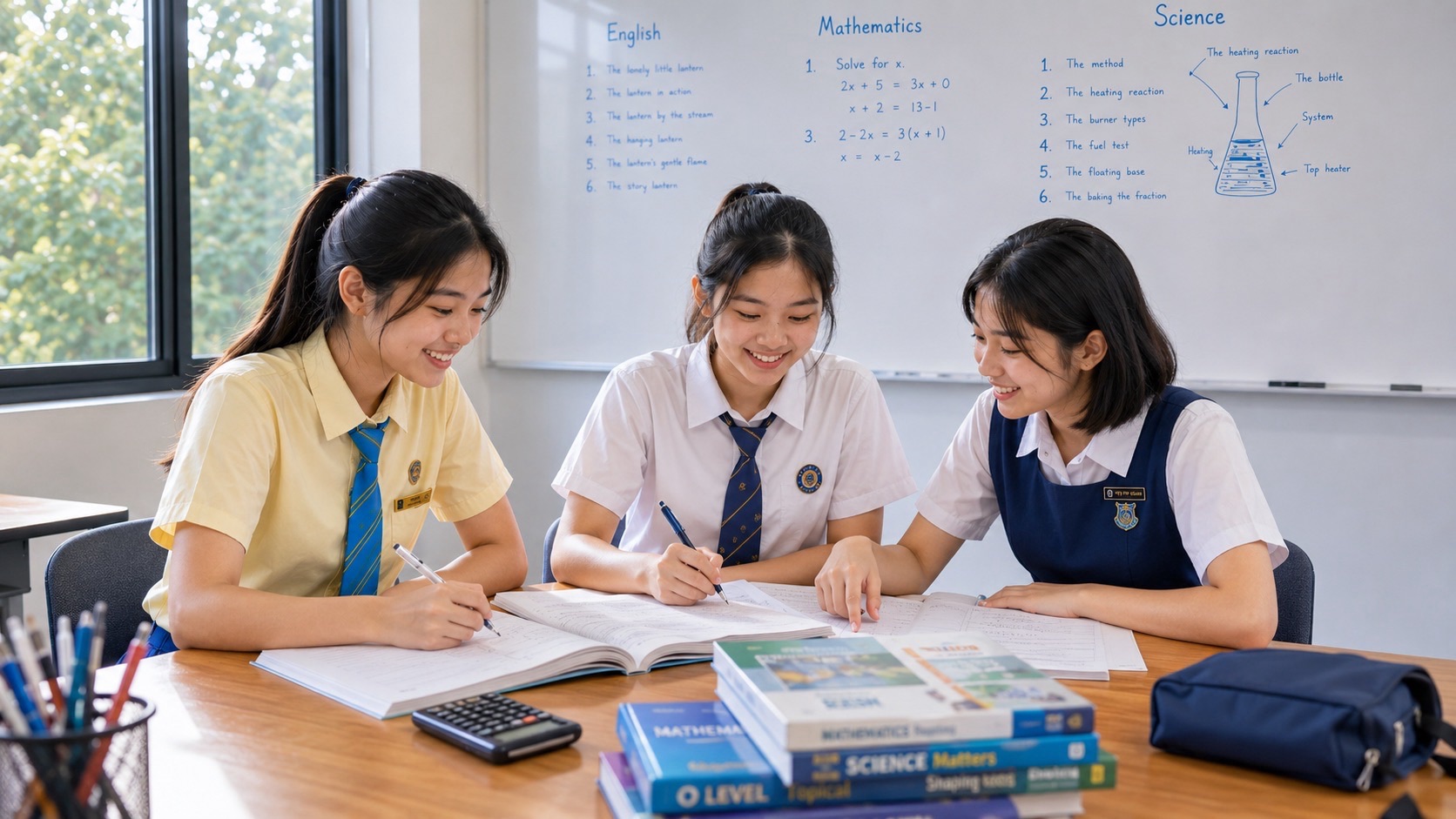
For a Primary 6 family, English tuition in Punggol changes character after the preliminary examinations. There is no longer unlimited time to rebuild every aspect of English. The child now has recent evidence from school papers, months of practice and a clear national examination ahead. The useful question becomes: what should we change between prelims and PSLE so the final weeks produce better execution rather than more anxiety?
This is a different job from general Primary 6 English tuition. The foundation should already exist. The final phase is calibration: identify where marks are still leaking across Writing, Language Use and Comprehension, Listening Comprehension and Oral Communication; distinguish knowledge gaps from execution failures; repair the most valuable weaknesses; rehearse transfer; and protect the child’s ability to perform under time and pressure.
This article supports the canonical Primary 6 PSLE English Tuition at eduKatePunggol owner and the examination-focused PSLE English Tuition route. It is also distinct from Surviving PSLE English Without Panic, which owns the broader survival problem. This page owns the narrower prelim-to-final calibration window.
The prelim result is a sensor, not a prophecy
A prelim score matters because it is recent evidence produced under school examination conditions. It does not tell the family what the child is permanently capable of. It tells the family what happened in one important test environment.
The productive response is to audit the script. For every lost mark, ask which category best explains it:
- Knowledge gap: the child genuinely did not know the word, rule or concept.
- Retrieval gap: the child knew it before but could not access it under pressure.
- Interpretation gap: the question or passage was misunderstood.
- Expression gap: the child understood but wrote an incomplete or vague answer.
- Execution gap: timing, attention, checking or recovery failed.
Those categories lead to different repairs. The site’s Prelims as Diagnostic Evidence guide develops the method further.
Do not spend the final weeks fixing low-value problems
Time is now a constrained resource. The family should prioritise by frequency, mark impact and repairability.
| Problem | Priority if recurring? | Why |
|---|---|---|
| Comprehension answers repeatedly too vague | High | Affects many open-ended marks and is often trainable through scope/evidence control |
| Composition occasionally lacks one impressive phrase | Low | Less important than relevance, structure, grammar and task control |
| Tense errors across many paragraphs | High | Recurring language accuracy issue with broad writing impact |
| One rare vocabulary word missed | Low | Low recurrence unless part of a broader vocabulary gap |
| Paper repeatedly unfinished | High | Execution problem can affect many otherwise obtainable marks |
| Oral response repeatedly stops after one sentence | High | Elaboration can be trained with flexible response structures |
The final phase should be selective. A smaller number of high-impact repairs done properly can outperform a frantic attempt to improve everything.
Paper 1: protect task fulfilment before style
In the final weeks, composition practice should focus on reliability. Can the child interpret the prompt, plan a relevant event chain, control pacing, maintain grammar and finish with time to check?
Before writing a full composition, make the child state the story obligation in one sentence: “This story must show…” That forces the learner to define the task before decorative language takes over.
Then inspect the event chain:
- What is normal at the beginning?
- What changes?
- What choice or action follows?
- What consequence makes the event matter?
- How does the resolution connect back to the central change?
Primary 6 is not the time to rebuild the child’s entire writing identity. It is the time to make good writing more dependable.
Situational Writing: completeness, audience and purpose
Situational Writing often rewards disciplined execution. The child must identify the audience, purpose, required content points and appropriate tone. A polished response that omits a required point is still incomplete. A complete response that uses unsuitable register still loses control.
Teach a compact planning routine: Who am I? Who am I writing to? Why am I writing? What must be included? What tone fits?
Paper 2: separate language errors from comprehension errors
Paper 2 can create the illusion that “English is weak everywhere” because it contains many different language operations. Audit by component.
- Grammar and vocabulary errors may indicate language knowledge or retrieval.
- Cloze errors may reflect context, collocation, grammar or logical relationships.
- Editing errors test noticing and accuracy.
- Synthesis and transformation can expose meaning-preservation problems.
- Visual-text errors can reveal rushed reading of purpose, audience and layout.
- Open-ended comprehension can expose evidence, inference and answer-scope problems.
Do not respond to a weak total Paper 2 score with generic “more Paper 2”. Identify which sub-systems are producing the loss.
Open-ended comprehension: precision wins late
One of the most repairable late-stage weaknesses is answer precision. A child may already understand the text but lose marks because the answer is too broad, too narrow, incompletely expressed or unsupported.
Use a four-step routine:
- identify the question function;
- locate the controlling evidence;
- perform the required inference or relationship;
- write only enough to complete the answer.
Then use a fresh passage immediately. Correction without transfer can create familiarity rather than learning.
Listening: protect attention after a missed item
Listening mistakes are not always knowledge mistakes. A learner may become mentally stuck on one uncertain item and lose attention for the next. Final preparation should therefore include recovery.
Teach the child to make the best available choice, release the previous item and re-enter the current audio. Recovery is a trainable examination skill.
Oral: replace memorised speeches with flexible development
At Primary 6, oral answers need enough structure to develop naturally under unfamiliar prompts. A useful mental framework is answer → reason → example → explanation → reflection.
The tutor should vary the stimulus and follow-up questions so the child cannot rely on one memorised script. The target is adaptability.
Full papers: use them for coordination, not basic teaching
Full papers matter in the final phase because they test endurance, pacing and coordination. But they are inefficient if the learner repeats the same error and receives only another total score.
A productive cycle is:
- sit a paper or major section;
- classify the error;
- repair the mechanism;
- practise a small focused set;
- wait;
- test the same capability inside a fresh mixed paper.
This turns papers into sensors and transfer tests rather than a substitute for teaching.
Time management: find where the time actually disappears
“Work faster” is not useful advice. Time can disappear because reading is slow, planning takes too long, the child overthinks one item, rewriting is excessive or checking is unstructured.
Time sections and record where the learner stalls. If a child spends too long planning composition, simplify the planning protocol. If open-ended comprehension consumes too much time because every answer is rewritten three times, train concise answer formulation. If vocabulary sections are slow because retrieval is weak, the problem is not primarily time management.
Checking: use a personal error shortlist
The final minutes are too short for “check everything”. Build a shortlist from the child’s recurring errors.
- task requirements;
- tense consistency;
- subject-verb agreement;
- pronoun clarity;
- punctuation and sentence boundaries;
- missing words;
- one or two personal spelling families;
- unanswered items.
A personalised checklist is faster because it targets the learner’s actual leakage.
Protect sleep and normality
The final weeks create a temptation to turn every free hour into revision. That can reduce the attention, memory and emotional control needed to perform. English is cognitively expensive: reading, inference, writing, listening and oral response all depend on sustained attention.
Protect sleep, meals, movement and reasonable downtime. The objective is not maximum study visibility. It is maximum usable performance.
What a 3-pax P6 lesson should do now
In a three-student class, the tutor can compare different error patterns quickly. One learner may need answer-scope repair, another composition relevance, another time control. Shared tasks can still be used, but the feedback should remain individual.
The class should increasingly resemble independent execution. Tutor prompts should become smaller. The child should be required to start, choose and check without immediate rescue.
If a student performs well only when the tutor points to every next step, the class is producing supported performance rather than PSLE readiness.
A final prelim-to-PSLE checklist
- Have we identified the three highest-impact recurring weaknesses?
- Do we know whether each is knowledge, retrieval, interpretation, expression or execution?
- Are composition plans staying relevant to the prompt?
- Are comprehension answers complete and evidence-controlled?
- Are grammar errors recurring in writing?
- Can the child recover after getting stuck?
- Can timed sections be completed reliably?
- Does the child have a personal checking routine?
- Are full papers followed by repair rather than only marking?
- Is sleep protected?
After PSLE, stop training PSLE
The final examination is a deadline, not the permanent purpose of English. After PSLE, the learning job changes. Secondary school requires longer texts, more abstract vocabulary, stronger evidence use, new writing purposes and greater independence.
Use What Happens After PSLE? and Secondary 1 English Tuition at eduKatePunggol when the family is ready to hand the learner forward.
The strongest final calibration is calm and selective. Repair what matters, test whether it transfers, practise execution under realistic conditions, and let the child arrive at PSLE with a plan they can run independently.
Explore the Punggol English reading library for related guides.


