
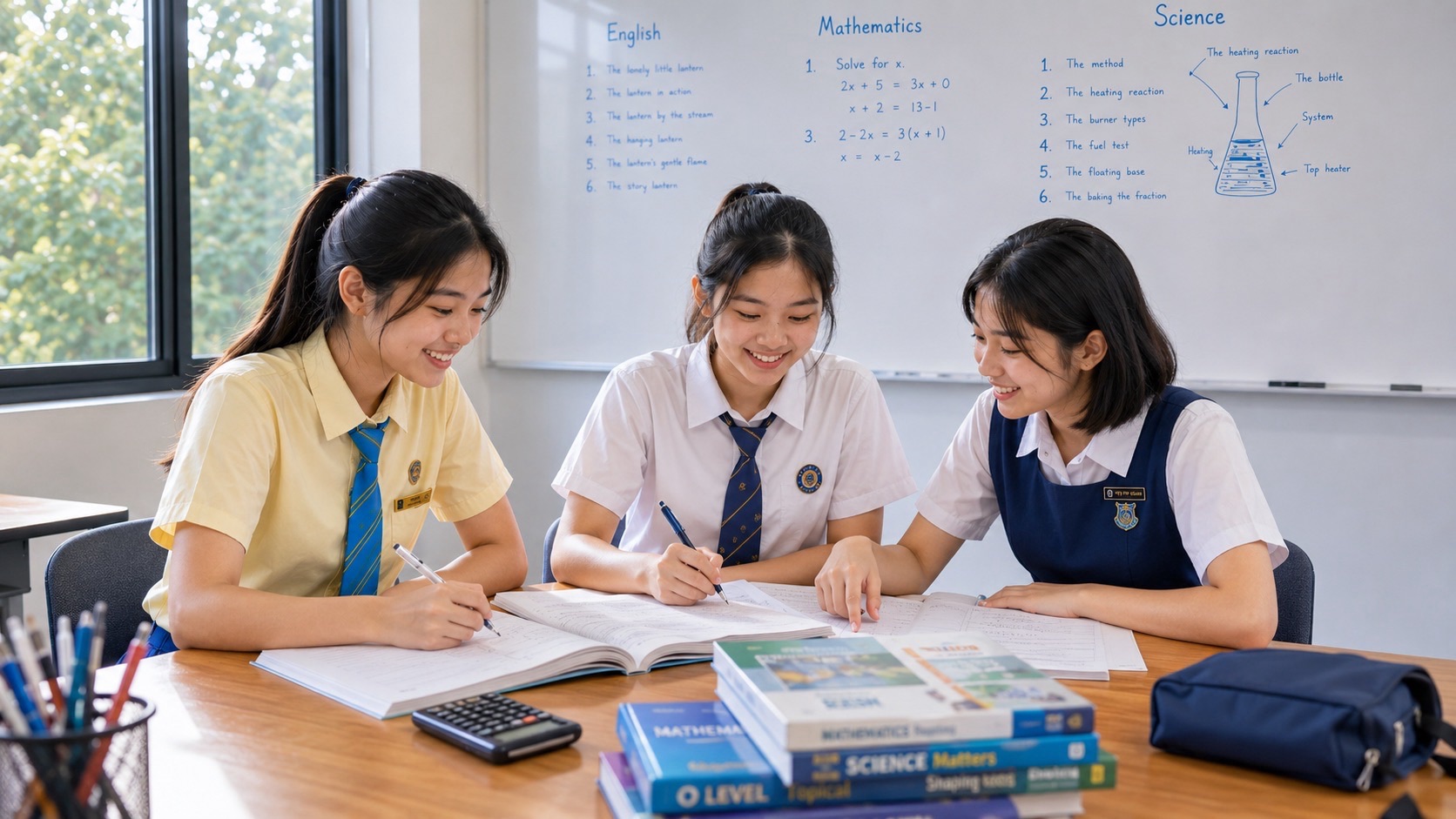
Secondary 4 Mathematics: choose your next revision step
Find a worked topic, practise paper skills or plan the next stage of revision. Choose the guide that fits the work in front of you.
From 2027, students sit the Singapore-Cambridge Secondary Education Certificate (SEC), with Mathematics offered at G1, G2 and G3 subject levels. The final-year problem is therefore precise: complete and consolidate the subject-level syllabus, repair old dependencies, convert topics into mixed-paper performance, use prelims diagnostically, then protect execution in the final weeks.
At eduKatePunggol, Secondary Mathematics is taught in focused groups of up to three students in 1.5-hour lessons near Punggol MRT. The useful parent question is: what should tuition be doing now that it should not still be doing three months later?
The Secondary 4 Mathematics year has five different jobs
- January–March: baseline and repair.
- April–June: syllabus control and cumulative retention.
- Mid-year to prelims: mixed-paper conversion.
- After prelims: error-budget triage.
- Final weeks: execution, recovery and stability.
A tuition programme that looks identical all year may be missing the changing job.
January–March: establish the real baseline
The first term should not begin with random full papers simply because the student is now in Secondary 4.
Start by asking what Secondary 3 actually left behind.
- Which algebra errors are still repeating?
- Are signed numbers and fractions stable?
- Can the student solve equations independently?
- Can the student interpret graphs rather than merely plot them?
- Which geometry facts are retained?
- Is working clear enough to diagnose?
The first goal is to prevent old weaknesses from consuming the examination year.
Do not confuse a Secondary 4 label with Secondary 4 readiness
A student may enter January with unfinished lower-secondary foundations.
When that happens, the tutor should identify the earliest high-leverage dependency rather than teach only the current chapter.
For example:
- quadratic work may be damaged by weak factorisation;
- graphs may be damaged by weak coordinate control;
- geometry may be damaged by weak algebraic manipulation;
- statistics may be damaged by careless calculator use or interpretation.
Repairing the first weak link is often faster than repeating the visible failure.
April–June: current syllabus plus cumulative maintenance
By the second part of the year, tuition should operate two tracks at once.
Track A: keep pace with current school Mathematics.
Track B: stop earlier topics from fading.
A useful weekly structure might include:
- current topic teaching;
- one mixed retrieval set from earlier topics;
- one error-log retest;
- one short timed section;
- one check of school assessment evidence.
This prevents Secondary 4 from becoming a sequence of chapters that disappear immediately after each class test.
June holidays: repair before paper volume increases
The June holiday is a major opportunity because the school timetable temporarily loosens.
Use it to:
- close the three highest-cost gaps;
- rebuild slow algebraic processes;
- retest difficult geometry or graph topics;
- organise formulas and definitions;
- begin longer mixed-paper sections.
The student should not spend the entire holiday consuming full papers if every paper reveals the same unrepaired error.
Mid-year to prelims: convert topics into paper performance
As prelims approach, the training unit changes.
The student should increasingly work across topics in the same sitting.
- mixed sections;
- timed work;
- paper-order decisions;
- calculator discipline;
- working clarity;
- recovery after difficult questions.
This is where strong topical knowledge either becomes examination performance or fails to transfer.
Full papers should produce an error map
A full paper is not useful merely because it was completed.
After every substantial paper, classify losses:
- concept;
- prerequisite;
- strategy selection;
- algebraic execution;
- calculator entry;
- working layout;
- timing;
- checking;
- recovery.
The next tuition lesson should respond to that evidence.
Use the Math Error Log framework rather than reducing the paper to a percentage.
Prelims: do not treat the result as a forecast
The prelim result is a late-stage diagnostic snapshot.
A low mark is serious because time is short, but it is still useful if it reveals what must change.
A high mark is encouraging, but it should not end training. The student still needs to preserve accuracy, stamina and exam routines.
For the broader framework, read Prelims as Diagnostic Evidence.
After prelims: stop pretending every topic deserves equal time
Late-stage revision is an allocation problem.
The student has limited remaining hours.
Prioritise by:
- marks repeatedly lost;
- topics with high syllabus importance;
- skills that damage several chapters;
- errors that can realistically improve in the remaining time;
- execution problems that affect every paper.
Do not spend three final weeks rebuilding a low-frequency edge topic while algebraic sign errors continue costing marks everywhere.
Final weeks: reduce novelty, increase reliability
Close to the examination, the goal changes from expansion to stability.
- rehearse familiar paper routines;
- retest repaired errors;
- protect sleep;
- avoid unnecessary new methods;
- maintain calculator familiarity;
- keep short retrieval alive;
- practise recovering after one bad question.
The student should arrive at the SEC paper with a trusted operating system rather than a head full of last-minute novelty.
G1, G2 and G3: the year plan must match the exact subject level
SEAB lists separate 2027 SEC Mathematics syllabuses at G1, G2 and G3. Tuition should therefore align to the subject level the student will actually sit.
Stretch can be added where appropriate, but the final-year core should remain anchored to the relevant syllabus and school programme.
See 2027 SEC Mathematics — G1, G2, G3 and Additional Mathematics Parent Guide.
Students taking A-Math need a two-subject calendar
Mathematics and Additional Mathematics share algebraic foundations but have distinct syllabus and examination demands.
A Secondary 4 student taking both should deliberately allocate time across:
- ordinary Mathematics maintenance;
- A-Math technical practice;
- separate error logs;
- separate timed papers;
- recovery between demanding subjects.
Frequently asked questions about Secondary 4 SEC Mathematics tuition
Should Secondary 4 tuition use full papers from January?
Not necessarily. Early full papers can provide a baseline, but targeted repair and current syllabus learning remain important. Paper volume should grow as syllabus coverage and readiness increase.
When should tuition become exam-focused?
The shift should be gradual. Mixed and timed work can increase through the year, with stronger full-paper emphasis once sufficient syllabus has been covered and prelims approach.
What should happen after prelims?
Convert the prelim into an error map, prioritise the highest-leverage losses, repair them, then retest using fresh questions and timed sections.
Mathematics Tuition in Punggol: Secondary 4 is a changing operating system
Diagnose early. Maintain cumulatively. Integrate before prelims. Triage after prelims. Stabilise before the final paper.
Families who want to discuss a Secondary 4 SEC Mathematics plan can WhatsApp eduKatePunggol.
Official SEC reference
SEAB | SEC Syllabuses for School Candidates
Find a Secondary 4 revision guide
Open a topic or school-year stage, then choose the guide you need.
Plan the year and the final weeks · 6 guides
When progress is uneven · 6 guides
Read, check and finish a paper · 24 guides
- Checking answers
- Finish the paper without rushing
- Read command words and questions
- Review a full paper
- Review and retest within 48 hours
- Use a calculator accurately
- “Show That” questions
- Use earlier results in “Hence” questions
- Recover when stuck halfway
- The first 15 minutes of a Math paper
- Show working clearly
- Start an unfamiliar question
- Classify careless mistakes
- Control rough work and scratch calculations
- Use a second pass for skipped questions
- Use the last 10 minutes well
- Choose the shortest valid reliable method
- Calculator or mental math?
- Control second-half paper fatigue
- Annotate diagrams before calculating
- Copy question data correctly
- Check assumptions and constraints
- Keep multi-part question chains connected
- Finish the final answer line cleanly
Plan practice and work independently · 8 guides
Number, fractions and accuracy · 5 guides
Algebra and equations · 11 guides
Graphs and functions · 3 guides
Ratio, rates and finance · 3 guides
Geometry, trigonometry and measurement · 13 guides
- Angle properties, parallel lines and polygons
- Circle properties
- Circles, arc length, sector area and mensuration
- Constructions and loci
- Pythagoras
- Scale drawings and maps
- Similarity, congruence and scale factors
- Sine rule, cosine rule and triangle area
- Surface area and volume
- Transformations
- Trigonometry and bearings
- Unit conversion
- Vectors
Data, sets and probability · 7 guides
Continue through the Punggol Mathematics route
- Secondary 4 Mathematics Tuition at eduKatePunggol
- Secondary 4 Mathematics in Punggol | The SEC Examination Year
- Secondary 3 to SEC Mathematics Runway
- 2027 SEC Mathematics Parent Guide
Continue Through the Mathematics System
Explore the Punggol Mathematics reading library for related guides.


